미술요법이 노인의 인지, 우울 및 삶의 질에 미치는 효과
최연희
1·전은영
2경북대학교 간호대학1, 대구대학교 간호학부2
Effects of Art Therapy on Cognition, Depression, and Quality of Life in Elderly
Choi, Yeon Hee1 · Jeon, En Young2
1College of Nursing, Kyungpook National University, Daegu
2Department of Nursing, Daegu University, Daegu, Korea
Purpose: The study attempted to examine whether the group art therapy using a collage medium and reminiscence therapy prevented or reversed dementia, prevented depression, and improved the quality of life of elderly women at high risk for dementia in community public health centers. Methods: As a quasi-experimental study with a non- equivalent control group, this study used a pre-post design. The subjects consisted of a random sample of women over 65 years of age who had been registered as being at high-risk for dementia at the Public Health Center of the G City, and the Dementia Support Center. Of these elders, 30 were assigned to the experimental group and 33 to the control group. The intervention was conducted twice a week for 5 weeks. x2-test, t-test, Wilcoxon test were used to analyze the data. Results: After the program, cognitive function, depression, and quality of life were significantly better in the experimental group than in the control group. Conclusion: The group art therapy can be utilized in community-based nursing practices by identifying and registering those who are at high risk for dementia. The results should prove useful when designing future intervention strategies targeting elderly in- dividuals residing in communities.
Key Words: Art therapy, Cognition, Depression, Quality of life, Elders
주요어: 미술요법, 노인, 인지, 우울, 삶의 질 Corresponding author: Choi, Yeon Hee
College of Nursing, Kyungpook National University, 101 Dongin-dong, Jung-gu, Daegu 700-422, Korea.
Tel: +82-53-420-4926, Fax: +82-53-421-2758, E-mail: [email protected]
- 본 연구는 2011년도 경북대학교 및 경북대학교 간호과학연구소 학술연구비에 의해 수행되었음.
- This Research was supported by Research Fund fromKyungpook National University & the Research Institute of Nursing Science, 2011.
투고일: 2013년 7월 9일 / 심사완료일: 2013년 8월 14일 / 게재확정일: 2013년 9월 13일
This is an open access article distributed under the terms of the Creative Commons Attribution Non-Commercial License (http://creativecommons.org/license/
by-nc/3.0), which permits unrestricted non-commercial use, distribution, and reproduction in any medium, provided the original work is properly cited.
INTRODUCTION
Longer life expectancy has resulted in a rapidly in- creasing elderly population who suffer from decreased cognition that leads to disorientation. There were about the number of 400,000 people with dementia in the last year in Korea and nearly 700,000 people with dementia people are expected to occur in 2020 (National Statistic
Organization Office, 2012). Thus, cognitive disorders will continue to constitute a heavy burden and increase the need for continuing care. Dementia reflects the loss of a wide range of nerve cells, and these changes result in cognitive dysfunction (Jeong, 2007). Cognitive dys- function, in turn, is associated with depression and re- duced quality of life. Comijs, Jonker, Beekman, and Deeg (2001) observed 641 people over 70 years of age
for 3 years and found an association between lower lev- els of cognition and more severe depression. Their study concluded that dementia rendered it difficult to main- tain an adequate quality of life. Hwang, Lim, and Lee (2009) administered the Mini‐Mental State Examination‐
Korean version (MMSE-K) to 3,012 people aged over 65 years who were categorized into three groups: normal individuals, individuals at risk for dementia, and in- dividuals with dementia. The group with lower levels of cognitive ability showed a higher rate of depression.
Finally, dementia support centers located in health centers nationwide serving individuals over 60 years of age have used the Korean dementia screening question- naire and the mini‐mental state examination in the Kore- an version of the assessment package issued by the Con- sortium to Establish a Registry for Alzheimer's Disease as dementia screening tests. Using the same three classi- fications, they found that people with dementia received a referral to a hospital for treatment but that no services were offered to the high‐risk group. Elderly people in the community need rehabilitation to prevent the exacer- bation of cognitive dysfunction and to improve cognition.
Although it is difficult to identify the cause of demen- tia and despite the fact that treatment for this disorder remains limited, we do know that cognitive rehabili- tation (e.g., art, music, horticultural., and other therapies) used to treat elderly individuals with dementia living in senior homes slows the progression of their cognitive impairment. However, the effect of such activities on high‐risk elderly individuals living in the community has never been measured. Art therapy helps people to ex- press their inner feelings, and activities using artistic media prevent cognitive impairment. Yet, artistic activ- ities such as painting, drawing, sculpting, and so on re- quire creativity and can be difficult for elderly indivi- duals. However, collages enable individuals to express their feelings quickly and easily. It has been reported that the creation of collages is an effective way for eld- erly individuals with cognitive impairments to form im- ages with relative ease (Sezaki & Bloomgarden, 2000).
Reminiscence therapy for elderly people stimulates their memories and emotions, thereby improving their cogni- tion and helping to increase their self‐awareness by allowing them to relive previous happy experiences, thereby overcoming depression and improving their quality of life.
Art therapy and reminiscence therapy help elderly people who have trouble communicating to recall the past and recover concepts of space and time. It has been reported that the interaction between group mem-
bers constitutes a very important intervention for peo- ple with dementia who lack interpersonal relationships (Sherman, 1996). 10 times of cognitive behavior therapy intervention was an effective nursing intervention to de- crease the level of mental health problems of elderly (Lee, Lee, Jhoo, & Youn, 2002).
Art therapy using collages and reminiscences with people at high risk for dementia relies on user‐friendly materials, recollections of happy memories, and group interactions to enhance awareness and facilitate cogni- tion. Additionally, the effects of stimulating memories and emotions are persistent, which is important given that people at high risk for dementia become increas- ingly isolated if they do not intentionally socialize with others, leading to a more rapid exacerbation of symp- toms. We studied the effects of group art therapy using a collage medium and reminiscence therapy in women at high risk for dementia who are living in the commu- nity.
1. Aim
The purpose of the study was to examine whether group art therapy using a collage medium and reminis- cence therapy prevented or reversed dementia, pre- vented depression, and improved the quality of life of elderly women at high risk for dementia in community public health centers.
2. Hypothesis
y Hypothesis 1: Those participating in art therapy us- ing a collage medium and engaging in a reminis- cence group would differ in cognition from those in a control group.
y Hypothesis 2: Those participating in art therapy us- ing a collage medium and engaging in a reminis- cence group would differ in terms of depression from those in a control group.
y Hypothesis 3: Those participating in art therapy us- ing a collage medium and engaging in a reminis- cence group would differ in terms of their quality of life from those in a control group.
3. Definition of Terms
1) Elderly individuals at high risk for dementia
This group consisted of women older than 65 years who registered with the Dementia Support Center of the Public Health Center and who had normal intelligence
and appropriate levels of knowledge in the absence of cognitive impairment before becoming ill. Members of this group obtained MMSE-KC scores between 16 and 24.
2) Cognition
Cognition refers to intellectual processes related to perception, thinking, reasoning, and memory (Korean Society of Biological Nursing Science [KSBNS], 2002).
This study followed Jhoo et al.,(2005) in using MMSE- KC scores to define functioning in this domain.
3) Depression
Depression is an abnormal emotional state in which a person feels sad, discouraged, worthless, empty, des- pairing, and so on (KSBNS, 2002). To measure the de- gree of depression in elderly individuals, we used Kee (1996) modification of the Korean Geriatric Depression Scale‐Short Form, which was originally developed by Yesavage et al.,(1983).
4) Quality of life
This phenomenon refers to an individual's subjective experience or evaluation of their overall satisfaction with life (Shin, Byeon, Kang, & Oka, 2008). This study meas- ured quality of life by extracting the eight items related to quality of life from the guide used by the Visiting Health Service (Ministry of Health and Welfare [MHW], 2008).
5) Group art therapy with reminiscence therapy Reminiscing is the mental process of recalling the past;
it operates through cognitive functions and involves emotions and talking about past experiences. Group art therapy uses visual media such as painting, drawing, sculpting, collages, and other forms of art to assist in the integration of parts of one's personality (Rebecca &
Magniant, 2004). In this study, the investigator designed a series of structured art activities according to the de- velopmental stage of individuals. The program, which relied on therapeutic art activities using the medium of collage, met twice per week, yielding a total of 10 ses- sions over the course of 5 weeks.
METHODS
1. Design
This study offered group art therapy involving col- lages and reminiscence therapy to elderly individuals at
high risk for dementia to determine the effects of these approaches on cognition, depression, and quality of life. We used a quasi‐experimental research design in- volving a nonequivalent control group and a pretest–
posttest structure.
2. Participants
The subjects consisted of women over 65 years of age who registered as being at high‐risk for dementia at the Public Health Center of the G City, Dementia Support Center. The target of study was selected the group using pre-prepared random number tables.
Selected inclusion criteria are listed below.
y Women over 65 years of age living in the community y The ability to communicate verbally
y The absence of brain lesions y MMSE-KC scores between 16 and 24
y No current treatment with psychiatric drugs and no psychiatric history
y No recent attendance at another similar program y The ability to understand the purpose of this study
and provide consent to participate
The study compared the groups using G 3 power‐
analysis software with a calculated effect size of .50, power (1-β)=.80, and ⍺=.05, which yielded a required sample size of 64 patients. The estimated dropout rates were equalized for the experimental and control groups.
The experimental group consisted of 34 subjects who met the selection criteria and resided in area A. The con- trol group consisted of 34 individuals living in area B.
During the study, four subjects in the experimental group and one subject in the control group were elimi- nated due to hospitalization, moving, or for other rea- sons. The final analysis included 63 subjects (experi- mental group: 30, control group: 33).
3. Instruments 1) Cognition
We used the MMSE-KC, developed by Jhoo et al., (2005) to assess the national rate of illiteracy among eld- erly individuals, to measure cognition. Items address orientation to time and place (5 points each), immediate recall (3 points), attention (5 points), delayed recall (3 points), language ability (6 points), configuration capa- bility (1 point), comprehension and judgment (1 point each), and so on. Scores range from 0 to 30 points;
higher scores indicate higher levels of cognition, and summary scores were evaluated according to norms for
sex, educational level, and age. Lee et al.,(2002) stand- ardized the MMSE-KC and found the Kappa coefficient indicating agreement between the diagnosis given by a psychiatrist and the score on the MMSE-KC to be .63. In this study, the reliability of this instrument was in- dicated by a Cronbach's ⍺ of .82.
2) Depression
To measure the degree of depression, we used the shortened Geriatric Depression Scale that Kee (1996) developed by modifying the Korean Geriatric Depres- sion Scale‐Short Form, which was originally developed by Yesavage et al.,(1983). This instrument consists of the 15 dichotomous items (yes/no) that were most high- ly correlated with depression in a study of its validity.
Scores ranging from 0 to 15 points are divided into 3 levels: 4 points or fewer indicate normal., 5–9 points in- dicate mild depression, and 10–15 points indicate se- vere depression. Thus, 5 points is the threshold for de- pression, and scores higher than 5 indicate the presence of depression in a linear fashion. Kee (1996) found a Cronbach's ⍺ of .88; the reliability of the instrument in the present study was shown by a Cronbach's ⍺ of .86.
3) Quality of life
The instrument addressing this domain consisted of eight items derived from the Visiting Health Service guidebook (MHW, 2008) that measured quality of life during the past month. It consists of two items that ask respondents to rate their health status and physical pain on a 6‐point scale and six items that ask respondents to use a 5‐point scale to rate limitations on their physical activity, limitations on their performance of everyday tasks, subjective feelings of energy, limitations on their social activity, pain caused by emotional problems, and limitations on their daily activities due to emotional problems. The scores ranged from 8 to 42 points, with higher scores indicating a lower quality of life. Chin, Lee, and Chang (2004) tested the reliability of this in- strument and reported a Cronbach's ⍺ of .92; the Cron- bach's ⍺ in the current study was .88.
4) Group art therapy with reminiscence therapy This therapeutic program was a revised version of the group art therapy program developed by Rebecca and Magniant (2004) and the reminiscence therapy program developed by Riiey and Malchlo (1994). The program, designed to meet the specific aims of this study, focused on the recollections arising during the creation of col- lages to facilitate interpersonal interactions and on
structured activities involving the recall of a pleasant life experience to improve cognition by improving skills re- lated to memorization and stimulus perception.
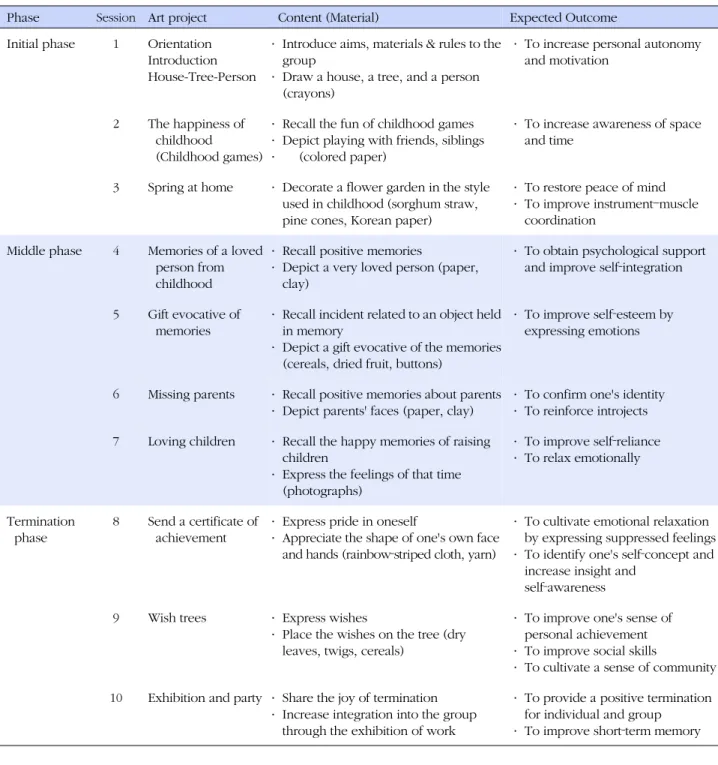
This program consisted of 10 twice weekly 1 hour sessions. The initial three sessions were devoted to the establishment of trusting relationships and the main- tenance of participants' motivation. Sessions 4–7 in- volved open‐ended discussions of feelings and thoughts.
Sessions 8–10 focused on the recovery of self‐esteem and self‐regulation. The content and expected outcomes of the 10 sessions are presented in Table 1.
4. Procedures
The protocol of this study was approved by Institu- tional Review Board of C University (IRB: CR-11-029).
The investigators conducted this study in accordance with the Ethical Principles for Nursing Research involv- ing Human Subjects as defined by the Helsinki Declara- tion.
Data were collected from April 5 to June 9, 2010, with assistance of the Dementia Support Center of the Public Health Center in G city.
1) Recruitment of Participants
Subjects were screened as part of a community proj- ect conducted by the Dementia Support Center of the Public Health Center to evaluate elderly individuals for dementia. A visiting nurse visited the homes of indi- viduals over 65 years of age who resided in the juris- diction of the public health center and who met the se- lection criteria. The nurse explained the purpose of this study, including that subjects could discontinue partic- ipation at any time and that the data would be used for research purposes. The final sample consisted of those who signed the participation agreement. Subjects were randomized into experimental and control groups ac- cording to area to rule out treatment effects.
2) Training investigators and assistants
The investigator attended courses in art therapy at the Continuing Education Academy of K University, be- came qualified as a certified art therapist, and has been an active member of the Korean Art Mental Healing Association. Two graduate students served as group therapists, and two specially qualified nurses served as visiting nurses. The investigator and all assistants pre- pared the art materials to be used at each session and practiced all procedures before the actual interventions were initiated.
Table 1. Group Art Therapy with Reminiscence Therapy
Phase Session Art project Content (Material) Expected Outcome
Initial phase 1 Orientation Introduction House-Tree-Person
․ Introduce aims, materials & rules to the group
․ Draw a house, a tree, and a person (crayons)
․ To increase personal autonomy and motivation
2 The happiness of childhood
(Childhood games)
․ Recall the fun of childhood games
․ Depict playing with friends, siblings
․ (colored paper)
․ To increase awareness of space and time
3 Spring at home ․ Decorate a flower garden in the style used in childhood (sorghum straw, pine cones, Korean paper)
․ To restore peace of mind
․ To improve instrument–muscle coordination
Middle phase 4 Memories of a loved person from childhood
․ Recall positive memories
․ Depict a very loved person (paper, clay)
․ To obtain psychological support and improve self‐integration
5 Gift evocative of memories
․ Recall incident related to an object held in memory
․ Depict a gift evocative of the memories (cereals, dried fruit, buttons)
․ To improve self‐esteem by expressing emotions
6 Missing parents ․ Recall positive memories about parents
․ Depict parents' faces (paper, clay)
․ To confirm one's identity
․ To reinforce introjects 7 Loving children ․ Recall the happy memories of raising
children
․ Express the feelings of that time (photographs)
․ To improve self‐reliance
․ To relax emotionally
Termination phase
8 Send a certificate of achievement
․ Express pride in oneself
․ Appreciate the shape of one's own face and hands (rainbow‐striped cloth, yarn)
․ To cultivate emotional relaxation by expressing suppressed feelings
․ To identify one's self‐concept and increase insight and
self‐awareness 9 Wish trees ․ Express wishes
․ Place the wishes on the tree (dry leaves, twigs, cereals)
․ To improve one's sense of personal achievement
․ To improve social skills
․ To cultivate a sense of community 10 Exhibition and party ․ Share the joy of termination
․ Increase integration into the group through the exhibition of work
․ To provide a positive termination for individual and group
․ To improve short‐term memory
3) Pretest
Visiting nurses conducted individual interviews at the homes of members of the experimental group from April 5 to 9, 2010. These interviews collected data on the general characteristics, cognition, level of depres- sion, and quality of life of participants. The same pretest was conducted from May 24 to 28, 2010, with members of the control group after all interventions with the ex- perimental group were completed.
4) Experimental treatment
The experimental group participated in group art therapy using collages and reminiscence therapy. The program was conducted during the 5 weeks from April 12 to May 15, 2010, in twice‐weekly 1-hour sessions.
The investigator and assistants conducted this program in the health education room of the public health cen- ter. Art therapy sessions consisted of an introduction, activities, and discussions of recollections, in that order.
Table 2. Homogeneity of General Characteristics of Groups
Characteristics Categories Exp. (n=30) Cont. (n=33) Total (n=63)
x2 or t p
n (%) or M±SD n (%) or M±SD n (%) or M±SD
Age (year) 75.5±5.21 75.1±5.22 75.3±5.19 0.21 .835
Education No
Yes
20 10
(66.7) (33.3)
23 10
(69.7) (30.3)
43 20
(68.3) (31.7)
0.07 .796
Spouse No
Yes
22 8
(73.3) (26.7)
22 11
(66.7) (33.3)
44 19
(69.8) (30.2)
0.33 .565
Live together Alone With family
10 20
(33.3) (66.7)
12 21
(36.4) (63.6)
22 41
(34.9) (65.1)
0.06 .801
Economic status
Difficulty Middle-class
14 16
(46.7) (53.3)
15 18
(45.5) (54.5)
29 34
(46.0) (54.0)
0.01 .923
Type of insurance
Medicare Health insurance
10 20
(33.3) (66.7)
10 23
(30.3) (69.7)
20 43
(31.7) (68.3)
0.07 .796
Cont.=control group; Exp.=experimental group.
The introduction framed the intervention, and the activ- ities facilitated recall through the creative techniques in- volved in making collages using environment‐friendly media. The discussion phase involved spontaneous conversations about recollections that emerged while the art works were explained by the artists. The inves- tigator facilitated open dialogue including the expres- sion of sympathy, support, and so on. After the recol- lection phase, the investigator summarized all the mem- ories of all participants and presented information about the next meeting and the challenges posed by remem- bering. After the termination of the experimental group, the same 5‐week program was offered to members of the control group in consideration of ethical issues.
5) Post‐test
After termination of the program, a post‐test on all study variables, with the exception of general charac- teristics, was conducted from May 17 to 21, 2010, by the same visiting nurse who had conducted the pre‐test. A post test was conducted with the control group in the same way from June 5 to 9, 2010.
5. Data analysis
All collected data were analyzed with the SPSS 18.0 statistical program as follows. A x2-test was used to compare general characteristics, cognition, levels of de- pression, and quality of life of the experimental and control groups. The scores for cognition, levels of de- pression, and quality of life were first examined with the Shapiro–Wilk test to assess the normality of the dis- tributions (p <.05, two-tailed). When normality was not
shown, the Wilcoxon rank‐sum test was used. Differen- ces between scores before and after the intervention were tested with t‐tests (p <.05, two-tailed). When the data did not satisfy conditions of normality required for a parametric paired t‐test, the non‐parametric Wilcoxon signed rank test was used.
RESULTS
1. General characteristics and homogeneity The mean age of all participants was 75.3 years; the experimental group consisted of 30 individuals, and the control group consisted of 33 individuals, yielding a to- tal sample of 63. Of the total sample, 68.3% were illiter- ate, 69.8% had not spouse, and 34.9% were living alone.
The perceived economic status of 54% was middle class, and 68.3% had health insurance. The homoge- neity test showed no significant differences between ex- perimental and control groups in terms of general char- acteristics; in other words, the experimental and control groups constituted a homogeneous group (Table 2).
2. Homogeneity of cognition, depression, and quality of life
Before the intervention, the experimental group had a mean score of 21.3 points, and the control group had a mean score of 21.2 points on the cognition measure;
the experimental group had a mean of 5.1 points, and the control group a mean of 5.3 points on the depres- sion measure; and the experimental group had a mean score of 21.1 points, and the control group a mean of
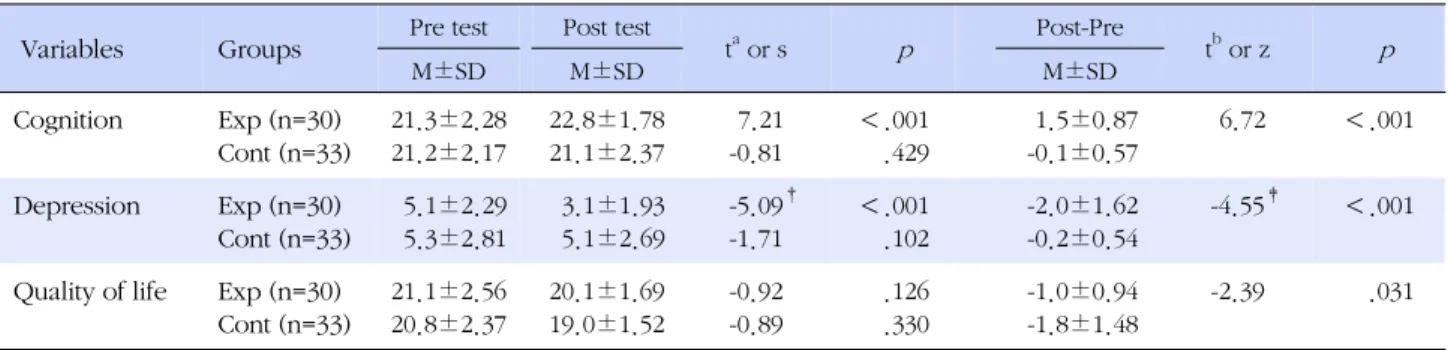
Table 4. Differences between Groups in Cognition, Depression, and Quality of Life (N=63)
Variables Groups Pre test Post test
ta or s p Post-Pre tb or z p
M±SD M±SD M±SD
Cognition Exp (n=30) Cont (n=33)
21.3±2.28 21.2±2.17
22.8±1.78 21.1±2.37
7.21 -0.81
<.001 .429
1.5±0.87 -0.1±0.57
6.72 <.001
Depression Exp (n=30) Cont (n=33)
5.1±2.29 5.3±2.81
3.1±1.93 5.1±2.69
-5.09† -1.71
<.001 .102
-2.0±1.62 -0.2±0.54
-4.55‡ <.001
Quality of life Exp (n=30) Cont (n=33)
21.1±2.56 20.8±2.37
20.1±1.69 19.0±1.52
-0.92 -0.89
.126 .330
-1.0±0.94 -1.8±1.48
-2.39 .031
Exp.=experimental group; Cont.=control group; ta=Paired test; tb=Independent test.
†Wilcoxon signed rank test; ‡Wilcoxon rank sum test.
Table 3. Homogeneity of Groups in Cognition, Depression,
and Quality of Life (N=63)
Variables Exp. (n=30) Cont. (n=33)
t or z p
M±SD M±SD
Cognition 21.3±2.28 21.2±2.17 0.11 .911 Depression 5.1±2.29 5.3±2.81 -0.21† .836 Quality of life 21.1±2.56 20.8±2.37 0.33 .745 Exp.=experimental group; Cont.=control group.
†Wilcoxon rank sum test.
20.8 points on the quality of life measure. No statisti- cally significant differences were observed between the two groups. Therefore, the experimental and control groups were not significantly different before the inter- vention in terms of cognition, depression, or quality of life (Table 3).
3. Hypothesis testing 1) Hypothesis 1
The cognition of the experimental group increased by an average of 1.5 points, whereas that of the control group decreased by an average of 0.1 points, indicating a statistically significant improvement in the cognition of the experimental group compared with that of the control group (t=6.72, p <.001).
Thus, those engaging in art therapy using the me- dium of collage and participating in a reminiscence group differed in cognition from those in the control group, thereby supporting our first hypothesis (Table 4).
2) Hypothesis 2
The level of depression in the experimental group decreased by an average of 2.0 points, whereas that in the control group decreased by an average of 0.2 points, indicating a statistically significant difference between
the two groups (z=-4.55, p <.001).
Thus, those participating in this intervention differed in level of depression from those in the control group, thereby supporting our second hypothesis (Table 4).
3) Hypothesis 3
The scores on the quality of life measure (where higher scores indicated poorer quality of life) among members of the experimental group decreased by an average of 1.0 points, whereas those among members of the control group decreased by an average of 1.8 points, reflecting that the quality of life among the ex- perimental group was significantly more improved than that among the control group (t=-2.39, p <.05).
Thus, participants exposed to art therapy and remi- niscing showed significantly greater improvement in quality of life than did members of the control group, thereby supporting our fourth hypothesis (Table 4).
DISCUSSION
This study targeted elderly individuals at high risk for dementia and evaluated the effects of group art and reminiscence therapies.
After the intervention program, the cognition of mem- bers of the experimental group was significantly more improved than was that of members of the control group.
Kerr (1999) provided a complex cognitive rehabilitation program including reminiscence therapy and resociali- zation training during 12 sessions offered over the course of 6 weeks; the significant increase in cognition found in the experimental group in that study is consistent with the results of our study. The effects of a cognitive enhancement group training program made a contribu- tion in improving cognitive function in the commun- ity-dwelling elders (Han, Song, & Lim, 2010). Bell (1998) emphasized that art activities using the medium of col-
lage are useful for helping elderly individuals engaged in continuing participation in group activities to express themselves and achieve internal integration; these re- sults were supported by those of this study. However, Hopf (1993) conducted an 8-week study among elderly individuals with dementia in a nursing home. Unlike the results of this study, the experimental intervention, which involved painting, was not associated with sig- nificant changes in cognition. Although Hopf's study (1993) included eight sessions, a greater number than provided in the current study, the intervention in that study may have had no effect on cognition because the subjects in Hopf's study (1993) had severe dementia, which may have rendered painting difficult. Indeed, it was not only creative activities but also the specific ac- tivities involved in collage making as well as the recall activities that helped elderly individuals at high risk for dementia in this study. Indeed, appropriate cognitive rehabilitation programs can improve the cognition of this population. Thus, group art therapy using the me- dium of collage and reminiscence therapy to promote long-term memory and concentration are effective for maintaining the cognition of patients with dementia liv- ing in the community.
The experimental group showed significantly lower levels of depression compared with the control group after the intervention implemented in this study. These results are consistent with those reported by Ko and Jung (2007), who used 12 sessions of art therapy to treat cognitive impairment among elderly individuals by im- proving their verbal recall and to reduce their anxiety and depression. Also consistent with the results of this study, Chu, Yoo, and Lee (2007) reported that art therapy with elderly individuals suffering from dementia was as- sociated with increased confidence, enhanced social skills, and positive affect and behavior. As Jeong (2007) argued, emotional problems such as depression can be ameliorated by facilitating interaction among individuals in which they talk about their feelings, have a sense of belonging, and socialize rather than isolate.
The reminiscence and art therapies used in this study rested on a group-oriented approach.
Art therapy implemented via collective interaction and recall helped our subjects express themselves and thereby alleviate their symptoms of depression.
This study found significant improvement in the qual- ity of life of the experimental group compared with that of the control group after the intervention. These results are consistent with those reported by Ko and Jung (2007), who provided 10 sessions of group art therapy
to elderly patients in nursing homes with the aim of fa- cilitating the use of the creative process to express re- pressed feelings and increase life satisfaction. The mu- sic therapy served 10 times made a contribution in im- proving cognitive function and in reducing depression in the elderly with mild dementia (Ji, Choi, Cho & Ju, 2004). Hwang et al.,(2009) emphasized the need to tai- lor-made interventional session of 10 times for the ap- proach to the cognitive level of the target group so as to promote the life satisfaction of elderly individuals. Given that social relationships are the most important contrib- utors to cognition, we need to develop group programs that promote social relationships.
The present study enhanced recall through the me- dium of collage, improved cognition, decreased depres- sion, and ameliorated the overall symptoms of dementia to enhance the subjective quality of life of elderly indi- viduals.
In summary, group art therapy using the medium of collage and reminiscence therapy improved cognition and quality of life and reduced depression in women at high risk for dementia. These results should encourage the use of nursing interventions with elderly individuals residing in the community.
This type of group art therapy using collage and remi- niscence can be utilized in community-based nursing practices by identifying and registering those at high risk for dementia. However, the Dementia Support Cen- ter of the Public Health Center does not provide pro- grams to improve cognition. The results of this study suggest methods for monitoring cognition that can pre- vent or slow cognitive impairment before a clinical di- agnosis of dementia is warranted.
Because this study was conducted among a group of individuals who had registered in a public health center as being at high risk for dementia, the results cannot be generalized to all elderly people. Additionally, this study was limited by using only one follow-up visit to assess the effect of the intervention program rather than by continuously measuring cognition, depression, and qual- ity of life.
CONCLUSION
In this study of elderly individuals at high risk for de- mentia, the intervention group engaged in 5 weeks of group art therapy using the medium of collage and par- ticipated in reminiscence therapy. After the interven- tion, they differed significantly from the control group in terms of cognition, depression, and quality of life.
Due to the positive effects of the intervention program tested in this study, our results should prove useful when designing future intervention strategies targeted at elderly individuals residing in the community.
The following recommendations are based on our study results.
First, various cognitive rehabilitation programs aimed at elderly individuals who are living in the community and who are at high risk for dementia should include group art therapy in combination with reminiscence the- rapy; this area of treatment has been largely overlooked by traditional healthcare.
Second, additional studies using physiological para- meters are needed to verify the clinical effects of group art and reminiscence therapies.
REFERENCES
Bell, S. (1998). Will the kitchen table do?: Art therapy in the com- munity. In M. Pratt & M. J. Wood (Eds.), Art therapy in pal- liative care: The creative response (pp. 38-49). New York:
Rutledge.
Chin, Y. R., Lee, I. S., & Chang, H. S. (2004). Analysis of the ef- fects and nursing intervention of home health care in pub- lic health centers. Journal of Korean Academy of Commun- ity Health Nursing, 15(3), 353-363.
Chu, S. K., Yoo, J. H., & Lee, C. Y. (2007). The effects of a cogni- tive behavior program on cognition, depression, and activ- ities of daily living in elderly with cognition impairment.
Journal of Korean Academy of Nursing, 37(7), 1049-1060.
Comijs, H. C., Jonker, C., Beekman, A., T., & Deeg, D. J. (2001).
The association between depressive symptoms and cogni- tive decline in community-doweling elderly persons. Inter- national Journal of Geriatric Psychiatry, 16 (3), 361-367.
Han, Y. R., Song, M. S., & Lim, J. Y. (2010). The effects of a cogni- tive enhancement group training program for community- dwelling elders. Journal of Korean Academy of Nursing, 40(5), 724-735.
Hopf, G. I. (1993). Group art therapy with schizophrenics in a drop-in center. Masters Abstracts International, 32 (6), 1066.
Hwang, R. I., Lim, J. Y., & Lee, Y. W. (2009). A comparison of the factors influencing the life satisfaction of the elderly accord- ing to their cognitive level. Journal of Korean Academy of Nursing, 39(5), 622-631.
Jeong, W. M. (2007). The effects of group occupational therapy program for improvement of cognitive abilities in mild case of dementia. Society of Occupational Therapy for the Aged and Dementia, 1(1), 46-55.
Jhoo, J. H., Kim, K. W., Lee, D. Y., Youn, J. C., Lee, T. J., Choo, I. H., et al. (2005). Comparison of the performance in two
different Korean versions of Mini-Mental State Examina- tion: MM-SE-KC and K-MMSE. Journal of Korean Neuro- psychiatric Association, 44 (1), 98-104.
Ji, H. R., Choi, S. H., Cho, M. S., & Ju, R. A. (2004). The effects of the continuous dementia nursing intervention program on cognitive function and depression of the elderly with mild dementia in the community. Journal of Korean Gerontolo- gical Nursing, 6(2), 216-227.
Kee, B. S. (1996). A preliminary study for the standardization of geriatric depression scale short form-Korea version. Journal of Korean Neuropsychiatric Association, 35(2), 298-307.
Kerr, C. C. (1999). The psychological significance of creativity in the elderly. Art Therapy: Journal of the American Art The- rapy Association, 16(1), 37-41.
Korean Society of Biological Nursing Sience. (2002). Mosby's medical, nursing & allied health dictionary. Seoul: Mosby &
Hyunmoosa.
Ko, S. G., & Jung, J. H. (2007). Efficacy of a multifactorial memo- ry enhancement program for older adults in the commu- nity. The Korean Journal of Clinical Psychology, 26(3), 545- 572.
Lee, D. Y., Lee, K. U., Jhoo, J. H., & Youn, J. C. (2002). A norma- tive study of the mini-mental state examination in the Korean elderly. Journal of Korean Neuropsychiatric Asso- ciation, 41(4), 508-525.
Ministry of Health and Welfare. (2008). 2008 Customized visiting health service guidebook, 117-118. Retrieved March 2, 2010, from http://www.mw.go.kr/front/sch/serch.jsp National Statistic Organization Office. (2012). Korean statistical
information service. Retrieved December 26, 2012, from http://kosis.kr/themes/themes_03List.jsp#jsClick
Rebecca, C., & Magniant, P. (2004). Art therapy with older adults.
Springfield: Charles Thomas, Publisher, LTD.
Riiey, S., & Malchlo, C. (1994). Integrative approaches to family art therapy. Chicago: Magnelia Street Publishers.
Sezaki, S., & Bloomgarden, J. (2000). Home-based art therapy for older adults. Art Therapy: Journal of the American Art Therapy Association, 17(2) 283-290.
Sherman, J. E. (1996). Group art therapy interventions with adults in psychiatric setting. Masters Abstracts International, 34 (8), 1684.
Shin, K. R., Byeon, Y. S., Kang, Y. H., & Oka, J. (2008). A study on physical symptom, activity of daily living, and health- related quality of life (HRQoL) in the community dwelling older adults. Journal of Korean Academy of Nursing, 38 (3), 437-444.
Yesavage, J. A., Brink, T. L., Rose, T. L., Lum, O., Huang, V., Adey, M. B., et al. (1983). Development and validation of geriatric depression screening scale: A preliminary report.
Journal of Psychiatric Research, 17(1), 37-49.