■
Bo-Kyung Song, PT, OT, MS
■
Department of Occupational Therapy, Bobath Memorial Hospital
Purpose: In this study, we tried to determine the effect of upper extremity training such as functional reaching onimproved trunk control and ADL performance in post‐stroke hemiplegic patients.
Methods: We randomly selected 11 stroke patients in the hospital, who had a problem with the upper extremity, trunk and ADL performance. The patients were divided into the conservative training group and the functional reaching training group. We applied general occupational therapy only in the conservative training group whereas we applied upper extremity training with a focus on functional reaching in the functional reaching training group. To compare the two groups we used several assessment tools such as Modified Barthel Index (MBI), total Trunk Impairment Scale (TIS), static TIS, dynamic TIS and coordinative TIS.
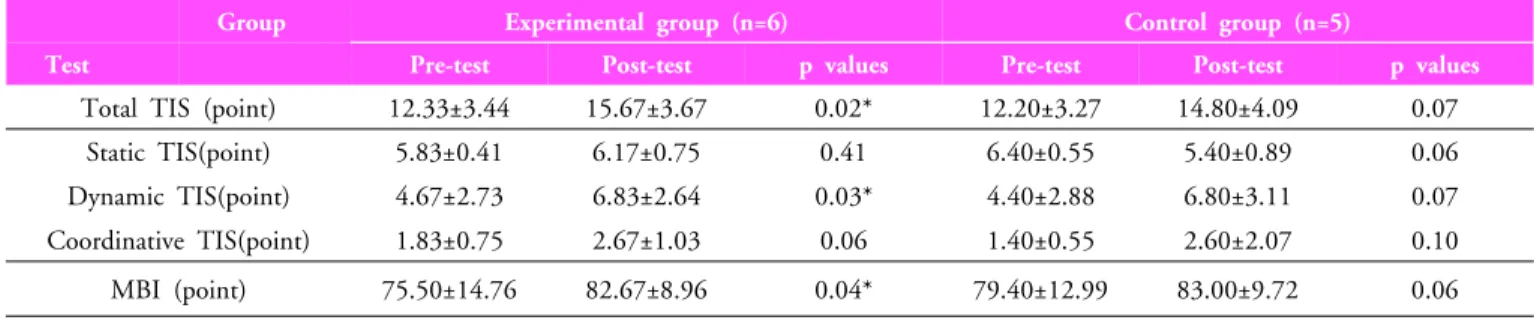
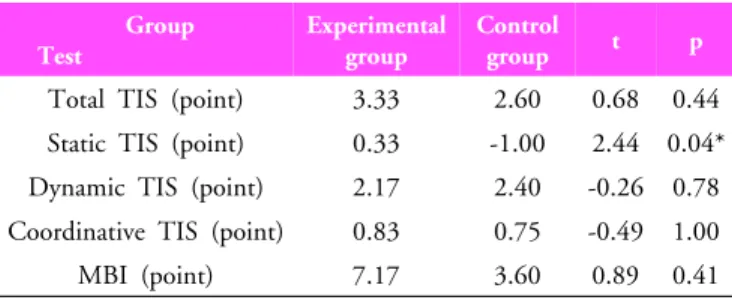
Results: The results obtained were as follows: (1) In the functional reaching training group, there was a statistically significant difference in the total TIS score, dynamic TIS score, and MBI. (2) We compared the results obtained before training with the changes in the results obtained after training and found that there was a relation between the assessment outcomes. Especially, static TIS score showed a relation in both groups.
Conclusion: Functional reaching training influenced both the trunk control and ADL performance. Especially, the functional reaching training group demonstrated better static trunk control ability than the conservative treatment group.
Key words: Stroke, Functional reaching, Trunk control, Anticipatory Postural Adjustments, ADL performance Received: March 17, 2011
Revised: June 01, 2011 Accepted: June 13, 2011
Corresponding author: Bo-Kyung Song, [email protected]
Functional Reaching, on Trunk Control and ADL Performance in Post-Stroke Hemiplegic Patients
The Journal of Korean Society of Physical Therapy