• 검색 결과가 없습니다.

The Effect of Obstacle Height on Balance Control While Stepping Over an Obstacle From a Position of Quiet Stance in Older Adults

N/A
N/A
Protected

Academic year: 2021

Share "The Effect of Obstacle Height on Balance Control While Stepping Over an Obstacle From a Position of Quiet Stance in Older Adults"

Copied!
5
0
0

로드 중.... (전체 텍스트 보기)

전체 글

(1)

김형동

대구가톨릭대학교 물리치료학과

The Effect of Obstacle Height on Balance Control While Stepping Over an Obstacle From a Position of Quiet Stance in Older Adults

Hyeong‐Dong Kim, PT. PhD

Department of Physical Therapy, College of Health Science, Catholic University of Daegu

Purpose: The purpose of this study was to examine the effect of an obstacle height on the balance control of older adults while stepping over an obstacle from a position of quiet stance.

Methods: Fifteen community‐dwelling healthy older adults (mean age, 74.4±4.27 yrs; age range, 67–82 yrs) volunteered to participate in this study. The subjects performed gait initiation (GI) and they stepped over obstacles of two different heights (10 cm and 18 cm) at a self‐paced speed from a position of quiet stance. Their performance was assessed by recording the changes in the displacement of the COP in the anteroposterior (A‐P) and mediolateral (M‐L) directions using a force platform.

Results: The M‐L displacement of the COP significantly increased for an 18 cm obstacle height condition as compared to the GI and a 10 cm obstacle height condition (p<0.01). Furthermore, the M‐L displacement of the COP for a 10 cm high obstacle was significantly greater for that for the GI (p<0.01). However, the mean of the A‐P displacement of the COP was similar between the stepping conditions for the A‐P displacement of the COP (p>0.05).

Conclusion: This study suggests that the M‐L COP displacement could be a better parameter to identify the dynamic balance control in older adults when negotiating obstacles.

Keywords: Balance, Falls, Gait initiation, Obstacle crossing 논문접수일: 2009년 3월 25일

수정접수일: 2009년 6월 26일 게재승인일: 2009년 8월 29일

교신저자: 김형동, [email protected]

장애물 높이의 변화가 평형감각에 미치는 효과

The Journal Korean Society of Physical Therapy

I. 서론

Falls in the elderly represent a challenge to the health care system and to society. Approximately one‐third of persons aged 65 and older are expected to fall every year.

1

Accidental falls in the elderly are the leading cause of injuries and the most common cause of hospital admissions for trauma.

2

Although falls in the elderly are multifaceted and heterogeneous, tripping over an obstacle during gait is one of the leading causes of falls in the elderly.

3,4

There have

been numerous studies describing how healthy young and elderly adults cross obstacles. For both young and older adults, the presence of an obstacle has been shown to increase toe clearance

5

and the obstacle‐crossing step length

6

for higher obstacles. An increase in the knee and hip flexion angles and the moments of the hip, knee, and ankle joints for higher obstacles have also been reported.

7,8

The obstacle‐

crossing speed decreases with higher obstacles.

5,6

Compared to young adults, while crossing an obstacle, older

adults showed a slower approach speed, a slower crossing

speed and a shorter in step length and they appear to

(2)

position both the lead and trail foot relatively farther from the step edge.

9,10

It seems that older adults use less efficient strategies than young adults to modify and adapt walking patterns while crossing an obstacle. However, previous reports have only investigated the spatiotemporal variables of obstacle crossing and not the potential underlying mechanisms for the diminished abilities of the elderly on obstacle avoidance.

The center of pressure (COP) is the point of application of the ground reaction forces (GRFs) on the platform and the COP is commonly used as an indicator of balance and postural control.

11,

Previous studies

12‐14

have reported that with aging and disability, the anteroposterior (A‐P) and mediolateral (M‐L) COP displacement decreased, leading to insufficient momentum during gait initiation (GI), which may cause older adults to fall.

15

For example, older adults demonstrated a reduced capability to generate a COP shift and a smaller magnitude of the peak COM‐COP moment arm (measurement of the COM‐COP distance) as compared to young adults during GI.

12‐14

However, these studies have mostly focused on unobstructed level walking, but not the process of actually crossing an obstacle. The purpose of this study was to examine the effect of obstacle height on balance control while stepping over an obstacle from a position of quiet stance in healthy older adults.

II. Methods

1. Subjects

Fifteen community‐dwelling healthy older adults (mean age, 74.4±4.27 yrs; age range, 67–82 yrs) volunteered to participate in this study. Inclusion criteria for the older participants was a Berg Functional Balance Scale

16,17

score>50, a Frenchay Instrumental Activities of Daily Living

18

score>50 and a Physical Function

19

score>20. All participants scored greater than 25 on the Mini Mental Status Examination.

20

These tests are considered reliable and valid based on previous studies.

21‐23

The subjects had no history of neurological or orthopedic problems that prevented them from participation in the study. All of the elderly participants reported no falls in the previous 12 months. All participants signed a written informed consent form prior to participation in the study. The subject characteristics and scores of questionnaires and functional tests are summarized in Table 1 and 2.

N Age (yrs) Height (cm) Weight (kg) Sex 15 74.4±4.27 157.47±3.91 52.13±7.56 7/8 (male/female) Table 1. Subject characteristics

Type MMSE

b

BFBS

c

FIADL

d

APF

e

Score 28.5±1.22

a

54.5±1.25 53.5±1.34 27.4±1.56

aMean±SD

bMMSE: Mini Mental Status Exam.

cBFBS: Berg Functional Balance Scale.

dFIADL: Frenchay Instrumental Activities of Daily Living.

eAPF: Assessment of Physical Function.

Table 2. Questionnaires and functional tests

2. Equipment

A force platform (Advanced Mechanical Technology, Inc, Newton, MA, USA), embedded in a level walkway (5 m in length and 1.22 m in width), measured ground reaction forces of walking. Amplified force platform signals were sampled on‐line at a rate of 1000 ㎐ for 3 seconds (Advanced Mechanical Technology, Inc, Watertown, MA, USA). The COP data were analyzed using BioAnalysis v2.0 software (Advanced Mechanical Technology, Inc, Watertown, MA, USA). Two different obstacles (10 cm in height, 10 cm in depth and 140 cm in width and 18 cm in height, 10 cm in depth and 140 cm in width, respectively) were used for obstacle clearance.

3. Procedures

For each trial, subjects stood in a predetermined position on a force platform. Subjects then initiated gait or stepped over an obstacle at a self‐paced speed, with the right limb in response to auditory cues. Subjects completed two practice trials and approximately five successful experimental trials under the following conditions:

(1) GI

(2) Stepping over a 10 cm high obstacle (3) Stepping over an 18 cm high obstacle All conditions were presented in a random order.

4. Data Analysis

One‐way repeated analysis of variance (ANOVA) was used

to determine the main effects. In case of significance paired

contrast analyses were conducted. Statistical significance was

indicated at p<0.05 and p<0.01. The independent variable

was the stepping condition (GI, a step over a 10 cm high

obstacle, a step over an 18 cm high obstacle). The

dependent variables included A‐P and M‐L displacement of

the COP. The A‐P (or M‐L) displacement of the COP was

(3)

defined as the total distance (or difference) between the minimum and maximum A‐P (or M‐L) COP location for the length of time either the left or right foot was in contact with the force platform. Statistical software SPSS 14.0 KO (SPSS, Chicago, IL, USA) was used for the statistical analyses.

III. Results

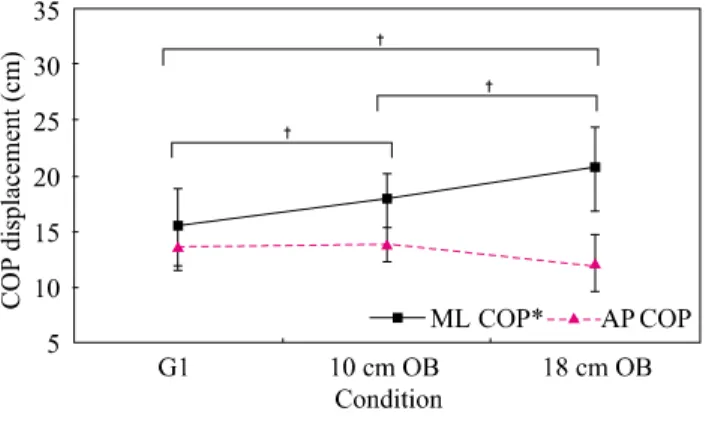
Comparisons of the COP data between GI, stepping over a 10 cm high obstacle, and stepping over an 18 cm high obstacle were analyzed for the A‐P and M‐L displacement of the COP. There was a significant difference between the stepping conditions for the M‐L displacement of the COP (p<0.01) (see Figure 1). The mean value for the 18 cm high obstacle of the M‐L displacement of the COP was greatest followed by the mean values for the 10 cm high obstacle and for GI of the M‐L displacement of the COP. The mean value for the 18 cm high obstacle for the M‐L displacement of the COP was 124% greater as compared to the combined mean M‐L displacement of the COP for GI and for the 10 cm high obstacle (p<0.01). The mean value for the 10 cm high obstacle for the M‐L displacement of the COP was 115% greater as compared to the mean M‐L displacement of the COP for GI (p<0.01). However, the mean values of the A‐P COP displacement were similar between GI, the 10 cm high obstacle and the 18 cm high obstacle (p>0.05). The mean values for the COP data for the participants are summarized in Table 3.

Figure 1. Comparisons of the COP parameters (cm) during gait initiation and obstacle crossing.

Note: COP: center of pressure, A‐P: anteroposterior, M‐L: mediolateral.

*Significant main effect for stepping condition (p<0.01).

Significant differences between conditions (p<0.01).

Dependent variables

Gait initiation

10cm obstacle

18cm obstacle M‐L

displacement (cm)* 15.39±3.45

a†§

17.76±2.44

†‡

20.6±3.76

‡§

A‐P

displacement (cm) 13.67±2.24 13.87±1.54 12.18±2.56

aMean±SD

COP: center of pressure, A‐P: anteroposterior, M‐L: mediolateral

*Significant main effect for stepping condition (p<0.05).

p<0.01, p<0.01, §p<0.01

Table 3. The COP parameters (cm) during gait initiation and obstacle crossing

IV. Discussion

The purpose of this study was to examine the relationship between obstacle height and the COP trajectory when older adults negotiate obstacles of different heights. The elderly subjects differently modulated the M‐L displacement of the COP magnitude while stepping over obstacles of different height or initiating gait. However, no significant difference in the A‐P displacement of the COP magnitude between the stepping conditions was observed.

The increased M‐L COP displacement required for the 18 cm high obstacle indicated that elderly subjects had more difficulty in maintaining dynamic stability in the frontal plane on obstacle crossing as compared to GI and for a 10 cm obstacle height. It is reasonable to expect that an 18 cm obstacle height condition was more challenging than a 10 cm obstacle height and GI conditions for obstacle crossing.

This observation suggests that stepping over a higher obstacle significantly affected control of dynamic balance during obstacle crossing, resulting in a greater displacement of the COP in the M‐L direction. A higher obstacle (18 cm) crossing required significantly greater momentum of external knee flexion, hip adduction and ankle dorsiflexion at the supporting limb as compared to GI.

5,7

Furthermore, a longer duration of the single limb support was required for a higher obstacle crossing.

6,24

The longer duration of the swing limb support may be necessary to provide enough time to stabilize the COP to cross a higher obstacle and to maintain body balance.

25

It has been suggested that the proper control of the M‐L COM motion and its coordination with the COP are important to maintain the lateral balance that is highly related to an increased risk of lateral falls in the elderly.

26,27

Somewhat surprisingly, the elderly subjects were successfully

able to maintain A‐P COP displacement, regardless of the

stepping conditions. There were no significant differences in

the displacement of A‐P COP between stepping conditions.

(4)

This is may be due as the elderly shifted the anterior trunk in the anterior direction prior to obstacle crossing, and subsequently straightened the trunk into a vertical position towards the end of the obstacle crossing as obstacle height increased.

28

This shift of the upper body in the anterior direction and subsequently straightening the trunk into a vertical position may increase the A‐P (Fx) ground reaction force, thus generating momentum necessary for crossing an obstacle.

14

This suggests that, as obstacle height increased, the elderly subjects were able to generate the momentum necessary for forward propulsion.

These findings could represent different strategies of obstacle avoidance of the elderly on the kinetic responses in the M‐L and A‐P directions. Significant difference in the displacement of M‐L COP magnitude between the stepping conditions also suggests that momentum‐generation capacity relative to frontal plane weight shift in the elderly subjects were more affected as compared to weight transfer in A‐P directions.

The current study has several limitations. There is a relatively small sample of older adults. Furthermore, the participants in this study were of a high functional level;

thus, the study population may not be representative of community dwelling older adults who have mobility deficits.

Finally, future studies should explore COP trajectory behavior in a wide variety of clinical populations, such as subjects with neurological and orthopedic deficits or diseases as well as a diverse set of activities.

V. Conclusion

The COP trajectory appears to modulate in the presence of different obstacle heights. The M‐L COP displacement increased as the obstacle height increased. However, the A‐P COP displacement did not change as the obstacle height increased. These findings suggest that the M‐L COP displacement could be a better parameter to identify dynamic balance control when negotiating obstacles as compared to the A‐P displacement of COP. The results also suggest that an investigation of the COP trajectory could be an important tool to measure the mechanisms of normal and/or pathological gait patterns or age‐related changes of gait.

Author Contributions Research design: Kim HD Acquisition of data: Kim HD

Analysis and interpretation of data: Kim HD

Drafting of the manuscript: Kim HD

Administrative, technical, and material support: Kim HD Research supervision: Kim HD

References

1. Hausdorff JM, Rios DA, Edelber HK. Gait variability and fall risk in community‐living older adults: a 1‐year prospective study. Arch Phys Med Rehabil. 2001;82(8):1050–6.

2. Alexander BH, Rivara FP, Wolf ME. The cost and frequency of hospitalization for fall‐related injuries in older adults. Am J Public Health. 1992;82(7):1020‐3.

3. Campbell AJ, Borrie MJ, Spears GF et al. Circumstances and consequences of falls experienced by a community population 70 years and over during a prospective study.

Age Ageing. 1990;19(2):136‐41.

4. Tinetti ME, Speechley M. Prevention of falls among the elderly. N Engl J Med. 1989;320(16):1055‐9.

5. Patla AE, Rietdyk S. Visual control of limb trajectory over obstacles during locomotion: effect of obstacle height and width. Gait Posture. 1993;1(1):45‐60.

6. Begg RK, Sparrow WA, Lythgo ND. Time‐domain analysis of foot‐ground reaction forces in negotiating obstacles. Gait Posture. 1998;7(2):99‐109.

7. Chou LS, Draganich LF. Stepping over an obstacle increases the motions and moments of the joints of the trailing limb in young adults. J Biomech. 1997;30(4):331‐7.

8. Whipple RH, Wolfson LI, Amerman PM. The relationship of knee and ankle weakness to falls in nursing home residents:

an isokinetic study. J Am Geriatr Soc. 1987;35(1):13‐20.

9. Chen HC, Ashton‐Miller JA, Alexander NB et al. Stepping over obstacles: gait patterns of healthy young and old adults.

J Gerontol. 1991;46(6):M196–203.

10. Begg RK, Sparrow WA. Gait characteristics of young and older individuals negotiating a raised surface: implications for the prevention of falls. J Gerontol A Bio Sci Med Sci.

2000;5(3):M147–54.

11. Doyle RJ, Hsiao‐Wecksler ET, Ragan BG et al.

Generalizability of center of pressure measures of quiet standing. Gait Posture. 2007;25(2):166‐71.

12. Chang H, Krebs DE. Dynamic balance control in elders:

gait initiation assessment as a screening tool. Arch Phys Med Rehabil. 1999;80(5):490‐4.

13. Martin M, Shinberg M, Kuchibhatla M et al. Gait initiation

in community‐dwelling adults with Parkinson disease:

(5)

comparison with older and younger adults without the disease.

Phys Ther. 2002;82(6):566‐77.

14. Polcyn AF, Lipsitz LA, Kerrigan DC et al. Age‐related changes in the initiation of gait: degradation of central mechanisms for momentum generation. Arch Phys Med Rehabil.

1998;79(12):1582‐9.

15. Cummings SR, Nevitt MC. A hypothesis: the causes of hip fractures. J Gerontol. 1989;44(4):107‐11.

16. Berg KO, Wood‐Dauphinee SL, Williams JI et al. Measuring balance in the elderly: preliminary development of an instrument. Physiother Can. 1989;41(6):304‐11.

17. Berg KO, Maki BE, Williams JI et al. Clinical and laboratory measures of postural balance in an elderly population. Arch Phys Med Rehabil. 1992;73(11):1073‐80.

18. Schuling J, de Haan R, Limburg M et al. The Frenchay Activities Index. Assessment of functional status in stroke patients. Stroke. 1993;24(8):1173‐7.

19. Ware JE Jr, Sherbourne CD. The MOS 36‐item short‐form health survey (SF‐36). I. Conceptual framework and item selection. Med Care. 1992;30(6):473‐83.

20. Folstein MF, Folstein SE, McHugh PR. "Mini‐mental state".

A practical method for grading the cognitive state of patients for the clinician. J Psychiatr Res. 1975;12(3):189‐98.

21. Tombaugh TN, McIntyre NJ. The mini‐mental state examination: a comprehensive review. J Am Geriatr Soc.

1992;40(9):922‐35.

22. Turnbull JC, Kersten P, Habib M et al. Validation of the Frenchay Activities Index in a general population aged 16 years and older. Arch Phys Med Rehabil. 2000;81(8):1034‐8.

23. Yip JY, Wilber KH, Myrtle RC et al. Comparison of older adult subject and proxy responses on the SF‐36 health‐related quality of life instrument. Aging Ment Health. 2001;5(2):136

‐42.

24. Chou LS, Draganich LF. Increasing obstacle height and decreasing toe‐obstacle distance affect the joint moments of the stance limb differently when stepping over an obstacle.

Gait Posture. 1998;8(3):186‐204.

25. Wang Y, Watanabe K. The relationship between obstacle height and center of pressure velocity during obstacle crossing.

Gait Posture. 2008;27(1):172‐5.

26. Chou LS, Kaufman KR, Hahn ME et al. Medio‐lateral motion of the center of mass during obstacle crossing distinguishes elderly individuals with imbalance. Gait Posture.

2003;18(3):125‐33.

27. Maki BE, Edmondstone MA, McIlroy WE. Age‐related differences in laterally directed compensatory stepping behavior. J Gerontol A Biol Sci Med Sci. 2000:55(5):M270–7.

28. Hahn ME, Chou LS. Age‐related reduction in sagittal plane center of mass motion during obstacle crossing. J Biomech.

2004;37(6):837‐44.

수치

Table 3. The COP parameters (cm) during gait initiation  and obstacle crossing

참조

관련 문서

• 이명의 치료에 대한 매커니즘과 디지털 음향 기술에 대한 상업적으로의 급속한 발전으로 인해 치료 옵션은 증가했 지만, 선택 가이드 라인은 거의 없음.. •

[r]

2재화 2요소 헥셔-올린 모형에서는 어느 한 경제에서 어느 한 요소의 양이 증가하면, 그 요소를 집약적으로 사용하는 산업의 생산량은 증가하고 다른

Ross: As my lawfully wedded wife, in sickness and in health, until

다양한 번역 작품과 번역에 관한 책을 읽는 것은 단순히 다른 시대와 언어, 문화의 교류를 넘어 지구촌이 서로 이해하고 하나가

The index is calculated with the latest 5-year auction data of 400 selected Classic, Modern, and Contemporary Chinese painting artists from major auction houses..

1 John Owen, Justification by Faith Alone, in The Works of John Owen, ed. John Bolt, trans. Scott Clark, &#34;Do This and Live: Christ's Active Obedience as the

The writer who suffered in this period of difficulty had an attitude to join in social movements focusing on national unification and later he was engaged