pISSN 2093-596X · eISSN 2093-5978
Article
Recent Insights into Insulin-Like Growth Factor Binding Protein 2 Transcriptional Regulation
Minsang Shin1, Hye Suk Kang2, Jae-Hyung Park2, Jae-Hoon Bae2, Dae-Kyu Song2, Seung-Soon Im2
1Department of Microbiology, Kyungpook National University School of Medicine; 2Department of Physiology, Keimyung University School of Medicine, Daegu, Korea
Insulin-like growth factor binding proteins (IGFBPs) are major regulators of insulin-like growth factor bioavailability and activity in metabolic signaling. Seven IGFBP family isoforms have been identified. Recent studies have shown that IGFBPs play a pivotal role in metabolic signaling and disease, including the pathogenesis of obesity, diabetes, and cancer. Although many studies have docu- mented the various roles played by IGFBPs, transcriptional regulation of IGFBPs is not well understood. In this review, we focus on the regulatory mechanisms of IGFBP gene expression, and we summarize the findings of transcription factor activity in the IGFBP promoter region.
Keywords: Insulin-like growth factor binding protein 2; Transcriptional regulation; Metabolic diseases; Liver
INTRODUCTION
Insulin-like growth factor binding proteins (IGFBPs) are a super- family member of homologous proteins present in serum [1]. All members of the IGFBP family include a cysteine-rich domain, which contains the GCGCCXXC motif in the N-terminal and C- terminal domains [2]. Insulin-like growth factors (IGFs) are cen- tral hormones involved in metabolic signaling, affecting glucose uptake, lipogenesis, glycogen storage, and suppression of protein degradation [3]. Studies have shown that IGFBPs have IGF-de- pendent and IGF-independent functions [1]. Within the IGFBP family, IGFBP-2 is a protein encoded by the IGFBP-2 gene [4].
Observations on the identification and function of IGFBP-2 in metabolic signaling and disease are discussed in this review.
These data provide new insights into our understanding of the pathophysiology of metabolic syndrome and have important clinical implications, although additional research is required.
TISSUE SURVEY OF IGFBP-2 GENE EXPRESSION
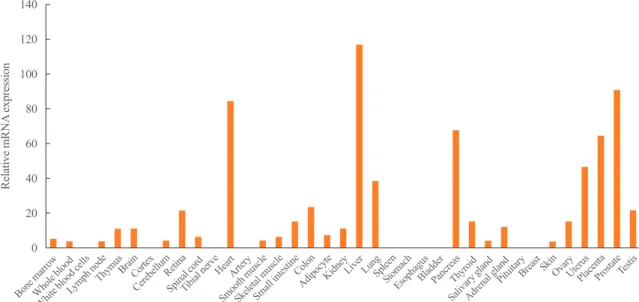
IGFBP-2 is a 36-kDa protein that it is mainly expressed during embryonic development; it is also expressed in adult liver and adipocytes, and in the central nervous and reproductive systems [5]. Tissue survey data have elucidated the IGFBP-2 gene ex- pression profile (Fig. 1). These data show that IGFBP-2 is main- ly expressed in the liver, heart, kidney, and prostate.
COMPARISON OF IGFBP-2 GENE SEQUENCES BETWEEN SPECIES
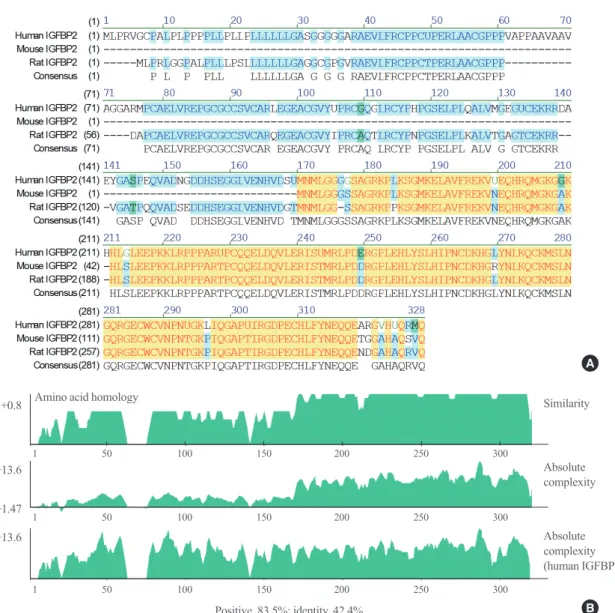
When the IGFBP-2 sequence was compared between species, several regions of high similarity between promoter sequences were observed (Fig. 2). The IGFBP-2 gene is identical in 49.4%
of sequences between humans, rats, and mice. Similarly, exon
Received: 18 November 2016, Revised: 13 December 2016, Accepted: 20 December 2016
Corresponding author: Seung-Soon Im
Department of Physiology, Keimyung University School of Medicine, 1095 Dalgubeol-daero, Dalseo-gu, Daegu 42601, Korea
Tel: +82-53-580-3863, Fax: +82-53-580-3795, E-mail: [email protected]
Copyright © 2017 Korean Endocrine Society
This is an Open Access article distributed under the terms of the Creative Com- mons Attribution Non-Commercial License (http://creativecommons.org/
licenses/by-nc/4.0/) which permits unrestricted non-commercial use, distribu- tion, and reproduction in any medium, provided the original work is properly cited.
sequences for the IGFBP-2 gene are about 42.2% identical across species (Fig. 3). In particular, consensus sequences for the major transcription factors match significantly between hu- mans, mice, and rats. Moreover, the IGFBP-2 gene C-terminal domain, including the consensus sequence for IGF binding and the CWCV (cysteine-tryptophan-cysteine-valine) domain, is highly conserved across a variety of species [6]. These data in- dicate that IGFBP-2 may have high binding affinity with IGFs.
TRANSCRIPTIONAL REGULATION OF IGFBP-2
Although the secretion of IGFBP-2 protein is well established in metabolic signaling, the molecular mechanisms of the IGFBP-2 gene have only recently been elucidated. A few tran- scription factors, including peroxisome proliferation-activator receptor α (PPARα), multiple endocrine neoplasia type 1 (MEN1), CCAAT-enhancer-binding protein α (C/EBPα), and hypoxia-inducible factor 1 (HIF-1), have been identified on the IGFBP-2 promoter (Fig. 4).
One study found that IGFBP-2 expression increased during prolonged fasting, and the plasma concentration of IGFBP-2 was consistently induced for 48 hours with no change postprandial or after glucose challenge [7]. Increased IGFBP-2 expression dur- ing fasting is regulated by PPARα [8,9]. The PPARα response el- ement (PPRE) was identified on a mouse IGFBP-2 promoter, in- dicating that IGFBP-2 is a direct target of PPARα. Moreover, mRNA expression of the IGFBP-2 gene is activated by metfor-
min, which is an antidiabetic drug for patients with diabetes and obesity, and the serum level of IGFBP-2 is stimulated in metfor- min-challenged diabetic patients [10]. A recent study in humans suggested that the circulating concentration of IGFBP-2 is asso- ciated with metabolic syndrome, including insulin resistance and obesity [11,12]. These results suggest that overexpression of the IGFBP-2 gene plays a protective role against insulin resistance.
Previous studies found that insulin suppresses induction of IGFBP-2, as well as IGFBP-1 [13]. Moreover, hepatic IGFBP-2 expression is decreased by insulin infusion, whereas IGFBP-1 mRNA recovers to baseline within 1 hour postinsulin challenge.
These results suggest that IGFBP-2 expression level is very im- portant for modulating insulin and IGF-1 sensitivity. In addition, the expression level of IGFBP-2 could potentially serve as a bio- marker of metabolic disease, such as diabetes or insulin resis- tance. Although IGFBP-2 is mainly expressed in the liver, tran- scriptional regulation of the IGFBP-2 gene has been studied in other tissues [11,14,15]. In particular, IGFBP-2 gene expression in 3T3-L1 adipocytes is regulated by C/EBPα, even though IGFBP-2 is expressed at a very low level in white adipose tissue [16]. Compared to the liver, insulin stimulated IGFBP-2 gene expression in adipocytes. Insulin activates IGFBP-2 expression in 3T3-L1 adipocytes and MCF-7 (Michigan Cancer Founda- tion 7) breast cancer cell lines through the phosphoinositide 3-kinase/mechanistic target of rapamycin signaling axis [16,17].
These findings indicate that insulin signaling might increase IGFBP-2 secretion by activating insulin-induced, adipocyte- specific expression of the C/EBPα gene in differentiated 3T3-
140
120
100
80
60
40
20
0
Relative mRNA expression
Fig. 1. Insulin-like growth factor binding protein 2 (IGFBP-2) expression profile from Genecards database (www.genecards.org).
Normal human tissues for IGFBP-2 gene
Fig. 2. Homology comparison of the insulin-like growth factor binding protein 2 (IGFBP-2) promoter region between species which show highly conserved regions with yellow color. (A) Alignment of human, mouse and rat IGFBP-2 promoter sequences between –1,000 and 1 bp from transcription start site. (B) Similarity plots of aligned IGFBP-2 promoter sequences between species.
1 300 600 900 1,200
1 300 600 900 1,200
1 300 600 900 1,200 Positive, 83.6%; identity, 49.4%
+0.8
+8
−4.67
+8
−5.4
Similarity
Absolute complexity
Absolute complexity (human IGFBP-2)
A
B
Fig. 3. Comparison of insulin-like growth factor binding protein 2 (IGFBP-2) exon regions between species which represent highly conserved regions with yellow color. (A) Alignment of human, mouse and rat IGFBP-2 exon sequences. (B) Similarity plots of aligned IGFBP-2 amino acids sequences between species.
Fig. 4. Summary of transaction factor binding to the promoter regions of the insulin-like growth factor binding protein 2 (IGFBP-2) gene for human and mouse. PPAR, peroxisome proliferation-activator receptor; PPRE, PPAR response element; C/EBPα, CCAAT-enhancer-binding protein α; RXRα, retinoid X receptor α.
1 50 100 150 200 250 300
1 50 100 150 200 250 300
1 50 100 150 200 250 300 Positive, 83.5%; identity, 42.4%
+0.8
+13.6
−1.47 +13.6
Similarity Amino acid homology
Absolute complexity
Absolute complexity (human IGFBP-2)
A
B
Human
Mouse
Transcription start
Transcription start
L1 adipocytes.
Transcriptional regulation of the IGFBP-2 gene also occurs in tumorigenesis [8,18-20]. During tumor growth, IGFBP-2 ex- pression is regulated by the transcription factor HIF-1α in hy- poxic conditions [8]. In addition, IGFBP-2 mRNA is upregulated by the tumor suppressor gene p53 in a dose-dependent manner, indicating that IGFBP-2 is a p53 target [20]. Also, the IGFBP-2 gene was upregulated by disruption of the menin gene in an ani- mal model and stable cell lines [21,22]. Menin is a nuclear pro- tein-encoded Men1 gene, which is mutated in patients with MEN1 [22]. MEN1 is a syndrome characterized by tumorigene- sis in multiple endocrine organs (e.g., pancreas and parathyroids) [22]. Menin is required to repress endogenous IGFBP-2 expres- sion by modifying the chromatin structure surrounding the IGFBP-2 gene promoter. Although IGFBP-2 promoter activity is decreased by overexpression of menin, the regulatory mecha- nism by which menin affects the IGFBP-2 promoter remains un- known.
FUNCTION OF IGFBPS IN METABOLIC SIGNALING
In a transgenic mouse model, overexpression of IGFBP-2 was associated with increased fat accumulation and reduced muscle weight [23]. Although IGFBP-2 is a secondary protein among the circulation binding proteins, the regulatory and functional roles of IGFBP-2 are not well understood compared to those of IGFBP-1. A recent study determined the role of IGFBP-2 to be a pleiotropic oncogenic protein in cancer development [24].
IGFBP-2 stimulates the nuclear form of epidermal growth fac- tor receptor (EGFR), increasing the activated transcription fac- tor 3 (STAT3) pathway. Moreover, overexpression of exogenous IGFBP-2 protein inhibits EGFR activity through suppression of nuclear EGFR signaling [24]. These results demonstrate a strong association between IGFBP-2 and STAT3 and suggest a novel tumor-inducing role for IGFBP2 by providing a linkage between IGFBP-2 and cancer development.
A novel function of IGFBP-2 has been reported in Duchenne muscular dystrophy (DMD) [14]. One study injected IGFBP-2 into the muscles of dystrophic mice and found that muscle-spe- cific upregulation of IGFBP-2 inhibited muscular dystrophy and protected against dystrophic pathophysiology. Although these discoveries could eventually lead to gene therapy for DMD, it is not yet possible to directly address the muscle atro- phy resulting from neuromuscular disorders such as DMD. IGF- 1 signaling slows progression of DMD [25-27], and studies
have found that overexpression of IGFBP-2 can assist in dystro- phic treatment by reducing muscle composition in a muscle- dystrophic animal model and patients with DMD.
CLINICAL RELEVANCE OF IGFBP-2 LEVELS IN HUMAN SERUM
Chronic hyperinsulinemia reduces IGFBP-2 secretion, resulting in increased availability of IGF-1 [28]. Studies have shown that IGFBPs serve a critical function in the metabolic system and rep- resent an important link between the IGF system and insulin sig- naling [29]. In recent years, in vivo and in vitro assays, as well as studies in human subjects, have focused on the functional pro- gression of IGFBPs. These investigations have confirmed the role of IGFBPs in metabolic syndrome, including fatty liver, in- sulin resistance, and obesity [30]. Production of IGFBP-2 is de- creased in obese people compared with nonobese individuals, and concentrations of serum IGFBP-2 decrease with increasing body mass index [13]. Several reports have demonstrated that circulating IGFBP-2 concentrations are lower in patients with type 2 diabetes mellitus or obesity [10,31]. Because overexpres- sion of IGFBP-2 leads to recovered blood glucose levels in dia- betic animal models, and because the antidiabetic drug, metfor- min, can recover serum IGFBP-2 levels in diabetic patients [10], decreased IGFBP-2 levels may lead to the development of diabe- tes in humans. Thus, IGFBP-2 may be useful as a biomarker of metabolic disease.
CONCLUSIONS
IGFBP-2 has been shown to be a key regulator of metabolic diseases, such as diabetes and obesity, as well as cancer metabo- lism. Although IGFBP-2 gene transcription is regulated by sev- eral metabolic conditions in endocrine organs, the underlying regulatory mechanism of IGFBP-2 gene expression remains un- known, and further studies are needed. Moreover, the functional roles of IGFBP-2 in metabolic diseases and signaling are still unclear and controversial. Therefore, the relevance of IGFBP-2 to metabolic diseases could be a main driver in the investigation of IGFBP-2’s underlying physiological function.
CONFLICTS OF INTEREST
No potential conflict of interest relevant to this article was re- ported.
ACKNOWLEDGMENTS
This study was supported by grants from the Korea New Faculty, Korea Research Foundation, Republic of Korea (NRF-2013R1 A1A1006606) to S.S.I. and Basic Science Research Program through the National Research Foundation of Korea (NRF) funded by the Ministry of Education (2015R1D1A1A01057610) to H.S.K.
ORCID
Minsang Shin http://orcid.org/0000-0001-8679-446X Hye Suk Kang http://orcid.org/0000-0001-7568-3211 Seung-Soon Im http://orcid.org/0000-0002-2743-2108
REFERENCES
1. Wheatcroft SB, Kearney MT. IGF-dependent and IGF-inde- pendent actions of IGF-binding protein-1 and -2: implica- tions for metabolic homeostasis. Trends Endocrinol Metab 2009;20:153-62.
2. Kim HS, Nagalla SR, Oh Y, Wilson E, Roberts CT Jr, Rosenfeld RG. Identification of a family of low-affinity in- sulin-like growth factor binding proteins (IGFBPs): charac- terization of connective tissue growth factor as a member of the IGFBP superfamily. Proc Natl Acad Sci U S A 1997;94:
12981-6.
3. Clemmons DR. The relative roles of growth hormone and IGF-1 in controlling insulin sensitivity. J Clin Invest 2004;
113:25-7.
4. Schoen TJ, Mazuruk K, Waldbillig RJ, Potts J, Beebe DC, Chader GJ, et al. Cloning and characterization of a chick embryo cDNA and gene for IGF-binding protein-2. J Mol Endocrinol 1995;15:49-59.
5. Shimasaki S, Ling N. Identification and molecular character- ization of insulin-like growth factor binding proteins (IGFBP-1, -2, -3, -4, -5 and -6). Prog Growth Factor Res 1991;3:243-66.
6. Kibbey MM, Jameson MJ, Eaton EM, Rosenzweig SA. In- sulin-like growth factor binding protein-2: contributions of the C-terminal domain to insulin-like growth factor-1 bind- ing. Mol Pharmacol 2006;69:833-45.
7. Clemmons DR, Snyder DK, Busby WH Jr. Variables control- ling the secretion of insulin-like growth factor binding pro- tein-2 in normal human subjects. J Clin Endocrinol Metab 1991;73:727-33.
8. Feldser D, Agani F, Iyer NV, Pak B, Ferreira G, Semenza GL. Reciprocal positive regulation of hypoxia-inducible factor 1alpha and insulin-like growth factor 2. Cancer Res 1999;59:3915-8.
9. Kang HS, Kim MY, Kim SJ, Lee JH, Kim YD, Seo YK, et al. Regulation of IGFBP-2 expression during fasting. Bio- chem J 2015;467:453-60.
10. Kang HS, Cho HC, Lee JH, Oh GT, Koo SH, Park BH, et al.
Metformin stimulates IGFBP-2 gene expression through PPARalpha in diabetic states. Sci Rep 2016;6:23665.
11. Li Z, Picard F. Modulation of IGFBP2 mRNA expression in white adipose tissue upon aging and obesity. Horm Metab Res 2010;42:787-91.
12. Ruan W, Lai M. Insulin-like growth factor binding protein:
a possible marker for the metabolic syndrome? Acta Diabe- tol 2010;47:5-14.
13. Frystyk J. Free insulin-like growth factors: measurements and relationships to growth hormone secretion and glucose homeostasis. Growth Horm IGF Res 2004;14:337-75.
14. Swiderski K, Martins KJ, Chee A, Trieu J, Naim T, Gehrig SM, et al. Skeletal muscle-specific overexpression of IGFBP-2 promotes a slower muscle phenotype in healthy but not dystrophic mdx mice and does not affect the dystro- phic pathology. Growth Horm IGF Res 2016;30-31:1-10.
15. Johnson MH, de Mejia EG. Phenolic compounds from fer- mented berry beverages modulated gene and protein expres- sion to increase insulin secretion from pancreatic beta-cells in vitro. J Agric Food Chem 016;64:2569-81.
16. Li Z, Miard S, Laplante M, Sonenberg N, Picard F. Insulin stimulates IGFBP-2 expression in 3T3-L1 adipocytes through the PI3K/mTOR pathway. Mol Cell Endocrinol 2012;358:
63-8.
17. Mireuta M, Darnel A, Pollak M. IGFBP-2 expression in MCF-7 cells is regulated by the PI3K/AKT/mTOR pathway through Sp1-induced increase in transcription. Growth Fac- tors 2010;28:243-55.
18. Dunlap SM, Celestino J, Wang H, Jiang R, Holland EC, Fuller GN, et al. Insulin-like growth factor binding protein 2 promotes glioma development and progression. Proc Natl Acad Sci U S A 2007;104:11736-41.
19. Tombolan L, Orso F, Guzzardo V, Casara S, Zin A, Bonora M, et al. High IGFBP2 expression correlates with tumor se- verity in pediatric rhabdomyosarcoma. Am J Pathol 2011;
179:2611-24.
20. Grimberg A, Coleman CM, Shi Z, Burns TF, MacLachlan TK, Wang W, et al. Insulin-like growth factor factor binding
protein-2 is a novel mediator of p53 inhibition of insulin-like growth factor signaling. Cancer Biol Ther 2006;5:1408-14.
21. Pannett AA, Thakker RV. Multiple endocrine neoplasia type 1. Endocr Relat Cancer 1999;6:449-73.
22. La P, Schnepp RW, Petersen CD, Silva AC, Hua X. Tumor suppressor menin regulates expression of insulin-like growth factor binding protein 2. Endocrinology 2004;145:3443-50.
23. Rehfeldt C, Renne U, Sawitzky M, Binder G, Hoeflich A.
Increased fat mass, decreased myofiber size, and a shift to glycolytic muscle metabolism in adolescent male transgenic mice overexpressing IGFBP-2. Am J Physiol Endocrinol Metab 2010;299:E287-98.
24. Chua CY, Liu Y, Granberg KJ, Hu L, Haapasalo H, Annala MJ, et al. IGFBP2 potentiates nuclear EGFR-STAT3 signal- ing. Oncogene 2016;35:738-47.
25. Allen RE, Boxhorn LK. Regulation of skeletal muscle satel- lite cell proliferation and differentiation by transforming growth factor-beta, insulin-like growth factor I, and fibro- blast growth factor. J Cell Physiol 1989;138:311-5.
26. Lynch GS, Cuffe SA, Plant DR, Gregorevic P. IGF-I treat- ment improves the functional properties of fast- and slow- twitch skeletal muscles from dystrophic mice. Neuromuscul
Disord 2001;11:260-8.
27. Schertzer JD, van der Poel C, Shavlakadze T, Grounds MD, Lynch GS. Muscle-specific overexpression of IGF-I im- proves E-C coupling in skeletal muscle fibers from dystro- phic mdx mice. Am J Physiol Cell Physiol 2008;294:C161- 8.
28. Aguirre GA, De Ita JR, de la Garza RG, Castilla-Cortazar I.
Insulin-like growth factor-1 deficiency and metabolic syn- drome. J Transl Med 2016;14:3.
29. Renehan AG, Frystyk J, Flyvbjerg A. Obesity and cancer risk: the role of the insulin-IGF axis. Trends Endocrinol Metab 2006;17:328-36.
30. Heald AH, Kaushal K, Siddals KW, Rudenski AS, Anderson SG, Gibson JM. Insulin-like growth factor binding protein-2 (IGFBP-2) is a marker for the metabolic syndrome. Exp Clin Endocrinol Diabetes 2006;114:371-6.
31. Levi J, Huynh FK, Denroche HC, Neumann UH, Glavas MM, Covey SD, et al. Hepatic leptin signalling and subdia- phragmatic vagal efferents are not required for leptin-in- duced increases of plasma IGF binding protein-2 (IGFBP-2) in ob/ob mice. Diabetologia 2012;55:752-62.