Validation of the Korean-Version of the Clinical Assessment Interview for Negative Symptoms of Schizophrenia (CAINS)
The Clinical Assessment Interview for Negative Symptoms (CAINS) was developed to overcome the limitations of existing instruments and reflect the current view of negative symptoms. The aim of the present study was to evaluate the reliability and validity of the Korean version of the Clinical Assessment Interview for Negative Symptoms (K-CAINS).
Inpatients (n = 49) and outpatients (n = 70) with schizophrenia were recruited from three institutions. The confirmative factor analysis, test-retest reliability, inter-rater reliability, convergent validity, and discriminant validity were assessed. The study group consisted of 71 males (59.7%) and 48 females (40.3%). Their mean age was 42.15 years (SD = 12.2).
The K-CAINS was confirmed to be divided into two subscales of 9 items related to
“motivation/pleasure” and 4 items related to “expression” in concordance with the original version of the CAINS. The results showed that the K-CAINS had a good inter-rater reliability (ICC = 0.84-0.94), test-retest reliability (r = 0.90, P < 0.001). Convergent validity was proven by demonstrating a significant correlation with the Positive and Negative Syndrome Scale (PANSS) negative subscale, and the Scale for the Assessment of Negative Symptoms (SANS). Discriminant validity was proven by the lack of a significant correlation with the PANSS positive subscale, the Korean version of the Beck depression inventory (BDI), the Korean version of the Calgary depression scale for schizophrenia (K-CDSS), and the Modified Simpson Angus scale (MSAS). The K-CAINS could be a reliable and valid tool to assess the negative symptoms of Korean schizophrenia patients.
Keywords: Schizophrenia; Negative Symptoms; CAINS; Korean Sung Il Jung,1 Jungmin Woo,1
Yang-Tae Kim,2 and Sang Gyu Kwak3
1Department of Psychiatry, Catholic University of Daegu School of Medicine, Daegu, Korea;
2Department of Psychiatry, Keimyung University Dongsan Medical Center, Daegu, Korea;
3Department of Medical Statistics, Catholic University of Daegu School of Medicine, Daegu, Korea
Received: 15 December 2015 Accepted: 4 April 2016 Address for Correspondence:
Jungmin Woo, MD
Department of Psychiatry, Catholic University of Daegu School of Medicine, 33 Duryugongwon-ro 17-gil, Nam-gu, Daegu 42472, Korea
E-mail: [email protected]
http://dx.doi.org/10.3346/jkms.2016.31.7.1114 • J Korean Med Sci 2016; 31: 1114-1120
INTRODUCTION
Schizophrenia is a chronic disease that causes dysfunction in various areas and is commonly associated with impairments in social and occupational function. Whereas positive symptoms (hallucination, delusion, disorganized speech, etc.) represent an exaggeration of normal processes, negative symptoms (an- hedonia, avolition, and flat affect) are conceptualized as an ab- sence or diminution of normal processes. Negative symptoms are more resistant to treatment (1,2) cause more severe func- tional impairments (3) and are related to a source of burden for caregivers (4). Despite the clinical importance of negative symp- toms, negative symptoms remain inadequately addressed by current clinical reality (5,6). Therefore, the management of neg- ative symptoms is an essential aspect on treatment of schizo- phrenia. Moreover, negative symptoms are difficult to distin- guish from depressive symptoms, drug side effects, and second- ary negative symptoms due to positive symptoms (7). There- fore, negative symptoms need to be accurately assessed prior to treatment.
The commonly used negative symptom rating scales include the Scale for the Assessment of Negative Symptoms (SANS) (8),
Positive and Negative Syndrome Scale (PANSS) (9), Schedule for Affective Disorders and Schizophrenia (SADS) (10), and the Schedule for the Deficit Syndrome (SDS) (11). However, recent studies have identified significant limitations associated with the current instruments used to assess negative symptoms (12, 13). For example, the SANS and the PANSS, which are the most commonly used instruments to assess negative symptoms in- clude items that assess cognitive functioning (12). However, these items do not correlate well with other negative symptoms items and are conceptually distinct from negative symptoms (14-17). Additionally, existing instruments do not consider the patient’s specific circumstances (e.g., a lack of opportunity due to social and economic deprivation, isolation related to geo- graphical location, a lack of social skills, and family conflicts) but instead assess the behavioral results (e.g., observation of behavior during the interview, occupational and interpersonal relationships, and social behavior). However, social and occu- pational failures that derive from these factors are distinct from those derived from emotional (anhedonia) or motivational (avo- lition) deficits, which are the core concepts of negative symp- toms (18). Therefore, existing instruments that assess only a pa- tient’s behavioral results are limited in their ability to assess the Psychiatry & Psychology
core concepts of negative symptoms.
Recent studies suggest that negative symptoms appear to cluster into two components, a diminished expression symp- tom cluster and an avolition-apathy cluster (19,20). The Clinical Assessment Interview for Negative Symptoms (CAINS) was de- veloped to consider limitations of existing instruments and re- flect the current view of negative symptoms (12,21-23). The fi- nal version of the CAINS consists of nine items related to “moti- vation/pleasure” factor and four items related to “expression”
factor (23). The final version of the CAINS demonstrated strong reliability and validity, and its independence from depression, medication side effects, and cognition which are difficult to dis- tinguish from negative symptoms, especially demonstrated its strong discriminant validity (23). The results of the validation studies of the German (24) and the Chinese version (25) of the CAINS were consistent with those of the original study (23).
Moreover, effective translation and verification of the reliabil- ity and validity of measurements must take precedence when seeking to apply a measurement developed for one area to an- other having a different culture and language.
Thus, we have translated the final version of the CAINS (23) and initiated standardization research in this study to verify and take complementary measures of its reliability and validity. The present study aims to make K-CAINS available for the study, di- agnosis and treatment of schizophrenia patients in Korea.
MATERIALS AND METHODS Participants
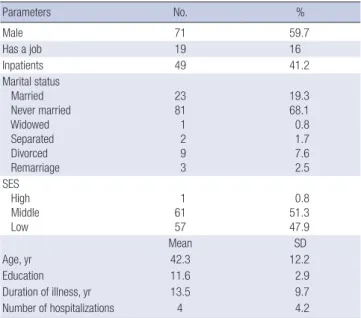
The participants consisted of 119 patients with schizophrenia, recruited in inpatient (n = 49, 41.2%) and outpatient (n = 70, 58.8%) at 3 medical centers (Department of Psychiatry, Catho- lic University of Daegu School of Medicine; Department of Psy- chiatry, Keimyung University Dongsan Medical Center; Depart- ment of Psychiatry, Bugok National Hospital). The patients were diagnosed with schizophrenia using the Korean version of Mini- International Neuropsychiatric Interview (K-MINI) (26). The study group consisted of 71 males (59.7%) and 48 females (40.3%).
Their mean age was 42.15 years (SD = 12.2), their mean dura- tion of illness was 13.4 years (SD = 0.7), and their mean number of episode was 4.02 (SD = 4.28). The exclusion criteria were a mood episode within the past month, substance dependence in the past 6 months, substance abuse in the past month, a his- tory of head injury or neurological disorder, or a clinically severe medical condition. All participants provided written informed consent.
Procedures
Prior to the translation, we obtained permission from the au- thor of the final version CAINS (23) for the translation and stan- dardized study in Korea. The Korean version of the Clinical As-
sessment Interview for Negative Symptoms (K-CAINS) was de- veloped via a forward-backward translation procedure (27).
Two authors of the Korean version who are native speakers of Korean with a high level of fluency in English, independently translated 13 items of the original (English) version of the CAINS.
Both translated versions were compared and after discussing, the first Korean version of the CAINS was obtained. The pre- liminary Korean version was back-translated to English by na- tive English speakers without reference to the CAINS. Finally, the translators compared the back-translated version and origi- nal version of the CAINS and discussed the translation differ- ence. The Korean version of the CAINS was administered to a pilot group of 10 schizophrenia patients to identify any latent problems in translation. After the interview, the patients were asked about each item. The patients demonstrated a good un- derstanding of each item. The final Korean version of the Clini- cal Assessment Interview for Negative Symptoms (K-CAINS) was then completed.
Three clinical raters with medical doctorate degrees and high- ly clinical experienced psychiatrists were trained in the admin- istration of the CAINS interview. Training included an overview of the CAINS, the interview procedure, each item’s anchor point, education regarding the assessment guide and ratings of 5 pa- tient’s videotaped interviews.
The interviews were conducted in two sessions approximately 4 weeks apart (mean = 27.4 days, SD = 3.7). In the first session, the K-CAINS, Positive and Negative Syndrome Scale (PANSS) (9), Scale for the Assessment of Negative Symptoms (SANS) (8), Korean version of Brief Psychiatric Rating Scale (K-BPRS) (28), Korean version of the Calgary Depression Scale for Schizophre- nia (K-CDSS) (29), the Korean version of the Beck Depression inventory (K-BDI) (30), and Modified Simpson Angus Scale (MSAS) (31) were administered to all participants. The CAINS interviews were videotaped, and 51 videos were rated indepen- dently by 2 other raters to evaluate inter-rater reliability. Video- tapes were only used to evaluate inter-rater reliability and were then discarded. In the second session, the K-CAINS and K-BPRS (28) were re-administered to evaluate the test-retest reliability.
Data analysis
Summary for sociodemographic characteristics variables were performed using descriptive analysis, the value of mean ± SD (standard deviation) presented for quantitative variables and the value of frequency (percent) for qualitative variables (Table 1). To assess the internal consistency of the K-CAINS, Cronbach’s α (32) was calculated for both the subscale and total scale. We conducted a confirmatory factor analysis (33) of the CAINS items to confirm that the structure of the K-CAINS was the same as that of the original version of the CAINS using structural equa- tion. To check consistency between measured variables in struc- tural equation, construct reliability was obtained and the value
of > 0.7 indicated good construct reliability. To check accuracy of measured concept in structural equation, construct validity was obtained and the value of the average variance extracted (AVE) > 0.5 indicated good construct validity. To check validity of item discrimination in structural equation, discriminant va- lidity was obtained and the value of the average variance ex- tracted (AVE) > the squared multiple correlation (SMC) indi- cated good discriminant validity (Table 2). Additionally, we cal- culated goodness of fit for model such as χ2, df, NFI, IFI, TLI, CFI, RMSEA, AIC. To assess the inter-rater reliability of 3 raters, the intraclass correlation coefficient (ICC) (34) was calculated.
Convergent validity was assessed by examining the correlation between the K-CAINS and negative symptom scales (SANS and PANSS negative subscale). Discriminant validity was assessed by examining the correlation between the CAINS and the PANSS positive subscale, PANSS general psychopathology subscale (9), Korean version of the Beck Depression inventory (K-BDI) (30), Korean version of the Calgary Depression Scale for Schizophre- nia (K-CDSS) (29), and Modified Simpson Angus Scale (MSAS) (31). All test 2-sided and P value of < 0.05 indicated statistical significance. All statistical analyses were performed using IBM SPSS version 19.0 and IBM SPSS AMOS 19.0.
Ethics statement
This study was approved by the Daegu Catholic University Med- ical Center institutional review board (DCUMC IRB approval No. CR-14-130). Written informed consent was given from all the individual participants.
RESULTS
The confirmative factor analysis was conducted to confirm that the K-CAINS was divided into two subscales, like the original (English) version of the CAINS (Fig. 1). The construct reliability of the motivation/pleasure subscale and the expression sub- scale was 0.883 and 0.891, respectively. Both of these values ex- ceeded 0.7, indicating good construct reliability. The average variance extracted (AVE) of both subscales were 0.802 and 0.858, i.e., more than 0.5, indicating construct validity. Additionally, the AVEs of both subscales were exceeded the SMC value of 0.496, indicating discriminant validity. The values of goodness of fit for model were as follow (χ2 [P] = 212.776 [0.000], df = 64, Table 1. Sociodemographic characteristics of participants with schizophrenia (n = 119)
Parameters No. %
Male 71 59.7
Has a job 19 16
Inpatients 49 41.2
Marital status Married Never married Widowed Separated Divorced Remarriage
23 81 1 2 9 3
19.3 68.1 0.8 1.7 7.6 2.5 SES
High Middle Low
1 61 57
0.8 51.3 47.9
Mean SD
Age, yr 42.3 12.2
Education 11.6 2.9
Duration of illness, yr 13.5 9.7
Number of hospitalizations 4 4.2
Table 2. Confirmatory factor analysis for the K-CAINS items and goodness of fit for model
Measured variables Construct
reliability AVE Correlation coefficient SMC 1. Social: Family Relationships 0.883 0.802 0.704 0.496 2. Social: Friendships
3. Social: Past Week Pleasure 4. Social: Expected Pleasure 5. Work & School: Motivation 6. Work & School: Expected Pleasure 7. Recreation: Motivation
8. Recreation: Past Week Pleasure 9. Recreation: Expected Pleasure
10. Expression: Facial 0.891 0.858 11. Expression: Vocal Prosody
12. Expression: Gestures 13. Expression: Speech
Statistic χ2 (P ) df NFI IFI
Value 212.776
(0.000) 64 0.820 0.867
Statistic TLI CFI RMSEA AIC
Value 0.806 0.863 0.140 292.776
CAINS, Clinical Assessment Interview for Negative Symptoms; AVE, average variance extracted; SMC, squared multiple correlation.
Fig. 1. Figure of structural equation model of K-CAINS.
Motivation
&
pleasure
Expression 0.66
0, 1.24 0, 0.59
1.00
V1CAINS_1 e1
1.66 1 0, 0.72
0, 0.75
0, 0.59
0, 0.51
0, 0.94
0, 0.59
0, 0.62
0, 0.54
0, 0.30
0, 0.31
0, 0.21
0, 0.39
0, 0.50 1
1
1
1
1
1
1
1
1
1
1
1 2.09
2.75
2.92
2.66
3.05
2.31
2.27
2.76
2.01
1.80
1.90
1.14
e2
e3
e4
e5
e6
e7
e8
e9
e10 e11 e12 e13
V1CAINS_2 V1CAINS_3 V1CAINS_4 V1CAINS_5 V1CAINS_6 V1CAINS_7 V1CAINS_8 V1CAINS_9 V1CAINS_10 V1CAINS_11 V1CAINS_12 V1CAINS_13 1.00
1.24 1.28 1.06
0.86 0.73 1.28 1.18
1.00 1.00 0.99 0.67
NFI = 0.820, IFI = 0.867, TLI = 0.806, CFI = 0.863, RMSEA = 0.140, AIC = 292.776) (Table 2). The results of the factor analysis of the K-CAINS were consistent with those of previous studies (23-25) in which two-dimensional structures were extracted.
Cronbach’s α value revealed that the K-CAINS had a good in- ternal consistency in the subscales of ‘motivation/pleasure’
(Cronbach’s α = 0.90) and ‘expression’ (Cronbach’s α = 0.91) as well as in the whole scale (Cronbach’s α = 0.93) (Table 3).
For the 98 participants who completed the K-CAINS in two sessions conducted one month apart, the test-retest reliability for the motivation/pleasure subscale, expression subscales and total scale were 0.89 (P < 0.001), 0.87 (P < 0.001), and 0.90 (P < 0.001) (Table 3), respectively, as measured by Pearson’s correlation r (35). The test-retest reliability of the K-BPRS was 0.92 (P < 0.001), which was similar to the result for the K-CAINS.
Convergent validity was assessed by examining the correla- tions between the K-CAINS scales and the negative symptom subscales of the PANSS, and SANS. Both the motivation/plea- sure subscale and the expression subscale significantly corre- lated with the negative symptom subscale of the PANSS (moti- vation/pleasure: r = 0.657, P < 0.001; expression: r = 0.657, P <
0.001), the SANS total score (motivation/pleasure: r = 0.65, P <
0.001; expression: r = 0.68, P < 0.001) and all subscales, indicat-
ing the good convergent validity of the K-CAINS (Table 4).
Discriminant validity was assessed by examining the correla- tion between the K-CAINS and positive subscale of the PANSS, general psychopathology of the PANSS, K-BDI, K-CDSS, and MSAS. Neither the motivation/pleasure subscale nor the expres- sion subscale significantly correlated with the positive symptoms subscale of the PANSS (motivation/pleasure: r = 0.13, P = 0.15;
expression: r = 0.12, P = 0.19), depression symptoms scale (K- BDI: motivation/pleasure: r = -0.001, P = 0.99; expression: r = -0.12, P = 0.18), (K-CDSS) (motivation/pleasure: r = 0.20, P = 0.21;
expression: r = 0.25, P = 0.11) or medication side effect scale (MSAS) (motivation/pleasure: r = -0.05, P = 0.63; expression:
r = 0.52, P = 0.64), indicating good discriminant validity. Al- though both subscales of the K-CAINS correlated with the gen- eral psychopathology of the PANSS (motivation/pleasure: r = 0.19, P = 0.03; expression: r = 0.52, P = 0.03), the SANS also sig- nificantly correlates with the general psychopathology subscale of the PANSS (r = 0.42, P < 0.001), and this latter correlation is stronger than that of the K-CAINS (Table 4).
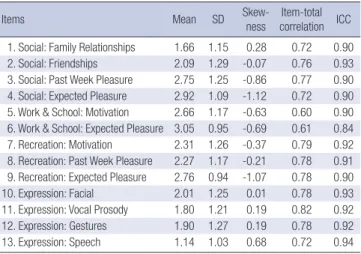
The item-total score correlation ranged from 0.60 to 0.70 in the subscale of motivation/pleasure and from 0.72 to 0.82 in the subscale of expression (Table 5).
The average intraclass correlation coefficient (ICC) between the three raters was 0.96 (P < 0.001) for the CAINS motivation/
pleasure subscale, 0.95 (P < 0.001) for the CAINS expression subscale, and 0.96 (P < 0.001) for the total scale. The ICC for all CAINS items exceeded 0.90 (P < 0.001) (Table 5).
DISCUSSION
The results of the present study demonstrated that the Korean version of the CAINS is valid and reliable. The Korean version of the CAINS (K-CAINS) was also confirmed to be divided into two subscales (motivation/pleasure subscale and expression subscale), in concordance with previous studies (23-25). It show- Table 3. Test-retest (K-CAINS)
Coefficients Test Retest
Mean (SD) 28.2 (10.7) 27.6 (10.4)
Cronbach’s α 0.933 0.926
Pearson correlation (P value) 0.907 (< 0.001)
Intraclass correlation coefficient (P value) 0.951 (< 0.001) CAINS, Clinical Assessment Interview for Negative Symptoms.
Table 4. Convergent validity and discriminant validity of the K-CAINS scale
Measures CAINS motivation/
pleasure subscale CAINS expression subscale Convergent validity
PANSS negative symptoms subscore 0.657† 0.657† SANS
Blunted affect subscore 0.613† 0.806†
Alogia subscore 0.518† 0.569†
Avolition-apathy subscore 0.479† 0.446†
Asociality/anhedonia subscore 0.631† 0.492†
Attention 0.515† 0.459†
Total score 0.656† 0.688†
Discriminant validity PANSS
Positive symptoms subscore 0.133 0.077
General psychopathology subscore 0.194* 0.194*
Beck depression inventory -0.001 -0.123
Calgary Depression Scale for 0.203 0.254
Schizophrenia score
Modified Simpson-Angus Rating Scale -0.054 0.052 CAINS, Clinical Assessment Interview for Negative Symptoms; PANSS, Positive and Negative Syndrome Scale; SANS, Scale for the Assessment of Negative Symptoms.
*P < 0.05; †P < 0.001.
Table 5. Descriptive statistics and inter-rater agreement for K-CAINS items
Items Mean SD Skew-
ness Item-total correlation ICC 1. Social: Family Relationships 1.66 1.15 0.28 0.72 0.90 2. Social: Friendships 2.09 1.29 -0.07 0.76 0.93 3. Social: Past Week Pleasure 2.75 1.25 -0.86 0.77 0.90 4. Social: Expected Pleasure 2.92 1.09 -1.12 0.72 0.90 5. Work & School: Motivation 2.66 1.17 -0.63 0.60 0.90 6. Work & School: Expected Pleasure 3.05 0.95 -0.69 0.61 0.84 7. Recreation: Motivation 2.31 1.26 -0.37 0.79 0.92 8. Recreation: Past Week Pleasure 2.27 1.17 -0.21 0.78 0.91 9. Recreation: Expected Pleasure 2.76 0.94 -1.07 0.78 0.90
10. Expression: Facial 2.01 1.25 0.01 0.78 0.93
11. Expression: Vocal Prosody 1.80 1.21 0.19 0.82 0.92 12. Expression: Gestures 1.90 1.27 0.19 0.78 0.92
13. Expression: Speech 1.14 1.03 0.68 0.72 0.94
CAINS, Clinical Assessment Interview for Negative Symptoms.
ed a high internal consistency in both the motivation/pleasure subscale and expression subscale (Cronbach’s α = 0.90 and 0.91). This finding was similar to that of the original study (23) (Cronbach’s α = 0.76 and 0.88), and the validation study (Cron- bach’s α = 0.85 and 0.90) of the CAINS performed in China (25).
In addition, the K-CAINS showed a high internal consistency in item-total correlation (0.60-0.82), which was similar to the re- sults of the validation study of the CAINS performed in China (0.50-0.79).
The scores were similar between the three tested institutions and between the test and retest, which were conducted one month apart. This similarity was more pronounced than that reported in previous studies. We attribute this similarity to our familiarity with the existing study, which sufficiently discussed before the research was carried out.
The Korean Version of the CAINS (K-CAINS) showed high convergent validity with scales evaluating the negative symp- toms (each subscale of the SANS and the total and negative symp- toms subscale of the PANSS). In addition, K-CAINS showed good discriminant validity, as indicated by a no significant cor- relation with scales that evaluate positive symptoms, depressive symptoms, and side effects of medication. Additionally, the Ko- rean version of the CAINS (K-CAINS) was also confirmed to be effectively divided into two subscales like the final version of the CAINS (23), as indicated by a confirmatory factor analysis that utilized the structural equation.
The original study only assessed outpatients (23). In the pres- ent study, inpatients were included to demonstrate the availabil- ity of K-CAINS in different circumstances and in patients who have relatively severe psychotic symptoms. In fact, we found that the inpatient groups had more severe psychotic symptoms, as indicated by significantly higher scores than the PANSS total score (82.78 vs. 57.84, P < 0.05), positive symptoms subscale (20.22 vs. 11.97, P < 0.001), and general psychopathology (42.41 vs. 27.53, P < 0.05) of outpatients. However, the PANSS negative symptoms subscale did not significantly differ between these groups. In other words, the present study demonstrated the va- lidity and reliability of the CAINS, even in a population (inpa- tient group) that is different from those examined in the original study.
In the correlation analysis to evaluate the discriminant valid- ity of the CAINS, only the CAINS and the general psychopathol- ogy subscale of the PANSS showed significant correlation. How- ever, the SANS also significantly correlates with the general psy- chopathology subscale of the PANSS, and this correlation is stronger than that of the CAINS. A previous validation study of the Chinese version of the CAINS showed similar results to those of the present study but demonstrated a stronger correlation than that observed in the present study (motivation/pleasure r = 0.466, P < 0.01; expression r = 0.527, P < 0.01). We postulate that this result is due to the wide range of conditions that are in-
cluded in the PANSS general psychopathology subscale. More- over, some items of general psychopathology subscale of the PANSS (‘motor retardation’, ‘disturbance of volition’, ‘active so- cial avoidance’) were conceptually closer to negative symptoms.
In the CAINS evaluation, evaluating the expression subscale can be considered more subjective than evaluating the motiva- tion/pleasure subscale because the expression subscale is only assessed by the rater’s observation during interview, whereas the motivation/pleasure subscale consists of specific questions to the patients. However, the current study showed a high de- gree of coincidence between raters in both the expression sub- scale and motivation/pleasure subscale, which suggests that the CAINS is not subject to this potential limitation.
In this study, the original study (23), studies performed in Germany (24) and studies performed in China (25), drug histo- ry, such as the type of drug or drug response were not investi- gated. In future studies, the validity and reliability of the K-CAINS needs to be proven in patient groups divided according to drug history (taking or not taking drugs and the response to treatment).
In this study, the condition of subjects may have changed in the time interval between the examination and re-examination, which was one month and longer than the two-week intervals reported in a previous study (23). However, the BPRS and CAINS motivation/pleasure subscale and expression subscale did not significantly differ upon test-retesting, as examined by a paired t-test; in other words, symptoms remained relatively stable over a period of one month. Composition of the subjects might ex- plain this finding as over half of the subjects were chronic out- patients. Furthermore, in the case of hospitalized patients (n = 49), most subjects (n = 40) were chronic patients hospitalized for long periods at the national hospital. Therefore, the patients like- ly remained relatively stable with no change in their condition.
The CAINS provides a clear and comprehensive measure- ment and has the advantages that the distinction of anchor points and evaluation of each item are easy. In addition, negative symp- toms can be distinguished from depressive symptoms and drug side effects. This multi-center study demonstrates that the Ko- rean version of the Clinical Assessment Interview for Negative Symptoms (K-CAINS) is reliable and valid. Thus, K-CAINS could be a useful tool for the diagnosis, treatment, and clinical study of schizophrenia in Korea.
ACKNOWLEDGMENT
The authors thank Dae-Hee Lee for data collection and man- agement.
DISCLOSURE
The authors have no potential conflicts of interest to disclose.
AUTHOR CONTRIBUTION
Study concept and coordination: Woo JM. Study design: Woo JM, Jung SI. Data collection: Woo JM, Kim YT, Jung SI. Analysis and interpretation of data: Kwak SG, Jung SI, Woo JM. Writing manuscript: Jung SI, Woo JM. Discussion and manuscript revi- sion: Woo JM, Kim YT, Jung SI.
ORCID
Sung Il Jung http://orcid.org/0000-0001-9619-2470 Jungmin Woo http://orcid.org/0000-0001-7180-9972 Yang-Tae Kim http://orcid.org/0000-0002-1609-6807 Sang Gyu Kwak http://orcid.org/0000-0003-0398-5514 REFERENCES
1. Buchanan RW, Kreyenbuhl J, Kelly DL, Noel JM, Boggs DL, Fischer BA, Himelhoch S, Fang B, Peterson E, Aquino PR, et al. The 2009 schizophre- nia PORT psychopharmacological treatment recommendations and sum- mary statements. Schizophr Bull 2010; 36: 71-93.
2. Kirkpatrick B, Kopelowicz A, Buchanan RW, Carpenter WT Jr. Assessing the efficacy of treatments for the deficit syndrome of schizophrenia. Neu
ropsychopharmacology 2000; 22: 303-10.
3. Strauss GP, Harrow M, Grossman LS, Rosen C. Periods of recovery in def- icit syndrome schizophrenia: a 20-year multi-follow-up longitudinal study.
Schizophr Bull 2010; 36: 788-99.
4. Provencher HL, Mueser KT. Positive and negative symptom behaviors and caregiver burden in the relatives of persons with schizophrenia. Schi
zophr Res 1997; 26: 71-80.
5. Murphy BP, Chung YC, Park TW, McGorry PD. Pharmacological treat- ment of primary negative symptoms in schizophrenia: a systematic re- view. Schizophr Res 2006; 88: 5-25.
6. Montgomery SA, van Zwieten-Boot B. ECNP consensus meeting. Nega- tive, depressive and cognitive symptoms of schizophrenia. Nice, March 2004. Eur Neuropsychopharmacol 2007; 17: 70-7.
7. Newcomer JW, Faustman WO, Yeh W, Csernansky JG. Distinguishing de- pression and negative symptoms in unmedicated patients with schizo- phrenia. Psychiatry Res 1990; 31: 243-50.
8. Andreasen NC. The scale for the assessment of negative symptoms (SANS):
conceptual and theoretical foundations. Br J Psychiatry Suppl 1989: 49- 58.
9. Kay SR, Fiszbein A, Opler LA. The positive and negative syndrome scale (PANSS) for schizophrenia. Schizophr Bull 1987; 13: 261-76.
10. Endicott J, Spitzer RL. A diagnostic interview: the schedule for affective disorders and schizophrenia. Arch Gen Psychiatry 1978; 35: 837-44.
11. Kirkpatrick B, Buchanan RW, McKenney PD, Alphs LD, Carpenter WT Jr.
The schedule for the deficit syndrome: an instrument for research in schi- zophrenia. Psychiatry Res 1989; 30: 119-23.
12. Blanchard JJ, Kring AM, Horan WP, Gur R. Toward the next generation of negative symptom assessments: the collaboration to advance negative symptom assessment in schizophrenia. Schizophr Bull 2011; 37: 291-9.
13. Horan WP, Kring AM, Blanchard JJ. Anhedonia in schizophrenia: a review
of assessment strategies. Schizophr Bull 2006; 32: 259-73.
14. Sayers SL, Curran PJ, Mueser KT. Factor structure and construct validity of the scale for the assessment of negative symptoms. Psychol Assess 1996;
8: 269-80.
15. White L, Harvey PD, Opler L, Lindenmayer JP; The PANSS Study Group.
Empirical assessment of the factorial structure of clinical symptoms in schizophrenia. A multisite, multimodel evaluation of the factorial struc- ture of the positive and negative syndrome scale. Psychopathology 1997;
30: 263-74.
16. van der Gaag M, Cuijpers A, Hoffman T, Remijsen M, Hijman R, de Haan L, van Meijel B, van Harten PN, Valmaggia L, de Hert M. The five-factor model of the positive and negative syndrome scale I: confirmatory factor analysis fails to confirm 25 published five-factor solutions. Schizophr Res 2006; 85: 273-9.
17. Harvey PD, Koren D, Reichenberg A, Bowie CR. Negative symptoms and cognitive deficits: what is the nature of their relationship? Schizophr Bull 2006; 32: 250-8.
18. Bellack AS, Sayers M, Mueser KT, Bennett M. Evaluation of social prob- lem solving in schizophrenia. J Abnorm Psychol 1994; 103: 371-8.
19. Strauss GP, Horan WP, Kirkpatrick B, Fischer BA, Keller WR, Miski P, Bu- chanan RW, Green MF, Carpenter WT Jr. Deconstructing negative symp- toms of schizophrenia: avolition-apathy and diminished expression clus- ters predict clinical presentation and functional outcome. J Psychiatr Res 2013; 47: 783-90.
20. Blanchard JJ, Cohen AS. The structure of negative symptoms within schi- zophrenia: implications for assessment. Schizophr Bull 2006; 32: 238-45.
21. Kirkpatrick B, Fenton WS, Carpenter WT Jr, Marder SR. The NIMH-MAT- RICS consensus statement on negative symptoms. Schizophr Bull 2006;
32: 214-9.
22. Horan WP, Kring AM, Gur RE, Reise SP, Blanchard JJ. Development and psychometric validation of the clinical assessment interview for negative symptoms (CAINS). Schizophr Res 2011; 132: 140-5.
23. Kring AM, Gur RE, Blanchard JJ, Horan WP, Reise SP. The clinical assess- ment interview for negative symptoms (CAINS): final development and validation. Am J Psychiatry 2013; 170: 165-72.
24. Engel M, Fritzsche A, Lincoln TM. Validation of the German version of the clinical assessment interview for negative symptoms (CAINS). Psy
chiatry Res 2014; 220: 659-63.
25. Chan RC, Shi C, Lui SS, Ho KK, Hung KS, Lam JW, Wang Y, Cheung EF, Yu X. Validation of the Chinese version of the clinical assessment interview for negative symptoms (CAINS): a preliminary report. Front Psychol 2015;
6: 7.
26. Yu SW, Kim YS, Noh JS, Oh KS, Kim CH, Namkoong K, Chae JH, Lee GC, Jeon SI, Min KJ, et al. Validity of Korean version of the mini-international neuropsychiatric interview. Anxiety Mood 2006; 2: 50-5.
27. Koller M, Aaronson NK, Blazeby J, Bottomley A, Dewolf L, Fayers P, John- son C, Ramage J, Scott N, West K; EORTC Quality of Life Group. Transla- tion procedures for standardised quality of life questionnaires: the Euro- pean organisation for research and treatment of cancer (EORTC) approach.
Eur J Cancer 2007; 43: 1810-20.
28. Kim MK, Lee BK, Jeon YW. Reliability of Korean brief psychiatric rating scale (BPRS): comparison of interrater reliability between the two rating methods and correlation of BPRS and SCL-90 self-report test. Korean J Clin Psychol 2003; 22: 685-98.
29. Kim YK, Won SD, Lee KM, Choi HS, Jang HS, Lee BH, Han CS. A study on
the reliability and validity of the Korean version of the Calgary depression scale for schizophrenia (K-CDSS). J Korean Neuropsychiatr Assoc 2005;
44: 446-55.
30. Han HM, Yeom TH, Shin YW, Kim KH, Yoon DJ, Chung KJ. A standard- ization study of Beck depression inventory in Korea. J Korean Neuropsy
chiatr Assoc 1986; 25: 487-500.
31. Simpson GM, Angus JW. A rating scale for extrapyramidal side effects.
Acta Psychiatr Scand 1970; 45: 11-9.
32. Zinbarg RE, Revelle W, Yovel I, Li W. Cronbach’s α, Revelle’s β, and Mc- Donald’s ω H: their relations with each other and two alternative concep-
tualizations of reliability. Psychometrika 2005; 70: 123-33.
33. Thompson B. Exploratory and Confirmatory Factor Analysis: Understand- ing Concepts and Applications. Washington, D.C.: American Psychologi- cal Association, 2004.
34. Shrout PE, Fleiss JL. Intraclass correlations: uses in assessing rater reliabil- ity. Psychol Bull 1979; 86: 420-8.
35. Ahlgren P, Jarneving B, Rousseau R. Requirements for a cocitation simi- larity measure, with special reference to Pearson’s correlation coefficient.
J Am Soc Inf Sci Technol 2003; 54: 550-60.