Prevention of Postsurgical Scars: Comparsion of Efficacy and Convenience between Silicone Gel Sheet and Topical Silicone Gel
To date, few studies have compared the effectiveness of topical silicone gels versus that of silicone gel sheets in preventing scars. In this prospective study, we compared the efficacy and the convenience of use of the 2 products. We enrolled 30 patients who had undergone a surgical procedure 2 weeks to 3 months before joining the study. These participants were randomly assigned to 2 treatment arms: one for treatment with a silicone gel sheet, and the other for treatment with a topical silicone gel. Vancouver Scar Scale (VSS) scores were obtained for all patients; in addition, participants completed scoring patient questionnaires 1 and 3 months after treatment onset. Our results reveal not only that no significant difference in efficacy exists between the 2 products but also that topical silicone gels are more convenient to use. While previous studies have advocated for silicone gel sheets as first-line therapies in postoperative scar management, we maintain that similar effects can be expected with topical silicone gel. The authors recommend that, when clinicians have a choice of silicone-based products for scar prevention, they should focus on each patient’s scar location, lifestyle, and willingness to undergo scar prevention treatment.
Keywords: Cicatrix; Postoperative Period; Wounds and Injuries; Prevention and Control Sue-Min Kim, Jung-Sik Choi,
Jung-Ho Lee, Young-Jin Kim, and Young-Joon Jun
Department of Plastic & Reconstructive Surgery, Bucheon St. Mary’s Hospital, The Catholic University of Korea, Bucheon, Korea
Received: 6 June 2014 Accepted: 28 July 2014 Address for Correspondence:
Young-Joon Jun, MD
Department of Plastic and Reconstructive Surgery, The Catholic University of Korea, Bucheon St. Mary’s Hospital, 327 Sosa-ro 327-beon-gil, Wonmi-gu, Bucheon 420-717, Korea Tel: +82.32-340-7062, Fax: +82.32-340-7062 E-mail: [email protected]
http://dx.doi.org/10.3346/jkms.2014.29.S3.S249 • J Korean Med Sci 2014; 29: S249-253
INTRODUCTION
Silicone-based products are widely used to limit pathologic scars. Using these products is cost- and time-effective, as well as more convenient and comfortable for patients. To date, a substantial number of studies have assessed the efficacy of these products in preventing scars, but have reached no defini- tive conclusions. However, in certain randomized, controlled studies, these products were significantly effective in reducing postoperative incision wound scarring (1-4). Currently, several types of silicone-based products are available for clinical use (5). Of these, silicone gel sheets and topical silicone gels are the most popular forms (5-7). However, both have known limita- tions and can be inconvenient for patients to use, thus posing a risk of to misuse or treatment interruption. Specifically, silicone gel sheets are disadvantageous because they cannot be applied to mobile or visible areas of the body, and require additional taping or bandaging (3, 4). Moreover, the sheets cannot achieve and maintain adequate contact with scars when applied to the skin with an irregular contour (3). On the other hand, topical silicone gels take time to completely dry (4). Furthermore, pa- tients have to take extra sunsceen precautions to prevent hy- perpigmentation, and must also apply topical silicone gels to scars multiple times per day (4, 8). Few studies have compared
the effectiveness of topical silicone gels to that of silicone gel sheets in surgical scar prevention. Consequently, we conducted this prospective study to examine both the efficacy and the con- venience of each product.
MATERIALS AND METHODS Patients and study design
This study enrolled 30 patients between January and November 2012. Participant inclusion criteria were as follows:
1) History of surgery 2 weeks to 3 months before enrollment 2) Scarring of a surface area < 10 × 10 cm2
3) Age 18 yr or older
Exclusion criteria were as follows:
1) Any infection
2) Any wound producing a significant amount of discharge, e.g., still requiring a dressing 2 weeks after surgery or lack- ing visible signs of normal epithelialization
3) Any systemic disease (e.g., diabetes mellitus, hematologic disorder, or dermatologic disorder)
4) Use of anticancer, psychiatric, or steroid medication 5) Psychiatric disorder
6) Deemed unable to complete the study according to the judgment of the authors.
Evaluation criteria and outcome measures
All patients were randomly assigned to and equally distributed between 2 treatment arms (treatment with either a silicone gel
sheet [ScarclinicTM-Thin, Hans Biomed, Seoul, Korea] or a topi- cal silicone gel [Kelo-CoteTM, SejongMedix, Seoul, Korea]). The arms were categorized as Group I (n = 15) and II (n = 15), re- spectively. First, patients’ scars were photographed and evalu- ated using the Vancouver Scar Scale (VSS), for which their vas- cularity, pigmentation, pliability, height, pain, and itchiness were measured as outcomes (Table 1) (6, 9). The aforementioned evaluation was performed by 2 independent observers. We also recorded patients’ questionnaire responses about any scar-re- lated pain, pruritus, color change, hardness, thickness, overall size, irregularity, and inconvenience of use they experienced, and scored them using a 10-point scale (Table 2). Then, we eval- uated the VSS scores and patient questionnaire scores at 1 and 3 months and compared them with the baseline measurements.
Table 1. Vancouver Scar Scale
Feature Score
Vascularity Normal Pink Red Purple
0 1 2 3 P igmenta-
tion
Normal Hypo-pigmentation Mixed-pigmentation Hyper-pigmentation
0 1 2 3 P liability
(Elasticity) Normal
Supple (flexible with minimal resistance) Yielding (giving way to pressure)
Firm (inflexible, not easily moved, resistant to manual pressure) Banding (rope-like tissue that blanches with extension of the scar) Contracture (permanent shortening of scar, producing deformity or distortion)
0 1 2 3 4 5 Height Flat
< 2 mm 2-5 mm
> 5 mm
0 1 2 3
Pain None
Occasional Requires medication
0 1 2 Itchiness None
Occasional Requires medication
0 1 2
Table 2. Patient questionnaire
Yes 1 2 3 4 5 6 7 8 9 10 No
Improved Aggravated
1 Do you have any pain on your scar?
2 Is there any pururitus on your scar?
3 Do you see any change of color on your scar?
4 Do you feel your scar getting hardened?
5 Does your scar get thicker or increase in size?
6 Does your scar change into irregular shape?
7 Was it uncomfortable to use?
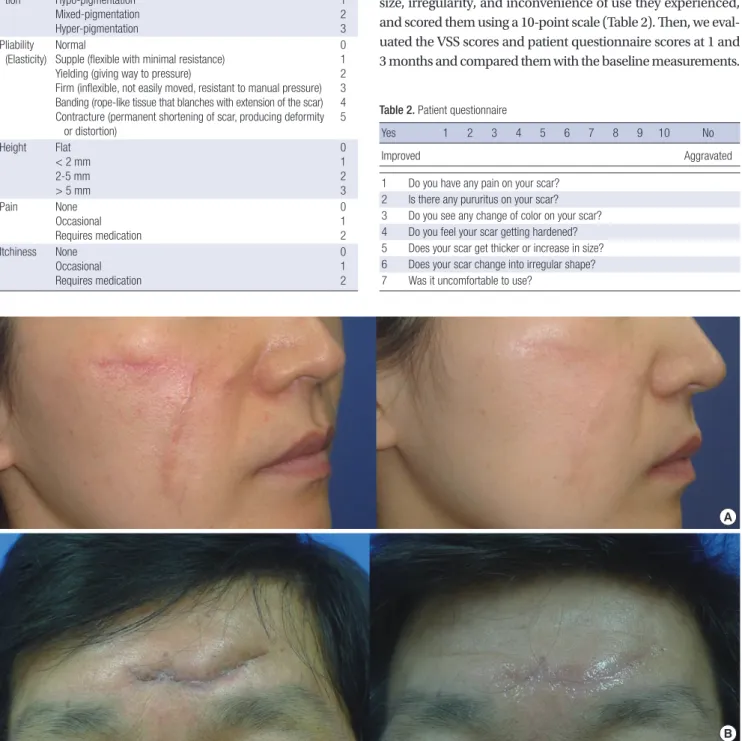
Fig. 1. (A) Before and after views of silicone gel sheet use in scar management. The scar has improved in its vascularity, irregularity, and height after 3 months of treatment. (B) Before and after views of topical silicone gel use in scar management. The scar has improved in its pigmentation, irregularity, and height after 3 months of treatment.
A
B
Statistical analysis
Statistical analysis was performed using SPSS version 16.0 for Windows (SPSS, Inc., Chicago, IL, USA). All data were express- ed as mean ± standard deviation (SD). We used the Mann-Whit- ney test to compare outcome measures between the two groups.
A P value of < 0.05 was considered statistically significant.
Ethics statement
This study was approved by the institutional review board (IRB) of our medical institution (IRB approval number: HC11DSSI0091).
All patients were informed of the study details (e.g., objectives, methods, predicted outcomes, adverse effects, and study devi- ces), and submitted a signed informed consent document.
RESULTS
Baseline and clinical characteristics of the patients We enrolled 30 patients (n = 30) in our study. Of these, 5 dropped out for personal reasons; therefore, 11 patients in Group I and
14 in Group II completed the study. These participants includ- ed 9 male and 16 female patients with a mean age of 37.52 yr (total range, 21-75 yr). When recording scar location, we observ- ed 17, 7, and 1 patients with scars in the head and neck region, in the extremities, and in the trunk, respectively. All patients demonstrated tolerability for the treatment; none experienced specific clinical problems. By the conclusion of the study peri- od, all patients’ scars had improved in terms of pigmentation, height, irregularity, and overall size (Fig. 1).
Changes from baseline in VSS scores at 1 and 3 months after treatment onset
At 1 month after treatment onset, we observed a degree of pain score change of -0.455 points in Group I and 0.143 points in Group II. This difference reached statistical significance (P = 0.033). However, with the exception of the pain score, as shown in Fig. 2, no significant differences were observed between ei- ther group in either their VSS scores by outcome measure or their total scores at 1 and 3 months from baseline.
Fig. 2. (A) Changes from the baseline in VSS scores at 1 month after treatment onset. (B) Changes from the baseline in VSS scores at 3 months after treatment onset. VSS, vancouver scar scale.
1 0.5 0 -0.5 -1 -1.5 -2 -2.5 -3 -3.5 -4 -4.5 -5
VascularityPigmenta
tionPliability Height Pain
Itchiness Total
Silicone gel sheet
Topical silicone gel 1
0.5 0 -0.5 -1 -1.5 -2 -2.5 -3 -3.5 -4 -4.5 -5
VascularityPigmenta
tionPliability Height Pain
Itchiness Total
Silicone gel sheet Topical silicone gel
A B
Fig. 3. (A) Changes from the baseline in patient questionnaire response scores at 1 month after treatment onset. (B) Changes from the baseline in patient questionnaire response scores at 3 months after treatment onset.
A B
1 0.5 0 -0.5 -1 -1.5 -2 -2.5 -3 -3.5 -4 -4.5 -5
Silicone gel sheet Topical silicone gel
1 0.5 0 -0.5 -1 -1.5 -2 -2.5 -3 -3.5 -4 -4.5 -5
Silicone gel sheet Topical silicone gel
Pain Pruritus
Color change Hardness Thickness and size
Irregularity
Pain Pruritus
Color change Hardness Thickness and size
Irregularity
Changes from baseline in patient questionnaire response scoring at 1 and 3 months after treatment onset
At 3 months after treatment onset, questionnaire response scores for inconvenience of use were 3.818 points in Group I and 1.571 points in Group II. This difference also reached statistical sig- nificance (P = 0.015). However, no significant differences be- tween the groups were seen in any other outcome measures at 1 or 3 months from baseline (Fig. 3).
DISCUSSION
Several treatment and prevention methods for surgical scarring are available today. These include intralesional corticosteroids;
5-fluorouracil; bleomycin; cryotherapy; silicone gel; pressure therapy; pulsed dye laser treatment; radiation; and surgical cor- rection (10-12). Emerging scar-reducing therapies include the TGF-β superfamily; COX-2 inhibitors and nonsteroidal anti-in- flammatory drugs; collagen synthesis inhibitors; angiotensin- converting enzyme inhibitors; minocycline; and gene therapy (11). Among these methods, silicone has typically been consid- ered the standard noninvasive approach (13).
Since the early 1980s, silicone has been described as having potential effectiveness in treating pathological scars (14). To- day, it is considered a conventional scar treatment approach (15-17). Indeed, a number of studies have assessed silicone’s efficacy in preventing scar formation during the postoperative period (1-4); it is frequently used after surgery because it is both non-invasive and causes few adverse effects (8, 16). However, a matter of controversy is whether silicone is truly effective in scar prevention (1, 18).
Various mechanisms have been proposed as possible modes of action for silicone materials. These hypotheses include incre- ased temperature or oxygen tension, direct action of silicone oil, wound hydration, polarization of scar tissue caused by neg- ative static charge and modulation of growth factors (7, 9, 10, 13). Silicone has been produced in several forms, including sili- cone cream compounds; silicone oil or gel, with additives such as Vitamin E; in combination with other dressing materials, and as custom-made silicone applications (18). Among these for- mats, silicone gel sheets are the most widely used; however, pa- tients’ compliance with silicone gel sheet use is not always sat- isfactory. The silicone gel sheets are inconvenient for patients to apply to large mobile areas, such as the area near the joints, and are generally not appropriate to use on visible areas like the face (3). Taping or bandaging is required to secure the silicone gel sheet to the scar, which may cause irritation in patients with pliable skin, particularly the elderly and the young (4). More- over, silicone gel sheets may also cause excessive sweating in hot and humid climates (4). They must be washed carefully to prevent infections and other complications (3). All of the above factors often lead to interruption of gel sheet treatment. Topical
silicone gels, by contrast, are available in a tube, and can be ap- plied in a thin layer on the skin. They form a flexible, gas-per- meable and invisible film on the scar (4); they may also be spread on the scar and will dry up within a period of several minutes, allowing patients to then wear clothes or apply makeup. In ad- dition, topical silicone gels are advantageous in that they require no fixation materials. At the same time, these gels do pose dis- advantages: they must be used in combination with sunscreen to prevent hyperpigmentation and must also be applied multi- ple times each day (8). Patients must also be sure that gel applied to parts of the body covered by clothing have dried completely before they get dressed; failure to do so may result in friction that removes the silicone film too early (4). Finally, these gels cannot be applied to the periocular or perioral area, particularly in younger patients.
Karagoz et al. (8) compared the efficacy of a topical silicone gel, a silicone gel sheet and a topical onion extract in treating postburn hypertrophic scars, and reported that the two silicone based-products were more effective than the onion extract. The authors also found no significant difference in the effectiveness of the two silicone-based products in treating hypertrophic scars.
However, they did conclude that silicone gel sheets are the pref- erable method of treatment. This is not only because the degree of treatment response was relatively higher in the silicone gel sheet group but also because 1 patient in their study showed no response to the topical silicone gel. In addition, Mustoe et al. (15) also deemed silicone gel sheets worthy of consideration as a first- line of therapy for scar prevention.
It was the objective of our study to compare both efficacy and convenience of use in silicone gel sheets and topical silicone gels as surgical scar preventives. Between our two groups, we found no statistically significant differences in either VSS or ques- tionnaire response scores at 1 or 3 months after treatment on- set. The only significant difference observed was the degree of change in VSS pain scores at 1 month. While we assume the sil- icone gel sheet offers a greater degree of stability and protection in the early stages of scar formation, we could find no statistical- ly significant difference in the degree of VSS pain score changes at 3 months after treatment onset. Meanwhile, the patient ques- tionnaire inconvenience of use score was higher in our silicone gel sheet group at 3 months after treatment onset. This means that convenience of use proved greater in the topical silicone gel group. Our results prove that topical silicone gel is as effec- tive as silicone gel sheet for preventing surgical scars and that it is also easier to use.
Our study did face several limitations. Although scar matura- tion can continue for up to a year after surgery, we followed scar progression for only 3 months. Previous studies that evaluated the efficacy of silicone gel in scar management also typically followed scar progression for a 2- to 4-month period (4, 19-21).
We believe this is because many clinicians regard that the early
stage of scar remodeling is the time of greatest change. An ad- ditional limitation was that our study population was small and consisted solely of Korean patients. Finally, when using the sili- cone gel sheet, patients who also used tape or bandaging to se- cure the sheet in arbitrary fashion may have influenced the pig- mentation of their scars.
In conclusion, numerous silicone-based products are used in modern management of postoperative scars. Clinicians should select products for each patient while considering both their ef- ficacy and convenience of use. Scar management is an ongoing process over a course of at least 3 to 6 months. It is therefore es- sential to ensure patient compliance throughout the treatment process. Consequently, clinicians must also carefully weigh the characteristics, lifestyle, and compliance likelihood of each pa- tient, as well as the location of their scars, in choosing the appro- priate management modality. In our study, we have demon- strated that there is no significant difference in the degree of ef- ficacy between either silicone-based product types; at the same time, our results indicate that topical silicone gels are more con- venient for patients to use than silicone gel sheets. While previ- ous studies have advocated for silicone gel sheets as first-line therapies in postoperative scar management, we maintain that similar effects can be expected with topical silicone gel. Further long-term, large-scale, prospective controlled studies are likely warranted to confirm our findings.
DISCLOSURE
There are no conflict of interest statements.
ORCID
Sue Min Kim http://orcid.org/0000-0002-0894-5207 Jung-Sik Choi http://orcid.org/0000-0002-9603-8235 Jung Ho Lee http://orcid.org/0000-0002-3800-5494 Young Jin Kim http://orcid.org/0000-0002-9046-9907 Young Joon Jun http://orcid.org/0000-0002-2678-9092
REFERENCES
1. Ahn ST, Monafo WW, Mustoe TA. Topical silicone gel for the prevention and treatment of hypertrophic scar. Arch Surg 1991; 126: 499-504.
2. Cruz-Korchin NI. Effectiveness of silicone sheets in the prevention of hy- pertrophic breast scars. Ann Plast Surg 1996; 37: 345-8.
3. Mustoe TA. Evolution of silicone therapy and mechanism of action in scar management. Aesthetic Plast Surg 2008; 32: 82-92.
4. Signorini M, Clementoni MT. Clinical evaluation of a new self-drying silicone gel in the treatment of scars: a preliminary report. Aesthetic Plast Surg 2007; 31: 183-7.
5. Gimble J, Guilak F. Adipose-derived adult stem cells: isolation, charac- terization, and differentiation potential. Cytotherapy 2003; 5: 362-9.
6. Bae SH, Bae YC. Analysis of frequency of use of different scar assessment scales based on the scar condition and treatment method. Arch Plast Surg 2014; 41: 111-5.
7. Ko WJ, Na YC, Suh BS, Kim HA, Heo WH, Choi GH, Lee SU. The effects of topical agent (kelo-cote or contractubex) massage on the thickness of post-burn scar tissue formed in rats. Arch Plast Surg 2013; 40: 697-704.
8. Karagoz H, Yuksel F, Ulkur E, Evinc R. Comparison of efficacy of silicone gel, silicone gel sheeting, and topical onion extract including heparin and allantoin for the treatment of postburn hypertrophic scars. Burns 2009;
35: 1097-103.
9. Di Rocco G, Gentile A, Antonini A, Ceradini F, Wu JC, Capogrossi MC, Toietta G. Enhanced healing of diabetic wounds by topical administra- tion of adipose tissue-derived stromal cells overexpressing stromal-de- rived factor-1: biodistribution and engraftment analysis by biolumines- cent imaging. Stem Cells Int 2010; 2011: 304562.
10. Shih R, Waltzman J, Evans GR; Plastic Surgery Educational Foundation Technology Assessment Committee. Review of over-the-counter topical scar treatment products. Plast Reconstr Surg 2007; 119: 1091-5.
11. Reish RG, Eriksson E. Scars: a review of emerging and currently available therapies. Plast Reconstr Surg 2008; 122: 1068-78.
12. Stavrou D, Weissman O, Winkler E, Yankelson L, Millet E, Mushin OP, Liran A, Haik J. Silicone-based scar therapy: a review of the literature. Aes- thetic Plast Surg 2010; 34: 646-51.
13. Berman B, Perez OA, Konda S, Kohut BE, Viera MH, Delgado S, Zell D, Li Q. A review of the biologic effects, clinical efficacy, and safety of silicone elastomer sheeting for hypertrophic and keloid scar treatment and man- agement. Dermatol Surg 2007; 33: 1291-302; discussion 302-3.
14. Perkins K, Davey RB, Wallis KA. Silicone gel: a new treatment for burn scars and contractures. Burns Incl Therm Inj 1983; 9: 201-4.
15. Mustoe TA, Cooter RD, Gold MH, Hobbs FD, Ramelet AA, Shakespeare PG, Stella M, Téot L, Wood FM, Ziegler UE, et al. International clinical recommendations on scar management. Plast Reconstr Surg 2002; 110:
560-71.
16. Kim SW, Kim DY, Oh DY, Lee JH, Rhie JW, Ahn ST, Yoon JH. Use of a sil- icone gel sheet vaginal mold in McIndoe vaginoplasty. Arch Plast Surg 2013; 40: 652-5.
17. Martins-Mendes D, Monteiro-Soares M, Boyko EJ, Ribeiro M, Barata P, Lima J, Soares R. The independent contribution of diabetic foot ulcer on lower extremity amputation and mortality risk. J Diabetes Complications 2014; 28: 632-8.
18. O’Brien L, Pandit A. Silicon gel sheeting for preventing and treating hy- pertrophic and keloid scars. Cochrane Database Syst Rev 2006: CD003826.
19. Chan KY, Lau CL, Adeeb SM, Somasundaram S, Nasir-Zahari M. A ran- domized, placebo-controlled, double-blind, prospective clinical trial of silicone gel in prevention of hypertrophic scar development in median sternotomy wound. Plast Reconstr Surg 2005; 116: 1013-20; discussion 21-2.
20. Chernoff WG, Cramer H, Su-Huang S. The efficacy of topical silicone gel elastomers in the treatment of hypertrophic scars, keloid scars, and post- laser exfoliation erythema. Aesthetic Plast Surg 2007; 31: 495-500.
21. Murison M, James W. Preliminary evaluation of the efficacy of dermatix silicone gel in the reduction of scar elevation and pigmentation. J Plast Reconstr Aesthet Surg 2006; 59: 437-9.