Received: May 19, 2018 Revised: July 1, 2018 Accepted: July 4, 2018
Correspondence to: Jae Sim Jeong, Department of Clinical Nursing, Graduate School of Industry, University of Ulsan, 88 Olympic-ro 43-gil, Songpa-gu, Seoul 05505, Korea Tel: 02-3010-5311, Fax: 02-3010-5332
E-mail: [email protected]
국내 조혈모세포이식센터의 감염관리
박선매1,2ㆍ정재심1ㆍ김미나3ㆍ최상호4
울산대학교 산업대학원 임상전문간호학1, 서울아산병원 간호부2,
울산대학교 의과대학 서울아산병원 진단검사의학교실3, 감염내과학교실4
Infection Control at Hematopoietic Cell Transplantation Centers in Korea
Sun Mae Park1,2, Jae Sim Jeong1, Mi Na Kim3, Sang Ho Choi4
Department of Clinical Nursing, Graduate School of Industry, University of Ulsan1, Seoul,
Department of Nursing, Asan Medical Center2, Seoul, Departments of Laboratory Medicine3, Infectious Diseases4, Asan Medical Center, University of Ulsan College of Medicine, Seoul, Korea
Background: The purpose of this study is to identify the current state of infection control practice at Hematopoietic Cell Transplantation (HCT) centers in Korea and to prepare effective standardized infection control guidelines.
Methods: From September to October 2011, 32 HCT centers received questionnaires after consenting to participate in the study. The questionnaire consisted of 17 questions; six about general characteristics of HCT centers and 11 about infection control practices.
Results: The response rate was 93.8% (30/32) while the HEPA filter performance in isolation room was 100 class (100%).
Visitors were limited to one or two people in most centers. Protective clothing for healthcare personnel comprised sterile gowns, gloves and masks at around 50%. Daily bathing was the most common skin care practice (53.6%) in allogeneic HCT and 46.7% in autologous HCT in. Most of the oral gargling solutions (including normal saline, sodium bicarbonate solution, and chlorhexidine), supported tooth brushing. Peripheral and central venous catheter insertion and dressing replacement cycle were shorter than those of general patients. The disinfectant used for venous catheter insertion and dressing exchange used more betadine. Most of the patients' diets were sterile.
Conclusion: Infection control of the HCT centers in Korea varied from each center. Generally, there is no difference between allogeneic and autologous HCT in infection control practices, except in some detailed categories.
Keywords: Guideline, Hematopoietic Cell Transplantation, Infection Control, Infection
Introduction
1. 연구 배경 및 목적
조혈모세포이식은 해마다 전 세계적으로 약
40,000건의 이식이 시행되고 있으며[1], 국내에서 도 1983년에 처음 동종골수이식을 시작으로 2009 년 12월 말까지 총 14,075건으로 지속적으로 증 가하여 2009년에는 37개의 이식센터에서 조혈모 세포이식을 시행하고 있다[2].
조혈모세포이식 시에는 호중구 감소기간 중에 발생한 세균 및 진균 감염이 환자들의 주요 사망 원인이 된다[3]. 이 기간 중에는 외부의 오염원들 로부터 환자를 보호하는 역격리가 시행된다. 역 격리는 일반병실에서 시행하는 단순 1인실 역격 리(simple single room reverse isolation)와 HEPA- filter 등의 공기정화장치를 병실에 장착한 특수
보호 역격리(special protective reverse isolation)로 나뉘어진다[4].
조혈모세포이식센터의 감염관리 현황에 대한 국외 선행연구 결과를 보면 조혈모세포이식센터 마다 감염관리가 매우 다양하였다[5-7]. 국내에서 는 조혈모 세포이식센터의 감염관리 현황에 대 한 전반적인 조사가 이루어지지 않았다. 이에, 본 연구는 국내 조혈모세포이식센터의 감염관리 현 황을 파악하여 효과적이고 표준화된 감염관리지 침을 마련하고자 한다.
Materials and Methods
1. 연구설계
국내 조혈모세포이식센터를 대상으로 감염관 리 현황을 파악하기 위한 서술적 조사연구이다.
2. 연구대상
동종 또는 자가 조혈모세포이식이 이루어지고 있는 37개의 국내 조혈모 세포이식센터 중에서 연구의 목적을 이해하고 참여에 동의한 32개 이 식센터를 대상으로 하였다.
3. 연구도구
설문지는 총 17문항과 이에 따른 세부항목으 로 구성되었으며, 조혈모세포이식 센터의 일반적 특성과 감염관리 현황으로 구성되어 있다. 조혈 모세포이식센터의 일반적 특성은 지역, 병원의 종류, 시행하고 있는 조혈모세포이식 종류 및 이 식건수(2010년), 무균실 설치여부, 감염관리 규정 유무, 직종별 전담 인원 수에 대한 총 6문항으로, 무균실 설치여부에 따른 무균실의 HEPA filter class, 병상수, 퇴원경로 및 퇴실기준에 답하는 4 문항의 세부 문항으로 구성되었다. 조혈모세포이 식센터의 감염관리 현황은 격리 병실 및 보호구 착용, 건축 공사 시 주의사항, 혈관 내 카테터 삽 입기구 교환주기, 혈관 내 카테터 삽입부위 소독 제, 환경관리, 방문객관리, 피부 관리와 구강관 리, 예방적 항균요법, 식이관리, 감염관리 해결과 제, 감염관리 문제발생시 해결방법에 대한 11문 항으로, 방문객 관리에 따른 규정여부와 방문객 스크리닝 2문항과, 식이관리에 따른 식이해제 기
준과 허용음식 2문항의 세부 문항으로 구성되었다.
4. 자료수집
서울아산병원 임상연구심의위원회(Institutional Review Board)로부터 환자와 보호자를 대상으로 한 연구가 아니므로 심의 대상이 아님을 확인하 였다. 2011년 9월 30일부터 10월 14일까지 국내 조혈모세포이식 센터가 있는 37개 병원을 대상 으로 연구 목적을 설명하고 설문조사에 동의한 32개 병원으로 우편으로 설문지를 배부하고 회 수하였다.
5. 자료분석
수집된 자료는 SPSS 18.0 (SPSS Inc., Chicago, IL, USA)을 이용하여 분석하였다. 조혈모세포이 식센터의 일반적 특성과 감염관리는 각 영역별 로 실수와 백분율로 산출하였다. 조혈모세포이식 종류(동종, 자가)에 따른 감염관리방법의 차이는 t-test, chi-square test로 분석하였고, 정맥주사 관 리지침의 동종 조혈모세포이식, 자가 조혈모세포 이식, 일반 환자에 따른 차이는 Kruskal Wallis test로 분석하였다. 모든 경우의 유의수준은 P<
.05로 하였다.
Results
1. 조혈모세포이식센터의 특성
설문지 회수율은 93.8%이었다. 총 30개의 조혈 모세포이식센터가 속해 있는 병원의 종류는 대 학병원이 76.7%, 서울 소재가 36.7%로 가장 많았 으며, 이식 병상 수는 5개 이하가 46.7%이었다.
이식 후 일반 병동으로 퇴실 후 퇴원이 73.3%, 이식병실에서 바로 퇴원이 26.7%였다. 이식 후 일반병동으로 퇴실하는 22개 센터의 퇴실기준은 ANC 1,000 이상이 연속 3일째인 경우가 63.6%로 가장 많았다. 조혈모세포이식 감염관리 규정은 모든 센터가 보유하고 있었다. 동종 조혈모세포 이식은 연구대상 센터의 93.3%에서, 자가 조혈모 세포이식은 100% 시행하고 있었다(Table 1).
Table 1. Characteristics of hematopoietic cell transplantation centers (N=30)
Variables Category N %
Type University hospital 23 76.7
General hospital 6 20.0
Cancer center 1 3.3
Region Seoul 11 36.7
GyeongGi-Do 7 23.3
ChungCheong-Do 1 3.3
GyeongSang-Do 7 23.3
Jeolla-Do 3 10.0
JeJu-Do 1 3.3
Number of HCT beds ≤5 14 46.7
6-10 8 26.7
11-15 4 13.3
≥16 4 13.3
Mean±SD 8.13±7.10
Discharge route after HCT Discharge to general ward 22 73.3
Immediately discharge from HCT center 8 26.7
Criteria of transfer togeneral ward (N=22)
ANC ≥500 2 9.1
ANC ≥1,000 4 18.2
ANC ≥1,000 in consecutive 3 days 14 63.6
14 days after cell infusion 2 9.1
Manual for Policy ofinfection control
Yes 30 100.0
No 0 0.0
Type of HCT
Allogeneic HCT Yes 28 93.3
No 2 7.7
Autologous HCT Yes 30 100.0
No 0 0.0
Abbreviations: ANC, absolute neutrophil count; HCT, hematopoietic cell transplantation.
2. 조혈모세포이식센터의 감염관리 현황 1) 조혈모세포이식 종류에 따른 격리병실
설비
동조 조혈모세포이식센터 100%와 자가 조혈모 세포이식센터 86.7%에서 1인실을 사용하였다.
HEPA 필터와 LAF, 양압 세 가지를 모두 적용하 는 경우가 동종 조혈모세포이식센터 71.4%, 자가 조혈모세포이식센터 66.7%이었다. 격리병실 설 비는 조혈모세포이식 종류에 따라 통계적으로 유의한 차이가 없었다. 격리병실 장소에 따른 HEPA filter class는 이식병실은 100% 모두 100 class를 유지하였으며, 전실은 63.6%, 복도는 76.7%
가 1,000 class를 유지하였다. 격리병실의 장소에 따라 HEPA filter class는 통계적으로 유의한 차이 가 있었다(P<.001) (Table 2).
2) 조혈모세포이식 종류에 따른 보호구 착용 병실 상주 의료진의 보호구는 동조 조혈모세 포이식에서 멸균 가운 60.7%, 멸균 장갑 46.4%, 멸균 모자와 멸균 마스크 모두는 53.6%에서 착용 하였고, 자가 조혈모세포이식에서는 멸균 마스크 와 멸균 가운을 50.0%, 멸균 모자를 46.7%, 멸균 장갑을 43.3%에서 착용하였다. 보호구 착용에서 는 조혈모세포이식 종류에 따라 통계적으로 유 의한 차이는 없었다(Table 3). 조혈모세포이식환 자의 건축 공사 시 환자 이동에 대한 주의사항은 6.7%가 특별한 주의사항이 없었고, 40.0%는 환자 에게 수술용 마스크를 착용하도록 하였으며, 50.0%는 N95 마스크를 착용하도록 하였고, 3.3%
는 건축공사 지역을 피하도록 하였다.
Table 2. Isolation facility according to the type of hematopoietic cell transplantation
Category
Allogeneic (N=28) Autologous (N=30)
N % N % P
Room type (multiple responses)
Single room 28 100 26 86.7 .113
Multiple beds room 3 10.7 8 26.7 .182
Protective environment
HEPA/LAF/positive pressure 20 71.4 20 66.7 .963
HEPA/positive pressure 2 7.1 4 13.3
HEPA 4 14.3 4 13.3
LAF 1 3.6 1 3.3
Positive pressure 1 3.6 1 3.3
HEPA filter class by different areas
HCT room(N=30) Anteroom (N=22) Hallways (N=30)
N % N % N % P
100 30 100.0 3 10.0 3 10.0 <.001
500 1 3.3
1,000 14 46.7 23 76.7
10,000 3 10.0 4 13.3
100,000 1 3.3
No response 8 26.7
Abbreviations: HCT, hematopoietic cell transplantation; HEPA, high-efficiency particulate air; LAF, laminar air flow.
Table 3. Use of cover garments in hematopoietic cell transplantation centers
Category
Allogeneic (N=28) Autologous (N=30)
N % N % P
Masks, sterile 15 53.6 15 50.0 .799
Masks, clean 12 42.9 14 46.7 .798
Gowns, sterile 17 60.7 15 50.0 .441
Gowns, clean 7 25.0 9 30.0 .772
Gloves, sterile 13 46.4 13 43.3 1.000
Gloves, clean 2 7.1 2 6.7 1.000
Head covers, sterile 15 53.6 14 46.7 .793
Head covers, clean 9 32.1 8 26.7 .775
Shoeschange or use of sterile shoe covers 3 10.7 2 6.7 .665
Shoeschange or use of clean shoe covers 24 85.7 26 86.7 1.000
3) 조혈모세포이식병실과 일반병실의 청소 방법 비교
이식 병실의 청소주기는 “매일”이 66.7%로 가 장 많았고, “하루에 2번”이 23.3%이었다. 일반 병 실 청소주기는 “매일”이 93.3%이었다. 이식병실 과 일반 병실의 청소주기는 통계적으로 유의한 차이(P<.033)가 있었다. 환경소독제는 이식병실 의 경우 sodium hypochlorite를 70.0%, quaternary ammonium compounds를 36.7% 사용하였다. 일반 병실 환경 소독제는 sodium hypochlorite를 76.7%
로 가장 많이 사용하였고, quaternary ammonium compounds를 36.7%가 사용하였다. 이식병실과 일반 병실 환경 소독제 종류는 통계적으로 유의 한 차이가 없었다.
4) 조혈모세포이식센터의 방문객 관리 방문객 관리 규정이 있는 센터는 86.7%였다.
13.3%에서 모든 방문객을 제한 하였고, 86.7%는 1-2명으로 제한하였다. 방문객 관리에 대한 규정 이 있는 26개 센터 중 방문객 스크리닝은 호흡기
Table 4. Visitor precautions in hematopoietic cell transplantation centers (N=30)
Category N %
Regulation for visitors
Yes 26 86.7
No 4 13.3
Restriction to the number of visitor
All visitors 4 13.3
One or two visitors 26 86.7
Visitor screening (multiple responses)
Signs or symptoms suggestive of respiratory infections 26 100.0
Recent known exposure to communicable infections 22 84.6
Person who suffers from varicella zoster virus 18 69.2
History of receiving live vaccines within previous 4 weeks 14 53.8
Fever 1 3.8
Table 5. Skin and mouth care in hematopoietic cell transplantation patients
Category
Allogeneic (N=28) Autologous (N=30)
N % N % P
Bathing
Everyday 15 53.6 14 46.7 .958
Every 2 days 9 32.1 11 36.7
Every 3 days 3 10.7 4 13.3
Etc 1 3.6 1 3.3
Mouth care regimens (multiple responses)
Normal saline 14 50.0 14 46.7 1.000
Sodium bicarbonate solution 14 50.0 14 46.7 1.000
Chlorhexidine solution 14 50.0 16 53.3 1.000
Tantum solution 6 21.4 8 26.7 .762
Nystatin solution 2 7.1 2 6.7 .872
Betadine solution 1 3.6 2 6.7 .595
Tooth brushing 23 82.1 23 76.7 .749
Oral gargling cycle (multiple responses)
Every 2 hours 10 35.7 10 33.3 1.000
Every 4 hours 10 35.7 11 36.7 1.000
After meal 16 57.1 18 60.0 1.000
Before going to bed 14 50.0 16 53.3 1.000
Oral gargling beginning
Conditioning regimen beginning 25 89.3 26 86.7 .867
ANC ≤1,000 1 3.6 2 6.7
On admission 2 7.1 2 6.7
Oral gargling discontinuation
Conditioning regimen discontinuation 1 3.6 1 3.3 .998
ANC ≥1,000 10 35.7 11 36.7
Transfer to general ward 3 10.7 4 13.3
At discharge 11 39.3 11 36.7
Continue after discharge 3 10.7 3 10.0
Abbreviation: ANC, absolute neutrophil count.
감염 증상이 의심되는 자는 100% 센터에서 시행 하였다(Table 4).
5) 조혈모세포이식 종류에 따른 피부관리와 구강관리
피부관리 방법으로 동종 조혈모세포이식에서
Table 6. Comparison of intravascular catheter care between hematopoietic cell transplantation patients and other patients
Category
Allogeneic
a(N=28)
Autologous
b(N=30)
General
c(N=30) P
N % N % N %
Timing of site and dressing changes
PVC site change Every day 3 10.7 3 10.0
Every 2 days 5 17.9 5 16.7 1 3.3
Every 3 days 13 46.4 14 46.7 23 76.7
Every 4 days 2 7.1 2 6.7 3 10.0
No response 5 17.9 6 20.0 3 10.0
Mean±SD 2.61±0.84 2.63±0.82 3.07±0.39 .031 (a <b<c)
CVC site gauze dressing
Every day 13 46.4 12 40.0 6 20.0
Every 2 days 12 42.9 12 40.0 13 43.3
Every 3 days 3 10.7 6 20.0 10 33.3
No response 1 3.3
Mean±SD 1.64±0.68 1.80±0.76 2.14±0.74 .036 (a <b<c)
CVC site transparent dressing
Every day 6 21.4 5 16.7 1 3.3
Every 2 days 5 17.9 6 20.0 3 10.0
Every 3 days 6 21.4 8 26.7 11 36.7
Every 5 days 1 3.6 1 3.3 2 6.7
Every 7 days 7 25.0 7 23.3 10 33.3
No response 3 10.7 3 10.0 3 10.0
Mean±SD 3.52±2.40 3.52±2.28 4.44±2.14 .235
Antiseptic of Catheter sites dressing (multiple responses)
PVC sitedressing Alcohol 16 57.1 17 56.7 28 93.3 <.001
Betadine 18 64.3 19 63.3 2 6.7 <.001
Chlorhexidine 4 14.3 4 13.3 .102
Normal Saline 1 3.3 .376
CVC site dressing
Alcohol 9 32.1 10 33.3 11 36.7 .931
Betadine 17 60.7 19 63.3 18 60.0 .962
Chlorhexidine 13 46.4 13 43.3 11 36.7 .742
Injection port dressing
Alcohol 18 64.3 18 60.0 26 86.7 .053
Betadine 12 42.9 14 46.7 2 6.7 .001
Chlorhexidine 9 32.1 9 30.0 3 10.0 .088
Normal Saline 1 3.6 1 3.3 1 3.3 .998
Abbreviations: PVC, peripheral venous catheter; CVC, central venous catheter.
53.6%, 자가 조혈모세포이식에서 46.7% 센터에 서 매일 목욕을 시행하였다. 구강관리 방법으로 는 생리식염수 사용이 동종 조혈모세포이식에서 50.0%, 자가 조혈모세포이식에서 46.7% 센터에 서 시행하였다. 칫솔질은 동종 조혈모세포이식에 서 82.1%, 자가 조혈모세포이식에서 76.7%에서 시행하였다. 가글링 적용은 전처치 약물 시작 시 시행이 동종 조혈모세포이식에서 89.3%, 자가 조 혈모세포이식에서 86.7% 센터로 가장 많았다. 조 혈모세포이식 종류에 따른 피부관리와 구강관리 방법은 통계적으로 유의한 차이가 없었다(Table 5).
6) 조혈모세포이식 종류에 따른 혈관내 카 테터 관리
말초정맥관 교환주기의 평균은 동종 조혈모세 포이식에서 2.61±0.84일, 자가 조혈모세포이식에 서 2.63±0.82일, 일반환자에서 3.07±0.39일로 차이 가 있었다(P<.031). 중심정맥관의 거즈 드레싱 교환주기의 평균은 동조 조혈모 세포이식에서 1.64일, 자가 조혈모세포이식에서 1.80일, 일반환 자에서 2.14일로 차이가 있었다(P<.036). 중심정 맥관의 투명필름 드레싱 교환주기는 동종 조혈 모세포이식에서 3.52일, 자가 조혈모 세포이식에 서 3.52일, 일반환자에서 4일로 차이가 없었다.
Table 7. Diet managementfor hematopoietic cell transplantation patients
Diet Management
Allogeneic (N=28) Autologous (N=30)
N % N % P
Type of diet
Low microbial diets 2 7.1 2 6.7 1.000
Sterile diets 26 92.9 28 93.3
Release criteria of dietary restriction
ANC ≥500 1 3.6 2 6.7
ANC ≥1,000 11 39.3 13 43.3
ANC ≥1,000 and discontinued immunosuppressant drug 2 7.1
ANC ≥1,000 and consecutive 3 days 3 10.7 3 10.0
ANC ≥1,000 and consecutive 4 days 1 3.6 1 3.3
ANC ≥1,500 1 3.6 1 3.3
ANC ≥3,000 1 3.6 2 6.7
At discharge 7 25.0 8 26.7
To 3 months after discharge 1 3.6
Allowed diet during admission period (multiple responses)
Kim-chi 1 3.6 2 6.7 .595
Natural water 7 25.0 8 26.7 1.000
Peeled fruits 7 25.0 12 40.0 .271
Cooked seafood (shellfish, squid, lobster) 2 7.1 2 6.7 .943
Outside foods 9 32.1 12 40.0 .593
Abbreviation: ANC, absolute neutrophil count.
말초정맥카테터 삽입부위 소독제와 정맥주사 주 입구 소독제로 조혈모세포이식에서는 베타딘을 가장 많이 사용하였고, 환자군별로 유의한 차이 가 있었다(P<.001) (Table 6).
7) 조혈모세포이식 종류에 따른 예방적 항 미생물제제 사용
항균제 중 quinolones 약물은 동종 조혈모세포 이식 64.3%, 자가 조혈모세포이식 56.7%에서 사 용하였으며, TMP/SMZ 약물은 동종 조혈모세포 이식 71.4%, 자가 조혈모세포이식 50.0%에서 사 용하였다. 예방적 항진균제는 동종 조혈모세포이 식에서는 micafungin을 57.1%, 자가 조혈모세포이 식에서는 fluconazole을 50.0%에서 가장 많이 사 용하였다. 항바이러스제 중 acyclovir 약물은 동종 조혈모세포 이식에서 89.3%, 자가 조혈모세포이 식에서 86.7%에서 사용하였다. Immunoglobulin은 동종 조혈모세포이식에서 60.7%, 자가 조혈모세 포이식에서 33.3%에서 사용하였다. 조혈모세포 이식 종류에 따른 항균제, 항진균제, 항바이러스 제, immunoglobulin 사용은 통계적으로 유의한 차 이가 없었다.
8) 조혈모세포이식 종류에 따른 식이 관리 멸균식은 동조 조혈모세포이식에서 92.9%, 자 가 조혈모세포이식에서 93.3% 제공하였다. 식이 제한 해제기준은 ANC 500 이상부터 퇴원 후 3개 월까지로 다양하였다. 입원기간 동안 외부음식 허 용은 동조 조혈모세포이식에서 32.1%, 자가 조혈 모세포이식에서 40.0%였으며, 껍질이 있고 깎아 먹을 수 있는 과일 허용은 동조 조혈모세포이식 25.0%, 자가 조혈모세포이식 40.0%였다(Table 7).
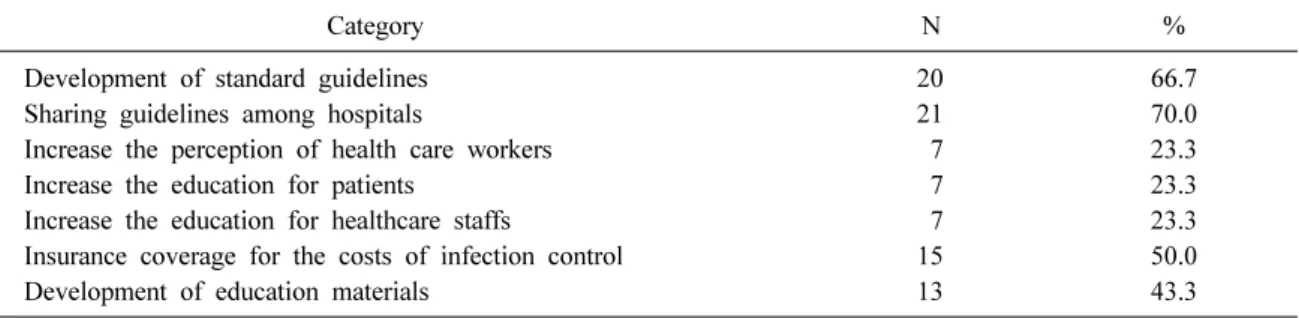
3. 조혈모세포이식 감염관리 해결과제에 대한 의견
병원 간 감염관리지침 공유 70.0%, 표준감염관 리지침 개발 66.7%, 감염관리에 소요되는 비용의 보험지급 50.0%, 감염관리 교육자료의 개발 43.3%
였고, 감염관리에 대한 의료인 인식 제고, 환자에 대한 감염관리 교육 강화, 의료인에 대한 감염관 리교육 강화가 각각 23.3%였다(Table 8).
Discussion
조혈모세포이식센터는 대학병원과 서울지역이
Table 8. Suggestions for further development of infection control practices in hematopoietic cell transplantation centers (asked to select three items) (N=30)
Category N %
Development of standard guidelines 20 66.7
Sharing guidelines among hospitals 21 70.0
Increase the perception of health care workers 7 23.3
Increase the education for patients 7 23.3
Increase the education for healthcare staffs 7 23.3
Insurance coverage for the costs of infection control 15 50.0
Development of education materials 13 43.3
가장 많이 분포하였고 국내에서 1996-2000년 사 이에 이식센터가 가장 많이 개설되었는데 혈액 질환 치료에 대한 큰 관심과 치료 효과로 인한 것으로 생각된다.
조혈모세포이식 종류에 따른 격리병실은 1인 실을 많이 사용하고 있었는데, 선행연구의 동종 조혈모세포이식시 1인실 사용률 81.8% [5] 보다 높았다. 보호환경으로 HEPA filter, LAF, 양압 세 가지를 모두 적용하는 경우가 가장 많았는데, 선 행연구[5] 결과보다 높았고, 또 다른 선행연구[7]
결과와 비교할 때 HEPA filter와 양압은 본 연구 결과와 유사하였으나 LAF 병실은 본 연구에서 현저히 높았다. 이는 동종과 자가 조혈모세포이 식이 이식센터 내에서 함께 이루어지고 있어 동 종 조혈모세포이식 환자에게 진균 감염 예방에 효과적이라고 입증되어 있는 HEPA 필터와 LAF 를 자가 조혈모세포이식 환자에게도 동일하게 적용할 지에 대하여는 센터마다 논의가 더 필요 할 것으로 생각한다.
조혈모세포이식환자의 건축 공사 중 이동 시 주의사항으로 본 연구에서 수술용 마스크를 40.0%에서 착용하였고, N95 마스크를 50.0%에서 만 착용 하였는데, CDC 지침[8]에서는 환자가 공 사 중 HEPA 필터가 설치된 방을 나올 때에는 N95 마스크를 착용해야 하고 일반 수술용 마스 크는 진균 포자를 막는 효과가 거의 없다고 하였 으므로 앞으로 시정이 필요한 부분이라고 생각 한다.
병실 안에서 보호구 착용은 선행연구[6]와 같 이 본 연구에서도 각 이식 센터마다 다양함을 알 수 있었다. 조혈모세포이식 환자에게 보호격리 시설을 제외하고 표준주의 이상의 불필요한 보
호구 착용을 지속해야 하는지는 논의가 더 필요 하다.
청소 주기는 이식병실이 비이식 병실보다 더 자주 시행하고 있었는데, 이는 CDC 지침[8]에서 조혈모세포이식센터는 먼지 발생 관리에 중점을 두고 매일 한 번씩 청소해야 한다고 하였으므로 이식 병실도 1회 이상 시행할 필요는 없다고 생 각한다.
방문객 수 제한은 1-2명이 가장 많았고, 방문 객 스크리닝은 선행연구[7]의 연구결과보다 높았 다. 그러나, 효율적인 방문객 관리를 위하여 방문 객의 허용범위를 구체적으로 문서화하여 관리할 필요가 있다.
조혈모세포이식 종류에 따른 구강관리 종류로 는 구내염 효과가 있다고 증명된 생리식염수와 중탄산나트륨액을 사용하는 것 외에 구내염 예 방 효과가 거의 없는 것으로 증명된 클로르헥시 딘 용액, 탄튬 용액을 사용하는 이식센터가 있어 근거에 기반한 실무 적용이 필요할 것이다.
말초정맥관 카테터 삽입부위 교환은 이식환자 가 일반환자에 비해 더 자주 교환되고 있는 것으 로 나타났고, 중심정맥관 거즈 드레싱 교환도 일 반환자 48시간보다 더 자주 교환되고 있는 것으 로 나타났다. 이는 혈관내 카테터 관리 지침이 이식 센터마다 다양하고 혈류감염 예방을 위한 근거기반 지침을 참조하여 지침 변경을 고려할 필요가 있다.
중심 정맥 카테터의 소독제는 베타딘을 가장 많이 사용하고 있었는데, 혈관내 카테터 관리 지 침[9]에서는 alcoholic chlorhexidine gluconate sol- ution 사용을 권고하고 있으므로 지침 변경을 고 려할 필요가 있다.
조혈모세포이식시 사용되는 예방적 약물의 사 용 빈도는 선행연구[5]의 결과와 비교하여 quino- lones과 TMP/SMZ 사용 빈도는 높았고, amphoter- icin-B/nystatine oral 약물과 fluconazole의 사용 빈 도는 낮았으며, itraconazole 사용 빈도는 높았다.
항바이러스제 중 acyclovir 약물 사용 빈도는 다 른 선행연구[5] 결과와 유사하였다.
조혈모세포이식 환자의 멸균식 제공은 선행연 구[5]의 결과보다 높았다. 그러나, 멸균식이 제공 기준은 기관마다 매우 다르고 근거 또한 부족하 여 식이 관리에 대한 연구가 지속적으로 필요할 것으로 생각한다.
조혈모세포이식 감염관리 해결과제로 병원 간 감염관리지침 공유와 표준화된 감염관리지침 개 발이 가장 많았다. 병원 감염관리의 중요성이 커 짐에 따라 정부의 적극적인 감염관리 지원이 필 요하다고 생각한다.
Summary
배경: 국내 조혈모세포이식센터의 감염관리 실 태를 파악하여 추후 효과적이고 표준화된 감염관 리지침을 마련하기 위함이다.
방법: 국내 32개 조혈모세포이식센터를 대상으 로 2011년 9월부터 10월 14일까지 설문조사연구 를 하였고, 설문지는 센터의 일반적 특성 6문항과 감염관리 11문항을 포함한 총 17문항으로 구성하 였다.
결과: 응답률은 93.8% (30/32)이었고, 병실 HEPA 필터의 성능은 100 class이었고, 방문객은 1-2명 으로 제한하는 센터가 대부분이었다. 의료종사자 의 보호복장은 멸균 가운, 장갑, 마스크를 50%
내외로 착용하였다. 피부관리는 매일 목욕하는 경우가 동종 조혈모세포이식 15 (53.6%)개 센터, 자가 조혈모세포이식 14 (46.7%)개 센터로 가장 많았다. 구강 관리 용액은 생리식염수, 중탄산나 트륨액, 클로르헥시딘을 주로 사용하였고 치솔질 을 허용하는 경우가 대부분이었다. 말초정맥 삽 입부위 교환주기와 중심정맥관 거즈 드레싱 교 환주기는 일반 환자보다 짧았으며, 정맥관 삽입 과 드레싱 교환에 사용하는 소독제는 일반환자 보다 베타딘을 더 많이 사용하였다. 환자 식이는
대부분 멸균식을 제공하였다.
결론: 국내 조혈모세포이식센터의 감염관리는 이식센터마다 다양하였다. 동종/자가 조혈모세포 이식 간 감염관리 실무는 큰 범주에서는 유사 하 였으나 세부내용에서는 차이가 있었다.
Acknowledgements
설문에 응답해 주신 조혈모세포이식센터 수간 호사와 관계자 분들께 진심으로 감사 드립니다.
References
1. Rizzo JD, Wingard JR, Tichelli A, Lee SJ, Van Lint MT, Burns LJ, et al. Recommended screening and preventive practices for long-term survivors after hematopoietic cell transplan- tation: joint recommendations of the European Group for Blood and Marrow Transplantation, the Center for International Blood and Marrow Transplant Research, and the American Society of Blood and Marrow Transplantation. Biol Blood Marrow Transplant 2006;12:138-51.
2. Kim KS. 2009 Status of Hematopoietic Stem Cell Transplantation in Korea. J Stem Cell Transpl Nurses Assoc 2010;12:9-12.
3. Yoo JH, Noh KT, Lee YS, Lee YH, Kwon HC, Kim JS, et al. Infectious complications during neutropenic period before and after hema- topoietic stem cell transplantation -based on central venous catheter related septicemia.
Korean J Hematop Stem Cell Transpl 2002;7:
80-5.
4. Fenelon LE. Protective isolation: who needs it?
J Hosp Infect 1995;30 Suppl:218-22.
5. Krüger WH, Hornung RJ, Hertenstein B, Kern WV, Kröger N, Ljungman P, et al. Practices of infectious disease prevention and management during hematopoietic stem cell transplantation:
a survey from the European group for blood and marrow transplantation. J Hematother Stem Cell Res 2001;10:895-903.
6. Lee SJ, Astigarraga CC, Eapen M, Artz AS, Davies SM, Champlin R, et al. Variation in supportive care practices in hematopoietic cell transplantation. Biol Blood Marrow Transplant 2008;14:1231-8.
7. Bevans M, Tierney DK, Bruch C, Burgunder M, Castro K, Ford R, et al. Hematopoietic stem cell transplantation nursing: a practice variation study. Oncol Nurs Forum 2009;36:E317-25.
8. Yokoe D, Casper C, Dubberke E, Lee G, Muñoz P, Palmore T, et al; Centers for Disease
Control and Prevention. Infection prevention and control in health-care facilities in which hematopoietic cell transplant recipients are treated. Bone Marrow Transplant 2009;44:
495-507.
9. Centers for Disease Control and Prevention.
Guidelines for the prevention of intravascular catheter-related infections. https://www.cdc.gov/
hai/pdfs/bsi-guidelines-2011.pdf (Updated on 2011).