• 검색 결과가 없습니다.

The Impact of Trimetazidine Treatment on Left Ventricular Functions and Plasma Brain Natriuretic Peptide Levels in Patients with Non-ST Segment Elevation Myocardial Infarction Undergoing Percutaneous Coronary Intervention

N/A
N/A
Protected

Academic year: 2022

Share "The Impact of Trimetazidine Treatment on Left Ventricular Functions and Plasma Brain Natriuretic Peptide Levels in Patients with Non-ST Segment Elevation Myocardial Infarction Undergoing Percutaneous Coronary Intervention"

Copied!
6
0
0

로드 중.... (전체 텍스트 보기)

전체 글

(1)

Korean Circulation Journal

Introduction

Despite rapid advancements in the therapeutic field of cardiovas- cular diseases, acute coronary syndromes (ACSs) are still the leading cause of morbidity and mortality worldwide. Increased numbers of coronary intensive care units, reperfusion techniques for percuta-

Original Article

http://dx.doi.org/10.4070/kcj.2013.43.7.462 Print ISSN 1738-5520 • On-line ISSN 1738-5555

The Impact of Trimetazidine Treatment on Left Ventricular Functions and Plasma Brain Natriuretic Peptide Levels in Patients with

Non-ST Segment Elevation Myocardial Infarction Undergoing Percutaneous Coronary Intervention

Selami Demirelli, MD 1 , S¸ule Karakelleog˘lu, MD 2 , Fuat Gündog˘du, MD 2 , Muhammed Hakan Tas¸, MD 2 ,

Ahmet Kaya, MD 3 , Hakan Duman, MD 4 , Hüsnü Deg˘irmenci, MD 5 , Hikmet Hamur, MD 6 , and Ziya S¸ims¸ek, MD 2

1

Department of Cardiology, Erzurum Regional Training and Research Hospital, Erzurum,

2

Department of Cardiology, Faculty of Medicine, Atatürk University, Erzurum,

3

Department of Cardiology, Faculty of Medicine Ordu University, Ordu,

4

Department of Cardiology, Rize State Hospital, Rize,

5

Department of Cardiology, Erzurum Palandöken State Hospital, Erzurum,

6

Department of Cardiology, Mengücek Gazi Regional Training and Research Hospital, Erzincan, Turkey

Background and Objectives: The aim of this study was to investigate the impact of treatment with oral trimetazidine (TMZ) applied before and after percutaneous coronary interventions (PCI) on short-term left ventricular functions and plasma brain natriuretic peptide (BNP) levels in patients with non-ST segment elevation myocardial infarction (NSTEMI) undergoing PCI.

Subjects and Methods: The study included 45 patients who were undergoing PCI with the diagnosis of NSTEMI. The patients were ran- domized into two groups. The first group (n=22) of the patients hospitalized with the diagnosis of NSTEMI was given conventional therapy plus 60 mg TMZ just prior to PCI. Treatment with TMZ was continued for one month after the procedure. TMZ treatment was not given to the second group (n=23). Echocardiography images were recorded and plasma BNP levels were measured just prior to the PCI and on the 1st and 30th days after PCI.

Results: The myocardial performance index (MPI) was greater in the second group (p=0.02). In the comparison of BNP levels, they signifi- cantly decreased in both of the groups during the 30-day follow-up period (29.0±8 and 50.6±33, p<0.01 respectively). However, decreasing of BNP levels was higher in the group administered with TMZ. The decrease of left ventriclular end-diastolic volume was observed in all groups at 30 days after intervention, but was higher in the group administered with TMZ (p=0.01).

Conclusion: Trimetazidine treatment commencing prior to PCI and continued after PCI in patients with NSTEMI provides improvements in MPI, left ventricular end diastolic volume and a decrease in BNP levels. (Korean Circ J 2013;43:462-467)

KEY WORDS: Natriuretic peptide, brain; Percutaneous coronary intervention; Trimetazidine.

Received: February 6, 2013 / Revision Received: May 14, 2013 / Accepted: June 14, 2013

Correspondence: Selami Demirelli, MD, Department of Cardiology, Erzurum Regional Training and Research Hospital, Erzurum, Turkey Tel: 90.442.3325555, Fax: 90.442.2325038, E-mail: [email protected]

• The authors have no financial conflicts of interest.

This is an Open Access article distributed under the terms of the Creative Commons Attribution Non-Commercial License (http://creativecommons.org/licenses/

by-nc/3.0) which permits unrestricted non-commercial use, distribution, and reproduction in any medium, provided the original work is properly cited.

neous coronary interventions (PCIs), and advanced medical thera- pies, including several pharmacological agents, have resulted in a significantly prolonged life expectancy. However, despite intensive therapies with hemodynamically effective agents, many patients with ischemic disease do not recover fully and remain at high risk for undesired further events. Hence, attempts to develop novel ther-

Editorial

(2)

apies are currently ongoing.

Trimetazidine (TMZ) has an anti-ischemic effect through the se- lective inhibition of long-chain 3-ketoacyl-CoA thiolase and the di- rect stimulation of pyruvate dehydrogenase, which provides a shift in cardiac energy metabolism from fatty acid oxidation to glucose oxidation.

1)

As a result, TMZ preserves the necessary ATP level in car- diomyocytes, promotes a decrease in intracellular acidosis, and pre- vents intracellular calcium overload.

2)3)

It reduces myocardial injuries caused by free radicals and, therefore, modulates the inflammatory response. It can limit the necrotic area of the myocardium. There- fore, TMZ preserves the contractile function of myocardium, reduc- ing ischemia and reperfusion damage following an ischemic attack.

4)

Elevated concentrations of brain natriuretic peptide (BNP) and the N-terminal portion of BNP prohormone, early and late after present- ation with an ACS, are strongly associated with an increase in ad- verse cardiovascular events.

5-7)

The aim of this study was to inves- tigate the impact of treatment with oral TMZ administered prior to and after PCI on short-term left ventricular (LV) functions and plasma BNP levels in patients with non-ST segment elevation myocardial infarction (NSTEMI) undergoing PCI.

Subjects and Methods

Study population

In the present study, 45 patients with NSTEMI and critical coronary artery lesions, as shown in the selective coronary angiography, who underwent PCI were included. Patients were included due to symp- toms of unstable coronary artery disease with objective signs of myocardial ischemia, such as electrocardiographic changes (ST- segment depression ≥0.1 mV or T-wave inversion ≥0.1 mV in 2 con- tiguous leads) or elevated biochemical markers of myocardial necro- sis. Patients with severe left heart valve regurgitation, chronic renal insufficiency, chronic cor pulmonale, acute pulmonary embolism, severe heart valve disease, ST-segment elevation myocardial infarc- tion, and hypertensive patients with LV hypertrophy were excluded.

The study was approved by the local Ethics Committee. Informed consent forms were obtained from the patients.

Those patients who were scheduled for PCI according to coro- nary angiographic findings were randomly assigned into two gr- oups. PCI was performed within 24 hours after admission. In Gr- oup 1, 22 patients underwent TMZ loading 60 mg before the pro- cedure and conventional therapy plus TMZ 60 mg daily (3×20 mg) for one month following the procedure. In Group 2, 23 patients un- derwent PCI and followed up with conventional therapy alone.

Coronary angiography and percutaneous coronary intervention All patients underwent standard coronary angiography via the

femoral approach. Patients assigned to the early invasive strategy were scheduled to undergo an angiography within 4 to 48 hours af- ter randomization, and percutaneous revascularization where appro- priate, based on the coronary anatomy. The coronary stenosis se- verity in the vessel to be monitored during angioplasty was assessed visually and was defined as >90% in all patients. Immediately after the procedure, the angiographic control demonstrated a residual st- enosis of <20% with Thrombolysis in Myocardial Infarction flow grade 3 in the dilated artery in all patients. Only patients with single- vessel disease were enrolled in the study. Routine care was taken before and after the procedure for all patients, including pretreat- ment with a loading dose of clopidogrel (300 mg initial oral bolus) the day prior to the procedure, followed by 75 mg/day for 1 month, in addition to aspirin medication (160 mg/day) and an intravenous bolus of unfractionated heparin (100 IU/kg) was administered at the beginning of the procedure.

Brain natriuretic peptide measurement

All samples were collected by venipuncture into ethylenediami- netetraacetic acid tubes. The samples were analyzed within ten mi- nutes using the Fluorescence Immunoassay technique and Biosite (CA, USA) using a BNP Triage Kit in the Biochemistry Lab, Emerg- ency Unit. Laboratory parameters of BNP were assessed by a rese- archer who was blind to the clinical characteristics of the patients.

Echocardiographic measurements

Transthoracic echocardiography was performed by one trained operator using the GE Vivid 7 system (GE Vingmed Ultrasound AS, Horten, Norway) with a 3.5-MHz transducer. All data were transferr- ed to a workstation for further offline analysis (EchoPAC PC; GE Vingmed Ultrasound AS). Left ventricular ejection fraction (LVEF) was calculated using Simpson’s formula from the measurement of end-diastolic and end-systolic volumes on apical 4-chamber views.

Transmitral flow velocities (E and A) were obtained by a pulsed-wave Doppler in the apical four-chamber view. The ratio of E/A velocity and E-wave deceleration time were measured. Tissue Doppler im- aging was used to measure mitral annular velocities. Early diastolic velocity (Em) and late diastolic velocity (Am) were obtained in the mitral septal annulus. Myocardial performance index (MPI) is a nu- meric value, obtained by using cardiac time intervals. This numeric value is defined as the sum of isovolumic contraction time and iso- volumic relaxation time divided by ejection time.

Statistical analysis

Statistical analyses were performed using SPSS version 18.0 for Windows (SPSS Inc., Chicago, IL, USA). Data are expressed as mean±

SD or percentages for categorical variables. To compare parametric

(3)

continuous variables, the independent Student t-test was used. For categorical variables, the χ

2

test was used. P<0.05 was considered to be statistically significant.

Results

A total of 45 patients were randomly divided into two groups:

TMZ (22 patients) and control (23 patients). There were no signifi- cant differences in heart rate or systolic and diastolic blood pressure obtained during the echocardiographic examination. Both groups were comparable at the baseline with regard to their clinical char- acteristics, blood testing, echocardiographic evaluation, as well as the distribution of their concomitant treatment. Patients’ characte- ristics at enrollment are reported in Table 1. All patients (n=45) com- pleted the trial.

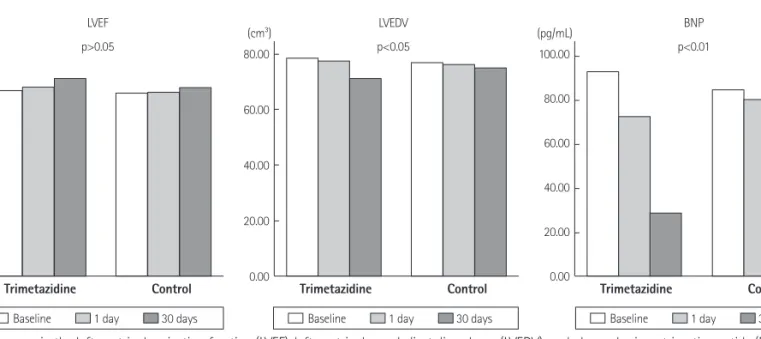
Left ventricular ejection fraction {TMZ group-58.2±3.7%, 59.1±

3.9% and 61.7±2.3%; control group-57.5±2.5%, 57.7±2.6% and 59.0±2.7% at the baseline, at 1 day and at 30 days, respectively; p=

not significant (NS)} (Fig. 1) as well as LV end-systolic volume (TMZ group-32.6±6.7, 31.2±5.9 and 27.5±4.0% cm

3

; control group- 34.4±

5.5 cm

3

, 33.6±5.6 cm

3

and 32.6±6.2 cm

3

at the baseline, at 1 day and at 30 days, respectively; p=NS) did not significantly change after 30 days of treatment.

Left ventricular end diastolic volume (LVEDV) TMZ group-78.7±

9.7 cm

3

, 77.5±9.3 cm

3

and 71.9±7.7 cm

3

; control group-77.1±13.1 cm

3

, 76.4±12.5 cm

3

and 75.1±13.1 cm

3

at the baseline, at 1 day and at 30 days, respectively (Fig. 1). While no difference was observed between LVEDV (p=0.05) levels, the decrease of LVEDV was observed in all groups at 30 days after intervention, but it was higher in the group administered TMZ treatment (p=0.01). BNP TMZ group-93.1±

Table 1. Baseline clinical, echocardiographic, laboratory and angiographic characteristics of the study population

Variables Trimetazidine (n=22) Control (n=23) p

Age (years) 57.2±10 58.9±10 0.58

Male/Female 20/6 15/8 NS

Systolic blood pressure (mm Hg) 122.6±15.1 122.3±13.3 NS

Diastolic blood pressure (mm Hg) 78.5±7.9 78.4±8.0 NS

Smoking (%) 45 56 0.55

Hypertension (%) 13.6 11.7 0.28

Diabetes (%) 0 8.6 0.48

Serum creatinine (mg/dL) 0.9±0.3 1±0.3 NS

Drug treatment (%)

Aspirin 100 100 0.43

Clopidogrel 100 100 0.43

β-blockers 95.4 91.3 0.38

Statins 90 86 0.43

ACE inhibitors 81.8 73.9 0.29

Echocardiography

LVEDV (cm

3

) 78.72±9.7 77.17±13.1 0.05

LVESV (cm

3

) 32.63±6.7 34.47±5.5 0.42

LV ejection fraction (%) 58.27±3.7 57.52±2.5 0.08

Myocardial performance index 0.58±0.91 0.58±0.08 0.55

Biomarker result

BNP (pg/mL) 93.1±44 85.0±37 0.73

Peak CK-MB (ng/mL) 33.4±17.4 35.0±20.1 NS

Peak troponin-I (ng/mL) 3.6±1.2 3.4±1.7 NS

Artery involved

Left circumflex coronary artery 6 6 NS

Left anterior descending coronary artery 11 12 NS

Right coronary artery 5 5 NS

ACE: angiotensin-converting enzyme, BNP: brain natriuretic peptide, NS: not significant, LV: left ventricular, LVEDV: LV end-diastolic volume, LVESV: LV

end-systolic volume, CK-MB: creatine kinase-MB

(4)

44 pg/mL, 73.0±16 pg/mL and 29.0±8 pg/mL; control group-85.0±

37 pg/mL, 80.3±43 pg/mL and 50.6±33 pg/mL at the baseline, at 1 day and at 30 days, respectively (Fig. 1). BNP levels significantly de- creased in both groups during the 30-day follow-up period (29.0±8 and 50.6±33, respectively). However, the decrease of BNP levels was higher in the group administered TMZ than the other group (p<0.01). MPI TMZ group-0.58±0.9, 0.55±0.8 and 0.48±0.7; control group-0.58±0.8, 0.56±0.9 and 0.52±0.1 at the baseline, at 1 day and at 30 days, respectively. Table 2 shows the differences between the baseline and the 30th day at LV ejection fraction, LVEDV, BNP,

and MPI. MPI, which incorporates both systolic and diastolic time intervals in expressing global ventricular performance, was greater in the second group (p=0.02). Transmitral flow velocities (E and A), the ratio of E/A velocity and E-wave deceleration time, tissue Dop- pler imaging early diastolic velocity (Em), and late diastolic velocity (Am) between the two groups showed similar variations.

Discussion

The present study demonstrated that short-term (30-day) TMZ treatment in patients with NSTEMI undergoing PCI reduces plasma levels of BNP, reduces LVEDV, and improves MPI.

Brain natriuretic peptide is synthesized in the ventricles as pre-pro BNP and transformed into pro-BNP. Thereafter, BNP is converted into biologically active BNP and biologically inactive N terminal-pro- BNP.

8)

BNP and NT-pro-BNP are released in response to ventricular myocardial contraction, indicating myocardial wall stress.

9)

It has been established in several clinical studies that increased BNP is re- lated to ischemia, rather than myocardial necrosis in ACS. BNP is considered an important prognostic indicator for ACS.

10-12)

In our study, we found that plasma BNP levels, an indicator of myocardial stress, were lower with TMZ treatment initiated before PCI and con- tinued for 30 days, compared to the controls.

Trimetazidine selectively inhibits fatty acid beta oxidation enzyme 3-ketoacyl-CoA dehydrogenase. This results in glucose oxidation, which is a more productive pathway for energy production, rather than fat oxidation.

13)

Shifting beta-oxidation to glucose oxidation, which requires lower oxygen demand, is beneficial for myocardial hypoperfusion, as ATP production per oxygen consumption unit (Mol) with glucose energy substrate is 12% higher compared to fat- ty acids. In addition, TMZ prevents calcium overload and cellular aci- Fig. 1. Changes in the left ventricular ejection fraction (LVEF), left ventricular end-disatolic volume (LVEDV), and plasma brain natriuretic peptide (BNP) levels during the follow-up period.

60.00

40.00

20.00

0.00

80.00

60.00

40.00

20.00

0.00

100.00 80.00 60.00 40.00 20.00

Trimetazidine Control Trimetazidine Control 0.00 Trimetazidine Control

p>0.05 p<0.05 p<0.01

LVEF LVEDV BNP

(%) (cm

3

) (pg/mL)

Baseline 1 day 30 days Baseline 1 day 30 days Baseline 1 day 30 days

Table 2. LVEF, LVEDV, BNP and MPI differences between the baseline and the 30th day

Variables Trimetazidine (n=22) Control (n=23) p BNP (pg/mL)

Baseline 93.1±44 85.0±37 0.730

1 day 73.0±16 80.3±43 0.480

30 days 29.0±8 50.6±33 <0.001

LVEF (%)

Baseline 58.2±3.7 57.5±2.5 0.820

1 day 59.1±3.9 57.7±2.6 0.100

30 days 61.7±2.3 59.0±2.7 0.520

LVEDV (cm

3

)

Baseline 78.7±9.7 77.1±13.1 0.050

1 day 77.5±9.3 76.4±12.5 0.150

30 days 71.9±7.7 75.1±13.1 0.010

MPI

Baseline 0.58±0.9 0.58±0.8 0.460

1 day 0.55±0.8 0.56±0.9 0.050

30 days 0.48±0.7 0.52±0.1 0.010

BNP: brain natriuretic peptide, LVEF: left ventricular ejection fraction,

LVEDV: LV end-diastolic volume, MPI: myocardial performance index

(5)

dosis and, thereby, preserves cellular homeostasis by reducing the oxidation of fatty acids and reactivating the glucose pathway.

14-16)

Trimetazidine preserves myocardial contractile function, reducing ischemic damage and reperfusion damage following ischemia.

17)

Fragasso et al.

18)

investigated the effects of conventional therapy plus TMZ on New York Heart Association (NYHA) functional class, exercise tolerance, quality of life, and LV function in patients with heart failure, irrespective of the underlying etiology (i.e. ischemic or non-ischemic). The authors found that NYHA functional class was significantly improved with reduced end-systolic volume and signi- ficantly reduced LVEF in patients administered TMZ. Labrou et al.

19)

found that pre- and post-PCI TMZ therapy resulted in procedure-re- lated myocardial damage with an improvement in the LV region, global wall movements, and LVEF at 1 and 3 months following PCI.

In our study, we found no significant increase in LV ejection fraction in the TMZ group, compared to the controls. However, this study par- tially supports our results that a significant reduction in LVEDV and BNP levels was found in the TMZ group.

Mitral E and A velocities used for the assessment of LV diastolic functions, as shown in the Doppler echocardiography, were similar to the control group. No significant difference was observed be- tween the groups in terms of Em and Am values of the Tissue Dop- pler parameters used for the assessment of diastolic functions. MPI is a numerical value obtained at cardiac time intervals. The Doppler index, irrespective of heart rate, is useful in the assessment of sys- tolic and diastolic myocardial performance simultaneously. The MPI increases in patients with coronary artery disease accompanied by any degree of systolic dysfunction. In our study, we also found that MPI increased significantly at 30 days in patients receiving TMZ, compared to the control group. In addition to the MPI increase, the lack of improvement in EF may be explained by the relatively brief follow-up period.

In conclusion, TMZ treatment commenced prior to PCI and con- tinued after PCI in patients with NSTEMI provided improvements in MPI, LVEDV, and a decrease in BNP levels. We concluded that the beneficial effects of PCI could be reinforced with a combination of PCI and TMZ treatment.

Study limitations

Our results should be applied only with caution to clinical situa- tions in which acute ischemia is potentially involved, and further investigation is required. This study was based on a limited number of observations made in a small population of patients and a brief follow-up period, potentially diminishing the validity of the drawn statistical inference. The reason for the small study population was based on the need for acquiring homogeneity for the trial. Future stu- dies are required for these findings to be applied to clinical practice.

References

1. Szwed H, Sadowski Z, Elikowski W, et al. Combination treatment in sta- ble effort angina using trimetazidine and metoprolol: results of a ran- domized, double-blind, multicentre study (TRIMPOL II). TRIMetazidine in POLand. Eur Heart J 2001;22:2267-74.

2. Lopaschuk GD, Kozak R. Trimetazidine inhibits fatty acid oxidation in the heart. J Mol Cell Cardiol 1998;30:A112.

3. Aussedat J, Ray A, Kay L, Verdys M, Harpey C, Rossi A. Improvement of long-term preservation of isolated arrested rat heart: beneficial effect of the antiischemic agent trimetazidine. J Cardiovasc Pharmacol 1993;

21:128-35.

4. American Heart Association. 1999 heart and stroke statistical update.

Chicago: American Heart Association;1999.

5. Pope JH, Aufderheide TP, Ruthazer R, et al. Missed diagnoses of acute cardiac ischemia in the emergency department. N Engl J Med 2000;

342:1163-70.

6. Rosano GM, Vitale C, Fragasso G. Metabolic therapy for patients with diabetes mellitus and coronary artery disease. Am J Cardiol 2006;98:

14J-8J.

7. Marazzi G, Wajngarten M, Vitale C, et al. Effect of free fatty acid inhi- bition on silent and symptomatic myocardial ischemia in diabetic pa- tients with coronary artery disease. Int J Cardiol 2007;120:79-84.

8. Nakamura S, Naruse M, Naruse K, et al. Atrial natriuretic peptide and brain natriuretic peptide coexist in the secretory granules of human cardiac myocytes. Am J Hypertens 1991;4:909-12.

9. Yoshimura M, Yasue H, Okumura K, et al. Different secretion patterns of atrial natriuretic peptide and brain natriuretic peptide in patients with congestive heart failure. Circulation 1993;87:464-9.

10. White HD, French JK. Use of brain natriuretic peptide levels for risk as- sessment in non-ST-elevation acute coronary syndromes. J Am Coll Cardiol 2003;42:1917-20.

11. Jernberg T, Stridsberg M, Venge P, Lindahl B. N-terminal pro brain na- triuretic peptide on admission for early risk stratification of patients with chest pain and no ST-segment elevation. J Am Coll Cardiol 2002;

40:437-45.

12. Ruzyllo W, Szwed H, Sadowski Z, et al. Efficacy of trimetazidine in pa- tients with recurrent angina: a subgroup analysis of the TRIMPOL II study. Curr Med Res Opin 2004;20:1447-54.

13. Kantor PF, Lucien A, Kozak R, Lopaschuk GD. The antianginal drug trimetazidine shifts cardiac energy metabolism from fatty acid oxida- tion to glucose oxidation by inhibiting mitochondrial long-chain 3-ke- toacyl coenzyme A thiolase. Circ Res 2000;86:580-8.

14. Banach M. The role of trimetazidine in the treatment of heart diseases.

Ponzan, Poland: Termedia Publishing House;2006. p.52-6.

15. Blardi P, de Lalla A, Volpi L, Auteri A, Di Perri T. Increase of adenosine plasma levels after oral trimetazidine: a pharmacological precondition- ing? Pharmacol Res 2002;45:69-72.

16. López N, Varo N, Díez J, Fortuño MA. Loss of myocardial LIF receptor in experimental heart failure reduces cardiotrophin-1 cytoprotection. A role for neurohumoral agonists? Cardiovasc Res 2007;75:536-45.

17. Stanley WC. Partial fatty acid oxidation inhibitors for stable angina.

Expert Opin Investig Drugs 2002;11:615-29.

(6)

18. Fragasso G, Palloshi A, Puccetti P, et al. A randomized clinical trial of trimetazidine, a partial free fatty acid oxidation inhibitor, in patients with heart failure. J Am Coll Cardiol 2006;48:992-8.

19. Labrou A, Giannoglou G, Zioutas D, Fragakis N, Katsaris G, Louridas G.

Trimetazidine administration minimizes myocardial damage and im-

proves left ventricular function after percutaneous coronary interven-

tion. Am J Cardiovasc Drugs 2007;7:143-50.

수치

Table 1. Baseline clinical, echocardiographic, laboratory and angiographic characteristics of the study population
Table 2. LVEF, LVEDV, BNP and MPI differences between the baseline and  the 30th day

참조

관련 문서

Prophylactic cranial irradiation for preventing brain metastases in patients undergoing radical treatment for non-small-cell lung.. A randomized trial of surgery

웹 표준을 지원하는 플랫폼에서 큰 수정없이 실행 가능함 패키징을 통해 다양한 기기를 위한 앱을 작성할 수 있음 네이티브 앱과

_____ culture appears to be attractive (도시의) to the

【판결요지】[1] [다수의견] 동일인의 소유에 속하는 토지 및 그 지상 건물에 관하여 공동저 당권이 설정된 후 그 지상 건물이 철거되고 새로 건물이 신축된 경우에는

Long-term outcome after an early invasive versus selective invasive treatment strategy in patients with non.ST-elevation acute coronary syndrome and elevated

It considers the energy use of the different components that are involved in the distribution and viewing of video content: data centres and content delivery networks

1 John Owen, Justification by Faith Alone, in The Works of John Owen, ed. John Bolt, trans. Scott Clark, &#34;Do This and Live: Christ's Active Obedience as the

A combination of parallel translational and non-translational symmetry elements produces an interesting effect on the way in which the pattern