Environmental Science
Vol. 36, No. 1, pp. 17-24, March, 2020 https://doi.org/10.7747/JFES.2020.36.1.17
The Three-year Effect of Thinning Intensity on Biomass in Larix kaempferi and Pinus koraiensis Plantation
Vireak Chhorn1,3, Yeongwan Seo2, Daesung Lee2 and Jungkee Choi1,*
1Department of Forest Management, College of Forest and Environmental Sciences, Kangwon National University, Chuncheon 24341, Republic of Korea
2Institute of Forest Science, College of Forest and Environmental Sciences, Kangwon National University, Chuncheon 24341, Republic of Korea
3Forestry Administration, Phnom Penh, Cambodia
Abstract
This study aimed to figure out and compare the increment of biomass by thinning intensity focused on the plantation of the two major coniferous species (Larix kaempferi and Pinus koraiensis) of South Korea. The inventory interval was three years under the effects of three types of thinning treatments; control (no thinning), light (20% thinning) and heavy (40% thinning). The results showed standing biomass increment of both species decreased as thinning intensity increased (heavy<light<control). Biomass increment of each tree compartment (roots, stem, branches and foliage) also followed the increment pattern of the total biomass. In contrast, the rate of biomass growth increased as increasing thinning intensity (heavy>light>control). Meanwhile, the lowest of on-site biomass changes occurred in the control plot, and the greatest was in the heavy thinning plot because thinning was involved with leaving the felling residual biomass (leaves, branches and roots) on the site. According to the results from this short-term study, unthinned stands is preferable for maximizing standing biomass as well as carbon sequestration. However long-term investigation should be considered in order to see more clear results.
Key Words: thinning intensity, standing biomass, on-site biomass, residual biomass, carbon sequestration
Received: March 15, 2019. Revised: February 3, 2020. Accepted: February 3, 2020.
Corresponding author: Jungkee Choi
Department of Forest Management, College of Forest and Environmental Sciences, Kangwon National University, Chuncheon 24341, Republic of Korea Tel: 82-33-250-8337, Fax: 82-33-259-5617, E-mail: [email protected]
Introduction
Forest management involves the integration of silvicul- tural practices in order to maximize both quality and quan- tity of the forest productivity. Thinning is a common man- agement activity used to manipulate the growth rate, size, and form of individual trees, as well as the structure and yield of forest stands (Smith 1986). One of the most im- portant objective of thinning is to accelerate size or diameter at breast height (DBH) of the residual trees by removing
nearby competing trees (Smith 1986; Oliver and Larson 1996; Fujimori 2001). There are number of studies found this positive relationship through establishing permanent plots and repeating periodic measurements (Mäkinen and Isomäki 2004a; 2004b; 2004c; Pfister et al. 2007;
Nishizono et al. 2008; Pelletier and Pitt 2008; Wallentin and Nilsson 2011; Choi et al. 2014; Kim et al. 2016).
Forests which are an important component of the global carbon cycle store over 80% of global terrestrial above- ground carbon. Much attention has turned to forest man-
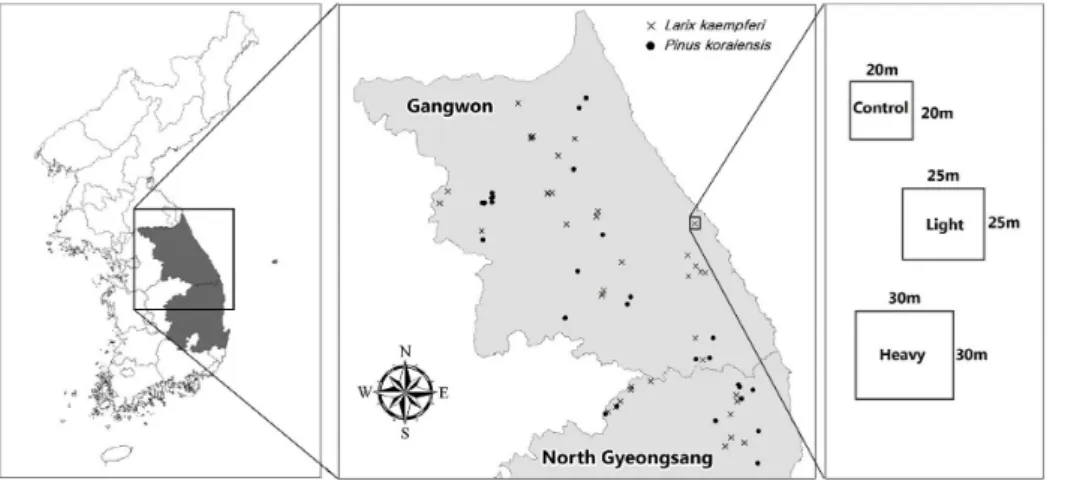
Fig. 1. Location of permanent monitoring sites and layout of plots.
agement as a means of mitigating climate change (Dixon et al. 1994; D’Amato et al. 2011). Especially woody biomass is a crucial renewable energy sources as an alternative to fossil energy in recent time because of global warming problems originating mostly from fossil fuel combustion.
With the dramatically increasing interest in biomass energy, such biomass harvesting guidelines are necessary to ensure sustainability (Abbas et al. 2011). Forests which are an im- portant component of the global carbon cycle store over 80% of global terrestrial aboveground carbon and attention has turned to forest management as a means of mitigating climate change (Dixon et al. 1994; D’Amato et al. 2011).
Especially woody biomass is a crucial renewable energy sources as an alternative to fossil energy in recent time be- cause of global warming problems originating mostly from fossil fuel combustion.
Efforts have focused on how much forest management influences carbon or sequestration (Hoover and Stout 2007; Harmon et al. 2009). Repeated thinnings over the course of a forest rotation increased carbon stores compared to stands that were clearcut on short rotations (Thornley and Cannell 2000; Hoover and Stout 2007; Harmon et al.
2009; Profft et al. 2009). In contrast, some studies have demonstrated that thinning reduces aboveground carbon stores relative to unthinned stands (Finkral and Evans 2008; Campbell et al. 2009). However, the influence of re- peated thinnings and different thinning methods on bio- mass growth and long-term patterns of carbon sequestra- tion has not been fully studied (Hoover and Stout 2007;
Ryan et al. 2010).
Meanwhile, Japanese larch (Larix kaempferi) and Korean white pine (Pinus koraiensis) are major timber spe- cies that appear in coniferous forests of the Republic of Korea. According to statistical yearbook of forestry reported by Korean Forest Service (2017), the forest areas of Larix kaempferi and Pinus koraiensis in 2015 contributed ap- proximately 7% of total forest areas which cover on 272,800 ha and 170,905 ha, respectively. In South Korea, these spe- cies have been widely planted, in 2016, Larix kaempferi was planted in 2,598 ha and Pinus koraiensis in 513 ha (Korean Forest Service 2017). Focused on these two major con- iferous species, this study aimed to figure out and compare the increment of biomass by thinning intensity for three years after thinning.
Material and Methods
Study areas and data collection
This study was conducted in permanent monitoring sites located in Gangwon and North Gyeongsang Province of South Korea (Fig. 1). These permanent monitoring sites were established by Forest Resource Monitoring Center on Climate Change (FRMCCC) found by Kangwon National University. In this study, we have 36 sites of Larix kaemp- feri and 26 sites of Pinus koraiensis which were located cov- ering on even-aged stands dominated by these major con- iferous species growing on average slope with 25° (5°-42°).
All sites were established in the public plantation forest areas under maintaining of Korea Forest Service (KFS) which had no recent evidence of past disturbance or
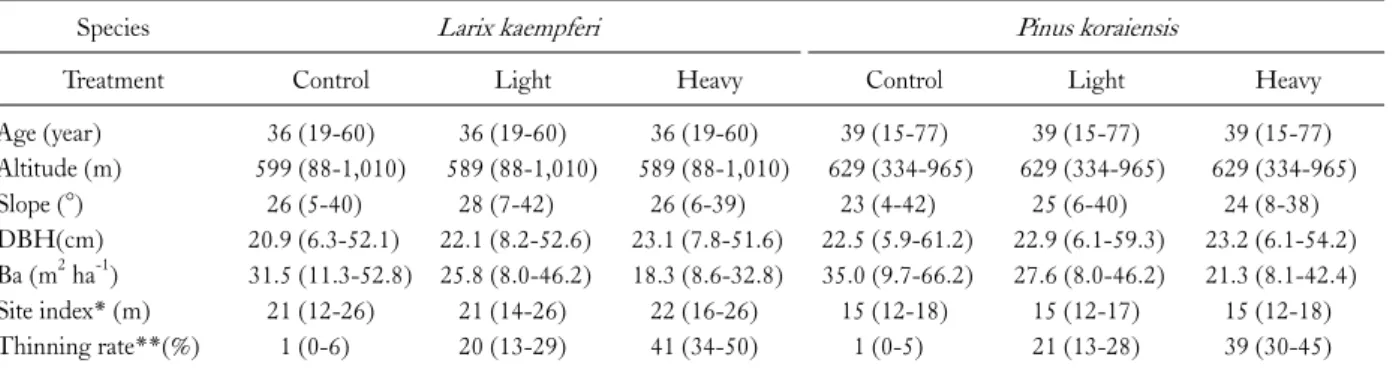
Table 1. Summary of stand characteristics in the study areas
Species Larix kaempferi Pinus koraiensis
Treatment Control Light Heavy Control Light Heavy
Age (year) 36 (19-60) 36 (19-60) 36 (19-60) 39 (15-77) 39 (15-77) 39 (15-77) Altitude (m) 599 (88-1,010) 589 (88-1,010) 589 (88-1,010) 629 (334-965) 629 (334-965) 629 (334-965) Slope (°) 26 (5-40) 28 (7-42) 26 (6-39) 23 (4-42) 25 (6-40) 24 (8-38) DBH(cm) 20.9 (6.3-52.1) 22.1 (8.2-52.6) 23.1 (7.8-51.6) 22.5 (5.9-61.2) 22.9 (6.1-59.3) 23.2 (6.1-54.2) Ba (m2 ha-1) 31.5 (11.3-52.8) 25.8 (8.0-46.2) 18.3 (8.6-32.8) 35.0 (9.7-66.2) 27.6 (8.0-46.2) 21.3 (8.1-42.4) Site index* (m) 21 (12-26) 21 (14-26) 22 (16-26) 15 (12-18) 15 (12-17) 15 (12-18) Thinning rate**(%) 1 (0-6) 20 (13-29) 41 (34-50) 1 (0-5) 21 (13-28) 39 (30-45)
*Mean height of dominant or codominant trees (30% of the tallest trees) was used as site index.
**Thinning rate was based on basal area.
harvesting. The monitoring permanent plots were installed and inventoried from 2012 to 2014 and the thinning were conducted in the year when the plots were installed.
Diameter and height were measured using D-tape and Haglof Hypsometer respectively and one dominant tree each site was felled and used for stem analysis.
In the year of the first inventory, Larix kaempferi stands ranged from 19 to 60 years old (mean age 36) and Pinus koraiensis stands ranged from 15 to 77 years old (mean age 39) (Table 1). Each site consists of three types of plot con- sidered as unthinned or control plot, light thinning plot, and heavy thinning plot. These three types of plots are de- marcated as squared with size of 20 m×20 m×25 m×25 m, and 30m×30m, respectively (Fig. 1). Thinning treat- ment was conducted in each plot with different thinning in- tensities based on basal area within the plot, no thinning or 0%, 20% and 40%, respectively.
Data analysis
We used the existing biomass allometric equation that has been developed by Korea Forest Research Institute (KFRI). The allometric prediction equation based on DBH was used to estimate the biomass both species. Each tree compartments such as stem, branch, foliage and root were used the same equation, but with different parameter.
The biomass equation (KFRI 2012) is:
Biomass=DBHb
Total biomass of each plot is expanded into the value per
hectare by divided to its own corresponding plot size that adjust with slope correction. The reason of using this ad- justment area size is because total biomass is expressed on the horizontal projection terrain. The calculation of adjust- ment plot size with slope is:
Sslope=[(cosθ)×y]×x
Where Sslope is the horizontal plot area (m2), θ is angle of plot slope (°), y is a tape length dimension of plot measured along slope (m), and x is another tape length dimension of plot measured across slope (m). Carbon uptake was con- verted by default carbon fraction value from biomass (0.51) by Intergovernmental Panel on Climate Change, 2007 (Eggleston et al. 2006).
One-way analysis of variance (ANOVA) was carried to statistically verify the significant difference among the three treatments. Duncan’s new multiple range test (=0.05) was used to analyze the difference among the treatments.
All the data were computed and generated by using the Microsoft Excel 2016 and SAS 9.4 program for windows.
Results
The results showed standing biomass increment of both species decreased with increasing thinning intensity (Table 2). In other word, both species showed the highest incre- ment in the control plot, while heavy thinning plot pro- duced the lowest biomass (control>light>heavy). The bi- omass in the Larix kaempferi stands increased 32.4 Mg/ha,
Table 2. Biomass increment per hectare by thinning intensity in the plantation of Larix kaempferi and Pinus koraiensis Thinning
treatment
1st inventory 2nd inventory
Increment Growth rate %
Initial Harvested Residual Standing
---Mg/ha--- Larix kaempferi**
Control 265.7 0.2 265.5 297.9 32.4a 12
Light 260.1 40.1 220.0 250.2 30.2a 14
Heavy 245.1 84.7 160.4 185.1 24.7b 15
Pinus koraiensis
Control 208.4 0.4 208.0 233.0 25.0 12
Light 203.8 38.2 165.7 188.9 23.3 14
Heavy 204.8 73.5 131.3 151.7 20.4 16
**Significant at the 0.01 level, the different letter followed by mean increment are significantly different among thinning treatments by Duncan’s new multiple range test (=0.05).
Fig. 2. Biomass increment per hec- tare of stem, branches, foliage and roots of Larix kaempferi and Pinus koraiensis by thinning intensity.
**Significant at the 0.01 level,
*significant at the 0.05 level; the different letter followed by mean increment are significantly differ- ent among thinning treatments by Duncan’s new multiple range test (=0.05).
30.2 Mg/ha and 24.7 Mg/ha respectively for control, light and hearvy thinning plot. Meanwhile, the biomass in the Pinus koraiensis site increased 25.0 Mg/ha, 23.3 Mg/ha and 20.4 Mg/ha respectively.
Furthermore, ANOVA analysis showed that Larix kaempferi was significantly different among the three treat- ments (p<0.01), while Pinus koraiensis was not. Followed by pairwise test using Duncan’s new multiple range test (=0.05), the biomass increment of Larix kaempferi stand in heavy plot was significantly different from control and light plot while the control and light plot were not sig- nificantly different.
In contrast, the biomass growth rate increased as increas- ing thinning intensity (heavy>light>control). Both spe-
cies increased the biomass by 12% and 14% respectively in control and light thinning plot. Meanwhile in heavy thin- ning plot, the growth rate of Larix kaempferi stand was 15%, while Pinus koraiensis stand was 16%.
Each tree compartment (roots, stem, branches and foli- age) biomass also followed the same increment pattern of the total biomass (heavy>light>control). ANOVA analy- sis of biomass increment for each tree compartments of Larix kaempferi showed significantly different at 0.01 level for stem, roots and foliage, while branches were significant different at 0.05 level. It is noticeable that tree compartment biomass increment in heavy thinning plot was significantly different from the other two plots, control and light, fol- lowed by post hoc test (Duncan’s new multiple range test;
Table 3. Biomass changes (Mg/ha) after three years by thinning intensity for Larix kaempferi and Pinus koraiensis plantation Thinning
treatment
Residual standing biomass
Standing after 3 years
Standing biomass incrementa
Felling residue biomassb
Biomass changec
Branches Foliage Roots
----Mg/ha--- Larix kaempferi**
Control 265.5 297.9 32.4 0.0 0.0 0.0 32.5a
Light 220.0 250.2 30.2 6.8 1.1 3.7 41.8b
Heavy 160.4 185.1 24.7 14.1 2.3 7.8 48.8c
Pinus koraiensis**
Control 208.0 233.0 25.0 0.1 0.0 0.0 25.1a
Light 165.7 188.9 23.3 5.4 1.3 4.2 34.1b
Heavy 131.3 151.7 20.4 9.8 2.4 8.1 40.8c
aDifference between residual standing biomass and standing biomass after 3 years.
bValue after deducing mass loss due to decomposition after 3 years (70% for foliage, 49% for roots and 30% for branches).
cSum of felling residual biomass (branches, foliage and roots) and standing biomass increment.
**Significant at the 0.01 level; the differentletter followed by mean increment are significantly different among thinning treatments by Duncan’s new multiple range test (=0.05).
=0.05) (Fig. 2). It should be noted that three years are too short to see the effect of thinning intensity on biomass increment.
Discussion
Biomass increment
Many studies showed that undisturbed stands produced higher stand biomass production and, therefore, maximized carbon storage (Thornley and Cannell 2000; D’Amato et al.
2011; Kirschbaum 2003; Eriksson 2006; Jhariya and Yadav 2108). Our results supported these findings, as unthinned plot accumulated the greatest biomass. In contrast, heavy thinning plot gave the highest growth rate (Table 2). With this manner, stands in light thinning plot seemed to rank between these two objectives, second largest biomass incre- ment as well as second highest growth rate. Magruder et al.
(2013) reported that increasing thinning intensity on red pine plantation could enhance tree-level productivity whereas uncut control plot could produce the greatest bio- mass production per area, and, as a result, thinning from below at a light thinning intensity was recommended in or- der to perceive higher benefits of maximum tree size, bio- mass per area, and level of climatic resilience. In our study non-thinning (control) was the best option to produce the greatest biomass, however, long-term study is recom-
mended to see a clearer result on biomass production ac- cording to thinning intensity.
Biomass changes
Change in biomass refers to a combination between net growth of stand and mortality (Oliver and Larson 1996).
Dead trees were not remarkable occurred in this short-term study, but felling residues are the major dead biomass on the site after thinning. In this study, biomass changes there- fore are included all felling residue biomass (branches, foli- age and roots) left on the site.
Felling residuals refer to branches and tops or foliage which were removed from harvested tree. Many biomass harvesting guidelines recommend that felling residues should be left as many as possible on the ground for forest ecosystem conservation purpose (Evans et al. 2010; Abbas et al. 2011). Leaving these the residues on site could serve as soil fertility, wildlife habitat, nutrient recycling, water pu- rification and soil carbon loss protection (Simpson and Martin 2008). In addition, root part or belowground bio- mass is relatively difficult to remove while harvesting sys- tems are mostly involved in removing portion of the above- ground biomass.
It is important to recognize how much the felling resi- dues biomass will be decomposed per year after left on the
Table 4. Annual rate of aboveground and belowground carbon (Mg C ha-1y-1) uptake by thinning intensity for Larix kaempferi and Pinus koraiensis plantation
Species Treatment Aboveground Belowground Total Larix
kaempferi**
Control 4.44a 1.08a 5.51a
Light 4.14a 1.00a 5.14a
Heavy 3.38b 0.82b 4.20b
Pinus koraiensis
Control 3.31 0.93 4.24
Light 3.10 0.86 3.96
Heavy 2.72 0.75 3.47
The figure was converted by default carbon fraction value from bi- omass (0.51) by Intergovernmental Panel on Climate Change, 2007 (Eggleston et al. 2006).
**Significant at the 0.01 level;,the different letter followed by mean increment are significantly different among thinning treat- ments by Duncan’s new multiple range test (=0.05)
site. A limitation with this study is the lack of information on the decomposition rate of those felling residues biomass.
However, there is a report on decomposition of logging res- idues in Finland showed mass loss decreased in order: foli- age>roots>branches (Palviainen et al. 2004). They re- ported mass loss of Scot pine in forest plot was 70% for foli- age, 49% for roots and 30% for branches of initial mass af- ter three years. In our study, we applied the above percent- age of logging residual mass loss, and heavy thinning stands, as a result for both species, accumulated the highest biomass while the lowest was in control or unthinned stands (Table 3).
Carbon sequestration
Managed forests generally store less carbon than un- managed forest due to carbon loss through forest biomass harvests or disturbances (Thornley and Cannell 2000;
Kirschbaum 2003; Eriksson 2006), and it is reasonable that higher carbon storage and increment exists at high stand density (Fang et al. 2007). Our results supported the above literature because we found annual carbon sequestration rate increased with increasing stand density (Table 4).
Disturbances, both human-induced and natural, are ma- jor driving to change the role of forests from carbon sink to source of carbon emission to the atmosphere (Krankina and Harmon 2006). This implies that thinning treatments have negative effect on carbon storages in the forest. Thinning
would enhance tree-level productivity, but tend to decrease level of carbon store and therefore mitigate less to climate change. These such tradeoffs need closed attention to con- sider about optimal set of management practices that should be applied to the forests (D’Amato et al. 2011). Objectively, clear purpose of forest management should be critical. If the objective is to maximize carbon stock in the forests, un- thinned stands should be a preferable option (Eriksson 2006).
Increasing interval of disturbances allows for a greater accumulation of carbon in forest stands (Smithwick et al.
2007; Harmon et al. 2009; Yan 2018). This is because the longer interval favors more carbon to accumulate in forest stands (Krankina and Harmon 2006). Our study repre- sented at very short period of measurement interval which therefore carbon increment rate has not yet supported the above notion. There were also a number of studies sug- gested to reduce harvesting intensity in order to maximize stand-productivity level and reduce impact on forest carbon sequestration (Harmon et al. 2009; Magruder et al. 2013;
Yan 2018). Hoover and Stout (2007) compared carbon se- questration rate among four types of thinning treatment, thinning from below, middle, above and non-thinning, and found that the thinning treatment from below had the greatest carbon sequestration rate. It is should be noticed that the study conducted in mixed hardwood stands with 25 years after thinning treatment. Because our study was con- ducted in short-term period, unthinned forests still the best management option to uptake the highest CO2 from the atmosphere.
Conclusion
Focused on the two major coniferous species; Japanese larch (Larix kaempferi) and Korean pine (Pinus kor- aiensis), the objectives of this study were to find out and compare the increment of biomass by three different in- tensity of thinning treatments namely control (no thinning), light (20% thinning) and heavy (40% thinning). The inter- val of measurement was three years. The study conducted on 62 permanence monitoring sites (36 sites of Larix kaempferi and 26 sites of Pinus koraiensis) located in Gangwon and North Gyeongsang Province of South Korea.
The results showed that both species gave the largest amount of standing biomass increment in unthinned plot while the smallest increment occurred in heavy thinning plot. Meanwhile, the biomass growth rate was heavy>ligh t>control for both species Larix kaempferi and Pinus koraiensis. Thinning operation seems to have negative ef- fect to forest biomass and carbon pool, and unthinned stands, therefore, was the best choice in term of mitigating climate change. However, on-site biomass changes oc- curred the lowest in unthinned plot, and the greatest in heavy thinning plot because thinning was involved with leaving the felling residual biomass (leaves, branches and roots) on the site. According to the results from this short-term study by thinning intensity, unthinned stand was preferable for maximizing standing biomass as well as car- bon sequestration. However further studies should be crit- ical, especially long-term investigation should be consid- ered in order to see more clear results.
Acknowledgements
This study was carried out with the support of ‘Forest plantation monitoring on developing the model for the im- pact by thinning intensity [Project No. 120190629]’ fund- ed by Korea Forest Service and the support of ‘Science and Engineering Individual Basic Research Project (Project No. NRF-2017R1A6A3A11034434)’ funded by National Research Foundation of Korea in 2018.
References
Abbas D, Current D, Phillips M, Rossman R, Hoganson H, Brooks KN. 2011. Guidelines for harvesting forest biomass for energy: a synthesis of environmental considerations. Biomass Bioenerg 35: 4538-4546.
Campbell J, Alberti G, Martin J, Law BE. 2009. Carbon dynamics of a ponderosa pine plantation following a thinning treatment in the northern Sierra Nevada. For Ecol Manag 257: 453-463.
Choi J, Lee B, Lee D, Choi I. 2014. Growth monitoring of Korean white pine (Pinus koraiensis) plantation by thinning intensity. J Korean For Soc 103: 422-430.
D’Amato AW, Bradford JB, Fraver S, Palik BJ. 2011. Forest man- agement for mitigation and adaptation to climate change: in- sights from long-term silviculture experiments. For Ecol Manag 262: 803-816.
Dixon RK, Solomon AM, Brown S, Houghton RA, Trexier MC,
Wisniewski J. 1994. Carbon pools and flux of global forest ecosystems. Science 263: 185-190.
Eggleston HS, Buendia L, Miwa K. Ngara T, Tanabe K. 2006.
2006 IPCC Guidelines for national greenhouse gas inventories:
volume 4 agriculture, forestry and other land use. Institute for Global Environmental Strategies, Hayama.
Eriksson E. 2006. Thinning operations and their impact on bio- mass production in stands of Norway spruce and Scots pine.
Biomass Bioenerg 30: 848-854.
Evans AM, Perschel RT, Kittler BA. 2010. Revised assessment of biomass harvesting and retention guidelines. Forest Guild, Santa Fe.
Fang S, Xue J, Tang L. 2007. Biomass production and carbon se- questration potential in poplar plantations with different man- agement patterns. J Environ Manag 85: 672-679.
Finkral AJ, Evans AM. 2008. The effects of a thinning treatment on carbon stocks in a northern Arizona ponderosa pine forest.
For Ecol Manag 255: 2743-2750.
Fujimori T. 2001. Ecological and silvicultural strategies for sustain- able forest management. Elsevier, Amsterdam.
Harmon ME, Moreno A, Domingo JB. 2009. Effects of partial harvest on the carbon stores in Douglas-fir/western hemlock forests: a simulation study. Ecosystems 12: 777-791.
Hoover C, Stout S. 2007. The carbon consequences of thinning techniques: stand structure makes a difference. J For 105:
266-270.
Intergovernmental Panel on Climate Change. 2007. Climate change 2007: the physical science basis, summary for policy makers: contribution of Working group I to the fourth assess- ment report of the IPCC. Cambridge University Press, Cambridge.
Jhariya MK, Yadav DK. 2018. Biomass and carbon storage pattern in natural and plantation forest ecosystem of Chhattisgarh, India. J For Environ Sci 34: 1-11.
Kim M, Lee WK, Kim YS, Lim CH, Song C, Park T, Son Y, Son YM. 2016. Impact of thinning intensity on the diameter and height growth of Larix kaempferi stands in central Korea. For Sci Tech 12: 77-87.
Kirschbaum MUF. 2003. To sink or burn? A discussion of the po- tential contributions of forests to greenhouse gas balances through storing carbon or providing biofuels. Biomass Bioenerg 24: 297-310.
Korea Forest Research Institute (KFRI). 2012. Stem volume, bio- mass, yield table. Korea Forest Research Institute, Seoul.
Korean Forest Service. 2017 Statistical yearbook of forestry. Korea Forest Service, Daejeon.
Krankina ON, Harmon ME. 2006. Forest management strategies for carbon storage. In: Forests, carbon and climate change: a synthesis of science findings (Oregon Forest Resources Institute; Oregon State University, College of Forestry; Oregon Department of Forestry, eds). Oregon Forest Resources Institute, Portland, pp 79-92.
Magruder M, Chhin S, Palik B, Bradford JB. 2013. Thinning in- creases climatic resilience of red pine. Can J For Res 43:
878-889.
Mäkinen H, Isomäki A. 2004a. Thinning intensity and growth of Scots pine stands in Finland. For Ecol Manag 201: 311-325.
Mäkinen H, Isomäki A. 2004b. Thinning intensity and long-term changes in increment and stem form of Norway spruce trees.
For Ecol Manag 201: 295-309.
Mäkinen H, Isomäki A. 2004c. Thinning intensity and long-term changes in increment and stem form of Scots pine trees. For Ecol Manag 203: 21-34.
Nishizono T, Tanaka K, Hosoda K, Awaya Y, Oishi Y. 2008.
Effects of thinning and site productivity on culmination of stand growth: results from long-term monitoring experiments in Japanese cedar (Cryptomeria japonica D. Don) forests in north- eastern Japan. J For Res 13: 264-274.
Oliver CD, Larson BC. 1996. Forest stand dynamics, update edition. John Wiley and Sons, New York.
Palviainen M, Finér L, Kurka AM, Mannerkoski H, Piirainen S, Starr M. 2004. Decomposition and nutrient release from log- ging residues after clear-cutting of mixed boreal forest. Plant Soil 263: 53-67.
Pelletier G, Pitt DG. 2008. Silvicultural responses of two spruce plantations to midrotation commercial thinning in New Brunswick. Can J For Res 38: 851-867.
Pfister O, Wallentin C, Nilsson U, Ekö PM. 2007. Effects of wide spacing and thinning strategies on wood quality in Norway spruce (Picea abies) stands in Southern Sweden. Scand J For
Res 22: 333-343.
Profft I, Mund M, Weber GE, Weller E, Schulze ED. 2009.
Forest management and carbon sequestration in wood products.
Euro J For Res 128: 399-413.
Ryan MG, Harmon ME, Birdsey RA, Giardina CP, Heath LS, Houghton RA, Jackson RB, McKinley DC, Morrison JF, Murray BC, Pataki DE, Skog KE. 2010. A synthesis of the sci- ence on forests and carbon for U.S. forests. Issues Ecol 13:
1-16.
Simpson J, Martin W. 2008. Forest biomass harvesting for energy:
recommendations for Nova Scotia. Ecology Action Centre.
Smith DM. 1986. The practice of silviculture. 8th ed. John Wiley and Sons Inc., New York.
Smithwick EAH, Harmon ME, Domingo JB. 2007. Changing temporal patterns of forest carbon stores and net ecosystem car- bon balance: the stand to landscape transformation. Landsc Ecol 22: 77-94.
Thornley JH, Cannell MG. 2000. Managing forests for wood yield and carbon storage: a theoretical study. Tree Physiol 20:
477-484.
Wallentin C, Nilsson U. 2011. Initial effect of thinning on stand gross stem-volume production in a 33-year-old Norway spruce (Picea abies (L.) Karst.) stand in Southern Sweden. Scan J For Res 26: 21-35.
Yan Y. 2018. Integrate carbon dynamic models in analyzing carbon sequestration impact of forest biomass harvest. Sci Total Environ 615: 581-587.