DOI 10.3349/ymj.2008.49.4.601
Purpose: Anaplastic large cell lymphoma (ALCL), a CD30+
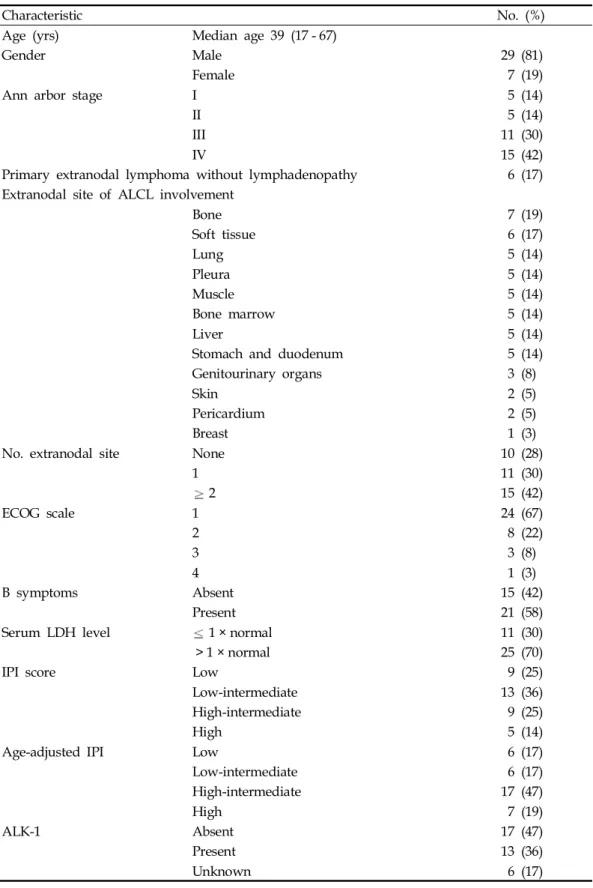
T-cell non-Hodgkin's lymphoma, represents only 2 - 8% of lymphoma overall. Information on the clinical findings of primary systemic ALCL in Korea is limited. Our aims were to report the clinical features and outcomes of primary systemic ALCL. Patients and Methods: We retrospectively reviewed the medical records of 36 adult patients diagnosed with primary systemic ALCL at Asan Medical Center from February 1995 through June 2006. Results: Of 36 patients, 29 were male. The median age was 39 years (range, 17 - 67 years), and 26 (72%) presented with Ann Arbor stages III and IV. The most commonly involved extranodal sites were bone (n = 7) and soft tissue (n = 6). Thirty-two of all patients (89%) were treated with an anthracycline-based regimen including cyclophosphamide/doxorubicin/vincristine/prednisone (CHOP) as induction chemotherapy; 16 (50%) achieved complete remission (CR), and 13 (41%) achieved partial remission (PR).
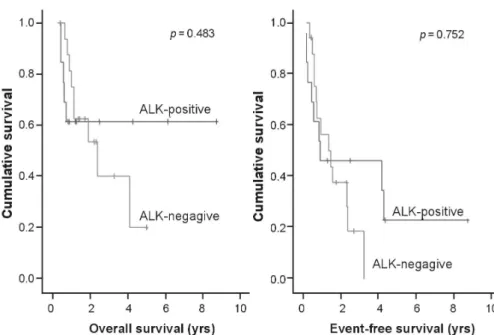
Median overall survival (OS) and event-free survival (EFS) were 49 and 17 months, respectively. Univariate analysis showed that performance status (p = 0.035), international prognostic index (IPI) (p = 0.025), and age-adjusted IPI (p = 0.034) were significant prognostic factors for OS, whereas anaplastic lymphoma kinase (ALK) expression did not affect OS (p = 0.483). Conclusion: Our retrospective analysis of Korean primary systemic ALCL patients showed that median OS was 49 months and overall response to CHOP was 91%. Perfor- mance, IPI, and age-adjusted IPI were predictors of OS, whereas ALK expression did not have prognostic significance.
Key Words: Anaplastic large cell lymphoma, anaplastic lymphoma kinase, CD 30, prognosis, International Prognostic Index
INTRODUCTION
Anaplastic large cell lymphoma (ALCL) is a CD30-positive neoplasm of T-cell or null-cell line- age with characteristic clinicopathologic features, and accounts for 2 - 8% of all lymphomas.
1Two subsets of systemic ALCL are currently recognized in the World Health Organization (WHO) classifi- cation scheme.
2One subset expresses the oncogenic protein anaplastic lymphoma kinase (ALK) as a result of either the t(2;5)(p23;q35) translocation or variant alk rearrangement that does not involve npm. The second subset includes ALK-negative (ALK ) tumors that are morphologically similar to ALK-positive (ALK+) ALCL and also express CD30.
3-8The major subgroups of primary ALCL also have been distinguished by the WHO classification
2as (1) systemic ALCL, a heterogeneous subgroup with a broad spectrum of morphology, immuno- phenotype, and clinical characteristics; and (2) cutaneous ALCL, a spectrum of cutaneous CD30+
lymphoproliferative disorders with a uniformly good prognosis.
9The treatment of primary cutaneous ALCL is conservative, consisting of resection, with or without irradiation or low-dose methotrexate, which is used in multifocal disease not amenable to localized therapy. In contrast, primary systemic ALCL requires multiagent chemotherapy.
10Despite recent advances in the characterization of ALCL, little is known regarding the clinical characteristics of Korean adult patients with primary systemic ALCL. We therefore analyzed the clinical features and treatment outcomes of 36 adult patients with primary systemic ALCL in
Primary Systemic Anaplastic Large Cell Lymphoma in Korean Adults: 11 Years' Experience at Asan Medical Center
Soo Jung Park,
1Shin Kim,
1Dae Ho Lee,
1Yong Pil Jeong,
1Yunjeong Bae,
1Eun Mee Han,
2Jooryung Huh,
3and Cheolwon Suh
1Departments of
1Internal Medicine and
3Pathology, Asan Medical Center, University of Ulsan College of Medicine, Seoul;
2