INTRODUCTION
Prostate cancer (PCa) is the most common, newly diagnosed cancer in men.
1Choice of therapy is based on risk stratifica- tion of the disease or the patient’s morbidity. Androgen depri-
vation therapy (ADT) represents a cornerstone of treatment for PCa.
2The association between androgen suppression and tumor regression was first described by Huggins
3in 1942, and the efficacy and usage of ADT for various stages of PCa have since been extensively studied.
National Comprehensive Cancer Network (NCCN
®) guide- lines currently recommend ADT as the primary treatment for metastatic PCa.
4In addition, external irradiation combined with ADT in patients with locally advanced PCa improves both clinical disease-free and overall survival (OS), as compared to radiotherapy alone.
5Radical prostatectomy (RP) followed by immediate adjuvant ADT for lymph node-positive metastatic PCa also improves cancer-specific survival (CSS) and OS.
6The efficacy of ADT for the treatment of clinical localized PCa re- mains controversial. Primary ADT does not improve survival in cases of localized PCa
7; however, adjuvant ADT improves Received: February 2, 2018 Revised: April 4, 2018
Accepted: April 17, 2018
Corresponding author: Young Deuk Choi, MD, PhD, Department of Urology and Urological Science Institute, Yonsei University College of Medicine, 50-1 Yonsei-ro, Seodaemun-gu, Seoul 03722, Korea.
Tel: 82-2-2228-2317, Fax: 82-2-312-2538, E-mail: [email protected]
•The authors have no financial conflicts of interest.
© Copyright: Yonsei University College of Medicine 2018
This is an Open Access article distributed under the terms of the Creative Com- mons Attribution Non-Commercial License (http://creativecommons.org/licenses/
by-nc/4.0) which permits unrestricted non-commercial use, distribution, and repro- duction in any medium, provided the original work is properly cited.
Impact of Early Salvage Androgen Deprivation Therapy in Localized Prostate Cancer after Radical
Prostatectomy: A Propensity Score Matched Analysis
Jae Won Park, Won Sik Jang, Dong Hoon Koh, Won Sik Ham, Koon Ho Rha, Sung Joon Hong, and Young Deuk Choi
Department of Urology, Urological Science Institute, Yonsei University College of Medicine, Seoul, Korea.
Purpose: Androgen deprivation therapy (ADT) is used as a salvage treatment for men with biochemical recurrence (BCR) of prostate cancer (PCa) following initial radical prostatectomy (RP). The optimal time at which to begin salvage ADT (sADT) re- mains controversial. In this retrospective study, we evaluated the efficacy of initiating sADT in patients before prostate-specific antigen (PSA) values met the clinical definition of BCR.
Materials and Methods: We identified 484 PCa patients who received sADT for BCR after RP. Median follow-up was 82 months.
Propensity score matching was performed based on preoperative PSA level, pathologic T stage, and Gleason score. Patients were assigned to two groups of 169 patients each, based on PSA levels at the time of sADT: Group A (without meeting of the definition of BCR) and Group B (after BCR). Kaplan-Meier survival analyses and Cox regression analyses were performed.
Results: The median PSA level at sADT initiation was 0.12 ng/mL in group A and 0.42 ng/mL in group B. Kaplan-Meier analyses showed that group A had favorable disease progression-free survival (DPFS) and distant metastasis-free survival (DMFS), but did not have better cancer-specific survival (CSS) than group B. In subgroup analyses, group A showed better CSS rates in the non- organ confined PCa group. In Cox regression analyses, early sADT was associated significantly with DPFS and DMFS rates, how- ever, did not correlate with CSS (p=0.107).
Conclusion: Early sADT after RP improved DPFS and DMFS. Furthermore, early sADT patients demonstrated better CSS in non- organ confined PCa.
Key Words: Radical prostatectomy, androgen deprivation therapy, prostate specific antigen, salvage therapy
pISSN: 0513-5796 · eISSN: 1976-2437 Yonsei Med J 2018 Jul;59(5):580-587
https://doi.org/10.3349/ymj.2018.59.5.580
CSS and systematic progression-free survival (PFS) after RP in node-positive PCa.
8ADT benefits patients with biochemical re- currence (BCR) or non-metastatic PCa recurrence after local treatment, especially in high-risk PCa patients.
9While early ADT delays biochemical and clinical disease progression,
10however, the optimal prostate-specific antigen (PSA) levels for initiation of ADT as a salvage treatment for BCR are not well defined.
In this retrospective study, we evaluated the impact of early salvage ADT (sADT) initiated in the presence of increasing PSA levels that did not yet meet the clinically-defined criteria for BCR. Our goal was to determine the optimal timing of ADT as a salvage treatment for BCR after RP to improve outcomes for these patients.
MATERIALS AND METHODS
Study population
After Institutional Review Board approval (4-2017-1206), we retrospectively reviewed medical records of 484 node-negative PCa (T1–T4, N0, and M0) patients who received sADT after RP,
performed at Yonsei University Health System, from 1995 to 2014. Patients with clinical distant metastasis or lymph node metastasis observed by lymph node dissection, and those who received neo-adjuvant therapy were excluded from the study.
Salvage treatment was defined as ADT or radiotherapy initiat- ed following rising PSA levels after RP. We considered ADT or radiotherapy administered in the absence of rising PSA levels after RP as adjuvant therapy, and excluded these patients from our analysis. The type and timing of sADT administered follow- ing observation of rising PSA levels were determined by dis- cretion of physicians. Clinical and pathologic variables as- sessed for this study included age, body mass index (BMI), PSA level, risk classification, type of sADT, PSA doubling time, and pathologic outcomes.
D’Amico risk classification for PCa was performed.
11PSA doubling time was calculated, based on PSA levels at the com- mencement of sADT, compared to the last PSA level recorded prior to sADT. Data regarding mortality and cause of death were obtained from the Yonsei Cancer Registry Center data- base at Severance Hospital. TNM stage was determined accord- ing to the American Joint Committee on Cancer, 8th edition.
12Table 1. Baseline Patient Characteristics (n=484)
Variable Early sADT (n=190) Delayed sADT (n=294) p value
Age (yr) 66 (60−71) 67 (63−70) 0.217
BMI (kg/m
2) 23.9 (22.2−26.1) 24.3 (22.6−25.8) 0.387
Prostate volume measure by TRUS (mL) 28.5 (23.0−38.0) 29.0 (24.0−39.0) 0.461
PSA (ng/mL) 8.3 (5.9−13.1) 11.8 (8.0−17.8) <0.001
PSA (categorical) <0.001
<20 174 (91.6) 230 (78.2)
≥20 16 (8.4) 64 (21.8)
D'Amico risk classification <0.001
Low 32 (16.8) 22 (7.5)
Intermediate 72 (37.9) 83 (28.2)
High 86 (45.3) 189 (64.3)
Pathologic T stage 0.323
Organ confined (T2) 63 (33.2) 85 (28.9)
Non-organ confined (>T2) 127 (66.8) 209 (71.1)
Pathologic Gleason score 0.001
<8 154 (81.1) 198 (67.3)
≥8 36 (18.9) 96 (32.7)
Positive surgical margin 125 (65.8) 200 (68.0) 0.609
PSA at sADT (ng/mL) 0.12 (0.11−0.15) 0.50 (0.29−1.26) 0.021
Type of ADT 0.073
LHRH agonist or antagonist with anti-androgens 104 (54.7) 177 (60.2)
LHRH agonist or antagonist only 64 (33.7) 72 (24.5)
Anti-androgens only 22 (11.6) 45 (15.3)
PSA doubling time at ADT (month) 3.7 (1.9−7.5) 3.5 (1.7−6.9) 0.283
Salvage radiotherapy 29 (15.3) 103 (35.0) <0.001
PSA >0.2 ng/mL after sADT 47 (24.9) 175 (59.9) <0.001
BMI, body mass index; LHRH, luteinizing hormone-releasing hormone; PSA, prostate-specific antigen; sADT, salvage androgen deprivation therapy; TRUS, tran- srectal ultrasonography.
Data are expressed as median (interquartile range) or n (%).
Statistical analyses
We divided patients into two groups based on PSA level at the initiation of sADT. Group A (early sADT) included patients ad- ministered sADT when PSA levels rose consecutively two or more times without meeting the clinical definition of BCR. BCR was defined as two consecutive increases in PSA levels >0.2 ng/mL after RP.
13Group B (delayed sADT) included patients administered sADT after standard BCR criteria were reached.
Propensity score matching was performed to adjust for con- founders (preoperative PSA level, pathologic T stage (pT), and pathologic Gleason score after RP). We compared clinical and pathologic parameters of each group before and after propen- sity score matching using Student-T tests and chi-square tests.
Age, surgical margin status, type of ADT, and other parameters were compared in each group.
Kaplan-Meier survival analyses were performed to compare disease progression-free survival (DPFS), distant metastasis- free survival (DMFS), and CSS between treatment groups. Sub- groups included patients divided by risk classification (low/
intermediate vs. high-risk), Gleason score (<8 vs. ≥8), and T stage [organ confined (pT2) vs. non-organ confined (pT3 or
4)]. Disease progression was defined as any progression of disease confirmed by radiologic evaluations, and distant me- tastasis was defined as metastasis to bone, non-regional lymph nodes or other sites. Cancer-specific mortality (CSM) was de- fined as death caused by PCa or PCa-related complications.
Univariable and multivariable Cox regression analyses were performed to identify associations between clinical parameters and survival outcomes. All statistical analyses were performed using SPSS Statistics software version 23.0 (IBM Corp., Ar- monk, NY, USA).
RESULTS
A total of 484 node-negative PCa patients who received sADT were evaluated for this study, and their characteristics are sum- marized in Table 1. Of these patients, 190 received early sADT, while 294 received delayed sADT. Median follow-up duration was 82 months. Significantly more patients with delayed sADT had high-risk PCa (45.3% vs. 64.3%, p<0.001) and higher PSA levels preoperatively (8.3 ng/mL vs. 11.8 ng/mL, p<0.001) Table 2. Baseline Patient Characteristics after Propensity Score Matching (n=338)
Variable Early sADT (n=169) Delayed sADT (n=169) p value
Age (yr) 66 (60−71) 66 (62−70) 0.208
BMI (kg/m
2) 23.9 (22.1−26.1) 24.1 (22.4−25.8) 0.262
Prostate volume measure by TRUS (mL) 28.0 (23.0−38.0) 28.0 (23.0−35.0) 0.558
PSA (ng/mL) 9.5 (6.2−14.0) 9.3 (6.4−13.0) 0.882
PSA (categorical) (ng/mL) 0.841
<20 155 (91.7) 156 (92.3)
≥20 14 (8.3) 13 (7.7)
D'Amico risk classification 0.530
Low 23 (13.6) 22 (13.0)
Intermediate 66 (39.1) 57 (33.7)
High 80 (47.3) 90 (53.3)
Pathologic T stage 0.817
Organ confined (T2) 55 (32.5) 57 (33.7)
Non-organ confined (>T2) 114 (67.5) 112 (66.3)
Pathologic Gleason score 0.790
<8 134 (79.3) 132 (78.1)
≥8 35 (20.7) 37 (21.9)
Positive surgical margin 117 (69.2) 111 (65.7) 0.486
PSA at sADT (ng/mL) 0.12 (0.11−0.16) 0.42 (0.27−1.10) 0.010
Type of ADT 0.115
LHRH agonist or antagonist with anti-androgens 90 (53.3) 101 (59.8)
LHRH agonist or antagonist only 57 (33.7) 40 (23.7)
Anti-androgens only 22 (13.0) 28 (16.6)
PSA doubling time (month) 3.4 (1.9−6.1) 3.6 (1.7−7.9) 0.572
Salvage radiotherapy 26 (15.4) 60 (35.5) <0.001
PSA >0.2 ng/mL after sADT 45 (26.8) 96 (57.1) <0.001
BMI, body mass index; LHRH, luteinizing hormone-releasing hormone; PSA, prostate-specific antigen; sADT, salvage androgen deprivation therapy; TRUS, tran- srectal ultrasonography.
Data are expressed as median (interquartile range) or n (%).
compared to those with early sADT. Among delayed sADT pa- tients, a pathologic Gleason Score ≥8 was observed more fre- quently than in patients with early sADT (18.9% vs. 32.7%, p=0.001).
Propensity score matching was used to adjust for confound- ing variables, resulting in 169 patients being assigned to two treatment groups (Groups A and B) based on PSA levels at the time of sADT. Basic characteristics of these two groups are displayed in Table 2. No statistical differences were observed in age, BMI, risk classification, and surgical margin status be- tween groups. The median PSA level at the initiation of sADT was 0.12 ng/mL in group A and 0.42 ng/mL in group B (p=0.010).
The majority of patients in both groups underwent similar treatment regimens which comprised of sADT with luteiniz- ing hormone-releasing hormone (LHRH) agonist with or with- out anti-androgens (Group A 87.0%, Group B 83.4%). Salvage radiotherapy was performed more frequently in group B than in group A (15.4% vs. 35.5%, p<0.001). After sADT, group A dem- onstrated a significantly slower rate of PSA increase to levels above 0.2 ng/mL than did group B (26.8% vs. 57.1%, p<0.001).
During the follow-up period, there were 17 cases of disease pro- gression in group A and 49 cases in group B. Distant metasta- sis was reported in four cases in group A and 24 cases in group B. A total of 11 deaths from PCa were recorded. There was one death from PCa in group A and 10 deaths in group B.
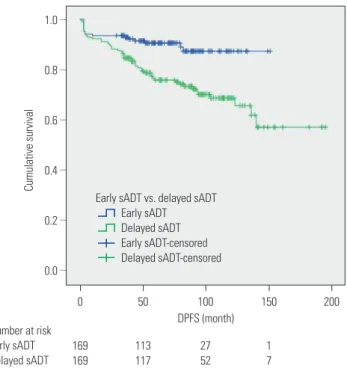
Kaplan-Meier analyses revealed that group A had a signifi- cantly more favorable DPFS than group B, with 7-year DPFS rates of 87.3% and 73.3% (p=0.001), respectively, as shown in Fig. 1. Group A also demonstrated a significantly higher 7-year DMFS than group B (96.1% vs. 88.7%, p=0.001) as displayed in
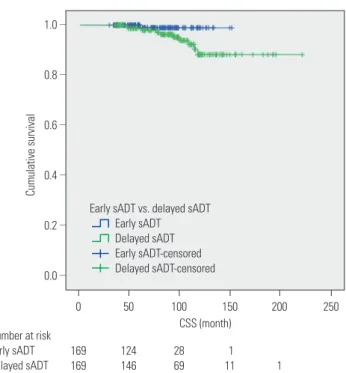
Fig. 2. The 7-year CSS rates of groups A and B were not signifi- cantly different (98.9% vs. 96.3%, p=0.071) (Fig. 3); however, group A experienced fewer mortalities. In a subgroup analysis of patients with non-organ confined PCa, the early sADT group showed statistically favorable CSS compared to those receiving delayed sADT (p=0.042), as shown in Fig. 4. This was not ob- served in other subgroups.
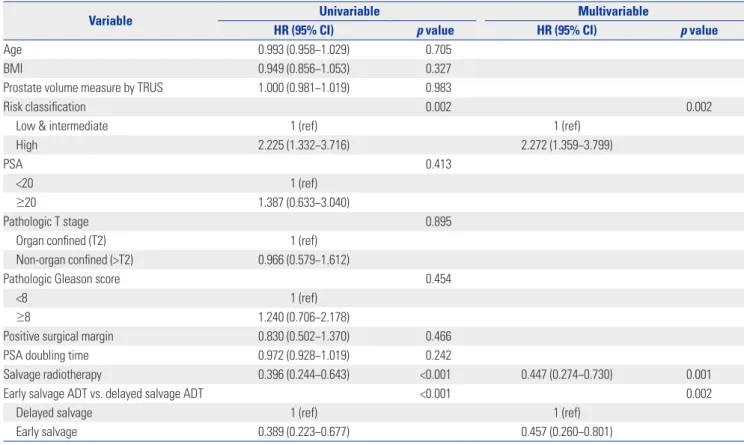
Univariable and multivariable Cox regression analyses re- vealed several factors that were significantly associated with DPFS (Table 3). These included high-risk PCa [hazard ratio (HR) 2.272, 95% confidential interval (CI) 1.359−3.799], salvage radiotherapy (HR 0.447, 95% CI 0.274−0.730), and early sADT (HR 0.457, 95% 0.260−0.801). The results of univariable and multivariable Cox regression analyses for predictive factors of DMFS are presented in Table 4. These predictive factors includ- ed pathologic Gleason score (HR 2.463, 95% CI 1.073−5.654), PSA doubling time (HR 0.875, 95% CI 0.773−0.990), and sal- vage radiotherapy (HR 0.389, 95% CI 0.183−0.826). Early sADT (HR 0.244, 95% CI 0.084−0.714) was positively associated with DMFS. High-risk PCa (HR 9.550, 95% CI 1.049−86.947) and a pathologic Gleason score ≥8 (HR 3.688, 95% CI 1.009−13.484) correlated significantly with CSS, while early sADT was not overall predictive of CSS (Supplementary Table 1, only online).
As shown in Supplementary Table 2 (only online), early sADT in non-organ confined PCa was not associated with CSS in Cox regression analysis, while only pathologic Gleason score was associated with CSS in non-organ confined PCa (HR 10.092, 95% CI 1.930−52.785).
DISCUSSION
Current NCCN
®guidelines recommend ADT for the treatment of advanced PCa.
4Immediate ADT has demonstrated benefits for patients with metastatic PCa in OS or CSS,
14as well as those with node-positive PCa following RP with pelvic lymph node dissection.
6,15In contrast, however, a population-based cohort study demonstrated that primary ADT is not associated with improved survival among men with localized PCa.
7Current guidelines do not recommend ADT for PCa without local de- finitive treatment.
4The utility of ADT after local definitive treatment of clinically localized PCa remains unresolved in the current literature. A study performed by Siddiqui, et al.
8suggests that adjuvant ADT improves CSS and systemic PFS after RP in node-negative PCa.
The benefits of ADT, however, are lost when treatment is initiat- ed after BCR or systemic progression. In a study involving 2096 PCa patients, Garcia-Albeniz, et al.
16suggest that ADT initiated within three months after PSA-only relapse results in similar survival to that observed with deferred ADT (initiated within three months after clinical progression). Furthermore, Duch- esne, et al.
17report that immediate ADT improves OS and time to clinical progression for PCa patients after BCR following cu- 1.0
0.8
0.6
0.4
0.2
0.0
Cumulative survival
DPFS (month) Number at risk
Early sADT Delayed sADT
0
169 169
100
27 52 50
113 117
150
1 7
200
–
–
–
–
–
–
Early sADT vs. delayed sADT Early sADT
Delayed sADT Early sADT-censored Delayed sADT-censored
Fig. 1. Kaplan-Meier curves of DPFS in early sADT group (Group A) and de-
layed sADT group (Group B). sADT, salvage androgen deprivation ther-
apy. DPFS, disease progression-free survival.
1.0
0.8
0.6
0.4
0.2
0.0
Cumulative survival
DMFS (month) Number at risk
Early sADT Delayed sADT
0
169 169
100
27 59 50
124 133
150 200
1
11 1
250
–
–
–
–
–
–
Fig. 2. Kaplan-Meier curves of DMFS in early sADT group (Group A) and delayed sADT group (Group B). sADT, salvage androgen deprivation therapy. DMFS, distant metastasis-free survival.
1.0
0.8
0.6
0.4
0.2
0.0
Cumulative survival
CSS (month) Number at risk
Early sADT Delayed sADT
0
169 169
100
28 69 50
124 146
150 200
1
11 1
250
–
–
–
–
–
–
Fig. 3. Kaplan-Meier curves of CSS in early sADT group (Group A) and delayed sADT group (Group B). sADT, salvage androgen deprivation therapy. CSS, cancer-specific survival.
1.0 0.8 0.6 0.4 0.2 0.0
1.0 0.8 0.6 0.4 0.2 0.0
1.0 0.8 0.6 0.4 0.2 0.0
1.0 0.8 0.6 0.4 0.2 0.0
1.0 0.8 0.6 0.4 0.2 0.0
1.0 0.8 0.6 0.4 0.2 0.0
Cumulative survival Cumulative survival Cumulative survival Cumulative survival Cumulative survival Cumulative survival
CSS (month)
CSS (month)
CSS (month)
CSS (month)
CSS (month)
CSS (month) Low/intermediate-risk PCa
Gleason score ≥8
High-risk PCa
Organ confined PCa (pT2)
Gleason score <8
Non-organ confined PCa (pT3 or 4) 0
0
0
0
0
0 100
100
100
100
100
100 50
50
50
50
50
50 150
150
150
150
150
150 200
200
200
200
200
200 250
250
250
– – – – – –
– – – – – –
– – – – – –
– – – – – –
– – – – – –
– – – – – –