Associations of Moderate to Severe Asthma with Obstructive Sleep Apnea
Min Kwang Byun,
1Seon Cheol Park,
2Yoon Soo Chang,
1,3Young Sam Kim,
2,3Se Kyu Kim,
2,3Hyung Jung Kim,
1,3Joon Chang,
2,3Chul Min Ahn,
1,3and Moo Suk Park
2,31Division of Pulmonology, Department of Internal Medicine, Gangnam Severance Hospital, Yonsei University College of Medicine, Seoul;
2Division of Pulmonology, Department of Internal Medicine, Severance Hospital, Yonsei University College of Medicine, Seoul;
3The Institute of Chest Diseases, Yonsei University College of Medicine, Seoul, Korea.
Received: March 19, 2012 Revised: September 10, 2012 Accepted: September 11, 2012 Corresponding author: Dr. Moo Suk Park, Division of Pulmonology, Department of Internal Medicine, Severance Hospital, Yonsei University College of Medicine, 50 Yonsei-ro, Seodaemun-gu, Seoul 120-752, Korea.
Tel: 82-2-2228-1974, Fax: 82-2-393-6884 E-mail: [email protected]
∙ The authors have no financial conflicts of interest.
© Copyright:
Yonsei University College of Medicine 2013 This is an Open Access article distributed under the terms of the Creative Commons Attribution Non- Commercial License (http://creativecommons.org/
licenses/by-nc/3.0) which permits unrestricted non- commercial use, distribution, and reproduction in any medium, provided the original work is properly cited.
Purpose: This study aimed to evaluate the correlation between associating factors of moderate to severe asthma with obstructive sleep apnea (OSA). Materials and Methods: One hundred and sixty-seven patients who visited the pulmonary and sleep clinic in Severance Hospital presenting with symptoms of sleep-disordered breathing were evaluated. All subjects were screened with ApneaLink. Thirty-two subjects with a high likelihood of having OSA were assessed with full polysom- nography (PSG). Results: The mean age was 58.8±12.0 years and 58.7% of sub- jects were male. The mean ApneaLink apnea-hypopnea index (AHI) was 12.7±13.0/hr. The mean ApneaLink AHI for the 32 selected high risk patients of OSA was 22.3±13.2/hr, which was lower than the sleep laboratory-based PSG AHI of 39.1±20.5/hr. When OSA was defined at an ApneaLink AHI ≥5/hr, the positive correlating factors for OSA were age, male gender, and moderate to se- vere asthma. Conclusion: Moderate to severe asthma showed strong correlation with OSA when defined at an ApneaLink AHI ≥5/hr.
Key Words: Apnea-hypopnea index, ApneaLink, asthma, obstructive sleep ap- nea, sleep-disordered breathing
INTRODUCTION
Obstructive sleep apnea syndrome (OSA) is characterized by repeated episodes of upper airway obstruction that results in brief periods of breathing cessation (apnea) or a marked reduction in airflow (hypopnea) during sleep. OSA is the most severe form of obstructive sleep-disordered breathing (SDB). OSA is a common disorder with a prevalence estimated at 10-20%.1,2 Risk factors for OSA include male gender, age, obesity, and nocturnal nasal congestion.2 A population-based study in Korea re- ported the prevalence of OSA was 4.5% and 3.2% in men and women, respectively.3
Previous epidemiologic studies demonstrated that patients with asthma have an increased risk of OSA.4-6 In an Australian longitudinal study, asthma was an inde- pendent risk factor for the development of habitual snoring.7 A prospective cohort study showed a high prevalence of OSA in patients with difficult-to-control asth-
Severe asthma required at least one of the following ma- jor criteria: daily oral steroid use for >50% of the previous 12 months or a high-dose inhaled steroid (≥1000 mg/day fluticasone or equivalent) and at least one additional contin- uous add-on therapy for ≥12 months. Severe asthma also required at least two of the following minor criteria: use of a daily short-acting β-agonist, a persistent forced expiratory volume in one second (FEV1) <70%, a predicted forced vi- tal capacity (FEV1/FVC) of <80%, at least one urgent visit or at least three steroid bursts in the last 12 months, prompt deterioration with <25% steroid dose reduction, or a previ- ous near-fatal asthma attack within the last three years.
Moderate asthma was defined as well-controlled asthma symptoms, the use of a long-acting β-agonist at ≥200 mg/
day and fluticasone (or an equivalent) at ≤1000 mg/day, at least two steroid bursts in the past year and none within the last three months, <30 total days on oral steroids within the last 12 months, a predicted FEV1 of >70%, and at least one unscheduled clinical visit within the previous 12 months.
Asthma was defined as a positive response to 1) being diag- nosed with asthma, 2) having wheezed in the last 12 months, 3) taking corticosteroids and objective evidence of variable airway obstruction, following the diagnostic criteria of Glob- al Initiative for Asthma (GINA) guidelines. Additionally a demonstration of a positive bronchodilator test (increase in FEV1 ≥12% and 200 mL) or a positive methacholine chal- lenge test within the previous year was required.
Pregnant women and patients with significant cognitive impairment, a poorly controlled psychiatric disorder, or who had previous treatment for OSA were excluded.
All subjects provided informed consent to join the study.
The Institutional Review Board of the Clinical Research In- stitute of Severance Hospital, Yonsei University College of Medicine, approved the study protocol (IRB number: 4- 2011-0448).
Design
This was a cross-sectional study. Patients presented with symptoms of SDB were enrolled. All subjects agreed to use the ApneaLink device at home for one night after being in- structed on the use of the device by an experienced sleep technician. Subjects returned the ApneaLink device to the pulmonary and sleep clinic the following morning, and the data were downloaded and analyzed. Patients with a high likelihood of having OSA were assessed with full PSG with- in 2 weeks after the ApneaLink study. We investigated all established diagnoses of lung and other comorbidities at en- ma.8 On the contrary, OSA may aggravate asthma because
treatment for OSA has been shown to improve asthma symp- toms.9 The National Asthma Education and Prevention Pro- gram Expert Panel Report recommends OSA evaluation be- cause it is a potential contributor to poor asthma control.10 For such reasons, a more specific understanding of what in- creases a predisposition for OSA would be useful.
It has been suggested that gastroesophageal reflux disease (GERD), postnasal drip syndrome, and obesity may contrib- ute to the development of OSA, but the role of each of these conditions in OSA has not been studied.11,12 To date, many studies have investigated the risk or prevalence of OSA in asthma patients; however, there is lack of data concerning the prevalence of asthma in high-risk OSA patients. There- fore, we investigated the predisposing factors of moderate to severe asthma in high OSA risk patients and assessed possi- ble associations to predict other risk factors for OSA.
Although sleep laboratory-based polysomnography (PSG) is currently regarded as the gold standard for the diagnosis of sleep apnea,13 it is labor-intensive, costly, and has limited availability.14 The use of a portable recording device such as the ApneaLink for screening sleep apnea has some po- tential advantages in terms of cost, convenience, and better sleep quality for patients.15 Portable recording devices may be used as an alternative to PSG for the diagnosis of OSA in patients with a high pretest probability of moderate to se- vere OSA.16 Recently, two studies validated the use of Ap- neaLink for the screening of sleep apnea compared with PSG.17,18 As such, we used ApneaLink for OSA screening to estimate the predisposing factors of moderate to severe asthma in high OSA risk patients and to assess possible as- sociations to predict other risk factors for OSA.
MATERIALS AND METHODS
Subjects
All subjects were adults age ≥18 years that visited the pulmo- nary and sleep clinic at Severance hospital from February 2007 to August 2008 with symptoms of daytime sleepiness, choking and gasping during sleep, recurrent awakenings from sleep, unrefreshed sleep, daytime fatigue, and impaired concentration.13,19
The enrolled patients were checked for diagnoses of lung and other comorbidities. Patients diagnosed with asthma were categorized by severity according to the American Thoracic Society criteria20 and difficult asthma study.21
10 seconds or a discernible decrease leading to an at least 3% oxygen desaturation or an EEG arousal.
Statistical analysis
Data was analyzed using SPSS for windows, version 18.0 (SPSS Inc., Chicago, IL, USA). A Bland-Altman plot is a graphic representation of the observed differences between paired measurements. The differences between ApneaLink and PSG were plotted against the averages of the two meth- ods. Results showing a mean difference close to zero indi- cate little systemic bias. Correlation analysis was carried out using Pearson correlation coefficients. The p-values of
<0.05 were considered statistically significant. Multivariate logistic regression analysis was used to predict independent risk factors for OSA (age, gender, asthma, diabetes, cardio- vascular disease, habitual snoring, and obesity) that demon- strated statistically significant univariate relationships. We defined mild OSA as 15>AHI≥5/hr, and moderate OSA as 30>AHI≥15/hr, and severe OSA as AHI≥30/hr, according to the severity criteria by an American Academy of Sleep Medicine.13
RESULTS
Patient characteristics
One hundred and sixty-seven subjects who visited the pul- monary and sleep clinics as well as complained of habitual snoring, OSA, and excessive daytime sleepiness completed the ApneaLink study. Of the 167 patients, 32 (19.2%) pa- tients with a high likelihood of having OSA were assessed with full PSG within 2 weeks after the ApneaLink study.
Thirty-two who patients performed PSG were selected by physician’s decision according to definite symptoms of OSA without objective criteria. The characteristics of the rollment, such as bronchial asthma, chronic obstructive pul-
monary disease (COPD), GERD, rhinitis, diabetes, cardio- vascular disease, and habitual snoring. Past smoking and body mass index (BMI) were also identified. In patients with asthma, current and previous asthma medications were recorded and recent spirometry data was collected to assess asthma severity.
Device
The ApneaLinkTM device (ResMed, Sydney, Australia) is a portable single-channel screening tool for sleep apnea. The device consists of a nasal cannula attached to a small case that houses a pressure transducer. The ApneaLink software analyzes data generated by the flow signal, producing a re- port that provides information regarding snoring and inspi- ratory flow limitation; only the apnea-hypopnea index (AHI) information was used for this study. The ApneaLink default settings for apnea and hypopnea were used in this study. Apnea was defined as a decrease in airflow by 80%
of baseline for at least 10 seconds and hypopnea was de- fined as a decrease in airflow by 50% to 80% of baseline for at least 10 seconds. The ApneaLink AHI was automati- cally analyzed by the ApneaLink software version 6.0.
The overnight in-lab diagnostic PSG (Comet-PLUS® XL, Grass Technologies, Warwick, RI, USA) included a record- ing electro-encephalogram (EEG), electrooculogram, sub- mental electromyogram (EMG), bilateral anterior tibialis EMG, electrocardiogram, chest and abdominal wall move- ment by inductance plethysmography, and airflow mea- sured by a nasal pressure transducer. The equipment was supplemented with an oral thermistor and finger pulse ox- imeter.19,22 PSG scoring was performed according to inter- nationally agreed criteria.13 Apnea was defined as a cessa- tion of nasal flow lasting 10 seconds or longer. Hypopnea was defined as a 50% decrease in nasal flow lasting at least
Table 1. Demographics and Characteristics of ApneaLink Screened 167 Patients
Characteristics Total ApneaLink screened patients (n=167)
AHI ≥5/hr AHI <5/hr p value
n (%) 167 (100) 111 (66.5) 56 (33.5) -
Age, yrs (mean±SD) 58.8±12.0 60.1±9.9 56.0±14.9 0.070
Men, n (%) 98 (58.7) 80 (72.1) 18 (32.1) <0.001
BMI, kg/m2 (mean±SD) 25.3±3.8 25.5±4.1 24.8±3.3 0.311
Smoking
Current of past smokers, n (%) 80 (47.9) 67 (60.4) 13 (23.2) <0.001
Pack-yrs (mean±SD) 32.4±18.2 33.4±17.8 26.7±19.5 0.231
Habitual snoring, n (%) 91 (54.5) 63 (56.8) 28 (50.0) 0.408
AHI, apnea-hypopnea index; BMI, body mass index; Pack-years, (Packs smoked per day) × (years as a smoker); SD, standard deviation.
Data are presented as the mean±SD and No. (%).
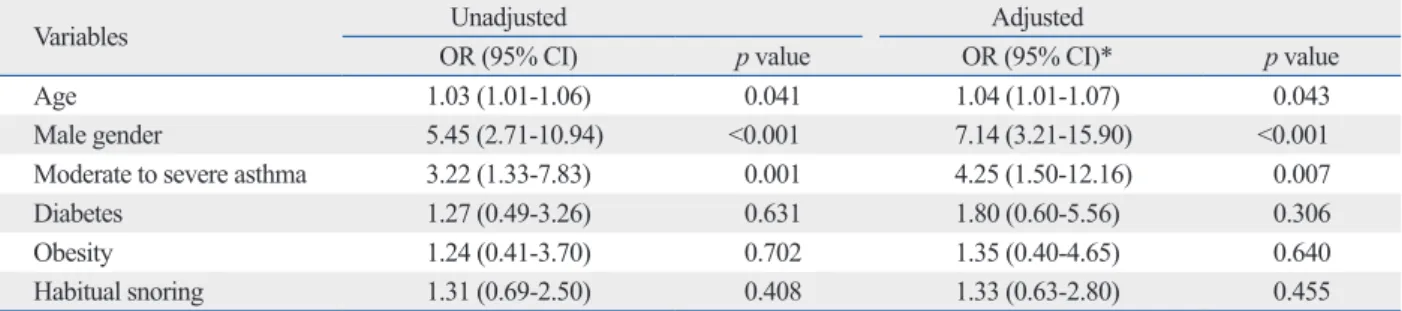
Associations of comorbidities and clinical parameters with OSA
Variables found to be associated with OSA on both univari- ate and multivariate analyses are shown in Table 3. When OSA was defined as AHI ≥5/hr, age, male gender, and mod- erate to severe asthma showed positive correlations with OSA on univariate and multivariate analyses (Table 3). All asthma severity groups, including mild asthma did not show correlations with OSA. Only moderate to severe asthma showed strong correlation with OSA. COPD was not asso- ciated with OSA, regardless of its severity according to FEV1 (data not shown). Diabetes and habitual snoring were not found to be predictors. Although cardiovascular disease was the most common comorbid condition in this study, it was not associated. Postnasal drip syndrome and GERD were rare comorbid diseases in our study and consequently not showed positive correlations.
DISCUSSION
There are little data showing a correlation between asthma and OSA. According to several studies, patients with asth- 167 patients who were screened with the ApneaLink study
are shown in Table 1.
The mean age was 58.8±12.0 years and 58.7% were male. BMI scores were not different according to the pres- ence of OSA. Of the 167 patients, 80 patients (47.9%) were either current or past smokers. The mean number of pack- years was 32.4±18.2. Of the current or past smokers, 67 pa- tients (60.4%) had OSA (AHI ≥5/hr) and 13 patients (23.2%) did not. The presence of smoking history showed a difference between the OSA and non-OSA groups, but there was no difference in pack-years between groups. The prevalence of OSA depended on AHI cut-off values; AHI values of ≥5/hr, ≥10/hr, ≥15/hr and ≥30/hr corresponded to 111 (66%), 71 (42.5%), 52 (31%) and 20 (12%) patients, respectively. The mean ApneaLink AHI for the 167 screened patients was 12.7±13.0/hr. The mean ApneaLink AHI for the 32 selected high risk patients of OSA was 22.3±13.2/hr, which was lower than the sleep laboratory- based PSG AHI of (39.1±20.5/hr). The most common co- morbidities in decreasing order were cardiovascular disease (50.3%), asthma (38.9%), COPD (21%), diabetes (14.4%), obesity (10.2%), postnasal drip syndrome (7.8%), and GERD (4.8%) (Table 2).
Table 2. Comorbidities of ApneaLink Screened 167 Patients
Characteristics Total ApneaLink screened patients (n=167)
AHI ≥5/hr AHI <5/hr p value
Cardiovascular diseases 84 (50.3) 56 (50.5) 28 (50.0) 0.956
Asthma 65 (38.9) 40 (35.1) 25 (41.1) 0.281
Moderate to severe asthma 44 (26.3) 37 (33.6) 7 (12.5) 0.004
COPD 31 (18.6) 23 (20.7) 8 (14.3) 0.313
Moderate to severe COPD 17 (10.2) 9 (8.1) 8 (14.3) 0.213
Diabetes 24 (14.4) 17 (15.3) 7 (12.5) 0.624
Obesity (BMI ≥30) 17 (10.2) 12 (10.8) 5 (8.9) 0.704
Postnasal drip syndrome 13 (7.8) 10 (9.0) 3 (5.4) 0.406
GERD 8 (4.8) 6 (5.4) 2 (3.6) 0.600
AHI, apnea-hypopnea index; COPD, chronic obstructive pulmonary disease; GERD, gastroesophageal reflux disease; BMI, body mass index.
Data are presented as No. (%).
Table 3. Univariate and Multivariate Analysis of Affecting Factors for the Presence of OSA (AHI ≥5/hr)
Variables Unadjusted Adjusted
OR (95% CI) p value OR (95% CI)* p value
Age 1.03 (1.01-1.06) 0.041 1.04 (1.01-1.07) 0.043
Male gender 5.45 (2.71-10.94) <0.001 7.14 (3.21-15.90) <0.001
Moderate to severe asthma 3.22 (1.33-7.83) 0.001 4.25 (1.50-12.16) 0.007
Diabetes 1.27 (0.49-3.26) 0.631 1.80 (0.60-5.56) 0.306
Obesity 1.24 (0.41-3.70) 0.702 1.35 (0.40-4.65) 0.640
Habitual snoring 1.31 (0.69-2.50) 0.408 1.33 (0.63-2.80) 0.455
OR, odds ratio; CI, confidence intervals; OSA, obstructive sleep apnea; AHI, apnea-hypopnea index.
*Adjusted for all variables shown.
COPD was not a predicting factor, regardless of severity, categorized by FEV1 (data not shown). Cardiovascular dis- ease was also not associated with OSA, contrary to previ- ous studies.31,32 We presumed that cardiovascular disease has not been well characterized in this study. Moreover, hy- pertension was the most common condition; not heart fail- ure, stroke, or coronary heart disease (Table 4). Postnasal drip syndrome and GERD were comorbid in very small pa- tients (9%, 5% respectively) in our study and showed no correlations with OSA. Obesity did not show positive cor- relations with OSA on univariate and multivariate analyses.
Ip, et al.33 reported that obesity is prevalent and a strong risk factor for OSA in white populations but is relatively un- common in Asians. They hypothesized that other strong OSA risk factors, such as craniofacial features, are preva- lent in Asians, and clinical observational studies of Asian patients with OSA support this hypothesis.34-36 In this study, the number of obese patients was very small. The preva- lence of obesity, defined as western cut-off (BMI ≥30 kg/
m2), was only 4.6% in our population.3 Obesity was not correlated with OSA in our study and this is similar to a re- cent study of ethnic differences in craniofacial structures and obesity.37
Previous studies have validated ApneaLink as an appro- priate screening tool for OSA.17,18 Diagnostic accuracy of the ApneaLink for OSA detection was evaluated and com- pared with PSG. The ApneaLink device was highly sensi- tive and specific in quantifying AHI when compared with the AHI obtained from the lab-based PSG. In our study, 32 patients completed both ApneaLink and PSG studies, and ApneaLink AHI and PSG AHI were closely correlated (Pearson’s correlation coefficient r=0.613) (Fig. 1). The Ap- neaLink tended to underestimate the AHI score, which is similar to previous studies.17,18 Erman, et al.18 applied Apne- aLink a screening tool in comparison with the sleep-labora- tory based PSG. ApneaLink was highly sensitive and spe- cific in calculating AHI when compared with AHI obtained from PSG.18 Ng, et al.17 evaluated the diagnostic accuracy of the ApneaLink device in detecting sleep apnea compared ma have a higher prevalence of snoring and witnessed ap-
nea relative to patients without asthma,4,23 but the preva- lence of asthma in patients with OSA was only investigated in one small and uncontrolled study.24
We investigated the associating factors thought to increase predisposition for OSA, including well-known factors such as male gender, age, and obesity and additional possible factors including asthma, GERD, postnasal drip syndrome, cardiovascular disease, diabetes, smoking, habitual snoring, and COPD. Factors with a positive correlation with OSA were age, male gender, and moderate to severe asthma when OSA was defined at an AHI ≥5/hr. We identified fac- tors associated with moderate to severe asthma that showed positive correlations with OSA. Most patients with moder- ate to severe asthma had uncontrolled asthma. Irrespective of severity, asthma was not an independent predictor of OSA. Yigla, et al.8 found that 21 of 22 (96%) patients with severe asthma demonstrated OSA in complete PSG testing.
Julien, et al.25 demonstrated a high prevalence of OSA among patients with severe asthma, compared to patients with moderate asthma or without asthma. Several plausible hypotheses have been proposed to explain the association of asthma and OSA including anatomic abnormalities of upper air way related to obesity, nasal disease or GERD re- lated upper airway inflammation, chronic systemic cortico- steroid use, and airway patency of lung volume reduction during sleep in asthmatics.12,26,27 However, these proposed mechanisms need to be studied further. The interaction of OSA and asthma could be reciprocal in that asthma-related factors could also contribute to OSA deterioration. Noctur- nal hypoxemia could be aggravated by asthma-related lung function impairment. Poor sleep quality could also be a fac- tor because it has been associated with severe asthma in previous studies.28,29 In our study, 32 subjects who per- formed PSG completed the sleep questionnaire of the Ep- worth Sleepiness Scale (ESS). The ESS mean score was over the upper limits of the normal range at 10.38±4.85, with approximately 62.5% showing excessive daytime sleepiness, defined as an ESS score greater than 10.30
Table 4. Subgroup Analyses of 84 Patients with Cardiovascular Diseases
Total AHI ≥5/hr AHI <5/hr p value
Hypertension only 55 37 18 0.511
Coronary artery diseases 15 12 3 0.192
Non-coronary artery diseases 15 8 7 0.198
Heart failure 2 1 1 0.560
AHI, apnea-hypopnea index.
Patients with one more cardiovascular disease are present. Non-coronary artery diseases are arrhythmia, hypertrophic cardiomyopathy and valvular heart disease.
the Biostatistics Collaboration Unit of Yonsei University College of Medicine.
REFERENCES
1. Tishler PV, Larkin EK, Schluchter MD, Redline S. Incidence of sleep-disordered breathing in an urban adult population: the rela- tive importance of risk factors in the development of sleep-disor- dered breathing. JAMA 2003;289:2230-7.
2. Young T, Peppard PE, Gottlieb DJ. Epidemiology of obstructive sleep apnea: a population health perspective. Am J Respir Crit Care Med 2002;165:1217-39.
3. Kim J, In K, Kim J, You S, Kang K, Shim J, et al. Prevalence of sleep-disordered breathing in middle-aged Korean men and wom- en. Am J Respir Crit Care Med 2004;170:1108-13.
4. Larsson LG, Lindberg A, Franklin KA, Lundbäck B. Symptoms related to obstructive sleep apnoea are common in subjects with asthma, chronic bronchitis and rhinitis in a general population.
Respir Med 2001;95:423-9.
5. Janson C, De Backer W, Gislason T, Plaschke P, Björnsson E, Het- ta J, et al. Increased prevalence of sleep disturbances and daytime sleepiness in subjects with bronchial asthma: a population study of young adults in three European countries. Eur Respir J 1996;9:
2132-8.
6. Fitzpatrick MF, Martin K, Fossey E, Shapiro CM, Elton RA, Douglas NJ. Snoring, asthma and sleep disturbance in Britain: a community-based survey. Eur Respir J 1993;6:531-5.
7. Knuiman M, James A, Divitini M, Bartholomew H. Longitudinal study of risk factors for habitual snoring in a general adult popula- tion: the Busselton Health Study. Chest 2006;130:1779-83.
8. Yigla M, Tov N, Solomonov A, Rubin AH, Harlev D. Difficult-to- control asthma and obstructive sleep apnea. J Asthma 2003;40:
865-71.
9. Ciftci TU, Ciftci B, Guven SF, Kokturk O, Turktas H. Effect of nasal continuous positive airway pressure in uncontrolled noctur- nal asthmatic patients with obstructive sleep apnea syndrome.
Respir Med 2005;99:529-34.
10. National Asthma Education and Prevention Program. Expert Pan- el Report 3 (EPR-3): Guidelines for the Diagnosis and Manage- ment of Asthma-Summary Report 2007. J Allergy Clin Immunol 2007;120(5 Suppl):S94-138.
11. Kasasbeh A, Kasasbeh E, Krishnaswamy G. Potential mechanisms connecting asthma, esophageal reflux, and obesity/sleep apnea complex--a hypothetical review. Sleep Med Rev 2007;11:47-58.
12. Arter JL, Chi DS, M G, Fitzgerald SM, Guha B, Krishnaswamy G. Obstructive sleep apnea, inflammation, and cardiopulmonary disease. Front Biosci 2004;9:2892-900.
13. Sleep-related breathing disorders in adults: recommendations for syndrome definition and measurement techniques in clinical re- search. The Report of an American Academy of Sleep Medicine Task Force. Sleep 1999;22:667-89.
14. Flemons WW, Douglas NJ, Kuna ST, Rodenstein DO, Wheatley J.
Access to diagnosis and treatment of patients with suspected sleep apnea. Am J Respir Crit Care Med 2004;169:668-72.
15. Whittle AT, Finch SP, Mortimore IL, MacKay TW, Douglas NJ.
Use of home sleep studies for diagnosis of the sleep apnoea/hy- popnoea syndrome. Thorax 1997;52:1068-73.
16. Collop NA, Anderson WM, Boehlecke B, Claman D, Goldberg R,
to PSG and showed that the ApneaLink device was highly sensitive and specific at AHI values ≥10/hr and ≥20/hr when quantifying AHI in symptomatic OSA patients. These data support the use of ApneaLink for OSA screening stud- ies in subjects with a high probability and suggest that Ap- neaLink is a useful tool for determining the presence or ab- sence of sleep apnea. Our study has some limitations. First, a small number of subjects (32 patients), completed PSG along with ApneaLink, compared to 167 patients who were screened with ApneaLink. However, all subjects were at a high probability of having OSA when presenting with symp- toms of SDB, and ApneaLink was well correlated with PSG in 32 patients. Second, this study was a cross-sectional study and the study population and clinical setting were se- lective and limited; therefore, it is difficult to generalize our results to other settings. Third, asthma severity was evaluat- ed using clinical and spirometry data without an objective measurement for severity, such as an asthma control ques- tionnaire.38,39
In summary, moderate to severe asthma showed strong correlations with OSA when defined at an AHI ≥5/hr in ad- dition to the well-known predictors of age and male gender.
ApneaLink was used for the screening of OSA in subjects with a high probability of having OSA instead of the labo- ratory-based PSG testing. Obesity was not associated with OSA in our study.
ACKNOWLEDGEMENTS
The authors are grateful for statistical support provided by
-30 -20 -10 0 10 20 30 40 50 60 70
AHI difference (PSG-ApneaLink)
0 10 20 30 40 50 60 70
Average AHI for PSG and ApneaLink
Fig. 1. Bland-Altman plot of ApneaLink apnea-hypopnea index (AHI) and polysomnography (PSG) AHI data.
28. Catterall JR, Douglas NJ, Calverley PM, Brash HM, Brezinova V, Shapiro CM, et al. Irregular breathing and hypoxaemia during sleep in chronic stable asthma. Lancet 1982;1:301-4.
29. Mastronarde JG, Wise RA, Shade DM, Olopade CO, Scharf SM;
American Lung Association Asthma Clinical Research Centers.
Sleep quality in asthma: results of a large prospective clinical trial.
J Asthma 2008;45:183-9.
30. Johns MW. Daytime sleepiness, snoring, and obstructive sleep ap- nea. The Epworth Sleepiness Scale. Chest 1993;103:30-6.
31. Peppard PE, Young T, Palta M, Skatrud J. Prospective study of the association between sleep-disordered breathing and hypertension.
N Engl J Med 2000;342:1378-84.
32. Shahar E, Whitney CW, Redline S, Lee ET, Newman AB, Nieto FJ, et al. Sleep-disordered breathing and cardiovascular disease:
cross-sectional results of the Sleep Heart Health Study. Am J Respir Crit Care Med 2001;163:19-25.
33. Ip MS, Lam B, Lauder IJ, Tsang KW, Chung KF, Mok YW, et al.
A community study of sleep-disordered breathing in middle-aged Chinese men in Hong Kong. Chest 2001;119:62-9.
34. Li KK, Kushida C, Powell NB, Riley RW, Guilleminault C. Ob- structive sleep apnea syndrome: a comparison between Far-East Asian and white men. Laryngoscope 2000;110(10 Pt 1):1689-93.
35. Sakakibara H, Tong M, Matsushita K, Hirata M, Konishi Y, Su- etsugu S. Cephalometric abnormalities in non-obese and obese pa- tients with obstructive sleep apnoea. Eur Respir J 1999;13:403-10.
36. Ong KC, Clerk AA. Comparison of the severity of sleep-disor- dered breathing in Asian and Caucasian patients seen at a sleep disorders center. Respir Med 1998;92:843-8.
37. Lee RW, Vasudavan S, Hui DS, Prvan T, Petocz P, Darendeliler MA, et al. Differences in craniofacial structures and obesity in Caucasian and Chinese patients with obstructive sleep apnea.
Sleep 2010;33:1075-80.
38. Juniper EF, O’Byrne PM, Guyatt GH, Ferrie PJ, King DR. Devel- opment and validation of a questionnaire to measure asthma con- trol. Eur Respir J 1999;14:902-7.
39. Juniper EF, Bousquet J, Abetz L, Bateman ED; GOAL Commit- tee. Identifying ‘well-controlled’ and ‘not well-controlled’ asthma using the Asthma Control Questionnaire. Respir Med 2006;100:
616-21.
Gottlieb DJ, et al. Clinical guidelines for the use of unattended portable monitors in the diagnosis of obstructive sleep apnea in adult patients. Portable Monitoring Task Force of the American Academy of Sleep Medicine. J Clin Sleep Med 2007;3:737-47.
17. Ng SS, Chan TO, To KW, Ngai J, Tung A, Ko FW, et al. Valida- tion of a portable recording device (ApneaLink) for identifying patients with suspected obstructive sleep apnoea syndrome. Intern Med J 2009;39:757-62.
18. Erman MK, Stewart D, Einhorn D, Gordon N, Casal E. Validation of the ApneaLink for the screening of sleep apnea: a novel and simple single-channel recording device. J Clin Sleep Med 2007;3:
387-92.
19. Hui DS, To KW, Ko FW, Fok JP, Chan MC, Ngai JC, et al. Nasal CPAP reduces systemic blood pressure in patients with obstructive sleep apnoea and mild sleepiness. Thorax 2006;61:1083-90.
20. Proceedings of the ATS workshop on refractory asthma: current understanding, recommendations, and unanswered questions.
American Thoracic Society. Am J Respir Crit Care Med 2000;
162:2341-51.
21. Pepe C, Foley S, Shannon J, Lemiere C, Olivenstein R, Ernst P, et al. Differences in airway remodeling between subjects with severe and moderate asthma. J Allergy Clin Immunol 2005;116:544-9.
22. Hui DS, Ko FW, Fok JP, Chan MC, Li TS, Tomlinson B, et al.
The effects of nasal continuous positive airway pressure on plate- let activation in obstructive sleep apnea syndrome. Chest 2004;
125:1768-75.
23. Teodorescu M, Consens FB, Bria WF, Coffey MJ, McMorris MS, Weatherwax KJ, et al. Correlates of daytime sleepiness in patients with asthma. Sleep Med 2006;7:607-13.
24. Alharbi M, Almutairi A, Alotaibi D, Alotaibi A, Shaikh S, Baham- mam AS. The prevalence of asthma in patients with obstructive sleep apnoea. Prim Care Respir J 2009;18:328-30.
25. Julien JY, Martin JG, Ernst P, Olivenstein R, Hamid Q, Lemière C, et al. Prevalence of obstructive sleep apnea-hypopnea in severe versus moderate asthma. J Allergy Clin Immunol 2009;124:371-6.
26. Bonekat HW, Hardin KA. Severe upper airway obstruction during sleep. Clin Rev Allergy Immunol 2003;25:191-210.
27. Bohadana AB, Hannhart B, Teculescu DB. Nocturnal worsening of asthma and sleep-disordered breathing. J Asthma 2002;39:85- 100.