pISSN 2288-9272 eISSN 2383-8493 J Oral Med Pain 2016;41(4):180-187 https://doi.org/10.14476/jomp.2016.41.4.180
Rapid Eye Movement-Related Obstructive Sleep Apnea: A Study on the Pathogenesis through Clinical and Polysomnographic Features
Ji Hee Jang, Jin Woo Chung
Department of Oral Medicine and Oral Diagnosis, School of Dentistry and Dental Research Institute, Seoul National University, Seoul, Korea
Received December 1, 2016 Revised December 12, 2016 Accepted December 12, 2016
Purpose: The aims of this study were to evaluate the differences of clinical and polysomno- graphic features between rapid eye movement (REM)-related obstructive sleep apnea (OSA) and not-REM-related OSA, and to suggest the pathogenesis according to the REM dependency of OSA.
Methods: One hundred ninety consecutive patients diagnosed with OSA were evaluated clini- cal features and performed full night polysomnography. The patients were divided into REM- related (REM apnea-hypopnea index [AHI] at least two times higher than their non-REM AHI) and not-REM-related (a REM AHI less than two times higher than their non-REM AHI) OSA groups and evaluated the differences in age, body mass index (BMI), neck circumference, Ep- worth Sleepiness Scale score, and parameters of polysomnography.
Results: REM-related patients were younger and showed higher sleep efficacy, low percentage of light sleep stage (stage 1 sleep), and low rate of positional OSA. Age was significantly asso- ciated with REM dependency of OSA and REM AHI were significant correlated with BMI, neck circumference, percentage of sleep in supine position, and percentage time of snoring.
Conclusions: Our results showed that REM-related OSA patients showed less severe polysomno- graphic parameters than not-REM-related patients. However, significant risk factors were dif- fered depending on the REM dependency and OSA severity, and the clinical features correlated with REM AHI and non-REM AHI were also showed differently. We suggest that the occurrence of OSA according to the REM dependency can be based on different mechanisms.
Key Words: Age; Obstructive sleep apnea; Polysomnography; Rapid eye movement; Sleep position
Correspondence to:
Jin Woo Chung
Department of Oral Medicine and Oral Diagnosis, School of Dentistry and Dental Research Institute, Seoul National University, 101 Daehak-ro, Jongno-gu, Seoul 03080, Korea Tel: +82-2-2072-3021 Fax: +82-2-744-9135 E-mail: [email protected]
JOMP Journal of Oral Medicine and Pain
Copyright Ⓒ 2016 Korean Academy of Orofacial Pain and Oral Medicine. All rights reserved.
CC
This is an open-access article distributed under the terms of the Creative Commons Attribution Non-Commercial License (http://creativecommons.org/licenses/by-nc/4.0/),
INTRODUCTION
Sleep-related breathing disorders (SRBD) are characterized by abnormal ventilation that occurs during sleep, and ob- structive sleep apnea (OSA)—characterized by repeated par- tial or complete collapse of the upper airway—is one of its representative forms. 1) Continuation of insufficient oxygen supply during sleep from SRBD can result in serious health issues including excessive daytime sleepiness, reduced cog- nitive function, and increased risk of cardiovascular diseas- es. Therefore, if the patient is aware that he or she may be
having SRBD, he or she must be diagnosed with appropriate standards and treated accordingly. 2)
The gold standard for diagnosing OSA is polysomnogra- phy (PSG). The apnea-hypopnea index (AHI), representing the number of apneas and hypopneas per hour, is also used to diagnose and determine the severity of OSA.
Rapid eye movement (REM) sleep is the important stage
in the sleep cycle, and is characterized by axial muscu-
lar hypotonia and reduced activation of the genioglossus
muscle. 3) Therefore, the risk of apnea event can be increased
is during this stage, because of the airway collapse from
deactivation of the pharyngeal dilator muscle. The patient who exhibits a more than two-fold increase in AHI dur- ing this stage compared to non-REM (NREM) sleep stage is defined as REM-related OSA patient. However, not all OSA patients exhibit higher AHI during REM sleep stage, and in some patients, observed AHI is higher during NREM sleep stage. OSA patients exhibit different sleeping characteris- tics, and their response to the same treatment may vary ac- cording to their sleeping characteristics. Based on these ob- servations, Ayas et al. 4) suggest that OSA should be consid- ered a complex, heterogeneous disorder.
The aims of this study were to evaluate the clinical and polysomnographic characteristics of REM-related and not- REM-related OSA patients, and to discuss the pathogenesis of OSA according to REM dependency.
MATERIALS AND METHODS
1. Subjects
One hundred ninety consecutive patients who visited the Snoring and Sleep Apnea Clinic, Department of Oral Medicine in Seoul National University Dental Hospital (Seoul, Korea) complaining of snoring or sleep apnea were evaluated. The patients diagnosed as OSA based on an AHI
≥5 were included and who had the history of major surgery on the orofacial region were excluded in this study. The study was approved by the Institutional Review Board of Seoul National University Hospital (CRI 14037).
2. Clinical Features
Each patient was measured neck circumference and body mass index (BMI) calculated with body weight and height.
The daytime sleepiness of each subject was examined using the Epworth Sleepiness Scale (ESS) questionnaire.
3. Polysomnography Evaluation and Diagnostic Criteria Multi-channel recordings of electroencephalogram (EEG), submental and leg electromyogram (EMG), electrocardio- gram (ECG), nasal thermistor, nasal pressure transducer, tho- racic and abdominal piezoelectric belts, and oxygen satura- tion were conducted using Alice 5 (Respironics, Pittsburgh, PA, USA) PSG. Body position was also confirmed through
direct observation of the patient by the technician using a low light camera and simultaneous digital recording with a posture tag at the thoracic piezoelectric belt.
Sleep was staged by an eligible sleep specialist and respi- ratory events were scored using the standard criteria of the American Academy of Sleep Medicine. Briefly, apnea was defined as a reduction in airflow greater than 90% with a duration of at least 10 seconds in which there was persis- tent respiratory effect, whereas hypopnea was defined as a reduction of airflow by 30% for more than 10 seconds ac- companied by oxygen desaturation ≥3%. 5)
The patients were divided into REM-related and not- REM-related OSA groups. These criteria state that REM- related OSA (REM OSA) patients have a REM AHI at least two times higher than their NREM AHI, and not-REM-relat- ed (not-REM OSA) patients will have a REM AHI less than two times higher than their NREM AHI.
Additionally, subjects were categorized into positional and non-positional OSA patients following the criteria sug- gested by Cartwright. 6) Positional OSA patients have a su- pine AHI at least two times higher than their lateral AHI, and non-positional patients will have a supine AHI less than two times higher than their lateral AHI.
4. Statistical Analysis
Differences between REM-related and not-REM-related OSA groups in clinical features (age, BMI, neck circum- ference, and ESS score), and results of PSG evaluation (AHIs, arousal indices, oxygen saturation, duration of each sleep stage, and percentage time of supine position during sleep) were analyzed with the independent t-test or Mann- Whitney test.
Multiple logistic regression analyses on the each inde- pendent variable including age, gender, ESS score, neck cir- cumference, and BMI were performed to evaluate the im- pact factors on REM dependency and OSA severity.
Correlations among clinical features, AHIs, percentage time of supine position, and percentage time of snoring were evaluated using Spearman’s correlation test.
All statistical analyses were performed with the IBM SPSS
Statistics version 23.0 software program (IBM Co., Armonk,
NY, USA).
RESULTS
1. Demographic and Clinical Features
This study was performed with 190 patients, where 34 (17.9%) were women and 156 (82.1%) were men. The aver- age age of the subjects was 45.5±13.3 years (range, 18-82 years).
One record for BMI and 43 records for neck circumfer- ence were missing. Therefore, the analyses for BMI and neck circumference were performed on 189 and 147 sub- jects, respectively. The average values for BMI and neck cir- cumference were 25.3±3.3 kg/m 2 and 37.8±3.8 cm, respec- tively. ESS score was available for 188 subjects, and the av- erage score was 8.2±4.4.
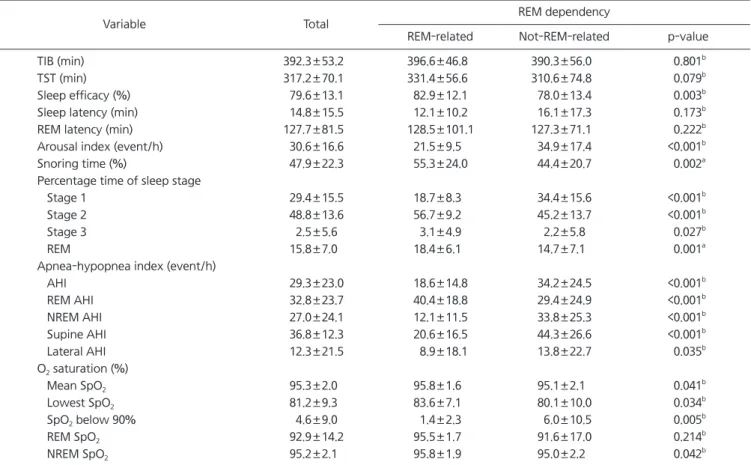
Comparing the results between the REM OSA group and not-REM OSA group according to REM dependency, the average age of REM OSA patients (40.3±11.8 years) was statistically significantly lower than that of not-REM OSA patients (47.9±13.3 years). Other results—the ratio of wom- en to men, ESS score, neck circumference, and BMI—were
similar between REM OSA patients and not-REM OSA pa- tients or had slightly lower values in the REM OSA group, but was not statistically significant (Table 1).
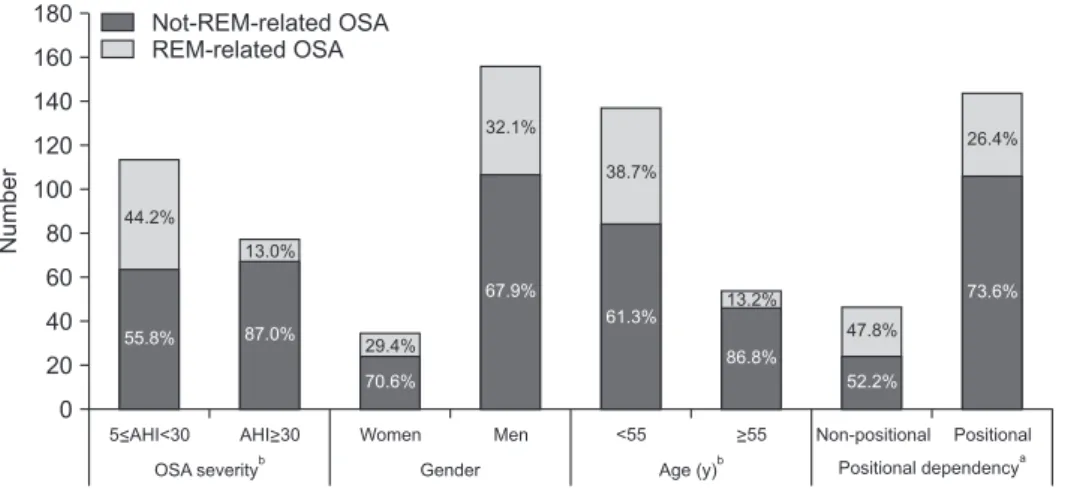
The proportion of REM OSA patients was 44.2% in 5≤AHI<30 group and 13.0% in AHI ≥30 group, with a sig- nificantly higher proportion of REM OSA patients in the mild to moderate group, based on OSA severity (p<0.001).
The proportion of REM OSA patients was 29.4% in the female group and 32.1% in the male group, indicating that there is no significant difference in the proportion of REM OSA patient based on gender.
When the subjects were divided into two groups based on age, the proportion of REM OSA patients was 38.7% in age
<55 group and 13.2% in age ≥55 group. The proportion of REM OSA based on age group was significantly higher in age <55 group (p<0.001) (Fig. 1).
2. Polysomnographic Features
PSG results were analyzed for all 190 subjects in the study. However, some subjects had missing records for
Fig. 1. Percentage of REM-related OSA according to OSA severity, gender, age, and sleep posture. REM, rapid eye movement; OSA, obstructive sleep apnea; AHI, apnea-hypopnea index;
Non-positional, non-positional OSA;
Positional, positional OSA.
aChi-square test, p<0.01.
bChi-square test, p<0.001.
180 160 140 120 100 80 60 40 20 0
Number
Not-REM-related OSA REM-related OSA
Women Men <55 Non-positional Positional
OSA severity
bGender Age (y)
bPositional dependency
a5<AHI<30 AHI>30 >55
44.2%
55.8%
13.0%
87.0%
29.4%
70.6%
32.1%
67.9%
38.7%
61.3% 13.2%
86.8%
47.8%
52.2%
26.4%
73.6%
Table 1. Demographic and clinical features of OSA patients according to REM dependency
Variable Total REM dependency
REM-related Not-REM-related p-value
Gender (women, %) 17.9 16.7 18.5 0.764
aAge (y) 45.5±13.3 40.3±11.8 47.9±13.3 <0.001
bBMI (kg/m
2) 25.3±3.3 25.2±3.7 25.3±3.1 0.828
bNeck circumference (cm) 37.8±3.8 37.0±4.0 38.1±3.7 0.207
cESS score 8.2±4.4 8.2±3.9 8.2±4.7 0.753
cOSA, obstructive sleep apnea; REM, rapid eye movement; BMI, body mass index; ESS, Epworth Sleepiness Scale.
Values are presented as mean±standard deviation.
a
p-values were obtained from chi-square test.
bp-values were obtained from independent t-test.
cp-values were obtained from Mann-
Whitney.
different categories including sleep latency, REM latency, and O 2 saturation. Therefore, the total number of subjects varies between different categories.
The REM OSA group showed higher sleep efficacy, lower sleep latency, lower percentage of sleep stage 1 time, high- er percentage of sleep stage 2 and REM time, lower AHI, higher O 2 saturation during sleep, lower arousal index, and higher percentage of snoring time compared to the not- REM OSA group. For the AHIs according to sleep position, AHI during supine position (supine AHI) was higher than AHI during lateral position (lateral AHI) in all groups (Table 2).
Fig. 1 shows the proportion of REM OSA according to positional dependency. The proportions of REM OSA were 26.4% in the positional OSA group and 47.8% in the non- positional OSA group. The proportion of REM OSA accord- ing to positional dependency was significantly higher in the
non-positional OSA group (p=0.006) (Fig. 1).
Fig. 2 shows the percentage time of each sleep stage ac- cording to OSA severity. In the mild to moderate OSA pa- tients (5≤AHI<30), the percentage time of each sleep stage for REM OSA group was 18.0% for REM, 18.5% for stage 1, 56.7% for stage 2, and 3.4% for stage 3 sleeps. For not- REM OSA group, the percentage time of each sleep stage was 15.2% for REM, 26.5% for stage 1, 51.8% for stage 2, and 2.5% for stage 3 sleeps. In the mild to moderate OSA patients, the percentage times of REM (p=0.027), stage 1 (p<0.001), and stage 2 (p=0.002) sleeps were significantly different according to REM dependency. In the severe OSA patients (AHI ≥30), the percentage time of each sleep stage for REM OSA group was 20.7% for REM, 19.5% for stage 1, 56.8% for stage 2, and 1.5% for stage 3 sleeps. For not- REM OSA group, the percentage time of each sleep stage
Table 2. Polysomnographic features of OSA patients according to REM dependency
Variable Total REM dependency
REM-related Not-REM-related p-value
TIB (min) 392.3±53.2 396.6±46.8 390.3±56.0 0.801
bTST (min) 317.2±70.1 331.4±56.6 310.6±74.8 0.079
bSleep efficacy (%) 79.6±13.1 82.9±12.1 78.0±13.4 0.003
bSleep latency (min) 14.8±15.5 12.1±10.2 16.1±17.3 0.173
bREM latency (min) 127.7±81.5 128.5±101.1 127.3±71.1 0.222
bArousal index (event/h) 30.6±16.6 21.5±9.5 34.9±17.4 <0.001
bSnoring time (%) 47.9±22.3 55.3±24.0 44.4±20.7 0.002
aPercentage time of sleep stage
Stage 1 29.4±15.5 18.7±8.3 34.4±15.6 <0.001
bStage 2 48.8±13.6 56.7±9.2 45.2±13.7 <0.001
bStage 3 2.5±5.6 3.1±4.9 2.2±5.8 0.027
bREM 15.8±7.0 18.4±6.1 14.7±7.1 0.001
aApnea-hypopnea index (event/h)
AHI 29.3±23.0 18.6±14.8 34.2±24.5 <0.001
bREM AHI 32.8±23.7 40.4±18.8 29.4±24.9 <0.001
bNREM AHI 27.0±24.1 12.1±11.5 33.8±25.3 <0.001
bSupine AHI 36.8±12.3 20.6±16.5 44.3±26.6 <0.001
bLateral AHI 12.3±21.5 8.9±18.1 13.8±22.7 0.035
bO
2saturation (%)
Mean SpO
295.3±2.0 95.8±1.6 95.1±2.1 0.041
bLowest SpO
281.2±9.3 83.6±7.1 80.1±10.0 0.034
bSpO
2below 90% 4.6±9.0 1.4±2.3 6.0±10.5 0.005
bREM SpO
292.9±14.2 95.5±1.7 91.6±17.0 0.214
bNREM SpO
295.2±2.1 95.8±1.9 95.0±2.2 0.042
bOSA, obstructive sleep apnea; REM, rapid eye movement; TIB, total in bed; TST, total sleep time; AHI, apnea-hypopnea index; NREM, non- REM.
REM AHI, AHI during REM sleep; NREM AHI, AHI during NREM sleep; Supine AHI, AHI during supine position; Lateral AHI, AHI during lateral position; SpO
2below 90%, percent of total sleep time with O
2saturation below 90%.
Values are presented as mean±standard deviation.
a
p-values were obtained from independent t-test.
bp-values were obtained from Mann-Whitney test.
was 14.1% for REM, 41.9% for stage 1, 39.0% for stage 2, and 1.9% for stage 3 sleeps. In the severe group, the per- centage times of REM (p=0.011), stage 1 (p<0.001), stage 2 (p<0.001) sleeps were significantly different according to REM dependency (Fig. 2).
3. Impacts of Risk Factors on REM-Related OSA
Table 3 shows the risk factors of REM OSA. In the logistic regression analysis by adding age, sex, ESS score, neck cir- cumference, and BMI, the results indicated that age (β=–0.04, p=0.003) was a statistically significant contributing factor
(Table 3).
Table 4 shows the risk factors of OSA severity. Age (β=0.031, p=0.028), gender (β=–1.89, p=0.003), and neck cir- cumference (β=0.397, p<0.001) were statistically significant contributing factors (Table 4).
4. Correlation between Each Clinical Features and AHI BMI, neck circumference, percentage of supine position, and percentage of snoring time were significantly correlat- ed with REM AHI. Age, BMI, and neck circumference were significantly correlated with NREM AHI (Table 5).
Fig. 2. Distribution of sleep stage accor- ding to OSA severity. OSA, obstructive sleep apnea; REM, rapid eye movement;
REM OSA, REM-related OSA; Not-REM OSA, not-REM-related OSA; AHI, apnea- hypopnea index.
at-test, p<0.05.
bt-test, p<0.01.
cMann-Whitney test, p<0.05.
d