INTRODUCTION
Asthma is one of the most common chronic respiratory dis- eases that results in pulmonary inflammation and reversible lower airway obstruction in subjects of all age groups and is a major cause of socioeconomic implications in many coun- tries.1-4 Immunoglobulin E (IgE) plays a central role in inflam- mation by binding of its Fc region to FcεRI receptors on mast cells or FcεRII receptors on B lymphocytes and eosinophils to release inflammatory mediators.1,2
According to the Global Initiative for management of Asthma (GINA) burden report in 2004, the prevalence of asthma in Chi-
na was 2.1%.5 The prevalence of asthma is increasing in China6 with a high case-fatality rate.7 The Chinese guidelines for asth-
Omalizumab Improves Quality of Life and Asthma Control in
Chinese Patients With Moderate to Severe Asthma: A Randomized Phase III Study
Jing Li,
1Jian Kang,
2Changzheng Wang,
3Jing Yang,
4Linda Wang,
5Ioannis Kottakis,
6Michael Humphries,
4Nanshan Zhong
1* for the China Omalizumab Study Group
1State Key Laboratory of Respiratory Disease, The First Affiliated Hospital, Guangzhou Medical University, Guangzhou, China
2Institute of Respiratory Disease, First Hospital of China Medical University, Shenyang, China
3Institute of Respiratory Disease, Xinqiao Hospital, Third Military Medical University, Chongqing, China
4Respiratory Franchise, Beijing Novartis Pharma Co. Ltd., Beijing, China
5IQS, Beijing Novartis Pharma Co. Ltd., Shanghai, China
6Novartis Pharma AG, Basel, Switzerland
This is an Open Access article distributed under the terms of the Creative Commons Attribution Non-Commercial License (http://creativecommons.org/licenses/by-nc/3.0/) which permits unrestricted non-commercial use, distribution, and reproduction in any medium, provided the original work is properly cited.
Purpose: Omalizumab is the preferred add-on therapy for patients with moderate-to-severe persistent allergic asthma and has demonstrated effi- cacy and safety in various ethnicities. This study evaluated the efficacy and safety of omalizumab in Chinese patients with moderate-to-severe aller- gic asthma. Methods: This randomized, double-blind, parallel-group, placebo-controlled, phase III study assessed lung function, quality of life, asth- ma control, and safety of omalizumab after 24-week therapy in Chinese patients (18-75 years of age). Results: A total of 616 patients were ran- domized (1:1) to omalizumab or placebo. The primary endpoint, least squares mean treatment difference (LSM-TD) in morning peak expiratory flow (PEF) (omalizumab vs placebo), at Weeks >20-24 was 8.85 L/min (Full analysis set; P=0.062). Per-protocol analysis set showed significant improve- ments with LSM-TD of 11.53 L/min in mean mPEF at Weeks >20-24 (P=0.022). The FEV1 % predicted was significantly improved with omalizumab vs placebo from 8 to 24 weeks (after 24-week treatment: LSM-TD=4.12%; P=0.001). At Week 24, a higher proportion of omalizumab-treated pa- tients achieved clinically relevant improvements in standardized AQLQ (58.2% vs 39.3%; LSM=0.51 vs 0.10; P<0.001) and ACQ (49.5% vs 35.5%;
LSM=-0.51 vs -0.34; P=0.002) scores vs placebo. Total and nighttime symptom scores reduced significantly with omalizumab vs placebo (LSM- TD=-0.21, P=0.048 and -0.12, P=0.011, respectively). Although the study was not powered to study differences in exacerbation rates (P=0.097), exacerbations in winter months were less frequent in the omalizumab vs placebo group (2 vs 21). Adverse event and severe adverse event rates were comparable between omalizumab and placebo. Conclusions: Omalizumab improves lung function, quality of life, and asthma control in Chi- nese patients with moderate-to-severe persistent allergic asthma and has a good safety profile.
Key Words: Asthma; omalizumab; allergy and immunology; quality of life; China
Correspondence to: Nanshan Zhong, MD, State Key Laboratory of Respiratory Diseases, The First Affiliated Hospital of Guangzhou Medical University, 151 Yanjiang Road, Guangzhou 510120, Guangdong, China.
Tel: +86-20-83062718; Fax: +86-20-83062729; E-mail: [email protected] Received: July 29, 2015; Revised: October 7, 2015; Accepted: October 27, 2015
•Jing Li, Jian Kang and Changzheng Wang contributed equally to this work.
• This study was supported by Novartis Pharma AG, Basel, Switzerland. Jing Yang, Linda Wang, and Michael Humphries are employees of Novartis. Ioannis Kottakis was an employee of Novartis during the conduct of the study and compilation of this manuscript.
•There are no financial or other issues that might lead to conflict of interest.
Allergy Asthma Immunol Res. 2016 July;8(4):319-328.
http://dx.doi.org/10.4168/aair.2016.8.4.319 pISSN 2092-7355 • eISSN 2092-7363
ma recommend oral corticosteroids (OCSs, lowest dose) and/or sustained-release theophylline as a step 5 therapy.8 Despite a high burden of pharmacotherapy, control of severe asthma is seldom achieved, and patients experience daily and nocturnal symptoms, frequent exacerbations, and poor quality of life, af- fecting daily activities.9,10
Omalizumab, a humanized monoclonal anti-IgE antibody, is recommended for the treatment of persistent moderate-to-se- vere allergic asthma.11 It binds to the Fc region of free-IgE, pre- venting its binding and allergen-induced cross-linking of high- affinity receptors on mast cells and basophils. With long-term therapy, high-affinity receptors on mast cells and basophils are down regulated, leading to a decrease in inflammatory media- tors released.1,12,13 Omalizumab has shown clinical benefits and favourable cost-effectiveness in patients with persistent severe al- lergic asthma and a high burden of disease.14 Considering evi- dence from randomized controlled clinical trials and real-world studies, the 2014 GINA asthma management guidelines suggest- ed the use of add-on omalizumab as the preferred step 5 therapy for patients with uncontrolled allergic asthma.15-19 However, there is no data on the management of Chinese patients with omali- zumab. This study evaluates the efficacy, safety, and tolerability of omalizumab therapy, compared to placebo, in Chinese pa- tients with moderate-to-severe persistent allergic asthma.
MATERAILS AND METHODS Patients
Patients were of either gender, aged 18-75 years, with con- firmed diagnosis of moderate-to-severe persistent allergic asth- ma (inadequately controlled symptoms despite medium-to- high-dose ICS+LABA [GINA step 4] therapy) for ≥1-year dura- tion at screening, weighing >20-≤150 kg, a serum total-IgE lev- el of 30-700 IU/mL. Eligible patients had a documented posi- tive reaction to at least 1 perennial aeroallergen and reported ≥ 2 or ≥3 exacerbation events in previous 12 or 24 months, re- spectively. Other inclusion criteria were forced expiratory vol- ume in 1 second (FEV1) of 40%-80% of predicted normal with post-bronchodilator reversibility of ≥12% within 30 minutes and compliance with completion of peak expiratory flow (PEF)/
electronic diary (eDiary) during the run-in period.
Patients were excluded if they had a history of malignancy, hypersensitivity, or severe food- or drug-related anaphylaxis, active lung disease other than allergic asthma, clinically signifi- cant ECG or chest X-ray abnormality, elevated total serum IgE level without increase in specific IgE, or use of other investiga- tional drugs within at least 30 days/5 half-lives of enrolment.
Study design
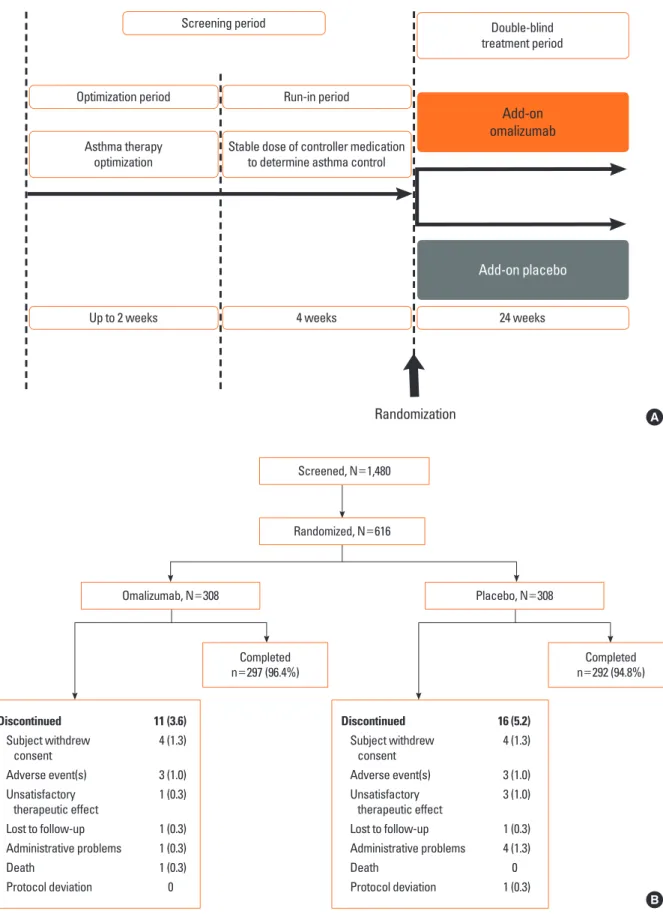
This is a randomized, double-blind, placebo-controlled, and parallel-group study (Fig. 1A). Patient’s eligibility criteria were assessed in a pre-treatment screening consisting of a 2-week
optimization period and a 4-week run-in period (baseline) to determine patient’s degree of asthma control. At the baseline visit, eligible patients were randomized (1:1) to receive either add-on omalizumab or add-on placebo by subcutaneous in- jections for 24 weeks. The dose and dosing frequency were de- termined by the omalizumab dosing table on the basis of pa- tient’s serum total-IgE level and body weight (≥0.016 mg/kg/
IgE-IU/mL every 4 weeks). Patients were advised to use rescue medication (inhaled salbutamol) as needed and record it in the eDiary. The study was conducted in accordance with the cur- rent Good Clinical Practice, and the protocol was approved by Independent Ethics Committee or Institutional Review Board for each center. Written informed consent was obtained from each enrolled patient. The study was registered at http://clini- caltrials.gov (NCT01202903).
Assessments
The efficacy and safety of add-on omalizumab treatment was assessed at 4-week (±3 days) intervals during the 24-week treatment period.
Efficacy assessment
The primary efficacy objective was to assess the mean change from baseline in morning PEF (mPEF, L/min) measured using a PEF meter after 24 weeks of treatment. Patients were instructed to record their mPEF within 15 minutes of waking, before using any medication. The secondary endpoints included FEV1 % predicted, Asthma Control Questionnaire (ACQ) scores, asthma symptom scores and rescue medication use, standardized Asth- ma Quality of Life Questionnaire (AQLQ[S]) scores, Global Eval- uation of Treatment Effectiveness (GETE) responder analysis, and safety. FEV1 % predicted at defined time-points and ACQ scores at Weeks 16 and 24 (Supplementary section S4) were as- sessed. Patients recorded the daily symptom scores (morning, daytime, and nocturnal symptoms) and rescue medication use twice daily (puffs taken in the last 12 hours; Supplementary sec- tion S6) using an eDiary. Investigators and patients assessed the GETE on a 5-point scale (excellent, good, moderate, poor, or worsening) at Weeks 16 and 24. AQLQ(S) at the beginning and after 24-week treatment period was used to assess the change in quality of life of patients (Supplementary section S5). The rate and seasonal effect of protocol-defined asthma exacerbations (clinically significant worsening of asthma requiring addition or increase in dose/dosing-frequency of systemic corticosteroids or intravenous theophylline) were assessed as exploratory out- comes.
Safety assessment
All adverse events (AEs), serious AEs, their severity and rela- tionship to the study drug, and pregnancies were assessed. Spi- rometry, eDiary data, and PEF were also used to monitor pa- tient’s safety.
Fig. 1. (A) Study design and (B) patient disposition. One administrative problem in the omalizumab group was due to drug administration being performed incorrectly.
For the placebo group, 4 administrative problems were due to incorrect administration of omalizumab instead of placebo. The above cases were considered as pro- tocol deviation.
Screening period
Optimization period
Up to 2 weeks Asthma therapy
optimization
Run-in period
4 weeks 24 weeks
Stable dose of controller medication to determine asthma control
Add-on omalizumab
Add-on placebo Double-blind treatment period
Randomization A
B Screened, N=1,480
Randomized, N=616
Omalizumab, N=308
Completed
n=297 (96.4%) Completed
n=292 (94.8%) Placebo, N=308
Discontinued 11 (3.6)
Subject withdrew 4 (1.3) consent
Adverse event(s) 3 (1.0) Unsatisfactory 1 (0.3) therapeutic effect
Lost to follow-up 1 (0.3) Administrative problems 1 (0.3)
Death 1 (0.3)
Protocol deviation 0
Discontinued 16 (5.2)
Subject withdrew 4 (1.3) consent
Adverse event(s) 3 (1.0) Unsatisfactory 3 (1.0) therapeutic effect
Lost to follow-up 1 (0.3) Administrative problems 4 (1.3)
Death 0
Protocol deviation 1 (0.3)
Statistical analysis
All efficacy variables were analyzed, unless specified, using the full analysis set (FAS). FAS consisted of all patients who re- ceived ≥1 dose of the study drug. The per-protocol set (PPS), a subset of the FAS without major protocol deviations (Supple- mentary section S2), was used for supportive analysis to assess robustness of the primary analysis. The primary outcome, change from baseline to Week 24 in mPEF, was assessed using an analysis of covariance (ANCOVA) model with the terms (treatment arm, dosing schedule [every 2 and/or 4 weeks], gen- der, center grouping, smoking status), and baseline mPEF as the covariates. The changes from baseline of FEV1 % predicted, AQLQ(S) and ACQ scores at the end of the 24-week treatment period were analyzed using ANCOVA, with baseline values as covariates. The investigator’s and patient’s GETE were analyzed using the Cochran-Mantel-Haenszel test for treatment compar- ison with respect to responder rate (proportion of patients achieving excellent/good response). The change from baseline of total asthma symptom score was calculated as the total of each day’s morning, daytime, and nocturnal scores, and treat- ment comparisons were evaluated using ANCOVA and the Van-Elteren test. Two-sided hypothesis tests were conducted at an alpha level of 0.05 for all endpoints. The analyses of changes from baseline in mean mPEF and FEV1 % predicted were based on the observed data. For mPEF if fewer than 7 daily readings during a 28-day period were available, the mean mPEF for that period were set to missing. Missing data was handled similarly for asthma symptom score. For ACQ and AQLQ(S), missing items were imputed by interpolation and for scoring ≤1 missing item and ≤10% of data was allowed, re- spectively.
All safety variables were analyzed using safety set unless spec- ified. The safety set included all patients who received at least 1 dose of the study drug.
RESULTS
Patient disposition and baseline characteristics
Among 1,480 patients screened, 616 eligible across 42 study centers in China were randomized (1:1) to either add-on omal- izumab or placebo. Of these, 7 were screen failures, but ran- domized in the IRT system according to the investigative site, and excluded from the FAS and the safety set. One patient did not receive study medication for >60 days and was also re- moved from the FAS. In effect, 608 and 609 patients were in- cluded in the FAS and the safety set. PPS analysis included 536 patients, and details of protocol deviations leading to exclusion from the PPS dataset is provided in Supplementary section S2.
Patient disposition is discussed in Fig. 1B. Both treatment arms were well-balanced in demographic and baseline characteris- tics (Table 1).
Efficacy mPEF
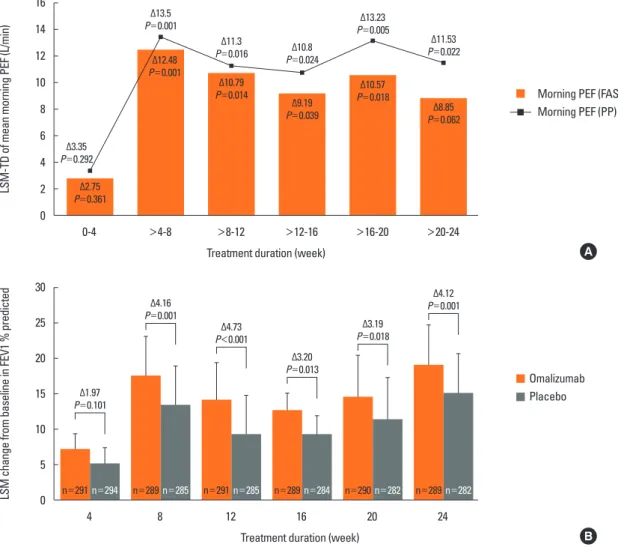
Omalizumab showed numerically greater improvement change from baseline in the mean mPEF after 24-week treat- ment when compared to placebo. However, the treatment dif- ference vs the placebo group at Week 24 was not statistically significant (LSM treatment difference [LSM-TD]=8.85 L/min;
P=0.062; Fig. 2A). At Weeks >4-8 through >16-20, omalizumab significantly improved mean mPEF from baseline vs placebo.
PPS analysis showed significant improvements in mean mPEF with omalizumab vs placebo from Weeks >4-8, which persist- ed throughout the remainder of study duration (Week 24 LSM- TD=11.53 L/min; P=0.022; Fig. 2A).
FEV1 % predicted
The FEV1 % predicted at all time-points, from 8-24 weeks of treatment, was significantly improved with omalizumab vs pla- Table 1. Demographic and baseline patient characteristics (safety set)
Omalizumab
n=310 Placebo
n=299 Total
n=609 Mean (SD) age (year) 45.8 (12.0) 47.1 (11.6) 46.5 (11.9)
Male, n (%) 139 (44.8) 142 (47.5) 281 (46.1)
Mean (SD) body weight (kg) 62.3 (11.0) 62.8 (10.4) 62.6 (10.7) Total IgE (IU/mL)
Mean (SD) 271.5 (180.4) 279.4 (176.7) 275.4 (178.5)
Range 32-698 31-696 31-698
Duration of asthma (year)
Mean (SD) 14.3 (12.9) 15.1 (13.5) 14.7 (13.2)
Range 1-58 1-60 1-60
Baseline AQLQ(S) score
n 251 237 488
Mean (SD) 4.37 (1.0) 4.59 (1.0) 4.48 (1.0)
Range 1.8-7.0 1.2-6.7 1.2-7.0
Baseline ACQ score
n 268 267 535
Mean (SD) 1.74 (0.6) 1.62 (0.6) 1.67 (0.6)
Range 0.1-4.0 0.1-3.9 0.1-4.0
Asthma exacerbation episode*
Mean (SD) 2.3 (0.8)† 2.2 (0.7) 2.2 (0.8)
FEV1 % predicted (pre-bronchodilator)‡
n 303 302 -
Mean (SD) 63.54 (12.0) 62.98 (12.7) -
FEV1 reversibility (%)
n 310 296 -
Mean (SD) 26.33 (14.1) 27.09 (13.6) -
*Asthma exacerbation history of at least prior 12 months was collected during the screening period; †n=309; ‡data from the full analysis set.
ACQ, asthma control questionnaire; AQLQ(S), standardized asthma related quality of life questionnaire; FEV1, forced expiratory volume in 1 second; SD, standard deviation.
cebo (after 24 weeks: LSM-TD=4.12%; P=0.001; Fig. 2B).
Asthma control questionnaire
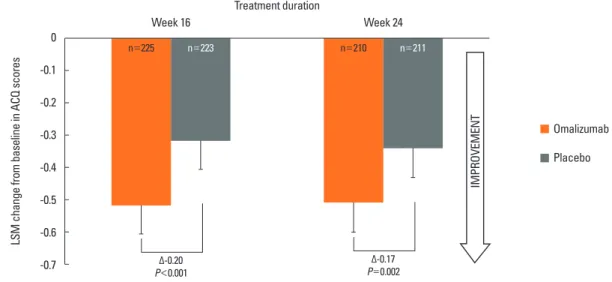
LSM changes from baseline of ACQ scores were clinically meaningful (reduction of ≥0.5 unit) in the omalizumab group (-0.51) at Week 24. Compared to placebo omalizumab showed a significant reduction in ACQ scores at Weeks 16 (LSM-TD=
-0.20, P<0.001) and Week 24 (LSM-TD=-0.17, P=0.002; Fig. 3).
The proportion of patients achieving clinically meaningful im- provements in ACQ scores was 49.5% (104/210) for the omali- zumab group vs 35.5% (75/211) for the placebo group when considering the response rate based on number of patients with available ACQ data. Approximately 30% of patients had missing ACQ data.
Total asthma symptom scores and rescue medication use
Statistically significant reductions were observed for total and night-time symptom scores with omalizumab vs placebo at
Week 24 (LSM-TD=-0.21; P=0.048, -0.12, and P=0.011, respec- tively) (Fig. 4A). Use of rescue medication during day/night de- creased (LSM-TD daytime/nighttime=-0.16/-0.14 puffs/day; Fig.
4B), and the percentage of days with no rescue medication in- creased significantly with omalizumab vs placebo (LSM±
SEM=28.5±11.33 vs 23.3±11.44; LSM-TD=5.16 [95% CI: 0.14, 10.18]; all P<0.05).
Investigator’s and patient’s GETE
After 16-week treatment, the proportion of patients who re- sponded to treatment was significantly higher in the omalizum- ab group than in the placebo group (investigator’s and patient’s GETE being 71.9% vs 52.3%; P<0.001 and 70.6% vs 59.6%;
P=0.006, respectively). Similarly at Week 24, investigator’s and patient’s GETE for omlaizumab vs placebo were 70.3% vs 50.7%
(P<0.001) and 71.9% vs 61.6 (P=0.006), respectively (Supple- mentary Figure).
LSM-TD of mean morning PEF (L/min)LSM change from baseline in FEV1 % predicted
0-4
4 Δ2.75 P=0.361
n=291n=294 n=289n=285 n=291n=285 n=289n=284 n=290n=282 n=289n=282 Δ3.35
P=0.292
Δ12.48 P=0.001
Δ13.5 P=0.001
Δ10.79 P=0.014
Δ11.3 P=0.016
Δ9.19 P=0.039
Δ10.8 P=0.024
Δ10.57 P=0.018
Δ13.23 P=0.005
Δ8.85 P=0.062
Δ11.53 P=0.022
>4-8
8
>8-12
12
Treatment duration (week)
Treatment duration (week)
>12-16
16
>16-20
20
>20-24
24 16
14 12 10 8 6 4 2 0
30
25
20
15
10
5
0
Morning PEF (FAS) Morning PEF (PP)
Omalizumab Placebo
A
B Δ1.97
P=0.101
Δ4.16 P=0.001
Δ4.73 P<0.001
Δ3.20 P=0.013
Δ3.19 P=0.018
Δ4.12 P=0.001
Fig. 2. Analysis of lung function following 24 weeks of treatment. (A) mean mPEF (L/min), (B) FEV1 % predicted. Data is presented as LSM-TD of omalizumab vs pla- cebo for mPEF and LSM treatment values±SEM for FEV1 % predicted. FAS, full analysis set; FEV1, forced expiratory volume in 1 second; LSM-TD, least square mean-treatment difference; PP, per-protocol set; PEF, peak expiratory flow; SEM, standard error of mean.
LSM change from baseline in ACQ scores IMPROVEMENT
n=225 n=223 n=210 n=211
Treatment duration
Week 16 Week 24
0 -0.1 -0.2 -0.3 -0.4 -0.5 -0.6
-0.7 P<0.001Δ-0.20 P=0.002Δ-0.17
Fig. 3. Analysis of changes from baseline in ACQ scores (full analysis set). Data is presented as LSM values±SEM from full analysis set. Patients with not more than 1 item missing are included with the missing item being imputed by interpolation (approximately 30% of patients in both treatment groups had missing ACQ data). ACQ, asthma control questionnaire; LSM, least squares mean; SEM, standard error of mean.
LSM change from baseline in asthma symptom scoresLSM change from baseline in mean number of puffs of asthma rescue medication IMPROVEMENTIMPROVEMENT
n=287
n=296
n=292
n=292
n=292 n=292
n=292 n=282
n=291
n=288
n=289
n=288 n=288
n=289 Total
Daily
Night-time
Day-time
Morning Day-time
Night-time 0
-0.4
-0.8
-1.2
-1.6
-2.0
-2.4
0 -0.2 -0.4 -0.6 -0.8 -1.0 -1.2 -1.4 -1.6 -1.8
Δ-0.21 P=0.048
Δ-0.29 P=0.024
Δ-0.12 P=0.011
Δ-0.16 P=0.022
Δ-0.01 P=0.845
Δ-0.08 P=0.173
Δ-0.14 P=0.022
Fig. 4. Analysis of changes from baseline following 24 weeks of treatment in (A) asthma symptom scores and (B) asthma rescue medication. Data is presented as LSM treatment values±SEM from the full analysis set. LSM, least squares mean; SEM, standard error of mean.
A
B Omalizumab Placebo
Omalizumab Placebo
Omalizumab Placebo
Asthma quality of life questionnaire (standardized)
LSM changes from baseline for the overall (0.51), emotions (0.64), and environmental scores (0.54) were clinically mean- ingful (≥0.5-point change from baseline) in the omalizumab group. After 24-weeks of treatment, omalizumab significantly improved overall AQLQ(S) and all individual domain scores (Fig. 5) vs placebo. The proportion of patients achieving a clini- cally meaningful AQLQ(S) improvement was significantly high- er (P<0.001) with omalizumab (58.2%, 106/182) vs placebo (39.3%, 2/178) for all evaluable patients. Of note, approximately 40% of patients had missing AQLQ(S) data.
Protocol- defined asthma exacerbations
The proportion of patients reporting asthma exacerbations was lower in the omalizumab vs placebo group (7.2% vs 10.9%, rate ratio=0.61; P=0.097). Protocol-defined exacerbations were less frequently reported in the omalizumab vs placebo groups in winter (2 vs 21), whereas for other seasons the frequency was comparable (for spring [8 vs 8], summer [8 vs 10], and autumn [9 vs 12]). Exacerbation rates per year were 0.06 vs 0.06 during spring, 0.06 vs 0.07 during summer, 0.06 vs 0.09 during autumn, and 0.01 vs 0.15 during winter, respectively, for omalizumab vs placebo.
Safety
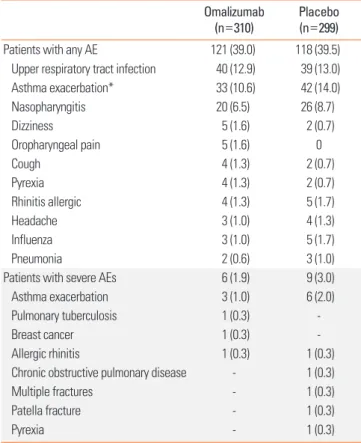
Patients were exposed to a median duration of 169 days in both the study arms over 24 weeks. Patients received omali- zumab or placebo every 2 or 4 weeks to reach a total of 6 or 12 doses, respectively. The overall incidence of AEs during the study period was similar in the omalizumab (39%) and placebo (39.5%) groups (Table 2). The majority of AEs in both groups were mild or moderate in severity. The incidence of severe AEs
was lower in the omalizumab group (1.9%) vs the placebo group (3.0%) and similar for mild (omalizumab 29.0% vs place- bo 27.4%) and moderate (15.8% vs 15.4%) AEs. Only 1 death LSM change from baseline in AQLQ(S) scores after 24 weeks of treatment
Overall score
n=182n=178 n=208n=206 n=203n=198 n=217n=213 n=201n=203
Symptoms score Activity score Emotions score Environmental score 0.9
0.8 0.7 0.6 0.5 0.4 0.3 0.2 0.1 0
Δ0.40
P<0.001 Δ0.30
P=0.001 Δ0.30
P<0.001
Δ0.28
P=0.016 Δ0.37
P=0.002
Fig. 5. Analysis of change from baseline in the AQLQ(S) scores (full analysis set). Data is presented as LSM treatment values±SEM from the full analysis set. Pa- tients with not more than 1 item missing are included with the missing item being imputed by interpolation (approximately 40% of patients in both the treatment groups had missing AQLQ(S) data). AQLQ(S), asthma quality of life questionnaire; LSM, least squares mean; SEM, standard error of mean.
Table 2. Number of patients with AEs by preferred term (safety set) Omalizumab
(n=310) Placebo
(n=299)
Patients with any AE 121 (39.0) 118 (39.5)
Upper respiratory tract infection 40 (12.9) 39 (13.0)
Asthma exacerbation* 33 (10.6) 42 (14.0)
Nasopharyngitis 20 (6.5) 26 (8.7)
Dizziness 5 (1.6) 2 (0.7)
Oropharyngeal pain 5 (1.6) 0
Cough 4 (1.3) 2 (0.7)
Pyrexia 4 (1.3) 2 (0.7)
Rhinitis allergic 4 (1.3) 5 (1.7)
Headache 3 (1.0) 4 (1.3)
Influenza 3 (1.0) 5 (1.7)
Pneumonia 2 (0.6) 3 (1.0)
Patients with severe AEs 6 (1.9) 9 (3.0)
Asthma exacerbation 3 (1.0) 6 (2.0)
Pulmonary tuberculosis 1 (0.3) -
Breast cancer 1 (0.3) -
Allergic rhinitis 1 (0.3) 1 (0.3)
Chronic obstructive pulmonary disease - 1 (0.3)
Multiple fractures - 1 (0.3)
Patella fracture - 1 (0.3)
Pyrexia - 1 (0.3)
Data is represented as n (%); AEs with ≥1% in any group were represented here.
*As reported by investigator.
AE, adverse event.
Omalizumab Placebo
was reported in the omalizumab group. The patient had 2 epi- sodes of asthma exacerbation in 4 months before randomiza- tion and a declining PEF during the run-in period. No rescue medication use was reported during the 12 days before the ex- acerbation event. The cause of death was recorded as severe asthma exacerbation.
DISCUSSION
Omalizumab is the only humanized anti-IgE monoclonal an- tibody approved as an add-on therapy for patients with allergic asthma inadequately controlled with high-dose ICSs with or without other controller medication.20 Omalizumab has dem- onstrated efficacy and safety in numerous controlled trials and real-world studies, mostly in predominantly Caucasian popula- tions.11,21-29
This is the first study investigating the efficacy and safety of omalizumab specifically in Chinese patients with moderate-to- severe persistent allergic asthma. Though the primary endpoint of demonstrating the effect of add-on omalizumab treatment on change from baseline in mean mPEF after 24 weeks of treat- ment vs placebo was not met in this study, statistically signifi- cant improvements in mPEF were observed with omalizumab vs placebo from Week 4-20. The statistically insignificant prima- ry endpoint at Week 24 may have been affected by the variability observed in mPEF data, which increased over time in both treat- ment groups and peaked at Week 24. This variability may reflect the imprecision of a self-administered and effort-dependent test. It is worthwhile to note that the supportive analysis using the PPS, which excluded patients with major protocol devia- tions, showed that omalizumab was superior to placebo in im- proving the mean mPEF, starting at >4-8 weeks and persisting throughout the remainder of the 24-week treatment period (LSM-TD=11.53 L/min; P=0.022). Previously reported clinical studies in patients with allergic asthma have also shown im- provements of 10-30 L/min in mPEF from their baseline values after 16-week treatment with omalizumab.26,27,30 In the present study, evident from FEV1 % predicted values from Week 8-24, improvements in lung function observed with omalizumab is consistent with recent published results.11,19,21,23,27
In addition to lung function, omalizumab has previously shown clinically relevant and significant improvements in the ACQ scores in patients with asthma vs placebo or optimized asthma therapy.18,19,28,30,31 Improvements in ACQ scores (clinically relevant change from baseline and significant vs placebo), over- all symptoms scores and decreased rescue medication use were observed with omalizumab in Chinese patients. Similar to re- sults published in a previous study,18 investigator’s and patient’s GETE responder analysis (at Week 16 assessment) also showed a greater number of responders in the omalizumab vs placebo groups.
Omalizumab also significantly improved quality of life vs pla-
cebo, with respect to the overall AQLQ(S) scores as well as its individual domains. Recent real-life evidence in other popula- tions also suggests an improvement in the quality of life of pa- tients treated with omalizumab.19,21,32
Previous studies have reported a higher mortality due to asth- ma in the winter season because of an increased incidence of seasonal influenza infection accompanied by severe asthma ex- acerbations.33,34 Although the present study of Chinese patients was not powered for exacerbations, omalizumab reduced the ex- acerbation rate per year and the number of exacerbations in win- ter compared to placebo (0.01 vs 0.15 and 2 vs 21, respectively).
The majority of adverse events were mild or moderate in se- verity. One death in the omalizumab group occurred on the day after the first and only dose from severe asthma exacerba- tion. Though the investigator suspected the death to correlate with treatment, anaphylaxis was not reported to be the reason.
No deaths were reported in the omalizumab groups in global pivotal studies.15,16,35,36
The international asthma management guidelines11,20 (GINA and NHLBI) recommend omalizumab as a step 5 asthma ther- apy for moderate or severe persistent allergic asthmatic pa- tients. Various studies have shown omalizumab to be an effec- tive and safe therapy for moderate-to-severe allergic asthma in patients of Asian ethnicity outside China.5,19,26,27 This study dem- onstrated an improvement in lung function and symptoms re- lated to asthma as well as decline in the frequency of daytime and nighttime symptoms, rescue medications use, or asthma exacerbations in Chinese patients who were treated with omal- izumab. This resulted in enhanced quality of life in patients with moderate-to-severe persistent allergic asthma in this study. Additionally, despite one death, omalizumab presented a safety profile that was comparable with that of placebo.
Although no formal hypothesis testing has been performed, by informal comparison with various other studies including non-Chinese ethnicities, the results from this study in Chinese patients suggests no clinically relevant ethnic differences in re- sponse to omalizumab therapy.16,26,27 Our results suggest that omalizumab may show similar tolerability and efficacy in Chi- nese patients compared to non-Chinese or Caucasian patients.
There are several limitations to this study. First, there is miss- ing data for some variables (e.g., ACQ and AQLQ[S]) with inter- polation performed. While expected to decrease precision around the point estimates, the fact that statistically significant differences between treatment groups were observed argues against these missing data as being a critical limitation. Sec- ondly, this study is not powered for studying effects of omali- zumab on asthma exacerbations. Thirdly, there is a lack of ad- justment for multiple comparisons between secondary end- points in this study. The fact that the benefits that were ob- served in these secondary endpoints are consistent with those of previous trials15-19 militates against concerns around lack of adjustment for multiple comparisons.
In conclusion, add-on treatment with omalizumab may prove to be an effective and safe therapy option for Chinese patients with moderate-to-severe persistent allergic asthma.
ACKNOWLEDGMENTS
This study was supported by Novartis Pharma AG, Basel, Swit- zerland.
The authors acknowledge all investigators and patients who contributed to the study.
The authors would also like to thank Vasavi Yada and Jenni Gray (Novartis) for medical writing assistance.
REFERENCES
1. Holgate ST, Djukanović R, Casale T, Bousquet J. Anti-immunoglob- ulin E treatment with omalizumab in allergic diseases: an update on anti-inflammatory activity and clinical efficacy. Clin Exp Allergy 2005;35:408-16.
2. Platts-Mills TA. The role of immunoglobulin E in allergy and asth- ma. Am J Respir Crit Care Med 2001;164:S1-5.
3. Ye YM, Kim SH, Hur GY, Kim JH, Park JW, Shim JJ, et al. Addition of montelukast to low-dose inhaled corticosteroid leads to fewer ex- acerbations in older patients than medium-dose inhaled cortico- steroid monotherapy. Allergy Asthma Immunol Res 2015;7:440-8.
4. Usmani OS. Small airways dysfunction in asthma: evaluation and management to improve asthma control. Allergy Asthma Immunol Res 2014;6:376-88.
5. Masoli M, Fabian D, Holt S, Beasley R; Global Initiative for Asthma (GINA) Program. The global burden of asthma: executive summary of the GINA Dissemination Committee report. Allergy 2004;59:469- 78.
6. Li J, Wang H, Chen Y, Zheng J, Wong GW, Zhong N. House dust mite sensitization is the main risk factor for the increase in preva- lence of wheeze in 13- to 14-year-old schoolchildren in Guang- zhou city, China. Clin Exp Allergy 2013;43:1171-9.
7. Li XY, Hu N, Huang ZJ, Jiang Y, Wu F. Mortality and death cause proportion of respiratory disease in China, 2004-2005. Zhonghua Yu Fang Yi Xue Za Zhi 2010;44:298-302.
8. Asthma Workgroup; Chinese Thoracic Society; Chinese Societ of General Practitioners. Chinese guideline for the prevention and management of bronchial asthma (Primary Health Care Version). J Thorac Dis 2013;5:667-77.
9. Chipps BE, Zeiger RS, Borish L, Wenzel SE, Yegin A, Hayden ML, et al. Key findings and clinical implications from the Epidemiology and Natural History of Asthma: Outcomes and Treatment Regimens (TENOR) study. J Allergy Clin Immunol 2012;130:332-342.e10.
10. López Tiro JJ, Contreras EA, del Pozo ME, Gómez Vera J, Larenas Linnemann D. Real life study of three years omalizumab in patients with difficult-to-control asthma. Allergol Immunopathol (Madr) 2015;
43:120-6.
11. Song WJ, Cho SH. Challenges in the management of asthma in the elderly. Allergy Asthma Immunol Res 2015;7:431-9.
12. Inführ D, Crameri R, Lamers R, Achatz G. Molecular and cellular targets of anti-IgE antibodies. Allergy 2005;60:977-85.
13. Nam YH, Kim JH, Jin HJ, Hwang EK, Shin YS, Ye YM, et al. Effects of omalizumab treatment in patients with refractory chronic urticar-
ia. Allergy Asthma Immunol Res 2012;4:357-61.
14. Sullivan SD, Turk F. An evaluation of the cost-effectiveness of omali- zumab for the treatment of severe allergic asthma. Allergy 2008;63:
670-84.
15. Hanania NA, Alpan O, Hamilos DL, Condemi JJ, Reyes-Rivera I, Zhu J, et al. Omalizumab in severe allergic asthma inadequately controlled with standard therapy: a randomized trial. Ann Intern Med 2011;154:573-82.
16. Humbert M, Beasley R, Ayres J, Slavin R, Hébert J, Bousquet J, et al.
Benefits of omalizumab as add-on therapy in patients with severe persistent asthma who are inadequately controlled despite best available therapy (GINA 2002 step 4 treatment): INNOVATE. Aller- gy 2005;60:309-16.
17. Niven R, Chung KF, Panahloo Z, Blogg M, Ayre G. Effectiveness of omalizumab in patients with inadequately controlled severe persis- tent allergic asthma: an open-label study. Respir Med 2008;102:
1371-8.
18. Bousquet J, Siergiejko Z, Swiebocka E, Humbert M, Rabe KF, Smith N, et al. Persistency of response to omalizumab therapy in severe allergic (IgE-mediated) asthma. Allergy 2011;66:671-8.
19. Braunstahl GJ, Chen CW, Maykut R, Georgiou P, Peachey G, Bruce J.
The eXpeRience registry: the ‘real-world’ effectiveness of omali- zumab in allergic asthma. Respir Med 2013;107:1141-51.
20. National Heart, Lung, and Blood Institute (US). Guidelines for the diagnosis and management of asthma (EPR-3) [Internet]. Bethes- da (MD): National Heart, Lung, and Blood Institute; 2007 Aug [cit- ed 2015 Jan 20]. Available from: http://www.nhlbi.nih.gov/health- pro/guidelines/current/asthma-guidelines.
21. Barnes N, Menzies-Gow A, Mansur AH, Spencer D, Percival F, Rad- wan A, et al. Effectiveness of omalizumab in severe allergic asth- ma: a retrospective UK real-world study. J Asthma 2013;50:529-36.
22. Cazzola M, Camiciottoli G, Bonavia M, Gulotta C, Ravazzi A, Ales- sandrini A, et al. Italian real-life experience of omalizumab. Respir Med 2010;104:1410-6.
23. Deschildre A, Marguet C, Salleron J, Pin I, Rittié JL, Derelle J, et al.
Add-on omalizumab in children with severe allergic asthma: a 1-year real life survey. Eur Respir J 2013;42:1224-33.
24. D’Urzo AD, Wong J. Effectiveness of omalizumab in severe persis- tent asthma under real-life conditions. Can Fam Physician 2014;60:
643-5.
25. Novelli F, Latorre M, Vergura L, Caiaffa MF, Camiciottoli G, Guarni- eri G, et al. Asthma control in severe asthmatics under treatment with omalizumab: a cross-sectional observational study in Italy.
Pulm Pharmacol Ther 2015;31:123-9.
26. Ohta K, Miyamoto T, Amagasaki T, Yamamoto M, Study G; 1304 Study Group. Efficacy and safety of omalizumab in an Asian popu- lation with moderate-to-severe persistent asthma. Respirology 2009;14:1156-65.
27. Ohta K, Yamamoto M, Sato N, Ikeda K, Miyamoto T. One year treatment with omalizumab is effective and well tolerated in Japa- nese Patients with moderate-to-severe persistent asthma. Allergol Int 2010;59:167-74.
28. Schumann C, Kropf C, Wibmer T, Rüdiger S, Stoiber KM, Thielen A, et al. Omalizumab in patients with severe asthma: the XCLUSIVE study. Clin Respir J 2012;6:215-27.
29. Subramaniam A, Al-Alawi M, Hamad S, O’Callaghan J, Lane SJ. A study into efficacy of omalizumab therapy in patients with severe persistent allergic asthma at a tertiary referral centre for asthma in Ireland. QJM 2013;106:631-4.
30. Tajiri T, Niimi A, Matsumoto H, Ito I, Oguma T, Otsuka K, et al.
Comprehensive efficacy of omalizumab for severe refractory asth- ma: a time-series observational study. Ann Allergy Asthma Immu- nol 2014;113:470-475.e2.
31. Braunstahl GJ, Chlumský J, Peachey G, Chen CW. Reduction in oral corticosteroid use in patients receiving omalizumab for aller- gic asthma in the real-world setting. Allergy Asthma Clin Immunol 2013;9:47.
32. Brusselle G, Michils A, Louis R, Dupont L, Van de Maele B, Delob- be A, et al. “Real-life” effectiveness of omalizumab in patients with severe persistent allergic asthma: the PERSIST study. Respir Med 2009;103:1633-42.
33. Johnston NW, Sears MR. Asthma exacerbations. 1: epidemiology.
Thorax 2006;61:722-8.
34. Wark PA, Gibson PG. Asthma exacerbations. 3: pathogenesis. Tho- rax 2006;61:909-15.
35. Solèr M, Matz J, Townley R, Buhl R, O’Brien J, Fox H, et al. The anti- IgE antibody omalizumab reduces exacerbations and steroid re- quirement in allergic asthmatics. Eur Respir J 2001;18:254-61.
36. Busse W, Corren J, Lanier BQ, McAlary M, Fowler-Taylor A, Cioppa GD, et al. Omalizumab, anti-IgE recombinant humanized mono- clonal antibody, for the treatment of severe allergic asthma. J Aller- gy Clin Immunol 2001;108:184-90.