대학기숙사 물리적 주거공간환경이 기숙사 거주학생들간 인지된 공동체의식 및 사회적 교류에 미치는 영향 연구
Effects of Physical Living Environment on the Social Interaction and Perceived Sense of Community among Students in University Dormitory
김 원 필* Kim, Won-Pil
Abstract
College students living in university dormitory continuously experience unique physical and social living conditions, being away from their hometown and loving families. Most college students has engaged in a very limited social activities in dormitory area. Studies have shown that sense of community(SOC) is closely related to students' social activities. However, few research have examined the relationship between physical environment and sense of community. Therefore, this research aims to evaluate the effects of physical environment of dormitory on students' perceived sense of community and their social interaction. Extensive literature review found that developing social interaction and building a sense of student community improve students' overall residential satisfaction with dormitory and personal academic growth. Survey on A university dormitory and Chi square analysis (χ2) indicated that each group's individual characteristics such as gender, grade, living period, and personality were statistically significant on the level of SOC at the level of p=.01. Individual analysis of SOC showed that sense of belonging was higher than shared emotional connection, which means certain level of intervention is needed. Pearson correlation analysis validated that there exists statistically significant relationship between physical environment and SOC. Further it also found that the most important predictor in facilitating social interaction were comfortable, quiet, and enough social space around the dormitory.
키워드:대학기숙사, 물리적 주거환경, 공동체의식, 사회적 교류, 학업성취
Keywords:university dormitory, residential physical environment, sense of community, social interaction, academic achievement
1. Introduction
1)When class start at university campus each semester, most college students tend to opt for dormitory facilities because it was economical, safe, and proximity to the academic buildings where most lectures offered. At the same time, these residence halls have been a good place where some social and extra curriculum activities are
* Professor, Ph. D., of Architecture, Registered Architect, P.E.
of Building Construction, School of Architecture, Seoul National University of Science & Technology.
Tel: 82-2-970-6588, E-mail: [email protected]
This study was supported bt the research program funded by the Seoul National Univ. of Science & Technology (#2015-1315)
generated. College students living in university dormitory continuously experience unique physical and social living conditions, being away from their hometown and loving families. Dormitory facilities of universities are now playing an unique role in campus environment for all the students who are interested in academic, or non- academic, cultural, and social activities.
However, college students live in a much more institutional facilities undergo new challenges of adapting into a new peer-group culture, new community rules, shared residential space with minimum privacy, and even financial difficulties. In fact, students living in dormitories are continuously exposed to dense, and noisy physical
environment, which sometimes create unnecessary distur- bing stress for them to concentrate on their academic activities. College students today are more likely to expect some degree of privacy and public space because many had their own well-furnished exclusive bedrooms at home.
On the other hand, most of the college students has engaged in a very limited social activities in dormitory area, because of the lack of time, limited access to leisure and sports facilities, the pressures of exam during regular semester. Curley's research (2003) already confirmed that the top predictor of housing satisfaction with university residence halls was interaction with others in the hall, which included the ability to meet people, live cooperatively, resolve conflicts and improve interpersonal relationships. These dormitory areas have often provided an opportunity for the association with those good and bad campus days and a unique place where most of the college students can have a fun and spend their daily times. It was well-known that the impact of residential experience in college dormitory included greater degrees of active and collaborative learning, more interaction with faculty members, potential for increased interaction with students of diverse backgrounds and beliefs, and easier access to campus programs that directly support the educational and social goals of the institution (Curley, 2003). The depth of students' integration and emotional engagement in both the academic and the social systems ofa college or university can have a tremendous effect on their academic achievement (Tinto, 1993, 2002). It became for most students in dormitory a space of memories imprinted by a strong sense of emotional attachment and a sense of membership by an academic atmosphere of unique group activities or by day and night light activity that used to take place.
In order to accomodate these various objectives, student-oriented residences in campus should be designed in a way to support diverse social activities and cohesion for all students involved. Numerous studies have claimed that SOC is a valuable component of students' social life, and it has been linked to increased psychological well- being, personal growth, and academic success (Pretty,
Conroy, Dugay, Fowler, & Williams, 1996; Prezza, Arrici Roberti, & Tedeschi, 2001; McKinney, McKinney, Franiuk, and Schwetzer, 2006; Tompson, Orr, Thompson, and Grover, 2007). Further, based on students' social integra- tion and their sense of community, it is not, however, well known whether physical environment of students' dormitory buildings in Campus fully provide an opportunity for an active socialization as well as group integration.
Therefore, this research intends to evaluate the effects of physical environment of students' dormitory facilities on their perceived sense of community and social interaction. The results will provide an useful design guidelines for the campus planners and other users in the future physical design of students' residential environ- ment.
1.2 Research Area and Method
For an investigation of students' dormitory in campus through the concept of sense of students' community and interplay of physical environment, A university in Seoul was selected. For this purpose, this study firstly examined how the sense of students' community and social networks were formulated to their residential environment. In-depth literature review sets the stage for collecting diverse evaluation and checklist for the physical environmental attributes of dormitory. For an assessment of sense of students' community and their physical environment, 40 indices were used for the instrumentation. Secondly, field survey for the dormitory were performed to investigate what physical components are influencing on the level of sense of community in student dormitory. Finally, the analyses focused on the effects of the physical attributes on the sense of students' community as a means of group socialization and suggested additional design implication for the facilitation of social interaction between students.
2. Review of the Literature
2.1 Students' social interaction and Sense of Community (SOC)
Many studies supporting the benefits of living on
campus indicates that living in the residence halls has a direct influence on academic performance and comple- tion of the educational process (Astin, 1993; Pascarella &
Terenzini, 1991; Li, et al, 2007). It is generally known that high level of sense of student community contributes to the safe and soundness of community, thus making a better social place to build strong personal connections among college students, finally leading to greater personal and intellectual growth. Further, life in dormitory envi- ronment possesses certain advantages over off-campus life in terms of social interaction and positive involvement with peer group communities (Pascarella, 1985; Li, et al, 2005; Ballou, et al, 1995). Li, Sheely, and Whalen (2005) denoted that students in dormitory environment for social interaction with other students is one of the most important factors in predicting their overall satisfaction and in enhancing academic and social integration (Pascarella, Terenzini, & Blimling, 1994) in campus environment. Students who frequently feels loneliness, being away from their hometown, tend to prefer a social community environment in ways that support peer networks, sense of belongs, safe and enough security, thus, providing opportunities of shares emotional connection, and high level of educational attainment.1)
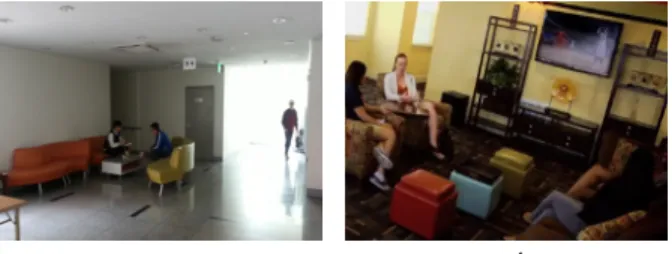
Figure 1. Typical view of university dormitory lounge(S University in Seoul, left, University of Texas, USA right)
Riker and Decoster (2008) argued that the interpersonal environment can, likewise, either facilitate learning or, if impoverished, inhibit the educational process. Newcomb (1962) also suggested that peer influence in social networking, although not necessarily opposed to faculty influence, is probably the more effective factor in
1) In the study of life in a university residence, Shaikh &
Descamps (2006) argued that loneliness, especially in female students in the university residence, was another common pre-disposing factor for depression, sadness, nostalgia, etc.
determining the direction and quality of student attitudes.
In fact, it appears that students' social community is closely related to a classical study of sense of community (SOC), which has been a vitally important in community planning since it was first conceptualized by Sarason (1974), and theoretically redeveloped by McMillan and Chavis in 1986, and rearranged again by McMillan in 19962). According to McMillan (1986), sense of commu- nity is defined as a feeling that members have sense of belong and being important to each other, and a shared faith that members' needs will be met by being together.
Students who lacked a sense of community were more likely to experience higher degrees of emotional and physical exhaustion in the campus environment (McCarthy et al, 1990).
According to the previous research, sense of commu- nity can be considered as a catalyst for social involve- ment and participation in the community (Chavis and Wandersman, 1990; Davidson and Cotter 1986; Perkins et al. 1990; Cicognani et al., 2008). In his research on the relationship between student social networks and sense of community, Dawson (2008) contended that an individual student's pre-existing external social network influences the type of support and information exchanges an individual requires and therefore, the degree of sense of community ultimately experienced. Similarly, McKinney, McKinney, Franiuk, and Schweitzer (2006) claimed that enhanced SOC was closely related with a variety of academic outcome variables, including students' perfor- mance on exams. Therefore, it is concluded that the social context that impact personal interaction is transi- tioned into a catalyst of sense of community for social integration and sustaining personal growth, implying college student educational attainment.
2.2 Physical housing characteristics
2) McMillan and Chavis (1984) explored that sense of community was categorized by four distinctive components:
membership, influence to group, fulfillment of personal needs, and shared emotional connection between members.
In this study, some of these indices were employed in survey instrument to measure sense of students' sense of community in dormitory.
While previous research on social environment in university dormitory has illuminated a great deal with regard to the interrelationship and its effects with perceived sense of community among peers, there is little empirical evidence as to what is required to generate and implement an effective sense of community in relation with physical environment in students' residential area.
Previous research in domestic and overseas regarding Campus facilities mainly dealt with class room, housing, library, public toilets, student hall/retail, dormitory individual unit and indoor and public outdoor areas (Hur
& Yang, 2002; Arboleda, et al, 2003; Song & Roh, 2004;
Thomsen and Eikemo, 2010; Kim, et al, 2010). Arboleda, Wang, Shelly, and Whalen (2003) maintained that residence hall students' involvement in their living community is influenced partly by such physical environment as living unit cabinet and environmental variables. Thomsen and Eikemo (2010) found that university housing charac- teristics such as size, light, and ease of personalization, as well as location in proximity to desirable locations, were significant predictors of satisfaction. Fay (1981) argues that the ways in which physical settings have an impact on student development and suggested that the lack of adequate facilities precludes the possibility of interpersonal growth. Many studies illuminated that comfortable common areas of residence halls where dormitory students can chat and have coffee, study or watch television are the key components for facilitating group interaction (Kennedy, 2003; Dellicker & Hill, 2005).
These areas include common are of each unit, lounge, dinning hall, laundry room, or outdoor rest area around main entry of dormitory.
Even though, developing social interaction and building a sense of student community improve students' overall residential satisfaction with dormitory and personal academic growth, it is, however, unclear whether physical settings of campus housing relative to the formation of students' sense of community, thus leading to active social involvement concerned.
3. Data Collection and Analysis
3.1 Study overview
In order to examine the effects of physical settings on the formation of sense of student community, it is necessary to investigate what the level of sense of perceived sense of community(SOC) in dormitory environ- ment. For that purpose, one residential complex of S university was selected for survey purpose. A question- naire on a five-point Li-kert scale was contrived to assess major students' perception on the sense of community. Students were asked to evaluate the level of agreement (1= strongly disagree; 5= strongly agree) of SOC and physical environment as well as personal information. Forty survey statements regarding SOC and physical environment of dormitory including personal characteristics were developed through the pilot test. The actual survey were performed during Spring semester 2015. 168 survey samples were responded and 152 collected for analysis through SPSS program. Each factor regarding SOC was mainly developed, based on the previous studies of SOC such as McMillan (1984) and Kim (2012).3)
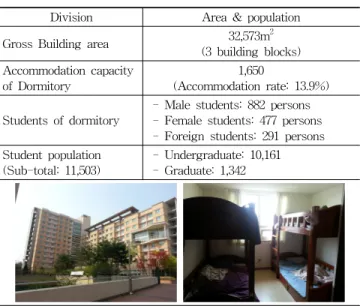
Division Area & population
Gross Building area 32,573m2
(3 building blocks) Accommodation capacity
of Dormitory
1,650
(Accommodation rate: 13.9%)
Students of dormitory
- Male students: 882 persons - Female students: 477 persons - Foreign students: 291 persons Student population
(Sub-total: 11,503)
- Undergraduate: 10,161 - Graduate: 1,342
Table 1. Profile of Target population as of June 2015 (S University Campus Dormitory)
3.2 Analysis and discussion
3) The concept and main survey items of SOC(sense of student community) are composed of membership -sense of belonging (7 indices), fulfillment of needs (7), influence - social participation (5), shared emotional connection (6), along with satisfaction with physical environment (8).
3 3 .1 3 .2 3 .3 3 .4 3 .5 3 .6 3 .7
le ss th a n 1 y r s
2 y r s 3 y r s m o r e th a n 3 y r s
M e a n o f S O C
Figure 2. Relationship between students' Living period and their reported SOC(Sense of Community); χ2= 437.7(p=.000)
SOC Factor & Physical env. No. of
index Mean SD
Membership 7 3.68 .56
Fulfillment of needs 7 3.48 .69
Influence 5 3.33 .58
Shared emotional connection 6 3.11 .64
Overall SOC 1 3.40 .45
Satisfaction with Physical
environment 8 3.58 .56
Table 3. Mean scores of Factors, SOC and Physical environment(n=152)
Physical Environment
.583** SOC
.429** .732** Membership
.632** .781** .430** Fulfillment of needs
.363** .744** .494** .494** Influence .260** .665** .274** .274** .283** Shared
connection
** Correlation is significant at the 0.01 level (2 tailed)
Figure 3. Pearson Correlation analysis between Physical environment and Sense of Community (SOC) in University dormitory
In order to evaluate students' the sense of community in relation with social involvement, χ2 analysis and General Lineal Model(GLM) were performed. Each factor of SOC was calculated by average means of group index such as membership, fulfillment of needs, influence, and shared emotional connection. In order to verify appropriateness of survey index, Cronbach's Reliability test was performed to secure the stability of 40 indices (α
=.8904). community satisfaction.
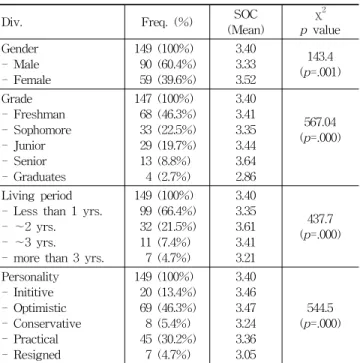
Div. Freq. (%) SOC
(Mean)
χ2 p value Gender
- Male - Female
149 (100%) 90 (60.4%) 59 (39.6%)
3.40 3.33 3.52
143.4 (p=.001) Grade
- Freshman - Sophomore - Junior - Senior - Graduates
147 (100%) 68 (46.3%) 33 (22.5%) 29 (19.7%) 13 (8.8%) 4 (2.7%)
3.40 3.41 3.35 3.44 3.64 2.86
567.04 (p=.000)
Living period - Less than 1 yrs.
- ∼2 yrs.
- ∼3 yrs.
- more than 3 yrs.
149 (100%) 99 (66.4%) 32 (21.5%) 11 (7.4%) 7 (4.7%)
3.40 3.35 3.61 3.41 3.21
437.7 (p=.000)
Personality - Inititive - Optimistic - Conservative - Practical - Resigned
149 (100%) 20 (13.4%) 69 (46.3%) 8 (5.4%) 45 (30.2%) 7 (4.7%)
3.40 3.46 3.47 3.24 3.36 3.05
544.5 (p=.000) Table 2. Descriptive statistics of Dormitory students
As shown in Table 2, the Chi square analysis(χ2) indicates that each group's individual characteristics such as gender, grade, living period, and personality were statistically significant on the level of SOC at the level of p=.01; female students (M=3.52pts.) reports more high degree of sense of community than male (M=3.33pts.), Graduate students (M=2.86pts.) responded to the low scores of SOC than any other grade groups, SOC of 2nd year(M=3.61 pts.) is greater than any other living period (See figure 2), and student who assessed his personality as optimistic (M=3.47) was higher than resigned (M=3.05). In particular, college administrator responsible for housing needs to provide specific implementation for graduate students who reported low sense of community in a way to promote their social environment.
Students' SOC (Sense of community) and their satisfaction with physical environment in relation with university dormitory were explored as following Table 3. In this table, it appears that membership (M=3.68) is higher than any other factors of SOC, while shared emotional connection showing low mean score (M=3.11 pts.). This means that social bondage between students is weak for social interaction and mutual support, implying mere impact on the building of SOC.
In order to examine the relationship between physical environment of dormitory and Sense of Community (SOC), correlation analysis was performed. Figure 3 is showing that there exists statistically significant relationship between physical environment and factors
related to Sense of Community (SOC). Among the components of SOC, it is apparent that physical environ- ment is strongly related to fulfillment of needs. This validates that providing basics of dormitory facilities such as furniture, heating and cooling, daylighting, up-keeping, comfortable personal space, and social lounge for students' relaxation and chat is the key in building strong sense of community.
Further, in an effort to explore what the important physical attributes are to facilities SOC in dormitory, stepwise multiple regression was performed by placing dependent variable of overall composit score of SOC (See Table 4). The most important predictors in facilitating social interaction were summarized as being comfortable, quiet, and enough social space around the dormitory. This means that some areas of dormitory space should be reserved to design exclusively for a specific social group of students not only for just a personal space but also for social activities as possibly minimizing institutional image.
Reg.
Model
Predictors Reg.
coefficients Std.
Error Beta Weight
F Sig.
Model Summary
Index P6*** .250 .030 .553 40.96 .000*
Index P1*** .108 .030 .221 Index P5*** .067 .028 .159
Constant 1.930 .150 R2=.454, Adj. R2=.443
* p <.01
** dependent variable: composite score of sense of community(SOC)
***
Index P6 refers to "If I come in my dormitory, it's comfortable like our home."
Index P1 indicates "Overall, our dormitory is quiet place."
Index P5 refers to "There is enough space to make a friend in dormitory area."
Table 4. A regression analysis for physical environment for facilitation of Social environment in dormitory
On the other hand, when placing overall SOC as a d.v. and all survey index as i.v. the multiple regression indicated that "Our dormitory is very comfortable to sleep," as the most weighted predictors (beta= .431), followed by "I do have strong place attachment to my dormitory (beta=.289) and "There ar many students who knows me in dormitory(beta=.275)." All together, the study indicates that as students' satisfaction with
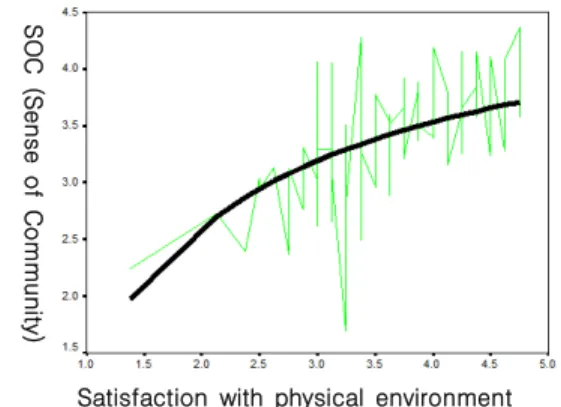
physical environment is higher, the statistics of sense of community shows somewhat the similar response except for an emotional connection. The linear graph in the below figure 4 demonstrates that as the physical environment facilitating social interaction goes up, the level of SOC does correspond in a positive way to the rate of regression coefficient.
SOC (Sense of Community)
Satisfaction with physical environment
Figure 4. Regression analysis, indicating the relationship bertween physical environment of dormitory and Sense of Community(SOC)
4. Conclusions and future research
University dormitory has always been a possible opportunity areas for diverse student social life, serving such various needs as studying, eating, sleeping, relaxing, and social networking of college students. Previous review of literature found that developing social intera- ction and building a sense of student community improve students' overall residential satisfaction with dormitory and personal academic growth. However, relatively few research have examined the relationship between physical environment and Sense of community.
In a survey on S university students, the Chi square analysis(χ2) indicated that each group's individual characteristics such as gender, grade, living period, and personality were statistically significant on the level of SOC at the level of p=.01. In particular, as students' residing period continued, it did not necessarily enforce more social involvement between students, implying certain limitation of the dormitory area itself.
Individual analysis of SOC indicated that sense of belonging(membership) was higher than shared emotional connection, which means certain level of intervention is
needed. Open-ended question by dormitory students revealed that regular parties, group activities in recrea- tional area and more cozy interior and furniture layout in social lounge would facilitate social interaction between students.
Pearson correlation analysis indicated that there exists statistically significant relationship between physical environment and factors related to Sense of Community (SOC). As shown in Figure 4, mean scores of physical environment attributes reported high, sense of community scores increased at the similar rate (Standardized regression coefficient Beta=.583, > p=.000). Further it also found that the most important predictors in facilitating social interaction were summarized as being comfortable, quiet, and enough social space around the dormitory.
Through the investigation of student dormitory, some useful design implications were explored. Providing public space such as social lounge and corridor area with furniture sets are an important element to accommodate all sets of social activities. Further, furnishing attractive interior design features with comfortable furniture on each floor rather than institutional appearance, is a natural moment to have a chat and to be socially involved each other in which they ultimately will become a friend and share emotional connection each other.
Finally, consistent up-keeping and social net-workng program by university management will maximize the potential of social environment, thus leading to higher satisfaction and successful academic achievement.
Since this research takes on one limited case of university, there exists limitation to generalize the results.
However, it is maintained that implications, generating from SOC concept will implement our residence hall design in a way to promote the social wellbeing of all users concerned.
References
1. Arboleda, A., Wang, Y., Shelly, M., & Whalen, D.
Predictors of residence hall involvement, Journal of College Student Development, 4, 2003, pp.517-531.
2. Astin, A. Student involvement: A developmental theory for higher education, Journal of College Student
Personnel, 25, 1984, pp.297-330.
3. Ballou, R., Reavill, L., & Schltz, B. Assessing the immediate and residual effects of the residence hall experience: Validating Pace's 1990 study of on-campus and off-campus students. Journal of College and University Student Housing, 1995, pp.16-21.
4. Berger, J.B., Students' sense of community in residence halls, social integration, and first-year persistence, Journal of College Student Development, 38, 1997, pp.441-452.
5. Bling, G.S. A metaanalysis of the influence of college residence halls on academic performance. Journal of College Student Development, 40, 1999. pp.551-561.
6. Bryant, C., Build a sense of community among young students wiyh student-centered activities, The Social Studies, May/June 1999, pp.110-113.
7. Chavis, D.M., & Wandersman, A. Sense of community in the urban environment: A catalyst for participation and community development. American Journal of Community Psychology, 18, 1990, pp.55-82.
8. Cicognani, E., Pirini, C., Keyes, C., Joshanloo, M., Rostami, R., & Nosratabadi, M. Social participation, sense of community and social well being: A study on American, Italian and Iranian University Students, Springer Science+Business Media B.V., 2007, pp.97-112.
9. Curley, Patrick, Making campus a home, American School & University, August, 2003, pp.146-149.
10. Davidson, W.B., & Cotter, P.R., Measurement of sense of community within the sphere of city. Journal of Applied Social Psychology, 16(7), 1986, pp.608-619.
11. Dawson, Shane, A study of the relationship between social networks and sense of community, Educational Technology & Society, 11(3), 2008, pp.224-238.
12. Dellicker, L. & Hill, C., Evolving design, American School & University, Feb., 2005, pp.34-36.
13. Fay, G., A model for reviewing growth environments, Journal of College and University Students Housing, 11(1), 1981, pp.46-47.
14. Hur, J. & Yang, S., Perceptions of privacy and territoriality and residential satisfaction in dormitory rooms, Journal of AIK, 18(8), 2002, pp.91-98.
15. Li, L, Maximova, E., Saunders, K., & Shelly, M.C., The influence of custodial maintenance, and residence life services on student satisfaction in residence halls, Journal of College and University Student Housing, 2007, pp.43-52.
16. Li, Y., Sheely, M. C., & Whalen, D.F., Contributors to Residence Hall Student Retention: Why do students choose to leave or stay, Journal of College and University Student Housing, 2005, pp.28-36.
17. Lounsbury, J.W. & DeNuie, D. Psychological sense of community on campus. College Student Journal, 1995, 11(2), pp.270-277.
18. Kennedy, M., Keeping up Appearances, American School
& University, Feb., 2003, pp.42-45
19. Kim, W., A cross-cultural investigation of adults' formation of sense of community through environment autobiography, Architectural Research, 14(4), Dec., 2012.
pp.125-132.
20. Kim, S., Kim, J, & Lee, J., A study on the planning of the communal dormitory for foreign students through POE- Focusing on foreign students and Korean students in the K-University C-Dormitory located in Daegu, Journal of AIK, 26(12), 2010, pp.137-146.
21. McCarthy, M.E., Pretty G. M. H., & Catano, V.
Psychological sense of community and student burnout, Journal of College Student Development, 31, 1990, pp.211-216.
22. McKinney, J.P., McKinney, K.G., Franiuk, R., &
Schweitzer, J., The college classroom as a community:
Impact on student learning, College Teaching, 54(3), 2006, pp.281-284.
23. McMillan, D.W. (1996). Sense of Community. Journal of Community Psychology, 24(4), pp.315-325.
24. McMillan, D.W., & Chavis, D.M. (1986). Sense of Community: A Definition and Theory. Journal of Community Psychology, 14, pp.6-23.
25. Newcomb, T.M. Student peer-group influence and intellectual outcomes of college experience. In R.L.
Sutherland et al. (Eds.) Personality of the College Campus. Austin, University of Texas, 1962, pp.69-71.
26. Pascarella, E.T. Racial differences in factors associated with bachelor's degree completion: A nine-year follow-up. Research in Higher Education, 23, 1985, pp.351-373.
27. Pascarella, E.T. Terenzini, P.T., & Blimling, G.S. The impact of residential life on students. In C.C. Schroeder, P. Mable, & Associates (Eds.), Realizing the educational potential of residence halls (pp.22-52). 1994, San Fransisco: Jossey-Bass.
28. Perkins, D., Florin,P., Rich,R., Wandersman, A., &
Chavis, D.M., Participation and the social and physical
environment of residential blocks: Crime and community context. American Journal of Community Psychology, 18, 190, pp.631-655.
29. Pretty, G.H., Conroy, C., Dugay, J., Fowler, K., &
Williams, D., Sense of community and its relevance to adolescents of all ages, Journal of Community Psychology, 24(4), 1996, pp.365-379.
30. Prezza, M., Arrici, M., Roberti, T., Tedeschi, G. Sense of community referred to the whole town: Its relations with neighboring, loneliness, life satisfaction, and area of residence. Journal of Community Psychology, 29(1), 2001, pp.29-52.
31. Riker, Harold & Decoster David, The educational role in college student housing, Journal of College and University Student Housing, 2008, pp.80-85.
32. Sarason, S.B. (1974). The psychological sense of community: Prospects for community psychology. San Francisco: Jossey-Bass.
33. Shaikh, B.T. & Deschamps, J.P., Life in a university residence: Issues, concerns and responses, Education for Health, 2006, 19(1), pp.43-51.
34. Song, B., & Roh, J., A study on satisfaction and behavior in a residence hall, Journal of AIK, 20(1), 2004, pp.59-67.
35. Thompson, D.E., Orr, B., Thompson, C., & Grover, K., Examining students' perceptions of their first-semester experience at a major land-grant institution, College Student Journal, 41(3), 2007, pp.640-648.
36. Thompson, J., & Eikemo, T., Aspects of student housing satisfaction: A quantitative study, Journal of Housing and the Built Environment, 25(3), 2010, 25(3), pp.273.
37. Tinto, V., Leaving college: Rethinking the cause and cures of student attrition (2nd ed.). 1993, Chicago, IL:
University of Chicago Press.
38. Tinto, V., Taking retention seriously: Rethinking the first year of college. VACADA Journal, 19(2), 2002, pp.5-9.
접수 2015. 7. 13 1차 심사완료 2015. 9. 2 게재확정 2015. 9. 18