− 672 − DOI:10.5720/kjcn.2011.16.6.672
서울지역 대학생의 주관적 건강상태에 따른 체형인식, 건강관련 생활습관 및 식습관 비교
곽호경·이미영1)·김미정1)†
한국방송통신대학교 가정학과,
1)서울여자대학교 식품영양학과
Comparisons of Body Image Perception, Health Related Lifestyle
and Dietary Behavior Based on the Self-Rated Health of University Students in Seoul
Ho-Kyung Kwak, Mi Young Lee
1), Mi Joung Kim
1)†Department of Home Economics, Korea National Open University, Seoul, Korea
1)
Department of Food and Nutrition, College of Natural Sciences, Seoul Women's University, Seoul, Korea
Abstract
This study was conducted to examine the differences in perceived body weight and image and various lifestyles based on the self-rated health of university students when gender was adjusted. Five hundred fifty-five participants were asked their perceived health condition, and 58, 289, 160 and 48 students answered themselves as “very healthy”, “healthy”,
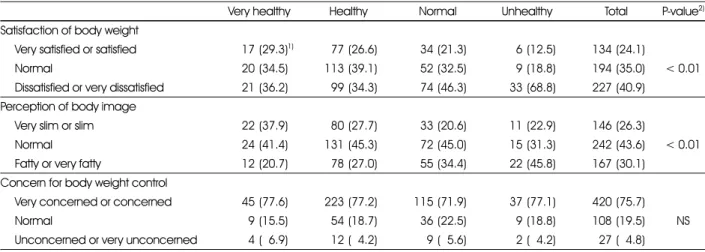
“normal”, and “unhealthy”, respectively. As compared to the other 3 groups, “unhealthy” group showed higher proportions in dissatisfaction of body weight and negative perception of body image (P < 0.01). As health related lifestyles, “very healthy” group reported longer sleeping time than “unhealthy” group (P < 0.05), and had a higher proportion of people with regular exercise. Among the dietary behaviors, the frequencies of followings significantly different among the groups: “Regularity of meal time” (P < 0.01), “Eat protein foods more than twice a day”
(P < 0.001), “Eat vegetables” (P < 0.01), “Eat fruit and fruit juice” (P < 0.01), “Eat vegetable oil added foods”
(P < 0.01), “Eat seaweed” (P < 0.01), “Eat breakfast” (P < 0.01), “Modulation in animal fat and high in cholesterol intake” (P < 0.01). Particularly, higher proportion of subjects answered “very healthy” had higher frequencies (6-7 times/
week) of these dietary behaviors. Overall results suggest that healthy lifestyle including adequate sleeping time, regular exercise, and good dietary behaviors might be potential factors affecting positive perception of health. In addition, positive perception of body weight and image were related with positive perception of health. (Korean J Community Nutr 16(6) : 672~682, 2011)
KEY WORDS : self-rated health, body image, dietary behavior, exercise, sleeping time
—————————————————————————
서 론
—————————————————————————
주관적 건강상태(self-rated health)는 자기가 인식하고 있는 건강상태와 함께 건강수준을 예견하는 지표중의 하나 로서 스스로 자신의 건강을 평가하는 방법으로 매우 의미가
있고, 이를 통해 건강추구 행태에 영향을 미치는 것으로 알 려져 있다. 비록 주관적 건강상태는 자신의 건강상태를 실제 보다 높게 지각하는 경향이 있으나(Idler & Angel 1990) 측정이 용이하고 의료비 지출과 사망의 위험을 예측하는데 유용하다(Mossey & Shapiro 1982; Idler & Angel 1990; Crystal 등 2000). 국내 연구에 의하면 연령, 교육 수준, 수입, 생활환경 및 식사의 다양성이 주관적 건강상태 를 예측하는 요인으로 보고되고 있으며(Ahn & Joung 2006), BMI가 주관적으로 인식하는 건강상태에 영향을 미 치는 요인이라고 보고하고 있다(Chang & Kim 2000). 또 한, Kim 등 (2008b)은 주관적 건강상태를 좋은 방향으로 인식할수록 사회적, 신체적, 경제적, 정서적 측면의 질이 높 게 평가가 된다고 보고하고 있어 주관적 건강상태는 삶의 질
접수일: 2011년 59월 52일 접수수정일: 2011년 59월 29일 수정 채택일: 2011년 12월 15일 채택
*This research was supported by Korea National Open University Research Fund
†Corresponding author: Mi Joung Kim, Department of Food and Nutrition, College of Natural Sciences, Seoul Women's University,
#126 Kongneung 2-dong, Nowon-gu, Seoul 139-774, Korea Tel: (02) 970-5644, Fax: (02) 976-4049
E-mail: [email protected]