집합적 리더십이 구성원의 직무열의에 미치는 영향 :
심리적 임파워먼트의 매개효과와 자기효능감의 조절효과를 중심으로
Effects of Collective Leadership on Follower’s Work Engagement:
Examining the role of Psychological Empowerment and Self-efficacy
엄기성*, 유태섭**
경희대학교 국제대학원*, 서울과학종합대학원**
Kiseong Um([email protected])*, Tae-Seob Yoo([email protected])**
요약
본 연구는 국내 기업의 근무자를 대상으로 집합적 리더십의 효과성을 연구하는데 있어 심리적 임파워먼 트와 직무열의의 관계를 규명하는데 목적이 있다. 이를 위하여 집합적 리더십이 직무열의에 미치는 영향, 집합적 리더십과 직무열의간의 관계에서 심리적 임파워먼트의 매개효과 그리고 심리적 임파워먼트와 직무 열의간의 관계에서 자기효능감의 조절효과를 검증하였다. 국내 7개 기업 237명을 대상으로 연구를 실시하 였고, 수집된 자료의 분석과 통계처리를 위하여 SPSS21.0과 M-Plus6을 사용하였다. 연구 결과, 집합적 리더십은 종업원의 직무열의에 긍정적인 영향을 미치는 것으로 밝혀졌고 이 과정에서 종업원의 심리적 임 파워먼트는 매개 역할을 하는 것으로 검증되었다. 이러한 결과는 집합적 리더십이 종업원의 심리적 임파워 먼트를 촉진하고 직무열의에 긍정적인 영향을 미치는 주요 변인임을 입증하는 것이다. 종업원의 심리적 임파워먼트와 직무열의의 관계에서 종업원의 자기효능감은 조절효과를 보이는 것으로 나타났다. 마지막으 로, 본 연구 결과가 주는 이론적 및 실무적 함의를 논하였으며, 마지막으로 연구의 한계 및 향후 연구방향 을 제시하였다.
■ 중심어 :∣집합적 리더십∣직무열의∣심리적 임파워먼트∣자기효능감∣
Abstract
The purpose of this study is to examine the relationship between collective leadership and employee’s work engagement and psychological empowerment. This study tested the impact of collective leadership on employee’s work engagement and the mediating role of psychological empowerment between the two variables. And also, this study tested moderating role of self-efficacy between psychological empowerment and work engagement. A total of 237 employees in 7 companies in South Korea participated in this study. The SPSS 21.0 and M-Plus6 statistical programs were used in this study to analyze and statistically process the collected survey data. The result showed that collective leadership positively influence employee’s work engagement and psychological empowerment works as mediator in the relationship between collective leadership and employee’s work engagement. This results means that collective leadership is a crucial factor to facilitate employee’s psychological empowerment toward employee’s work engagement. Self-efficacy had moderating effect between psychological empowerment and work engagement. Finally, theoretical and practical implications of the study results have been discussed along with limitations and future direction of the study.
■ keyword :∣Collective Leadership∣Work Engagement∣Psychological Empowerment∣Self-Efficacy∣
접수일자 : 2018년 06월 15일 수정일자 : 2018년 07월 20일
심사완료일 : 2018년 07월 20일
교신저자 : 유태섭, e-mail : [email protected]
I. INTRODUCTION
The fundamental nature of the organization is rapidly changing. As organizational members are specialized and the interconnectivity among knowledge workers is increased due to the globalization and digitalization, jobs are organized by team units, and knowledge and information are distributed to the top and bottom according to the hierarchy of the organization. Such changes suggest an important influence on leadership[1]. Especially, innovation and adaptation capability is becoming important as the team system spreads within an organization[2], and new problems to face emerges faster and complex[3] (Friedrich, Mumford, Vessey Beeler, & Eubank, 2010). As today, the management environment rapidly changes and the issues within the organization are getting more complex, solving the issues by the leader alone is limited.
Nevertheless, the dominant approach to leadership research had been tending to find all aspects of the leadership role within a team from a single individual until the early 2000s. Recently, transition of paradigm in leadership research is occurring. The focus of leadership research is moving from understanding behaviors or interactions of the leaders to newly emerging, unofficial, and dynamic leadership carried out by many members[1]. In addition, it is recognized as an essential competence to cope with complex workplaces where the collective leadership by the main bodies sharing leadership role through official and unofficial relationships with multiple individuals are increasing every day[4]. The work engagement in which a member is in completely immersed state in one’s own role through the intrinsic motivation is the topic most actively discussed in HR field, especially in consulting businesses and corporate workplaces, and it has been contended that the corporates in the
advanced countries including the US recognize the work engagement of the members of the organization as an important agent that increases the competitiveness of the corporate, and the work engagement predicts members’ achievements and the success of the organization, and the financial performance of the company such as stockholders’
earnings[5]. Recently, some major corporates even in South Korea regularly measure the work engagement of employees, and cases of making various efforts to increase the work engagement or using the level of members' work engagement as an important item for the leadership evaluation are increasing[6]. This study has the following research questions. First, what is the relationship between collective leadership and work engagement in a team? Second, what variables mediate the relationship between collective leadership and work engagement? Third, which variables moderate the effect of psychological empowerment on work engagement? And, the purpose of the present study is to investigate the influence of the collective leadership on the work engagement of the members with the focus given to the mediating effects of psychological empowerment and the moderating effect of self-efficacy. Accordingly, Based on the above research questions and research objectives, the present study will attempt to find out the effect of collective leadership on the work engagement of the members. First, the effect of the collective leadership on the psychological empowerment of the members will be investigated, and its effect on the work engagement of the members as an attitude toward work will be verified. In addition, the relationships among collective leadership, psychological empowerment, self-efficacy, and work engagement will be empirically investigated, and theoretical and practical implications will be provided through the investigation.
II. THEORETICAL BACKGROUND
1. Collective Leadership
Complexity theory implies approaches that focus on flatter, more flexible organizations, rather than top-down, command-and-control styles of management[7]. Pearce (2004) argued that as the complexity of work increases, the probability of a specific individual becomes an expert in all elements of work becomes lower. A complex organization needs leadership in all stages, and accordingly, such an organization cannot rely on one individual for all leadership and knowledge to run efficiently (Pearce &
Conger, 2003). Instead, collective leadership where all members are actively participating in creating the leadership is needed.
The definition of collective leadership is a dynamic leadership process in which a defined leader, or set of leaders, selectively utilize skills and expertise within a network, effectively distributing elements of the leadership role as the situation at hand requires[10].
First of all, attention should be given to the fact that there are multiple individuals in defining the leadership. Gronn[11] discusses “one individual, an aggregate of separate individuals, sets of small numbers of individuals”, Pearce and Conger (2003)[12] refer “individuals and groups’, and Hiller et al. (2006)[13] discuss multiple “team members.” The second aspect of collective leadership stems from the fact that leadership serves multiple collective functions or roles. Mayo et al.[14] used the transactional and transformational leadership framework, describing collective leadership as multiple members of the group engaging in contingent reward, management by exception, charisma, individualized consideration, and intellectual stimulation behaviors. Hiller et al.[13] presented a four-type classification system that includes planning
and organizing, problem-solving, support and consideration, and developing and mentoring. Hiller and colleagues succeeded in expanding the dimension of the collective leadership, but failed to expiscate its structure. Nevertheless, the role provides a good perspective for understanding the leadership activities in a social group, and leadership includes complex roles is generally agreed among scholars (e.g., Hollander[15]). Among the recent research on collective leadership, Friedrich et al.[10] suggested 55 propositions related to collective leadership processes hereafter in research presented a framework to understand collective leadership, and Contractor et al.
[1] presented a key concept on collective leadership from the perspective of people, role, and time in a structural pattern study. In addition, Cullen &
Yammarino[16] called for important ideas related to official, unofficial, and collective leadership, and leadership from the perspective of network in their collective leadership and network approaches study on leadership. Friedirch et al.[17] conducted a study on the validity of core elements of collective leadership through a study on the career of General George C. Marshall. Friedrich, Griffith, & Mumford presented communication, network development, and leader/team exchange as three dimensions of collective leadership in a study on collective leadership behaviors.
2. Work Engagement
Work engagement was first theoretically conceptualized by Kahn[18]. Schaufli et al.[19] defined work engagement as energetic, committed, and absorbed mental attitude, and a positive and achievement-oriented mindset related to work, and stated that it has three sub-constructs of vigor, dedication, and absorption. The most representative model that theoretically explain work engagement is
job Demand-Resource(JD-R) Model[20]. The perspective of the job demand-resource model is that all occupations have their unique specific elements related to stress or motivation, and assumes those elements are largely categorized into job demand and job resource[20][21]. The job demand is the physical, social, and organizational aspects of work and demands members of continuous physical or mental efforts, and they are work overload, time pressure, role ambiguity, and difficult physical environment related to a certain psychological cost such as burnout. The job resource plays functional roles to achieve not only work goals but also personal growth and development or reduces physiological and psychological costs incurred from the job demand and work, and it means job control, development opportunity, participation in decision making, process diversity, and feedback[22]. And, the positive relationship between job demand and job burnout, and the positive relationship between job resource and work engagement are proven through empirical studies in various jobs and countries[21]. Christian et al.[23] studied the relationship between work engagement and task and contextual performance and presented job characteristics such as autonomy, task variety, job complexity, work conditions, and leadership, and dispositional characteristics as the antecedent factors that influence work engagement.
Among those factors, the leader is the factor that exerts the most important influence on the work context, and the leader greatly influences how an individual perceives the work he or she is performing.
Macey & Schneider[24] stated that if the leader shows clear expectations, fair, and acknowledges good outcome of the members, it will positively influence the engagement that brings about a sense of attachment to the work the members perform.
3. Psychological Empowerment
Psychological empowerment is defined as the process of giving self-efficacy to the organizational members by removing the situation causing a feeling of helplessness through an official or unofficial institutional device[25]. Thomas & Velthouse[26]
stated that psychological empowerment is a set of perception reflecting an individual's orientation on the role, and it is an enhancement of intrinsic task motivation that meaningfulness, competence, influence, and choice are materialized. Spreitzer[27]
defined psychological empowerment as the experience of intrinsic motivation based on perception related to each individual's role. In addition, Spreitzer[27] (1995) proved that the four perceptual set of Thomas &
Velthouse is an appropriate concept to explain psychological empowerment and renamed meaningfulness to meaning and choice to self-determination. Spreitzer's[27] four constructs of meaning, competence, self-determination, and impact are most widely used at present. Seibert et al.[28]
completed mata analysis and classified the antecedents of psychological empowerment into individual propensity (positive self-evaluation and human capital) and job characteristics. In addition, the results of their meta-analysis showed that meaningfulness and self-determination are related to core job characteristics[29]. Also, Spreitzer[30] stated that supportive and trustworthy relationship with the leader is an important antecedent factor. In addition, Seibert and colleagues[28] note that leadership (in its various forms) has been examined as an antecedent of individual psychological empowerment more than any other antecedent[31-34]. Therefore, leadership can be considered to have a positive relationship with the psychological empowerment. Meanwhile, according to Meyerson & Kline[35] individuals who feel psychological empowerment are first, more
satisfied with their work, second, more emotionally committed, third, have low turnover intention, and lastly show higher work performance than those with lower psychological empowerment. In addition, Bhatnagar[36], while examining the fields of psychological empowerment, work engagement and innovation, found that psychological empowerment affected work engagement and led to high innovation and lower turnover intention. Psychological empowerment was found to have strong predictive power on work engagement and innovation.
4. Self-Efficacy
Self-efficacy is based on social cognitive theory, which states that an individual'sbehavior is built by observing and imitating behaviors of others or given situations[37]. Bandura[38] stated that self-efficacy means having belief or confidence on one's own job performance competence needed to perform specific tasks, and it affects individual's choice of behavior, strength of effort, and persistency. Self-efficacy is different from efficacy, which is an actual ability to achieve something. Self-efficacy is a belief in one's efficacy. In addition, self-efficacy is distinguished from confidence. While confidence is the strength of belief in a nonspecific situation and an assurance without valid evidence, self-efficacy is definite in both the level of competence and the strength of belief[38]. Self-efficacy can be considered as a perceived belief, which means one's own judgment on one's own competence, but not an objective evaluation on competence[38]. He suggested four elements of the experience of success, vicarious experience, verbal persuasion, and emotional arousal as the source for an individual to obtain self-efficacy as stated above. In many studies, self-efficacy has been proven to be a strong variable having the moderating effect on the attitude and behavior of
members[39]. Judge et al.[40] found, within moderator categories, there were several cases in which self-efficacy made unique contributions to work-related performance in their study on self-efficacy and work-related performance. Elias et al.[41] stated that self-efficacy beliefs are of great importance given countless studies have demonstrated positive correlations between efficacy beliefs and any number of motivational and behavioral outcomes in clinical, educational, and organizational surroundings in their study the treatment of self-efficacy among psychology and management scholars. Chen et al.[42] verified that self-efficacy showed a moderating effect between supervisor's support and members' intrinsic motivation in their study on the relationship between supervisor support and members' innovative behavior. That is, it signifies that if the member has low self-efficacy, the effect of motivation also decreases even if the supervisor's support is increased. Such a research result proves that self-efficacy is a moderating variable for member's attitude and behavior.
Ⅲ. RESEARCH HYPOTHESIS
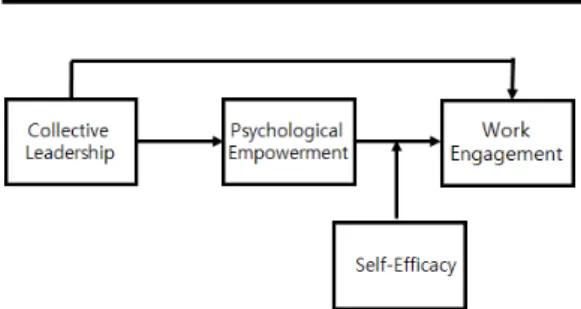
The present study set up the following research model to investigate the effects of collective leadership, which is the new trend of leadership suggested by Freidrich et al.[10][43], on work engagement, which recently receives attention as an attitude variable affecting human resource and corporate performance, as discussed above in the theoretical background focusing on the mediating effect of psychological empowerment and the moderating effect of self-efficacy[Figure 1].
Figure 1. Conceptual Model of the Present Study
1. Collective Leadership and Work Engagement
Vogelgesnang et al.[44] found out a positive relationship between leader communication transparency and follower work engagement with leader behavioral integrity as a mediator in a study on the relationship between communication, which is one of the construct of collective leadership, and work engagement. In addition, Yammarino et al.[45]developed a measuring instrument for the collective leadership construct and outcome variables based on the collective leadership framework suggested by Friedrich et al.[10] in their collective leadership study on the United States Army. Here, job performance, satisfaction, commitment, trust, innovation, which are the outcomes of collective leadership, are similar to the outcome variables of general leadership.
Meanwhile, Christian et al.[23] presented job characteristics, leadership and dispositional characteristics as the antecedents that influence work engagement in a study on antecedents and consequences of work engagement. Among those factors, the leader is the factor that exerts the most important influence on the work engagement, and the leader greatly influences how an individual perceives the work he or she is performing. Macey &
Schneider[24] stated that if the leader shows clear expectations, fair, and acknowledges good outcome of the members, it will positively influence the engagement that brings about a sense of attachment to the work the members perform. Furthermore, if the
members trust the leader, they will feel psychological safety and they will be more absorbed in their work[19]. Graen & Scandura[46] also stated that the quality of leader-member relationships or leader-member exchange (LMX) will positively influence the emotions and attitudes of the members.
Yoo[47] empirically proved that the high level of shared leadership, a similar concept to collective leadership positively influence team work engagement Putting these studies together, following hypothesis can be set up.
H1. Collective Leadership will be positively related to work engagement.
2. Collective Leadership and Psychological Empowerment
Spreitzer[30] stated that a supportive and trustworthy relationship with leader is an
\empowerment of the organizational members. The leader can increase meaningfulness by giving a value to what the leader is doing to the organizational members, increase impact by active participation of the organizational members or giving them autonomy, or increase self-efficacy (competence) of the organizational members by providing them with role model or constructive feedback[28]. In addition, Seibert and colleagues[28] note that leadership (in its various forms) has been examined as an antecedent of individual psychological empowerment more than any other antecedents[26][32-34][47], in their meta-analysis on the studies of empowerment in the past 20 years, presented leadership, individual and team characteristics, work design, organizational support as the antecedents and performance and affective reaction as the outcome. The psychological empowerment essentially acts as a mediating mechanism tying the antecedent conditions with
work-related outcomes. Putting these studies together, following hypothesis can be set up.
H2. Collective leadership will be positively related to psychological empowerment.
3. Psychological Empowerment and Work Engagement
According to Meyerson & Kline (2008) individuals who feel psychological empowerment are first, more satisfied with their work, second, more emotionally committed, third, have low turnover intention, and lastly show higher work performance than those with lower psychological empowerment. Thomas &
Velthouse[26] proposed activity, focus, initiative, resilience, and flexibility as the results of the psychological empowerment in terms of behavior.
Recently, Seibert et al.[28] carried out a meta-analysis on behavioral aspect (such as job satisfaction and organizational commitment) and behavioral aspect (such as task performance and organizational citizenship behavior) as the consequence variables of psychological empowerment and found out they are positively related to psychological empowerment. In addition, Bhatnagar [36], while examining the fields of psychological empowerment, work engagement and innovation, found that psychological empowerment affected work engagement and led to high innovation and lower turnover intention. Psychological empowerment was found to have strong predictive power on work engagement and innovation. Based on the literature review, the following hypothesis was established.
H3. Psychological empowerment will be positively related to work engagement.
4. Mediating role of Psychological Empowerment
As discussed in the theoretical background above, leadership was verified to be a meaningful antecedent for the psychological empowerment more than any other factors[28], and Bhatnagar[36] stated that the psychological empowerment has a strong and predictable influence on work engagement and innovation. In addition, Maynard et al.[48], presented leadership as the antecedent of the psychological empowerment and affective reaction as the outcome from their meta-analysis on the studies of empowerment in the past 20 years. Collective leadership is a dynamic leadership process that allocates leadership role to the official leader or the members who have expertise appropriate to the problem situation. In collective leadership, the leader encourages communication and exchange among the members, emphasizes building of good relationships, provides feedback, and emphasizes the necessity of knowledge and information sharing. In addition, the leader lets the members freely present their ideas and opinions, delegates various tasks or responsibilities, and also gives leadership role and authority to the members[43]. Such words and deeds of the leader will increase the psychological empowerment of the members, and it will influence work engagement of the members. In recent, Hwang and Kim[49] found that psychological empowerment mediated the relationship between the confirmed of boss and organizational effectiveness. Based on the theoretical implications of past studies, the following hypothesis was established.
H4. Psychological empowerment will mediate the relationship between collective leadership and work engagement.
5. Moderating role of self-efficacy
Self-efficacy means having belief or confidence on
one's own job performance competence needed to perform specific tasks, and it affects individual's choice of behavior, strength of effort, and persistency [38]. Self-efficacy is distinguished from confidence.
While confidence is the strength of belief in a nonspecific situation and an assurance without valid evidence, self-efficacy is definite in both the level of competence and the strength of belief[38]. In many studies, self-efficacy has been proven to be a strong variable having the moderating effect on the attitude and behavior of members[39]. Kim[49] proved that shared leadership has the moderating effect in the relationship between shared leadership and organizational citizenship behavior. It means the stronger the shared leadership and the higher the self-efficacy, organizational citizenship behavior can be enhanced. Chen et al.[42] verified that self-efficacy showed a moderating effect between supervisor's support and members' intrinsic motivation in their study on the relationship between supervisor support and members' innovative behavior. That is, it signifies that if the member has low self-efficacy, the effect of motivation also decreases even if the supervisor's support is increased. Such a research result proves that self-efficacy is a moderating variable for member's attitude and behavior. Putting together the results of the studies above, if self-efficacy is high when the psychological empowerment is high, the individual will engage in work more, on the contrary, if self-efficacy is low, the individual will engage in work less. Based on the results and implications of existing studies, the following hypothesis was established.
H5. Self-efficacy will moderate the relationship between psychological empowerment and work engagement.
Ⅳ. Methodology
For the present study, a survey was carried out on office workers of seven major corporates in electricity, energy, and machinery. The survey was conducted on employees who were in training program in corporate training institute from June 27 to July 29, 2016. Excluding five questionnaires for unanswered demographic items and 38 questionnaires for insincere answers, a total of 280 questionnaires were collected and 237 questionnaires were subjected to statistical analysis. The demographic characteristics were as follows. The gender distribution showed a predominant male proportion with 206 male (86.9%) and 31 female (13.1%), which showed the characteristics of electricity, energy, and machinery businesses. The age of the majority of participants was in 30-40s, 179 (75.5%), while 58 participants (24.5%) were in their 20s and 50s. In terms of education, college graduates were most prevalent with 177 people (74.7%), and the most prevalent team size was 6-10 people (75 people, 31.6%) followed by 21 people or more (66 people, 27.8%). Teams of 21 people or more appear to reflect the characteristics of large team system of manufacturing and R&D teams.
The definition of collective leadership is a dynamic leadership process in which a defined leader, or set of leaders, selectively utilize skills and expertise within a network, effectively distributing elements of the leadership role as the situation at hand requires[10].
In the present study, 12 items questionnaire developed by Friedrich et al.[43] was used to measure collective leadership. Since the scale was used for the first time in South Korea, the questionnaire was translated into Korean by two foreign language education institutions and supervised by a doctor in Industrial Organizational Psychology. The collective leadership measuring instrument by Friedrich et al. is composed
of 12 items in three factors of communication, leader-team exchange, and network development.
The measurements were on a five-point Likert scale.
Representative questionnaire items include “The leader mentions giving feedback to followers, and encouraging them to give feedback to him/her and their teammates.”(Communication), “The leader mentions delegating different tasks or responsibilities to specific people or groups.”(Leader-team exchange),
“The leader mentions encouraging communication and interaction between team members.”(Network development). Schaufeli et al.[18] defined work engagement as vigorous, dedicated, and absorbed mental attitude, and a positive and achievement- oriented mindset related to work, and stated that it has three constructs of vigor, dedication, and absorption. The most popular measuring tool related to work engagement is the Utrecht Work Engagement Scale (UWES)[18]. Schaufeli et al.[18]
defined work engagement as vigor, dedication, and absorption, and measured each using three questions for a total of nine questions. Examples of the questionnaire are: “At my work, I feel bursting with energy.”(Vigor), “I am enthusiastic about my job.
”(Dedication), “I feel happy when I am working intensely.”(Absorption). Thomas & Velthouse[26]
stated that psychological empowerment is a set of perception reflecting an individual's orientation on the role, and it is an enhancement of intrinsic task motivation that meaningfulness, competence, impact, and choice are materialized. Spreitzer[27] defined psychological empowerment as the experience of intrinsic motivation based on perception related to each individual's role, and the four perceptual set of Thomas & Velthouse[26] is an appropriate concept to explain psychological empowerment and renamed meaningfulness to meaning and choice to self-determination. The measuring instrument by
Spteritzer[27] was used for the psychological empowerment, and it is composed of 12 items in four factors of meaning, competence, self-determination, and impact. The measurements were on a five-point Likert scale. Representative questionnaire items include “What I am doing is very important to me."
“I have confidence in my job competence."
(competence), “I have the autonomy to determine how I perform my tasks at work”(self-determination), “I am very influential in my department.”(impact) Bandura[38] stated that self-efficacy means having belief or confidence on one's own job performance competence needed to perform specific tasks, and it affects individual's choice of behavior, strength of effort, and persistency. In addition, Bandura[38]
stated, on the ripple effect of the experience of success, that differences in self-efficacy emerge according to the three dimensions of the level of self-efficacy, intensity, and generalization, and suggested confidence, self-regulation efficacy, and task preference as the composing elements. The measuring instrument of Bandura[38] was used, and the measurements were on a five-point Likert scale.
Representative questionnaire items include “I believe in myself.”(self-confidence), “I tend to plan ahead and systematic in my work.”(self-regulatory efficacy), “I like to stick to difficult or challenging tasks.”
(task-difficulty preference)
Ⅴ. Results
1. Correlations and reliabilities
The correlations and reliabilities of each variable are presented in [Table 1]. The correlation coefficients among variables ranged from .325 to .584.
The results of reliability analysis showed that the reliability coefficients for collective leadership were
.886, psychological empowerment was .871, self-efficacy was .896, and work engagement was .835. The results indicate that all variables are appropriate to be used for research purposes[51].
Table 1. Correlation and Reliability analysis
2. Confirmatory Factor Analysis
Structural equation models test the relationship between the observed variable and latent variable.
Anderson & Gerbing[52] recommended to carefully studying the goodness of fit of construct of the variable before using the variables in the study.
Accordingly, the present study tested the uni-dimensionality of the variables through confirmatory factor analysis (CFA) by using M-Plus 6. To test the validity of the construct,
喻 2, TLI, CFI,
RMSEA, and SRMR will be examined as the index of concordance.2.1 Confirmatory factor analysis on collective leadership
Collective leadership is composed of three sub-factors of network development, communication, and leader-team exchange, and there are a total of 12 measuring indices. The CFA results of collective leadership on the 12 items show that the scale has a good concordance index. As shown in [Table 2], the values of CFI and TLI were either over or close to .90, and both SRMR and RMSEA had errors close to .05.
Table 2. Goodness of Fit Indices for collective leadership
2.2 Confirmatory factor analysis on psychological empowerment
Psychological empowerment is composed of four sub-factors of meaning, competence, self determination, and impact, and there are a total of 12 measuring indices. The CFA results of psychological empowerment on the 12 items show that the scale has a superior concordance index. As shown in [Table 3], the concordance indices CFT and TLI were .95 or higher, which indicates superior concordance, and both SRMR and RMSEA had errors close to .05.
Table 3. Goodness of Fit Indices for psychological empowerment
2.3 Confirmatory factor analysis on self-efficacy Self-efficacy is composed of three sub-factors of self-confidence, self-regulatory efficacy, and task-difficulty preference, and there are a total of 15 measuring indices. The CFA results of self-efficacy on the 15 items show that the scale has a good concordance index. As shown in Table 4, the values of CFI and TLI were close to .90, and both SRMR and RMSEA had errors less than .10.
Table 4. Goodness of Fit Indices for self-efficacy
2.4 Confirmatory factor analysis for work engagement
Work engagement is composed of three sub-factors of vigor, dedication, and absorption, and there are a total of 9 measuring indices. The CFA results of work engagement on the 9 items show that the scale has a superior concordance index. As shown in [Table 5], the concordance indices CFI and TLI were .90 or higher, which indicates superior concordance, and since SRMR was less than .05 even though RMSEA was .10, the overall concordance index can be considered superior.
Table 5. Goodness of Fit Indices for work engagement
3. Main Analysis
H1. Collective Leadership will be positively related to work engagement.
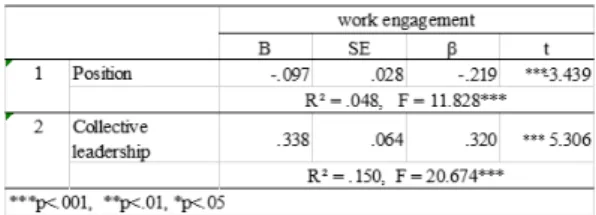
Before the hypothesis test, the relationship between demographic control variables and work engagement was examined. As shown in [Table 6], even though the variance accounted for by the demographic variables of work engagement for the overall model was 8.7%, only position was statistically significant.
Table 6. The effects of demographic control variables influencing work engagement
To test the hypothesis 1, which stated collective leadership will be positively related to work engagement, a hierarchical regression analysis was performed.
As shown in [Table 7], in step 1, position variable, which was statistically significant among the demographic variables, was entered, and in step 2, collective leadership was entered with position variable among the demographic variables controlled.
As seen in the result, collective leadership was directly influencing work engagement of members even after the demographic variables were controlled (△R .102), and it was statistically significant (β = .320, p<.000). Therefore, hypothesis 1 was supported.
Table 7. Test of direct effect of collective leadership on work engagement
H2. Collective leadership will be positively related to psychological empowerment.
Before testing the hypothesis, the relationship between demographic control variables and psychological empowerment was examined. As shown in [Table 8], even though the variance accounted for by the demographic variables of psychological empowerment for the overall model was 21.2%, only position was statistically significant.
To test the hypothesis 2, which stated collective leadership will positively influence the psychological empowerment, a hierarchical regression analysis was performed. As shown in [Table 9], in step 1, position variable, which was statistically significant among
the demographic variables, was entered, and in step 2, collective leadership was entered with the demographic variables controlled. As seen in the result, collective leadership was directly influencing psychological empowerment of members even after the demographic variables were controlled (△R .113), and it was statistically significant (β = .337, p<.000).
Therefore, hypothesis 2 was supported.
Table 8. The effects of demographic control variable influencing psychological empowerment
Table 9. Test of direct effect of collective leadership on psychological empowerment
H3. Psychological empowerment will be positively related to work engagement.
To test the hypothesis 3, which stated psychological empowerment will positively influence work engagement, a hierarchical regression analysis was performed. As shown in [Table 10], in step 1, position variable was entered as a statistically significant variable that influences work engagement among the demographic variables, and in step 2, psychological empowerment was entered with the demographic variables controlled.
Table 10. Test of direct effect of psychological empowerment on work engagement
As seen in the result, psychological empowerment was directly influencing work engagement of members even after the demographic variables were controlled (△R .294), and it was statistically significant (β = .601, p<.000). Therefore, hypothesis 3 was supported
H4. Psychological empowerment will mediate the relationship between collective leadership and work engagement.
To test the mediation effect, analysis was carried out according to the guidelines of Kenny et al.[53].
As shown in [Table 11], in step 1, collective leadership and psychological empowerment should be related. In step 2, collective leadership and work engagement should be related. In step 3, psychological empowerment and work engagement should be related after collective leadership is controlled. Lastly, the effect of collective leadership on work engagement in step 2 should be reduced when the psychological empowerment, which is a mediator, is entered in step 3. The results of analysis after controlling demographic variables showed significant relationship between collective leadership and psychological empowerment (β =.337, p<.000). In step 2, collective leadership and work engagement showed a positive relationship (β =.320, p<.000). In step 3, even after the effect of collective leadership was controlled, psychological empowerment was positively
related to work engagement (β =.545, p<.000). Lastly, the relationship between collective leadership and work engagement was reduced when psychological empowerment was entered into the model (before the psychological empowerment was entered: β=.320, p<.000; after the psychological empowerment was entered: β=.136, p<.000). To see if the decrease in coefficient is significant, Sobel test was performed, and the result was statistically significant (Z=4.84, p<.05). Because collective leadership was influencing work engagement even after the psychological empowerment was entered into the model in step 3, the psychological empowerment was partially mediating collective leadership and work engagement.
Therefore, hypothesis 4 was supported.
Table 11. Test of mediation effect of psychological empowerment on the relationship between collective leadership and work engagement
H5. Self-efficacy will moderate the relationship between psychological empowerment and work engagement.
To test the hypothesis 5, which stated self-efficacy will moderate the relationship between psychological empowerment and work engagement, a hierarchical regression analysis was performed. That is, after controlling the effect of demographic variables was controlled, the main effect of psychological empowerment and self-efficacy was tested in step 2.
Lastly, after controlling the main effect of
psychological empowerment and self-efficacy, the interaction effect of psychological empowerment and self-efficacy was tested in step 3. Even though the analysis results indicated that the main effect of psychological empowerment and self-efficacy was significant (F=54.547, p<.000) as shown in [Table 12], since the interaction effect was significant (F=42.453, p<.000) the interpretation of the main effected is limited.
Table 12. Test of moderation effect of self-efficacy on the relationship between psychological empowerment and work engagement
The moderation effect of self-efficacy is represented in a figure as follows. As seen in [Table 12] and [Figure 2], even if members' perception of psychological empowerment is high, if the perception of self-efficacy is low, members' work engagement will decrease.
Figure 2. The moderation effect of self-efficacy
Ⅵ. DISCUSSIONS
The purpose of the present study was to investigate the influence of the collective leadership on the work engagement of the members with the focus given to the mediating effects of psychological empowerment and the moderating effect of self-efficacy. To achieve the goal of the present study, literature was reviewed, and a model and hypotheses were set up based of the review. Then, a questionnaire was composed using the measuring instrument developed by a previous study, a survey was conducted, and then an empirical analysis was carried out. For the present study, a survey was carried out on office workers of seven major corporates in electricity, energy, and machinery, and a five-point Likert scale was used for each question. A total of 280 questionnaires were collected and final 237 of them were subjected to statistical analysis.
Basic statistical analysis, reliability analysis, and correlation analysis were carried out on the collected data through the survey using SPSS 21 statistics program. In addition, confirmatory factor analysis was conducted using M-Plus 6. The test results were as follows. First, collective leadership was found to positively influence work engagement of members.
That is, allocation of leadership role to the members who have expertise appropriate to the problem situation by the leader of the team the member belongs to and encouraging mutual communication have positive influences on work engagement of the members. Second, collective leadership was found to positively influence the psychological empowerment of the members. The higher the members' perception of leader's collective leadership exercise, the intrinsic motivation related to the role performance of the members was found to increase. Third, the psychological empowerment was found to positively
influence work engagement. The more the members' intrinsic motivation related to the role performance increases, members were found to be vigorous, absorbed, and dedicated in their job performance.
Fourth, the analysis results of the mediating effect of psychological empowerment indicated that the psychological empowerment of members plays the mediating role in the relationship between collective leadership and work engagement. It is the psychological process the members perceive between collective leadership and work engagement, and the psychological empowerment was found to play the role and promotes work engagement. Fifth, self-efficacy was found to control the relationship between psychological empowerment and work engagement. It was found that even if members have high level of psychological empowerment, work engagement decreased if their perception of self-efficacy was low.
Based on the results of the present study, compared with existed leadership studies, mainly focused on one man owned hierarchical leadership, this paper has the following significance. First, in the leadership literatures, compared to its importance, there are not many studies conducted on collective leadership, which is drawing attention recently. Since the recent paradigm shift in leadership research, the focus of leadership research is moving from leaders' behavior or understanding interactions to leadership performed by multiple members, newly emerging, unofficial, and dynamic[1]. The present study has its significance in presenting the results of empirical research on collective leadership. Second, by investigating work engagement, which is increasingly gathering attention and utilization mostly by human resource area, consulting businesses, and major corporates, as the dependent variable of collective leadership, the significance of collective leadership is expected to
increase in academia and corporates. Especially, this study contributes to expand our understanding on the effect of collective leadership by highlighting the concept of work engagement – a topic that has been mainly investigated to be stimulated by one man owned vertical leadership, but seems to be stimulated by the emergence of collective leadership among team members. Third, even though there has been research conducted to test the validity of collective leadership in the United States, it is difficult to find one domestically. The present study presented empirical results on collective leadership research that is rarely conducted in South Korea. Fourth, a case of examining the indirect effect with various variables considered between collective leadership and work engagement was presented by testing the mediation effect of the psychological empowerment and the moderation effect of self-efficacy in the relationship between collective leadership and work engagement.
In addition, following practical implications can be presented from the present study. First, to cope with the rapidly changing management environment and problem situations within the organization such as the wave of the 4th industrial revolution, globalization, increasing proportion of knowledge workers, arrival of the management environment in which low growth has to be accepted as a normal situation, it is the era difficult to rely on a leader anymore. Many members exchanging information through internal and external networks and performing leader role according to the problem situation based on expertise are becoming the essential elements to guarantee the organizational survival. That is, changes in leadership behaviors to maximally utilize members’ expertise by allocating the leadership role according to the problem situation rather than relying on the leader’s personal expertise are necessary. In that perspective, collective leadership provides corporate management and
leadership behavior a significant implication. Second, the concept of collective leadership provides implications especially to HR staff when they design the organizational structure or a leadership program.
When the life cycle of products is changing fast, customers' demand is changing all the time, or the stronger the intensity of competition within the industry, the concept of collective leadership needs to be considered when the organizational structure is designed. Since it is difficult for collective leadership to emerge in the vertical hierarchy, better results can be produced if the concept of collective leadership is utilized especially in the R&D area, task forces, and project teams. In addition, an introspection of the leader is necessary on how to change his or her leadership behavior to solve problems with the entire members rather than relying on leader's personal characteristics such as personal traits, personality, and behavior when designing a leadership program as in the past. That is, introspection is necessary on various elements that produce organizational outcomes such as allocation of role responsibility, activation of communication, network formation, empowerment, and feedback provision. The organizational performance will further increase if the authority is delegated to maximally utilize members' expertise, encourage the exchange of various information by supporting the formation of internal and external networks, and promote the activation of communication instead of leader solve all the problems alone. The present study has several limitations. First, since the present study was conducted on employees of seven major manufacturing corporates, additional research on various forms of organizations such as service corporations and public organizations is needed.
Depending on the form of business, a unique organizational culture forms, and because such
organizational culture affects the behavior of the members in many cases, research on collective leadership on various types of business organizations is necessary. Second, it is necessary to examine the indirect effect with considerations given to various variables such as types of organizational culture, recognition of core value, positive psychological capital, and individual-organization fit as mediating or controlling variables when investigating the relationship between collective leadership and work engagement. Third, since the problems of job stress and job burnout are becoming social issues, research on collective leadership in connection with job stress and burnout is necessary.
참 고 문 헌
[1] N. S. Contractor, L. A. DeChurch, J. Carson, D.
R. Carter, and B Keegan, “The topology of collective leadership,” The Leadership Quarterly, Vol.23, pp.994-1011, 2002.
[2] S. J. Zaccaro, A. L. Rittman, and M. A. Marks,
“Team leadership,” The Leadership Quarterly, Vol.12, pp.451-483, 2001.
[3] T. L. Friedrich, M. D. Mumford, B. Vessey, C.
Beeler, and D. Eubank, “Leading for innovation:
Re-evaluating leader influences with regard to innovation type and complexity,” International Studies of Organization and Management, Vol.40, pp.6-29, 2010.
[4] K. Cullen and F. J. Yammarino, “Special issue on collective and network approaches to leadership,” The Leadership Quarterly, Vol.25, pp.180-181, 2014.
[5] J. K. Harter, F. L. Schmidt, and T. L. Hayes,
“Business unit-level relationship between employee satisfaction, employee engagement
and business outcomes: A meta-analysis,”
Journal of Applied Psychology, Vol.87, pp.268-279, 2002.
[6] M. S. Kim, Antecedents and consequences of
job engagement, Doctoral Dissertation, Soongsil
Universit, 2014.[7] Burns, Bernard, “Complexity theories and organizational change,” International Journal of Management Reviews, Vol.7, No.2, pp.73-90, 2005.
[8] C. L. Pearce, “The future of leadership:
Combining vertical and shared leadership to transform knowledge work,” Academy of Management Executive, Vol.18, pp.47-55, 2004.
[9] C. L. Pearce and J. A. Conger, Shared
leadership: Reframing the hows and whys of leadership,
Thousand Oaks, CA: Sage Publications, 2003.[10] T. L. Friedrich, W. B. Vessy, M. J. Schuelke, G. A. Ruark, and M. D. Mumford, “A framework for understanding collective leadership: The selective utilization of leader and team expertise within networks,” The Leadership Quarterly, Vol.20, pp.933-958, 2009.
[11] P. Gronn, “Distributed leadership as a unit of analysis,” The Leadership Quarterly, Vol.13, pp.423-451, 2002.
[12] C. L. Pearce and J. A. Conger, Shared
leadership: Reframing the hows and whys of leadership,
Thousand Oaks, CA: Sage Publications, 2003.[13] N. J. Hiller, D. V. Day, and R. J. Vance,
“Collective enactment of leadership roles and team effectiveness: A field study,” The Leadership Quarterly, Vol.17, pp.387-397, 2006 [14] M. C. Mayo, J. R. Meindl, and J. C. Pastor,
“Shared leadership in work team: A social network approach,” In C. Perce, & J. Conger
(Eds.). Shared leadership: Reframing the hows
and whys of leadership, Thousand Oaks, CA:
Sage, pp.193-214, 2003.
[15] E. P. Hollander, Leadership and power. In G.
Lindzey, & E. Aronson (Eds.), Handbook of
social psychology (pp.485-538), (3rd ed.), New York: Random House, 1985.[16] K. L. Cullen-Lester and F. J. Yammarino,
“Collective and network approaches to leadership: Special issue introduction,” The Leadership Quarterly, Vol.27, pp.173-180, 2016.
[17] T. L. Friedirch, W. B. Vessey, M. J. Schuelke, M. D. Mumford, F. J. Yammarino, and G. A.
Ruark, “Collectivistic leadership and George C.
Marshall: A historiometric analysis of career events,” The Leadership Quarterly, Vol.25, pp.449-467, 2014.
[18] W. B. Schaufeli, M. Salanova, U. Gonzalez- Roma, and A. B. Bakker, “The measurement of engagement and burnout: A two sample confirmatory factor analytic approach,” Journal of Happiness Studies, Vol.3, pp.71-92, 2002.
[19] W. A. Kahn, “Psychological conditions of personal engagement and disengagement at work,” Academy of Management Journal, Vol.33, pp.692-724, 1990.
[20] W. B. Schaufeli and A. B. Bakker, “Job demand, job resources, and their relationship with burnout and engagement: A multi-sample study,” Journal of Organizational Behavior, Vol.25, pp.293-315, 2004.
[21] A. B. Bakker and E. Demerouti, “The job demands-resources model: State of art,” Journal of Managerial Psychology, Vol.22, pp.309-328, 2007.
[22] B. L. Rich, J. A. LePine, and E. R. Crawford,
“Job engagement: Antecedents and effect on job performance," Academy of Management Journal,
Vol.53, pp.617-635, 2010.
[23] M. S. Christian, A. S. Garza, and J. E.
Slaughter, “Work engagement: A quantitative review and test of its relations with task and contextual performance,” Personnel Psychology, Vol.64, pp.89-136, 2011.
[24] W. H Macey and B. Schneider, “The meaning of employee engagement,” Industrial and Organizational Psychology, Vol.1, pp.3-30, 2008.
[25] J. A. Conger and R. N. Kanungo, “The empowerment process: Integrating theory and practice,” Academy of Management Review, Vol.13, pp.471-482, 1988.
[26] K. Thomas and B. Velthouse, “Cognitive elements of empowerment: An integrative model of intrinsic task motivation,” Academy of Management Review, Vol.15, pp.666-681, 1990.
[27] G. M. Spreitzer, “Psychological empowerment in the workplace: Dimensions, measurement, and validation,” Academy of Management Journal, Vol.38, pp.1442-1465, 1995.
[28] S. E. Seibert, G. Wang, and S. H. Courtright,
“Antecedents and consequences psychological and team empowerment in organizations: A meta-analysis review," Journal of Applied Psychology, Vol.96, pp.981-1003, 2011.
[29] S. E. Humphrey, J. D. Nahrgang, and F. P.
Morgeson, “Integrating motivational, social, and contextual work design features: A meta analytic summary and theoretical extension of the work design literature,” Journal of Applied Psychology, Vol.92, pp.1332-1356, 2007.
[30] G. M. Spreitzer, “Taking stock: A review of
more than twenty years of research on empowerment at work. In J. Barling & C. L.
Cooper(Eds.),” Handbook of organizational
behavior, Thousnad Oaks, CA: Sage, 2008.[31] R. Kark, B. Shamir, and G. Chen, “The two
faces of transformational leadership:
Empowerment and dependency,” Journal of Applied Psychology, Vol.88, pp.246-255, 2003.
[32] C. S. Koberg, R. W. Boss, J. C. Senjem, and E. A. Goodman, “Antecedents and outcomes of empowerment: Empirical evidence from the health care industry,” Group and Organization Management, Vol.24, pp.71-91, 1999.
[33] R. C. Liden, R. T. Sparrowe, and S. J. Wayne,
“Leader-member exchange theory: The past and potential for the future,” Research in Personnel and Human Resources Management, Vol.15, pp.47-119, 1997.
[34] R. C. Liden, S. J. Wayne, and R. T. Sparrowe,
“An examination of the mediating role of psychological empowerment on the relationship between the job, interpersonal relationships, and work outcomes,” Journal of Applied Psychology, Vol.85, pp.407-416, 2000.
[35] S. L. Meyerson and T. J. Kline, “Psychological and environmental empowerment: Antecedents and consequences,” Leadership & Organization Development Journal, Vol.29, pp.444-460, 2008.
[36] J. Bhatnagar, “Management of innovation: role of psychological empowerment, work engagement and turnover intention in the Indian context,” The International Journal of Human Resource Management, Vol.23, pp.928-951, 2012.
[37] T. M. Sun, Structural relationship between
mid-level administrators’ authentic leadership, level of learning organization, self-efficacy of staff, and organizational effectiveness in Korean national universities, Doctorial Dissertation,
Soongsil University, 2015.[38] A. Bandura, “Self-efficacy: Toward a unifying theory of behavioral change,” Psychological Review, Vol.84, pp.191-215, 1977.
[39] A. R. Elangovan and J. L. Xie, “Effects of
perceived power of supervisor on subordinate stress and motivation: The moderating role of subordinate characteristics,” Journal of Organizational Behavior, Vol.20, pp.359-373, 1999.
[40] T. A. Judge, C. L. Jackson, J. C. Shaw, B. A.
Scott, and B. L. Rich, “Self-efficacy and work-related performance: The integral role of individual difference,” Journal of Applied Psychology, Vol.92, pp.107-127, 2007.
[41] S. M. Elias, C. E. Barney, and J. W. Bishop,
“The treatment of self-efficacy among psychology and management scholars,” Journal of Applied Social Psychology, Vol.43, pp.811-822, 2013.
[42] T. Chen, F. Li, and K. Leung, “When does supervisor support encourage innovative behavior? Opposite moderating effects of general self-efficacy and internal locus of control,” Personnel Psychology, Vol.69, pp.123-158, 2016.
[43] T. L. Friedrich, J. A. Griffith, and M. D.
Mumford, “Collective leadership behaviors:
Evaluating the leader, team network, and problem situation characteristics that influence their use,” The Leadership Quarterly, Vol.27, pp.312-333, 2016.
[44] G. R. Vogelgesang, H. Leroy, and B. J. Avolio,
“The mediating effects of leader integrity with transparency in communication and work engagement/performance,” The Leadership Quarterly, Vol.24, pp.405-413, 2013.
[45] F. J. Yammarino, M. D. Mumford, W. B.
Vessey, T. L. Friedrich, G. A. Ruark, and J. M.
Brunner, “Collective leadership measurement for the U.S. Army,” Study report 2014-01, contract No.91WAW-09-C-0090. Fort Belvoir, VA: U.S.
Army Research Institute for the Behavioral and
Social Sciences, 2014.
[46] G. Graen and T. Scandura, “Toward a psychology of dyadic organizing. In Staw B, Cummings LL(Eds.),” Research in organizational behavior, Vol.9, pp.175-208, Greenwich, CT: JAI Press, 1987.
[47] T. S. Yoo and S. J. Oh, “Impact of Shared Leadership on Team Work Engagement- Focusing on the Mediating Role of Team Positive Psychological Capital and the Moderating Role of Task Characteristics,” 한국 콘텐츠학회논문지, Vol.16, No.9, pp.308-328, 2016 [48] M. T. Maynard, L. L. Gilson, and J. E. Mathieu,
“Empowerment_Fad or Fab? A multilevel review of the past two decades of research,”
Journal of Management, Vol.38, pp.1231-1281, 2012.
[49] 황종문, 김성종, “상사신뢰가 조직효과성에 미치 는 영향 연구-심리적 임파워먼트의 매개효과를 중심으로,” 한국콘텐츠학회논문지, Vol.16, No.3, pp.617-629, 2016.
[50] J. W. Kim, “The Impact of shared leadership on employees’ job attitude,” Doctoral Dissertation, Kyung Hee University, 2013.
[51] J. C. Nunnally, Psychometric theory (2nd ed), New York: McGraw-Hill, 1978.
[52] J. C Anderson and D. W. Gerbing, “Structural equation modeling in practice: A review and recommended two-step approach,” Psychological Bulletin, Vol.103, pp.411-423, 1988.
[53] D. A. Kenny, D. Kashy, and N. Bolger, “Data
analysis in social psychology” In D. Gilbert, S.
Fiske, and G Lindzey(Eds.), Handbook of socila
psychology(4th ed. pp.233-265), New York:
McGraw-Hill.
저 자 소 개
엄 기 성(Kiseong Um) 정회원
▪2006년 2월 : 연세대학교 교육학 석사(산업교육 전공)
▪2017년 2월 : 경희대학교 국제경 영학 박사
▪현재 : (주)LS 인재육성팀(LS미 래원)
<관심분야> : 리더십, 조직행동, HRD
유 태 섭(Tae-Seob Yoo) 정회원
▪1992년 6월 : DePaul University, Graduate School of Business, MBA
▪2016년 9월 : 경희대학교 국제경 영학 박사
▪2018년 ~ 현재 : 서울과학종합 대학원대학교 기업교육 MBA/PhD 겸임교수 <관심분야> : 리더십, 조직행동, HRD