ⓒ IEMEK J. Embed. Sys. Appl. 2017 Apr. 12(2) 79-88 ISSN : 1975-5066
http://dx.doi.org/10.14372/IEMEK.2017.12.2.79
Ⅰ. Introduction
The appliance identification has been studied and applied for power monitoring aimed to reduce energy consumption during energy usage. The classification and device identification must guarantee the accuracy and reliability. In particular, these works are performed based on detecting the appliance
state transition (e.g., on to off) and the apparatus operation process by analyzing the changes in levels of power metrics (e.g., active and reactive power) or raw data (i.e., voltage and current signals).
The previous studies have been developed as Appliance Load Monitoring (ALM) aimed to perform detailed energy sensing and to provide the energy usage information. Most research on in-home appliances has concentrated on ALM from two approaches: Intrusive Load Monitoring (ILM) and Non-intrusive Load Monitoring (NILM). NILM method that laid foundation has been performed by Hart [1].
Since then, NILM algorithm has been developed by many studies with different combinations such as nearest neighbor [2-4].
Recent studies on NILM have spent a majority of time consuming to identify the representative values such as active power, reactive power, RMS current and RMS voltage.
In [5-7], identification appliance methods using analysis of power consumption signatures have been proposed. In general, the framework of
논문 2017-12-09
Identification of In-Home Appliance Types Based on Analysis of Current Consumption Using Energy Metering Circuit
Tin Trung Tran, Trung Xuan Pham, Jong-Wook Kim*
Abstract : One of the important applications of activity sensing in the home is energy monitoring.
Many previous methodologies for detecting and recognizing household appliances have been proposed. This paper presents an approach that uses an energy metering circuit (EMC) to classify and identify the various electrical devices in home based on root-mean-square (RMS) consumed current value. EMC gathers the RMS current values created by appliance state transition (e.g., on to off) and apparatus operating process. In this paper, an identification algorithm is proposed to detect a change in current levels using the standard deviation of current signals and their average values. In addition, characteristic of the appliance is extracted concerning four feature parameters concerning the number of current levels, the minimum level, the maximum level, and signal-to-noise ratio (SNR) of them. Experiment results validate the reliable performance of the proposed identification method for 11 representative appliances.
Keywords : RMS consumed current, Identification, Monitoring, Energy meter
*Corresponding Author ([email protected]) Received: Aug. 7 2016, Revised: Dec. 6 2016, Accepted: Jan. 16 2017.
Tin Trung Tran, Trung Xuan Pham, Jong-Wook Kim: Dong-A University
※ This work was supported partly by the MSIP (Ministry of Science, ICT and Future Planning), Korea, under the ITRC (Information Technology Research Centre) support program (IITP-2017-2014-0-00743) supervised by the IITP (Institute for Information &
communications Technology Promotion), and partly by the Ministry of Trade, Industry &
Energy (MOTIE, Korea) under Industrial Technology Innovation Program. No. 10062368.
Using Energy Metering Circuit
NILM approach includes data acquisition module, extraction of appliance feature, inference, and learning (load identification).
Accordingly, detection methods for the electrical events have been proposed in [8, 9]
to detect and characterize the events as the appliance feature extraction.
In NILM method, the voltage and current values are measured in order to compute the power metrics. Then, based on computed power metrics the electrical events of an appliance such as the appliance state transition (e.g., on to off and vice versa) are detected.
To perform load disaggregation, Artificial Neural Network (ANN) and Hidden Markov Model (HMM) are the most popular algorithms to learn and detect the appliance state transition [10,11]. Robert et al. [12] proposed an interesting approach for detecting a certain appliance and its operation states based on measurable parameters by using Factorial Hidden Markov Model (FHMM) to identify multiple appliances at the same time.
Numerous studies with off-line training approach have used the load power data for extracting the consumed power signatures to label the appliances.
In fact, the change in magnitude of RMS current consumption leads to the change in the power consumption. Therefore, analyzing the changes in the magnitude level of the RMS current consumption during operation of the appliance allows achieving better recognition rate and lower identification time.
The primary goal of this paper is to propose the method for identifying the individual appliance via analyzing the RMS current consumption. The present approach is measuring the level information and signal-to-noise ratio of RMS current signal by the proposed EMC and analyzing some practically measurable parameters (i.e., the total number, minimum and maximum of the estimated current levels and SNR of the current signal) in order to recognize and distinguish the appliance from the others by
Fig. 1 Proposed EMC design
the observed current consumption features. In general, magnitude levels of current consumption depend directly on the appliance type and operation mode of the appliance, which will be obvious from measurement results. The contribution of this study is, therefore, the ability to gain the identification performance in the energy monitoring system.
The paper is organized as follows. Section 2 describes the data acquisition system and the proposed data processing for appliance identification. Section 3 explains the reliable algorithm for recognizing the appliance type based on detecting the event of level transition on RMS current consumption. Section 4 summarizes and mentions the present study and future work.
Ⅱ. Research Methodology
1. Energy meter circuit design
The authors analyzed and evaluated the appliance recognition capability based on the differences in magnitude of RMS current [13].
With this motivation, in this literature, the prototype DAQ system uses the distributed energy meter for gathering the RMS current of individual appliance for identifying the residential appliances type based on detecting the level differences in magnitude of the RMS current.
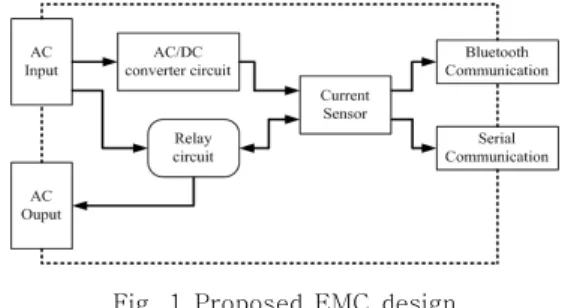
The structure of EMC with main components, including an energy sensor, relay circuit, AC/DC converter, and two communication methods is shown in Fig. 1.
The communication interfaces are used in the
proposed design of EMC, which are both serial and Bluetooth communications.
Measuring the RMS current consumption is fully implemented by the energy sensor MCP39F501. During the measurement of RMS current, analog current signal is amplified through programmable gain amplifier (PGA) and subsequently converted to digital signal by a Delta sigma analog-to-digital converter (ADC) with 24 bits and a coherent sampling algorithm to lock the sampling rate to the line frequency.
When RMS current calculation is performed with
current samples, its expression is given as
(1)
where
donates the current value, and in
is the number of line cycles.
2. Feature Exaction
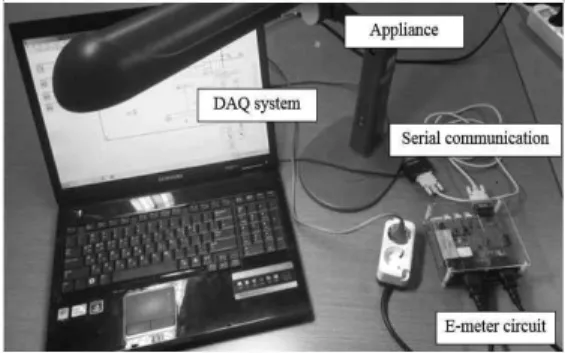
The data used in this study are collected from the prototype EMC. Accordingly, the EMC acquires RMS current consumption as raw data for an individual home appliance. Afterward, the raw data is extracted and analyzed by programs running on a computer. To obtain the derived RMS current consumption, the program running on a computer for signal processing is designed to transmit and receive the data via serial communication between the EMC and the computer. For data transmission, a data packet containing the raw data and power metrics is transmitted to the computer through serial port RS-232.
The proposed system is set to measure and gather RMS current consumption of such real residential appliances as a fan, lamp, TV, PC, refrigerator, and the like as shown in Fig. 2.
The gathering and extracting raw data aims to build the database of RMS current pattern of each device used for experiments. Based on the distinct current value profile of the appliance, the identification algorithm performs
Fig. 2 The proposal system
analyzing characteristic of the current signal to detect on/off or multi-mode operations of the different devices.
Fig. 3 shows measured current magnitude profiles of the 11 popular and representative in-home appliances that are used for experiments The RMS current consumption patterns describe the current of individual appliances in their operating process and on/off state of transition.
3. Proposed Measures for Appliance Identification
The recent approach for current signature recognition has been proposed to solve the identification problem with current consumption of total load [14-16]. To identify appliance types based on analyzing the characteristic of RMS current magnitude, four measurable current level features are proposed in this paper; the total number, the minimum and maximum values, and the SNR of the estimated current levels.
RMS current levels of the appliance being
measured will apparently vary depending on
the consumption power and the number of
operation modes. Therefore, in this study, the
minimum and maximum current levels are
estimated using average current magnitude (as
defined
) and its standard deviation (as
defined
). To this end, a simple and reliable
approach is used by sliding a window of size
N over the recent current magnitude values to
compute the
and
. That is,
can be
Using Energy Metering Circuit
Fan Microwave Hair-dryer
TV PC Refrigerator
Lamp Monitor Printer
Heater Set-top box
Fig. 3 Patterns of RMS current levels for 11 residential electric appliances measured
calculated by averaging a series of recent current values from the present time to the previous N-1th sample time, as shown in Equation 2. Then,
can be attained by calculating the standard deviation for the windowed data, as presented in Equation 3.
(2)
(3)where is the signal of RMS current magnitude at the -th sampling instance, is the sampling time, and denotes the size of windowed data.
To record the RMS current value at the moment when the current magnitude leaps to the other operation level, average standard deviation (ASD),
, is newly proposed like the following
(4)
where is the size of the window for averaging the latest standard deviation values, and
is presented in Equation 3. The ASD value allows detecting a sudden change in current magnitude level, which will be explained in the following section.
In addition, as shown in Fig. 3, the RMS current pattern of PC contains sharp and noisy signals, which is quite peculiar. Therefore, to obtain another feature, SNR of the current signal,
, is calculated by ratio between
and
with the following expression
(5)
Ⅲ. Appliance Identification with Experiment Data
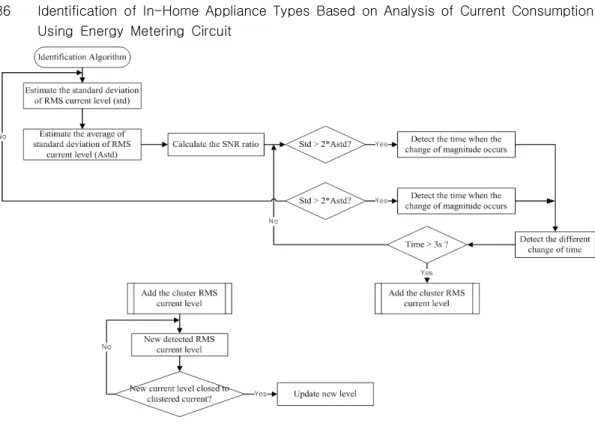
This paper focuses on developing the proposed identification algorithm with consideration of various measures provided in Section 2.3. The identification algorithm is composed of four steps, which is explained below.
First, a profile of RMS current consumption is measured and collected by the DAQ system as described in Section 2.1 and 2.2.
Subsequently,
,
, and
for each RMS current are calculated to detect a new RMS current magnitude level.
Second,
is compared with
to detect
Fig. 4 Measurement of transition time using current magnitude values
Fig. 5 Extraction of current magnitude levels with experiment data for a fan
Fig. 6 Extraction of current magnitude levels with experiment data for a PC
a change in current magnitude level. If the present current magnitude changes abruptly,
will be greater than *
where
denotes coefficients for
, i.e., the latest
Using Energy Metering Circuit
Appliance Estimated Current Levels No. of Level Average Current SNR
Lamp 5.4mA – 142.9mA 2 173.76
TV 34.1mA – 214mA 2 157.93
PC 49.9mA – 543.4mA 2 64.83
Printer 232mA – 2.55A 2 89.18
Microwave 307.2mA – 7.16A 2 704.60
Monitor 4.9mA – 13.2mA – 283.4mA 3 68.11
Refrigerator 4.0mA – 558.4mA – 3.848A 3 68.69
Fan 4.9mA – 115.0mA –124.5mA – 46.5mA 4 3963.67
Hair-dryer 5mA – 641.2mA –2.30A – 3.42A – 5.34A 5 1510.7
Heater 4.8mA – 1.39A 2 1362.061
Set-top box 47mA - 56mA 2 129.25
Table 1. Four practicable measurable parameters associated with the current magnitude levels
short-time pattern of
. Then, as the signal is stabilized,
will be quickly smaller than
. The proposed algorithm records the two moments and calculates time duration between them, which is called the transition time , as shown in Fig. 4 where
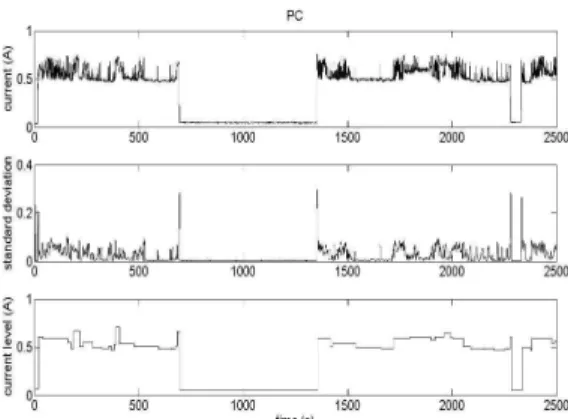
is set to 1. In the case that an actual level change occurs, the transition time will be longer than that of mere noise signals. A good criterion for the appropriate transition time is determined 3 seconds after experiments with our appliances.Fig. 5 and 6 exemplify extraction of current amplitude levels from current magnitude data for a fan and a PC, which are contrasts to each other. In each figure, the top subfigure represents the profile of original current RMS values; the middle one is the standard deviation
calculated by (3) with the window size of 10, and at the bottom shows the profile of estimated current magnitude levels attained by setting
. As can be seen in the standard deviation profiles, peak signals are much more salient for the fan than for PC, which results in a better match between original and extracted magnitude levels.In contrast, significant perturbation occurs
in the current magnitudes of PC owing to the multiple application software running in processors of PC. Therefore, the sharp peaks in the derived standard deviation contain numerous local current amplitude levels, which correspond to the same degree, i.e., on the state. At this point, the local magnitude levels varying within a small range need to be clustered and updated into the single one at the next step.
Third, once a new current level is detected, the algorithm compares it with the ones found so far to update the estimated current levels.
If a new current level, e.g.,
, is regarded matching best with one of the previously estimated current levels, e.g.,
, with their difference below % of the maximum current level,
is updated by weighted average of both levels in such a way that
′
′
(6)where
′ and
′ denote the newly updated current level and duration time respectively, and
is the duration time for
.Finally, the proposed algorithm refers to an
Current Level Value Range 1 Range 2 Range 3
Total number (Rule 1)
1 2 3 4 ~
Set-top box
TV, Printer, PC, Microwave,
Lamp, Heater
Refrigerator, Monitor Fan, Hair-dryer
Minimum (Rule 2)
0 ~ 10mA 10mA ~ 100mA 100mA ~
Fan, Hair-dryer, Lamp, Monitor,
Set top box, Heater TV, PC Refrigerator, Printer,
Microwave
Maximum (Rule 3)
0 ~ 0.5A 0.5 ~ 5A 5A ~
Fan, TV, Lamp, Monitor Refrigerator, PC, Printer,
Heater Microwave, Hair-dryer
Average SNR (Rule 4)
0 ~ 100 100 ~ 1000 1000 ~
Refrigerator, PC, Printer, Lamp, Monitor
TV, Microwave, Lamp,
Set-top box Fan, Hair-dryer, Heater Table 2. Four identification rule types of information relevant with current magnitude levels
Appliance Fan Hair-dryer Printer Lamp Microwave Monitor PC Refrigerator TV Set-top box Heater
Id. no 1 2 3 4 5 6 7 8 9 10 11
Table 3. Identification numbers assigned to appliances
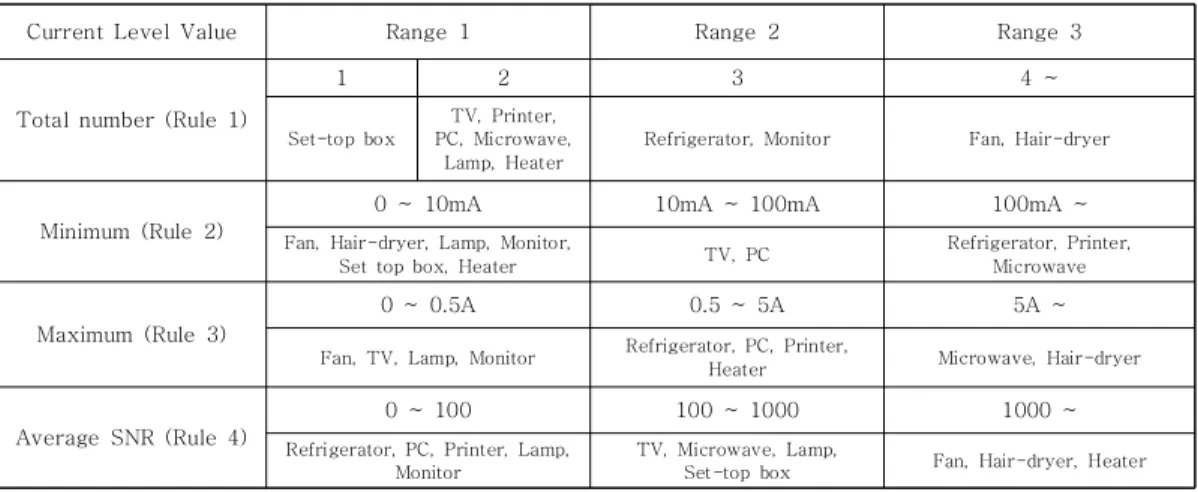
identification rule table with the four feature parameters concerning the current levels attained so far such as their total number, maximum, and minimum current levels and average SNR of the current. Then, each feature parameter suggests a set of matched appliance types as a candidate list, and the device which appears most often in the four resultant records are selected as an identified one.
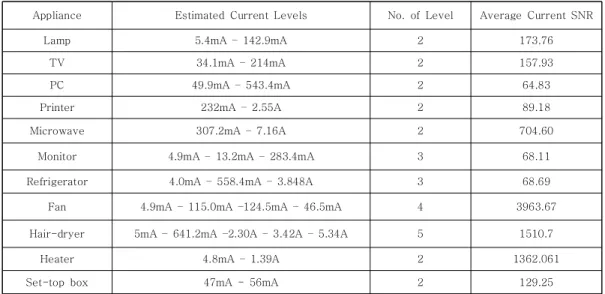
To this end, database concerning the four parameters needs to be constructed for the representative home appliances by either experiments or specification data, which is provided in Table 1.
Based on Table 1, we can make the identification rule table concerning appropriate value ranges as shown in Table 2. While the current magnitude levels are detected online by EMC, each current feature parameter is compared with the parameter range of the corresponding rule enrolled in Table 2, and the resultant sets of matched appliance types are attained as the temporary candidates for the appliance connected to EMC. Among them, the
device common to all the four criteria is the identification output. For instance, assume that we are not aware of the connected in-home device and the four feature parameters along with their candidate appliances are attained from Table 3 like the following
- Total number of level is 2: TV, Printer,
PC
, Microwave, Lamp-
Minimum level is 0.06A: TV,PC
- Maximum level is 0.7A: Refrigerator,
PC
, Printer- Average SNR of level is 75: Refrigerator,
PC
, Printer, Lamp, MonitorAmong the four candidate lists, in this case study, it is apparent that PC is the only appliance common to all the lists, which fulfills all the four criteria. Subsequently, the result indicates that the appliance identified in this case is the PC with the probability of 100% as identification rate.
This inference scheme can be numerically implemented using an integer frequency matrix whose rows are appliance identification number
Using Energy Metering Circuit
Fig. 7 Flow diagram of the proposed identification algorithm
and its cumulative number of inclusion in the candidate list. At every cycle of inference with the four feature parameters, the appliance whose count number is the largest becomes the identified appliance at that time. In the example above, after the check cycle the count number of PC will be increased by 4, while 3 for Printer and 2 for TV, Refrigerator, and Lamp in the frequency matrix. Therefore, the PC is selected as an identification result.
The proposed algorithm of identification method is shown in Fig. 7. The algorithm is designed with the proposed measures for appliance identification based on RMS current signal as mentioned in Section 2.3. Table 3 summarizes 11 identification numbers assigned to all the appliances considered in this paper.
From the achieved results, the proposed algorithm allows performing appliance recognition easier and simpler with only one EMC and a microprocessor. With the novelty of identification in terms of current level transitions and operating condition of home
appliances based mainly on RMS current consumption, the proposed model has no limit in the number of appliances to be measured and not require exhaustive training for each appliance as the previous methods.
Ⅳ. Conclusion
In this paper, a new identification algorithm has been proposed to detect and recognize the household appliances only by current signals.
The authors focused on developing the identification algorithm based on analyzing and extracting the behavior of RMS current consumption for residential electrical appliances. This paper selected four feature parameters concerning the estimated current levels such as its total number, minimum, maximum, and the SNR as information for inference. By referring to all these parameters, identification analysis was performed to match them with the appliance database.
For preparing to identify the household
appliances, the characteristic of RMS current signals has been analyzed and evaluated from the different appliances through their current profiles. The following three selection steps were performed: (a) calculating the average and standard deviation of current magnitude and its average standard deviation to find a new current magnitude level in real-time; (b) comparing standard deviation and average standard deviation to detect level change; and (c) updating the estimated current levels by matching a new current level with previously estimated current levels. The algorithm was developed based on these selection steps to detect the behavior of the recent RMS current level and identify appliances through matching the corresponding estimated RMS current levels.
In the future work, the server system for the smart home application whose main ingredient is the database with RMS current consumption profile of the different appliance types, will be developed and connected to many EMC. It enables the system to recognize all the connected appliances to EMC. In addition, the system can update information of a new appliance automatically and identify it when it is connected to the system next time.
References
[1] G. W. Hart, “Nonintrusive Appliance Load Monitoring,” Proceeding of the IEEE, Vol. 80, No. 12, pp. 1870-1891, 1992.
[2] H. Pihala, “Non-intrusive Appliance Load Monitoring System Based on a Modern kWh-meter. Degree of Licentiate in Technology, Espoo,” Technical Research Centre of Finland, 1998.
[3] M. Zeifman, K. Roth, “Nonintrusive Appliance Load Monitoring: Review and Outlook,” IEEE Transactions on Consumer Electronics, Vol.
57, No. 1, pp. 76-84, 2011.
[4] S. Drenke, A. Kader, “Nonintrusive Monitoring of Electric Loads,” IEEE Computer Application
in Power Vol. 12, No. 4, pp. 47-51, 1999.
[5] H. Park, “Load Profile Disaggregation Method for Home Appliances Using Active Power Consumption,” Journal of Electrical Engineering & Technology, Vol. 8, No. 3, pp.
572-580, 2013 (in Korean).
[6] R. Streubel, B. Yang, “Identification of Electrical Appliances via Analysis of Power Consumption,” Proceedings of the 47th International Universities Power Engineering Conference, pp. 1-6, 2012.
[7] K. Chen, H. Chang, N. Chen, “A new Transient Feature Method of Power Signatures for Nonintrusive Load Monitoring Systems,” Proceedings of the 2013 IEEE International Workshop on Applied Measurements for Power System, pp. 79-84, 2013.
[8] S.N. Patel, T. Robertson, J.A. Kientz, M.S.
Reynolds, G.D. Abowd, “At the Flick of a Switch: Detecting and Classifying Unique Electrical Events on the Residential Power Line,” Proceedings of the 9th international Conference on Ubiquitous Computing, pp.
271-288, 2007.
[9] L.K. Norford, S.B. Leeb, “Non-intrusive Electrical Load Monitoring in Commercial Buildings Based on Steady-state and Transient Load-detection Algorithms,” Energy and Buildings, Vol. 24, No. 1, pp. 51-64, 1996.
[10] A.G. Ruzzelli, C. Nicolas, A. Schoofs, G.M.P.
O’Hare, “Real-Time Recognition and Profiling of Appliances Through a Single Electricity Sensor,” Proceedings of the 7th Annual IEEE Communications Society Conference on Sensor, Mesh and Ad Hoc Communications and Networks, pp. 1-9, 2010.
[11] T. Zia, D. Bruckner, A. Zaidi, “A hidden markov model based procedure for identifying household electric loads,” Proceedings of the 37th Annual Conference on IEEE industrial Electronics Society, pp. 3218-3223, 2011.
[12] L. Robert, L. Krzysztof, W. Wieslaw,
“Method of Electrical Appliances
Identification in Systems monitoring electrical
energy consumption,” Proceedings of 7th
Using Energy Metering Circuit
International Conference on Intelligent Data Acquisition and Advanced Computing Systems: Technology and Applications, pp.
10-14, 2013.
[13] T. T. Tin, P. X. Trung, N. M. Tri, J. Kim,
“Measurement of current magnitude for home appliances using smart e-meter,” Proceedings of the 2015 KIIT Summer Conference, pp.
279-283, 2015.
[14] B. Gerald, S. Karl, L. Paul, “Recognizing the use-mode Kitchen Appliances From Their Current Consumption,” Smart Sensing and Context, Vol. 5741, pp. 163-176, 2009.
[15] K. Takekazu, S.C. Hyun, L. Dongwook, T.
Tetsuo, Y. Tatsuya, “Appliance Recognition From Electric Current Signals for Information-energy Integrated Network in Home Environments,” Lecture Notes in Computer Science. Ambient Assistive Health and Wellness Management in the Heart of the City, Vol. 5597, pp. 150-157, 2009.
[16] S. Takeshi, O. Tomoyuki, K. Ryosuke, S.
Kazunori, “Current Sensor Based Home Appliance and State of Appliance Recognition,” Journal of Control, Measurement, and System Integration, Vol. 3, No. 2, pp. 86-93, 2010.
Tran Trung Tin
2015. 8 : M.S. in Dep- artment of Electronic Engineering, Dong-A Uni- versity, Busan, Korea.
2015. 9∼present : PhD in Department of Elect- ronic Engineering, Dong-A University, Busan, Korea.
Research Interests : Embedded system, Power electronics, Artificial intelligence.
Email: [email protected]
Pham Xuan Trung
2003 : B.S. in The Uni- versity of Danang- University of Science and Technology, Danang, Vietnam.
2015∼present : M.S. in Department of Elec- tronic Engineering, Dong-A University, Busan, Korea.
Research Interests : Embedded system, Humanoid Robot, Cognitive Architecture.
Email: [email protected]
Jong-Wook Kim (김 종 욱)
1997. 8 : B.S. in Dep- artment of Electronics and Electrical Engine- ering, POSTECH, Pohang, Korea.
2000. 2 : M.S. in El- ectronics and Electrical Engineering, POSTECH, Pohang, Korea.
2004. 2 : PhD. in Electronics and El- ectrical Engineering, POSTECH, Pohang, Korea.
2006. 3∼present : Professor in Dep- artment of Electronic Engineering, Dong-A University, Busan, Korea.
Research Interests : Embedded system, Optimization algorithm, Robotics, Artificial intelligence.
Email: [email protected]