Recurrence and Its Impact on the Health-related Quality of Life in Patients with Gastroesophageal Reflux Disease: A Prospective Follow-up Analysis
Yang Won Min,1 Yong Woon Shin,2 Gab Jin Cheon,3 Kyung Sik Park,4 Hyun Soo Kim,5 Chong-Il Sohn,6 Tae Nyeun Kim,7 Hyeung Cheol Moon,8 and Poong-Lyul Rhee1*
1Department of Medicine, Samsung Medical Center, Sungkyunkwan University School of Medicine, Seoul, Korea; 2Department of Internal Medicine, Inha University College of Medicine, Incheon, Korea; 3Department of Internal Medicine, Gangneung Asan Hospital, Ulsan University College of Medicine, Gangneung, Korea; 4Department of Internal Medicine, Keimyung University School of Medicine, Daegu, Korea; 5Department of Internal Medicine, Daegu Fatima Hospital, Daegu, Korea; 6Department of Medicine, Kangbuk Samsung Hospital, Sungkyunkwan University School of Medicine, Seoul, Korea; 7Department of Internal Medicine, Yeungnam University Hospital, Daegu, Korea; and 8Department of Internal Medicine, Kwangju Christian Hospital, Gwangju, Korea
Background/Aims
Limited data exist on the outcome of gastroesophageal reflux disease (GERD) treatment and its impact on the health-related quality of life (HRQoL) in the Asian population. This study aims to evaluate the treatment outcomes, to investigate the factors associated with recurrence, and to evaluate the impact of the treatment outcome on the HRQoL in a Korean GERD population.
Methods
This was a prospective, multicenter study involving a total of 824 GERD patients. The response to treatment was assessed at week 4 (or week 8 for the patients who did not achieve complete resolution [CR] at week 4). The EQ-5D questionnaire was used at baseline, end of treatment, and first recurrence to assess the HRQoL. To assess GERD symptoms, contact of patients by phone at 1, 6, and 12 months following treatment was carried out.
Results
CR was achieved in 65.6% and recurrence was observed in 47.8% following treatment. CR and recurrence rates did not differ by the presence of esophagitis. Multivariate analysis revealed that acid regurgitation (odds ratio 2.249; 95% confidence interval 1.293-3.912;
P = 0.004) and both acid regurgitation and heartburn (odds ratio 2.330; 95% confidence interval 1.392-3.901; P = 0.001) were independent risk factors for GERD recurrence. EQ-5D scores were more improved in patients with CR than in those without CR, and worsened more during follow-up in patients with recurrence than in those without recurrence.
Conclusions
We should achieve complete symptom relief and attempt to prevent recurrence in GERD patients to improve their HRQoL.
(J Neurogastroenterol Motil 2016;22:86-93) Key Words
Gastroesophageal reflux; Quality of life; Recurrence; Therapy
Received: July 30, 2015 Revised: September 3, 2015 Accepted: September 7, 2015
This is an Open Access article distributed under the terms of the Creative Commons Attribution Non-Commercial License (http://creativecommons.
org/licenses/by-nc/4.0) which permits unrestricted non-commercial use, distribution, and reproduction in any medium, provided the original work is properly cited.
*Correspondence: Poong-Lyul Rhee, MD, PhD
Department of Medicine, Samsung Medical Center, Sungkyunkwan University School of Medicine, 81 Irwon-ro, Gangnam-gu, Seoul 06351, Korea
Tel: +82-2-3410-3409, Fax: +82-2-3410-6983, E-mail: [email protected]
JNM Journal of Neurogastroenterology and Motility
Introduction
Although proton pump inhibitor (PPI) therapy is effective for patients with gastroesophageal reflux disease (GERD), many patients will relapse over time when they are no longer taking PPIs.
1-3Thus, maintenance PPI therapy is recommended for patients who continue to have symptoms after discontinuing PPIs, and for patients with complications including erosive esophagitis and Barrett’s esophagus.
In Eastern Asia, the lifestyle and dietary habits have changed to- wards a more Western style, and the prevalence of GERD is likely to have increased as a result.
4-9However, limited data exist on the response to PPI therapy and the recurrence of GERD in East Asian countries, including Korea.
10-13Patients with GERD have a decreased health-related quality of life (HRQoL).
12,14,15Although HRQoL improves with treat- ment, persistent symptoms after PPI therapy are associated with a reduced HRQoL.
14,16,17However it is unclear how the recurrence of GERD symptoms impacts patients’ HRQoL. Furthermore, there have been no reports regarding the difference in the impact of relapsed GERD symptoms on HRQoL between patients with ero- sive reflux disease (ERD) and non-erosive reflux disease (NERD).
The aim of the current study is to evaluate the response rate to PPI therapy and the post-treatment recurrence rate in a Korean GERD population. In addition, we investigated the factors associ- ated with recurrence and assess HRQoL in patients with GERD.
Materials and Methods Study Design and Population
This was a prospective, multicenter, observational study involv- ing a total of 857 GERD patients among 23 hospitals in South Korea. Patients aged between 20 and 80 years, who complained of typical reflux symptoms of heartburn and/or regurgitation were consecutively enrolled into this study. The study subjects underwent an upper endoscopy within the preceding 12 months and were supposed to take no acid suppressing agents at least 4 weeks before enrollment. The first subject was enrolled on the 7th of July 2011 and the last visit of all subjects was on the 21st of September 2013.
Subjects who fell under any of the following criteria were excluded:
(1) any previous gastrointestinal surgery; (2) any malignancies; (3) significant medical comorbidity including ischemic heart disease, chronic renal disease, congestive heart failure, chronic obstructive pulmonary disease, liver cirrhosis, and acute or chronic pancreatitis;
(4) pregnant or nursing women; (5) subjects who participated in another clinical study within 30 days or are currently enrolled in;
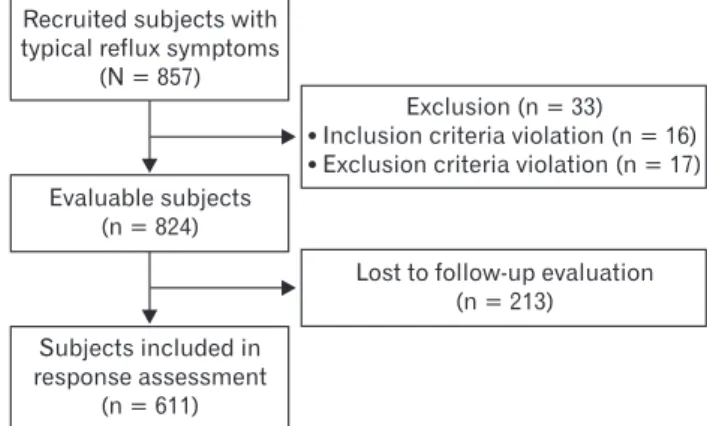
and (6) other conditions likely to interfere with study procedures, as judged by the investigator. Of the participating subjects, 33 were excluded from the study: 13 used acid suppressing agents during the 4 week period preceding enrollment, 10 had histories of ma- lignancy, 7 had significant ischemic heart disease or chronic renal disease, and 5 had no typical reflux symptoms. Finally, a total of 824 consecutive patients were included in the current study (Fig. 1).
This study protocol was conducted in accordance with the Declara- tion of Helsinki and approved by the Institutional Review Board at the Samsung Medical Center, Seoul, Korea (No. 2011-08-109). All subjects provided written informed consent before inclusion in the study.
Data Collection and Questionnaire
At baseline, data including age, gender, weight, height, waist circumference, hip circumference, smoking history, drinking histo- ry, concomitant medications, previous medical history, and previous GERD treatment history were collected. The response to treatment was assessed by interview with an attending physician at week 4 (or week 8 for the patients who did not achieve complete resolution [CR] at week 4).
The EuroQol-5D-3L
18(EQ-5D-3L) questionnaire was used at baseline, end of treatment (week 4 or week 8), and first recur- rence (if applicable) to assess the impact of GERD on HRQoL.
The EQ-5D-3L questionnaire consisted of a descriptive system and visual analogue scale (VAS). The EQ descriptive system comprises the following 5 dimensions: mobility, self-care, usual activities, pain/discomfort, and anxiety/depression. Each dimension has 3 levels: no problems, some problems, and extreme problems.
Recruited subjects with typical reflux symptoms
(N = 857)
Evaluable subjects (n = 824)
Subjects included in response assessment
(n = 611)
Exclusion (n = 33) Inclusion criteria violation (n = 16) Exclusion criteria violation (n = 17)
Lost to follow-up evaluation (n = 213)
Figure 1.
Patients flow.
The EQ VAS records the respondent’s self-rated health on a verti- cal, visual analogue scale (from 0 to 100), where the endpoints are labelled “best imaginable health state” and “worst imaginable health state.” Higher scores represent a better health status.
To assess GERD symptoms, phone contact at 1, 6, and 12 months following the end of treatment was conducted on the sub- jects without recurring disease. This survey was conducted by the contract research company Gallup using structured questions. If a subject visited after a recurrence, a phone contact was only carried out at month 12.
Definitions and Assessments
Subjects were divided into ERD or NERD based on the en- doscopic findings, according to the Los Angeles (LA) classification system.
19Subjects with at least grade LA-A esophagitis were in- cluded in the ERD group. Response to treatment was categorized into 4 grades (CR, ≥ 80% of the symptoms resolved; satisfactory resolution, ≤ 50% of the symptoms remained; partial response,
≥ 50% of the symptoms remained; and refractory response, no response to the 8-week PPI treatment). Recurrence was defined as the recurrence of typical symptoms of reflux after complete resolu- tion of GERD symptoms.
The primary outcomes were the response rate to PPI treatment and the post-treatment recurrence rate. The secondary outcomes were the factors associated with the recurrence of GERD following PPI treatment and the difference between ERD and NERD in terms of the rate of CR with the treatment, the rate of recurrence, and HRQoL.
Statistical Methods
The current study is an observatory, descriptive study based on routine medical practice without any intervention except the mea- surement of HRQoL using verified questionnaires. Therefore, the estimation of the required number of subjects based on the estima- tion of statistical power could not be applied to this study. Consider- ing the number of patients who visited 30 representative study sites during a 6 month period, our intended study period, we planned to recruit 2000 subjects. The full analysis set (n = 824) defined as the subject group without serious violation at enrollment was used for analysis, and the response to PPI treatment and recurrence could be confirmed in 611 subjects.
Continuous variables were compared parametrically using a Student’s t test or non-parametrically using the Mann-Whitney U-test. Categorical variables were compared using the χ
2-test or Fisher’s exact test as appropriate. Multivariate analysis was per-
formed on variables that were associated with recurrence based on univariate analysis (P < 0.2). Odds ratios (ORs) were presented together with 95% confidence intervals (CI). Statistical results are presented as the mean ± SD, median (minimum and maximum), or number of patients (%). Two-sided P-values < 0.05 were taken as statistically significant. Statistical analyses were conducted using SAS version 9.2 (SAS Institute Inc, Cary, North Carolina, USA).
Results
Subject Characteristics
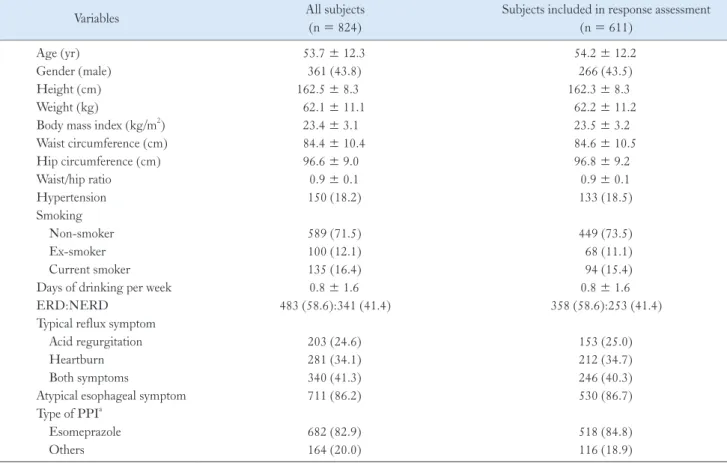
Baseline characteristics of subjects are summarized in Table 1.
The mean age was 53.7 ± 12.3 years and 361 patients (43.8%) were male. The mean height, weight, and body mass index (BMI) were 162.5 ± 8.3 cm, 62.1 ± 11.1 kg, and 23.4 ± 3.1 kg/m
2, re- spectively. The mean waist circumference, hip circumference, and waist/hip (W/H) ratio were 84.4 ± 10.4 cm, 96.6 ± 9.0 cm, and 0.9
± 0.1, respectively. A total of 150 subjects (18.2%) had hyperten- sion. Regarding smoking, 589 subjects (71.5%) were non-smokers, 135 (16.4%) current smokers (mean 20.8 ± 12.3 pack-years), and 100 (12.1%) ex-smokers (mean 22.4 ± 13.8 pack-years).
The number of times alcohol was drunk per week was 0.8 ± 1.6 times. Normal or minimal change lesion on endoscopy in the lower esophagus (NERD) was shown in 341 subjects (41.4%), while 483 (58.6%) had reflux esophagitis (ERD). Of the 824 subjects who participated in the current study, 281 (34.1%) complained of heartburn, 203 (24.6%) experienced regurgitation, and 340 (41.3%) had both. Atypical esophageal symptoms were also observed in 711 subjects (86.2%). The most prevalent symptom was epigastric burning in 542 subjects (76.2%), followed by globus sensation in 389 (54.7%), chest pain in 303 (42.6%), a cough in 250 (35.2%), hoarseness in 155 (21.8%), and wheezing in 78 (11.0%). The most common PPI used was esomeprazole (82.9%). The characteristics of all study participants are similar to that of subjects included in the response assessment.
Treatment Response and Recurrence Rate
Figure 2 shows the similar treatment responses between pa-
tients with ERD and NERD (P = 0.835). Among the 611 sub-
jects assessed at the end of the treatment, a CR was present in 401
(65.6%), a satisfactory resolution in 132 (21.6%), a partial response
in 70 (11.5%), and a refractory response in 8 (1.3%). The CR rate
did not differ between patients with ERD and NERD (64.5% vs
67.2%, P = 0.494). Among the subjects with CR, recurrence was
able to be assessed in 343, and of these, 164 subjects (47.8%) ex- perienced recurrent symptoms following treatment, and the recur- rence rate did not differ between patients with ERD and NERD (45.1% vs 51.3%, P = 0.250).
Among the 329 subjects without CR at week 4, 111 achieved CR at week 8 and 218 did not. However, response at week 4 did not differ between the subjects with and without CR at week 8.
Factors Associated with Gastroesophageal Reflux Disease Recurrence
Factors associated with recurrence after complete resolution of GERD were investigated. There were no significant differences between patients with and without recurrence with respect to age, gender, BMI, W/H ratio, smoking, alcohol consumption, presence of reflux esophagitis, and atypical esophageal symptoms (Table 2).
However, patients with acid regurgitation, and both acid regur- gitation and heartburn, were more likely to recur than those with heartburn alone (31.1% and 43.3% vs 25.6%, respectively; P =
Table 1.
Baseline Characteristics of Subjects
Variables All subjects
(n = 824)
Subjects included in response assessment (n = 611)
Age (yr) 53.7 ± 12.3 54.2 ± 12.2
Gender (male) 361 (43.8) 266 (43.5)
Height (cm) 162.5 ± 8.3 162.3 ± 8.3
Weight (kg) 62.1 ± 11.1 62.2 ± 11.2
Body mass index (kg/m
2) 23.4 ± 3.1 23.5 ± 3.2
Waist circumference (cm) 84.4 ± 10.4 84.6 ± 10.5
Hip circumference (cm) 96.6 ± 9.0 96.8 ± 9.2
Waist/hip ratio 0.9 ± 0.1 0.9 ± 0.1
Hypertension 150 (18.2) 133 (18.5)
Smoking
Non-smoker 589 (71.5) 449 (73.5)
Ex-smoker 100 (12.1) 68 (11.1)
Current smoker 135 (16.4) 94 (15.4)
Days of drinking per week 0.8 ± 1.6 0.8 ± 1.6
ERD:NERD 483 (58.6):341 (41.4) 358 (58.6):253 (41.4)
Typical reflux symptom
Acid regurgitation 203 (24.6) 153 (25.0)
Heartburn 281 (34.1) 212 (34.7)
Both symptoms 340 (41.3) 246 (40.3)
Atypical esophageal symptom 711 (86.2) 530 (86.7)
Type of PPI
aEsomeprazole 682 (82.9) 518 (84.8)
Others 164 (20.0) 116 (18.9)
aThere were multiple counts.
ERD, erosive reflux disease; NERD, non-erosive reflux disease.
Data are shown as the mean ± SD or number (%) of patients.
Responserate(%)
ERD NERD
Complete resolution 80
60
40
20
Refractory response 0
Satisfactory resolution
Partial response
P = 0.835
Figure 2.
Response at the end of the treatment. Among the 611 sub-
jects assessed, a complete resolution was present in 401 (65.6%), a
satisfactory resolution in 132 (21.6%), a partial response in 70 (11.5%)
and a refractory response in 8 (1.3%). The treatment response did not
differ between patients with erosive reflux disease (ERD) and non-
erosive reflux disease (NERD).
0.001). In addition, patients who achieved CR at week 4 showed a tendency to recur less often than those who achieved CR at week 8, with marginal statistical significance (44.6% vs 56.4%, P = 0.051).
Multivariate analysis using the two significant factors from univariate analysis revealed that acid regurgitation and both acid re- gurgitation and heartburn were independent risk factors associated with GERD recurrence (Table 3). Compared with heartburn, the ORs of acid regurgitation and both acid regurgitation and heart- burn were 2.249 (95% CI, 1.293-3.912, P = 0.004) and 2.330 (95%
CI, 1.392-3.901, P = 0.001), respectively.
Health-related Quality of Life
Figure 3 shows the change in HRQoL after treatment, accord- ing to the outcome. The EQ descriptive score showed a marked improvement in subjects with CR compared with those without CR (change from baseline of 0.06 ± 0.10 vs 0.03 ± 0.08, P < 0.001).
The EQ VAS score also showed greater improvement in subjects with CR than in those without CR (change from baseline of 14.3 ± 17.9 vs 9.4 ± 16.4, P = 0.001).
Figure 4 shows the change in HRQoL according to the pres- ence of recurrence after CR. Among the subjects with CR, the EQ descriptive score at the end of the treatment did not differ between subjects with and without recurrence (0.92 ± 0.05 vs 0.93 ± 0.04, P = 0.732), but worsened more during follow-up in subjects with recurrence compared with those without recurrence (change from the end of treatment at recurrence vs. at month 12, -0.02 ± 0.08 vs 0.00 ± 0.06, P = 0.003). However, the EQ VAS score at the end of the treatment was lower in subjects with recurrence than in those without recurrence (79.6 ± 12.9 vs 82.5 ± 12.8, P = 0.042), but the change in EQ VAS during follow-up did not differ between subjects with and without recurrence (change from the end of treat-
Table 2.
Factors Associated with the Recurrence of Gastroesophageal Reflux Disease
Variables Recurrence
(n = 164)
No recurrence
(n = 179) P -value
Age (yr) 54.3 ± 11.7 55.2 ± 11.8 0.476
Gender (male) 74 (45.1) 83 (46.4) 0.817
Body mass index (kg/m
2) 23.6 ± 3.0 23.9 ± 3.2 0.520
Waist/hip ratio 0.9 ± 0.1 0.9 ± 0.1 0.285
Hypertension 32 (19.5) 34 (19.0) 0.903
Smoking 0.999
Non-smoker 117 (71.3) 128 (71.5)
Ex-smoker 21 (12.8) 23 (12.9)
Current smoker 26 (15.9) 28 (15.6)
Days of drinking per week 1.7 ± 2.2 1.4 ± 1.8 0.224
ERD:NERD 87 (53.1):77 (46.9) 106 (59.2):73 (40.8) 0.250
Typical reflux symptom 0.001
Heartburn 42 (25.6) 80 (44.7)
Acid regurgitation 51 (31.1) 43 (24.0)
Both symptoms 71 (43.3) 56 (31.3)
Atypical esophageal symptom 142 (86.6) 150 (83.8) 0.469
Complete remission 0.051
At week 4 111 (44.6) 138 (55.4)
At week 8 53 (56.4) 41 (43.6)
ERD, erosive reflux disease; NERD, non-erosive reflux disease Data are shown as the mean ± SD or number (%) of patients.
Table 3.
Multivariate Analysis of Factors Associated with the Recur- rence of Gastroesophageal Reflux Disease
Variables Multivariate analysis
OR (95% CI) P -value
Typical reflux symptom
Heartburn 1.000
Acid regurgitation 2.249 (1.293-3.912) 0.004 Both symptoms 2.330 (1.392-3.901) 0.001 Complete remission
At week 4 1.000
At week 8 1.526 (0.937-2.488) 0.090
OR, odds ratio; CI, confidence interval.
ment at recurrence vs. at month 12, –6.3 ± 17.3 vs –3.4 ± 16.3, P
= 0.131).
The EQ descriptive score at baseline and its changes after treatment and recurrence did not differ between subjects with ERD and NERD (0.87 ± 0.10 vs 0.86 ± 0.10, P = 0.179; 0.04 ± 0.10 vs 0.05 ± 0.09, P = 0.260; and -0.01 ± 0.07 vs –0.01 ± 0.08, P
= 0.919, respectively). However, the EQ VAS score at baseline was higher in subjects with ERD than in those with NERD (66.2 ± 17.3 vs 62.7 ± 18.4, P = 0.005). Its changes after treatment and recurrence did not differ between subjects with ERD and NERD (11.4 ± 16.0 vs 14.4 ± 19.4, P = 0.051 and –5.3 ± 15.8 vs –4.0
± 18.1, P = 0.498, respectively).
Discussion
Considering the increasing prevalence of GERD in Asia, ef- forts to establish optimal treatment strategies are necessary. How- ever, data regarding the outcomes of PPI therapy in GERD from Asian countries, including Korea, are limited.
10-12Furthermore, the impact of GERD on the QoL according to the treatment response and recurrence following the treatment has yet to be evaluated.
Thus the present study sought to evaluate the treatment outcome of PPI therapy in a Korean GERD population, to further investigate its prognostic factors, and to assess its impact on QoL. In this study population, CR was achieved in 65.6% after PPI therapy, however almost half of them experienced recurred symptoms following treat- ment. Patients with acid regurgitation at baseline were more likely to recur than those without. HRQoL was markedly improved in
patients with CR compared with those without, and worsened more during follow-up in patients with recurrence compared with those without.
In our results, complete relief on PPI therapy was similarly ob- served between the patients with ERD and NERD, however, this is in contrast to data from other studies. PPI therapy has been as- sociated with a greater rate of relief in patients with ERD compared with those with NERD.
20-22In an Asian study, PPI response rates at 8 weeks were also different between the patients with ERD and NERD (72.4% vs 66.6%, P = 0.02).
11Other recent Asian studies also show lower similar findings.
12,23,24In the present study, ERD was determined according to the LA classification system.
19Despite the exclusion of minimal changes constituting a grade of reflux esophagitis in this system, uncertainty remains in the detection of mucosal breaks, leading to an inconsistency among endoscopists.
25,26Thus, there may be a small possibility that patients without a true mucosal break were erroneously included into the ERD group. In fact, subjects with ERD were more prevalent (58.6%) than those with NERD in the present study.
After achieving CR, almost half of the subjects experienced recurrent symptoms within 12 months. The recurrence rate did not differ between patients with ERD and NERD. Maintenance PPI therapy was administered according to the attending physi- cians’ judgement. The proportion of subjects with maintenance, on- demand or continuous medication, was not included in the present study. However, our results are consistent with a prior Asian study.
11In that study, 44.3% of the subjects in the erosive esophagitis group and 43.2% in the NERD group had symptomatic relapses without
Complete resolution No complete resolution
EQ VAS score
Changefrombaseline
0.20
0.15
0.10
0.05
0.00
EQ descriptive score
Changefrombaseline
40
30
20
10
0
P < 0.001 P = 0.001
Figure 3.
Change in health-related quality of life after the end of treatment according to the presence of recurrence. The EQ descrip- tive score and the visual analogue scale (VAS) score shows a greater improvement in subjects with complete resolution compared with those without complete resolution.
EQ VAS score
Changefromendoftreatment
0.00
0.05
0.10
0.15
EQ descriptive score
Changefromendoftreatment
0
10
20
30 P = 0.003
P = 0.131 Recurrence
No recurrence
Figure 4.