강우 자료와 밭작물 물관리 지침서를 이용한 노지 밭작물의 관개 필요량 산정 연구
Irrigation Water Requirements for Upland Crops Using Rainfall Data and Water Management Guidelines
최용훈
a⋅김영진
b,✝⋅김용원
c⋅김민영
d⋅전종길
eChoi, Yonghun⋅Kim, Youngjin⋅Kim, Yongwon⋅Kim, Minyoung⋅Jeon, Jonggil
Abstract
The purpose of this study is to determine the amount of irrigation water for upland crop growth based on the 30 year of historical rainfall data and the water management guidelines as a reference. Five regions and ten crops were selected by their cultivation size. The changes of soil moisture contents were calculated using daily mean rainfall and irrigation demand. This study assumed that crops are irrigated when the soil moisture contents fell below of the field capacity for more than 5 days, which is the drought condition defined by RDA. The maximum irrigation water requirements was 167.2 mm for chinese cabbage during the growing season, which was followed by corn (112.0 mm), daikon (102.3 mm), spinach (66.1 mm), lettuce (56.7 mm), pepper (46.5 mm), potato (33.9 mm), sweet tomato (27.4 mm), peanut (11.5 mm) and bean (10.3 mm), The results of this study could contribute to providing valuable data to determine the capacity of irrigation facilities and to establish the emergency operation plans under extreme unfavorable weather condition (heat wave, etc.) for crop growth.
Keywords: Irrigation water requirements; water management guidelines; rainfall; upland crop; soil moisture
Ⅰ. 연구배경 및 목적
이상 기후로 인하여 우리나라는 최근 국지적인 가뭄발생이 증가하고 있다. 특히, 갈수기 강수량 감소에 의하여 2013년부 터 2016년까지 중부지방의 가뭄이 심각하였고, 2017년에는 남부지방을 중심으로 가뭄이 발생하는 등 지역적인 가뭄의 편차도 심해지고 있다. 가뭄이 발생하는 근본적인 원인은 강 수량 부족이며, 농업 분야의 가뭄은 주로 봄철 강수량 부족이
영농기로 이어져 사용할 수 있는 농업용수가 부족한 형태로 진행된다 (Kim et al., 2017). 또한 충분한 수자원을 확보하지 못한 상태에서 일정 규모 이상의 가뭄이 발생하거나 기간이 장기화 되는 경우 물 부족으로 인한 농업 분야의 피해가 증가 할 수 있다 (Lee, 2012).
수자원의 변동성 증가에 따라 노지 밭작물에 큰 영향을 미 칠 수 있기 때문에 기상 및 기후 특성, 작물의 종류, 지역 특성 에 따라 효율적인 물관리 방안이 수립되어야 한다고 하였다 (Shin, 2017). 밭작물의 물 관리와 관련된 연구는 관개용수량 산정 방법 연구 (Suh and Lee, 2002; Hong et al., 2015; Lee and Shin, 2016; Shin et al., 2017; Shin, 2018), 관개 계획 수립 과 관련된 연구 (Kim and Koh, 1977a, 1977b; Yoon et al., 1990; Ro, 1996), 그리고 농업 가뭄 및 관개용수 수요 등을 전망하는 연구 (Nam et al., 2014; Hong et al., 2015; Shin et al., 2017) 등으로 구분할 수 있으며, 지속적으로 수행되고 있 다. 밭작물 물 관리와 관련된 다양한 연구들이 진행된 가운데 농업인에게 보급된 농촌진흥청의 밭작물 물관리 지침서 (Eom et al., 1999)는 작물별, 생육시기별, 지역별로 관개 시기 와 간격 그리고 1회 관개량 등의 정보를 토양 종류에 따라 물관리가 이루어질 수 있도록 정보를 제공하고 있다. 이를 통 해 작물의 재배에 필요한 총 용수량 또는 시기별 용수량 등을 개략적으로 산정할 수 있게 되었다.
우리나라는 농업용 저수지 등 기존 용수원과 근접한 지역 에 대한 농업용수 공급은 관개 수로정비를 통해 원활한 편이
a Post-doctoral Researcher, Department of Agricultural Engineering, National Institute of Agricultural Sciences (NAS), Rural Development Administration (RDA)
b Agricultural Researcher, Department of Agricultural Engineering, National Institute of Agricultural Sciences (NAS), Rural Development Administration (RDA)
c Researcher, Department of Agricultural Engineering, National Institute of Agricultural Sciences (NAS), Rural Development Administration (RDA)
d Post-doctoral Researcher, Department of Agricultural Engineering, National Institute of Agricultural Sciences (NAS), Rural Development Administration (RDA)
e Post-doctoral Researcher, Department of Agricultural Engineering, National Institute of Agricultural Sciences (NAS), Rural Development Administration (RDA)
† Corresponding author
Tel.: +82-63-238-4159 Fax: +82-63-238-4145 E-mail: [email protected]
Received: November 16, 2018 Revised: December 6, 2018 Accepted: December 26, 2018
지만, 관개용수 공급이 어려운 산간 및 도서 지역 등에 위치한 밭은 가뭄에 취약하다. 이러한 지역에서 관개용수 확보 및 저 장에 활용 할 수 있는 빗물 집수 및 저장 기술과 관련된 연구 가 진행되고 있다 (Jun et al., 2013; Kim, 2015; Maeng and Hwang, 2015; Choi et al., 2018). 이처럼 용수 확보가 우선적으 로 필요한 지역에서는 작물에 필요한 용수량을 산정하고, 용 수를 저장하는 적절한 시설의 규모 또는 적정 보관량 등이 먼저 결정되어야 한다. 농업용수의 저장 규모가 합리적으로 결정되어야 시설투자에 대한 부담이 적어질 수 있기 때문이 다. 이러한 측면에서 밭작물 물관리 지침서를 활용하여 필요 한 총 용수량 등을 결정 할 수 있다. 그러나 밭작물 물관리 지침서는 강우량이 고려되지 않고, 작물의 최대 물 이용량을 이용하여 관개량이 산정되어 있다. 관개량 산정이 과도하게 되면 실제로 필요한 저장 시설 등의 크기보다 커질 수 있으므 로, 강우량을 고려할 필요가 있다고 판단하였다.
따라서 본 연구에서는 우리나라의 주요 밭작물과 그 주산 지에 대하여 밭작물 물관리 지침서에서 제공하는 관개량과 기상청에서 제공하는 강우량을 이용하여 평년 강우에 대해 추가적으로 필요한 관개용수량을 산정하였고, 관개가 필요한 시기 등을 분석하였다. 본 연구결과는 노지 밭작물을 재배하 는 지역에서 효율적인 관개 계획을 수립하기 위해 필요한 용 수량 및 저장 시설의 크기 등을 결정하는 기초 자료로 활용 할 수 있을 것으로 판단된다.
Ⅱ. 연구방법
1. 대상 작물과 주산지 선정
농촌진흥청의 밭작물 물관리 지침서는 작물의 생육시기별 최대 증발산량을 기준으로 산정된 작물 계수를 고려하여 1회
관개량과 관개간격을 별도의 자료 없이 결정할 수 있는 자료 이며 (Eom et al., 2010; Han et al., 2012), 경기도 수원 등 65개 지역과 봄 배추 등 36개 작물에 대한 정보를 제공하고 있다.
본 연구에서는 밭작물 물관리 지침서에 수록된 작물 중에서 3월부터 6월 사이에 파종 및 정식이 이루어지며, 재배지역이 노지인 밭작물 (재배면적 순: 콩, 고추, 배추, 감자, 무, 고구마, 옥수수, 시금치, 상추, 땅콩)을 대상 작물로 선정하였다. 2015 년 기준 작물별 전국 재배면적에서 콩의 재배면적이 56,500 ha로 가장 컸고, 땅콩의 재배면적이 2,373 ha로 가장 작게 나 타났으며, 작물별로 재배 면적의 차이가 큰 것으로 나타났다 (Fig. 1). 그러나 노지 밭작물의 물 부족 현상이 전국재배면적 의 영향을 받는다고 할 수 없으며, 연구 결과의 신뢰성을 높이 기 위해 면적에 관계없이 10개 작물을 모두 분석하였다.
선정된 작물의 주산지는 2015년 기준 시군별 통계연보의 작물 재배 면적을 기준으로 상위 5개 지역으로 선정하였다.
시군별 작물재배 면적 통계의 특성상 봄배추-가을배추와 같 이 계절적으로 재배 시기가 다른 동일 작물의 재배면적 및 노지와 시설 등 재배방식에 따른 면적을 분리할 수 없기 때문 에 주산지 결정에서 재배 시기와 재배 환경에 대한 영향을 고려할 수는 없었다. 작물별로 선정된 주산지가 밭작물 물관 리 지침서에 수록되어 있지 않거나, 강우 관측소가 없는 경우 에는 인접한 지역의 자료를 활용하였다. 예를 들어, 콩의 재배 면적 상위 5개 지역 중에서 무안은 밭작물 물관리 지침서에 수록되어 있지 않고, 강우를 관측하는 지역이 아니기 때문에 인접 지역인 함평 또는 목포의 자료를 적용하였다 (Table 1).
2. 토양수분 변화와 관개필요량 산정
가. 토양수분 변화량 산정 방법농업 분야에서의 가뭄은 토양의 유효수분함량 (Available Water Capacity, AWC)인 포장용수량 (Field Capacity, FC)부 터 위조점 (Wilting Point, WP)까지의 토양수분량이 50% 이하 가 되는 기간을 농업 가뭄으로 정의하고 있다 (Choi and Kim, 2006). 농촌진흥청이 제공하는 주간영농정보에서도 토양의 수분함량이 유효수분의 하위 15∼45%일 때 관개가 필요하다 고 하였다. 또한 이 시기에 필요한 최소 관개량을 제시하였고, 토양수분함량이 낮은 환경이 10일 이상 지속될 경우에는 즉 각적인 관수가 필요하다고 하였다. 실제 농경지에서 관개가 필요한 시기는 토양의 수분함량과 함께 작물의 생육상태도 중요한 요인으로 볼 수 있으나, 본 연구에서는 수치적으로 정 량화가 가능한 토양수분함량에 초점을 맞추어 분석하였다.
농촌진흥청의 가뭄대책 및 가뭄기술 정보, 작물기술정보 그리고 주간농사정보 등에서는 작물이 생육하는 과정 중에서 물 부족에 취약한 재배시기의 시들음 방지를 위한 관개 간격 Fig. 1 Status of upland crop production by cultivation sizes
Crop
Main producing
areas
Cultivation area (ha)
Application area Water
management guidelines
Weather station
Bean
Jeju 4,883 Seogwipo Seogwipo Jeju Muan 1,854 Hampyeong
Mokpo Mokpo
Chungju 1,807 Chungju Chungju Andong 1,636 Uiseong
Yeongju Andong Sinan 1,532 Hampyeong
Mokpo Heuksando
Pepper
Yeongyang 1,637 Uljin Yeongdeok
Uljin Yeongdeok Andong 1,572 Uiseong
Yeongju Andong Bonghwa 1,434 Yeongju
Uljin Bonghwa Cheongju 963 Cheongju Cheongju
Gochang 955 Buan
Jeongeup Gochang
Chinese cabbage
Haenam 4,320 Haenam Haenam
Samcheok 1,392 Samcheok
Donghae Jeongseon
Taebaek Uljin Pyeongchang 1,357 Pyeongchang Daegwallyeong
Sunchang 1,147
Jeongeup Imsil Namwon
Sunchang
Jeongseon 1,144 Pyeongchang
Gangneung Jeongseon
Potato
Pyeongchang 1,508 Pyeongchang Daegwallyeong
Anseong 1,349 Icheon Icheon
Jeju 1,129 Seogwipo Seogwipo Jeju Gangneung 994 Gangneung Gangneung
Boseong 930
Suncheon Jangheung
Goheung
Boseong
Daikon
Jeju 5,710 Seogwipo Seogwipo Jeju
Gochang 663 Buan
Jeongeup Gochang
Pocheon 520 Chuncheon
Chuncheon Dongducheon
Cheorwon Gangneung 509 Gangneung Gangneung Hongcheon 437 Hongcheon Hongcheon Table 1 Application area used for computing crop water requirements
from the water management guidelines and weather station
Crop
Main producing
areas
Cultivation area (ha)
Application area Water
management guidelines
Weather station
Sweet tomato
Yeoju 1,587
Icheon Yangpyeong
Wonju
Icheon Yangpyeong
Wonju
Haenam 1,508 Haenam Haenam
Gochang 1,320 Buan
Jeongeup Gochang
Yongam 924 Mokpo
Haenam
Mokpo Haenam
Nonsan 889
Daejeon Buyeo Geumsan
Daejeon Buyeo Geumsan
Corn
Chungju 1,867 Chungju Chungju Cheorwon 1,821 Chuncheon Cheorwon
Goesan 1,148
Boeun Cheongju Mungyeong
Boeun Cheongju Mungyeong
Jeongseon 821
Pyeongchang Gangneung
Samcheok
Jeongseon
Pyeongchang 763 Pyeongchang Daegwallyeong
Spinach
Pocheon 1,226 Chuncheon
Chuncheon Dongducheon
Cheorwon Sinan 1,104 Hampyeong
Mokpo Heuksando Namhae 1,095 Namhae Namhae
Goseong 261 Jinju
Tongyeong
Jinju Tongyeong
Pohang 236 Pohang Pohang
Lettuce
Icheon 796 Icheon Icheon
Busan 522 Busan Busan
Namwon 240 Namwon Namwon
Nonsan 231
Daejeon Buyeo Geumsan
Daejeon Buyeo Geumsan
Yongin 155 Suwon Suwon
Peanut
Gochang 259 Buan
Jeongeup Gochang Cheongju 183 Cheongju Cheongju Jeongeup 157 Jeongeup Jeongeup
Buan 146 Buan Buan
Taean 129 Seosan Seosan
을 3∼7일로 제시하고 있다. 토양수분 이동 및 저장에 관한 예측 모형을 개발한 Seo et al. (2012)은 지표에서 깊이 300 mm까지 작물의 뿌리가 가장 많이 존재하고 있다고 하였다.
이와 같은 기존 연구를 참고하여, 본 연구에서도 깊이 300 mm 토양의 수분함량이 유효수분의 50% 이하인 상태를 물이 부족 상태로 가정하였고, 물 부족이 5일 이상 지속되는 경우 반드 시 관개가 필요한 것으로 설정하였다.
따라서 본 연구에서는 깊이 300 mm 토양의 수분함량이 포장용수량인 상태에서 파종 및 정식을 하고, 밭작물 물관리 지침서의 관개요구량만큼 토양 수분이 감소되며, 일평균 강우량만큼 토양 수분이 증가한다고 가정하였다 (Eq. 1).
(1)
여기서, w는 d일 경과 후 토양수분량, FC는 포장용수량 (mm), R는 일 강우량, I는 일 관개요구량, d는 작물의 파종 또는 정식이 이루어진 날로부터 경과된 일수이다.
나. 관개필요량 산정 방법
작물에 필요한 관개요구량은 밭작물 물관리 지침서에서 제 공하는 1회 관개량을 관개 간격으로 나누어 일일 관개요구량 으로 환산하였다. 강우량은 기상청에서 제공하는 자료 중에 서 지역 단위로 30년 이상 관측된 일 강우량 자료를 활용하여, 평균 일일 강우량으로 환산하였다. 주산지가 물관리 지침서 에 수록되지 않은 경우 또는 강우관측 자료가 없는 경우에는 주산지와 인접한 지역의 밭작물 물관리 지침서 및 강우 자료 를 활용하였다.
위에서 언급한 Eq. 1을 R과 I에 대한 w로 도시하면 Fig.
2와 같은 형태로 나타날 수 있다. w가 FC를 초과하는 기간에 는 추가적인 관개가 필요 없는 상태를 의미한다. 반대로 w가 FC보다 작아지면 토양의 수분이 작물의 생육에 불리한 상태 로 변화하기 때문에 관개가 필요한 것을 의미한다.
따라서 본 연구에서는 토양의 수분함량을 포장용수량까지 유지할 수 있는 관개필요량 (IT)과 이 때의 물 부족 기간 (T) 그리고 토양수분함량이 유효수분의 50% 미만으로 떨어지지 않도록 요구되는 최소 관개필요량 (It), 그리고 그 때의 물 부 족 기간 (t)를 산정하여 작물별 지역별로 필요한 관개용수를 확인하였다.
토양의 유효수분함량은 토질에 따라 차이가 있으나, 본 연 구에서는 우리나라의 밭 표토 토성 중에서 가장 많은 면적을 차지하고 있는 양토의 유효수분함량을 기준으로 관개필요량 을 산정하였다 (RDA, 2018). 여기서, 300 mm 양토 토층의
Crop Cultivation period (day)
Irrigation interval (day)
Irrigation water of one time
(mm)
Total of irrigation water
(mm)
Daily average of irrigation water
(mm/day)
Bean 129 10.2 34.45 445.30 3.4
Pepper 159 7.9 27.55 579.67 3.6
Chinese cabbage (april) 57 4.7 16.65 248.64 4.0
Chinese cabbage (may) 47 4.6 16.73 194.64 4.0
Potato 76 9.4 28.78 256.17 3.3
Daikon 67 6.6 22.40 257.76 3.6
Sweet tomato 124 8.7 29.36 429.35 3.5
Corn 118 10.4 41.76 484.78 4.2
Spinach 42 4.5 15.13 163.49 3.5
Lettuce 57 4.9 15.28 215.02 3.5
Peanut 144 10.6 35.43 475.98 3.4
Table 2 Total and daily average of irrigation water by crops
Fig. 2 Conceptual plot for the curve of soil moisture change
유효수분함량은 Choi et al. (2016)이 제시한 내용에 따라 포장 용수량은 67.5 mm, 위조점은 26.1 mm이며, 유효수분의 50%
는 46.8 mm으로 포장용수량과의 차이는 -20.7 mm로 사용하 였다.
Ⅲ. 연구결과
1. 작물-지역별 강우량 및 관개필요량 분석
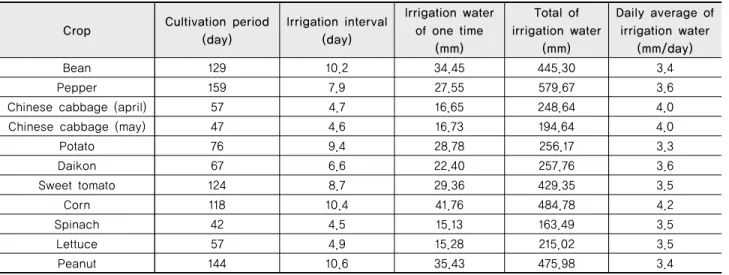
작물의 총 관개요구량은 시금치 163.5 mm∼고추 579.7 mm로 작물별로 큰 차이를 나타냈으나, 일평균 관개요구량은
Fig. 3 Conceptual diagram of matching crop and application areas
Crop M-G-W ∑I ∑R T IT t It
Bean Andong-Uiseong-Andong 458.6 731.8 14 10.3 0 0
Andong-Yeongju-Andong 442.0 731.8 14 9.5 0 0
Pepper
Yeongyang-Uljin-Uljin 572.1 759.0 38 33.8 14 13.1
Yeongyang-Yeongdeok-Yeongdeok 601.0 742.1 37 32.2 14 11.5
Andong-Uiseong-Andong 602.4 810.4 25 30.0 8 9.3
Andong-Yeongju-Andong 586.0 810.4 24 29.6 8 8.9
Bonghwa-Yeongju-Bonghwa 586.0 919.8 15 14.4 0 0
Gochang-Buan-Gochang 630.0 900.6 30 46.5 21 25.8
Gochang-Jeongeup-Gochang 531.1 900.6 21 22.5 2 1.8
Chinese cabbage
(april)
Haenam-Haenam-Haenam 247.8 234.0 16 19.9 0 0
Samcheok-Samcheok-Donghae 288.3 133.8 46 154.5 38 133.8
Samcheok-Samcheok-Jeongseon 288.3 121.1 46 167.2 38 146.5
Samcheok-Samcheok-Taebaek 288.3 182.8 40 105.4 33 84.7
Samcheok-Samcheok-Uljin 288.3 148.4 42 139.8 37 119.1
Pyeongchang-Pyeongchang-Daegwallyeong 283.4 215.0 37 68.4 25 47.7
Sunchang-Jeongeup-Sunchang 236.3 174.2 19 62.1 13 41.4
Sunchang-Imsil-Sunchang 241.7 174.2 23 67.6 14 46.9
Sunchang-Namwon-Sunchang 248.6 174.2 28 74.4 17 53.7
Jeongseon-Pyeongchang-Jeongseon 283.4 121.1 46 162.3 38 141.6
Jeongseon-Gangneung-Jeongseon 156.6 121.1 22 35.5 7 14.8
Chinese cabbage
(may)
Haenam-Haenam-Haenam 192.1 260.7 6 3.1 0 0
Samcheok-Samcheok-Donghae 209.9 154.9 35 80.9 31 60.2
Samcheok-Samcheok-Jeongseon 209.9 164.2 36 97.4 31 76.7
Samcheok-Samcheok-Taebaek 209.9 209.0 32 45.5 19 24.8
Samcheok-Samcheok-Uljin 209.9 153.2 36 72.2 31 51.5
Pyeongchang-Pyeongchang-Daegwallyeong 203.3 243.8 19 16.3 0 0
Sunchang-Jeongeup-Sunchang 199.0 170.9 28 54.0 23 33.3
Sunchang-Imsil-Sunchang 194.4 170.9 29 51.5 23 30.8
Sunchang-Namwon-Sunchang 203.0 170.9 29 57.2 23 36.5
Jeongseon-Pyeongchang-Jeongseon 203.3 164.2 36 92.2 31 71.5
Jeongseon-Gangneung-Jeongseon 145.6 164.2 19 35.4 10 14.7
Potato Anseong-Icheon-Icheon 265.5 231.6 23 33.9 16 13.2
Daikon
Jeju-Seogwipo-Jeju 255.2 217.0 35 40.5 14 19.8
Gochang-Buan-Gochang 294.0 191.8 60 102.3 48 81.6
Gochang-Jeongeup-Gochang 236.6 191.8 50 44.8 23 24.1
Pocheon-Chuncheon-Chuncheon 311.8 269.0 41 70.2 35 49.5
Pocheon-Chuncheon-Dongducheon 311.8 259.4 43 82.0 36 61.3
Pocheon-Chuncheon-Cheorwon 311.8 252.2 46 76.6 28 56.0
Sweet tomato
Yeoju-Wonju-Wonju 448.6 932.8 7 8.6 0 0
Gochang-Buan-Gochang 481.9 814.0 21 27.4 13 6.7
Gochang-Jeongeup-Gochang 406.3 814.0 10 7.1 0 0
Corn
Chungju-Chungju-Chungju 450.8 713.5 28 36.4 14 15.7
Cheorwon-Chuncheon-Cheorwon 482.7 893.1 34 40.8 24 20.1
Goesan-Boeun-Boeun 508.2 787.9 27 41.0 15 20.3
Goesan-Cheongju-Cheongju 479.8 752.2 31 40.4 18 19.7
Goesan-Mungyeong-Mungyeong 537.1 763.4 31 43.3 16 22.6
Jeongseon-Pyeongchang-Jeongseon 438.8 687.1 48 107.0 39 86.3
Jeongseon-Gangneung-Jeongseon 533.8 687.1 13 17.5 0 0
Jeongseon-Samcheok-Jeongseon 470.4 687.1 49 112.0 39 91.3
Spinach
Pocheon-Chuncheon-Chuncheon 172.2 144.0 13 28.2 3 7.5
Pocheon-Chuncheon-Dongducheon 172.2 139.5 13 32.8 5 12.1
Pocheon-Chuncheon-Cheorwon 172.2 137.3 18 35.0 6 14.3
Sinan-Hampyeong-Heuksando 170.6 143.1 16 27.5 3 6.8
Sinan-Mokpo-Heuksando 157.2 143.1 12 14.1 0 0
Pohang-Pohang-Pohang 192.2 126.1 26 66.1 16 45.4
Lettuce
Icheon-Icheon-Icheon 232.5 175.8 40 56.7 19 36.0
Namwon-Namwon-Namwon 208.0 179.7 28 28.3 6 7.6
Nonsan-Geumsan-Geumsan 208.5 170.1 36 38.4 14 17.6
Nonsan-Daejeon-Daejeon 224.4 176.2 40 48.1 17 27.4
Nonsan-Buyeo-Buyeo 214.0 184.4 34 29.6 5 8.9
Yongin-Suwon-Suwon 218.7 163.6 41 55.1 24 33.4
Peanut Gochang-Buan-Gochang 525.3 859.1 17 11.5 0 0
*M: Main production area, G: Application area from the water management guidelines, W: Application area from the weather station, ∑I: Total irrigation requirement, ∑R: Total rainfall, T: Number of days of soil moisture deficit (lower than FC), t: Number of days of soil moisture deficit (lower than (FC-WP)/2)
Table 3 Calculation of duration (T, t) and amount (IT, It) of irrigation required
감자 3.3 mm/day∼옥수수 4.2 mm/day (전체 작물 평균 3.6 mm/day, 표준편차 0.3, 변동계수 0.08)로 큰 차이가 나타나지 는 않았다. 밭작물 물관리 지침서에 제시된 관개간격은 작물 의 생육시기에 따라 다르지만 평균적으로 시금치 4.5일∼땅 콩 10.6일로 작물에 따른 차이가 나타났다 (Table 2).
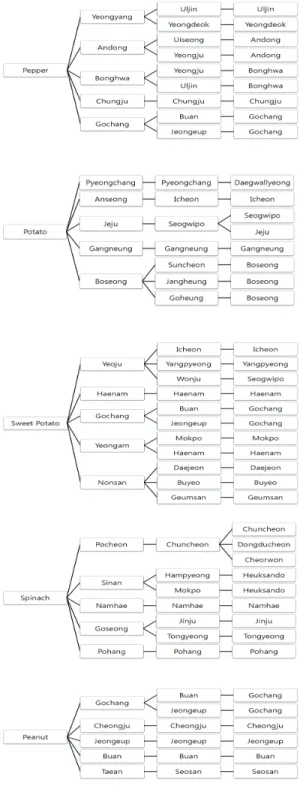
작물-주산지-밭작물 물관리 지침 적용지역-강우 적용지역 순서로 연결하여 콩 9지역, 고추 9지역, 배추 22지역 (4월과 5월 파종 각 11지역), 감자 8지역, 무 9지역, 고구마 11지역, 옥수수 9지역, 시금치 9지역, 상추 7지역 그리고 땅콩 6지역 등 주요 작물의 강우량 및 관개요구량 파악을 위해 총 99개 지역의 자료를 분석하였다 (Fig. 3).
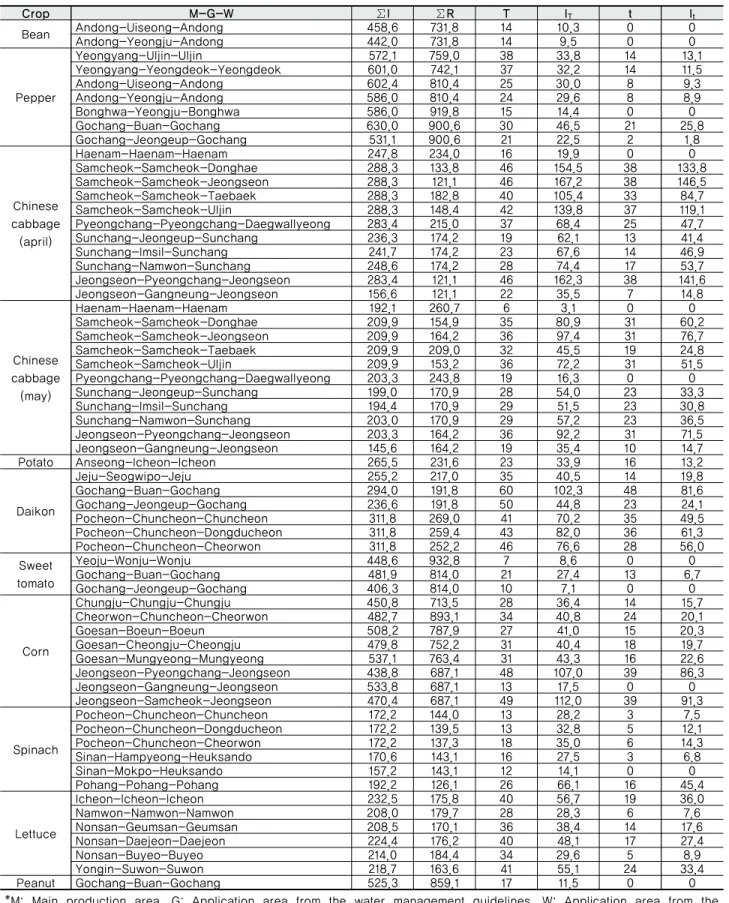
토양의 수분함량을 포장용수량까지 유지할 수 있는 관개 필요량 (IT)은 콩의 경우 주산지 5곳 가운데 안동 지역에서 약 10 mm/T (여기서, 10 mm/T는 T일 동안 10 a의 관개 면적 에 10 ton의 관개용수가 필요하다는 것을 의미하며, T는 Table 2에 보여지는 것과 같이 지역과 작물에 따라 다름), 고추는 영양 34 mm/T, 안동 30 mm/T, 봉화 14 mm/T, 고창 47 mm/T 가 필요한 것으로 나타났다. 배추는 파종시기에 따라 4월과
5월로 구분하였으며, 4월 파종 배추는 해남 20 mm/T, 삼척 167 mm/T, 평창 68 mm/T, 순창 74 mm/T, 정선 162 mm/T로 대상 작물 가운데 가장 많은 관개용수가 필요한 작물인 것으 로 나타났다. 5월 파종 배추는 해남이 3 mm/T, 삼척 97 mm/T, 평창 16 mm/T, 순창 57 mm/T, 정선 92 mm/T가 필요한 것으 로 분석되었다. 감자는 안성 지역에서 약 34 mm/T, 무는 제주 도 41 mm/T, 고창 102 mm/T, 포천 82 mm/T, 고구마는 여주와 고창 지역에서 9 mm/T와 27 mm/T, 옥수수는 충주 36 mm/T, 철원 41 mm/T, 괴산 43 mm/T, 정선 112 mm/T, 시금치는 포천 33 mm/T, 신안 28 mm/T, 포항 66 mm/T, 상추는 이천 57 mm/T, 남원 28 mm/T, 논산 48 mm/T, 용인 55 mm/T, 땅콩은 고창 지역에서 12 mm/T가 필요한 것으로 분석되었다 (Table 3).
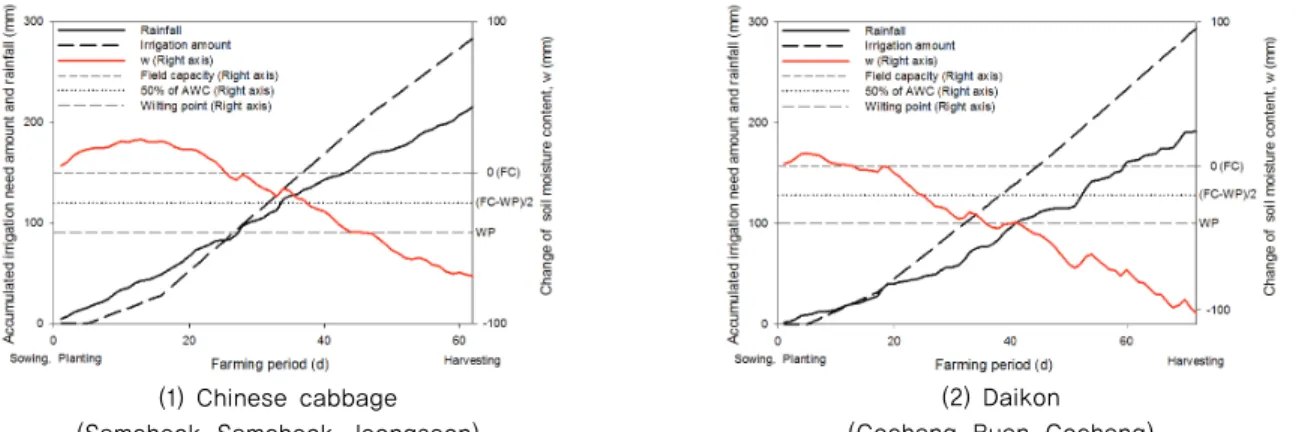
작물/주산지별 관개필요량 산정 결과 세가지 경향으로 분 류되었다. 첫 번째로 배추, 감자, 무, 시금치, 상추의 경우에는 관개요구량보다 재배시기에 발생하는 강우량이 적은 경향이 나타났으며, 부족한 강우량만큼의 관개용수 공급이 필요한 것으로 분석되었다 (Fig. 4-a). 또한 관개요구량-강우량 누적곡 선에서 재배기간 경과함에 따라 토양수분이 포장용수량 이하 (1) Chinese cabbage
(Samcheok-Samcheok-Jeongseon)
(2) Daikon (Gochang-Buan-Gochang) (a) Total rainfall amount < accumulated irrigation requirement
(1) Pepper (Yeongyang-Uljin-Uljin)
(2) Corn
(Chungju-Chungju-Chungju) (b) Total rainfall amount > accumulated irrigation requirement
Fig. 4 Change of soil moisture content under the condition of irrigation required
로 떨어지는 경향이 나타났다. 따라서 용수확보를 통해 작물 생육 중반기 이후의 충분한 관개가 필요할 것으로 판단된다.
두 번째로 콩, 고추, 고구마, 옥수수의 경우에는 관개요구량 보다 재배시기에 발생하는 강우량이 더 많았으나, 토양수분 이 포장용수량 이하로 떨어져 관개용수가 필요한 기간이 발 생하는 것으로 분석되었다 (Fig. 4-b). 이는 관개가 필요한 시 기에 강우가 발생하지 않거나 강우량이 적다는 것을 의미한 다. 따라서 작물 파종 전에 관개용수를 확보하여 관개가 요구 되는 시기에 적절한 관개가 필요한 것으로 사료된다.
마지막으로 유효토양수분함량이 50% 이하로 내려가지 않 아 최소 관개필요량 (It)이 ‘0’으로 산정되는 콩 (안동), 고추 (봉화), 배추 (해남, 평창), 고구마 (여주), 옥수수 (정선), 시금 치 (신안), 땅콩 (고창)과 같은 경우도 존재하였다 (Fig. 5). 하 지만 단순히 과거 자료의 통계를 이용해 분석된 결과이므로, 강우량이 평년에 비하여 부족할 경우를 대비한 용수확보는 필요할 것으로 보여진다.
Ⅳ. 결 론
강우량 관측지역과 밭작물 물 관리 지침서 수록 지역을 기 준으로 콩 등 10개 작물에 대하여 99개의 지역을 대상으로 작물 재배기간 동안 필요한 관개량을 산정하였다. 재배 지역 에 따라서 관개 필요량의 차이는 크게 나타났으나, 콩, 감자, 고구마 그리고 땅콩 재배지역과 같이 관개 요구량을 평균적 인 강우로 해결 할 수 있는 지역도 존재하는 것으로 분석되었 다. 작물별로 물 부족은 배추, 옥수수, 무, 시금치, 상추 그리고 고추 순으로 심각하게 나타났으며, 배추-삼척-삼척-정선에서 재배기간동안 167.2 mm의 최대 관개 필요량이 산정되었다.
관개가 필요한 시기에 따라 재배기간 동안 지속적으로 강
우량이 부족해 관개가 필요한 경우와 일정 시기에 한시적으 로 강우가 부족한 경우로 분류 할 수 있었다. 배추, 감자, 무, 시금치 그리고 상추는 지속적으로 강우량이 부족하여 재배 중반기를 지나면서 물 부족이 심각해지는 것으로 분석되었다. 반면 콩의 안동지역 재배와 고추, 고구마 그리고 옥수수는 한 시적으로 관개가 필요한 것으로 나타났다. 지속적으로 강우 량이 부족한 배추와 감자 등의 경우에는 용수 저장시설을 구 비하고, 저장능력에 맞춰 지속적인 용수의 확보가 필요할 것 으로 판단된다. 한시적으로 관개용수가 필요한 콩과 고추 등 의 경우에는 재배 준비기간동안 충분한 용수를 확보해 두고 필요한 시기에 사용하는 것이 효율적일 것으로 판단된다. 본 연구에서는 장기간의 강우자료를 통하여 평균 강우량을 분석 한 결과이므로 추가적인 관개가 필요하지 않다고 분석된 작 물의 경우에도 예기치 못한 물 부족의 발생을 대비하기 위한 관개용수의 확보가 필요하다고 사료된다. 또한 충분한 관개 용수를 확보하지 못하는 경우에는 유효토양수분함량이 50%
이하로 떨어지지 않도록 관개하여 작물의 시듦을 방지할 필 요가 있다.
본 연구는 산정된 관개필요량은 밭작물 물관리 지침서에 명시된 재배기간동안의 과거 강우량 자료를 활용하여 통계적 으로 접근한 결과이기 때문에 지역별, 작물별, 재배기간 그리 고 토성 등의 차이를 모두 반영하는 결과는 아니다. 그러나 본 연구와 같이 장기 관측된 강우 자료를 바탕으로 재배기간 동안의 강우 패턴을 분석하여 작물별로 물이 부족한 시기 및 필요한 관개 용수량 등을 산정하면, 필요한 관개용수의 확보 방안 마련, 저장 시설 규모의 적정 설계, 보관 또는 활용 계획 등을 수립 할 수 있다. 이러한 일련의 과정을 통해 물 부족에 대비하는 노지 밭작물 재배 계획에 대한 정보를 제공 할 수 있을 것으로 기대된다.
(a) Bean
(Andong-Uiseong-Andong)
(b) Sweet tomato (Yeoju-Wonju-Wonju) Fig. 5 Change of soil moisture content under the condition of no irrigation required
REFERENCES
1. Choi, J. Y., and Y. S. Kim, 2006. Development of soil moisture index. Water for Future 39(3): 24-28 (in Korean).
2. Choi, Y. H., M. Y. Kim, Y. J. Kim, J. G. Jeon, and M.
C. Seo, 2016. Spatial variability of soil moisture and irrigation scheduling for upland farming. Journal of the
Korean Society of Agricultural Engineers 58(5): 79-88 (in
Korean). doi:10.5389/KSAE.2016.58.5.081.3. Choi, Y. H., Y. J. Kim, M. Y. Kim, and J. G. Jeon, 2018.
On-site evaluation of rainwater harvesting device for securing irrigation water in small fields. Journal of the
Korean Society of Agricultural Engineers 60(1): 31-36 (in
Korean). doi:10.5389/KSAE.2018.60.1.031.4. Eom, K. C., D. S. Oh, K. C. Song, I. S. Jo, and D. W.
Seo, 1999. A guide book irrigation for upland crop in Korea. Rural development adminstration, Suwon (in Korean).
5. Eom, K. C., P. K. Jung, S. H. Choi, W. T. Kim, S. Y.
Yoo, S. H. Park, and Y. K. Sonn, 2010. Water requirement of red pepper in different growth stages. Korean Journal
of Soil Science and Fertilizer 43(6): 844-847 (in Korean).
6. Han, K. H., 2011. Development of water management techniques for water saving. Annual report, Rural Development Administration, Jeonju (in Korean).
7. Hong, E. M., W. H. Nam, and J. Y. Choi, 2015. Climate change impacts on agricultural drought for major upland crops using soil moisture model focused on the Jeollanam-do.
Journal of the Korean Society of Agricultural Engineers
57(3): 65-76 (in Korean). doi:10.5389/KSAE.2015.57.3.065.8. Hong, M. K., S. H. Lee, J. Y. Choi, S. H. Lee, and S.
J. Lee, 2015. Estimation of soil moisture and irrigation requirement of upland using soil moisture model applied WRF meteorological data. Journal of the Korean Society
of Agricultural Engineers 57(6): 173-183 (in Korean).
doi:10.5389/KSAE.2015.57.6.173.
9. Kim, C. H., and C. K. Koh, 1977(1). A study on the development of a simulation model for predicting soil moisture content and scheduling irrigation (I). Magazine of
the Korean Society of Agricultural Engineers 19(1):
4279-4295 (in Korean).
10. Kim, C. H., and C. K. Koh, 1977(2). A study on the development of a simulation model for predicting soil moisture content and scheduling irrigation (II). Magazine
of the Korean Society of Agricultural Engineers 19(2):
4367-4376 (in Korean).
11. Kim, M. J., H. Y. Kang, T. S. Oh, and J. S. Park, 2017.
Drought status and outlook for 2017. Water for Future 50(9): 56-61 (in Korean).
12. Kim, Y. J., 2015. Research on rainwater catchment and storage in dry-field farming. Annual report, Rural Development Administration, Jeonju (in Korean).
13. Lee, J. Y., 2012. A study of the application of an agricultural drought index considering climate change.
Working Paper 2012-01, Korea Environment Institute, Seoul, Korea (in Korean).
14. Lee, T. H., and Y. C. Shin, 2016. Estimation of irrigation water amounts for farm products based on various soil physical properties and crops. Journal of the Korean
Society of Agricultural Engineers 58(6): 1-8 (in Korean).
doi:10.5389/KSAE.2016.58.6.001.
15. Maeng, S. J., and J. H. Hwang, 2015. Utilization of rainwater tanks for securing agricultural water against drought. Rural Resources 57(4): 10-15 (in Korean).
16. Nam, W. H., E. M. Hong, M. W. Jang, and J. Y. Choi, 2014. Projection of consumptive use and irrigation water for major upland crops using soil moisture model under climate change. Journal of the Korean Society of Agricultural
Engineers 56(5): 77-87 (in Korean). doi:10.5389/KSAE.
2014.56.5.077.
17. Ro, K. K., 1996. Irrigation facilities and water resource development. Magazine of the Korean Society of Agricultural
Engineers 38(1): 17-23 (in Korean).
18. Rural development administration (RDA), 2018. Soil and environmental information system of korea, http://soil.rda.
go.kr/soil/chart/chart.jsp.
19. Seo, M. C., S. O. Hur, Y. K. Sonn, H. S. Cho, W. T. Jeon, M. K. Kim, and M. T. Kim, 2012. The development of estimation model (AFKAE0.5) for water balance and soil water content using daily weather data. Korean Journal of
Soil Science and Fertilizer 45(6): 1203-1210 (in Korean).
20. Shin, Y. C., 2017. Analysis of irrigation water amount variability based on crops and soil physical properties using the IWMM model. Journal of the Korean Society of
Agricultural Engineers 59(2): 37-47 (in Korean). doi:10.5389/
KSAE.2017.59.2.037.
21. Shin, Y. C., T. H. Lee, S. W. Kim, H. W. Lee, K. S. Choi, J. G. Kim, and G. H. Lee, 2017. Development of agricultural drought assessment approach using SMAP soil moisture footprints. Journal of the Korean Society of
Agricultural Engineers 59(1): 57-70 (in Korean). doi:10.5389/
KSAE.2017.59.1.057.
22. Shin, Y. H., 2018. Soil moisture simulation considering saturated water flow and irrigation requirement estimation in upland fields. Master’s thesis, Seoul National University, Seoul (in Korean).
23. Shin, Y. H., J. Y. Choi, S. J. Lee, and S. H. Lee, 2017.
Estimation of irrigation requirements for red pepper using soil moisture model with high resolution meteorological data. Journal of the Korean Society of Agricultural
Engineers 59(5): 31-40 (in Korean). doi:10.5389/KSAE.
2017.59.5.031.
24. Suh, Y. J., and K. Y. Lee, 2002. Irrigation requirement estimation in upland. Magazine of the Korean Society of
Agricultural Engineers 44(1): 25-34 (in Korean).
25. Yoon, H. K., S. O. Chung, and S. D. Suh, 1990. The optimum irrigation level and the project water requirement for upland crops. Magazine of the Korean Society of
Agricultural Engineers 32(1): 72-86 (in Korean).
26. Yu, M. S., Y. H. Cho, T. W. Kim, and H. S. Chea, 2018.
Analysis of drought propagation using hydrometeorological data: from meteorological drought to agricultural drought.
Journal of Korea Water Resources Association 51(3):
195-205 (in Korean). doi:10.3741/JKWRA.2018.51.3.195.