Prospects of Activated Sludge Process in Japan - Its Past, Present, and Future -
Masanori Fujita*+
Abstract : Our life totally depends on activated sludgeprocess for treatment of wastewater: sewage and industrial wastewater. Activated sludge process was the epoch-making technology in Environmental field. One century has been almost passed since the process was developed in England, and the process is still on the development of improvement. Here, history of activated sludge process, its mechanismsof treating the wastewater, expectations that we had on the process in the past, and future image and possibility on the process were presented. By reviewing the events related to the process, we can foresee potentials for new possibility of activated sludge process.
Keywords : activated sludge process, BOD reduction rate, oxygen uptake rate, microorganism ecosystem, gene analysis, bioaugmentation
+ Corresponding author : [email protected]
* Professor Emeritus of Osaka University, President of Kochi National College of Technology, 200-1 Monobe-Otsu, Namgoku, Kochi 783-8508 Japan
History of Activated Sludge
A report which was publicized by E.
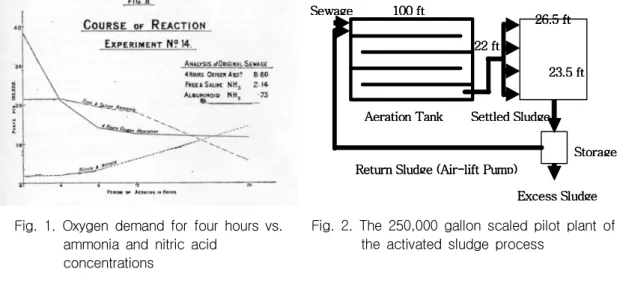
Ardernand W.T.Lockett in 1914 received a sensational reputation as the epoch-making research related to sewage treatment. The report described that to mix sewage with sludge named as "activated sludge" and then to aerate the mixed solution for a short period of time produced clean treated water. Fig. 1 showed
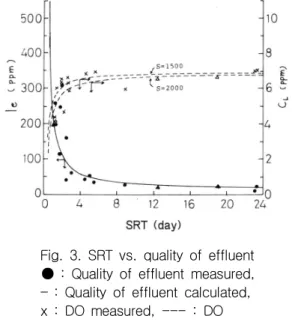
oxygen demand for four hours (similar to the concept of BOD) vs. ammonia and nitric acid concentrations as a function of time. Based on this principal, the operation of the 250,000 gallon scaled pilot plant (Ardern, E., 1920) started in October, 1917 (Fig. 2), which was a debut of the activated sludge process to the world market of sewage treatment. Let’s look back the past how the concept of activated sludge was born.
Fig. 1. Oxygen demand for four hours vs.
ammonia and nitric acid concentrations
100 ft 100 ft100 ft 100 ft
22 ft 22 ft22 ft 22 ft
26.5 ft 26.5 ft26.5 ft 26.5 ft
23.5 ft 23.5 ft 23.5 ft 23.5 ft Sewage
SewageSewage Sewage
Settled Sludge Settled Sludge Settled Sludge Settled Sludge Aeration Tank
Aeration Tank Aeration Tank Aeration Tank
Return Sludge (Air Return Sludge (Air Return Sludge (Air
Return Sludge (Air---lift Pump-lift Pumplift Pump)lift Pump)) )
Excess Sludge Excess Sludge Excess Sludge Excess Sludge
Storage Storage Storage Storage
Fig. 2. The 250,000 gallon scaled pilot plant of the activated sludge process
In countries of Europe and USA in the 1880s, researches related to sewage treatment were intensively conducted for water quality conservation. The main purposes of the researches were to remove suspended solids (SS) and to nitrify ammonium-nitrogen. The reason why SS and ammonia were chosen was that dissolved oxygen (DO) was used as an indicator of water quality in rivers so that any factors which consumed DO should be monitored.
Settling tank was practically already used at that time and supernatant in the tank was decanted, however, large amount of coagulants was required for effective settling of SS and problem of odor was a big headache of this practice.
For nitrification of supernatant, filter bed was employed on site although it was not cost effective. Under the circumstances, a report brought a light in sewage treatment field.
According to the report, improvement of SS settling, acceleration of nitrification, and reduction of odor were effectively achieved after a long time aeration and especially coagulants cost reduced to 1/3 or 1/4 due to SS settling improvement. The sludge produced by aeration was called as "humus" distinguishing from "raw sludge." The discovered process "aeration of sewage" was installed as prior process of filter bed because the process required much time.
During this period, researches proved that brownish slime on the surface of a filter bed was actually colony of bacteria which played essential roles for oxidation of organic matters and ammonium-nitrogen. Researches also revealed the facts that seeding of algae to sewage improved treatment efficiency and a bacterium screened from a pond at a mining site treated sewage effectively with Fe ion in six hours (G.J.Fowler and E.M.Munford).
Aeration is a key factor for those mechanisms so that importance of aeration in sewage
treatment was emphasized in 1900s. It can be said from those trials by forerunners that a series of steps; seeding of bacteria into sewage, aerate it, let it settle, and decant its supernatant, was already done as a usual manner before activated sludge process was invented. Later, through many modifications, filter bed process was removed from a sewage treatment and a conventional activated sludge process was completed. Its completion came true only because many researchers in Europe and USA made tremendous and a long time efforts for the dream.
Development of Activated Sludge Process Application to industrial wastewater treatment The first challenge of the activated sludge process arose after the World War II when the process faced to an obligation to treat wastewater from industries which grew fast. As the matter of fact, biological treatment of industrial wastewater drastically improved at this period. Contributions intensive researches by W.W.Eckenfelder, Jr. to understand the activated sludge process was tremendous large. He introduced a concept of scale-up used in chemical industries to the activated sludge process. For example, the increase in the mass of sludge used to be calculated by sludge age or BOD loading but can be obtained using BOD reduction rate as follows;
∆ (1)
where ∆ = Increase rate of volatile suspended solids (VSS) (kg/day)
Lr = BOD reduction rate (kg/day) Sa = Increase rate of mixed liquor
volatile suspended solids (MLVSS) in aeration tank (kg)
a’, b’ = Constants
Since oxygen uptake rate by activated sludge controlled oxygen supply rate to an aeration tank, he proposed the following empirical equation3)
RO2 = a’ Lr + b’ Sa (2)
where RO2= Oxygen uptake rate (kg/day) Lr = BOD reduction rate (kg/day) Sa = Increase rate of mixed liquor
volatile suspended solids (MLVSS) in aeration tank (kg)
a’, b’ = Constants
Equation (2) may be derived from the following equation which described the relationship between respiration by microbes and endogenous respiration;
QO2 = a μ + b (3)
where QO2 = Specific oxygen uptake rate (mgO2/g-cell/hr)
= Specific growth rate (1/hr) μ
a, b = Constants
As described above, W.W.Eckenfelder, Jr.
proposed the theories of organic matter degradation rate and optimization for organic matter degradation. Those landmark contributions by him opened the way to the theory of activated sludge process control. The success in the challenge enabled the activatedsludge process to treat industrial wastewater effectively and the process can be found as a main wastewater treatment process in many industries such as the oil refinery industry, the textile industry, the chemical industry, the steel industry, and other heavy industries.
Control theory and practice of microorganism ecosystem
Treatment mechanism of activated sludge was
intensively studied when employment of the activated sludge process was spread in industries as a cost effective wastewater treatment method.
Hashimoto (1968) stressed on importance of
"adsorption phenomenon" by activated sludge for wastewater treatment based on his laboratory and field data in the research of degradation theory and mechanism. His theory was led by the widely accepted knowledge of applicability of Michaelis-Menten equation to most of biological reactions, the research on biosorption by G.H.Rohlich (1956), and the pioneering works on degradation rate by W.W.Eckenfelder, Jr.(1961). At that time, Monod equation was intensively studied to describe growth kinetics of micro- organisms. The fact that the activatedsludge process, a completely heterogeneous system in microorganisms and substrates, could be explained by Monod equationwhich is designed for pure culture of microorganisms and a single growth-limiting substrate was a disitinguished foot step in the history of the activated sludge process.
P.L.McCarty (1970) introduces the concept of SRT (Sludge retention time) based on his long time research on anaerobic digestion. SRT is given by the following concept.
SRT = Total amount of activated sludge in a system / (waste sludge + SS in
wastewater) (4)
The reciprocal SRT became a specific growth rate of activated sludge μ = 1/ SRT in constant growth phase. Hence, SRT was related to Monod equation, then, it can be said that quality of treated water (substrate concentration) was controlled by SRT.
= 1/ SRT = max le / (Ks + le) (5)
μ μ
where μ = specific growth rate (1/day)
max = maximum specific growth rate μ
(1/day)
le = concentration of growth-limiting substrate in system (mg/l) Ks = half-velocity constant, substrate
concentration at one-half the maximum growth rate (mg/l) Figure 3 showed one example of the relationship between SRT and the quality of treated water. Figure 3 also showed the relationship between DO concentration in aeration tank and SRT as a function of the change in concentration of mixed liquor suspended solids (MLSS).SRT was controlled by withdrawal rate of waste sludge.
Fig. 3. SRT vs. quality of effluent : Quality of effluent measured,
●
: Quality of effluent calculated, –
x : DO measured, --- : DO
For treatment of wastewater contained persistent organic pollutant (POPs), Hashimoto proposed an operation of activated sludge process with a longer SRT to maintain effective microbes for POPs degradation in the system because the specific growth rate of the microbes were pretty small. It was also found that the theory of SRT control was very effective for nitrification. The activated sludge process had
surely been evolving by efforts and enthusiasm by many researchers.
More Expectation to Activated Sludge Process
Extraction of weakness and modification Concept of sorption by activated sludge stated earlier developed the contact stabilization process for strength wastewater treatment (Figure 4).
Tapered aeration process was developed based on the researches of oxygen uptake rate by activated sludge. The activated sludge process had been modified and upgraded and a variety of activated sludge processes was proposed.
From the researches, it was found that having a deeper aeration tank led some advantages such as smaller land requirement and low energy consumption. The deep-shaft tank (50-100 m depth) was proposed in this period. Competition among makers for development on diffuserwas very tough at this period since aeration occupied the most of operational cost in the activated sludge process.
Fig. 4. The activated sludge process with the contact stabilization process
Bulking by filamentous bacteria and foaming by actinomycetes became a big problem around the world and sometimes sewage treatment system was paralyzed by them. Many researchers faced up to the problems (Eikelboom, D.H., 1975; Pipes, W.O., 1978).
When the people who studied biology
startedworking in sewage treatment field, activated sludge was understood as ecosystem not just as usual sludge. Studies on taxonomy and characteri- zationof filamentous bacteria, behavior of actinomycete in activated sludge, function of microorganisms including protozoa became hot topics in this field.
N and P treatment
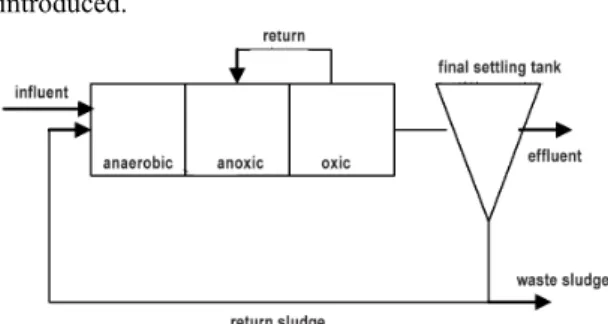
In 1970s, eutrophication in closed water bodies became a serious social issue, so the activated sludge process was studied for effective treatment of N and P. The treatment of N and P was mainly focused by physical and chemical processes but researches’ interests moved to biological treatment. The bottle neck of activated sludge treatment was high cost due to carbon source supply such as methanol required for de-nitrification. The well known phenomenon among the operators of the activated sludge processes gave researchers a big clue for cheap treatment of N and P in the process. In summer, raising activated sludgein final settling tanks was often reported by operators. Inert respiration of activated sludge was taken place in the settling tanks and nitrogen produced through the respiration raised activated sludge. Taking advantage of this mechanism, the nitrification/de-nitrification activated sludge process was developed. Figure 5 showed a flow of anaerobic-anoxic-oxic A2O process. This development can be said the epock-making event in a long history of the activated sludge process. Nitrification was a big target in activated sludge process but de- nitrification was completely out of consideration.
Immobilized activates sludge was proposed to minimize low temperature effects for treatment performancein winter, the activated sludge processes without the final settling tanks and with low waste sludge production were also
introduced.
Fig. 5. Anaerobic-anoxic-oxic A2O process
Endless Dream in Activated Sludge Process
Use of gene analysis for estimation of treatment performance
Since new regulations on POPs, the activated sludge process faced to new challenge for degradation of POPs. Unlike the case of BOD reduction, POPs could not be degraded by activated sludge unless specific microbes which had abilities for POPs’degradation existed in the sludge. By using gene analysis, acclimatization process for obtaining the essential microbes with POPs degradation ability became more effective.
Building DNA data base for microbes with special ability for certain topics such as degradation of POPs or endocrine disrupting chemicals (EDCs), nitrification, de-nitrification, de-toxification f of hazardous wastes, and so on will be a strong tool for enhancing the ability and for diagnosing potential ability of the activated sludge process.
Possibility of bioaugmentation in the activated sludge process
Usually inoculation of exogenous micro- organisms into activated sludge does not succeed and the microbes cannot be maintained at a sufficient high level of stability to show its full activity because endogenous microorganisms in the sludge try to terminate them. Success in
inoculation of the special microbes such as the microbes with special degradation abilities and the genetically engineered microorganisms (GEMs) could drastically enhance the performance of the activated sludge process.
GEMs are now not novelty and the concept of engineered gene is applied in many fields. It is not so difficult to install a new function into microbes through genetic engineering, so if we could achieve genetic stability of GEMs in the activated sludge process, we could control in operationallyand functionally the activated sludge process at our will.
Future of the Activated Sludge Process The activatedsludge process was improved by enthusiasms and perspiration of many researchers and engineers whenever new challenging difficulties arose. We should make more efforts to enhance the ability of the activated sludge process for satisfy the demand of society. As stated earlier, answer to POPs and EDCs treatment should be investigated. Knowing limitations and understanding of the activated sludge process is very important for us and we may employ some physico-chemical process such
Fig. 6. The degradation pathway of Alkylphenol waterbodies
biological treatment is always an environmentally friendly solution. Many researches are going on as ozonation, chemical-oxidation, and so on, in the activated sludge process. The importance of understanding the activated sludge process or the biological process can be realized the following the fact. Nonylphenol polyethoxylates (NPE), non estrogenic activity, is a non-ionic surfactant and now used in large amount for industrial use in Japan. The wastewater contained NPE is discharged into sewage system. NPE is treated in an activated sludge process and a remained intermediate of NPE is discharged into rivers.
The intermediate becomes finally nonylphenol in waterbodieswhich possesses estrogenic activity and the one of EDCs designated by Japanese government. The degradation pathway of NPE is shown in Figure 6. The more the degradation proceeds in the activated sludge process, the more toxicity of the intermediate increases. This is one example of a shortcoming of the biologicaltreatment and we should know that the investigation of degradability of the considered chemicals which may need their monitoring in environment, however, not only degradability of the chemical but also accumulation and toxicity of their intermediates must be investigated.
Material Safety Data Base (MSDS) should upload treatability and degradability of chemicals by biological treatment in the future. The activated sludge process will continue to evolve eternally when academia, a country, local governments, and industries work together.
References
Ardern, E. and Lockett, W.T., 1914.
Experiments on the Oxidation of Sewage without the Aid of Filters, J. Soc. Chem.
Ind. xxxiii , pp.523
Ardern,E., 1920. The Activated Sludge Process of Sewage Purification-Large Scale Operation, J. Soc. Chem. Ind. xxxix , 60T.
Eckenfelder,W.W.Jr. and O`Connor,D.J., 1961. Biological Wastes Treatment, Pergamon Press, Oxford, London.
Eikelboom,D.H., 1975. Filamentous Organisms Observed in Activated Sludge, Water Research, 9, pp.365-388.
Fujita M. and Hashimoto S., 1976. Study of Kinetics on Treatment Capacity of Activated Sludge Process through Oxygen Transfer in Aeration Tank, Hakkoukogaku Zasshi, 54、
pp.659-666 (in Japanese).
Hashimoto S., Fujita M., 1968. Study on Treatment Reaction Theory and Mechnisms, Hakkoukogaku Zasshi, pp.46、649 (in Japanese).
Katz,W.J. and Rohlich,G.H., 1956. Biological Treatment of Sewage and Industrial Wastes, Vol.1, pp.66, Reinhold Pub. Co. New York.
Lawrence,A.W. and McCarty, P.L., 1970.
Unified Basis for Biological Treatment Design and Operation, Journal of SA Div.,96, pp.757
Pipes, W.O., 1978. Actinomycete scum production in activated sludge processes, J.
of Water Pollution Control Federation, April, pp.628-634.