비디오 영상에서 컬러와 움직임 기반의 화재 검출
Color and Motion-based Fire Detection in Video Sequences
알라김*, 김윤호*
Alla Kim
*, Yoon-Ho Kim
*요 약
CCTV 카메라는 비디오 감시분야나 화재검출 시스템 등에 다양하게 응용되는 바, 본 논문에서는 고정된 카
메라에서 영상 정보를 취득하여 비디오 시컨스를 분석한 후 화재정보를 검출하는 방법을 제안하였다. 연속영상 의 배경과 화재정보를 공간적으로 검출하고, 시공간적으로 편차가 급격하게 나타나면 화재 발생 인자로 결정하 여 실험을 수행하였다.
Abstract
A wide distribution of CCTV cameras in many public areas can be used not only for video surveillance systems but also for preserving fire occurrence. A proposed approach is based on visual information through a static camera. Video sequences are analyzed to find fire candidates and then spatial analyses procedure for detected fire-like color foreground is carried out. If spatial and temporal variances changes rapidly and close to fire motion, fire candidate is considered as fire.
Key words : 화재 검출, 근사화 메디안필터, 배경분리, 컬러정보
* Division of Computer Engineering, Mokwon University.
‧ 제 1저자(First Author) : Alla Kim ‧ 교신저자(Corresponding Author) : Yoon-Ho Kim ‧ 투고일자 : 2011년 6월 10일
‧ 심사(수정)일자 : 2011년 6월 10일 (수정일자 : 2011년 6월 21일) ‧ 게재일자 : 2011년 6월 30일
I. Introduction
Fire detection conventional smoke and fire detectors are widely used, but they are fail to maintain open and large spaces. The advantage of visual fire detection systems is that they can be used in cases when above mentioned detectors are not reliable, in addition visual systems can use cameras to obtain video data for further processing.
An approach that is proposed in this paper based on several steps. In a pre-processing stage raw input video is changed in a form that can be used and conformed
to an algorithm's goal and capability of acquisition device.
A pre-processing step is followed by background
subtraction procedure in order to detect motion (changes
in a video sequences). Background modeling was
constructed by using Approximated Median Filter
(AMF) [1-3]. Background/Foreground detection plays a
distinctive role in visual based analysis systems. In this
step motion is detected and background (or statical)
pixels are removed. The procedure is a foundation for
many visual systems. Lately a lot of different approaches
have been proposed and developed, ability to separate background and new foreground object is a crucial point for further pro-processing steps.
Color verification process classifies detected foreground pixels as fire in case if they match color detection procedure and remove all foregrounds that don't. Pixels that are detected by algorithm are considered as fire candidates. We form blobs and check their spatial characteristics and apply to noise suppression technique to remove some fire-like pixels caused by illumination changes [4][7-9]. Then all blobs go through spatial analysis in order to take final decision whether it is a fire and system should make a notification or it is a fire-like object. The organization of the paper is as follows: in section Ⅱ a description of research is given. In section Ⅲ results of approach are presented. In section Ⅳ approach's results are discussed and test performance is done. Finally section VI is devoted to conclusion.
Ⅱ. Proposed fire detection method in a video sequence
Fire detection was conducted by using Matlab Image Acquisition toolbox, test was performed on Intel Processor 2.83 HGz, 1.98 Gb of RAM. We acquired RGB video sequence with an ignited New Year tree in-doors, human motion in-doors and red pen motion.
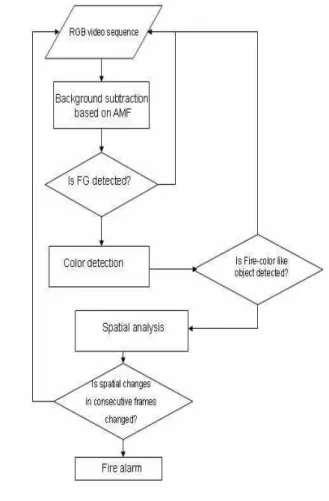
Video was adjusted in a form appropriated for conducting experiment on Matlab (transformed to avi format). An overall description of fire-detection algorithm is given in Figure 1.
In order to identify changes that can be resulted by fire we used motion detection procedure from previous paper[1]. Then detected pixels went through a color
(detection) classification procedure. Background modelling (also referred too as background subtraction) was based on Approximated Median filter (AMF). AMF had been previously used for classification system and urban traffic monitoring [5][6].
그림 1.화재검출 순서도 Fig. 1. A fire-detection flow-chart
AMF based B/F (Background/Foreground) detection
maintains a background model and background
subtraction procedure separates foreground and
background. If a pixel value in the current frame has a
value larger than the corresponding background pixel,
the background pixel is incremented by 1. Otherwise the
background is decremented by one. In this way input
data comes to a state when half of pixels are greater
then the background and half are less than the
background.
Foreground pixel are detected by calculating the Euclidean norm at time t:
∥
∥
(1)
where is the pixel intensity value, is the background intensity value at time t and is the foreground threshold.
(2)
where is the number of image channels[6].
The foreground threshold
determined experimentally. We used different thresholds for different video sequences, remember that threshold should be adjusted with respect to the complexity of the scene and depends on dynamics of the environment. The parameter is adaptive, if the object movements are fast, then can be kept small, otherwise should be kept large [7][13-14]. For ignited New Year tree we intentionally used
, for human motion in-doors sequence
, for pen motion (we just waved a red pen in front of camera)
.
For color detection procedure we used next classification:
1) First we try to define pixels whose value in a Red channel is greater then mean of pixels of Red channel.
(3)
Where R(x,y) is the pixel intensity value at time t in spatial location of (x,y).
is the mean of
Red channel pixels intensity values.
(4)
where N is a total number of pixels in frame.
2) Pixels in a Red channel suppose to be greater then pixels values of Green channel and those ones suppose to be greater then Blue channel's ones.
(5)
where R(x,y), G(x,y), B(x,y) are Red, Green and Blue channel values at spatial location of (x,y).
If colors of foreground pixels match to the fire color, we carried out spatial analyses procedure [10-12].
Spatial analysis is used in order to enhance algorithm output. There are many things that share the same color as fire that's why color alone is not enough sufficient for fire identifying the key solution here to use spatial temporal variations. In further step color is not important anymore so we obtained binary blobs and analyzed their area and spatial mean.
If blob's area (connected components) is less then 10 pixel we suppose that it is a noise and remove it. An assumption that flame (fire) has temporally spatial changes in area can be used so if blob's area doesn't change through video sequence it is considered as non-fire object (ex. sun, red roof, red clothes on a human and soon), otherwise a notification is generated by system.
Ⅲ. Test performance and discussion
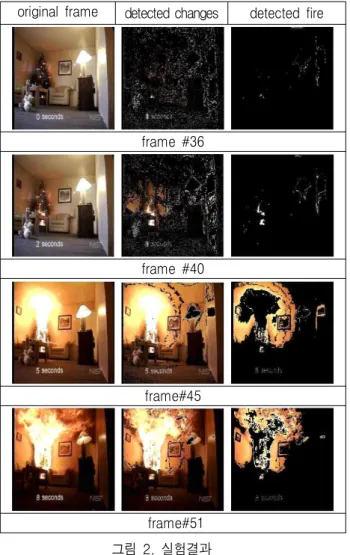
original frame detected changes detected fire
frame #36
frame #40
frame#45
frame#51 그림 2. 실험결과 Fig. 2. Experimental results
Changes that were detected by Back/Foreground detection procedure were represented in column 1, Fig.
2 (experimental result).
Background scene modelling was implemented by using approximated median filter, though the AMF has a good performance it adapts very slowly to large changes in background and is sensitive to environmental noise.
Since the amount of background update (+1 or -1) is independent of the foreground pixels, it is very robust against moving traffic. The only drawback is that it adapts slowly toward a large change in background[8] - for example, as shown in frames that includes a quick or abrupt explosion (frame#45, frame#51) of fire were failed to define background and foreground, except regions that contain furniture and other static objects, but
color-like object was defined and segmented by color classification procedure. Low frame rate can also improve the result. Additional sophistications can be implemented to enhance algorithm's output. All others motion segmentation details are described in a section
Ⅱ and III [1].
Color classification procedure was maintained as formulated in (3), (4) and (5) and was tested in still images (Fig.3) and video sequences (Fig. 2)
그림 3. 정지영상의 컬러처리 Fig. 3. Color procedure in still images
Bounding box was constructed and covered every fire colored blob
그림 4. 사각형내 표현된 화재인지 영역 Fig. 4. Fire-colored blob covered by bounding box
Unfortunately, on a video with a tree, bright regions
in the center of flame wasn't defined, cause their color is more close to white then red and doesn't match color classification rules.
Commonly for background subtraction algorithm and color classifier as well, binary mask is used in order to mark all matched components. However color information is extremely important for visual color detection system, it is commonly advised to use some noise suppress on this stage, but noise suppression was performed after applying color classification and removing all non-fire colored objects (Fig. 2, column 3).
For noise suppression and spatial analysis binary changes map was obtained by converting all defined objects into binary representation.
All isolated pixel (individual 1's that are surrounded by 0's) were removed. Then all connected components (objects) that have fewer than 10 pixels were removed from a binary image (Fig.4).
Then spatial and temporal analysing was done.
Because many objects can have fire-like color, color detection procedure can give many false positives in case of red car, sun or others. Implementing spatial changes in area can be used to confirm that object is fire.
그림 5.연속 플레임 #38 a) 원영상, b) 변환된 비트맵 영상
c)잡음이 제거된 영상 Fig. 5. Frame #38;
a)original image, b) transformed bit map c) after noise removing
If blob's area doesn't change through video sequence
it is considered as non-fire object (ex. sun, red roof, red clothes on a human and soon), otherwise a notification is generated by system.
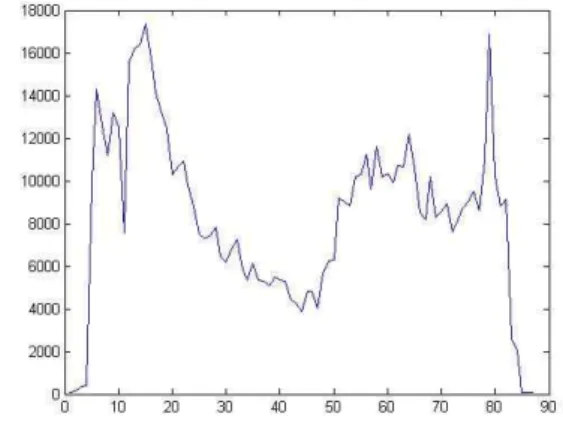
그림 6. 목표영역 대비 시간지연(신년 트리) Fig. 6. Object's area versus time (Ignited New Year
tree)
On video sequences with ignited tree, object's area changed significantly versus time. This spatial variation happens because of fire nature. Fire is tending to change its area during the swinging (Fig.6). On video sequences with red pen, changes doesn't occurs much throughout the course of the sequences (Fig.7).
On last sample video (human motion in-doors) color segmentation procedure didn't detected any fire colored regions (human was dressed in dark T-shirt and shorts), so area analysing wasn't performed.
그림 7. 목표영역 대비 시간지연(붉은 연필) Fig. 7. Object's area versus time (red pencil motion)
Ⅳ. Experimental results
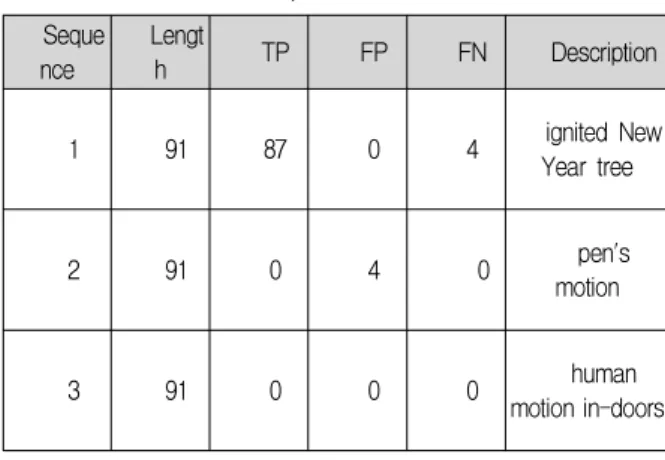
In order to have a quantitative evaluation of the performance, we applied our approach on sampled video sequences. Then detected fire frames were counted.
If the algorithm counts a frame with no fire, we consider that an error (false positive) occurs (FP), in case when there is a fire on frame, but it was missed we consider that it is false negative (FN).
표 1. 연속영상의 실험 결과
Table 1. Results for sequences tested Seque
nce Lengt
h TP FP FN Description
1 91 87 0 4 ignited New
Year tree
2 91 0 4 0 pen's
motion
3 91 0 0 0 human
motion in-doors
Ⅴ. Conclusion
In this paper we have developed a fire detection approach in RGB video sequences. Approach includes different techniques to obtain object and define whether it is a fire candidate or not. Objects detection was based on background subtraction procedure. After motion pixels had been defined color classification was implemented, all fire-like pixels where checked on possible spatial variation. If pixel intensity changes fast and spatial changes are high, fire is detected, otherwise it is considered as fire-like object.
References
[1] Alla Kim, Yoon-Ho Kim, “ Motion segmentation from
color video sequence based on AMF”, KIIECT, vol.
2, no. 3, 2009.
[2] N. McFarlane and C. Shofield, “Segmentation and tracking of piglets in images”, Machine Vision and Applications, Springer, vol. 8, no.3, 1995.
[3] Seth Benton, “Background subtraction, Matlab Models”, 2008.
[4] Water Philips III, Mubarak Shah, Niels da Vitoria Lobo, Flame recognition in video, Pattern Recognition Letters 23 (2002) 319–.327.
[5] Swantje Johnsen and Ashkey Tews, “Real-Time Object Tracking and Classification Using a Static Camera”, Proceedings of the IEEE ICRA 2009, Workshop on People Detection and Tracking, Kobe, Japan, May, 2009.
[6] P. Remagnino et al., "An integrated traffic and pedestrian model-based vision system”, Proceedings of BMVC97, Vol. 2, Colchester, 8-11 th September, University of Essex, UK, pp380-389, 1997.
[7] Turgay Celik, Hasan Demirel, Huseyin Ozkaramanli, Mustafa Uyguroglu “Fire detection using statistical color model in video sequences”, Advanced Technologies Research and Development Institute, Eastern Mediterranean University, Gazimagusa TRNC, Mersin 10, Turkey, 2005.
[8] Sen-Ching S. Cheung and Chandrika Kamath " Robust techniques for background subtraction in urban"
[9] Thanarat Horprasert, David Harwood, Larry S. Davis,
“A statistical approach for real-time robust background subtraction and shadow detection”, 1999.
[10] Behzcet Ugur Toreyin, “Fire detection algorithms using multimodal signal and image analysis”, 2009.
[11] Rastislav Lukac, Konstantinos N. Plataniotis, “Color image processing: methods and applications”, Published by CRC Press, ISBN 084939774X, 9780849397745, 2006.
[12] Alexandre R. J. Francois and Gerard G. Medioni,
“Adaptive color background modeling for real-time segmentation of video streams”, Proceedings of the Int’l on Imaging Science, Systems, and Technology, pp. 227-232, Las Vegas, Nevada, June 1999.
[13] Amy L. Tabb, Donald L. Peterson, Johnny Park,
“Segmentation Apple Fruit from Video via Background Modeling”, ASABE, 063060, Portland, Oregon, 2006.
[14] Tom Fawcett, "An introduction to ROC analysis", Institute for study of Learning and Expertise, USA.
Alla Kim
2008: B. S. degree in Department of Economics and Management, Tashkent University of Informational Techonologies.
2010: M. D. degrees in Department of Computer Engineering, Mokwon University.
2010: - now: CN Robot Company.
Research interests : image processing, video processing
Yoon-Ho Kim
received the M.S. degree in electronic engineering from Kyung-Hee Univ.
in 1986, and the ph.D. degree in electronic engineering in 1992 from Chong-Ju Univ., respectively. In 1992, he joined the faculty member of the Mokwon Univ.. He is currently a professor in the Dept. of Computer Engineering, Mokwon Univ.. From 2005 to 2006, he was with Univ. of Auckland, where he served as a research fellow. He has been working as Korea Delegate in ISO/TC223 since 2008.
His research interests focus on image processing, including pattern recognition, computer vision, fuzzy technologies. He is a member of the IEEE, and IEEE Computer Society, IEEK, KICS and KIIT.