• 검색 결과가 없습니다.

The Effect of Personality Type on Human Performance Tool Compliance and General Recommendations for Enhancement of the its Practical Utilization

N/A
N/A
Protected

Academic year: 2021

Share "The Effect of Personality Type on Human Performance Tool Compliance and General Recommendations for Enhancement of the its Practical Utilization"

Copied!
18
0
0

로드 중.... (전체 텍스트 보기)

전체 글

(1)

JESK http://jesk.or.kr eISSN:2093-8462

The Effect of Personality Type on Human Performance Tool Compliance and General Recommendations for Enhancement of the its Practical Utilization

Kyung-Sun Lee

1

, Jong-Hyun Lee

2

, Yong-Hee Lee

1

1

Korea Atomic Energy Research Institute (KAERI); I&C/Human Factors Research Division, Daejeon, 305-353

2

Ajou University; College of Social Sciences Social Science Research Institute, Suwon, 443-749

Corresponding Author Yong-Hee Lee

Korea Atomic Energy Research Institute (KAERI); I&C/Human Factors Research Division, Daejeon, 305-353

Mobile : +82-10-5500-7958 Email : [email protected]

Received : November 21, 2014 Revised : November 24, 2014 Accepted : December 05, 2014

Copyright@2015 by Ergonomics Society of Korea. All right reserved.

ccThis is an open-access article distributed under the terms of the Creative Commons Attribution Non-Commercial License (http://

creativecommons.org/licenses/by-nc/3.0/), which permits unrestricted non-commercial use, distribution, and reproduction in any medium, provided the original work is properly cited.

Objective: The purpose of this study is to investigate the effect of personality type on human performance tool compliance in nuclear power plants (NPPs) and to propose general recommendations for an enhancement of its practical utilization.

Background: Various guidelines, regulating criteria, and recommendations have been developed to prevent human errors in NPPs. Despite these efforts, the accidents sometimes caused by human errors have steadily occurred, and therefore, various human performance tools have been adopted as countermeasures against human errors. The major and inevitable contributing factors among the many hazards to human errors might be the trait and personality, which are considered to be the inner world of humans. Thus, we try to investigate the utilization of human performance tools by considering the different types of operating crew personalities, and we suggested more practical recommendations to prevent human errors according to the personality.

Method: We developed the Questionnaire using the Big 6 (HEXACO) models, which are human performance tools for workers in NPPs, and individual (condition) variables to investigate the effect of personality types on human performance tools. We slightly modified them to help the survey respondents understand them better. A survey was conducted for ordinary people over the age of 20. SPSS 22.0 was used to perform a correlation analysis and a hierarchical regression analysis to find the relationship between personality types and human performance tools.

Results: The utilization of human performance tools shows significant differences statistically by personality. The correlation result reveals that the types of Honesty (H), Extraversion (X), Conscientiousness (C), and Openness to experience (O) show a higher utilization of human performance tools. In hierarchical regression results, human performance tools of task preview, questioning attitude, stopping when unsure, self-checking, effective communication, and place-keeping show a higher utilization with personality types. However, the Agreeableness (A) type did not show significant differences statistically with human performance tools.

Conclusion: We tried to investigate the utilization of human performance tools by considering the different types of human personality and provide more practical recommendations to prevent human errors according to the personality. These results will be able to prevent human errors owing to the characteristics (advantages and disadvantages) of personality types.

Application: This information can be utilized as guidelines for proactive recommendations according to the workers' personalities for more practical human performance tools to prevent human errors in an NPP.

Keywords: Personality Types, Big 6 (HEXACO), Human Performance Tools, Human

Error, Nuclear Power Plants (NPPs)

(2)

1. Introduction

Many studies on individual characteristics on safety and human errors in academia and industrial sites have been carried out thus far, and researches on accident proneness have been performed especially in the field of psychology. Accident proneness sees an accident that occurs by human's psychological characteristics as a phenomenon having consistent characteristics that can be predicted, rather than a random phenomenon. According to the accident proneness, an accident is systematically affected by personal traits in addition to flexible characteristics (Lee, 2006). Accidents occur by specific people and the reason why they are prone to accidents is derived from their personality (Greenwood and Woods, 1919), and those who cause accidents in a specific environment have consistency in causing accidents in the other environments as well (Newbold, 1927).

Personality is the most basic attribute that humans have, and it means a consistent pattern is revealed when a person feels, thinks, and behaves (Pervin and John, 1997). Therefore, efforts to identify relevance with personal behavior prediction, job execution, job performance, accident and safety through research on personality have been actively made (Barrick and Mount, 1991; Stewart, 1996; Yoo, 2007). According to the study by Eysenck, extraversion and neurosis types are more closely related with accidents than other types of personality (Chung, 2000). Clarker and Roberson (2005) said low likeability can become a valid and generalized variable of accidents through a literature analysis on the 24 types of accidents and injuries. In addition, likeability and conscientiousness types are concerned with safety attitude according to the study of Wallace (2003) and Henning et al.

(2009). In a study to apprehend the relation between human errors of aircraft pilots and personality types, a person having a high disposition of neurosis and extraversion pursues risk taking and stimulation, and a person with a high disposition of introversion experiences excessive awakening (Chappelow, 1989).

Although, it was revealed that personality is related with unsafe behaviors, human errors, accidents, and safety through several studies, most scholars said all of these occur in a complex situation together with other external factors in addition to personality (Diaz and Cabrera, 1997; Neal and Griffin, 2006; Von Thaden et al., 2008). That is, it is difficult to jump to a conclusion that personality is inseparably related with weakness to accidents; however, we cannot deny that personality affects behaviors (Chung, 2000). Famer (1984) said that developments would be made in the concerned field, when the characteristics of personality are specifically studied in association with specific unsafe behaviors, human errors, and accident cases.

In some industrial fields, countermeasures to prevent unsafe behaviors, human errors, and accidents according to personality are already implemented. In the aviation field, personality theory and personality analysis are included in the education/training of workers and are utilized in the safety and flight management (KTSA, 2011). In addition, a personality test (aviation physical examination test certificate) is carried out to evaluate mental disorders. The workers' personality and behavior disorders are evaluated (Article 12.2 of the Enforcement Regulations of the Railway Safety Act) in the railway field as well. Soldiers are managed through character and personality tests to prevent accidents by soldiers to be cared for, who increase each year in the military.

In the nuclear power field representing a high reliability and large system, workers' mental health status is cyclically evaluated (KAERI, 2010), and suitability was reviewed by evaluating their personality and stress in order to check workers' soundness. In addition, several basic studies were undertaken to understand the correlations between an individual's personality/disposition and its influence on organization, job stress and job satisfaction/commitment (Lee, et al., 2011; Lee, et al., 2012). Korea Hydro

& Nuclear Power carried out a personality test for visitors to NPPs and new personnel.

Because the nuclear power field is a large and complex system, non-injury and irreversible safety system, and tightly-coupled

technology system, it needs high reliability (Lee, 2014). Therefore, system safety and human error prevention should be emphasized

more than in other industries. As a part of preventing human errors, the procedures of human performance tools with which

NNP workers should comply have been established and operated. Although, the procedures present application procedures that

the workers need to comply with, as well as prohibitions, some workers tend to regard the utilization of the procedures as very

(3)

http://jesk.or.kr uncomfortable and formal.

It is difficult to conclude that personality has an inseparable relation with unsafe behaviors, human errors, and weakness to accidents, and it is not simple to identify which type of personality is dangerous. The reason is that most unsafe behaviors, human errors, and accidents take place by various factors, not by a single factor. However, different methods of each type of personality to cope with accidents exist, and we cannot deny that personality types affect behaviors (Seo, 2007).

In this regard, this study tried to examine the relation between the status of utilization of human performance tool application procedures and prohibitions in reference to those currently used in NPPs and personality types, rather than deciding what personality types cause human errors and accidents. Based on this, this study actually aims to present general recommendations by personality type to enhance the utilization of human performance tools and utilization procedures.

2. A Survey on the Relationship between Human Performance Tools and Personality 2.1 Questionnaire configuration and development

2.1.1 Big 6 (HEXACO)

This study used the 6 personality factor (HEXACO) personality test method to identify the personality types of the study subjects.

HEXACO is a scale developed through a vocabulary research on personality. This study used the HEXACO-PI-R scale developed by Ashton and Lee (2009). HEXACO is classified into honesty, emotionality, extraversion, agreeableness, conscientiousness, and openness to experience, and HEXACO consists of 60 questions in total with ten questions in each type. The definitions and characteristics based on the personality type of HEXACO are as follows:

1) Honesty (H): H type indicates individual honesty and humbleness and the extent to avoid the characteristics of Machiavellism and irregularities including corruption.

2) Emotionality (E): E type demonstrates high individual neurotic characteristics, sensitivity, anxiety, and sensibility.

3) Extraversion (X): X type reveals high individual vitality, sociality, self-assertiveness, and bold heartedness.

4) Agreeableness (A): A type is the area including personal flexibility, spirit of team work, altruism, and patience.

5) Conscientiousness (C): C type indicates high behavioral disposition according to a personal plan and desire to achieve goals.

6) Openness to experience (O): O type demonstrates a high degree of individual creativity, imagination, and artistic and intelligent curiosity.

2.1.2 Individual (condition) variables

The control of individual (condition) variables is necessary to verify the effects of personality types on human errors. Therefore, this study included three condition variables related to individual conditions with high relevance with human errors presented by many researchers.

1) Impulsiveness is a psychological configuration concept, different from an individual personality system (Whiteside and Lynam, 2000), and contains multilateral characteristics such as the disinhibition, risk taking, and hasty behavioral disposition. Individual impulsiveness has been studied in relation with traffic accidents and addiction to gambling (Steel and Blaszczynski, 1998). In the study by Shappel (2000), he says personal concern, dissatisfaction with job, and hastiness are the factors causing human errors.

This study also added impulsiveness as an indicator to evaluate this. For the impulsiveness scale, the Barratt Impulsiveness

Scale developed by Barratt (1955) and validated by Lee and Jung (1997) was used in this study.

(4)

2) Individual affectivity is activated quickly by external stimuli, and the unleashed affectivity is delivered to the nervous system again and changes the individual cognitive process (Damasio, 2000). Emotion affects the cognitive process, has been measured as an individual condition variable in extensive fields, and studies on behaviors such as individual risk taking or risk selection are being carried out (Mano, 1994; Figner et al., 2009). This study used PANAS (Positive and Negative Affect Schedule) developed by Watson et al. in 1988 and validated by Lee at al. in 2003 for affectivity evaluation.

3) Stress is an individual mental and physical awakening reaction on specific demand. That is, stress indicates the relation between a person and the environment. Stress is caused when an ability to cope with stress is lacking, personal volition is frustrated beyond the permissible scope, or personal wellbeing is threatened (Lazarus and Folkman, 1984). Stress always exists, and if it is excessively high, harm is caused to mental and physical conditions, and a weak individual in a stressed state has a big risk to be exposed to human errors or accidents (Dupont, 1990). Such a stress variable was recently studied as the concept of burnout proposed by Masclach et al. (1996). Burnout is defined as the affective exhaustion, cynicism in work or interpersonal relations and low personal achievement. Originally, the schedule was specialized for service jobs, but the scale suitable for general position was developed, and thus, the study scope is expanding. For the burnout scale, this study used MBI-GS (Maslach Burnout Inventory-General Survey) developed by Maslach et al. (1996) and validated by Shin (2003).

2.1.3 Human performance tool

To investigate the status of utilization of human performance tools by personality type, this study configured questionnaire questions based on the application procedures and prohibitions of the human performance tools used in Korean NPPs. The human performance tool is divided into basic human performance tools and conditional human performance tools. The basic human performance tools includes task preview, questioning attitude, stopping when unsure, self-checking, effective communication, and a phonetic alphabet. The conditional human performance tools consist of pre-job briefing, concurrent verification, independent verification, peer check, flagging and operational barriers, place-keeping, turnover, and post-job review (Table 1).

2.1.4 Questionnaire development

The questionnaire developed for this study consisted of 213 questions in total including 60 questions of HEXACO for personality type identification, nine questions of positive emotionality, and 11 questions of negative emotionality in relation with individual Table 1. Human performance tool in NPPs

Fundamental Conditional

1. Situation awareness 1. Pre-job briefing

1-1. Task preview 2. Verification practices

1-2. First check 2-1. Concurrent verification

1-3. Questioning attitude 2-2. Independent verification

1-4. Stop when unsure 3. Peer check

2. Self-checking 4. Flagging and operational barriers

3. Effective communication 5. Place-keeping

3-1. 3-way communication 6. Turnover

3-2. Phonetic alphabet 7. Post-job review

(5)

http://jesk.or.kr emotionality, five questions of affective exhaustion, five questions of cynicism, six questions of efficiency reduction related to burnout, 23 questions of impulsiveness, and 94 questions in relation with human performance tool utilization procedures and prohibitions. This study was evaluated using a five-point scale for the 213 questions (1: never so, 2: slightly not so, 3: fair, 4: slightly so, 5: very so).

The questionnaire questions used to evaluate the status of human performance tool utilization by personality type consisted of the application procedures and prohibitions of the human performance tools shown in Table 1. To determine the questions, 1) a focus group interview (FGI) with a personality expert was carried out. This study selected the final questionnaire tools, except the tools predicted to show a difference in the status of utilization and the tools of which a revision is difficult with the questionnaire questions, through an FGI. Therefore, this study selected nine human performance tools in consideration of onsite applicability (Table 2). The detailed procedure of each tool applied the tools utilized in the U.S. INPO, and others except the workers in NPPs, have some difficulties to understand. 2) This study revised some details by using easy and plain terms through an agreement with personality and ergonomics experts.

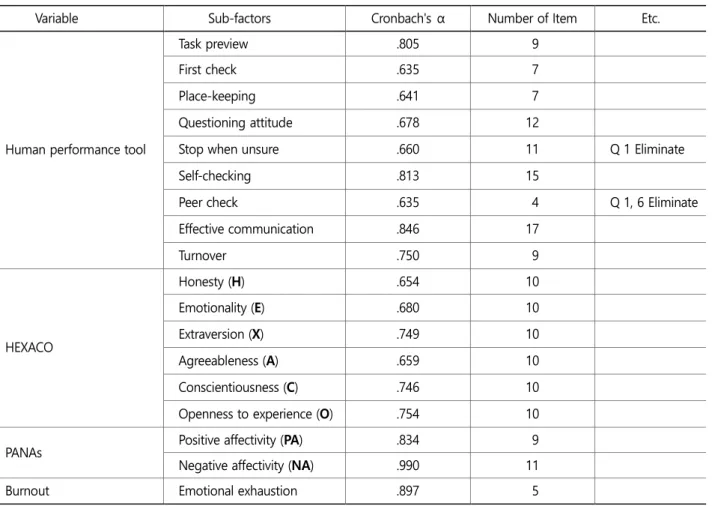
Also, Cronbach α reliability analysis was conducted to evaluate a question's reliability as the coefficient indicating the consistency of questions (SPSS 22.0). Table 2 shows the reliability analysis results of the variables included in the questionnaire (Cronbach's α). The questions showing .6 and lower reliability were removed and a re-analysis was performed.

Table 2. Cronbach's α results of variables in questionnaire

Variable Sub-factors Cronbach's α Number of Item Etc.

Human performance tool

Task preview .805 9

First check .635 7

Place-keeping .641 7

Questioning attitude .678 12

Stop when unsure .660 11 Q 1 Eliminate

Self-checking .813 15

Peer check .635 4 Q 1, 6 Eliminate

Effective communication .846 17

Turnover .750 9

HEXACO

Honesty (H) .654 10

Emotionality (E) .680 10

Extraversion (X) .749 10

Agreeableness (A) .659 10

Conscientiousness (C) .746 10

Openness to experience (O) .754 10

PANAs Positive affectivity (PA) .834 9

Negative affectivity (NA) .990 11

Burnout Emotional exhaustion .897 5

(6)

2.2 Subject for questionnaire survey

The questionnaire survey targeted males and females in their 20s and over (high school graduates and above). 100 copies of the questionnaire were distributed, and the collected questionnaires were 70: the collection rate was 70.0%. The mean age of the subjects was 33.38 (standard deviation (SD): 5.68), and 61.5% were in their 30s, 24.6% were in their 20s, and 13.8% were in their 40s. The mean job duration was five years and nine months (SD: four years and eight months): 31.8% have 5~10 years and 21.2%

have 1~3 years. Actually, all except for two respondents showed an education level of junior college graduates and above. Table 3 reveals a frequency of 30% and higher in each personality type among the questionnaire respondents.

2.3 Statistic analysis

A correlation analysis was carried out to identify the relations between the measurement variables. For the correlation coefficient, this study applied a Pearson's product-moment correlation coefficient (r), a generally used scale to obtain the relevance between two variables, and a two-tailed test was undertaken. To verify the regression model, this study performed a hierarchical regression analysis: population statistics variables (gender, age, education, job duration) were controlled for the first phase, the relations of individual (condition) variables (affectivity, burnout and impulsiveness) affecting human errors were controlled for the second phase and the effects of a prediction variable, i.e., the personality factor, on the human performance tool utilization was analyzed as the next step.

2.4 Results

2.4.1 Correlation analysis

Table 4 exhibits the mean, SD, and correlation coefficient of the variables used in this study. The (C) type showed a positive correlation with all human performance tools. The (H) type showed a correlation with all human performance tools except the Table 2. Cronbach's α results of variables in questionnaire (Continued)

Variable Sub-factors Cronbach's α Number of Item Etc.

Burnout

Cynicism .708 5

Efficacy .805 6

Total .847 15

Impulsiveness Total .792 23

Table 3. Number of subject personality type

Gender Personality (upper 30%)

H E X A C O

Male 7 3 1 11 10 11

Female 8 8 8 6 6 8

Total 15 11 19 17 16 19

(7)

2 8 F e b , 2 0 1 5 ; 3 4 (1 ): A n E n h a n ce m e n t o f th e P ra ct ic a l U ti liz a ti o n o f H u m an P e rf o rm an ce T o o ls b a se d o n P e rs o n a lit y T yp e 5 1 h tt p :/ /j e sk .o r. k r Ta b le 4 . C o rr el at io n r es u lt s am o n g t h e va ri ab le s Va ri ab le 1 2 3 4 5 6 7 8 9 10 11 12 13 14 15 16 17 18 19 20 21 1. A g e 1 2. C ar ee r .6 5 9 ** * 1 3. H .1 18 .1 28 1 4. E -. 02 5 .0 64 .1 04 1 5. X -. 01 1 .1 04 .0 88 -. 13 1 1 6. A -. 01 6 -. 10 1 .2 6 2 * -. 02 0 .0 16 1 7. C .0 73 .0 96 .3 7 8 ** .2 5 0 * .3 1 4 * .3 3 3 ** 1 8. O .1 46 .0 87 .2 6 1 * -. 2 5 5 * .4 7 0 ** * .0 92 .2 5 0 * 1 9. T as k p re vi ew .1 72 .0 80 .4 1 5 ** .1 43 .3 3 7 ** .2 18 .6 0 2 ** * .4 0 7 ** 1 10 . F ir st c h ec k .1 37 .2 15 .1 61 .1 79 .3 1 8 ** .0 14 .4 4 1 ** * .2 07 .6 2 9 ** * 1 11 . P la ce -k ee p in g .0 04 .0 54 .3 1 0 * .0 04 .3 1 5 * -. 04 6 .3 4 1 ** .4 5 3 ** * .6 0 3 ** * .5 5 2 ** * 1 12 . Q u es ti o n in g at tit u d e -. 00 2 -. 11 8 .3 0 6 * .2 8 9 * .1 59 .2 4 4 * .5 1 1 ** * .1 92 .5 5 2 ** * .6 3 2 ** * .4 3 7 ** * 1 13 . S to p w h en u n su re -. 20 1 -. 14 1 .3 0 0 * .2 7 1 * .3 0 4 * .1 07 .4 2 2 ** * .0 87 .4 9 2 ** * .4 8 2 ** * .3 8 1 ** * .5 2 7 ** * 1 14 . S el f- ch ec ki n g -. 03 7 -. 05 1 .4 8 3 ** * .1 27 .3 8 3 ** .1 84 .5 7 2 ** * .3 6 4 ** .6 3 8 ** * .4 8 1 ** * .5 1 5 ** * .6 0 9 ** * .6 2 1 ** * 1 15 . P ee r ch ec k .1 34 .0 64 .3 2 8 ** .2 27 .3 6 8 ** -. 03 0 .3 4 4 ** .2 7 5 * .4 9 8 ** * .4 7 7 ** * .4 1 5 ** .4 0 0 ** .4 8 5 ** * .4 5 1 ** * 1 16 . E ff ec ti ve co m m u n ic at io n -. 00 2 .0 05 .3 9 7 ** .2 23 .3 2 1 ** .1 81 .5 3 3 ** * .3 7 1 ** .5 7 5 ** * .4 1 6 ** .5 8 6 ** * .5 8 5 ** * .4 9 8 ** * .6 5 7 ** * .4 8 2 ** * 1 17 . T u rn o ve r .1 21 .1 36 .3 4 8 ** .1 51 .3 5 2 ** .1 07 .4 2 7 ** * .2 9 2 * .6 9 1 ** * .4 1 1 ** .6 5 5 ** * .3 9 2 ** .5 0 7 ** * .5 7 9 ** * .4 4 9 ** * .6 6 5 ** * 1 18 . P A .1 38 .1 02 .2 6 9 * -. 16 5 .4 8 6 ** * -. 05 4 .2 04 .3 3 7 ** .3 8 6 ** .3 1 3 * .4 2 1 ** * .0 88 .1 89 .2 31 .3 2 5 ** .2 35 .3 0 4 * 1 19 . N A -. 06 5 -. 09 4 -. 3 1 4 * .2 5 6 * -. 17 1 -. 3 2 4 ** -. 20 6 -. 3 5 1 ** -. 20 6 -. 20 7 -. 2 7 0 * -. 15 6 -. 21 7 -. 3 1 7 ** -. 07 9 -. 3 4 6 ** -. 2 8 0 * .0 27 1 20 . B u rn o u t -. 13 4 -. 14 6 -. 3 7 3 ** .0 87 -. 4 1 5 ** -. 2 8 7 * -. 3 3 3 ** -. 3 7 1 ** - .4 2 6 ** * -. 3 1 3 * -. 4 2 3 ** * -. 09 8 -. 2 7 6 * -. 3 5 8 ** -. 3 5 2 ** - .4 2 6 ** * -. 4 6 6 ** * -. 6 4 4 ** * .4 3 7 ** * 1 21 . I m p u ls iv en es s -. 04 4 -. 05 9 -. 3 7 1 ** -. 12 4 -. 4 0 2 ** -. 3 3 0 ** - .6 2 0 ** * -. 3 8 2 ** - .5 7 6 ** * -. 4 7 8 ** * -. 3 9 7 ** - .4 9 5 ** * -. 5 5 4 ** * -. 6 3 2 ** * -. 4 5 3 ** * -. 6 1 8 ** * -. 5 3 9 ** * -. 3 0 0 * .4 8 4 ** * .5 1 6 ** * 1 M 33 .3 8 69 .6 8 3. 58 3. 24 3. 24 3. 20 3. 52 3. 25 3. 88 3. 60 3. 45 3. 40 3. 76 3. 76 3. 63 3. 75 3. 85 3. 03 2. 31 2. 59 2. 42 SD 5. 68 56 .2 7 .5 1 .5 8 .5 5 .5 3 .6 0 .6 4 .5 4 .4 9 .5 3 .4 2 .4 4 .5 0 .6 6 .5 1 .5 7 .7 3 .8 2 .5 5 .4 1 *p < .0 5, * *p < .0 1, * ** p < .0 01

http://jesk.or.kr

(8)

task preview. The (X) type demonstrated a positive correlation with all human performance tools except a questioning attitude.

The (E) type showed a positive correlation with a questioning attitude and stopping when unsure. The (A) type showed a positive correlation with a questioning attitude. The (O) type demonstrated a positive correlation with all human performance tools except the first check, questioning attitude, and stopping when unsure. Summarizing the correlation analysis results, the personality types, and human performance tools showed statistically significant relations. In particular, the honesty (H), extraversion (X), conscientiousness (C), and openness to experience (O) types demonstrated more positive correlations with human performance tools than the other personality types.

2.4.2 Hierarchical regression analyses

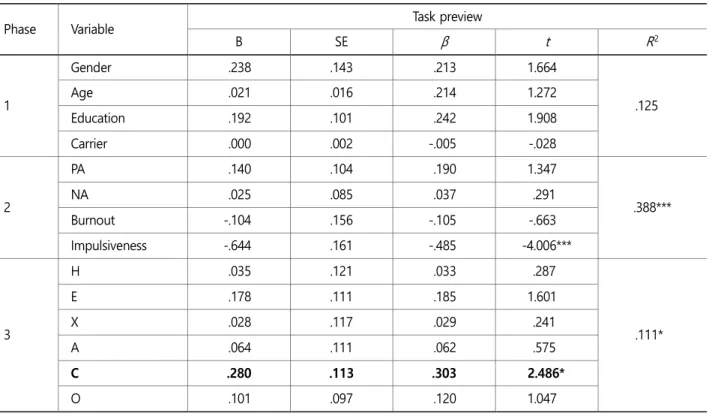
Table 5 shows the analysis results of the effects of personality types on the status of task preview utilization, after the control of population statistics variables and individual (condition) variables, and also presents the regression coefficient, standard error, explanation amount, and significance level of the prediction variables. Among the personality types of HEXACO, only (C) type had significance effects on the task preview ( β = .303, p < .05), and the other personality type factors did not have an effect on the task preview.

As a result of an analysis on the status of the first check utilization, according to the personality type, after population statistics variables and individual (condition) variables were controlled, there was no variable significantly affecting the first check among the personality factors.

Table 5. Hierarchical regression result regarding the task preview by personality

Phase Variable Task preview

B SE β t R

2

1

Gender .238 .143 .213 1.664

.125

Age .021 .016 .214 1.272

Education .192 .101 .242 1.908

Carrier .000 .002 -.005 -.028

2

PA .140 .104 .190 1.347

.388***

NA .025 .085 .037 .291

Burnout -.104 .156 -.105 -.663

Impulsiveness -.644 .161 -.485 -4.006***

3

H .035 .121 .033 .287

.111*

E .178 .111 .185 1.601

X .028 .117 .029 .241

A .064 .111 .062 .575

C .280 .113 .303 2.486*

O .101 .097 .120 1.047

* p < .05, *** p < .001

(9)

http://jesk.or.kr As a result of an analysis on the effects on place-keeping according to the personality type, only O type had significant effects on place-keeping utilization ( β = .276, p < .10), and other personality factors had no statistical effects (Table 6).

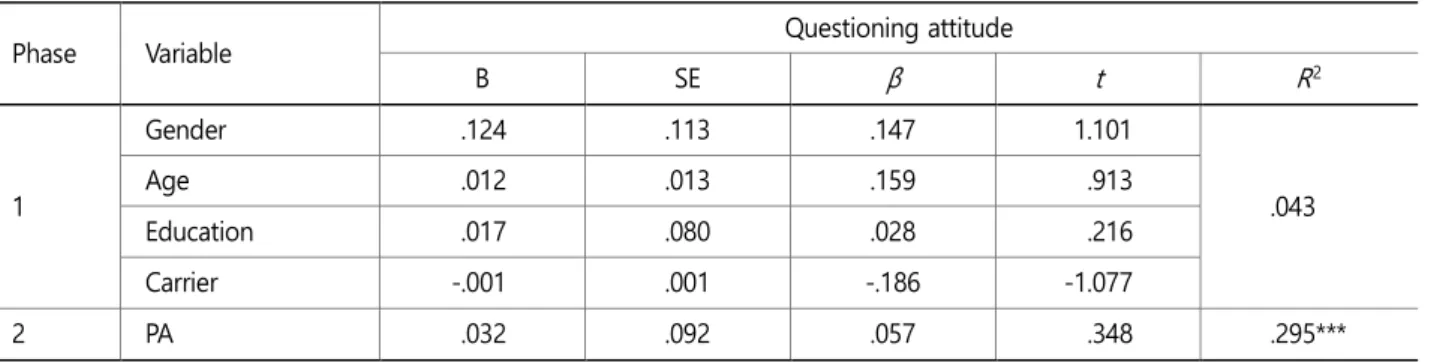
Table 7 shows the analysis results of the effects on the status of questioning attitude utilization according to personality type, after the control of population statistics variables and individual (condition) variables, and presents the regression coefficient, explanation amount, and significance level of the prediction variables. As a result of the analysis, the (E) type ( β = .240, p < .10) and (C) type ( β = .254, p < .10) had significant effects on questioning attitude, and the other personality factors had no effects.

Table 6. Hierarchical regression result about place-keeping by personality

Phase Variable Place-keeping

B SE β t R

2

1

Gender .126 .149 .115 .846

.017

Age -.003 .017 -.029 -.164

Education .039 .105 .050 .369

Carrier .001 .002 .099 .563

2

PA .280 .121 .386 12.314*

.301***

NA -.130 .098 -.199 -1.319

Burnout -.019 .182 -.020 -.107

Impulsiveness -.237 .187 -.181 -1.266

3

H .017 .147 .017 .118

.107

E .122 .135 .129 .902

X -.080 .143 -.083 -.561

A -.210 .134 -.207 -1.559

C .168 .137 .185 1.223

O .231 .118 .276 1.958

†p < .10, * p < .05, *** p < .001

Table 7. Hierarchical regression results regarding questioning attitude by personality

Phase Variable Questioning attitude

B SE β t R

2

1

Gender .124 .113 .147 1.101

.043

Age .012 .013 .159 .913

Education .017 .080 .028 .216

Carrier -.001 .001 -.186 -1.077

2 PA .032 .092 .057 .348 .295***

(10)

As a result of an analysis on the status of utilization of stopping when unsure according to personality type, only the (E) type had significant effects on stopping when unsure ( β = .254, p < .10), and the other personality factors did not have effects statistically (Table 8).

Table 7. Hierarchical regression results regarding questioning attitude by personality (Continued)

Phase Variable Questioning attitude

B SE β t R

2

2

NA .026 .075 .051 .346

.295***

Burnout .174 .139 .231 1.256

Impulsiveness -.652 .142 -.643 -4.577***

3

H .048 .111 .059 .436

.114

E .173 .098 .240 1.765

X .007 .107 .010 .069

A .075 .101 .095 .740

C .179 .104 .254 .1731

O .041 .089 .062 .455

†p < .10, *** p < .001

Table 8. Hierarchical regression results regarding stopping when unsure by personality

Phase Variable Stop when unsure

B SE β t R

2

1

Gender .031 .118 .034 .260

.077

Age -.020 .013 -.252 -1.472

Education .126 .084 .195 1.509

Carrier .000 .001 .050 .293

2

PA .043 .093 .072 .463

.320***

NA .014 .076 .026 .186

Burnout -.020 .140 -.024 -.139

Impulsiveness -.583 .144 -.543 -4.048***

3

H .098 .111 .113 .880

.113

E .211 .098 .276 2.145*

X .171 .108 .214 1.587

A -.069 .102 -.083 -.683

C .042 .104 .056 .405

O -.132 .089 -.191 -1.483

* p < .05, *** p < .001

(11)

http://jesk.or.kr The (H) type ( β = .306, p < .05), (X) type ( β = .214, p < .10) and (C) type ( β = .211, p < .10) had effects on the status of utilization of self-checking, and other personality factors did not have such effects (Table 9). The status of peer check utilization did not show statistical effects.

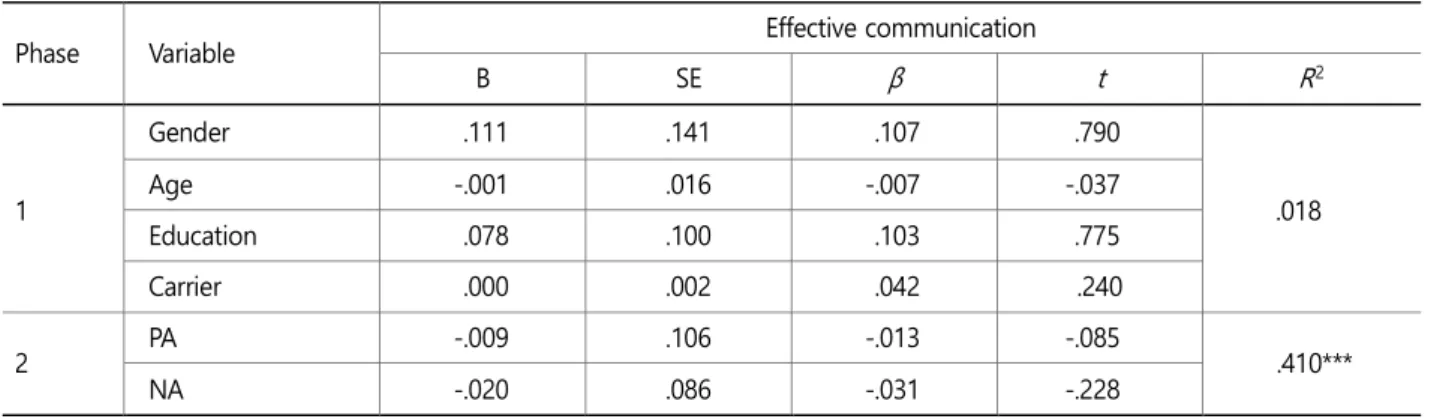
Lastly, (E) type had significant effects on the status of effective communication utilization ( β = .236, p < .10), and no personality types had significant effects on the status of the (T) type utilization (Table 10).

Table 9. Hierarchical regression results regarding the self-checking by personality

Phase Variable Self-checking

B SE β t R

2

1

Gender .029 .135 .028 .211

.054

Age -.006 .016 -.063 -.361

Education .173 .096 .236 1.804

Carrier .000 .002 .014 .082

2

PA .050 .101 .073 .497

.402***

NA -.041 .082 -.067 -.502

Burnout -.044 .151 -.048 -.291

Impulsiveness -.670 .155 -.549 -4.315***

3

H .300 .114 .306 2.629*

.143*

E .078 .101 .089 .767

X .192 .111 .211 1.731

A -.096 .104 -.101 -.920

C .182 .107 .214 1.704

O .038 .092 .049 .419

†p < .10, * p < .05, *** p < .001

Table 10. Hierarchical regression results regarding the effective communication by personality

Phase Variable Effective communication

B SE β t R

2

1

Gender .111 .141 .107 .790

.018

Age -.001 .016 -.007 -.037

Education .078 .100 .103 .775

Carrier .000 .002 .042 .240

2 PA -.009 .106 -.013 -.085

.410***

NA -.020 .086 -.031 -.228

(12)

Summarizing the study results, the tools that showed statistically significant differences on the status of human performance tool utilization, after the control of population statistics variables and condition variables, were task preview, questioning attitude, stopping when unsure, self-checking, effective communication, and place-keeping (Tables 5~10).

The (H) type was related with the status of the utilization of self-checking and the (E) type was related with questioning attitude, stopping when unsure and effective communication. The (X) type had a relation with questioning attitude, stopping when unsure, and self-checking. The (C) type had a relation with a task preview, questioning attitude, and self-checking. The (O) type was related with place-keeping (Tables 5~10). The (A) type did not show any statistically significant result with any human performance tools.

3. General Recommendations for Enhancement of the Practical Utilization in Considering of Personality Type

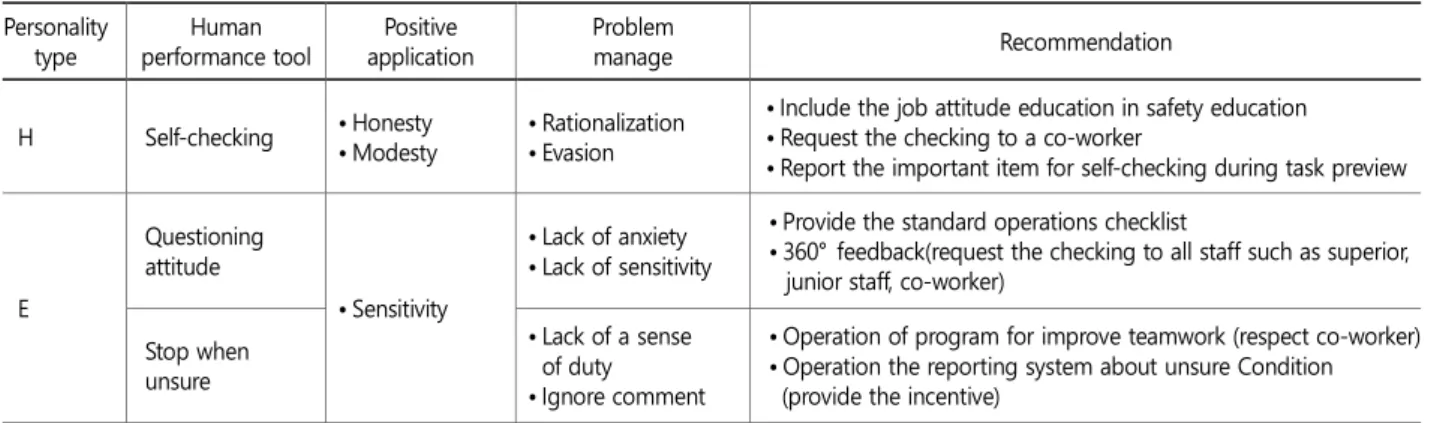
Table 11 shows the general recommendations proposed in this study on the personality types and human performance tools that showed statistically significant results.

Table 10. Hierarchical regression results regarding the effective communication by personality (Continued)

Phase Variable Effective communication

B SE β t R

2

2 Burnout -.172 .159 -.185 -1.084

.410***

Impulsiveness -.644 .163 -.517 -3.957***

3

H .082 .127 .082 .645

.094

E .210 .113 .236 1.858

X .046 .123 .049 .371

A -.081 .117 -.084 -.697

C .157 .119 .180 1.316

O .118 .102 .147 1.153

†p < .10, *** p < .001

Table 11. Proposed recommendations according to personality types Personality

type

Human performance tool

Positive application

Problem

manage Recommendation

H Self-checking • Honesty

• Modesty

• Rationalization

• Evasion

• Include the job attitude education in safety education

• Request the checking to a co-worker

• Report the important item for self-checking during task preview

E

Questioning attitude

• Sensitivity

• Lack of anxiety

• Lack of sensitivity

• Provide the standard operations checklist

• 360° feedback(request the checking to all staff such as superior, junior staff, co-worker)

Stop when unsure

• Lack of a sense of duty

• Ignore comment

• Operation of program for improve teamwork (respect co-worker)

• Operation the reporting system about unsure Condition

(provide the incentive)

(13)

http://jesk.or.kr A person with high honesty has a high utilization of self-checking. The (H) type shows the extent of an individual's honesty and humbleness, and the extent to avoid the characteristics of Machiavellism and irregularities such as corruption. Therefore, when a question or contradiction occurs in a work situation to a worker with low (H) type, he/she is likely to rationalize it without checking with the work plan or leaves the reporting to his/her colleague or senior. In this regard, on the job attitude for safety training, requesting a check of one's own work to colleagues and providing a checklist by drawing major items to check upon a task preview can be of help with the performance of the tools.

A person with high emotionality has a high utilization of questioning attitude, stopping when unsure and affective communication.

A high level (E) type demonstrates a high degree of individual neurotic characteristics and sensitivity, anxiety, and sensibility. A worker with a low (E) type may have boldness by handling duties roughly or rationalizing an unclear situation him/herself. In this regard, there is a possibility to neglect a situation check or ignore a delicate discord, although a question arises, and such as person may simply avoid the situation concerned or neglect a check, rather than being anxious, if he/she is faced with an unclear situation. Therefore, such a person may show a lacking communication aspect including ignoring colleagues' opinions and neglecting reporting to seniors, although an unclear situation or clear discord occurs. In this context, the operation of a system to a voluntarily report is helpful through a method offering incentives, if an unclear situation is predicted. Training for improving opinion expression capability for smooth communication needs to be repeatedly carried out, and effective communication should be conducted under the supervision of a senior, if necessary.

A person with high extraversion has a high utilization of questioning attitude, stopping when unsure, and self-checking. The (X) type demonstrates individual self-assertiveness and boldness, but is also related with leadership or responsibility. Therefore, a worker with a low (X) type may lack the sense of obligation to maintain the worksite in a safe state because of a low responsibility demonstrated under an autonomous checking situation or may not listen to others' opinions, despite an unclear result. In addition, when a question or contradiction is discovered, the worker may lack an attitude to check their work with responsibility and may believe his/her colleagues or senior will discover an issue, although a problem is caused. To prevent Table 11. Proposed recommendations according to personality types (Continued)

Personality type

Human performance tool

Positive application

Problem

manage Recommendation

E Effective

communication • Sensitivity • Lack of responsibility

• Manage and oversee of superior

• Operation of education and training program à communication skill and repeat

X Self-checking

• Vitality, boldness

• Sociality

• Self-assertiveness

• Be self-assertive

• Lock of responsibility

• Include the job attitude education in safety education

• Request the checking to a co-worker

• Report the important item for self-checking during task preview

C

Task preview

• Flexibility

• Cooperation

• Altruism

• Patience

• Work neglect • Manage and oversee of superior

Questioning attitude

• Not reported

• Work neglect

• Provide the standard operations checklist

• 360° feedback(request the checking to all staff such as superior, junior staff, co-worker)

Self-checking • Perform roughly

• Include the job attitude education in safety education

• Request the checking to a co-worker

• Report the important item for self-checking during task preview

O Place-keeping

• Creativity

• Imagination

• Intellectual

• Curiosity

• Lack of learning

• Report the checklist for checking the procedure phase

• 360° feedback(request the checking to all staff such as superior,

junior staff, co-worker)

(14)

such problems, carrying out job attitude training in the case of safety training, and letting such a worker check their work together with a colleague can be helpful. In addition, devising a checklist for a precise check will be helpful to work performance.

A person with high conscientiousness has a high utilization of task preview, questioning attitude, and self-checking. The (C) type indicates a high degree of disposition acting according to personal plan, scrupulosity, perfectionism, and desire to achieve goals.

Therefore, the (C) type is a personality type having a high degree of relation with performance in most job groups. If a worker with low conscientiousness may neglect preparation of work including a pre-summary of important steps of work procedures, and may suspend work to perfectly carry it out, although a question arises, or an effort not to miss a delicate difference may be lacking. Such a person asks his/her performance to him/herself and commits him/herself to work and lacks an ability to identify the accuracy of the performed result. Therefore, the offering of a senior’s supervision and standard work instructions and a full feedback system operation to be checked by a senior, junior, or colleague can be helpful to the work performance.

A person with high openness to experience has a high utilization of place-keeping. The (O) type indicates a high degree of individual creativity, imagination, and acceptance of new information. A worker with a low (O) type has a high possibility of insufficient learning on safety training for work and relevant guidelines. In this regard, checklist preparation and a full feedback system operation to be checked by a senior, junior, or colleague can be helpful to work performance.

4. Discussions

This study examined the relations between personality types and the utilization of human performance tool application procedures and prohibitions used in NPPs, and presented recommendations by personality type to enhance the human performance tool utilization, based on the study results. Additionally, this study presented problems and cautions that may be caused in the utilization process of the tools in the case of a low level of each personality type in relation with personality types with high correlations.

As a result of an analysis on correlations in the context of no control of population statistics variables (gender, age, education and job duration) and individual (condition) variables (emotionality, burnout and impulsiveness), the types of honesty (H), extraversion (X) and conscientiousness (C) showed high correlations with most human performance tools (Table 4). According to the analysis on the effects of the peculiar characteristics of personality type variables on human performance tools, all personality types except the agreeableness (A) type showed statistical effects on some human performance tools (Tables 5~10).

As mentioned in the introduction, it is difficult to assert that personality types have causality with accidents and human errors with only a single factor. However, the reason why testing and management on personality types in various fields are performed is that problems may be caused when the personality types work complexly with a variety of risk factors. By selecting those who have personality types weak to at coping with human errors or a personality type with problems in safety, it will be good to change their personality through education and training, but it will not be easy and may be impossible (Seo, 2007). In this regard, it is important to proactively cope with human errors that may be caused from work by supplementing management and education/training, centered on recommendations in line with workers' personality types (Lee et al., 2014).

The findings of this study have a meaning in that it deducted practical details required for proactive management by personality type from a human error prevention aspect. Presenting the problems and cautions that may be caused in the case of a low level of Big-6 personality types by the existing human performance tool has actually presented a development possibility of proactive human performance tools that can be applied to industrial sites.

The limitation of this study is that the questionnaire developed in this study had many questions and the respondent size was

(15)

http://jesk.or.kr relatively small. In addition, the questionnaire participants did not include workers in NPPs or workers in a similar field, which is also a limitation of this study. The currently proposed recommendations by personality type were presented through the merits and demerits of the personality types. To present easier and more practical recommendations to be used at worksites, it is necessary to develop new human performance tools reflecting the personality types. In addition, an effort to develop a program to educate/train these tools in advance is necessary. For the long-term, a further study to reflect individual characteristics related with actual accidents and incidents needs to be undertaken.

Acknowledgements

This research was supported by the nuclear energy research and development project (Grant. 2012M2A8A-4004256) funded by the Ministry of Education, Science and Technology.

References

Ashton, M.C. and Lee, K.B., The HEXACO-60: A short measure of the major dimensions of personality, Journal of Personality Assessment , 91(4), 340-345, 2009.

Barrick, M.R. and Mount, M.K., The Big Five personality dimensions and job performance: A Meta-analysis, Personnel Psychology , 44(1), 1-26, 1991.

Barratt, E., Anxiety and impulsiveness related to psychomotor efficiency, Perceptual and Motor skills , 9, 191-198, 1959.

Chung, C.W., The case of railroad officials accident involvement = The role of personality in predicting safety, The Korean Journal of Industrial and Organization Psychology , 13(1), 41-60, 2000.

Cheppelow, J.W., Remedies for aircrew error (Report No. 664 ). Farnborough, UK: Royal Air Force Institute for Aviation medicine, 1989.

Clarke, S. and Robertson, I.T., A meta-analytic review of the Big Five personality factors and accident involvement in occupational and non-occupational settings, Journal of Occupational and Organizational Psychology , 78(3), 355-376, 2005.

Damasio, A., A Second chance for emotion , In R. D. Lane, & L. Nadel (Eds.), New York: Oxford University Press, 2000.

Dupont, G., The Dirty Dozen errors in aviation maintenance , Canada: Transport, 1990.

Diaz, R.I. and Cabrera, D.D., Safety climate and attitude as evaluation measures of organizational safety, Accident analysis and Prevention , 29(5), 643-650, 1997.

Farmer, E., Personality factors in aviation, International Journal of Aviation Safety , 2, 175-179, 1984.

Figner, B., Mackinlay, R.J., Friedrich, Wilkening, F. and Weber, E.U., Affective and deliberative processes in risky choice: age differences in risk taking in the Columbia card task, Journal of Experimental Psychology: Learning, Memory, and Cognition , 35(3), 709-730, 2009.

Greenwood, M. and Woods, H.M., A report on the incidence of industrial accidents with special reference to multiple accidents

(16)

(Industrial Fatigue research board report No. 4). London: Her Majesty's Stationary office, 1919.

Henning, J.B., Stufft, C.J., Payne, S.C. and Bergman, M.E., The influence of individual differences on organizational safety attitudes, Safety science , 47(3), 337-345, 2009.

Korea Atomic Energy Research Institute (KAERI)., Development report for work suitability criteria , 2010.

Korea Transportation Safety Authority (KTSA)., A study on knowledge information system of human factors in aviation , 2011.

Lazarus, R.S. and Folkman, S., Stress, Appraisal, and Coping , New York: Springer, 1984.

Lee, C.W. and Jung, Y.O., A study of factor structures of the Barratt impulsiveness scale in Korean university students, The Korean Journal of Clinical Psychology , 16(1), 117-129, 1997.

Lee, H.H., Kim, E.J. and Lee, M.G., A validation study of Korea positive and negative affect schedule, The Korean Journal of Clinical Psychology , 23(4), 935-946, 2003.

Lee, K.S., Lee, J.H. and Lee, Y.H., "An enhancement of the practical utilization of human performance tools by considering the personality", Proceedings of the Fall Conference of the Ergonomic Society of Korea , (pp. 1-7), Won-Ju, Gangwon-do., 2014.

Lee, K.S., Lee, J.H. and Lee, Y.H., Guideline of personal traits for countermeasures against to the human error in Nuclear Power Plants (NPPs), KAERI/TR-5659/2014, 2014.

Lee, W.Y., The interacting effects of cognitive failure, consciousness and job stress on safety behavior and accident, The Korean Journal of Industrial and Organization Psychology , 19(3), 475-497, 2006.

Lee, Y.H., Jang, T.L., Lee, Y.H., Oh, Y.J., Kang, S.H. and Yun, J.H., Research activities and techniques for the prevention of human errors during the operation of nuclear power plants, Journal of the Ergonomics Society of Korea , 30(1), 75-86, 2011.

Lee, Y.H. and Yoon, J.H., A study on the effect of the coincidences between group traits and personal traits upon the job stress, J. KISE , 35(2), 19-27, 2012.

Lee, Y.H., "A review on the effective countermeasures to the recent human errors in high-reliability industrial systems", Proceedings of the Fall Conference of the Ergonomic Society of Korea , (pp. 1-6), Won-Ju, Gangwon-do., 2014.

Mano, H., Risk-Taking, Framing Effects, and Affect, Organizational Behavior and Human Decision Processes . 57(1), 38-58, 1994.

Maslach, C., Jackson, S.E. and Leiter, M.P., Maslach burnout inventory manual (3rd ed) , Palo Alto, CA: Consulting Psychologists Press, 1996.

Neal, A. and Griffin, M.A., A study of the lagged relationships among safety climate, safety motivation, safety behavior, and accidents at the individual and group levels, Journal of Applied Psychology , 91, 946-953, 2006.

Newbold, E.M., Practical applications of the statistics of repeated events, Journal of the Royal Statistical Society , 92, 487-535,

1927.

(17)

http://jesk.or.kr Pervin, L.A. and John, O.P., Personality: Theory and Research , New York, NY, US: Guilford Press, 1997.

Seo, S.B., Railway safety from a view point of human science, Korean Society of Civil Engineers , 55(3), 116-125, 2007.

Shappel, S., Human factors analysis & classification . Prentice Hall, 2000.

Shin, G.H., The Maslach Burnout inventory-General survey (MBI-GS). The Korea Journal of Industrial and Organizational Psychology , 16(3), 1-17, 2003.

Steel, Z. and Blaszczynsk, A., Impulsivity, personality disorders and pathological gambling severity, Addiction , 93(6), 895-905, 1998.

Stewart, G.L., Trait bandwidth and stages of job performance: Assessing differential effects for conscientiousness and its sub traits, Journal of Applied Psychology , 84, 959-968, 1996.

Yoo, T.Y., The relationship between HEXACO personality factors and variety of performance in work organization, The Korean Journal of Industrial and Organization Psychology , 20(3), 283-314, 2007.

Von Thaden, T.L., Kessel, J. and Ruengvisesh, D., Measuring indicators of safety culture in a major european airline's flight operations department, The Proceedings of the 8

th

International symposium of the Australian Psychology Association . MovotelBrightonBeach, Sydney, 8-11 April, 2008.

Wallace, J.C., Workplace safety performance: conscientiousness, cognitive failure, and their interaction, Journal of Occupational Health Psychology , 8(4), 316-327, 2003.

Watson, D., Clark, L.A. and Tellegen, A., Development and validation of brief measures of positive and negative affect: The PANAS scale, Journal of Personality and Social Psychology , 54(6), 1063-1070, 1988.

Whiteside, S. and Lynam, D., The five factor model and impulsivity: Using a structural model of personality to understand impulsivity, Personality and Individual Differences , 30(4), 669-689, 2000.

Author listings

Kyung-Sun Lee: [email protected]

Highest degree: PhD, Department of Industrial Engineering, Ajou University

Position title: Senior Researcher, I&C Human Factors Research Division, Korea Atomic Energy Research Institute (KAERI) Areas of interest: Physical ergonomics, WMSDs, Work design, Biomechanics, Human Error

Jong-Hyun Lee: [email protected]

Highest degree: PhD, Department of Psychology, Ajou University

Position title: Chief Researcher, Social Science Research Institute, College of Social Science

Areas of interest: Industrial and Organizational Psychology, Personality, HEXACO

Yong-Hee Lee: [email protected]

(18)

Highest degree: MS, Department of Industrial Engineering, Seoul National University

Position title: Principal Researcher, I&C Human Factors Research Division, Korea Atomic Energy Research Institute (KAERI)

Areas of interest: Cognitive System Engineering, Human Interface Design, Human Error, System Safety, Safety Culture

수치

Table 2. Cronbach's α  results of variables in questionnaire
Table 4 exhibits the mean, SD, and correlation coefficient of the variables used in this study
Table 5 shows the analysis results of the effects of personality types on the status of task preview utilization, after the control of  population statistics variables and individual (condition) variables, and also presents the regression coefficient, stan
Table 6. Hierarchical regression result about place-keeping by personality
+4

참조

관련 문서

Modern Physics for Scientists and Engineers International Edition,

If both these adjustments are considered, the resulting approach is called a bootstrap-BC a -method (bias- corrected-accelerated). A description of this approach

③ A student who attended Korean course at KNU Korean Language Program and holds TOPIK Level 3 or a student who completed Korean course Level 4 at the KNU Korean Language

The proposal of the cell theory as the birth of contemporary cell biology Microscopic studies of plant tissues by Schleiden and of animal tissues by Microscopic studies of

· 50% exemption from tuition fee Ⅱ for the student with a TOPIK score of level 3 or higher or completion of level 4 or higher class of the Korean language program at the

웹 표준을 지원하는 플랫폼에서 큰 수정없이 실행 가능함 패키징을 통해 다양한 기기를 위한 앱을 작성할 수 있음 네이티브 앱과

_____ culture appears to be attractive (도시의) to the

【판결요지】[1] [다수의견] 동일인의 소유에 속하는 토지 및 그 지상 건물에 관하여 공동저 당권이 설정된 후 그 지상 건물이 철거되고 새로 건물이 신축된 경우에는