이류체 포그시스템 및 천연물을 이용한 친환경적 가루이 방제
김성은1*·이상돈1·이문행2·김영식1†
1상명대학교, 2부여토마토시험장
Eco-friendly Control of Whiteflies by Two-Fluid Fogging System with Natural Substances in Greenhouses
Sung Eun Kim1*, Sang Don Lee1, Moon Haeng Lee2, and Young Shik Kim1†
1Sangmyung University, 300 Anseo-dong, Cheonan, Choongnam 330-720, Korea
2Buyeo tomato experimnet station C.A.R.E.S., Buyeo, Choongnam 323-814, Korea
Abstract. We have conducted 4 experiments to develop the most environmental and effective use of the two-fluid fog system to prevent and exterminate whiteflies in tomato cultivation. In particular, these experi- ments used Vitamini tomatoes grown in stand-alone greenhouses at Buyeo Tomato Experiment Station as subjects. Each experiment utilized the fog system in a different way. The first experiment provided the con- trol group, which was subject to the two-fluid fog system without additional humidity control. In the second experiment, the two-fluid fog system controlled the humidity level to be above 70%. The third and the fourth experiment utilized natural substances, which were 1.5 mg/L of Neem Oil and 2 mg/L of Oleic acid respectively, without additional humidity control. From the first experiment, we could observe that a simple use of the two-fluid fog system decreased the density of whiteflies in the greenhouses. This impact of the fog system on whiteflies was greater in the second experiment. By comparing the first and the second exper- iment, we concluded that whiteflies are more effectively prevented by maintaining a higher humidity level via the fog system’s smaller water droplets that float in the air for longer time than the standard fog system in rather dry condition. In the third and the fourth experiments, the extermination level was 78% and 76.4%
respectively, comparing only 53% in the first experiment without the humidity control. Therefore, using the natural substances in addition to the humidity control increases the extermination effectiveness. Considering the similar results from the 3rdand the 4th experiments, Oleic acid has a greater appeal for its lower price.
Using the two-fluid fog system to both control the humidity on a daily basis and spray the substances for occasional extermination would reduce labor cost and increase production in an environmental way.
Key words : fog nozzle, insect pest, temperature and humidity control
서 론
여름철의 온실온도를 낮추는 방법으로는 차광, 환기, 증발냉각, 국부냉방, 지붕살수 등이 있는데, 그 중에서 증발냉각법을 이용한 포그시스템이 냉방과 보습에 효 과적인 것으로 보고되어 있다(Kim 등, 1999; Kim 등, 2001; Nam 등, 2005). Sim(2010)은 이류체 포그시스 템이 노즐의 막힘이 없고, 자가 보수가 용이하며, 낙수
의 문제를 크게 해결하였고, 수분입자의 크기가 기존의 포그시스템과 상이하게 미세하여 공기 중 체류시간이 매우 긴 저압 포그시스템이라고 보고하였고, Lee와
Kim(2011)은 고온기 시설의 냉방과 보습에 이류체 포
그시스템이 효과적이라고 보고하였다. 또한 이류체 포 그시스템에서 분무되는 미세수분입자는 시설내 가루이 의 생육과 운동성을 감소시키는 효과가 있으며(Kim 등, 2011a), 시설내 특정 구역으로 가루이 밀도가 편 중되는 습성과 미세수분입자에 의해 시설내 가루이의 수직분포밀도가 달라지는 점을 이용한 가루이 방제가 가능하게 되었다(Kim 등, 2011b).
우리나라는 가루이의 방제에 델타린 유제 등 29종의
*Corresponding author:
*Received February 9, 2012; Revised March 11, 2012;
*Accepted April 19, 2012
†These authors contributed equally to this work.
화학 살충제를 사용하고 있다(KCPA, 2007). 이러한 유기인계, 카바메이트계, 피레스로이드계 뿐만 아니라 IGR계와 같은 살충제의 반복사용은 생물적 방제 체계 에 혼란을 초래하였고, 가루이의 살충제 저항성이 발달 하는 결과를 낳았다(Dittrich와 Ernst, 1990; Immaraju 등, 1992; Nauen 등, 2002). 또한 수출용 과채류에서 의 농약잔류 문제와 살충제의 다량 사용에 의한 경제 적 부담도 큰 문제가 되고 있다(Stern 등, 1959). 화 학 살충제는 사용방법에도 여러 가지 어려움이 따른다.
화학 살충제를 뿌리기 위해 사용되는 기계배부식 동력 분무기는 잎의 뒷면에 약제를 살포하기가 힘들고, 기기 가 무거워서 노약자나 부녀자의 사용이 어려우며, 배기 가스 배출로 인해 작물에 해를 입히며, 농약 살포 후 에 환기시켜야 하므로 저온기에 사용이 어려운 등의 여러 가지 문제점을 가지고 있다(Lee와 Kim, 2010).
또한 연무기를 이용할 경우에는 고독성 원액 사용으로 인한 약제 손실이 크고, 분사입자가 커서 약해가 발생 할 수 있으며, 환경오염과 인체에 해로운 등의 어려움 이 보고되었다(Park 등, 2002). 따라서 악성 노동력을 요구하지 않으면서 환경과 인체에 부작용이 적고, 방제 에는 효과적인 방법이 모색되어야 한다.
화학 살충제가 갖고 있는 여러 가지 부작용을 피하 기 위해 미생물농약이나 천적 등을 이용하는 생물적 방제에 대한 관심이 많아졌으나(Faria와 Wraight,
2001), 큰 성과를 거두지는 못하고 있다. 다른 방안의
하나로 식물정유의 이용에 관한 많은 연구가 진행되고 있다(Isman, 2000; Choi 등, 2003). 식물정유는 식물의 2차 대사산물로 낮은 독성을 가지고 있어(Mohamed와 Abdelgaleil, 2008) 사람과 환경에는 안전하기 때문에 매우 친환경적인 것으로 알려져 있다(Katz 등, 2008).
반면 곤충에 대해서는 훈증독성, 섭식저해, 성장조절, 기 피효과 등의 다양한 생물활성을 나타낸다고 보고되고 있어(Coloma 등, 2006; Negahban 등, 2007; Tandon 등, 2008; Nerio 등, 2009), 기존의 화학 살충제를 대체할 수 있는 수단으로 주목받고 있다(Samarasekera 등, 2008).
Neem Oil의 살충효과와 가루이에 대한 연구는 많이 보고되어 있다(Kumar와 Poehling, 2007; Liu와 Stansly, 1995; Price와 Schuster, 1991; Souza와 Vendramim, 2000a, 2005b). Neem Oil에 함유된 antiecdysteroid 성분이 살충효과가 있어(Coudried 등, 1985) 화학 살
충제를 대신하는 친환경제재로 사용되고 있다(Ahirwar 등, 2010; Rimpi 등, 2010). 가루이 살충을 위해서 Neem Oil을 사용할 때, 적정농도는 1~2mg/L(Hussain 등, 2001) 혹은 1~1.5mg/L(Gupta 등, 2000)로 보고 되어 있다. Oleic acid는 불포화지방산으로 올리브나 땅콩과 같은 식물에 다량 함유되어 있으며(Untoro 등, 2006; Villarreal 등, 2007), 꿀벌과 개미류를 포함한 벌레들의 시체로부터 배출되기도 하는데, 살아있는 곤 충이 본능적으로 위험을 감지하는 페로몬의 역할을 하 는 것으로 보고되어 있다(Purnamadjaja와 Russell, 2005). 벌이나 개미류가 Oleic acid에 흠뻑 묻으면 죽 은 것으로 인식한다고 알려져 있으며(Ayasse 등, 2002; Krulwich, 2009), Oleic acid의 냄새는 곤충에 게 질병이나 천적의 출현 등을 나타내는 위험신호가 된다고도 알려져 있다(Walker, 2009).
본 연구는 온실 내 토마토재배에서 이류체 포그시스 템과 천연물의 상승작용을 이용하여 효과적이고 친환 경적인 가루이 예방 및 방제 방법을 구명하기 위해 수행되었다.
재료 및 방법
본 연구는 2011년 6월 20일부터 2011년 9월 30 일까지 충남도농업기술원 부여토마토시험장 단동형 플 라스틱하우스(폭 25m, 길이 7m, 측고 2.5m, 동고
3.8m)에서 수행되었다. 대추형 토마토 비타미니(부농
종묘, 한국)를 2011년 6월 20일 피트모스 상토를 채 운 50공 플러그 육묘판에 파종했으며, 1일 1회(오전 11시30분) 급액하며 육묘하였다. 육묘 중 비료를 시 비하지 않았다. 2011년 7월 15일 본엽 7~8매 전개, 1화방 출현시 정식하였다. 작물의 재식간격은 0.3m, 줄 간 간격은 2m이었다. 급액방법은 타이머 제어법 을 사용하였고, 1회 급액량 120mL, 11회/1일로 급 액하였다.
가루이 방제 실험은 각각 2011년 8월 15일~8월 25일, 8월 26일~9월 7일, 9월 8일~9월 19일, 9월 20 일~9월 30일까지 총 4회에 걸쳐 수행되었다. 실험은 동일한 크기와 방향의 단동하우스(폭 25m, 길이 7m, 측고 2.5m, 동고 3.8m)를 이류체 포그시스템을 사용 하는 처리구와 사용하지 않는 대조구로 각각 한 동씩 사용하였다. 처리구에 설치한 이류체 포그시스템은 저
압의 노즐을 통해 공기와 물이 1 : 1.5의 비율로 분사 되는 시스템으로, 미세한 물입자는 분사된 즉시 공기 중에 증발되는 것이 특징이다(Lee와 Kim, 2011). 분 사되는 물이 작물에 닿지 않도록 노즐의 높이는 지상 에서 2.5m 높이에 설치하였고, 측면에서 중앙으로 분 사되게 하였으며, 1m 간격으로 식물과 식물 사이로 분무되게 하였다.
1차 실험에서는 이류체 포그시스템을 8시부터 18시 까지 2분30초 작동 후 40초 휴식을 반복하여 작동한 처리구와 포그시스템을 설치하지 않은 대조구를 두었 다. 처리구와 대조구는 천창과 측창을 완전히 개방하였 다. 2차 실험에서 처리구는 측창을 25% 닫고 이류체 포그시스템을 8시부터 18시까지 2분30초 작동 후 40 초 휴식을 반복하여 작동하여 시설내 습도를 70% 이 상으로 제어하였고, 대조구는 포그시스템을 설치하지 않고 천창과 측창을 완전히 개방하여 습도를 제어하지 않았다. 1차와 2차 실험에서는 물만 분무하였다. 3차 실험에서는 이류체 포그시스템을 이용하여 8시에 1.5mg/L 농도의 Neem Oil을 분무처리 한 후 11시부 터 18시까지 2분30초 작동 후 40초 휴식을 반복하며 물만 분무하였다. 4차 실험에서는 이류체 포그시스템을 이용하여 8시에 2 g/L 농도의 Oleic acid를 분무처리 한 후 11시부터 18시까지 2분30초 작동 후 40초 휴 식을 반복하여 물만 분무하였다. 분무시 Neem Oil과 Oleic acid가 토마토 잎의 앞뒷면 모두에 잘 묻을 수 있도록 시설 내부를 완전 연무하였으며, 소요시간은 15분이었다. 그리고 3차와 4차 실험에서는 시설의 천 창과 측창을 모두 개방하고 습도를 조절하지 않았다.
전 실험기간동안 시설내 가루이의 분포밀도와 수직 분포밀도를 알아보기 위해 처리구와 대조구를 4개 구 역으로 나누고, 각 구역에서 약 1.8m 정도 길이의 기 주식물을 기준으로 상부(High, 기부로부터 1.6m), 중 부(Middle, 1.0m), 하부(Low, 0.4m)로 나누어 황색점 착트랩을 설치하였다. 일출시간에 황색점착트랩을 설치 하고, 익일 일출시간에 수거한 후에 새로운 트랩을 설 치하였다. 영역별 및 높이별로 수거한 트랩에 포집된 가루이의 개체수를 계수하여 밀도를 측정하였다. 방제 가는 처리전 밀도를 기초로 처리후 밀도를 보정하고 이를 다시 무처리에 대한 보정살충율로 환산하여 표시 하였다(Abbott, 1925).
실험기간동안 온도와 습도는 data logger용 HTR-
10(한스 시스템, 한국)을 처리구와 대조구의 황색점착 트랩이 설치된 위치와 동일한 곳에 총 12개씩 설치하 여 자료를 수집하였다.
결과 및 고찰
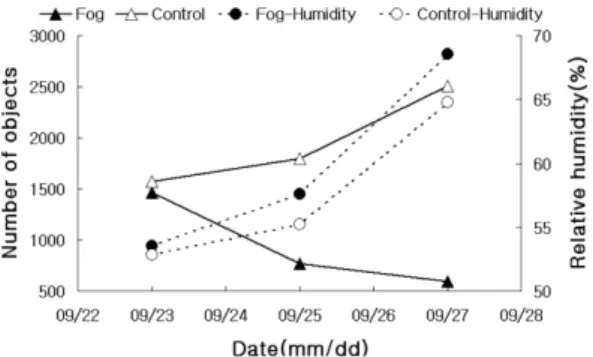
1차 실험에서는 습도를 제어하지 않고 이류체 포그 시스템을 처리하는 실험을 수행하였는데, 대조구와 처 리구간의 상대습도 차이는 5% 내외인 것으로 조사되 었다(Fig. 1). 실험기간동안 측창과 천창을 모두 열어 놓았기 때문에 이류체 포그시스템을 작동하여도 시설 내부의 습도가 크게 높아지지 않았다. 그러나 처리구의 가루이의 밀도는 처리 후에 크게 감소하였고, 대조구의 가루이 밀도는 계속 증가하였다. 이류체 포그시스템을 이용한 가루이 방제효과에 대한 실험은 몇 차례 수행 되었는데, 방제효과의 이유를 이류체 포그시스템에서 분사되는 미세수분입자가 가루이의 생육과 활동을 방
Fig. 1. Trends of the number of whiteflies and air humidity in the greenhouse where the air humidity was maintained at 55% in the greenhouse.
Fig. 2. Trends of the number of whiteflies and air humidity in the greenhouse where the air humidity was maintained at 70% in the greenhouse.
해하여, 가루이에게 기피환경을 제공하는 것으로 설명 하였다(Kim 등, 2011a, 2011b). 이는 비가 오거나 안 개가 낀 날에 곤충이 비상하지 않는 이유와 같다.
2차 실험에서는 시설 내 습도를 70%로 유지되도록 실험을 수행하였는데, 대조구와 처리구간의 상대습도는 처리 후에 약 20% 차이가 나는 것으로 조사되었다
(Fig. 2). 1차 실험과 같이, 처리구의 가루이의 밀도는
처리 후에 크게 감소하였고, 대조구의 가루이 밀도는 계속 증가하였다. 특히 2차 실험에서 1차 실험에서보 다 대조구와 처리구 사이에 더 큰 밀도차를 나타내었 다. 이를 통해 습도를 높게 관리하여 미세수분입자의 양이 많고 또한 오래 공중에 머물게 하는 것이 가루 이 방제에 더욱 효과적인 것으로 판단되었다.
Neem Oil을 처리한 3차 실험에서 처리구의 가루이 밀도는 급격하게 감소하였으며, 대조구와 처리구에서의 가루이 수의 차이는 1000마리 이상으로 조사되었다 (Fig. 3). 이는 Neem Oil의 살충효과와 포그시스템의 미세수분입자 때문으로 사료된다.
4차 실험에서 Oleic acid를 처리한 처리구의 가루이 밀도는 3차 실험에서의 Neem Oil의 효과와 유사한 수준으로 급격한 감소를 보였다(Fig. 4).
이류체 포그시스템을 이용하여 미세수분입자, Neem Oil, 그리고 Oleic acid를 분무하여 가루이에 대한 방 제가를 계산한 결과는 다음과 같다(Fig. 5). 미세수분 입자는 많을수록 가루이의 밀도를 감소시키는데 효과 적이며, 습도를 약 70%로 조절하면 방제가가 53%
정도인 것으로 조사되었다. 이류체 포그시스템을 이용 하여 Neem Oil과 Oleic acid를 처리한 결과, 각각 78%와 76.4%의 높은 방제가를 나타냈다.
우리나라에서는 방제가 어려운 해충의 경우, 화학 살충제의 방제가가 80%가 되어야 유의성을 인정하며, 신규약제 등록은 90% 이상이어야 하고 반드시 포장실 험을 마쳐야 한다(농촌진흥청 국립농업과학원, 2010).
본 실험에서 조사된 Neem Oil과 Oleic acid의 방제 가는 현재 우리나라에 등록되어 사용되고 있는 화학 살충제의 방제가에 근접한 값으로, 가루이 방제에 화학 살충제를 대신하여 두 가지 천연물을 사용하는 것이 매우 좋은 방법임을 보여준다. 이 경우 Neem Oil의 1/10 정도로 저렴한 Oleic acid를 이용하는 것이 경제 적으로 매우 유리한 것으로 사료된다. 또한 약제공급방 법으로 이류체 포그시스템을 이용하는 것은 기계배부 식 동력분무기나 연무기를 사용할 때 발생하는 악성 노동력, 환경, 생산비 인상의 문제를 획기적으로 해결 할 수 있는 방안이 될 것으로 사료된다. 단, 이들 천 연물의 처리시기, 회수 및 농도 등의 조건을 설정하고 농약과의 방제가를 비교하는 실험을 보완하여 농가에 적용해야 할 것이다.
Fig. 5. Control effects. RH 55% and RH 70% mean the air humidity in the greenhouse maintained at a relative humidity of 55% or 70%.
Fig. 4. Trends of the number of whiteflies and air humidity in the greenhouse with Oleic acid treatment.
Fig. 3. Trends of the number of whiteflies and air humidity in the greenhouse with Neem Oil treatment.
적 요
본 연구는 이류체 포그시스템과 천연물을 이용하여 효과적이고 친환경적인 가루이 예방 및 방제 방법을 구명하기 위해 수행되었다. 실험은 단동형 플라스틱하 우스에서 공시품종으로 비타미니를 사용하여 총 4회 수행되었다. 1차 실험에서는 별도의 습도조절 없이 이 류체 포그시스템을 작동하였다고, 2차 실험에서는 이류 체 포그시스템으로 습도를 70% 이상으로 제어하였다.
3차 실험에서는 이류체 포그시스템으로 1.5mg/L Neem Oil을 분무처리하였고, 4차 실험에서는 2mg/L 농도의 Oleic acid를 분무처리하였다. 1차 실험에서 분무처리구의 가루이의 밀도는 크게 감소하였다. 2차 실험에서는 1차 실험보다도 분무효과가 더 크게 조사 되었다. 이를 통해 습도를 높게 관리하여 미세수분입자 의 양이 많고 또한 오래 공중에 머물게 하는 것이 가 루이 방제에 더욱 효과적인 것으로 판단되었다. 3차 및 4차 실험에서 Neem Oil과 Oleic acid의 방제효과 는 78%와 76.4%로, 분무만 했을 때의 53%보다 큰 효과를 나타내었다. 따라서 가루이 방제에 화학 살충제 대신에 이류체 포그시스템을 이용하여 두 가지 천연물 을 사용하는 것이 매우 좋은 방법이며, 특히 저렴한
Oleic acid를 이용하는 것이 경제적인 것으로 사료된다.
또한 평소에 이류체 포그시스템으로 온도와 습도관리 를 하다가, 약제방제시 이류체 포그시스템을 이용하는 것이 악성 노동력 감소, 환경친화성, 생산성 증대 등에 기여하는 방안이 될 것으로 사료된다.
주요어 : 분무노즐, 해충방제, 온도강하, 습도상승
사 사
이 연구는 농림수산식품부 농림기술개발사업의 지원 에 의해 이루어진 것임.
이 연구는 농촌진흥청 연구비의 지원에 의해 이루어 진 것임.
인 용 문 헌
1. Abbott, W.S. 1925. A method of computing the effec- ticeness of an insecticide. J. Econ. Entomol. 18:265-267.
2. Ahirwar, R.M., M.P. Gupta, and S. Banerjee. 2010.
Field efficacy of natural and indigenous products on sucking pests of Sesame. Indian J. of Natural Products and Resources 1(2):221-226.
3. Ahn, K.S., K.Y. Lee, M.H. Choi, J.W. Kim, and G.H.
Kim. 2001. Effect of temperature and host plant on development and reproduction of the sweet potato whitefly, bemisia tabaci (Homoptera: Aleyrodidae).
Kor. J. Appl. Entomol. 40:203-209.
4. Ayasse, M., R. Paxton, M. Hilker, and T. Meiners.
2002. Brood protection in social insects; Chemoecol- ogy of insect eggs and egg deposition. Berlin: Black- well. pp. 117-148.
5. Choi, W.I., E.H. Lee, B.R. Choi, H.M. Park, and Y.J.
Ahn. 2003. Toxicity of plant essential oils to Trialeu- rodes vaporariorum (Homoptera: Aleyrodidae). J.
Econ. Entomol. 96:1479-1484.
6. Choi, Y.M and G.H. Kim. 2004. Insecticidal activity of spearmint oil against Trialeurodes vaporariorum and Bemisia tabaci adults. Kor. J. Appl. Entomol. 43:323-328.
7. Coloma, A.G., D.M. Benito, N. Mohamed, C.G.
Vallejo, and A.C. Soria. 2006. Antifeedant effects and chemical composition of essential oils from different populations of Lavandula luisieri L. Biochem. Syst.
Ecol. 34:609-616.
8. Coudriet, D.L., N.Prabhaker, D.E. Meyerdirk. 1985.
Sweet potato whitefly (Homoptera, Aleyrodidae) effects of neem-seed extract on oviposition and immature stages. Environ. Entomol. 14:776-779.
9. Dittrich, V.S. and G.H. Ernst. 1990. Chemical control and insecticide resistance of whiteflies. pp. 263-285.
Intercept Ltd., Andover, U.K.
10. Faria, M. and S.P. Wraight. 2001. Biological control of Bemisia tabaci with fungi. Crop Prot. 20:767-778.
11. Gupta, M. P., S.K. Chourasia, and H.S. Rai. 2000. Effi- cacy of neem plant products against the budfly (Dasy- neura lini Barnes) on linseed (Limum usitatissimum Linn). Indian J. Agric Sci. 70(11):762-770.
12. Hussain, D.M., P.Q. Rizzvi, and N.A. Nagvi. 2001.
Evaluation of neem for management of pest complex of mung been. In: Proceeding of symposium on Bio- control based pest management for quality crop pro- duction in the current millennium held at P.A.U., Ludhiana, July 18-19, pp. 202-203.
13. Immaraju, J.A., T.D. Paine, J.A. Bethke, K.L. Robb, and J.P. Newman. 1992. Western flower thrips (Thys- anopter: Thripidae) resistance to insecticides in caoastal California greenhouse. J. Econ. Entomol. 85:9-14.
14. Isman, M.B. 2000. Plant essential oils for pest and dis- ease management. Crop Prot. 19:603-608.
15. Katz, T.M., J.H. Moller, and A.A. Hebert. 2008. Insect repellents: Historical perspectives and new develop- ments. J. Am. Acad. Dermatol. 58:865-871.
16. Kim, J.K., J.J. Park, C.H. Pak, H.S. Park, and K.J.
Cho. 1999. Implementation of yellow sticky trap for
management of greenhouse whitefly in cherry tomato greenhouse. J. Kor. Soc. Hort. Sci. 40:549-553.
17. Kim, M.K., K.S. Kim, and H.J. Kwon. 2001. The cool- ing effect of fog cooling system as affected by air exchange rate in natural ventilation greenhouse. J. Bio- Env. Con. 10(1):10-14.
18. Kim, S.E., S.D. Lee, S.Y. Sim, Y.S. Kim. 2011. Con- trol of Bemisia tabaci by Two-Fluid Fogging Syste. J.
of Bio-Environ. Con. 20(4):394-398.
19. Kim, S.E., S.D. Lee, S.Y. Sim, Y.S. Kim. 2011. Envi- ronmentally friendly with Two-Fluid Fogging system controlling whitefly. Kor. J. of Hort. Sci. & Technol.
29(Supplement 2):73.
20. Korea Crop Protection Association (KCPA). 2007.
Agrochemical Use Guide Book (Annually). Korea Crop Protection Association, Seoul, Korea.
21. Krulwich, R. 2009. Hey I’m Dead! The Story of the Very Lively Ant. NPR. http://www.npr.org/templates/
story/story.php?storyId=102601823.
22. Kumar, P. and H.M. Poehling. 2007. Effects of aza- dirachtin, abamectin, and spinosad on sweet potato whitefly (Homoptera: Aleyrodidae) on tomato plants under laboratory and greenhouse conditions in the humid tropics. J. Econ. Entomol. 100:411-420.
23. Lee, H.W. and Y.S. Kim. 2011. Application of low pressure fogging system for commericial tomato green- house cooling. J. Bio-Env. Con. 20(1):1-7.
24. Lee, S.K. and W. Kim. 2010. Ergonomic and Perfor- mance Analyses of a Pull-type Prayer for Floriculture in Greenhouse. J. of Biosystems Eng. 35(6):426-433.
25. Liu, T.X. and P.A. Stansly. 1995. Deposition and bio- assay of insecticides applied by leaf dip and spray tower against Bemisia argentifolli nymphs (Homoptera, Aleyrodidae). Pesticide Sci. 44:317-322.
26. Mohamed, M.I.E. and S.A.M. Abdelgaleil. 2008. Chem- ical composition and insecticidal potential of essential oils from Egyptian plants against Sitophilus oryzae (L.) (Coleoptera: Curculionidae) and Tribolium casta- neum (Herbst) (Coleoptera: Tenebrionidae). Appl. Ento- mol. Zool. 43:599-607.
27. Nam, S.W., K.S. Kim, and G.A. Giacomelli. 2005.
Improvement of cooling efficiency in greenhouse fog system using the dehumidifier. J. Bio-Env. Con. 14(1):
29-37.
28. Nauen, R., N. Stumpf, and A. Elbert. 2002. Toxicolog- ical and mechanistic studies on neonicotinoid cross resistance in Q-type Bemisia tabaci. Pest Manag. Sci.
58:868-875.
29. Negahban, M., S. Moharramipour, and F. Sefidkon.
2007. Fumigant toxicity of essential oil from Artemi- sia sieberi Besser against three stored product insects.
J. Stored Prod. Res. 43:123-128.
30. Nerio, L.S., J.O. Verbel, and E.E. Stashenko. 2009.
Repellent activity of essential oils from seven aromatic
plants grown in Colombia against Sitophilus zeamais Motschulsky (Coleoptera). J. Stored Prod. Res. 45:
212-214.
31. Park, H.M., S.K. Lee, S.Y. Lee, J.B. Kim, H.J. Sung, and Y.B. Lim. 2002. Paddy Power opened the weapon’s effectiveness and safety assessment of insect pest con- trol. Kor. J. Pesticide Sci. 6(2):159-166.
32. Price, J.F. and D.J. Schuster. 1991. Effects of natural and synthetic insecticides on sweet potato whitefly Bemisia tabaci (Homoptera: Aleyrodidae) and its hymenopterous parasitoids. Florida Entomol. 74:60-68.
33. Purnamadjaja, A.H. and R.A. Russell. 2005. Pheromone communication in a robot swarm: necrophoric bee behaviour and its replication. Robotica 23(6):731-742.
34. Rimpi, D., B.C. Chutia, M. Sarmah, and A. Rahman.
2010. Effect of neem kernel aqueous extract (NKAE) on growth and development of red slug caterpillar, Eterusia magnifica butl in tea in North-East India, India. J. Biopesticides 3(2):489-494.
35. Samarasekera, R., I.S. Weerasinghe, and K.D.P.
Hemalal. 2008. Insecticidal activity of menthol deriva- tives against mosquitoes. Pest Manag. Sci. 64:290-295.
36. Sim, S.Y. 2010. Overcoming high temperature prob- lem by using low pressure fog nozzle in greenhouse.
Contemts 51(2):32-37.
37. Souza, A.P. and J.D. de Vendramim. 2000. Efeito de extratos aquosos de meliceas sobre Bemisia tabaci bitipo B em tomateiro. Bragantia, 59:173-179.
38. Souza, A.P. and J.D. de Vendramim. 2005. Efeito translaminar, sistmico e de contato de extrato aquoso de sementes de nim sobre Bemisia tabaci (Genn.) bitipo B em tomateiro. Neotropical Entomol. 34:83-87.
39. Stern, V.M., R.F. Smith, R. Van den Bosch, and K.S.
Hagen. 1959. The integrated control concept. Hilgar- dia 29:81-101.
40. Tandon, S., A.K. Mittal, and A.K. Pant. 2008. Insect growth regulatory activity of Vitex trigolia and Vitex agnus-castus essential oils against Spilosoma oblique.
Fitoterapia 79:283-286.
41. Untoro, J., W. Schultink, C.E. West, R. Gross, and J.G.
Hautvast. 2006. Efficacy of oral iodized peanut oil is greater than that of iodized poppy seed oil among Indonesian schoolchildren. The Amer. J. of Clin. Nutr.
84(5):1208-1214.
42. Villarreal, J.E., L. Lombardini, and L. Cisneros-Zeval- los. 2007. Phytochemical constituents and antioxidant capacity of different pecan Carya illinoinensis (Wan- genh) K. Koch cultivars. Food Chem. 102(4):1241- 1249.
43. Walker, M. 2009-09-09. Ancient ‘smell of death’ revealed.
BBC-Earth News. http://news.bbc.co.uk/earth/hi/earth_
news/newsid_8232000/8232607.stm.
44. 농촌진흥청, 국립농업과학원. 2010. 농약등록 시험 및 약초약해분야 세부지침: 살충제. pp. 396-397.