초록갈파래(Umbraulva japonica)에서 분리한 세균의 군집 구조 분석 및 항균 활성
김지현, 박소현, 문경미, 김동휘, 허문수*
제주대학교해양과학대학수산생명의학과
Received: April 3, 2018 / Revised: May 3, 2018 / Accepted: May 9, 2018
서 론
해조류는해양생태계의일차생산자로서물질순환의중 심이되며여러해양 생물에게서식지와산란장을제공한 다[1, 2]. 이러한 해조류에는 탄닌류(tannins), 카테킨류 (catechins), 페놀류(phenol) 등의기능성물질이함유되어있 어항균, 항산화, 항염증, 항암과같은생리활성능을나타내 며, 항비만, 항치매효과를비롯한혈중콜레스테롤저하, 수 면개선등의다양한기능이밝혀짐에따라식용뿐만아니 라화장품및기능성식품, 천연물신약개발의원료로주목
받고있다[3−5].
해양미생물은다양한해양환경에서서식하고있으며그 중해조류는해양미생물의주요서식지가된다. 해조류와 해조류표면의미생물은상호작용하여외부환경으로부터 서로를보호하며영양소의공급과성장, 발달및번식에긍 정적인효과를미치는것으로알려져있다[6−8].
해양미생물은고염분, 고압등과같은특이한해양환경에 노출되어있어육상미생물과는다른대사계혹은생체방 어계를가지고있으며, 해양미생물에의해생성된대사산 물은다양한생리활성을나타내고있다[9, 10]. 해양미생물 로부터분리되어주목받는생리활성물질로는 marinostatin, aplasmomycin, marinactam, istamycin, biopolymer, glycine betaine 등이있으며, 이러한물질은항균, 항암, 항바이러스 효과가있는것으로알려져있다. 이처럼해양미생물은다 Bacterial Community Analysis and Antibacterial Activity Isolated from Umbraulva japonica
Ji-Hyun Kim, So-Hyun Park, Kyung-Mi Moon, Dong-Hwi Kim, and Moon-Soo Heo*
Marine Applied Microbes and Aquatic Organism Disease Control Lab, Department of Marine Life Science, Jeju National University, Jeju 63243, Republic of Korea
In this study, 79 bacterial isolates were collected from the surface of marine algae Umbraulva japonica. As a result of analysis of 16s rRNA gene sequence, the 79 isolated bacteria were divided into 4 major groups:
[Proteobacteria (74.69%), Actinobacteria (2.53%), Fimicutes (2.53%), and Bacteroidetes (20.25%)] – 7 classes (Actinobacteria, Flavobacteria, Sphingobacteria, Baciili, Alphaproteobacteria, Betaproteobacteria, and Gammaproteobacteria), 12 orders, 17 families and 31 genera. The newly isolated 3 strains could be novel species because of less than 97% similarity in 16s rRNA sequence. Therefore, it is considered that additional experiments should be conducted together with the standard strain. Analysis of 79 bacterial antibacterial activity against human and fish pathogens, such as Edwardsiella tarda, Vibrio harveyi, Streptococcus iniae, Steptococcus parauberis, Escherichia coli, Steptococcus mutans, Listeria monocytogenes and Vibrio vulnifi- cus, was performed by using the supernatant liquid and pellet. As a result, pellet of UJT9, UJT20 and UJR17 showed antibacterial activity against V. vulnificus, UJR17 also showed antibacterial activity against S. parauberis. UJT7 and UJT20, UJR17 have been identified as Bacillus sp. and Pseudomonas sp.
and it may be safely assented that it’s beneficial to carry out additional experiments for various applica- tions.
Keywords: Antibacterial activity, bacterial community, marine algae, marine bacteria, Umbraulva japonica
*Corresponding author
Tel: +82-64-754-3473, Fax: +82-64-756-3493 E-mail: [email protected]
© 2018, The Korean Society for Microbiology and Biotechnology
양한생리활성을나타내며화장품, 식품, 제약등여러산업 분야에서의적용이확대될것이라기대된다[11−13].
초록갈파래는(Umbraulva japonica)는갈파래과(Ulvaceae) 에속하는녹조류로조하대의수심 10−20 m에서서식하며, 한국과일본, 중국등북태평양서안등지에분포한다. 초록 갈파래는식용해조류로분류되지만많이활용되지않고있 다. 최근초록갈파래가일본해양지역에서광범위한성장으 로엄청난생산량을보였지만, 활용이어려워악취와경관 훼손등의문제원인이되었다. 이를해결하기위해일본에 서는초록갈파래를이용하여불소또는중금속이온제거를 위한흡착겔로서의활용가능성에대하여연구를진행하였 고[14, 15] 국내에서는탈모방지예방및발모촉진대한연 구가이루어졌다[16]. 이러한노력에도불구하고전세계적 으로초록갈파래와초록갈파래에서식하는미생물에대한 연구가부족한실정이다. 따라서다양한분야에서해조류를 더욱효율적으로이용하기위해서는해조류와밀접한관계 를가지는해양미생물의연구또한중요하다고할수있다. 본연구에서는초록갈파래로부터세균을분리·배양하여세 균군집을파악하고, 어류질병및인체유해세균에대한항 균활성을확인함으로써분리된미생물의활용가능성을확 인하고자한다.
재료 및 방법
시료채집 및 세균의 분리∙배양
본연구에서사용된초록갈파래(Umbraulva japonica)는 제주도비양도바다에서채집하였으며, 멸균된지퍼백에담 아 4℃에보관·운반하였다. 채집한초록갈파래는멸균된인
공해수로세척한뒤잘게잘라멸균된 0.85% 생리식염수에
넣어균질화시켰다. 균질화된시료는연속단계희석법으로 10-1−10-5배로희석한후 Marine Agar (MA, Difco., USA)와 MA를 10배희석한 1/10 MA, R2A Agar (Difco., USA)에도 말한후 25℃에서배양하였다. 7일후각배지에서형태학 적특징에따라 colony를선별하여, 각각의배지에 2−3회계
대배양하여순수분리하였다. 순수분리된균주는 20% (v/v) glycerol에현탁한후−80℃에동결보관하여실험에사용하 였다.
DNA 분리 및 16s rRNA 염기서열 분석
분리한 균주의 DNA를 추출하기 위하여 2.5% Chelex (Chelex® 100 Molecular Biology Grade Resin, BIO-RAD, USA)를사용하였다. 균주를 2.5% Chelex에접종하고 95℃ boiling 방법으로 genomic DNA를추출한뒤 4℃에보관하 여실험에사용하였다. 16S rRNA 유전자를증폭하기위하 여 27 Forward (5'-AGAGTTGATCCTGGCTCAG-3') primer와 1522 Reverse (5'-AAGGAGGTGATCCAGCCGCA-3') primer 를사용하였다. AccuPowerTM PCR Premix (Bioneer, USA) 에 DNA 1 µl를첨가한후최종부피 25 µl로맞추어 PCR 을 수행하였다. PCR 조건은 95℃에서 초기 변성 단계 (Initial denaturation) 5분반응을시킨 후 94℃변성단계 (Denaturation) 1분, 55o에서 결합단계(Annealing) 1분, 72℃에서합성단계(Extention) 1분반응을 30 cycle 반복진 행하였고 75℃에서최종합성단계(Final extention) 10분으 로실시하였다. 증폭된 PCR 산물은 1% agarose에서전기영 동(Sub-Cell® Agarose Gel Electrophoresis System, Bio- rad)을하여밴드를확인하였다.
증폭이 확인된 16S rDNA 유전자는 솔젠트(Daejeon, Korea)에의뢰하여분석하였다. 분석한염기서열은 NCBI (National Center for Biotechnology Information) 및 EzBioCloud (https://www.ezbiocloud.net/)에서유사한염기 서열을비교하였고가장근연속이나종으로나타나는서열 을확인하였다. 본연구에서결정된염기서열과 NCBI 및 EzBioCloud에서확인된표준미생물염기서열은 Clustal X program [17]으로 multiple alignment를수행하였고, Mega 6.0 software [18]를 이용하여 neighbor-joining과 Jukes- Cantor model, Pairwise deletion 방법을사용하여계통수를 작성하였다. 계통수의신뢰성조사는 1,000회 replication을 적용한 bootstrap 분석으로진행하였다[19].
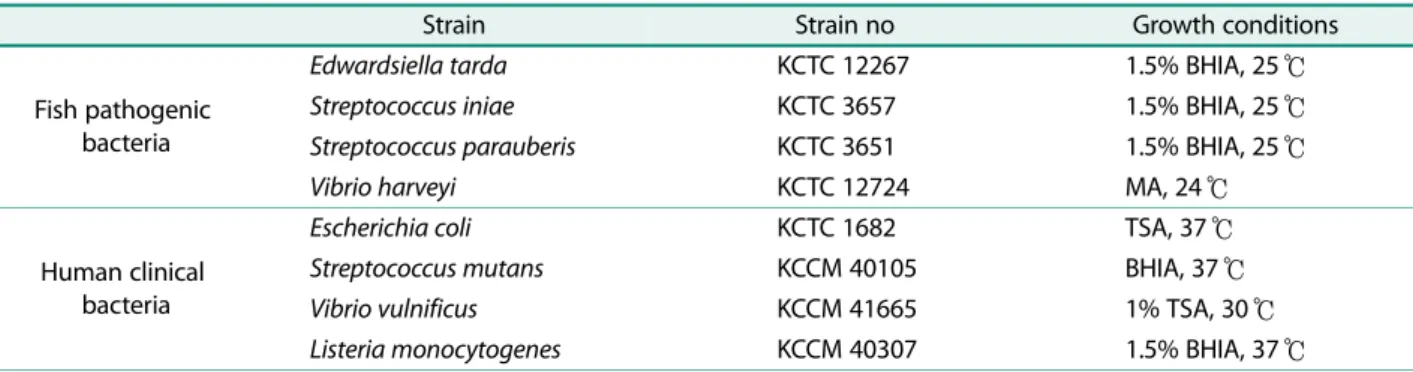
Table 1. List of the strains of fish pathogenic and Human clinical bacteria.
Strain Strain no Growth conditions
Fish pathogenic bacteria
Edwardsiella tarda KCTC 12267 1.5% BHIA, 25℃
Streptococcus iniae KCTC 3657 1.5% BHIA, 25℃
Streptococcus parauberis KCTC 3651 1.5% BHIA, 25℃
Vibrio harveyi KCTC 12724 MA, 24℃
Human clinical bacteria
Escherichia coli KCTC 1682 TSA, 37℃
Streptococcus mutans KCCM 40105 BHIA, 37℃
Vibrio vulnificus KCCM 41665 1% TSA, 30℃
Listeria monocytogenes KCCM 40307 1.5% BHIA, 37℃
항균 활성 균주의 선별
순수분리된균주를대상으로인체유해세균과어류질병세 균에대한항균활성실험을수행하였다. 항균활성효과는 paper disc method [20]를이용하였으며실험에사용된각 병원균들은 한국생물자원센터(Korea Collection for Type Culture, KCTC)와 한국미생물보존센터(Korea Culture Center of Microorganisms, KCCM)로부터 분양받았다 (Table 1).
분양받은병원균은각각의최적배지에서배양하였으며, 배 양된병원균은생리식염수로희석하여 McFarland No. 0.5 농도로제조하였다. 멸균된면봉을사용하여희석한병원균 을 Mueller Hinton Agar (MHA, Difco., USA)에도말하였 다. 순수 분리한세균은 Marine Broth (MB, Difco., USA), 1/10 Marine Broth와 R2A Broth (Difco., USA)에배양한 후배양액을 10분동안원심분리(14,240 ×g) 하여상층액과 균체를획득하였다. 상층액과균체를각각 8 mm paper disc 에 100 µl씩분주한뒤 25℃배양기에서건조하였다. 건조 된 paper disc를병원균이도말된 MHA 배지에올려놓고적 정온도에서 48시간배양한후 paper disc 주변에형성된생 육저해환을측정하였다.
결과 및 고찰
염기서열 분석 및 계통학적 분석
해조류에서분리한세균의 16S rRNA 유전자염기서열은 NCBI 및 EzBioClod를이용하여분석하고계통수를작성하 였다(Fig. 1).
초록갈파래(U. japonica)에서분리한 79개의균주는 31속 46종으로동정되었다. Proteobacteria 문(Phylum)은기존에 보고된 염기서열과 97.39−100%의 상동성을 나타내었다. Proteobacteria 문(Phylum)에속한 Acinetobacter 98.81%, Altererythrobacter 98.37−98.53%, Brevundimonas 99.04− 99.41%, Comamonas 97.50%, Enhydrobacter 98.81− 99.02%, Erythrobacter 97.39−98.95%, Loktanella 98.97%, Neisseria 100%, Novoshingobium 98.68%, Pantoea 99.27%, Paracoccus 99.04%, Pseudoaltermonas 99.71−99.72%, Pseudomonas 99.23−99.93%, Psychrobacter 99.30−99.93%, Ruegeria 98.23−99.04%, Shewanella 98.02−98.09%, Sphingobium 99.49−99.71%, Sphingorhabdus 98.84%, Sulfitobacter 98.82−99.33%, Vibrio 98.34−100%의상동성 을보여주었다.
Firmicutes 문(Phylum)에속한 Bacillus는기존의염기서 열과 98.48−99.10%의상동성을보여주었으며, Actinobacteria 문(Phylum)에속하는 Microbacterium와 Citricoccus은각각 98.57%, 98.31%의유사성을나타내었다. 그리고 Bacteroidetes
Fig. 1. Phylogenetic tree analysis of 16s rRNA gene sequences of bacteria isolated from Umbraulva japonica and some other related taxa. Numbers above branches indicate boostrap values of neighbor-joining analysis (>50%) from 1,000 replica- tion. Bar 0.05 nucleotide substitution per nucleotide position.
문(Phylum)은기존염기서열과 97.07−99.65%의상동성을 나타내었는데, Aquimarina 98.64−99.65%, Cellulophage 99.08%, Chryseobacterium 98.70%, Croceitalea 98.72%, Dokdonia 98.97−99.50%, Flavobacterium 98.21−98.65%, Nonlabens 97.01%, Algoriphagus 99.22%의유사성을보여 주었다. Proteobacteria 문(Phylum)에 속하는 UJM28은 Erythrobacter longus DSM6997T와 97.39%, UJR4는 Comamonas jiangduensis YW1T와 97.50%, Bacteroidetes 문에 속하는 UJT9는 Nolabense arenilitoris M-M3T와 97.09%의낮은상동성을나타내었다. 이와같이 16S rRNA 유전자염기서열분석결과를비교한결과 79균주중 3균주 가표준균주의유전자염기서열과 97% 이하의상동성을보
여신속또는신종으로보고될가능성이있다고여겨지며, 향후표준균주들과함께추가적인신종실험이수행되어야 할것으로사료된다.
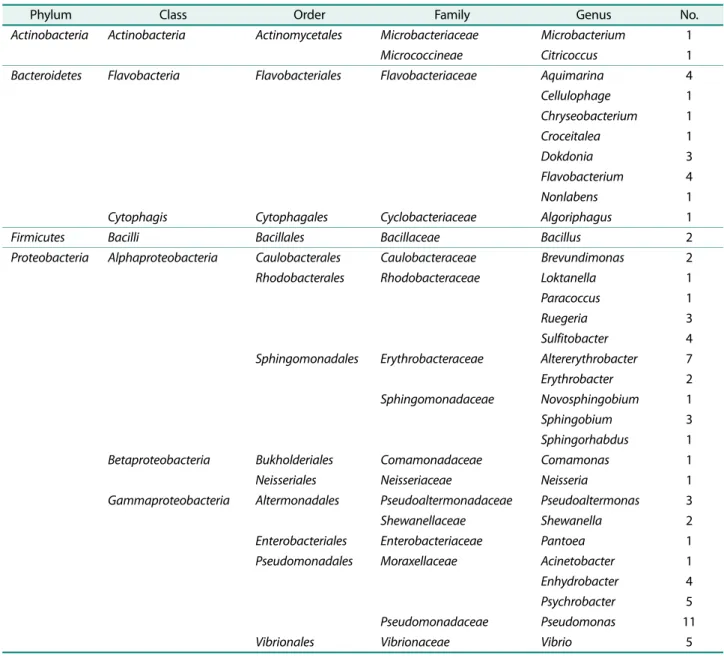
16S rRNA 유전자염기서열로부터세균군집다양성을분
석하였다. 그결과, 초록갈파래의세균군집구조는 Proteo- bacteria, Firmicutes, Actinobacteria, Bacteroidetes의 4개 의문(Phylum), 7개의강(Class), 12개의목(Order), 17개의 과(Family), 31개의속(Genus)으로구성되었다(Table 2). 그 중 Proteobacteria 문의 Alpha-proteobacteria 강은 3개의 목, 4개의과, 10개의속이, Gamma-proteobacteria 강에서 는 4개의목, 6개의과, 8개의속등다양한분류군이나타 났다.
Table 2. Bacterial diversity associated with Umbraulva japonica.
Phylum Class Order Family Genus No.
Actinobacteria Actinobacteria Actinomycetales Microbacteriaceae Microbacterium 1
Micrococcineae Citricoccus 1
Bacteroidetes Flavobacteria Flavobacteriales Flavobacteriaceae Aquimarina 4
Cellulophage 1
Chryseobacterium 1
Croceitalea 1
Dokdonia 3
Flavobacterium 4
Nonlabens 1
Cytophagis Cytophagales Cyclobacteriaceae Algoriphagus 1
Firmicutes Bacilli Bacillales Bacillaceae Bacillus 2
Proteobacteria Alphaproteobacteria Caulobacterales Caulobacteraceae Brevundimonas 2
Rhodobacterales Rhodobacteraceae Loktanella 1
Paracoccus 1
Ruegeria 3
Sulfitobacter 4
Sphingomonadales Erythrobacteraceae Altererythrobacter 7
Erythrobacter 2
Sphingomonadaceae Novosphingobium 1
Sphingobium 3
Sphingorhabdus 1
Betaproteobacteria Bukholderiales Comamonadaceae Comamonas 1
Neisseriales Neisseriaceae Neisseria 1
Gammaproteobacteria Altermonadales Pseudoaltermonadaceae Pseudoaltermonas 3
Shewanellaceae Shewanella 2
Enterobacteriales Enterobacteriaceae Pantoea 1
Pseudomonadales Moraxellaceae Acinetobacter 1
Enhydrobacter 4
Psychrobacter 5
Pseudomonadaceae Pseudomonas 11
Vibrionales Vibrionaceae Vibrio 5
분리된균주의속은 Pseudomonas 13.92%, Altererythrobacter 8.86%, Psychrobacter와 Vivrio 각각 6.33%, Aquimarine, Flavobacterium, Sulfitobacter, Enhydrobacter 5.06%, Dokdonia, Ruegeria, Sphingobium, Pseudoaltermonas 각 각 3.80%, Bacillus, Brevundimonas, Erythrobacter, Shewanella 2.53%, 그 외 Microbacterium, Citriccoccus, Cellulophage, Chryseobacterium, Croceitalea, Nolabense, Algoriphagus, Loktanella, Paracoccus, Novosphingobium, Comamonas, Neisseria, Pantoea, Acinetobacter 각각 1.27%로 나타났다.
Proteobacteria 분류군에서는 Gamma-proteobacteria 40.51%, Alpha-proteobacteria 31.65%, Beta-proteobacteria 2.53%
로나타났으며 Bacteroidetes 분류군은 20.25%로나타났다 (Fig. 2). 이는 해양생태계에서일반적으로 Proteobacteria (Alpha-proteobacteria, Gamma-proteobacteria) 문과
Bacteroidetes 문이우점으로서식한다는결과와일치한다
[21, 22]. 하지만수심 200 m 이내의해역에서는대체적으로 Alpha-proteobacteria (50%)가 Gamma-proteobacteria (30%) 보다높은비율로분포한다는 Zinger et al. [23]과달리, 수
심 10−20 m 서식하는초록갈파래에서분리한세균의군집
구조 분석 결과에서는 Gamma-proteobacteria (40.51%)가 Alpha-proteobacteria (31.65%)보다더높은비율을차지하 는것을확인할수있었다.
말레이시아에 서식하는 ulva sp.에서는 Protoobacteria (Gamma-proteobacteria)에속하는그룹이확인되었고, 호주
에서서식하는 ulva sp.에서는동일한종임에도불구하고,
한연구에서는 Proteobacteria (Alpha-proteobacteria, Gamma- proteobacteria), Bacteroidetes, Planctomycetes로 3개의 문 에속하는그룹이, 다른연구에서는 Proteobacteria (Alpha- proteobacteria, Gamma-proteobacteria), Actinibacteria
2개의문이확인되었다. 반면, 같은호주지역에서분리된홍 조류 Delisea pulchra에서는 Proteobacteria (Alpha- proteobacteria, Gamma-proteobacteria), Bacteroidetes, Firmicutes에속하는 3개의문으로, 동일한지역이지만더다 양한모습을보였다[24−26]. 본연구와동일한지역에서채집 한 구멍갈파래에서는 Proteobacteria (Alpha-proteobacteria, Beta-proteobacteria, Gamma-proteobacteria), Firmicutes, Actinobacteria, Bacteroidetes로 4개의문에속하는그룹으
로본연구와같은결과를보였다[27]. 같은종의해조류라
도서식하는지역에따라, 같은지역이라할지라도해조류에 따라세균의군집구조는다르거나동일한모습을보인다. 한연구에서는각각다른지역에서채취한 Ulva sp.에서분 리한세균의군집구조를분석하였다. 그중군집구조를이 루는대부분의세균이숙주종류와지리적으로무관하게일
관된형태를보였고, 30%에해당하는세균만이서로다르게
관찰되었다. 이는해조류에부착하여공생하는세균의일부 분만이숙주특이성및지리적영향과관련이있는것으로 보여진다[28]. 이러한결과들을미루어볼때, 해조류표면의 세균군집구조는세균이부착하여공생하는해조류나서식 하는주위의해양환경을비롯하여실험방법, 배양조건등 에따라달라질수있다는것을시사하며, 해조류에서식하 는공생세균의데이터베이스구축을위해다양하고많은해 조류의세균군집구조의비교·분석연구가필요하다고사료 된다.
항균 활성 탐색
초록갈파래로부터분리한세균을이용하여인체유해세균 과어류질병세균에대한항균활성결과, 인체유해세균중 V. vulnificus에서 UJT7, UJT20, UJR17이항균활성효과 를나타내었으며, 어류질병세균에서는 S. parauberis에대
해 UJR17이항균활성이있음을확인하였다. 나머지세균
에서는인체유해세균과어류질병세균에대한항균활성효 과가관찰되지않았다.
항균활성을나타내는 UJT7, UJT20, UJR17을배양하여
항균 활성을 측정한 결과는 다음과 같다(Table 3). V.
vulnificus에대해 UJT7, UJT20, UJR17의균체현탁액에서 만 항균 활성을 관찰하였다. UJT7은 20 mm, UJT20은 13 mm, UJR17은 18 mm의생육저해환을나타내어 UJT7 이세균주중항균활성이가장높은것을확인하였다. UJT7 과 UJT20이 S. parauberis에대해서는항균활성을나타내 지않은반면 UJR17의균체현탁액에서 18 mm의생육저해 환이관찰되었으며, UJR17이 V. vulnificus과 S. parauberis에 대하여활성이있는것으로확인되었다.
항균활성을나타내는세균주는항균펩타이드를생산하 는것으로사료된다. 자연계의생명체들은스스로를보호하 Fig. 2. Pie-diagram showing structure and the diversity of
bacterial community of Umbraulva japonica.
기위해항균펩타이드를분비하는것으로알려져있다. 그 중미생물이생산하는항균펩타이드를통칭하여박테리오 신이라하며기존의항생제내성문제를극복할수있는대 안으로여겨지고있다. 이러한박테리오신은세포막투과, 핵 산분해, 단백질합성저해등다양한메커니즘을통해항균 활성을나타내는것으로알려져있다. 항균활성을가지는 항균펩타이드는향후항바이러스제, 항암제, 생체기능을모 방한의료용소재개발의적용과생물학적보존제및천연 항생제로활용이가능하기때문에이에대한추가적인연구 가필요로하다고사료된다[29, 30].
UJT7은 1/10MA에서분리된세균으로 Bacillus aryabhattai B8E22T와 99.10%의상동성을나타내었다. Bacillus sp.에 속하는세균은곰팡이와세균에대하여광범위한억제화합 물을생산한다. 특히 B. subtilis는그람양성균의성장을저 지하는데효과적이라고알려져있다[31, 32]. 인체유해세 균뿐만아니라식물과어류에질병을일으키는세균에대하 여항균활성효과가보고되었으며[33−35], B. subtilis를비 롯한 B. licheniformis, B. polymyxa, B. laterosporus, B.
circulans는대하와어류의성장과면역에긍정적인영향을
미치는프로바이오틱스로 활용이 되고있다[36, 37]. 1/10 MA에서분리된 UJT20과 R2A에서분리된 UJR17은각각 Pseudomonas koreensis Ps9-14T 99.51%, Pseudomonas putida NBRC14164T 99.44%의 상동성을 나타내었다. Pseudomonas sp.에속하는세균또한질병을일으키는다 양한세균에대하여항균활성을가지는것으로보고되었
으며[38], 식물성장에도움을주고페놀을분해하는것으로
알려져있다[39, 40]. 따라서초록갈파래에서분리한 Bacillus sp.와 Pseudomonas sp. 또한다양한활용을위한추가적인 실험을수행한후유익하게이용될수있을것이라사료된다.
요 약
본연구에서는해조류인 Umbraulva japonica의표면에서 79개의세균을분리하였다. 16s rRNA 유전자분석결과, 주 요 계통군은 Proteobacteria (74.69%), Actinobacteria (2.53%), Fimicute (2.53%), Bacteroidetes (20.25%)로 4개 의문(Phylum)이관찰되었고, 7개의 강(Class), 13개의 목 (Order), 17개의과(Family), 31개의속(Genus)을확인하였
다. 계통학적분석결과 3개의균주가표준균주와 97% 이하 의유사성을보여신속또는신종으로보고될가능성이있 다고여겨지며, 향후표준균주들과함께추가적인신종실험 이수행되어야할것으로사료된다. 분리된 79 균주를이용 하여인체및어류병원균을대상으로항균활성을확인하 였다. UJT7, UJT20, UJR17의 균체 현탁액이 Vibrio vulnificus에대하여항균활성을나타냈으며 UJR17의균체 현탁액은 V. vulnificus와 Streptococcus parauberis에항균 활성능이있음을확인하였다. UJT7은 Bacillus sp., UJT20 과 UJR17은 Pseudomonas sp.로확인되었으며다양한활용 을위한추가적인실험을수행한후유익하게이용될수있 을것이라사료된다.
Acknowledgments
This research was supported by the 2018 scientific promotion pro- gram funded by Jeju National University.
Conflict of Interest
The authors have no financial conflicts of interest to declare.
References
1. Yoo JW, KIM HJ, Lee HJ, Lee CG, Kim CS, Hong JS, et al. 2007.
Interaction between invertebrate grazers and seaweed in the East coast of Korea. J. Korean Soc. Oceanogr. 12: 125-132.
2. Cho JK, Lim YS, Hong D, Kim JK. 2012. Modeling algae transport in costal areas with marine afforestation. J. Korean Soc. Mar. Envi- ron. Eng. 15: 1-8.
3. Son HJ, Um MY, Kim IH, Cho SM, Han DS, Lee CH. 2016. In vitro Screening for anti-dementia activities of seaweed extract. J.
Korean Soc. Food Sci. Nutr. 45: 966-972.
4. Lee MS, Lee YK. 2014. Effects of seaweed consumption on obe- sity and food intake. Korean Contents Association 14: 478-485.
5. Kim JH, Kim YH, Kim SK, Kim BW, Nam SW. 2011. Properties and industrial applications of seaweed polysaccharides-degrading enzymes from the marine microorganisms. J. Korean Microbial.
Biotechnol. 39: 189-199.
6. Campbell AH, Marzinelli EM, Gelber J, Steinberg PD. 2015. Spa- tial variability of microbial assemblages associated with a domi- nant habitat-forming seaweed. Front. Microbiol. 6: 230. doi:
Table 3. Antibacterial activity of UJT7, UJT20, UJR 17 against pathogenic bacteria.
Isolated strain Diameter of inhibition zone (mm)
Closet relative Similarity V. vulnificus S. parauberis
UJT7 Bacillus aryabhattai B8E22T 99.10% 20 -
UJT20 Pseudomonas koreensis Ps9-14T 99.51% 13 -
UJR17 Pseudomonas putida NBRC14164T 99.44% 18 18
10.3389.
7. Duan D, Xu L, Fei X, Xu H. 1993. Short Communication: Marine organisms attached to seaweed surfaces in Jiaozhou Bay, China.
World J. Microb. Biot. 11: 351-352.
8. Marshall K, Joint I, Callow ME, Callow JA. 2006. Effect of marine bacterial isolates on the growth and morphology of axenic plantlets of the green alga Ulva linza. Microbial Ecology 52: 30- 310.
9. Yun KJ, Yang G, Feng Z, Nenkep VN, et al. 2010. Screening on receptor tyrosin kinase inhibitory activity of marine algae- derived symbiotic microorganisms. Korean T. Pharmacogn. 41:
43-47.
10. Li Y, Li X, Son BW, Choi HD. 2003. Screening of antimicrobial activity from the marine-derived fungus. Korean J. Phamacogn.
34: 142-144.
11. Choi JD, Park UK. 1993. Identification of the marine microorgan- isms producing bioactives. Bull. Korean Fish. Soc. 26: 305-300.
12. Choi HJ, Jung MJ, Jeong YK. 2000. Isolation and identification of a marine bacterium producing an immunostimulant. J. Korean Soc. Food Sci. Nutr. 29:1145-1150.
13. Kim DH, Park SH, Kim JH, Lee HR, Heo MS. 2017. Screening of antimicrobial activity of marine-derived biomaterials against fish pathogens. J. Life. Sci. 45: 250-256.
14. Ghimire KN, Katsutoshi I, Keisuke O, Hayashida T. 2007. Adsorp- tive separation of metallic pollutants onto waste seaweeds, Por- phyra Yezoensis and Ulva Japonica. Separ. Sci. Technol. 42: 2003- 2018.
15. Paudyal H, Pangeni B, Inoue K, Kawakita H, Ohto K, Ghimire KN.
2013. Preparation of novel alginate based anion exchanger from Ulva japonica and its application for the removal of trace con- centrations of fluoride from water. Bioresource. Technol. 148:
221-227.
16. Jeju National University Industry-Academic Cooperation Foun- dation, JeJu Technopark. Composition comprising the extract of Ulva japonica for prevention of hair loss or promoting hair growth. Korea patent 10-2016-0073042.
17. Jeanmougin F, Thompson JD, Gouy M, Higgins DG, Gibson TJ.
1998. Multiple sequence alignment with Clustal X. Trends in Bio- chem. Sci. 23: 403-405.
18. Tamura K, Stecher G, Peterson D, Filipski A, Kumar S. 2013.
MEGA6: Molecular evolutionary genetics analysis version 6.0.
Mol. Biol. Evol. 30: 2725-2729.
19. Park SH, Kim JY, Kil YJ, Heo MS. 2014. Pylogenic diversity of bac- terial community inhabited in Callyspongia Elegans. J. Korean Microbiol. 50: 152-157.
20. Valgas C, Souza SM, Smania EFA. 2007. Screening methods to determine antibacterial activity of natural products. Braz. J.
Microbial. 38: 1678-4405.
21. Alfreider A, Pernthaler J, Amann R, Sattler B, Glockner F, Wille A, et al. 1996. Community analysis of the bacterial assemblages in the winter cover and pelagic layers of high mountain lake by in situ hybridization. Appl. Environ. Microbiol. 62: 2138-2144.
22. Eilers H, Pernthaler J, Glöckner FO, Amann R. 2000. Culturability
and in situ abundance of pelagic bacteria from the North Sea.
Appl. Environ. Microbiol. 66: 3044-3051.
23. Zinger L, Amaral-Zettler LA, Fuhrman JA, Horner-Devin MC, Huse SM, Welch DB, et al. 2011. Global patterns of bacteria beta- diversity in seafloor and ecosystems. PLoS One 6: e24570.
24. Vairappan CS, Suzuki M. 2000. Dynamics of total surface bacte- ria and bacterial species counts during desiccation in the Malay- sian sea lettuce, Ulva reticulata (Ulvales, Chlorophyta). Phycological Res. 48: 55-61.
25. Burke C, Thomas T, Lewis M, Steinberg P, Kjelleberg S. 2011.
Composition, uniqueness and variability of the epiphytic bacte- rial community of the green alga Ulva australis. ISME J. 5: 590- 600.
26. Pensyan A, Marshall-Jones Z, Holmstrom C, Kjelleberg S, Egan S.
2009. Antimicrobial activity observed among cultured epiphytic bacteria reflects their potential as source of new drugs. FEMS Microbial Ecol. 69: 11-124.
27. Choi HR, Park SH, Kim DH, Kim JY, Heo MS. 2016. Phylogenetic diversity and community analysis of marine bacteria associated with Ulva pertusa. J. Life Sci. 26: 819-825.
28. Roth-Schulze AJ, Pintado J, Zozaya-Valdes E, Cremades J, Ruiz P, Kjelleberg S, et al. 2018. Functional biogeography and host spec- ificity of bacterial communities associated with the Marine Green Alga Ulva spp. Mol. Ecol. Doi: 10.1111/mec.14529.
29. Cha YK, Kim YS, Choi YS. 2012. Antimicrobial peptide as natural antibiotic materials. Biotechnol. Bioprocess Eng. 27: 9-15.
30. Cleveland J, Montville TJ, Nes IF, Cjikindas ML. 2001. Bacteriocin:
safe, natural antimicrobials for food preservation. Int. J. Food Microbial. 71: 1-20.
31. Baruzzi F, Quintieri L, Morea M, Caputo L. 2011. Antimicrobial compounds produced by Bacillus spp. and applications in food, pp. 1102-1111. In Vilas AM (ed.), Science against Microbial Pathogens: Communicating Current Research and Technologi- cal Advances, Formatex: Badajoz, Spain.
32. Yilmaz M, Soran H, Beyatli Y. 2006. Antimicrobial activities of some Bacillus spp. strains isolated from the soil. Microbiol. Res.
161: 127-131.
33. Amin A, Khan MA, Ehsanullah M, Haroon U, Azam SMFAH. 2012.
Production of peptide antibiotics by Bacillus SP. GU 057 indige- nously isolated from saline soil. Braz. J. Microbiol. 43: 1340-1346.
34. Berić T, Kojić M, Stanković S, Topisirović LJ, Degrassi G, Myers M, et al. 2012. Antimicrobial activity of Bacillus sp. natural isolates and their potential use in the biocontrol of phytopathogenic bacteria. Food Technol. Biotechnol. 50: 25-31.
35. Chen Y, Li J, Xiao P, Zhu W, Mo Z. 2016. The ability of marine Bacillus spp. isolated from fish gastrointestinal tract and culture pond sediment to inhibit growth of aquatic pathogenic bacte- ria. Iran J. Fish. Sci. 15: 701-714.
36. Arığ N, Suzer C, Gökvardar A, Başaran F, Çoban D, Yıldırım S, et al.
2013. Effects of probiotic (Bacillus sp.) supplementation during larval development of gilthead sea bream (Sparus aurata, L.).
Turk. J. Fish. Aquat. Sci. 13: 407-414.
37. Zuenko VA, Laktionov KS, Pravdin IV, Kravstsova LZ, Ushakova
NA. 2017. Effect of Bacillus subtilis in feed probiotic on the diges- tion of fish cultured in cages. Iran J. Ichthyol. 57: 152-157.
38. Vachee A, Mossel DA, Leclerc H. 1997. Antimicrobial activity among Pseudomonas and related strains of mineral water origin.
J. Appl. Microbiol. 83: 652-658.
39. Degrassi G, Aguilar C, Bosco M, Zahariev S, Pongor S, Venturi V.
2002. Plant growth-promoting Pseudomonas putida WCS358 produces and secretes four cyclic dipeptides: cross-talk with quorum sensing bacterial sensors. Curr. Microbiol. 45: 250-254.
40. Kumar A, Kumar S, Kumar S. 2005. Biodegradation kinetics of phenol and catechol using Pseudomonas putida MTCC 1194. Bio- chem. Eng. J. 22: 151-159.