Introduction
The blenniid genus Istiblennius Whitley, 1943, being characterized by modally 14 pectoral fin rays and three segmented pelvic fin rays, bran- ched nasal tentacle, fleshy blade-like crest on dorsal midline of head in male, and supraorbital crest, comprises 14 species from the Indo-Pacific Ocean (Springer and Williams, 1994). From the Korean waters, only one species, I. enosimae (Jordan and Snyder, 1902) has been known from the coastal waters of Jeju Island to date (Kim and Kang, 1991; Kim et al., 2005).
While investigating the ichthyofauna of Jeju Island, Korea, we found six specimens belong to the genus Istiblennius from the eastern coastal waters of the island. They were identified as I.
dussumieri (Valenciennes in Cuvier and Valen- ciennes, 1836), which has been recently reported from Kochi Prefecture, Southern Japan as the northernmost record of the species in the Indo- West Pacific to date (Lee et al., 2000).
In the present study, we describe Istiblennius
dussumieri both as a new Korean record and as a new northernmost record of the species in the Indo-west Pacific. Counts and measurements fol- lowed those of Springer and Williams (1994).
Voucher specimens were deposited in the Marine and Environmental Research Institute, Cheju National University (MRIC), Korea.
Istiblennius dussumieri (Valenciennes in Cuvier and Valenciennes, 1836)
(New Korean name:
Geom-eun-jeom-be-do-ra-chi) (Fig. 1; Table 1)
Salarias dussumieri Valenciennes in Cuvier and Valenciennes, 1836: 310 (type locality: Mala- bar).
Istiblennius dussumieri: Springer, 1986: 748 (Indo-Pacific); Shen et al., 1986: 40 (Taiwan);
Springer and Williams, 1994: 131 (Indo-Paci- fic); Lee et al., 2000: 20 (Japan).
Material examined. MRIC 101, 35.2 mm in standard length (SL), 15 October, 2002, MRIC 104, 35.3 mm SL, MRIC 115, 33.8 mm SL, MRIC 116, 27.9 mm SL, 16 October, 2002, MRIC 107,
Korean J. Ichthyol. 19(2), 160~163, 2007New Korean Record of the Streaky Rockskipper, Istiblennius dussumieri (Perciformes: Blenniidae)
Byung-Jik Kim* and Jung-Hyun An
1Marine and Environmental Research Institute, Cheju National University, 3288 Hamdeok-ri, Jocheon-eup, Jeju-si, Jeju-do 690-968, Korea
1Institute of Biodiversity Research, 202 Hosu Building, 785-4 Hoseong-dong 1(il)-ga, Deokjin-gu, Jeonju-si, Jeollabuk-do 561-211, Korea
Based on six specimens collected from eastern coast of Jeju Island, Korea, Istiblen- nius dussumieri is described as a new Korean record representing the northernmost occurrence of the species in the Indo-Pacific Ocean. The species is characterized by having a dark spot between first and third dorsal spines, branched orbital cirrus, and lacking nape cirri. A new Korean name, “Geom-eun-jeom-be-do-ra-chi” is pro- posed for the species.
Key words : Istiblennius dussumieri, new Korean record, Blenniidae, Jeju Island
*Corresponding author: [email protected]
─
─ 160 ──
46.6 mm SL, MRIC 108, 35.9 mm SL, 17 October, 2002, Seongsan-ri, Seongsan-eup, Seogwipo-si, Jeju-do, Korea, collected by E.J. Kim, J.H. An, and B.J. Kim, hand net.
Description. Dorsal fin rays XIII, 19~22;
anal fin rays II, 21~23; pectoral fin rays 13~14;
segmented pelvic fin rays 3; branched caudal fin rays 5
++4. Proportions are presented as % SL:
head length 21.0~24.0 (mean 22.8); snout length 5.9~7.1 (6.3); eye diameter 6.9~7.5 (7.2); inte- rorbital width 2.1~3.0 (2.5); body depth 17.6~
19.3 (18.2); snout to origin of dorsal fin 22.3~
24.3 (23.4); snout to origin of pectoral fin 23.8~
25.4 (24.4); snout to origin of anal fin 46.1~48.5 (47.5); caudal peduncle length 9.2~11.3 (10.3);
caudal peduncle depth 7.5~8.8 (8.2); pectoral fin length 19.1~24.8 (20.7); caudal fin length 18.4~
19.4 (18.8).
Body slender and compressed. Head small, an- tero-dorsal contour steep. Eye moderate, interor- bital portion narrow. Mouth inferior, small, pos- terior tip of maxilla extending a vertical at poste- rior margin of eye; small comb-like teeth on both jaws; posterior dentary canines absent. Dorsal fin base long, a shallow notch between spinous and soft dorsal portions. Pectoral fin relatively large. Anal fin base long. Caudal fin round.
Body naked. Lateral line continuous canal an-
terodorsally with simple pore, posteriormost pore reaching to a vertical at eighth dorsal spine. Su- praorbital pores 3; infraorbital pores 8; dentary pores 5; preopercular pores 7; supratemporal pores 5~6; lateral temporal pores 5.
Nape cirri absent. Orbital cirrus variable; sim- ple to six branches. Nasal cirri short, simple or branched. Male with flesh, a blade-like crest on dorsal midline of head (Fig. 1A).
Color when fresh. Head and body dark gray with small greenish or violet blotches, and two vertical rows of reddish dots along side of body in female (restricted on caudal peduncle in male).
Spinous dorsal portion gray with three dark stripes in male and soft dorsal portion striped. A black spots between first and third spines in male. Anal fin pale dusky, darker distally with white margin. Pectoral and pelvic fins dusky.
Caudal fin with two or three dark crescentic markings.
Color after preservation. Head dark dusky, without distinct markings. Spinous dorsal fin with a dark spot between first and third spines in male, soft dorsal with several wavy, dusky stripes. Anal fin uniformly dusky, darker distally with white margin. Pectoral fin nearly trans- parent, except for its brownish base and dusky lower rays. Pelvic fin dusky without distinct
Istiblennius dussumieri from Korea 161
Fig. 1. Istiblennius dussumieri collected from eastern coastal waters of Jeju Island, Korea (A, male, MRIC 0107, 46.6 mm SL; B, female, MRIC 0108, 35.9 mm SL).
A
B
markings. Caudal fin darkish with two or three crescentic markings.
Ecological notes. Istiblennius dussumieri has been known as a shallow-dweller, often collected at depth less than 1 m in rocky areas (Springer and Williams, 1994). In the present study, we also collected all specimens from a tide pool at depth less than 0.3 m in rocky area.
Distribution. Known from the Indo-West Pa- cific Ocean: southern Africa east to Palau, north- west to Japan and Korea, and southeast to Fiji (Springer and Williams, 1994; Lee et al., 2000;
present study).
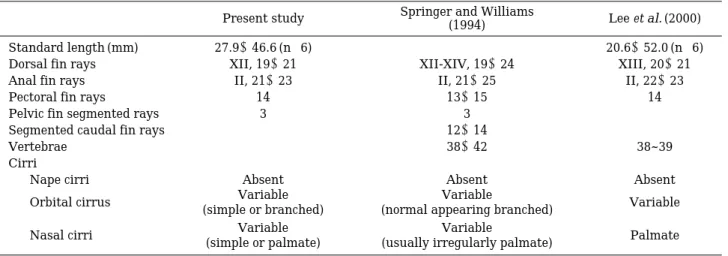
Remarks. The present specimens collected from the coastal waters of Jeju Island, Korea agree well with the description of the species given by Springer and Williams (1994), which is a comprehensive work of the genus Istiblennius distributed in the Indo-Pacific Ocean as well as the original description of I. dussumieri (Table 1). Thus, we identified the present Istiblennius species from Jeju Island as I. dussumieri repre- senting a new Korean record. Recently, the spe- cies has been reported from the coastal waters of Kochi Prefecture, Japan, representing the north- ernmost record of the species (Lee et al., 2000).
They also considered that the occurrence of the species from southern Japan might be resulted from the larval transport by the Kuroshio Cur- rent, judging from their occurrence season, fre- quency, and size. In the present study, because all specimens were collected in only autumn (October) and also were attained small size (less than 50 mm SL), the occurrence of I. dussumieri from the coastal waters of Jeju Island, Korea seems to be affected the larval transport by the
Tsushima Current divided from the Kuroshio Current. We also could not find out any remark- able differences between Korean specimens and Japanese specimens of I. dussumieri (Table 1). I.
dussumieri differs from its similar sympatric species in Jeju Island, I. enosimae in having branched supraorbital cirrus and lacking nape cirri. We proposed a new Korean name, “Geom- eun-jeom-be-do-ra-chi” for the species.
Acknowledgements
This work is partly supported by the grant (no.
2006-421) from the Ministry of Environment, Korea.
References
Cuvier, G. and A. Valenciennes. 1836. Histoire naturelle des poisons. Vol. 11, pp. i~xx++1~506.
Jordan, D.S. and J.O. Snyder. 1902. A review of the blen- noid fishes of Japan. Proc. U. S. Nat. Mus., 25 : 441~
504.
Kim, I.S. and E.J. Kang. 1991. Taxonomic revision of the suborders Blennioidei and Zoarcoidei (Pisces: Perci- formes) from Korea. Korean J. Zool., 34 : 500~525. (in Korean)
Kim, I.S., Y. Choi, C.L. Lee, Y.J. Lee, B.J. Kim and J.H.
Kim. 2005. Illustrated book of Korean fishes. Kyohak Publishing, Seoul, Korea, pp. 1~615. (in Korean) Lee, C.L., Y. Machida and S. Nagatomo. 2000. First record
of the blenniid fish Istiblennius dussumieri (Blenniidae, Perciformes) from Japan. Korean J. Ichthyol., 12 : 20~
24.
Shen, S.-C., T.-H. Yang and J.J. Lin. 1986. A review of the blenniid fishes in the waters, around Taiwan and its
162 B.J. Kim and J.H. An
Table 1. Comparison of meristic characters and cirri on head of Istiblennius dussumieri Present study Springer and Williams
Lee et al. (2000) (1994)
Standard length (mm) 27.9~46.6 (n==6) 20.6~52.0 (n==6)
Dorsal fin rays XII, 19~21 XII-XIV, 19~24 XIII, 20~21
Anal fin rays II, 21~23 II, 21~25 II, 22~23
Pectoral fin rays 14 13~15 14
Pelvic fin segmented rays 3 3 -
Segmented caudal fin rays - 12~14 -
Vertebrae - 38~42 38~39
Cirri
Nape cirri Absent Absent Absent
Orbital cirrus Variable Variable
Variable (simple or branched) (normal appearing branched)
Nasal cirri Variable Variable
Palmate (simple or palmate) (usually irregularly palmate)
adjacent Islands. Taiwan Mus. Spec. Publ. Ser., 5 : 1~
74.
Springer, V.G. 1986. Family No. 235: Blenniidae. In: Smith, M.M. and Heemstra P.C. (eds.), Smith’s Sea Fishes.
Macmillan South Africa, Johannesburg, pp. 742~755.
Springer, V.G. and J.T. Williams. 1994. The Indo-west
Pacific blenniid fish genus Istiblennius reappriaised: A revision of Istiblennius, Blenniella, and Paralticus, new genus. Smith. Contri. Zool., (565): 1~193.
Whitley, G.P. 1943. Ichthyological notes and illustrations.
(Part 2). Aust. Zool., 10 : 167~187.
Istiblennius dussumieri from Korea 163
제주도 동부연안에서 채집된 청베도라치과
(
농어목) 1
미기록종, Istiblennius dussumieri
김 병 직*∙안 정 현1
제주대학교 해양과환경연구소, 1생물다양성연구소
제주 동부 연안 암반역 조간대 웅덩이에서 청베도라치과에 속하는Istiblennius dussumieri 6개 체(표준체장 27.9~46.6 mm)를 채집하였다. 본 종은 한국미기록종으로 ‘검은점베도라치’라 명명 하였으며, 형태적 특징을 상세히 기재하였다. 제주도 동부 연안역은 인도-태평양해역에서 검은점 베도라치의 새로운 최북단기록이며, 쓰시마난류에 편승한 난∙자치어 수송에 의한 일시적인 출 현으로 사료된다.
Received : May 1, 2007 Accepted : June 5, 2007