—38—
INTRODUCTION
During a trawl survey conduced by the National Fish- eries Research & Development of Institute, Korea, three gobiid specimens belong to the genus Obliquogobius Koumans, 1941 were collected from the southern sea off Jeju Island, Korea. The deep-dwelling gobiid genus Obli- quogobius is characterized by having the following com- bination of characters: VI-I, 8~10 dorsal fin rays, I, 8~
10 anal fin rays; 20~24 pectoral fin rays; 22~26 longi- tudinal scales; reduced longitudinal pattern of sensory- papillae rows on cheek; and 26 vertebrae (see Shibukawa and Aonuma, 2007 for more information). According to Shibukawa and Aonuma (2007), only five valid species have currently been reported in this genus worldwide, i.e., O. cometes (Alcock, 1890) from the central Indian Ocean and Gulf of Aden, O. turkayi Goren, 1992 from the Red Sea, and three species from the East China Sea by Shibukawa and Aonuma (2007): O. cirrifer, O. mega- lops, and O. yamadai.
These three specimens collected off Jeju Island were finally identified as O. yamadai and described as the first record from Korea. Counts and measurements are those of Hubbs and Lagler (1964) and Shibukawa and Aonuma (2007). The interdigitation pattern of the dorsal fin ptery- giophores between the neural spines follows those of Akihito (1984). Notations of cephalic sensory canal pores and papillae follow those of Akihito (1984) and Miller (1986), respectively. Specimens examined are deposited
in the National Institute of Biological Resources (NIBR- P), Korea as vouchers.
Genus Obliquogobius Koumans, 1941 (New Korean name:
Gip-eun-ba-da-no-ran-ddi-mang-dug-sog) Obliquogobius Koumans, 1941: 219 (type species: Gobius
cometes Alcock, 1890 by original designation and mo- notypic).
Obliquogobius yamadai Shibukawa and Aonuma, 2007
(New Korean name:
Gip-eun-ba-da-no-ran-ddi-mang-dug) (Figs. 1, 2; Table 1)
Obliquogobius yamadai Shibukawa and Aonuma, 2007:
147 (type locality: East China Sea).
Materials examined. NIBR-P16520, 3 specimens, 30.3 mm in standard length (SL) (formerly registered as
# 3503 in Marine and Environmental Research Institute, Cheju National University, Korea), 35.2 mm SL (# 3502), 47.0 mm SL (#2892), southern sea off Jeju Island, Korea, N32�44.51′, E126�15.85′~N32�44.48′, E126�17.22′, 103 m depth, 27 April 2006, B.J. Kim and J.H. Choi, bottom trawl, R/V Tamgu 1-ho.
Description. Dorsal fin rays VI~VII-I, 9; anal fin rays I, 9; pectoral fin rays 23; pelvic fin rays I, 5; segmented caudal rays 3++2, including 6++6 branched rays; upper and lower unsegmented caudal fin rays 7~8 and 8, res- pectively; longitudinal scales ca. 25 (counted by scale pouches); gill rakers 2++10~12==12~14; vertebrae 26;
First Record of a Deep-dwelling Goby, Obliquogobius yamadai (Perciformes: Gobiidae) from Korea
By Byung-Jik Kim*
Wildlife Genetic Resources Center, National Institute of Biological Resources, Incheon 404-170, Korea
ABSTRACT A deep-dwelling goby, Obliquogobius yamadai, was described as the first record from Korea based on three specimens (30.3~~47.0 mm SL) collected from the southern sea off Jeju Island.
The species is characterized by having I, 9 second dorsal fin rays, scaled lateral side of nape, smaller head with large eye, and asymmetrical caudal fin dorsoventrally as well as about nine yellowish bars on body side. A new Korean name, “Gip-eun-ba-da-no-ran-ddi-mang-dug”, is proposed for the species.
Key words : Obliquogobius yamadai, first record, Korea, description
*Corresponding author: Byung-Jik Kim Tel: 82-32-590-7360, Fax: 82-32-590-7260, E-mail: [email protected]
KOREAN JOURNAL OF ICHTHYOLOGY, Vol. 25, No. 1, 38-41, March 2013 ISSN: 1225-8598
Received: July 31, 2012 Revised: October 23, 2012 Accepted: February 22, 2013
http://www.fishkorea.or.kr
P-V 3/II II I I 0/9. Proportional measurements in % of SL: head length 29.7~30.9 (mean 30.2); head width 16.8
~18.3 (17.5); head depth 19.6~20.8 (20.1); snout length 6.3~7.1 (6.7); eye diameter 9.7~10.4 (10.0); interorbi- tal width 0.6~1.1 (0.8); nape width 12.5~14.8 (13.4);
jaw length 12.2~12.5 (12.4); body depth 21.3~24.0 (22.3); body width 14.8~17.4 (15.8); predorsal length 36.4~36.6 (36.5); prepelvic length 31.3~32.7 (31.8);
caudal peduncle length 26.4~27.0 (26.8); caudal pedun- cle depth 10.2~11.1 (10.5); length of 1st dorsal fin base 12.2~14.5 (13.5); length of second dorsal fin base 17.5~
19.0 (18.4); length of anal fin base 15.8~16.2 (16.0);
length of 1st spine of first dorsal fin 11.2~14.8 (13.1);
length of 2nd spine of first dorsal fin 13.8~15.6 (14.7);
length of 3rd spine of first dorsal fin 14.5~16.5 (15.3);
*length of 4th spine of first dorsal fin 13.5~15.3 (14.3);
length of spine of second dorsal fin 10.2~11.9 (11.2);
*length of first segmented ray of second dorsal fin 16.2
~16.5 (16.3); *length of longest segmented ray of second dorsal fin 17.5~18.3 (17.9); length of spine of pelvic fin 5.5~9.2 (8.0); *length of first segmented ray of anal fin 10.9~11.9 (11.4); length of longest segmented ray of anal fin 15.8~23.6 (18.5); pectoral fin length 25.1~27.6 (26.7); pelvic fin length 19.6~24.1 (21.9); length of spine of pelvic fin 6.8~8.0 (7.2); length of 4th segmented ray of pelvic fin 17.4~19.9 (18.8); length of 5th segmented ray of pelvic fin 17.0~22.7 (20.2); caudal fin length 22.8
~29.5 (26.2). Pattern of cephalic sensory canal systems are as follows: oculoscapular canal with B′, C (single), D (single), E, F, G and H′; preopercular canal with M′, N, and O′ (Fig. 2). *, only two specimens were included in measurements due to damage of fin ray.
Body rather elongate and compressed. Head slightly compressed. Snout short, its length shorter than eye dia- meter. Eye large and dorsolateral. Interorbital region very narrow, its width narrower than pupil diameter. Anterior nasal pore a short tube and posterior one simple pore.
Gape oblique; lower jaw slightly projecting beyond upper jaw; posterior end of maxilla nearly reaching a vertical at center of pupil; teeth on both jaws small conical arrang- ed irregularly in three to five rows, outer teeth larger than inner ones. Anterior margin of tongue slightly emar- ginated, free from floor of mouth. Posterior margin of
Obliquogobius yamadai from Korea 39
Fig. 1. Obliquogobius yamadai, NIBR-P16520 (47.0 mm SL) collected from the southern sea off Jeju Island, Korea.
Fig. 2. Cephalic sensory canal pores and papillae of Obliquogobius yamadai, NIBR-P16520, 47.0 mm SL. AN and PN, anterior and pos- terior nostrils, respectively. Some papillae on opercle and nape omitted due to damage. Arrow shows point where gill membrane attached to isthmus. Scale bar==2 mm.
preopercle smooth without any spine-like projections.
Gill membranes attach to isthmus. All spines of dorsal and anal fins slender and flexible. Pectoral fin large with- out free rays. Pelvic fins fused medially with well-devel- oped connecting membrane and thin frenum; all segment- ed pelvic fin rays branched. Caudal fin somewhat asym- metrical dorsoventrally. Scales on body deciduous (all scales already missing in all specimens examined).
Color when fresh (based on the former registered as # 2892). Head and body light gray with about nine yellow- ish bars from posterior portion of head to caudal fin base:
anterior two of which on nape, next five on lateral body between dorsal fins, and last four on caudal peduncle.
Small yellowish spots on middle of upper jaw and cheek.
First dorsal fin with a blackish tinge. Pectoral fin trans- parent. Pelvic fin dusky. Caudal fin with two semicircu- lar dusky spots on basal region. Ventral midline of cau- dal peduncle with a thin blackish line.
Color after preservation. Similar to coloration of fresh specimen, except for all yellowish bars or spots faded.
Distribution. Known from East China Sea including Japan (Shibukawa and Aonuma, 2007) and southern sea off Jeju Island, Korea (present study).
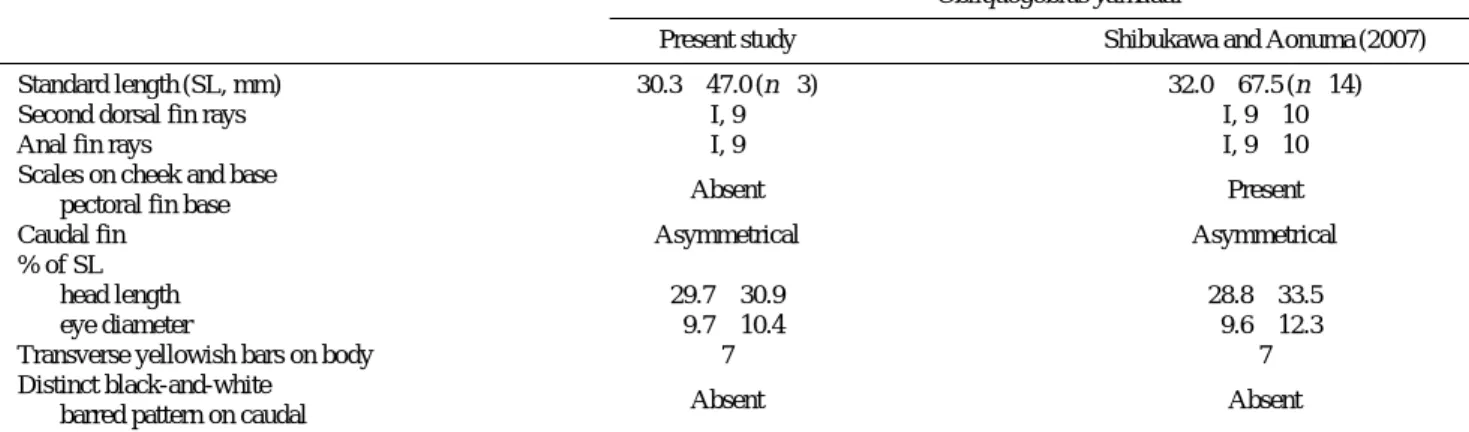
Remarks. According to Shibukawa and Aonuma (2007), Obliquogobius yamadai has cycloid scales on both cheek and pectoral fin base, however it couldn’t be confirmed that the presence of any scales on pectoral fin base as well as on cheek in all Obliquogobius specimens collected from the Korean waters. Some sensory papilla on head in the present specimens were unclear due to damage resulted from sampling method (i.e., bottom trawling), although the cephalic sensory canal system was well accordance with that of O. yamadai presented by Shibukawa and Aonuma (2007). Additionally, the basicaudal spot was indistinct in fresh specimens collect- ed from Korea, however it could be observed after pre- servation. It is not determined yet whether the differences between the Korean specimens and the original descrip- tion of O. yamadai come from infraspecific variation of
the species or bad condition of specimens due to damage.
On the other hand, other diagnostic characteristics were well agreed to the original description of O. yamadai Shi- bukawa and Aonuma (Table 1). As a result, the Korean Obliquogobius specimens were identified as O. yamadai in the present study. A new Korean name, “Gip-eun-ba- da-no-ran-ddi-mang-dug” is proposed for the species re- ferring to its having yellowish bars on body side as well as its habitat feature of deep-dwelling.
ACKNOWLEDGMENTS
I deeply express my thanks to the captain and crews of R/V Tamgu 1-ho and to coworkers on board (especially Dr. Jung Hwa Choi) during the Trawl Survey for their assistance in sampling.
REFERENCES
Akihito, Prince. 1984. Suborder Gobioidei. In: Masuda, H., K. Amaoka, C. Araga, T. Uyeno and T. Yoshino.
(eds.), The fishes of the Japanese Archipelago. Eng- lish text. Tokai University Press, Tokyo, pp. 236-238.
Alcock, A.W. 1890. Natural history notes from H.M. Indian marine survey steamer “Investigator”. No. 16. On the bathybial fishes collected in the bay of Bengal during the season of 1889-1890. Annals and Magazine of Natural History, including Zoology, Botany and Geo- logy, Sixth Series, 6: 197-222, pls. 8-9.
Goren, M. 1992. Obliquogobius turkayi, a new species of gobiid fish from the deep water of the central Red Sea.
Senckenbergiana Maritima, 22: 265-270.
Hubbs, C.L. and K.F. Lagler. 1964. Fishes of the Great Lakes region. University of Michigan Press, Ann Arbor, xv
+ +213pp.
Koumans, F.P. 1941. Gobioid fishes of India. Memoirs of 40 Byung-Jik Kim
Table 1. Comparison of diagnostic characters of Obliquogobius yamadai between the Korean specimens and type materials Obliquogobius yamadai
Present study Shibukawa and Aonuma (2007)
Standard length (SL, mm) 30.3~47.0 (n==3) 32.0~67.5 (n==14)
Second dorsal fin rays I, 9 I, 9~10
Anal fin rays I, 9 I, 9~10
Scales on cheek and base
pectoral fin base Absent Present
Caudal fin Asymmetrical Asymmetrical
% of SL
head length 29.7~30.9 28.8~33.5
eye diameter 9.7~10.4 9.6~12.3
Transverse yellowish bars on body 7 7
Distinct black-and-white
barred pattern on caudal Absent Absent
the Indian Museum, 13(pt 3): 205-329.
Miller, P.J. 1986. Gobiidae. In: Whitehead, P.J.P., M.-L.
Bauchot, J.-C. Hureau, J. Nielsen and E. Tortonese (eds.), Fishes of the North-eastern Atlantic and the Mediterranean. UNESCO, Paris, pp. 1019-1085.
Shibukawa, K. and Y. Aonuma. 2007. Three new species of
the deep-dwelling goby genus Obliquogobius (Perci- formes: Gobiidae: Gobiinae) from Japan, with com- ments on the limits of the genus. Bulletin of the Nati- onal Museum of Nature and Science (Ser. A), Suppl.
1: 137-152.
Obliquogobius yamadai from Korea 41
제주도 남부 외해에서 출현한 망둑어과(농어목) 한국미기록종, Obliquogobius yamadai
김병직
국립생물자원관 야생생물유전자원센터
요 약 :제주도 남부 외해에서 채집된 3개체의 표본(체장 30.3~47.0 mm)에 근거해 깊은 바다에 서식하는 망 둑어과 Obliquogobius yamadai를 한국미기록종으로 보고한다. 본 종은 체측에 황색 띠가 있는 점, 제2등지느러 미 기조수가 1극조 9연조인 점, 후두부 측면에 비늘이 있는 점, 머리가 작고 눈이 비교적 큰 점, 꼬리지느러미가 상하로 비대칭인 점 등의 특징이 있다. 본 종의 신한국명으로 “깊은바다노란띠망둑”을 제안한다.
찾아보기 낱말 :Obliquogobius yamadai, 한국미기록종, 기재, 깊은바다노란띠망둑