• 검색 결과가 없습니다.

A new record for Korean flora: Scutellaria tuberifera C. Y. Wu & C. Chen (Lamiaceae)

N/A
N/A
Protected

Academic year: 2021

Share "A new record for Korean flora: Scutellaria tuberifera C. Y. Wu & C. Chen (Lamiaceae)"

Copied!
4
0
0

로드 중.... (전체 텍스트 보기)

전체 글

(1)

249 Korean J. Pl. Taxon. (2011)

Vol. 41 No. 3, pp.249-252

A new record for Korean flora: Scutellaria tuberifera C. Y. Wu & C. Chen (Lamiaceae)

Chan-Soo Kim*, Soo-Young Kim

1

and Gwang-Ok Byun

Warm-Temperate Forest Research Center, Korea Forest Research Institute, Seogwipo, Jeju 697-050, Korea

1

Wildlife Genetic Resources Center, National Institute of Biological Resources, Incheon 404-708, Korea (Received 22 August 2011; Revised 09 September 2011; Accepted 18 September 2011)

ABSTRACT: Scutellaria tuberifera C. Y. Wu & C. Chen belonging to Lamiaceae, a species previously unre- corded for Korean flora, was collected streamside in the Andeok valley of Seogwipo-Si, on Jeju island. This spe- cies can be distinguished from others of Scutellaria from Korea by having rhizomes with leafless and branching stolons at the nodes, globose to ovoid tubers 5 −7 mm in diameter at the terminal parts, and stems densely spreading pilose. Photos of the habit and illustration are provided.

Keywords: Lamiaceae, Scutellaria tuberifera, unrecorded

Lamiaceae are mostly annual or perennial herbs but can be included as shrubs, rarely trees, or lianous, and herbage plants usually with aromatic oils. The stems and twigs are usually rectangular and the leaves which do not have a stipule, are simple or pinnate either opposite or whorled, and most of the inflorescence are composed of an axillary pair of dichasial or circinate cymes that form on the apparent whorl (verticil), but some are solitary (Lawrence, 1951). This family contains 236 genera and about 7,173 species, mostly cosmopolitan but absent from the coldest regions at high latitudes or altitudes. Of the 236 genera, 50%

of the known species are restricted to the ten largest genera (Harley et al., 2004).

The genus Scutellaria L. differs from related genera by having anterior stamens with one theca aborted, nutlet attachment-scar minute, with the upper lip of the calyx bearing a conspicuous projection called a scutellum (Harley et al., 2004). This genus contains about 360 species and is listed as the third-largest genus following Salvia L., which includes about 900 species and Clerodendrum L. which includes about 500 species (Paton, 1990; Harley et al., 2004).

The genus Scutellaria in Korea has been reported to 10 − 16 taxa (Kim and Lee, 1995; Lee, 1980; Suh, 2007). This paper reports, Scutellaria tuberifera C. Y. Wu & C. Chen which were known previously not to be distributed in Korea, collected from Jeju Island. Voucher specimens are preserved in the Warm-temperate Forest Research Center Herbarium (WFRC).

Species Description

Scutellaria tuberifera C. Y. Wu & C. Chen, Fl. Yunnan. 1:

566. 1977. Fig. 1 & 2.

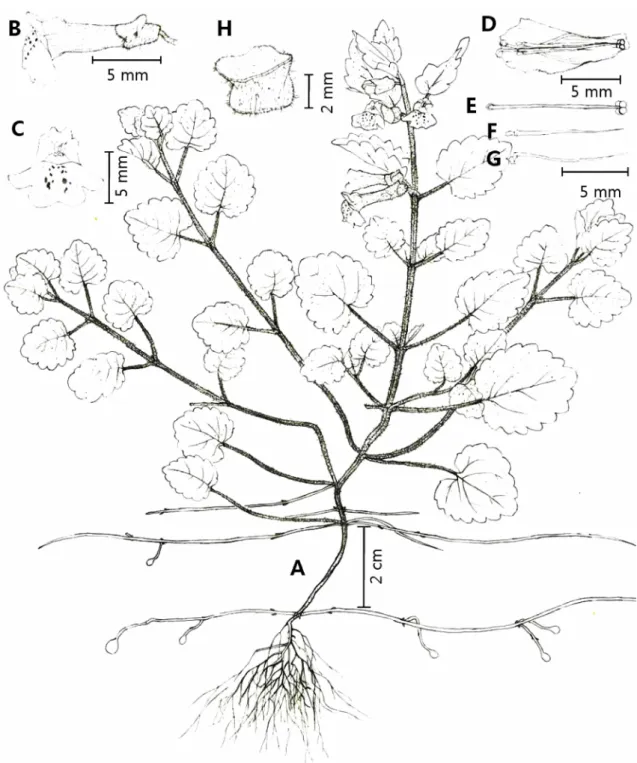
Herb, perennial, rhizomes with long leafless stolons at nodes, stolons long along side, branched at nodes, with tubers of 5−

7 mm in diam. at tip, stems erect to ascending, with many branches coming from the bottom, 10 −30 cm tall, densely spreading pilose. Leaves opposite, laminas circular-ovate to lanceolate-ovate, or reniform, sparsely appressed pilose, abaxially glaucous, palmately veined, base subtruncate to deep cordate, margin almost regularly 4 −7 pairs, crenate, apex obtuse to rounded, petiole of radical leaf 2−3.5 cm long, laminas 1.2−1.6 cm long, 1.2−2 cm wide, petiole of cauline leaf 0.6−2.7 cm long, laminas 1.4−2.5 cm long, 1.4−

2.8 cm wide, bracts 2−4 mm long, 2.4−3 mm wide. Flowers terminal or axillary, erect or horizontal, gradually becoming pendent. Pedicel 2−4 mm long, calyx ca. 3 mm, pilose outside, to 6 mm in fruit, scutellum ca. 0.7 mm long but up to 3 mm long at maturity. Corolla purple or purplish-blue, 10−13 mm long, sparsely pubescent outside, glabrous inside, tube straight, slightly saccate in front at base, gradually dilated to ca. 3 mm wide at throat. Upper lip erect, oblong, ca. 1.5 mm, rounded, rarely emarginate, and middle lobe of lower lip opens upward in the cleft of the trapezoid, apex emarginate. Lateral lobes oblong- ovate, slightly shorter than middle lobe. Calyx in fruiting drum- shaped, ca. 2 mm in diam. ca. 1.5 mm in thickness. Nutlets brown, ovoid-globose, ca. 1.2 mm in diam., globose tuberculate projections arranged on surface. Flowers March to April, fruits April.

*Author for correspondence: [email protected]

(2)

Korean J. Pl. Taxon, Vol. 41, No. 3

250 Chan-Soo Kim, Soo-Young Kim and Gwang-Ok Byun

Korean name: 제주골무꽃(Je-ju-gol-mu-kkot)

Distribution: Korea (Jeju island), China (Anhui, Yunnan, Jiangsu, Zhejiang) (Li and Hedge. 1994).

Specimens observed: Jeju Special Self-Governing Province, Seogwipo-si, Andeok-myeon, Hwasun-ri, 18 Apr. 2011, C.S. Kim 15662 (4 sheets), 15663 (1 sheet), 15665 (1 sheet); 22 Apr. 2011,

C.S. Kim 15670 (1 sheet); 02 May 2011, C.S. Kim 15692 (2 sheets, WFRC).

Key of the genus Scutellaria in Korea

1. Rhizomes enlarged up to 3 cm in diameter, fleshy ···

Fig. 1. Scutellaria tuberifera C. Y. Wu & C. Chen. A. Habit; B. Flower, side view; C. Flower, front view; D, Flower, longitudinal section; E.

Pistil; F. Stamen, staminode; G. Stamen, fertile; H. Calyx in fruiting.

(3)

Korean J. Pl. Taxon, Vol. 41, No. 3 A new record for Korean flora: Scutellaria tuberifera C. Y. Wu & C. Chen (Lamiaceae) 251

··· S. baicalensis 1. Rhizomes not enlarged, less than 0.7 cm in diameter, not

fleshy.

2. Stolons grown at nodes of rhizome terminated with globose to ovoid tubers 0.5−0.7 cm in diameter ···

··· S. tuberifera 2. Stolons grown at nodes of rhizome not terminated with

tubers.

3. Racemes terminal.

4. Leaf blade ovately lanceolate to narrowly triangular, hastate-based, with entire margin or sparsely blunt- toothed at base ··· S. hastifolia 4. Leaf blade ovate to elliptical, rounded, truncate to cuneate-based, with crenate, shallowly obtuse dentate to incised dentate margin.

5. Stem leaves heteromorphic, lower stem leaves crowded, ovate-lanceolate to ovate, upper stem leaves widely spaced, linear ··· S. orthocalyx 5. Stem leaves homomorphic, upper leaves gradually

reduced.

6. Leaves subsessile; petiole less than 0.3 cm long

··· S. insignis 6. Leaves distinctly petiolate; petiole 0.5−3 cm long.

7. Calyx throat straight; corolla purplish, ca. 1.3 cm long, glabrous outside ··· S. indica

7. Calyx throat oblique; corolla blue-purple, 1.7−

2.5 cm, glandular pubescent outside ···

··· S. pekinensis 3. Racemes axillary on upper part of stem.

8. Rhizomes moniliform, with enlarged internodes ···

··· S. moniliorrhiza 8. Rhizomes not moniliform.

9. Stems from base of plant 6 or 7 ···· S. asperiflora 9. Stems from base of plant 1−3.

10. Leaves linear-lanceolate ··· S. regeliana 10. Leaves ovate-triangular or elliptic.

11. Leaves ovate-triangular to triangular, margin irregularly and shallowly 1-3-dentate to subentire

··· S. dependens 11. Leaves usually elliptic, rarely ovate to oblong, margin shallowly obtuse dentate, sometimes serrate to subentire ··· S. strigillosa

This species is reported to be distributed along water streams

and shady slopes at 100−200 m above sea level in the Anhui,

Jiangsu, Yunnan and Zhejiang provinces of China,; it is still

known as endemic to China (Li and Hedge, 1994). This time

we have collected it in the Andeok Valley, located in Seogwipo-si,

from valley points where water flows at all times to valley slopes

where the existence of water is rare. Part of this place includes

Fig. 2. Photographs of Scutellaria tuberifera C. Y. Wu & C. Chen. A. Habit; B. Calyx, in fruiting; C. Tubers on stolons, grown in greenhouse.

(4)

Korean J. Pl. Taxon, Vol. 41, No. 3

252 Chan-Soo Kim, Soo-Young Kim and Gwang-Ok Byun

damaged natural vegetation due to river bed maintenance, though parts are not thus damaged. Therefore, this species could be a naturalized plant, but considering the geographic location and habitats along with the conservation status of the vegetation, it is more likely a native species. In addition, the species as a whole is small, because its stems are slender and weak, growing easily while lying,; it is likely that no collection yet exists. As, the investigation proceeds forward in a similar environment it is assumed that more will be found.

As this species distribution on Jeju Island comes to verify, the distribution of 8 taxon on Jeju Island as this genus are S. indica L. var. indica, S. indica L. var. alba S. Kim et S. Lee, S. indica L. var. coccinea S. Kim et S. Lee, S. orthocalyx Hand.-Mazz., S. pekinensis Maxim. var. transitra (Makino) Hara, S. pekinensis Maxim. var. ussuriensis (Regel) Hand.-Mazz, S. strigillosa Hemsl.

var. strigillosa and S. tuberifera C. Y. Wu & C. Chen (Kim and Lee, 1994; Yang, 2004; Kim et al., 2006). the Korean name

“ Jeju gol-mu-kkot ” was granted, as this was the first time it was collected on Jeju island.

Acknowledgement

The authors wish to thank eco-photographer Seong-Gwon Lee, Young-Sun Lee and Kyeong-Pal Lim for providing detailed information on the habitats. This research was supported by the Korea Ministry of Environment as part of the “ The Eco- Innovation project ”.

Literature Cited

Harley, R. M., S. Atkins, A. Budantsev, P. D. Cantino, B. Conn, R.

Grayer, M. M. Harley, R. de Kok, T. Krestovskaja, R. Morales, A. J. Paton, O. Ryding and T. Upson. 2004. Labiatae. In The Families and Genera of Vascular Plants, Vol. 7. Kadereit J. W.

(ed.), Springer-Verlag, Heidelberg. Pp. 167-275.

Kim, C. S., Y. J. Kang, M. O. Moon, G. P. Song, S. H. Jung, J, G. Oh and W. B. Kim. 2006. The Lists of Animals and Plants of Mt.

Halla. Jeju-Do Province & Hallasan Mountain Ecology and Culture Institute, Jeju (in Korean).

Kim S. and S. Lee. 1995. Fruit surface morphology of Scutellaria (Lamiaceae) in Korea and its taxonomic implication. Korrean J. Pl. Taxon. 25: 165-175 (in Korean).

Kim S. and S. Lee. 1995. Taxonomy of the genus Scutellaria (Lamiaceae) in Korea. Korean J. Pl. Taxon. 25: 71-102 (in Korean).

Kim, S. and S. Lee. 1994. Two new varieties of Scutellaria indica L.

from Korea. Korean J. Pl. Taxon. 24: 73-78 (in Korean).

Lawrence, G. H. M. 1951. Taxonomy of Vascular Plants. Macmillan Co., New York.

Lee, T. B. 2003. Colored Flora of Korea (I). Hyangmunsa, Seoul (in Korean).

Li, H. and I. C. Hedge. 1994. Lamiaceae. In Flora of China. Vol. 17 (Vervenaceae to Solanaceae). Wu, U.-Y. and P. H. Raven (eds), Science Press and Missouri Botanical Garden, Beijing and St.

Louis. Pp. 50-299.

Paton, A. J. 1990. A global taxonomic investigation of Scutellaria (Labiatae). Kew Bull. 45: 399-450.

Suh, Y. 2007. Scutellaria L. In The Genera of Vascular Plants of Korea.

Park, C. W. (ed.), Academy Publishing. Co., Seoul. Pp. 819-822.

Yang, Y. H. 2004. One unrecorded species from Korea: Scutellaria

orthocalyx Hand.-Mazz. Korean J. Plant Res. 17: 41-42 (in

Korean).

수치

Fig. 1. Scutellaria tuberifera C. Y. Wu & C. Chen. A. Habit; B. Flower, side view; C

참조

관련 문서

the material balance for a reaction component must be made for a differential element of volume dV.. For constant-volume reaction.. The integral can be evaluated in any

• For the continuous random variable Y the probability density function f ( y ) can be represented by an equation , which can be described graphically by a curve. •

A series of experiments was conducted from March 16 to July 12 in 2004 in Jeju Island to investigate the effects of sowing date, sowing rate, sand

For a statistical process of collected materials after testing the effectiveness of Korean Soldiers suicide prevention program, we practiced Frequency

In an effort to develop a new method to remove nitrogen, this study examined the effects of C/N ratio, carbon source and nitrogen concentration on

The number of migrating individuals of the Oriental Honey Buzzard by hour (A: Hong island, B: Eocheong island, C: Socheong island, D: Busan and Geoje island) ···92

§ To develop new mesh-type reference Korean phantoms (MRKPs) for adult male and female to address limitations of current voxel-type reference Korean adult phantoms...

A summer marine benthic algal flora and community of uninhabited islands in Haenamgun, southern coast of Korea. Seasonal Variations in the Macroalgal Flora and