• 검색 결과가 없습니다.

Convergence research on the possibility of development of oral care products using the anti-plaque activity of natural essential oils against Streptococcus mutans

N/A
N/A
Protected

Academic year: 2021

Share "Convergence research on the possibility of development of oral care products using the anti-plaque activity of natural essential oils against Streptococcus mutans"

Copied!
6
0
0

로드 중.... (전체 텍스트 보기)

전체 글

(1)

Convergence research on the possibility of development of oral care products using the anti-plaque activity of natural essential oils against

Streptococcus mutans

Minhyung Kim

1

, So-Young Lee

1

, Hee-Hong Min

2*

1

Daejeon Goejeong High School

2

Department of Dental Hygiene, Daejeon Health Institute Technology

천연에센셜오일의 Streptococcus mutans 에 의한 치석형성 억제 활성을 이용한 구강관리제품 개발

가능성에 대한 융합연구

김민형1, 이소영1, 민희홍2*

1대전괴정고등학교, 2대전보건대학교 치위생과

Abstract This article intended to examine the anti-plaque activity of 4 essential oils of Lavender, Tea tree, Eucalyptus, Lemongrass against Streptococcus mutans. In the results of measuring the anti-plaque effect against Streptococcus mutans, Minimum anti-adhesive concentration of Lavender oil was 1.0% and that of Tea tree, Eucalyptus, lemongrass essential oils was 0.5 %. Also, it was confirmed that the essential oils have the effect of inhibiting acid generation by Streptococcus mutans. It was confirmed that pH of the concentration was lowered by the acid generation under the MAC by measuring pH of the solution after incubating Streptococcus mutans and the essential oils in the thermostatic bath varying their concentration. From these results, the essential oils, particularly, Tea tree, Eucalyptus, Lemongrass essential oils are the natural material inhibiting the plaque generation and the potential that they can be used to develop the oral care products was confirmed

Key Words : Anti-plaque activity, Streptococcus mutans, Natural essential oils, Antibacterial activity, pH, MAC

요 약 본 논문은 Lavender, Tea tree, Eucalyptus, Lemongrass 4종의 천연에센셜오일의 Streptpccous mutans 에 의한 치석형성억제 효과에 대하여 연구해 보고자 하였다. Streptpccous mutans 에 의한 치석형성 억제 활성 측정결과인 Lavender 에센셜 오일의 MAC (Minium anti-adhesive concentration, 최소부착저지 농도)가 1.0 % 이고 Tea tree 에센셜 오일, Eucaliptus 에센셜 오일, lemongrass 에센셜 오일의 MAC는 0.5 % 로 나타났다. 에센셜오일의 농도를 달리하여 Streptpccous mutans와 혼합한 배양액을 항온조에서 배양한 후 용액의 pH를 측정하여 최소부착 저지농도 이하에서 산의 생성으로 pH가 낮아진 것을 확인할 수 있었고, 이 결과는 에센셜 오일이 Streptpccous mutans 에 의한 산의 생성을 억제하 는 효과가 있다는 것이다. 이러한 결과들로부터 천연에센셜오일 중 특히 Tea tree, Eucalyptus, Lemongrass는 치석생성을 억제하는 천연소재로 구강관리 제품개발에 활용할 수 있는 가능성을 확인할 수 있었다.

주제어 : 치석형성억제활성도, 스트렙토코쿠스 뮤탄스, 천연에센셜오일, 항균효과, 수소이온농도지수 (pH), 최소부착저지 농도,

*Corresponding Author : Hee-Hong Min ([email protected]) Received June 8, 2018

Accepted July 20, 2018

Revised July 12, 2018 Published July 28, 2018

(2)

1. Introduction

The dental caries occurs by the oral streptococcus called mutans streptococci and in the human oral cavity, it is classified into Streptococcus mutans (S.

mutans) 와 Streptococcus sobrinus [1]. Between them, S. mutans produces glucosyltransferase(GTase) and it

synthesize the glucan, which is insoluble and strong adhesion [2]. This insoluble glucan serves the adhesive that adheres S. mutans on the surface of the tooth and settles it sown. S mutans, which grows up and proliferates on the tooth surface, produces the bacterial colony by associating with the various bacteria in oral cavity. If this bacterial colony grows up and covers the tooth surface, it becomes visible plaque [3]. If pH is lowered if the organic acids such as lactic acid generated when S. mutans metabolizes the sugar are accumulated within the plaque, it causes the decalcification of enamel covering the tooth, which is the protective film of tooth resulting in the dental caries [4-6]. Recently, to prevent the dental caries, searching for natural anti-bacterial material having anti-bacterial effect, inhibiting effect of acid generation, etc. against

S. mutans is being made actively. [7-15]

That is, the enamel covering the tooth surface is damaged by the acid generated in the course of the bacteria being formed and regenerated in the plaque, resulting in dental caries. To prevent the occurrence of dental caries, oral preventive measures are to wipe away starch, sugar, and teeth to remove food residues in your mouth, wipe your teeth, and brush your teeth afterwards. Since removing the bacteria existed in the form of dental plaque in the mouth through brushing the tooth after meal or before sleep, removing the dental plaque in the adjacent surface of the teeth and receiving the scaling regularly are needed. preventing the plaque from adhering to the tooth by giving the tolerance against the acids by supplying the fluoride to the tooth through the fluoride toothpaste, gargling with fluoride solution and fluoride application to the tooth, etc. is good preventive measure, too [19-20]. In

addition. gargling with anti-bacterial ingredient against S. mutans will be a good preventive measure.

Therefore, in this study, to examine the anti-bacterial effect of essential oils against S. mutans, MAC having anti-plaque effect was measured and whether it has effect of inhibiting the acids were evaluated through the experiment.

2. Materials and Methods

2.1 Materials and instruments

4 kinds of essential oils such as Lavender essential oil (Huile & Co, France), tea tree essential oil (Huile &

Co, Australia), eucalyptus essential oil (Huile & Co, Australia), lemongrass essential oil (Perfect portion, Vietnam) were purchased and used. For the sucrose (manufacturer: CJ), tween 80, the product from Samjung Chemistry was used. For the strain used in this study, S. mutans ATCC 25175 from Korean Collections for Type Cultures at Korea Research Institute for Bioscience and Biotechnology was used and for the culture medium, BHI (Brain Heart Infusion, Difco Co., USA) broth was used by pre-incubating it at 37℃. For autoclave, product from SANYO was used and incubator (SANYO MLS-3020 AUTO CLAVE, Japan), clean bench (Green FLOW TECH, Korea), UV-visible spectrophotometer (Evolution

260 Bio UV-Vis spectrophotometer, Thermo Scientific, UK), micro auto pipet, pH meter, buffer solution of pH 4 and pH 7 and the 10 mL of glass tube with cap were used.

2.2 Method of anti-plaque activity test BHI broth containing 2% sucrose was prepared by taking 11.1g of BHI and 6 g of sucrose with distilled water in order to make total volume of 200 mL S.

mutans inoculum was used by incubating S. mutans in
the BHI broth for 14 ~ 16 hours to make 10

8

CFU/mL.

The blank solution (total 5 mL was prepared by mixing

4.5 mL of BHI broth, 0.2ml of S. mutans inoculum,

0.3mL of 5% Tween 80 solution) was prepared in the

(3)

glass tube with the sterilized medium, 5% Tween 80 solution and S. mutans inoculum. the sample solutions of essential oils (total 5 mL of solution were prepared by adding 4.5 mL of BHI broth, o.2mL of S. mutans inoculum, 0.3ml of 5% Tween 80 solution were taken to make 0.1 %, 0.5 %, 1.0 % and 5 % concentration of each essential oil) were prepared. The blank solution and the sample solutions of each concentration prepared were incubated in the incubator at 37℃ inclined about 30° for 48 hours. After incubation, the adhesion of strain in the glass tube wall was observed. The lowest concentration that the strain was not adhered to the wall was taken as the minimum anti-adhesive concentration (MAC) [9, 16-17].

2.3 pH Measurement

After incubating the blank solution prepared according to the method described in 2.2 in the incubator at 37℃ inclined about 30° for 48 hours, pH was measured using pH meter by transferring it in the beaker from test tube [11].

2.4 Measurement of plaque absorbance with UV-visible spectrophotometer

After incubating the blank solution prepared according to the method described in 2.2 in the incubator at 37℃ inclined about 30° for 48 hours, the cultured medium was transferred to beaker and the absorbance of the NaOH solution that the plaque formed on the glass tube wall was dissolved with 5mL of 5N NaOH solution was measured at 540 nm using UV-visible spectrophotometer.

3. Results

3.1 Results of anti-plaque activity test The results of measuring the anti-plaque effect at 5.0, 1.0, 0.5, 0.1% concentrations of Lavender, Tea tree, Eucalyptus and Lemongrass essential oil and the black solution (0.0%) were shown with pictures in Fig 1. (a),

(b), (C) and (d). It was observed that in the blank solution, 0.1% and 0.5% of Lavender essential oil, the white plaque was formed on the glass tube wall and in 1.0% and 5.0% concentrations, no adhesion was found on the glass tube. That is, it has anti-plaque effect in the concentration of 1.0% or above (Fig. 1. (a)). in the blank solution and 0.1% concentration of Tea tree, Eucalyptus and Lemongrass essential oil, the white plaque was found on the glass tube wall but in the concentration of . 0.5%, 1.0% and 5.0%, no adhesion was observed on the glass tube wall. That is, they have anti-plaque effect in the concentration of 1.0% or above (Fig. 1. (b)-(d)).

Fig. 1. (a) Picture of plaque formed by S. mutans and adhered to the glass tube wall in the Lavender essential oil concentrations of 5.0, 1.0, 0.5 and 0.1% and in the blank solution (0.0%)

Fig. 1. (b) Picture of plaque formed by S. mutans

and adhered to the glass tube wall in the

Tea tree essential oil concentrations of 5.0,

1.0, 0.5 and 0.1% and in the blank solution

(0.0%)

(4)

Fig. 1. (C) Picture of plaque formed by S. mutans and adhered to the glass tube wall in the Eucalyptus essential oil concentrations of 5.0, 1.0, 0.5 and 0.1% and in the blank solution (0.0%)

Fig. 1. (d) Picture of plaque formed by S. mutans and adhered to the glass tube wall in the Lemongrass essential oil concentrations of 5.0, 1.0, 0.5 and 0.1% and in the blank solution (0.0%)

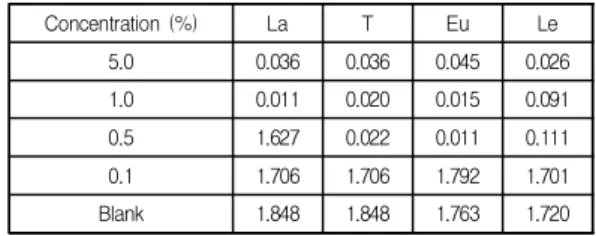
The results of observing the anti-plaque effect against S. mutans on the glass tube according to the concentration of Lavender, Tea tree, Eucalyptus and Lemongrass are shown in Table 1. In Table 2, the results of measuring the absorbance of the solution that the plaque adhered to the surface of the glass tube wall was dissolved in the 0.5n NaOH solution were shown.

Considering that in the concentration above the MAC (minimum anti-adhesive concentration), the lower absorbance of 0.050 or less was shown, it can be interpreted that it has anti-plaque effect. MAC of each essential oils was shown in Fig. 2 aggregating Table 1 and Table 2 showing the plaque formation observation results from Fig. 1 (a) to (d). Since Tea tree, Eucalyptus and Lemongrass were measured to have 0.5% of MAC and Lavender was measured to have

1.0% of MAC, it was observed that they have superior anti-plaque effect.

Table 1. Anti-plaque activities of essential oils against S. mutans.

Concentration (%) La T Eu Le

5.0 + + + +

1.0 + + + +

0.5 - + + +

0.1 - - - -

Blank - - - -

-: Plaque Formation +: Inhibition of Plaque Formation La: Lavender, T: Tea tree, Eu: Eucalyptus, Le: Lemongrass

Table 2. Absorbance of 0.5 N NaOH solution where the plaque formed on the glass tube wall was dissolved

Concentration (%) La T Eu Le

5.0 0.036 0.036 0.045 0.026

1.0 0.011 0.020 0.015 0.091

0.5 1.627 0.022 0.011 0.111

0.1 1.706 1.706 1.792 1.701

Blank 1.848 1.848 1.763 1.720

La: Lavender, T: Tea tree, Eu: Eucalyptus, Le: Lemongrass

Fig. 2. MAC of Lavender, Tea tree, Eucalyptus and Lemongrass essential oils against S. mutans

3.2 Results of acid inhibition effect

When S. mutans formed the plaque and it generates the acids like lactic acid using the sugar entered into the oral cavity inside of plaque, pH is lowered and the dental caries occurs as the enamel is decalcified.

Therefore, it is observed that pH of the broth in the

glass tube where the plaque was formed is lower than

(5)

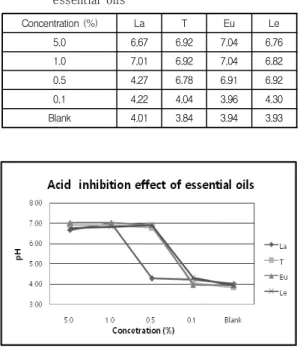
pH of the broth in the glass tube where the plaque was not formed in Table 3. This can be considered as the results by the anti-bacterial effect of essential oils against S. mutans as the acid inhibition effect of essential oils according to the concentrations above MAC was observed. [10, 16] In Fig. 6, the results of measuring pH of the broth after incubating S. mutans were shown by varying the concentration of 4 essential oils. Below the MAC the activity of S. mutans is not inhibited and the pH is lowered due to the formation of acid by this bacteria.

Table 3. Results of measuring pH after incubating S. mutans varying the concentration of essential oils

Concentration (%) La T Eu Le

5.0 6.67 6.92 7.04 6.76

1.0 7.01 6.92 7.04 6.82

0.5 4.27 6.78 6.91 6.92

0.1 4.22 4.04 3.96 4.30

Blank 4.01 3.84 3.94 3.93

Fig. 3. Picture of plaque formed by S. mutans and adhered to the glass tube wall in the Lemongrass essential oil concentrations of 5.0, 1.0, 0.5 and 0.1% and in the blank solution (0.0%)

4. Conclusions

Through the results of this study, it was observed that the anti-plaque effect and the acid inhibition effect were shown by the anti-bacterial effect of 4 essential oils.

1. MAC of Lavender essential oil against S. mutans was 1.0% and MAC of Tea tree, Eucalyptus and Lemongrass was 0.5 %.

2. The acid inhibition effect of these essential oils against S. mutans was also observed. Considering that pH of the cultured medium was low in the concentrations under MAC by the generation of acid and pH was high in the concentrations above MAC in the results of measuring pH of the cultured medium, it is observed that the vitality of strain was declined in the concentration above MAC.

3. From these results, the potential of essential oils having anti-bacterial effect against S. mutans to be used as material for oral gargle was confirmed.

The direction of follow-up research is to use the essential oils to develop the products that can maintain the oral health by measuring accurate MAC reducing the difference between the concentrations and by examining the anti-bacterial effect against other oral bacteria.

REFERENCES

[1] Hamada S., Ooshima T., Torii M., Imanishi, H., Masuda N., Misuno J., Sobue S., and Kotai S. (1978). Dental caries induction in experimental animals by clinical strains of Streptococcus mutans isolated from Japanese children, Microbiol. Immunol., 22, 301-314.

[2] Hamada S., Ooshima T., Masuda N., Misuno J. and Sobue S. (1976). Inhibition of rat dental caries by dextranase from a strain of Spicaria violacea. Jpn. J.

Microbiol., 20, 321-330.

[3] Koga T. and Hamada S. (1982). Adhesion of oral bacteria and plaque, dental caries. progress of research.

Nihon Shika Hyoron Publishers, Tokyo, Japan.

[4] Gibbons R. J. and Van Houte J. (1973). The formation of dental plaques. J. Periodontol. 44(6), 347-360.

[5] McGhee J. R. and Michalek S. M. (1981). Immunology of dental caries: microbial aspects and local immunity. Ann.

Rev. Microbial., 135, 595-638.

[6] Hamada S., Slade H. D. (1980). Biology, immunology,

(6)

and cariogenicity of Streptococcus mutans. Microbial Rev. 35, 331-384.

[7] Prabu G. R, Gnanamani A. and Sadulla S. (2006).

Guaijaverin a plant flavonoid as potential antiplaque agent against Streptococcus mutans. J Appl Microbiol, 101, 487-195.

[8] E. S. Lee, S. M. Kang, E. U. Kim, H. K. Kwon, B. I.

Kim (2011). Inhibitory effects of several commercial oral rinses on Streptococcus mutans biofilm formation. J.

Korean Acad. Oral. Health. 35(3), 289-296.

[9] W. J. Park, H. J. Lee and S. G. Yang (1990). The inhibitory Effect of Sanggenon C from the Root-bark of Morus alba L. on the Growth and the Cellular Adherence of Streptococcus mutans. Yakhak Hoeji, 34(6), 434–438.

[10] J. Y. Paek, Y. H. Kim, H. J. Kwon, E. N. Kim, W. J. Kim, and M. D. Han (2008). Effects of Antibacteria and Adhesive Inhibition of Scutellaria baicalensis Extract on Streptococcus mutans. J. Dent. Hyg. Sci. 8(4), 367-373.

[11] Y. R. Choi, S. S. Bae, and M. K. Kang (2016).

Antibacterial Effect of Tea Tree Ingredient for Denture Cleaners. J. Dent. Hyg. Sci. 16(6), 409-414.

[12] Cohen S. H., Morita M. M., Bradford M. (1991). A-seven year experience with methicillin- resistant Streptococcus aureus. Am. J. Med., 91, 233S-237S.

[13] Otake S., Makimura M., Kuroki T., Nishibara Y., Hirasawa M. (1991). Anticaries effects of polyphenolic compounds from Japanese green tea. Caries Res., 25, 438-443.

[14] S. S. Kim, J. H. Won, G. E. Lee, R. R. Lee, S. M. Lee, J. H. Lee, K. H. kang. (2017). Anti-bacteria effect of green tea, mulberry and mate leaves extracts on S.

mutnas. Journal of Digital Convergence, 15(1), 347-353.

[15] S. Y. Lee. (2016). Convergence study on anti-caries effect of chlorhexidine and essential oils. Journal of Digital Convergence, 14(10), 25, 367-373.

[16] Hamada S. and Slade, H. D. (1976). Adherence of serotype e Streptococcus mutans and the inhibitory effect of Lancefield group E and S. mutans type e antiserum. J. Dent. Res. 55, 65-74.

[17] Mukase, H. and Slade, H. D. (1974). Machanism of adherence Streptococcus mutans to smooth surfaces. II Nature of the binding site and the adsorption of dextran-levan synthetase enzymes on the cell-wall surface of the streptococcus. Inject. Immum., 9, 419-429.

[18] S. Y. Yoon, S. H. Kim, H. L. Chung, J. J. Lee, C. S. Huh and Y. J. Baek (2000). Anticariogenic Effects of Unripe Apple Extract. KOREAN J. FOOD SCI. TECHNOL.

32(1), 168-173.

[19] M. G. Ji. (2017). Relationships among Self-Efficacy and Self-Resilience, Oral Health Promotion Lifestyle in Some High School Students. Journal of Convergence for Information Technology, 7(6), 347-353.

[20] Y. J. Doe, M. G. Ji, M. H. Yun. (2018). Association between cognition of periodontal disease periodontal patients`, life-stress and oral health related quality of life Journal of Convergence for Information Technology, 8(3), 53-62.

김 민 형(Kim, Minhyung) [정회원]

▪2016년 3월 ~ 현재 : 대전괴정고 등학교 (재학생)

▪관심분야 : 통계, 미분, 화학, 생물

▪E-Mail : [email protected]

이 소 영(Lee, So Young) [정회원]

▪2017년 3월 : 대전괴정고등학교 (교사)

▪2018년 3월 ~ 현재 : 대전어은중 학교 (교사)

▪관심분야 : 생물, 생명과학

▪E-Mail : [email protected]

민 희 홍(Min, Hee Hong) [정회원]

▪2002년 2월 : 단국대학교 치의학 과(치의학 석사)

▪2005년 2월 : 단국대학교 치의학 과(치의학 박사)

▪1996년 9월 ~ 현재 : 대전보건대 학교 치위생과 교수

▪관심분야 : 통계, 예방, 치과임상

▪E-Mail : [email protected]

수치

Table  1.  Anti-plaque  activities  of  essential  oils  against  S.  mutans. Concentration (%) La T Eu Le 5.0 + + + + 1.0 + + + + 0.5 - + + + 0.1 - - -  -Blank - - -
Table  3.  Results  of  measuring  pH  after  incubating  S.  mutans varying  the  concentration  of  essential  oils Concentration (%) La T Eu Le 5.0 6.67 6.92 7.04 6.76 1.0 7.01 6.92 7.04 6.82 0.5 4.27 6.78 6.91 6.92 0.1 4.22 4.04 3.96 4.30 Blank 4.01 3.

참조

관련 문서

이에 전남지역 중학생들 대상의 설문조사를 통해서 체벌의 실태와 중학교 교사와 학생들의 체벌에 관한 인식 및 체벌의 교육적 효과 등을 파악하여 체벌이 진정

It considers the energy use of the different components that are involved in the distribution and viewing of video content: data centres and content delivery networks

After first field tests, we expect electric passenger drones or eVTOL aircraft (short for electric vertical take-off and landing) to start providing commercial mobility

1 John Owen, Justification by Faith Alone, in The Works of John Owen, ed. John Bolt, trans. Scott Clark, "Do This and Live: Christ's Active Obedience as the

The proliferations of MC3T3-E1 cell seeded on pristine PCL scaffold and surface modified scaffolds for 1, 3, and 5 days... ALP activity of the MC3T3-E1 cell seeded

캐나다정부간행물목록(Weekly checklist of Canadian government publications) 에 수록된 자료 중 Folder자료, 인구센서스, 전화번호 자료 등을 제외한

2. The finite element is calculating using tension test of uni-direction 0° and 90°, compression test of uni-direction 0° and 90° and shear test results and, the results

for a future of work that does not yet exist, careers that have not yet been invented, an economy that prizes things not yet created, and that puts STEAM into the