Introduction
Venous thromboembolism (VTE) is a common, life- threatening disease that can frequently recur and cause long term complications. VTE comprises deep venous thrombosis (DVT) and/or pulmonary embolism (PE). The clinical pre- sentation of about two-thirds of VTE cases is DVT, and the remaining one third present with PE
1.
VTE is an important safety issue in patients who are on an- ticoagulation therapy. Early and long-term management is es- sential in order to prevent complications including recurrence of VTE, chronic thromboembolic pulmonary hypertension (CTEPH), and post thrombotic syndrome (PTS). The inci- dence of VTE in Asia is than in Western countries, but a recent
Incidence and Risk Factors of Recurrent
Venous Thromboembolism after Pulmonary Embolism
Hun-Gyu Hwang, M.D.
1,* , Won-Il Choi, M.D.
2,* , Bora Lee, M.S.
3and Choong Won Lee, M.D.
41
Respiratory Division, Department of Internal Medicine, Soonchunhyang University Gumi Hospital, Gumi,
2Department of Medicine, Keimyung University Dongsan Hospital, Daegu,
3Department of Biostatistic Consulting, Soonchunhyang University Bucheon Hospital, Bucheon,
4Department of Occupational and Environmental Medicine, Sungso Hospital, Andong, Korea
Background: Information about the epidemiology of venous thromboembolism (VTE) recurrence in Korea is lacking.
The purpose of this study was to investigate VTE cumulative recurrence rates and identify risk factors for VTE recurrence among Korean adults.
Methods: A retrospective cohort study was conducted on adult patients (≥18 years) admitted to a university teaching hospital for pulmonary embolism (PE) from 2005 to 2013. The main outcome of interest was a recurrence of VTE. We used Cox proportional hazard regression analyses to calculate the relative risk of VTE recurrence.
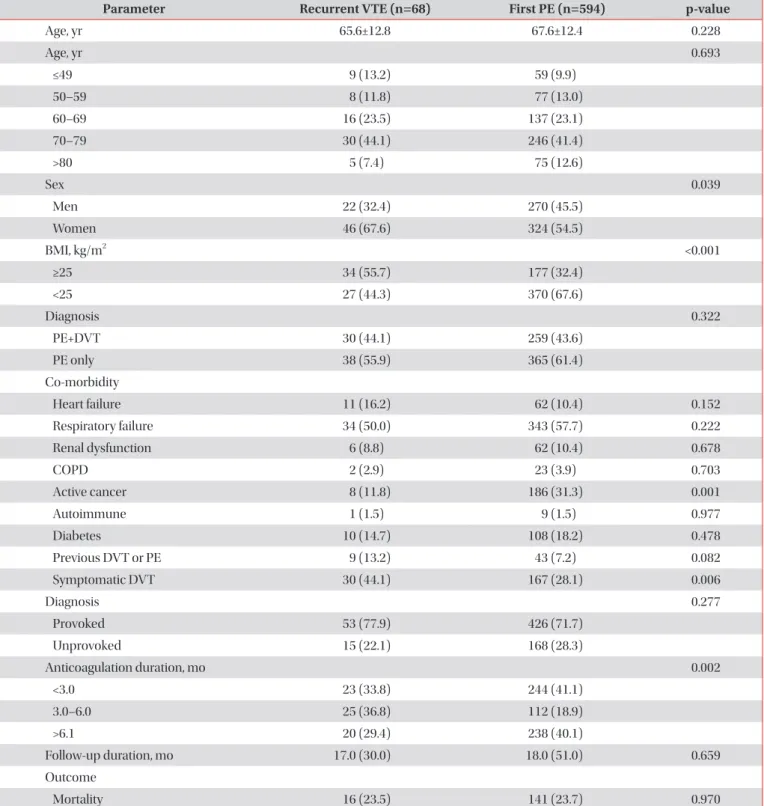
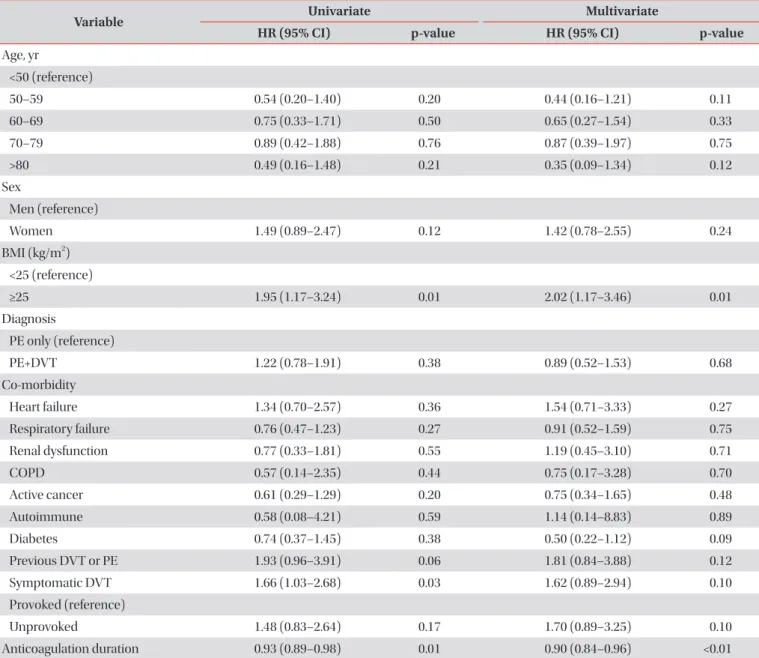
Results: Five-year cumulative incidence of recurrent VTE events was 21.5% (95% confidence interval [CI], 17.7–25.4) in all cases of PE; 17% after provoked and 27% after unprovoked PE. Multivariate analysis showed that body mass index (BMI) of ≥25 (hazard ratio [HR], 2.02; 95% CI, 1.17–3.46; p=0.01) and longer anticoagulation therapy duration (HR, 0.90;
95% CI, 0.84–0.96; p<0.01) were independently associated with risk of VTE recurrence. Risk factors not found to be statistically significant at the <0.05 level included history of VTE (HR, 1.81; 95% CI, 0.84–3.88; p=0.12), unprovoked PE (HR, 1.70; 95% CI, 0.89–3.25; p=0.10), symptomatic deep vein thrombosis (HR, 1.62; 95% CI, 0.89–2.94; p=0.10), and female sex (HR, 1.42; 95% CI, 0.78–2.55; p=0.24). We found that age, history of cancer, and other co-morbidities did not significantly affect the risk of VTE recurrence.
Conclusion: Recurrence of VTE after PE is high. Patients with BMI ≥25 or reduced anticoagulation therapy duration have a higher risk of recurrent VTE.
Keywords: Pulmonary Embolism; Recurrence; Venous Thromboembolism
Address for correspondence: Won-Il Choi, M.D.
Department of Medicine, Keimyung University Dongsan Hospital, 56 Dalseong-ro, Jung-gu, Daegu 41931, Korea
Phone: 82-53-250-7572, Fax: 82-53-250-8379 E-mail: [email protected]
*Hun-Gyu Hwang and Won-Il Choi contributed equally to this work.
Received: Mar. 4, 2019 Revised: Apr. 21, 2019 Accepted: May. 17, 2019 Published online: May. 31, 2019
cc