Korean J Intern Med 2020;35:682-691 https://doi.org/10.3904/kjim.2018.370
1Department of Internal Medicine, Seoul National University Hospital, Seoul; 2Department of Internal Medicine, Seoul National University Bundang Hospital, Seongnam;
3Department of Internal Medicine, Keimyung University Dongsan Medical Center, Daegu; 4Medical Research Collaborating Center, Seoul National University Bundang Hospital, Seongnam; 5Institute of Environmental Medicine, Seoul National University Medical Research Center, Seoul; 6Environmental Health Center, Seoul National University College of Medicine, Seoul;
7Department of Internal Medicine, CHA Bundang Medical Center, Seongnam, Korea
Received : October 15, 2018 Revised : November 1, 2018 Accepted : November 3, 2018 Correspondence to
Soo-Mee Bang, M.D.
Department of Internal Medicine, Seoul National University Bundang Hospital, 82 Gumi- ro 173beon-gil, Bundang-gu, Seongnam 13620, Korea Tel: +82-31-787-7039 Fax: +82-31-787- 4098 E-mail: [email protected]
Background/Aims: Seasonal variation is an environmental factor proposed to affect the incidence of venous thromboembolism (VTE). However, VTE seasonal variation is not well studied in Asian populations, which have different genetic determinants of VTE compared to Westerners. The present study aimed at in- vestigating seasonal variation of VTE occurrence and the effect of various demo- graphic factors (i.e., age, sex, and co-morbidities) on variation.
Methods: VTE seasonal variation was evaluated in 59,626 index cases (from Jan- uary 2009 to December 2013) in the Korean Health Insurance Review and Assess- ment Service database. We quantified and compared VTE occurrence across four seasons, and additionally assessed monthly through a chronobiological analysis.
Results: VTE incidence varied both seasonally and monthly, with new cases peak- ing in the winter (January and February) and the lowest incidence in the summer (August and September). After adjusting for sex, age, type of VTE, and combined cancer diagnosis, winter remained a significant independent factor driving VTE incidence. Additionally, seasonal variation was prominent in patients aged 60 years or older and in patients with pulmonary embolism, but not so prominent in patients of aged less than 60 years and patients with deep vein thrombosis.
Conclusions: Seasonal variation was a weak but independent contributor to VTE incidence in a Korean population diagnosed from 2009 to 2013, especially in those individuals with old age or suffering from a pulmonary embolism.
Keywords: Venous thromboembolism; Pulmonary embolism; Deep vein throm- bosis; Epidemiology; Seasons
Prominent seasonal variation in pulmonary
embolism than deep vein thrombosis incidence:
a Korean venous thrombosis epidemiology study
Junshik Hong1, Ju Hyun Lee2, Ji Yun Lee2, Jeong-Ok Lee2, Won-Il Choi3, Soyeon Ahn4, Youn-Hee Lim5,6, Soo-Mee Bang2, and Doyeun Oh7
INTRODUCTION
Venous thromboembolism (VTE) occurs when a blood clot breaks loose and travels freely in the blood. Deep vein thrombosis (DVT) is a blood clot in a deep vein,
most often in the lower extremities, which may break off and travel to the lungs, causing a pulmonary embo- lism (PE). PEs can cause acute cardiopulmonary collapse and death [1], and, when not fatal, may be associated with chronic complications such as post-thrombotic
syndrome and chronic thromboembolic pulmonary hypertension [2]. The social and economic costs asso- ciated with VTE are significant [3] and lead to decreased quality of life for patients and caretakers. Therefore, it is critical to identify factors contributing to increased VTE incidence to improve monitoring of those at risk and to enable proper and timely prevention and treatment.
Several VTE risk factors have been identified and in- clude old age, inherited thrombophilia, surgery, and cancer and other comorbidities; additionally, VTE is more common in women than in men [4]. Because many of these factors are unchangeable and unavoid- able, identifying and leveraging environmental factors contributing to VTE likely represents a better approach for VTE prediction and prevention. Seasonal variation is a proposed environmental factor associated with VTE incidence, with several studies reporting a seasonal or monthly variation in the incidence of VTE [5-16]. Howev- er, some studies failed to detect an association between season and VTE [17] or reported only a small associa- tion [18]. These results may be due to differences in the definition of seasonal or monthly variation across stud- ies; however, differences in annual climate patterns and geography as well as ethnicity (and therefore, genetics) may play a role. For example, the genetic factors associ- ated with VTE in Asian populations are fundamentally different from those in Western populations [19,20].
Whether seasonal variation affects VTE in Asian pop- ulations remains unclear. A previous retrospective study of 1,495 Korean VTE patients indeed reported an in- creased risk of VTE in winter [21]; however, the num- ber of patients evaluated was relatively small, and over 90% of patients were inpatient cases diagnosed in ter- tiary teaching hospitals [21]. We therefore conducted a nationwide epidemiologic study to evaluate the extent of seasonal and monthly variation in VTE incidence among the Korean population from January 2009 to De- cember 2013. We also evaluated the impact of age, sex, cancer, and thromboembolism type on seasonal and monthly VTE variation to fully elucidate the factors af- fecting VTE seasonal variation.
METHODS
Data source and availability
With the exception of about 3% of the population, Re- public of Korea nationals that reside in the Republic of Korea are subject to a single public health care insurer, the National Health Insurance Service (NHIS; the other 3% are covered by the National Medical Aid program). In 2013, the number of peopled registered by the NHIS to- taled 49,989,620, including 645,828 foreign residents and Koreans travelling abroad that were also covered by the NHIS. Health care providers, whether hospitals or out- patient clinics, whether public or private institutions, submit claims data to the Health Insurance Review and Assessment Service (HIRA), a government-owned orga- nization established for building a proper review an d quality assessment system for NHIS claims. Claims data submitted to HIRA include patients’ age, sex, diagnosis codes, and prescribed medications, procedures or sur- geries. Because claims data from individuals covered by the National Medical Aid program (1,458,871 in 2013) are also reviewed by HIRA, the HIRA database is a powerful resource that enables essentially nationwide epidemio- logic studies [22].
Ethical review of the current study and informed consent from study subjects were exempted from the Institutional Review Board of Seoul National Univer- sity Bundang Hospital because this study used public information and did not collect or record personally identifiable data (IRB exemption number: X-1608/360- 901). The use of HIRA database is regulated by the Rules for Data Exploration and Utilization of the HIRA, and our study was reviewed and approved by the HIRA data access committee (Big Data Division, Healthcare Data Convergence Department, HIRA, Wonju, Korea). All data were anonymized prior to delivery to remove per- sonally identifying information.
Case definition and identification
For this study, we defined VTE as PE and/or DVT in a lower extremity. Patients with DVT in upper extremities or splanchnic veins were excluded. If a patient had both DVT and PE, the patient was categorized as a PE patient.
Only primary VTE events, diagnosed between January 2009 and December 2013, were included (recurring VTE episodes were excluded) in the current study. To ensure
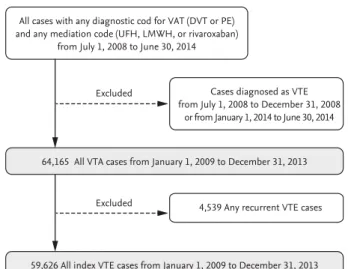
accurate identification of treated VTE cases, we required both a diagnostic code for VTE and a medication code for anticoagulants in the HIRA database record. Ac- cepted medication codes were codes for unfractionated heparin, low-molecular weight heparin, or direct oral anticoagulants. Medication codes for warfarin was not included for the initial identification of VTE patients but was subsequently monitored in the follow-up of treatment of the patients. Detailed methods regarding the selection of patients who were diagnosed as VTE from January 2009 to December 2013 and are summa- rized in Fig. 1 and explained in our previous study [23].
Diagnosis season was categorized according to the general distribution of four seasons in Korea: March to May, spring; June to August, summer; September to November, autumn; and December to February, winter.
Statistical analysis
The incidence of VTE in the Korean population from January 2009 to December 2013 was determined by di- viding the number of individuals with DVT and/or PE by the total number individuals registered in the HIRA database. We quantified VTE diagnoses for each of the four seasons and cross-compared seasonal incidence using a chi-square test. Because the number of days in a month varies from 28 to 31, we calculated VTE incidence ratios adjusted for the numbers of days. A poisson re- gression analysis adjusted for age, sex, and co-morbid- ities confirmed seasonal differences in VTE incidence.
We additionally assessed monthly VTE incidence vari- ation using the R version 3.4.1 (R Foundation for Statisti- cal Computing, Vienna, Austria) package ‘season,’ apply- ing a generalized linear model with month (GLMM) as the categorical variable.
RESULTS
Comparison of VTE incidence across four seasons A total of 59,626 index VTE cases occurring between Jan- uary 2009 and December 2013 were identified and clas- sified into one of four seasons. Overall, the number of VTE diagnoses was significantly higher in winter com- pared to other seasons (p < 0.001), with the largest differ- ence between winter and summer (10.1% higher) (Table 1). When accounting for demographic factors, seasonal Table 1. Comparison of VTE incidence across four seasons stratified by sex, age, cancer, and VTE type subgroups ParameterTotalSpringSummerAutumnWinterChi-squarea p valueRatiob , winter/ summer, %a Total59,626 (23.12)c 14,975 (5.76)d 14,412 (5.54)d 14,709 (5.72)d 15,530 (6.10)d 74.242< 0.001110.1 Male27,303 (21.10)c 6,934 (5.32)d 6,657 (5.10)d 6,790 (5.26)d 6,922 (5.42)d 13.1250.004106.2 Female32,323 (25.14)c 8,041 (6.20) d 7,755 (5.98)d 7,919 (6.18)d 8,608 (6.78)d 74.546< 0.001113.4 Age < 60 yr17,451 (8.03)c 4,368 (1.99) d 4,432 (2.02)d 4,399 (2.03)d 4,252 (1.98)d 1.6560.64797.9 Age ≥ 60 yr42,175 (103.67)c 10,607 (25.86) d 9,980 (24.32)d 10,310 (25.41)d 11,278 (28.08)d 120.125< 0.001115.5 With cancer19,725 (1,831.01)c 4,898 (405.07)d 4,803 (442.22)d 4,974 (406.03)d 5,050 (474.70)d 14.3880.002107.3 Without cancer39,901 (15.54)c 10,077 (3.89)d 9,609 (3.71)d 9,735 (3.80)d 10,480 (4.13)d 67.373< 0.001111.4 Deep vein thrombosise 23,8005,9296,0465,8086,0177.040.071101.6 Pulmonary embolisme 35,8269,0468,3668,9019,51399.48< 0.001116.2 Values are presented as number (%). VTE, venous thromboembolism. a A p values for trends across four seasons. b Ratios were adjusted to number of days in each season. c Crude annual incidence. d Crude incidence per season, difference of days for each month was adjusted. e If a patient had both deep vein thrombosis and pulmonary embolism, the patient was categorized as a pulmonary embolism patient.
differences in VTE incidence were most prominent in females (p < 0.001), patients age 60 years or greater (p <
0.001), patients without cancer (p < 0.001), and patients with PE (p < 0.001). In contrast, the difference was less prominent in males (p = 0.004) and in patients with can- cer (p = 0.002). No significant seasonal differences were observed in patients less than 60 years old (p = 0.647), or in patients with DVT (p = 0.071) (Table 1).
Adjusted multivariate statistics reveal winter as an independent factor affecting VTE incidence
Adjusting for age (greater than 60 years vs. less than 60 years), sex, type of VTE (PE vs. DVT) and cancer di- agnosis in a multivariate Poisson regression analysis revealed the winter season as an independent factor associated with significantly higher VTE incidence (Table 2). Among patients with PE, the incidence in winter season was significantly higher than in spring (p < 0.001), summer (p < 0.001), and autumn (p < 0.001).
Among patients with DVT, the incidence in winter was significantly higher than that in autumn (p = 0.015) but only marginally higher than that in spring (p = 0.058) and was not significantly higher than that in summer (p = 0.374).
Monthly variation in VTE occurrence
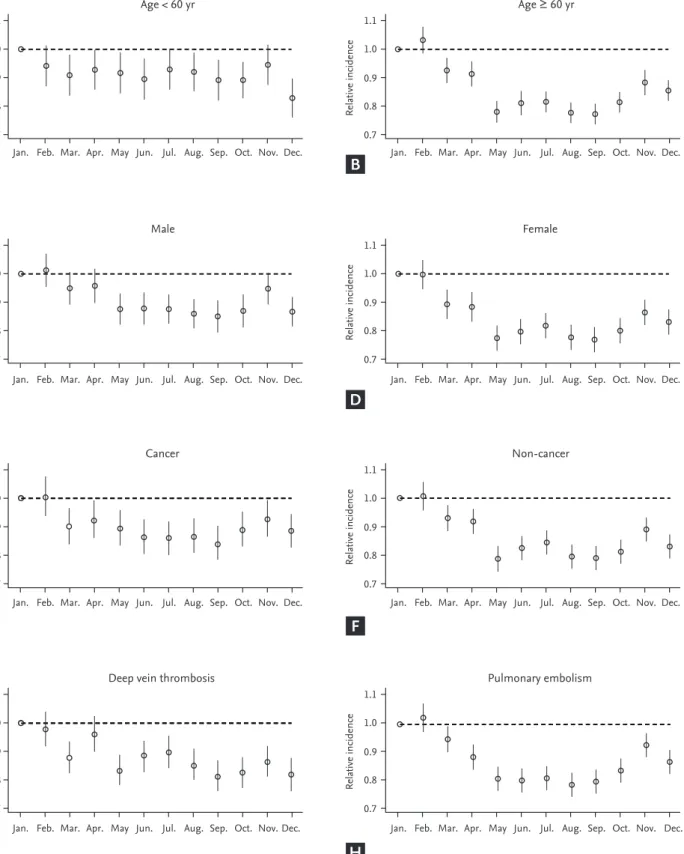
A plot of the generalized linear model with month as the categorical variable revealed monthly variation in addition to seasonal variation (Figs. 2 and 3). VTE inci-
All cases with any diagnostic cod for VAT (DVT or PE) and any mediation code (UFH, LMWH, or rivaroxaban)
from July 1, 2008 to June 30, 2014
64,165 All VTA cases from January 1, 2009 to December 31, 2013 Excluded
Excluded
Cases diagnosed as VTE from July 1, 2008 to December 31, 2008
or from January 1, 2014 to June 30, 2014
59,626 All index VTE cases from January 1, 2009 to December 31, 2013 4,539 Any recurrent VTE cases
Figure 1. Selection of index venous thromboembolism (VTE) patients from January 2009 to December 2013. DVT, deep vein thrombosis; PE, pulmonary embolism; UFH, unfractionated heparin; LMWH, low molecular weight heparin.
Table 2. Result of multivariate poisson regression analysis of seasonality and VTE, DVT, and PE
Subgroup Venous thromboembolism Deep vein thrombosisa Pulmonary embolisma
RR 95% CI p value RR 95% CI p value RR 95% CI p value
Sex
Male 1.00 1.00 1.00
Female 1.20 1.18–1.22 < 0.001 1.18 1.15–1.21 < 0.001 1.22 1.20–1.25 < 0.001 Age, yr
< 60 1.00 1.00 1.00
≥ 60 8.42 8.26–8.58 < 0.001 6.07 5.90–6.26 < 0.001 10.67 10.41–10.95 < 0.001 Association to cancer
Non-cancer 1.00 1.00 1.00
Cancer 53.25 52.30–54.23 < 0.001 58.20 56.53–59.91 < 0.001 50.39 49.23–51.57 Season
Winter 1.00 1.00 1.00
Spring 0.94 0.92–0.97 < 0.001 0.97 0.93–1.00 0.058 0.93 0.90–0.95 < 0.001 Summer 0.91 0.89–0.93 < 0.001 0.98 0.95–1.02 0.374 0.86 0.84–0.89 < 0.001 Autumn 0.94 0.92–0.96 < 0.001 0.96 0.92–0.99 0.015 0.93 0.90–0.96 < 0.001 VTE, venous thromboembolism; DVT, deep vein thrombosis; PE, pulmonary embolism; RR, relative risk; CI, confidence interval.
a If a patient had both deep vein thrombosis and pulmonary embolism, the patient was categorized as a pulmonary embolism patient.
dence was highest in January and February but lowest in August and September, agreeing with our previous observation that VTE incidence is higher in winter.
Similar to our seasonal analysis, monthly variation was apparent in PE patients and in patients 60 years old or
older but was not observed in patients with DVT or less than 60 years of age (Figs. 4 and 5). Monthly variations were apparent in males and females and in patients with and without cancer, and the variation was more prominent in VTE patients without cancer. Figs. 3 and 5 show that the incidence of VTE is going up with time, as we defined in a recent epidemiologic study [23].
DISCUSSION
Here, using data available in a nationwide database, we demonstrate seasonal and monthly variation in VTE incidence in the Korean population. We assessed NHIS claims records for over 59,000 VTE patients, making this the largest study of its kind in an Asian population. Our results agree with several other stud- ies [5,6,8,9,11,14] and a meta-analysis [16] in other popu- lations also reporting an association between seasonal climate change and VTE incidence. We specifically ob- served highest incidence of VTE in the winter months, which may be due to a thrombophilia caused by in- creased fibrinogen and red blood cell aggregation in the cold environment [24]. Seasonal variation has also been pathophysiologically explained by the circannual rhythm (endogenously generated, year-long biological rhythms), which has been proposed in other systemic vascular disorders [25-28].
The only other study in another population that rivals the size of ours is a United States-based study comprised of 7,682,000 VTE patients diagnosed between 1979 and 1999 [17]. Unlike our study and many others, VTE incidence was not associated with season. These contrasting results were previously partly explained by the usage of different anal- ysis methods across studies [29,30]. Additionally, the Unit- ed States study is older than most; therefore, although the number of patients was large, they were diagnosed mostly in 1980s and 1990s, which likely does not reflect the current medical environment with improved early screening and diagnostic techniques for VTE. Our study, which is large- scale, better reflects the current medical landscape, and takes place in a geographical region with sharp seasonal cli- mate differences therefore yields more reliable and realistic conclusions regarding seasonal variation of VTE incidence.
In our study, seasonal variation was stronger in pa- tients with PE, with a particularly strong association
Relative Incidence
0.7 0.8 0.9 1.0 1.1
Jan. Feb. Mar. Apr. May Jun. Jul. Aug. Sep. Oct. Nov. Dec.
Figure 2. The relative risks and 95% confidence intervals from Poisson model with month as a categorical variable and Janu- ary as a reference month.
Times January
2009 January
2010 January
2011 January
2012 January 2013
Winter season
800 1,000 1,200
VTE occurrence (n)
1,400
Figure 3. Trends of the monthly venous thromboembolism (VTE) occurrence from January 2009 to December 2013. The difference in the number of days for each month was statis- tically corrected.
Relative incidence
Age < 60 yr Age ≥ 60 yr
Relative incidence
Relative incidence
Male Female
Relative incidence
Relative incidence
Cancer Non-cancer
Relative incidence
Relative incidence
Deep vein thrombosis Pulmonary embolism
Jan. Feb. Mar. Apr. May Jun. Jul. Aug. Sep. Oct. Nov. Dec. Jan. Feb. Mar. Apr. May Jun. Jul. Aug. Sep. Oct. Nov. Dec.
Jan. Feb. Mar. Apr. May Jun. Jul. Aug. Sep. Oct. Nov. Dec. Jan. Feb. Mar. Apr. May Jun. Jul. Aug. Sep. Oct. Nov. Dec.
Jan. Feb. Mar. Apr. May Jun. Jul. Aug. Sep. Oct. Nov. Dec. Jan. Feb. Mar. Apr. May Jun. Jul. Aug. Sep. Oct. Nov. Dec.
Jan. Feb. Mar. Apr. May Jun. Jul. Aug. Sep. Oct. Nov. Dec. Jan. Feb. Mar. Apr. May Jun. Jul. Aug. Sep. Oct. Nov. Dec.
Relative incidence
0.7 0.8 0.9 1.0 1.1
0.7 0.8 0.9 1.0 1.1
0.7 0.8 0.9 1.0 1.1
0.7 0.8 0.9 1.0 1.1
0.7 0.8 0.9 1.0 1.1
0.7 0.8 0.9 1.0 1.1
0.7 0.8 0.9 1.0 1.1
0.7 0.8 0.9 1.0 1.1
Figure 4. Plots of the generalized linear model with month as the categorical variable, per subgroup. The incidence in January is the reference (1.0) for the relative incidence of each other month. (A) Age < 60 years, (B) age ≥ 60 years, (C) male, (D) female, (E) cancer, (F) non-cancer, (G) deep vein thrombosis, (H) pulmonary embolism.
A
C
E
G
B
D
F
H
between PE incidence and the winter season. This re- sult aligns with other studies reporting seasonable vari- ability for other potentially fatal vascular conditions, such as myocardial infarction [25,28], stroke [26], and aortic dissection [27], as well as with several reports in the 1990s describing a higher incidence of fatal PE in winter [5,7,8,13]. Several studies have also reported sea- sonal variation in the incidence of non-fatal PE [10,12].
Moreover, recently published studies showed that the seasonal variation of PE incidence was affected by age of patients [11,14], in line with our study, and suggest that
for younger patients, other factors including inherited thrombophilia or diagnosis of cancer may have a stron- ger impact on the incidence of PE.
The strong association between season and PE inci- dence may have several explanatory mechanisms. First, inhalation of cold air produces a considerable increase in blood viscosity [31], increasing the risk for thrombophil- ia during the cold winter season [32]. Second, pulmonary infections and aggravation of pulmonary diseases such as chronic pulmonary obstructive disease are more com- mon in winter [33]. Inflammation of pulmonary blood
Times January
2009 January
2010 January
2011 January
2012 January 2013 Pulmonary embolism
200 400 600
Patient numbers
800
200 400 600 800
200 300 400 500
Times January
2009 January
2010 January
2011 January
2012 January 2013 Deep vein thrombosis
Winter season
Patient numbers
Times January
2009 January
2010 January
2011 January
2012 January 2013 500
700 900
Patient numbers
1,100
Times January
2009 January
2010 January
2011 January
2012 January 2013
Patient numbers
Age ≥ 60 yr Age < 60 yr
Figure 5. Trends of the monthly venous thromboembolism occurrence from January 2009 to December 2013 in patients with (A) pulmonary embolism, (B) deep vein thromsis, (C) age ≥ 60 years, and (D) age < 60 years. The difference in the number of days for each month was statistically corrected.
A
C
B
D
vessels caused by these conditions may provoke de novo PE or complicate recovery from DVT-caused pulmonary vascular clots. Third, sepsis also occurs more frequently in winter [34], and considering that the surface area of the pulmonary vasculature is larger than that of the low- er extremities, pulmonary inflammation may be more likely to facilitate PE. Finally, during winter season air pollutants are elevated [35], particularly in big cities, and this may be responsible for the seasonal variation of PE, as in other cardiovascular diseases [36]. Future studies considering these factors will be critical to fully charac- terize the relationship between season and PE incidence and inform clinicians regarding best practices for early PE detection at different times of year.
Unlike PE, reports of seasonal variation in DVT inci- dence are conflicting. Some early studies reported no seasonal or monthly variation in patients with DVT, but they also did not indicate whether DVT patients had concomitant PE or not, which may skew results [6,37]. An Italian study of 1,164 consecutive cases of DVT reported at a single institution from 1998 to 2002 revealed a peak in DVT incidence in winter, with a lower incidence in summer [9]; however, 793 patients (68.1%) had concomitant PE a variable which was not controlled for. The Italian multicenter MASTER study (January 2002 to November 2004 [32]) did evaluate DVT and PE seasonal variability separately in 2,119 VTE pa- tients (72.7% of patients had DVT alone) reporting sea- sonal variation in the incidence of both VTE and PE, with peak incidence in winter and lowest incidence in summer [38]. Similar observations were reported using data from the Swedish Hospital Discharge Register from 1987 to 2010, but a family history of VTE was a confounding factor when considering seasonal varia- tion in DVT incidence [14]. In our study, we consider DVT and PE separately, and observed a weak, insignif- icant association between season and DVT incidence.
The association was even weaker in younger patients and in those with cancer, suggesting that seasonal vari- ation is a relatively weak contributor to VTE occurrence compared to inherited thrombophilia or combined malignancy. This observation supports a nationwide Swedish family study in Sweden [14]; however, doctors and patients should not assume that these results indi- cate that young patients or patients with cancer should dismiss the risk of VTE in winter.
Detection of low-burden, isolated DVT has improved drastically, which may explain the less prominent sea- sonal variation in patients with DVT alone, and we pro- pose that it can be assumed that earlier stage, minimally or asymptomatic DVT can occur without the influence of seasonal change. For those with earlier staged DVT, which often presents as DVT alone, factors other than seasonal variation seem to be more influential on DVT incidence. Further studies are needed to evaluate these potential explanations for the lack of seasonal variation in DVT incidence.
Our study has several limitations. First, the informa- tion in the HIRA database was insufficient to discern be- tween provoked and unprovoked VTE or to sub-divide patients into of VTE into inpatient or outpatient. Be- cause we collected VTE patients with cancer according to having diagnostic code for cancer at the time of diag- nosis, we could not clearly discern actual status of can- cer for each patient. We could not evaluate provoking conditions such as surgery, bone fracture, or pregnan- cy. However, such provoking factors themselves are not likely to occur in particular seasons. If DVT is diagnosed first in practice then co-existing PE was confirmed later, physician may not have registered additional diagnostic code for PE. For this reason, there is a risk of overesti- mation of the incidence of isolated DVT. Despite some of these limitations, our study clearly demonstrated sea- sonal variation in overall VTE incidence in the Korean population and identified sub-groups for which this association is strongest. This study would be a spring- board to further studies designed to inform improved VTE detection, prevention, and patient education in Ko- rea and Asian population.
KEY MESSAGE
1. Seasonal variation was a weak but clear and in- dependent contributor to venous thromboem- bolism (VTE) incidence in Korean population diagnosed VTE from 2009 to 2013.
2. The seasonal variation was more prominent in patients with pulmonary embolism, older age, and without a diagnosis of cancer, compared to those with deep vein thrombosis, younger age, and with a diagnostic code of cancer, respectively.
Conflict of interest
No potential conflict of interest relevant to this article was reported.
Acknowledgments
This work was supported by grants from the Korean Society on Thrombosis and Haemostasis (KSTH 2016- 002) and Seoul National University Bundang Hospital (04-2012-003).
REFERENCES
1. Tapson VF. Acute pulmonary embolism. N Engl J Med 2008;358:1037-1052.
2. Winter MP, Schernthaner GH, Lang IM. Chronic compli- cations of venous thromboembolism. J Thromb Haemost 2017;15:1531-1540.
3. Ruppert A, Steinle T, Lees M. Economic burden of ve- nous thromboembolism: a systematic review. J Med Econ 2011;14:65-74.
4. Anderson FA Jr, Spencer FA. Risk factors for venous thromboembolism. Circulation 2003;107(23 Suppl 1):I9-I16.
5. Allan TM, Douglas AS. Seasonal variation in deep vein thrombosis. Fatal pulmonary embolism is increased in both autumn and winter. BMJ 1996;312:1227.
6. Bounameaux H, Hicklin L, Desmarais S. Seasonal varia- tion in deep vein thrombosis. BMJ 1996;312:284-285.
7. Chau KY, Yuen ST, Wong MP. Seasonal variation in the necropsy incidence of pulmonary thromboembolism in Hong Kong. J Clin Pathol 1995;48:578-579.
8. Colantonio D, Casale R, Natali G, Pisqualetti P. Seasonal periodicity in fatal pulmonary thromboembolism. Lancet 1990;335:56-57.
9. Gallerani M, Boari B, de Toma D, Salmi R, Manfredini R.
Seasonal variation in the occurrence of deep vein throm- bosis. Med Sci Monit 2004;10:CR191-CR196.
10. Manfredini R, Gallerani M, Boari B, Salmi R, Mehta RH.
Seasonal variation in onset of pulmonary embolism is independent of patients' underlying risk comorbid con- ditions. Clin Appl Thromb Hemost 2004;10:39-43.
11. Olie V, Bonaldi C. Pulmonary embolism: does the sea- sonal effect depend on age? A 12-year nationwide analysis of hospitalization and mortality. Thromb Res 2017;150:96- 100.
12. Sharma GV, Frisbie JH, Tow DE, Yalla SV, Khuri SF.
Circadian and circannual rhythm of nonfatal pulmonary embolism. Am J Cardiol 2001;87:922-924.
13. Silcocks P. Seasonal variation in numbers of necropsies with pulmonary embolism. J Clin Pathol 1994;47:478-479.
14. Zoller B, Li X, Ohlsson H, Sundquist J, Sundquist K. Age- and sex-specific seasonal variation of venous thrombo- embolism in patients with and without family history: a nationwide family study in Sweden. Thromb Haemost 2013;110:1164-1171.
15. Ferrari E, Baudouy M, Cerboni P, et al. Clinical epide- miology of venous thromboembolic disease. Results of a French Multicentre Registry. Eur Heart J 1997;18:685-691.
16. Dentali F, Ageno W, Rancan E, et al. Seasonal and month- ly variability in the incidence of venous thromboembo- lism. A systematic review and a meta-analysis of the liter- ature. Thromb Haemost 2011;106:439-447.
17. Stein PD, Kayali F, Olson RE. Analysis of occurrence of venous thromboembolic disease in the four seasons. Am J Cardiol 2004;93:511-513.
18. Ribeiro DD, Bucciarelli P, Braekkan SK, et al. Seasonal variation of venous thrombosis: a consecutive case series within studies from Leiden, Milan and Tromso. J Thromb Haemost 2012;10:1704-1707.
19. Ro A, Hara M, Takada A. The factor V Leiden mutation and the prothrombin G20210A mutation was not found in Japanese patients with pulmonary thromboembolism.
Thromb Haemost 1999;82:1769.
20. Choi HS, Choi CW, Kim HM, Park HW. Venous throm- boembolism in pediatric patients: a single institution experience in Korea. Blood Res 2016;51:164-170.
21. Jang MJ, Kim HJ, Bang SM, et al. Seasonal variation in the occurrence of venous thromboembolism: a report from the Korean Venous Thromboembolism Working Party.
Thromb Res 2012;130:e199-e202.
22. Kim JA, Yoon S, Kim LY, Kim DS. Towards actualizing the value potential of Korea Health Insurance Review and Assessment (HIRA) data as a resource for health research:
strengths, limitations, applications, and strategies for op- timal use of HIRA data. J Korean Med Sci 2017;32:718-728.
23. Hong J, Lee JH, Yhim HY, et al. Incidence of venous thromboembolism in Korea from 2009 to 2013. PLoS One 2019;13:e0191897.
24. Woodhouse PR, Khaw KT, Plummer M, Foley A, Meade TW. Seasonal variations of plasma fibrinogen and factor VII activity in the elderly: winter infections and death from cardiovascular disease. Lancet 1994;343:435-439.
25. Arntz HR, Willich SN, Schreiber C, Bruggemann T, Stern R, Schultheiss HP. Diurnal, weekly and seasonal variation of sudden death. Population-based analysis of 24,061 consecutive cases. Eur Heart J 2000;21:315-320.
26. Gallerani M, Portaluppi F, Maida G, et al. Circadian and circannual rhythmicity in the occurrence of subarach- noid hemorrhage. Stroke 1996;27:1793-1797.
27. Mehta RH, Manfredini R, Hassan F, et al. Chronobio- logical patterns of acute aortic dissection. Circulation 2002;106:1110-1115.
28. Spencer FA, Goldberg RJ, Becker RC, Gore JM. Seasonal distribution of acute myocardial infarction in the second National Registry of Myocardial Infarction. J Am Coll Cardiol 1998;31:1226-1233.
29. Manfredini R, Boari B, Salmi R, Gallerani M. Seasonal variation of venous thromboembolic disease. Am J Cardi- ol 2004;94:276.
30. Gallerani M, Boari B, Smolensky MH, et al. Seasonal vari- ation in occurrence of pulmonary embolism: analysis of the database of the Emilia-Romagna region, Italy. Chro- nobiol Int 2007;24:143-160.
31. Keatinge WR, Coleshaw SR, Cotter F, Mattock M, Murphy M, Chelliah R. Increases in platelet and red cell counts, blood viscosity, and arterial pressure during mild sur- face cooling: factors in mortality from coronary and
cerebral thrombosis in winter. Br Med J (Clin Res Ed) 1984;289:1405-1408.
32. Carder M, McNamee R, Beverland I, et al. The lagged effect of cold temperature and wind chill on cardiore- spiratory mortality in Scotland. Occup Environ Med 2005;62:702-710.
33. Tseng CM, Chen YT, Ou SM, et al. The effect of cold tem- perature on increased exacerbation of chronic obstruc- tive pulmonary disease: a nationwide study. PLoS One 2013;8:e57066.
34. Danai PA, Sinha S, Moss M, Haber MJ, Martin GS. Sea- sonal variation in the epidemiology of sepsis. Crit Care Med 2007;35:410-415.
35. Latha KM, Badarinath KV. Seasonal variations of PM10 and PM2.5 particles loading over tropical urban environ- ment. Int J Environ Health Res 2005;15:63-68.
36. Fares A. Winter cardiovascular diseases phenomenon. N Am J Med Sci 2013;5:266-279.
37. Galle C, Wautrecht JC, Motte S, et al. The role of season in the incidence of deep venous thrombosis. J Mal Vasc 1998;23:99-101.
38. Manfredini R, Imberti D, Gallerani M, et al. Seasonal variation in the occurrence of venous thromboembolism:
data from the MASTER Registry. Clin Appl Thromb He- most 2009;15:309-315.