ABSTRACT
BACKGROUND: The annual incidence of venous thromboembolism (VTE) is increasing, and
the treatment pattern of oral anticoagulants (OACs) has changed with introduction of new oral anticoagulants (NOACs). The aims of this study were to assess the annual incidence of VTE in a Korean population and the change of treatment pattern with availability of NOACs using a population-based database.
METHODS: Using the Korean National Health Insurance Services database, we identified
patients diagnosed with VTE between 2009 and 2016. The annual prevalence of VTE and clinical characteristics and treatment pattern were investigated. The annual incidence of VTE was calculated using direct and indirect methods using the estimated Korean population in 2009 as the reference.
RESULTS: The annual incidence of VTE in Korean has increased yearly from 23.9 per 100,000
in 2009 to 42.2 in 2016. The overall rate of OAC prescription for VTE treatment increased from 55.9% to 68% in the same time period. The rate of initiation of NOAC treatment greatly increased, particularly from 2013 onwards, with a 20-fold increase from 2009 to 2016 (2.1%
vs. 54.3%).
Original Article
Hyung Yoon Kim , MD
1, Sung-A Chang , MD, PhD
2, Kye Hun Kim , MD, PhD
1, Jae-Young Kim , MS
3, Woo-Keun Seo , MD, PhD
3, Hyungseop Kim , MD, PhD
4, Jeong-Sook Seo , MD, PhD
5, Sung-Hee Shin , MD, PhD
6, Sang Jae Rhee , MD, PhD
7, Sun Hwa Lee , MD, PhD
8, and Jung Sun Cho , MD, PhD
9; Venous Thromboembolism Research Group of Korean Society of Echocardiography
1 Department of Cardiovascular Medicine, Chonnam National University Hospital, Chonnam National University Medical School, Gwangju, Korea
2 Department of Internal Medicine, Cardiovascular Imaging Center, Heart, Vascular & Stroke Institute, Sungkyunkwan University School of Medicine, Seoul, Korea
3 Department of Neurology and Stroke Center, Samsung Medical Center, Sungkyunkwan University School of Medicine, Seoul, Korea
4 Division of Cardiology, Department of Internal Medicine, Keimyung University Dongsan Medical Center, Daegu, Korea
5Division of Cardiology, Department of Internal Medicine, Busan Paik Hospital, Inje University, Busan, Korea
6Division of Cardiology, Department of Internal Medicine, Inha University Hospital, Incheon, Korea
7Department of Cardiovascular Medicine, Wonkwang University Hospital, Iksan, Korea
8 Department of Cardiology in Internal Medicine, Jeonbuk National University Medical School and Hospital, Jeonju, Korea
9Department of Cardiology, College of Medicine, The Catholic University of Korea, Seoul, Korea
Epidemiology of Venous
Thromboembolism and Treatment Pattern of Oral Anticoagulation in Korea, 2009–2016: a Nationwide Study Based on the National Health Insurance Service Database
Received: Jan 21, 2021 Revised: Mar 2, 2021 Accepted: Mar 19, 2021 Address for Correspondence:
Kye Hun Kim, MD, PhD
Department of Cardiovascular Medicine, Chonnam National University Hospital, Chonnam National University Medical School, 42 Jebong-ro, Dong-gu, Gwangju 61469, Korea.
E-mail: [email protected] Sung-A Chang, MD, PhD
Department of Medicine, Heart Vascular Stroke Institute, Samsung Medical Center, Sungkyunkwan University School of Medicine, 81 Irwon-ro, Gangnam-gu, Seoul 06351, Korea.
E-mail: [email protected] Copyright © 2021 Korean Society of Echocardiography
This is an Open Access article distributed under the terms of the Creative Commons Attribution Non-Commercial License (https://
creativecommons.org/licenses/by-nc/4.0/) which permits unrestricted non-commercial use, distribution, and reproduction in any medium, provided the original work is properly cited.
ORCID iDs Hyung Yoon Kim
https://orcid.org/0000-0002-0692-5640 Sung-A Chang
https://orcid.org/0000-0001-5124-605X Kye Hun Kim
https://orcid.org/0000-0002-6885-1501 Jae-Young Kim
https://orcid.org/0000-0001-9628-421X Woo-Keun Seo
https://orcid.org/0000-0002-4004-8434
Hyungseop Kim
https://orcid.org/0000-0001-7056-4221 Jeong-Sook Seo
https://orcid.org/0000-0001-6724-4227 Sung-Hee Shin
https://orcid.org/0000-0002-8306-9622 Sang Jae Rhee
https://orcid.org/0000-0001-9738-0481 Sun Hwa Lee
https://orcid.org/0000-0001-9752-9717 Jung Sun Cho
https://orcid.org/0000-0002-0308-0021 Conflict of Interest
The authors have no financial conflicts of interest.
Author Contributions
Conceptualization: Kim KH; Data curation:
Chang SA, Kim H; Investigation: Chang SA;
Formal analysis: Kim HY, Rhee SJ; Funding acquisition: Kim KH; Methodology: Kim JY, Seo JS; Project administration: Seo JS, Lee SH; Resources: Seo WK, Seo JS; Validation:
Cho JS, Kim KH; Visualization: Shin SH; Writing - original draft: Kim HY; Writing - review &
editing: Chang SA, Kim KH.
CONCLUSIONS: The annual incidence of VTE in Korea increased by almost two-fold from
2009 to 2016. The rate of initiation of NOAC treatment has increased substantially since 2013, and these agents have surpassed VKAs as the anticoagulant of choice for VTE. This temporal pattern of OAC prescription is consistent with the current clinical guidelines, which indicate NOACs over the warfarin in patients with VTE.
Keywords: Annual incidence; Oral anticoagulants; NOACs; Temporal trend;
Venous thromboembolism
INTRODUCTION
Venous thromboembolism (VTE) is the third leading cause of cardiovascular death following myocardial infarction and stroke.
1)Deep vein thrombosis (DVT) and pulmonary embolism (PE) are associated with reduced survival and increased re-hospitalization.
2)3)The economic burden of VTE is considerable, with estimated costs of VTE hospitalization of 16,644 dollars per patient per year in the USA.
4)VTE has become a growing public health problem largely due to the increasing aging population. The population of patients with VTE is smaller in Asian populations compared with Western populations (DVT, 5.3–30 vs. 78–269; PE, 3.9–11.7 vs. 45–189, per 100,000 population, Asian vs. Western populations).
2)5-16)Vitamin K antagonists (VKAs) are currently the most commonly used treatment option for VTE. However, VKAs have several potential pitfalls in clinical use. VKAs have a narrow therapeutic index, and the intensity of the anticoagulation effect using the international normalized ratio should be closely monitored. Food intake and use of drugs are frequently limited in patients taking VKAs because of the predisposition to drug and food interactions, and the influence of VKAs on quality of life is not negligible.
17)With the introduction of new oral anticoagulants (NOACs), the conventional OAC warfarin is rapidly being replaced by NOACs because of titration-free preparation and lack of interactions with food and drugs. In Korea, the first NOAC (Rivaroxaban, Xarelto
®) was approved by the KFDA on 13 April, 2009, followed by dabigatran (Pradaxa
®, 18 February, 2011), apixaban (Eliquis
®, 30 November, 2011), and edoxaban (Lixiana
®, 25 August, 2015).
18)The Reimbursement by Public Health Insurance system for VTE was started in 2013, in the order of rivaroxaban (January 1, 2013), dabigatran (January 1, 2013), apixaban (May 1, 2015), and edoxaban (February 1, 2016).
In this study, we investigated the update on the annual incidence of VTE in Korea and how the treatment pattern of VTE in Korea changed according to the approval and reimbursement policy for treatment.
METHODS
Study population
Data were collected from the Korean National Health Insurance Service (NHIS) in Korea between 2009 and 2016. The NHIS covers 97% of the population in Korea. The other 3%
of records from Medical Aid were not included in this study. Cases were extracted with
the diagnostic code of VTE that is composed of DVT and PE. The diagnostic code was
selected from the 10th revision of the International Statistical Classification of Disease
and Related Health Problems (ICD-10) that consisted of primary and secondary diagnoses
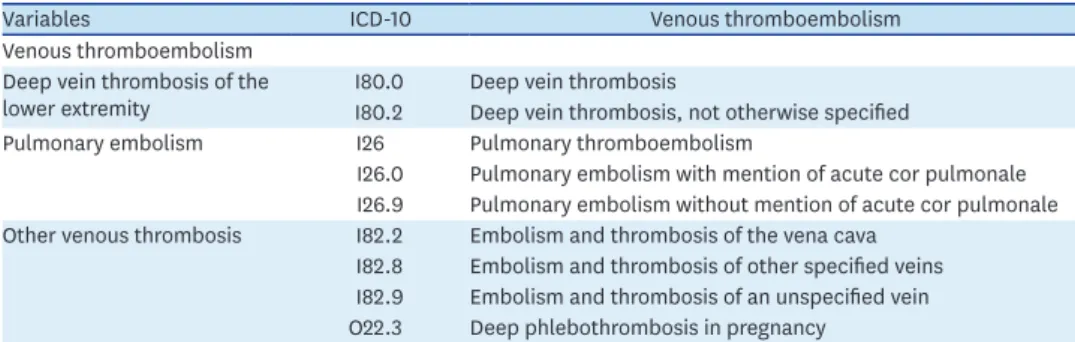
related to VTE as follows. DVT comprises deep vein thrombosis, not otherwise specified (I80.2) and embolism or thrombosis of a lower extremity (I80.3). PE comprises pulmonary thromboembolism (I26), PE with mention of acute cor pulmonale (I26.0), and PE without mention of acute cor pulmonale (I26.9). VTE is composed of embolism and thrombosis of the vena cava (I82.2), embolism and thrombosis of other specified veins (I82.8), embolism and thrombosis of an unspecified vein (I82.9), and deep phlebothrombosis in pregnancy (O22.3) as well as the above diagnosed DVT and PE (Table 1). Venous thrombosis of other sites, such as upper extremities and intra-abdominal sites, was not included in this study. A patient who was included in the data was excluded from the data of the following year. If a patient had both diagnostic codes of DVT and PE, the patient was classified as PE. The data consisted of main and secondary diagnoses related to VTE.
Data collection
Demographic and clinical data were age, sex, prior surgery within 6 months, and previous medical history. The previous medical history was determined by ICD-10 codes as follows:
diabetes mellitus (E10.x, E11.x, E12.x, E13.x, E14.x), hypertension (I10.x, I11.x-I13.x, I15.x), malignancy (C00.x-C26.x, C30.x-C34.x, C37.x-C41.x, C43.x, C45.x-C58.x, C60.x-C76.x, C81.x-C85.x, C88.x, C90.x-C97.x), heart failure (I09.9, I11.0, I13.0, I13.2, I25.2, I42.0, I42.5-I42.9, I43.x, I50.x, P29.0), and cerebral vascular accident (G45.x, G46.x, H34.0, I60.x- 169.x). Lipid lowering agents were investigated by medication codes and categorized as statins, ezetimibe, omega 3, and fenofibrate.
All OACs prescribed between 2009 and 2016 were investigated, comprising warfarin (2 mg and 5 mg), rivaroxaban (10, 15, and 20 mg), dabigatran (75, 110, and 150 mg), apixaban (2.5 and 5 mg), and edoxaban (15, 30, and 60 mg). Drugs prescribed before approval by Korean Ministry of Food & Drug Safety (MFDS) for the purpose of research were excluded from the investigation. Aspirin use was investigated to examine the temporal trend of OAC use according to the initiation of insurance coverage.
Statistical methods
The annual incidence of VTE in adults was calculated as a crude rate of number of events divided by a specified population, usually expressed as number of patients per 100,000 population at risk. We also calculated the age-standardized annual incidence of VTE with the direct method using the estimated Korean population and with the indirect method using the crude incidence rate in 2009 as the reference.
19)20)The rates of OAC prescription were calculated as the number of new OAC cases divided by a specific disease population by year.
Table 1. Diagnostic codes of venous thromboembolism
Variables ICD-10 Venous thromboembolism
Venous thromboembolism Deep vein thrombosis of the
lower extremity I80.0 Deep vein thrombosis
I80.2 Deep vein thrombosis, not otherwise specified
Pulmonary embolism I26 Pulmonary thromboembolism
I26.0 Pulmonary embolism with mention of acute cor pulmonale I26.9 Pulmonary embolism without mention of acute cor pulmonale Other venous thrombosis I82.2 Embolism and thrombosis of the vena cava
I82.8 Embolism and thrombosis of other specified veins I82.9 Embolism and thrombosis of an unspecified vein O22.3 Deep phlebothrombosis in pregnancy
ICD-10: 10th revision of the International Statistical Classification of Disease and Related Health Problems.
Ethics
This study protocol was exempted by the Institutional Review Board (IRB) of Samsung Medical Center (IRB File No: 2018-03-027).
RESULTS
Patient characteristics
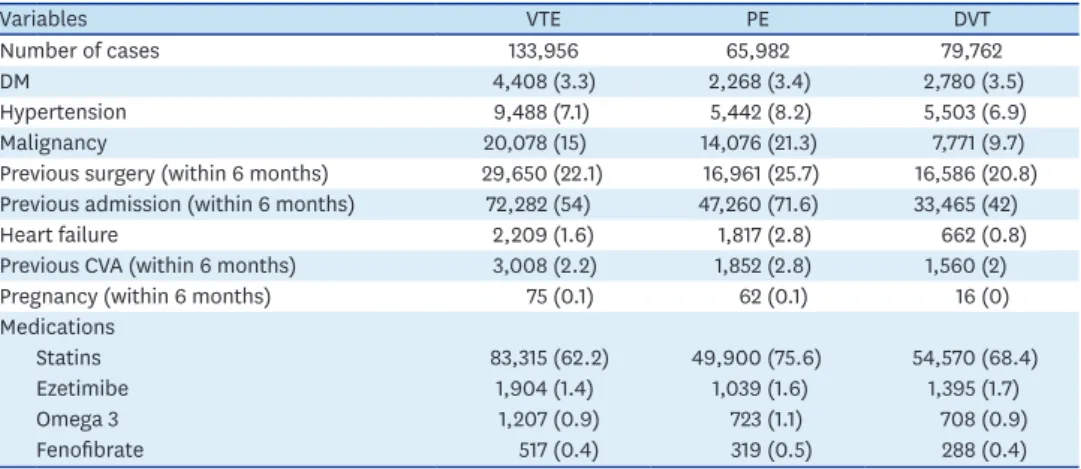
Between 2009 and 2016, a total of 133,956 patients was newly diagnosed with VTE, 65,982 patients were diagnosed with PE, and 79,762 patients were diagnosed with DVT. The descriptive characteristics of the cases including venous thromboembolic risk factors are summarized in Table 2. Among the investigated risk factors for VTE, prior admission within 6 months was most prevalent (54%), followed by previous surgery within 6 months (22.1%), malignancy (15%), hypertension (7.1%), DM (3.3%), and prior history of cerebral vascular accident within 6 months (2.2%).
Incidence of VTE, PE, and DVT between 2009 and 2016 in Korea
A total of 133,956 cases was newly diagnosed with VTE in Korea between 2009 and 2016; of these cases, 58,808 (43.9%) were men and 75,148 (56.1%) were women. The number of cases substantially increased from 12,064 cases in 2009 to 22,039 cases in 2016.
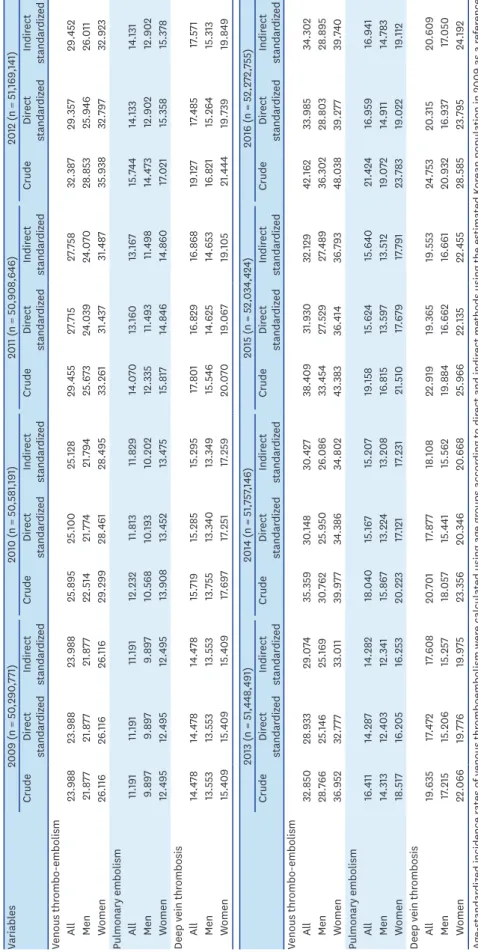
The total crude incidence rate in 2016 was 42.16 for VTE, 21.42 for PE, and 24.75 for DVT per 100,000 population (0.042%, 0.021%, and 0.024%, respectively) (Table 3).
Age-standardized incidence rates are shown in Table 3. The age-standardized incidence rate of VTE steadily increased by about 5% annually, from 23.98 per 100,000 population (0.024%) in 2009 to 33.98 per 100,000 population (0.034%) in 2016. The age-standardized annual incidence of PE and DVT also gradually increased from 2009 to 2016, from 11.19 to 21.42 per 100,000 (0.011% to 0.021%) for PE and from 14.47 to 24.75 per 100,000 (0.014% to 0.024%) for DVT.
The overall annual incidence of DVT was higher than that of PE (Table 3 and Figure 1A).
Table 2. Descriptive characteristics including venous thromboembolic risk factors in patients diagnosed between 2009 and 2016
Variables VTE PE DVT
Number of cases 133,956 65,982 79,762
DM 4,408 (3.3) 2,268 (3.4) 2,780 (3.5)
Hypertension 9,488 (7.1) 5,442 (8.2) 5,503 (6.9)
Malignancy 20,078 (15) 14,076 (21.3) 7,771 (9.7)
Previous surgery (within 6 months) 29,650 (22.1) 16,961 (25.7) 16,586 (20.8) Previous admission (within 6 months) 72,282 (54) 47,260 (71.6) 33,465 (42)
Heart failure 2,209 (1.6) 1,817 (2.8) 662 (0.8)
Previous CVA (within 6 months) 3,008 (2.2) 1,852 (2.8) 1,560 (2)
Pregnancy (within 6 months) 75 (0.1) 62 (0.1) 16 (0)
Medications
Statins 83,315 (62.2) 49,900 (75.6) 54,570 (68.4)
Ezetimibe 1,904 (1.4) 1,039 (1.6) 1,395 (1.7)
Omega 3 1,207 (0.9) 723 (1.1) 708 (0.9)
Fenofibrate 517 (0.4) 319 (0.5) 288 (0.4)
Data are presented as number (%). CVA: cerebral vascular accident, DM: diabetes mellitus, DVT: deep vein thrombosis, PE: pulmonary embolism, VTE: venous thromboembolism.
Table 3. Crude and age-standardized annual incidence of venous thromboembolism (per 100,000): crude and age-standardized annual incidence of venous thromboembolism: overall and by sex Variables2009 (n = 50,290,771)2010 (n = 50,581,191)2011 (n = 50,908,646)2012 (n = 51,169,141) CrudeDirect standardizedIndirect standardizedCrudeDirect standardizedIndirect standardizedCrudeDirect standardizedIndirect standardizedCrudeDirect standardizedIndirect standardized Venous thrombo-embolism All23.98823.98823.98825.89525.10025.12829.45527.71527.75832.38729.35729.452 Men21.87721.87721.87722.51421.77421.79425.67324.03924.07028.85325.94626.011 Women26.11626.11626.11629.29928.46128.49533.26131.43731.48735.93832.79732.923 Pulmonary embolism All11.19111.19111.19112.23211.81311.82914.07013.16013.16715.74414.13314.131 Men9.8979.8979.89710.56810.19310.20212.33511.49311.49814.47312.90212.902 Women12.49512.49512.49513.90813.45213.47515.81714.84614.86017.02115.35815.378 Deep vein thrombosis All14.47814.47814.47815.71915.28515.29517.80116.82916.86819.12717.48517.571 Men13.55313.55313.55313.75513.34013.34915.54614.62514.65316.82115.26415.313 Women15.40915.40915.40917.69717.25117.25920.07019.06719.10521.44419.73919.849 2013 (n = 51,448,491)2014 (n = 51,757,146)2015 (n = 52,034,424)2016 (n = 52,272,755) CrudeDirect standardizedIndirect standardizedCrudeDirect standardizedIndirect standardizedCrudeDirect standardizedIndirect standardizedCrudeDirect standardizedIndirect standardized Venous thrombo-embolism All32.85028.93329.07435.35930.14830.42738.40931.93032.12942.16233.98534.302 Men28.76625.14625.16930.76225.95026.08633.45427.52927.48936.30228.80328.895 Women36.95232.77733.01139.97734.38634.80243.38336.41436.79348.03839.27739.740 Pulmonary embolism All16.41114.28714.28218.04015.16715.20719.15815.62415.64021.42416.95916.941 Men14.31312.40312.34115.86713.22413.20816.81513.59713.51219.07214.91114.783 Women18.51716.20516.25320.22317.12117.23121.51017.67917.79123.78319.02219.112 Deep vein thrombosis All19.63517.47217.60820.70117.87718.10822.91919.36519.55324.75320.31520.609 Men17.21515.20615.25718.05715.44115.56219.88416.66216.66120.93216.93717.050 Women22.06619.77619.97523.35620.34620.66825.96622.13522.45528.58523.79524.192 Age-standardized incidence rates of venous thromboembolism were calculated using age groups according to direct and indirect methods using the estimated Korean population in 2009 as a reference.
VTE PE DVT 42.16
24.75
21.42 23.99
14.48 11.19 Annual incidence of VTE, PE and DVT in all patients
A
2009 2010 2011 2012 2013 2014 2015 2016 0
20 10 40 50
30
VTE, 166.31
DVT, 73.096 PE, 104.36
VTE, 288.44
DVT, 138.68 PE, 173.79
2009
Annual incidence of VTE, PE and DVT by age Annual incidence of VTE, PE and DVT by age
B
0−9 10−19 20−29 30−39 40−49 50−59 60−69 70−79 80− 0−9 10−19 20−29 30−39 40−49 50−59 60−69 70−79 80−
0 200
100 400
300
0 200
100 400
300
2016
Male, 205.169
Female, 150.503
Male, 302.408 Female, 282.103
Annual incidence of VTE by age and sex Annual incidence of VTE by age and sex
D
0−9 10−19 20−29 30−39 40−49 50−59 60−69 70−79 80− 0−9 10−19 20−29 30−39 40−49 50−59 60−69 70−79 80−
0 150
50 350
250
0 150
50 350
250
100 300
200
100 300
200 VTE, 36.302
DVT, 20.932
PE, 19.072
VTE, 48.038
DVT, 28.585
PE, 23.783
Men
Annual incidence of VTE, PE and DVT by sex Annual incidence of VTE, PE and DVT by sex
C
2009 2010 2011 2012 2013 2014 2015 2016 0
20 10 40 50
30
0 20 10 40 50
30
Women
2009 2010 2011 2012 2013 2014 2015 2016
*Incidence per 100,000 population by age
Figure 1. Annual incidence of VTE, PE, and DVT in all patients (A), patients classified by age (B), patients classified by sex (C), and patients classified by age and sex in Korea between 2009 and 2016 (D). (A) Annual incidence of VTE, PE, and DVT in all patients. (B) Annual incidence of VTE, PE, and DVT by age. (C) Annual incidence of VTE, PE, and DVT by sex. (D) Annual incidence of VTE by age and sex.
DVT: deep vein thrombosis, PE: pulmonary embolism, VTE: venous thromboembolism.
Annual trends in incidence by age, sex, and disease category
The annual incidence of VTE increased markedly with age. VTE is very rare before the age of 20 years (Supplementary Table 1). The annual incidence of VTE in elderly people older than 60 years was approximately 13–14 times greater than that of younger people and 5 times greater than that of the middle aged group (Table 4 and Figure 1B).
Comparison of the incidence rates of each disease according to age showed that the incidence of DVT was almost twice that of PE in patients younger than 60 years. However, the incidence of PE increased steeply after the age of 60, and the incidence of PE was higher than that of DVT after age 70 (Table 4, Supplementary Table 1 and Figure 1B).
Women showed higher annual incidences of disease than men. The crude annual incidence rates for women were approximately 1.3 times greater than that of men (48.0 vs. 36.3 for VTE, 23.8 vs. 19.1 for PE, and 28.6 vs. 20.9 for DVT in 2016; Table 3 and Figure 1C). The crude incidence rates of VTE, PE, and DVT increased in all age and sex categories from 2009 to 2016 (Table 4). The incidence of VTE was similar between the sexes younger than 50 years; in patients older than 60 years, the incidence of disease in women was higher than that of men;
in patients 80 years and older, the incidence of disease in men was higher than that of women (Supplementary Table 1 and Figure 1D).
Table 4. Crude and age-standardized annual incidence of venous thromboembolism (per 100,000): crude annual incidence of venous thromboembolism, classified by sex and age
Variables 2009 (n = 50,290,771) 2010 (n = 50,581,191) 2011 (n = 50,908,646) 2012 (n = 51,169,141)
All Men Women All Men Women All Men Women All Men Women
Venous thrombo-embolism
All 23.99 21.88 26.12 25.90 22.51 29.30 29.45 25.67 33.26 32.39 28.85 35.94
20 to < 40 7.32 7.63 6.99 7.43 7.30 7.57 8.38 8.61 8.15 8.59 8.49 8.71
40 to < 60 20.88 21.33 20.42 21.67 20.43 22.94 23.36 23.12 23.61 24.99 24.91 25.08
60– 101.85 99.50 103.62 109.14 103.49 113.42 122.96 113.53 130.15 132.03 126.22 136.51
Pulmonary embolism
All 11.19 9.90 12.50 12.23 10.57 13.91 14.07 12.34 15.82 15.74 14.47 17.02
20 to < 40 2.49 2.83 2.13 2.45 2.82 2.06 3.18 3.73 2.59 3.27 3.53 2.98
40 to < 60 7.14 7.93 6.34 7.54 7.94 7.12 8.68 9.31 8.04 9.91 10.99 8.81
60– 55.10 50.93 58.23 59.53 54.29 63.50 65.63 60.05 69.88 70.50 68.60 71.97
Deep vein thrombosis
All 14.48 13.55 15.41 15.72 13.76 17.70 17.80 15.55 20.07 19.13 16.82 21.44
20 to < 40 5.44 5.77 5.08 5.82 5.55 6.10 5.91 5.88 5.95 6.20 6.15 6.25
40 to < 60 15.07 14.84 15.30 15.65 14.10 17.23 16.57 16.03 17.13 16.82 15.95 17.71
60– 53.99 54.91 53.31 58.24 56.48 59.58 67.52 62.20 71.59 71.59 67.42 74.81
2013 (n = 51,448,491) 2014 (n = 51,757,146) 2015 (n = 52,034,424) 2016 (n = 52,272,755)
All Men Women All Men Women All Men Women All Men Women
Venous thrombo-embolism
All 32.85 28.77 36.95 35.36 30.76 39.98 38.41 33.45 43.38 42.16 36.30 48.04
20 to < 40 8.54 8.88 8.16 8.66 9.02 8.26 9.82 10.20 9.40 10.43 10.54 10.32
40 to < 60 24.39 24.35 24.43 25.27 23.79 26.77 25.96 25.72 26.19 29.33 28.63 30.04
60– 130.96 120.30 139.24 137.89 128.55 145.22 143.74 130.73 154.04 151.18 135.71 163.55
Pulmonary embolism
All 16.41 14.31 18.52 18.04 15.87 20.22 19.16 16.82 21.51 21.42 19.07 23.78
20 to < 40 3.42 3.92 2.88 3.59 4.01 3.12 4.03 4.60 3.40 4.43 4.93 3.88
40 to < 60 9.88 10.52 9.22 10.54 10.93 10.14 10.85 11.59 10.08 12.70 13.49 11.88
60– 71.55 64.58 76.96 76.36 70.60 80.87 77.41 70.29 83.04 82.10 75.59 87.30
Deep vein thrombosis
All 19.64 17.21 22.07 20.70 18.06 23.36 22.92 19.88 25.97 24.75 20.93 28.58
20 to < 40 6.11 6.27 5.93 6.00 6.23 5.74 6.91 7.11 6.68 7.33 7.34 7.31
40 to < 60 16.72 16.21 17.25 17.13 15.66 18.64 17.63 16.89 18.38 19.33 18.20 20.49
60– 72.18 66.13 76.87 74.59 69.82 78.32 79.89 71.85 86.26 83.16 72.56 91.63
A distinct increase was observed in the annual incidence of PE over time, with a substantial increase in PE in elderly patients. The incidence of PE in 2009 was higher in women younger than 50 years but was higher in men in their 60s and 70s; in patients older than 80 years, the incidence of disease in women was higher than that in men. In contrast, the incidence of PE was higher in men than women in patients younger than 50 years, and the incidence in 2016 was higher in women after 60 years of age (Supplementary Table 1). The annual incidence of DVT in women increased considerably over time compared to that of men, with a remarkable increase in elderly patients.
Trends in OAC prescription for VTE, PE, and DVT
Between 2009 and 2016, a total of 86,033 cases were newly prescribed an OAC for VTE, 52,580 cases for PE, and 47,085 cases for DVT. Furthermore, 51,069 (40.7%) cases were initiated on VKAs and 34,964 (22.5%) cases were initiated on NOACs for VTE; 31,849 (52.1%) on VKAs and 20,731 (26.4%) on NOACs for PE; and 27,330 (37.7%) on VKAs and 19,755 (21.9%) on NOACs for DVT.
The mean crude rate of OAC prescription was 63.3% for VTE, 78.4% for PE, and 59.5% for DVT, and these rates gradually increased during the study period. The rate of NOAC use increased over the study period by 52.1% for VTE, 64.2% for PE, and 46.5% for DVT. In contrast, the rate of VKA use decreased by 40.0%, 51%, and 33.4% for VTE, PE, and DVT, respectively (Figure 2). These changes were noticeable after onset of insurance coverage for NOACs (Table 5). In 2016, the rate of NOAC prescription was 54.3%, 66.6%, and 48.9%
of VTE, PE, and DVT cases, respectively, whereas the rate of VKA prescription was 13.7%, 16.9%, and 14.1% of cases. The total number of prescriptions for OACs and time trend of OAC use are summarized in Figure 3.
The average prescription rate of aspirin was 25% for all cases and decreased slightly over the study period (25.3% in 2009 and 17.4% in 2016, average of all VTE, PE, and DVT cases, Table 5).
Temporal trends in NOAC choice
Rivaroxaban was the most commonly prescribed OAC during the entire study period, with 20.1% of OAC prescriptions. Of the total NOAC prescriptions during the study period, rivaroxaban accounted for the largest portion (84.1%), followed by dabigatran (7.8%), apixaban (6.7%), and edoxaban (1.5%) (Table 5 and Figure 4).
VTE
%
0 80
50
10 70
30 40 60
20
%
0 80
50
10 70
30 40 60
20
%
0 80
50
10 70
30 40 60
20
A
2009 2010 2011 2012 2013 2014 2015 2016
B PE
2009 2010 2011 2012 2013 2014 2015 2016
C DVT
2009 2010 2011 2012 2013 2014 2015 2016
VKA
NOAC Aspirin NOAC VKA Aspirin NOAC VKA Aspirin
Figure 2. Time trends in oral anticoagulant choice for VTE (A), PE (B), and DVT (C) from 2009 to 2016.
DVT: deep vein thrombosis, PE: pulmonary embolism, VTE: venous thromboembolism.
Rivaroxaban and dabigatran were covered by medical insurance starting in 2013, which is two years earlier than other NOACs, so the prescription rate of these two drugs increased markedly starting in 2013. Apixaban was not covered by medical insurance until 2015 despite approval from the MFDS in 2011, so the prescription rate of apixaban was relatively low.
However, apixaban and edoxaban were covered by medical insurance since 2015 and 2016, respectively, after which the prescription rates increased significantly.
DISCUSSION
The present study investigated the annual incidence of VTE, PE, and DVT and evaluated the treatment pattern of OACs using data from the NHIS in Korea from 2009 through 2016.
The mean age-standardized annual incidence of VTE during the study period was 0.028%
(range 0.024% in 2009 to 0.034% in 2016). This is much lower compared with the reported annual incidence of approximately 0.1%–0.2% in Western populations.
2)9)11)13)21)However, recent studies have reported gradual increases in the incidence of VTE in Asian populations.
7)14)22)In our study, the annual incidence increased by 5% annually from 2009 to 2016. The rate increased nearly two-fold during the 7 years of the study period, especially in patients older than 60 years. The increasing incidence of VTE might be due to the increase in the elderly population and the associated increase in comorbidities. Increased access to medical services for elderly patients could also contribute to the increased incidence. The wide and increased use of non-invasive imaging such as computed tomographic angiography and echocardiography and the improved imaging quality of non-invasive imaging also are important contributing factors for the increased prevalence of VTE in Korea.
Table 5. Trends of oral anticoagulant prescription for VTE, PE, and DVT from 2009 to 2016
Diagnosis Medication 2009 2010 2011 2012 2013 2014 2015 2016
VTE Number of cases 12,064 13,098 14,995 16,572 16,907 18,301 19,986 22,039
NOAC 260 (2.16) 380 (2.90) 724 (4.83) 1,061 (6.40) 3,690 (21.8) 6,948 (38.0) 9,934 (49.7) 11,967 (54.3) Rivaroxaban 260 (2.16) 380 (2.90) 621 (4.14) 944 (5.70) 3,503 (20.7) 6,716 (36.7) 8,348 (41.8) 8,626 (39.1)
Dabigatran - - 67 (0.45) 74 (0.45) 125 (0.74) 123 (0.67) 984 (4.92) 1,318 (5.98)
Apixaban - - 36 (0.24) 43 (0.26) 62 (0.37) 109 (0.60) 561 (2.81) 1,555 (7.06)
Edoxaban - - - 41 (0.21) 468 (2.12)
Vitamin K antagonist 6,478 (53.7) 7,115 (54.3) 8,105 (54.1) 8,490 (51.2) 7,548 (44.6) 5,964 (32.6) 4,345 (21.7) 3,024 (13.7) Aspirin 2,966 (24.6) 3,362 (25.7) 4,484 (29.9) 4,536 (27.4) 4,322 (25.6) 4,368 (23.9) 4,297 (21.5) 3,703 (16.8)
PE Number of cases 5,628 6,187 7,163 8,056 8,443 9,337 9,969 11,199
NOAC 136 (2.42) 205 (3.31) 357 (4.98) 504 (6.24) 1,892 (22.4) 4,188 (44.8) 5,988 (60.1) 7,461 (66.6) Rivaroxaban 136 (2.42) 205 (3.31) 293 (4.09) 424 (5.26) 1,767 (20.9) 4,036 (43.2) 4,963 (49.8) 5,355 (47.8)
Dabigatran - - 43 (0.60) 47 (0.58) 87 (1.03) 86 (0.92) 727 (7.29) 957 (8.55)
Apixaban - - 21 (0.29) 33 (0.41) 38 (0.45) 66 (0.71) 269 (2.70) 801 (7.15)
Edoxaban - - - 29 (0.29) 348 (3.11)
Vitamin K antagonist 3,820 (67.9) 4,346 (70.2) 4,848 (67.7) 5,165 (64.1) 4,942 (58.5) 4,042 (43.3) 2,799 (28.1) 1,887 (16.9) Aspirin 1,641 (29.2) 1,872 (30.3) 2,409 (33.6) 2,446 (30.4) 2,355 (27.9) 2,447 (26.2) 2,393 (24.0) 2,071 (18.5)
DVT Number of cases 7,281 7,951 9,062 9,787 10,102 10,714 11,926 12,939
NOAC 174 (2.39) 251 (3.16) 485 (5.35) 715 (8.95) 2,448 (24.2) 3,889 (36.3) 5,469 (45.9) 6,324 (48.9) Rivaroxaban 174 (2.39) 251 (3.16) 428 (4.72) 657 (8.22) 2,342 (23.2) 3,765 (35.1) 4,638 (38.9) 4,589 (35.5)
Dabigatran - - 37 (0.41) 38 (0.48) 70 (0.69) 58 (0.54) 434 (3.64) 598 (4.62)
Apixaban - - 20 (0.22) 20 (0.25) 36 (0.36) 66 (0.62) 376 (3.15) 941 (7.27)
Edoxaban - - - 21 (0.18) 196 (1.51)
Vitamin K antagonist 3,464 (47.6) 3,749 (47.2) 4,386 (48.4) 4,496 (56.3) 3,947 (39.1) 2,998 (28.0) 2,462 (20.6) 1,828 (14.1) Aspirin 1,622 (22.3) 1,921 (24.2) 2,582 (28.5) 2,607 (32.6) 2,599 (25.7) 2,534 (23.7) 2,567 (21.5) 2,187 (16.9) Data are presented as number (%). Gray shading indicates cases after initiation of insurance coverage for each drug. DVT: deep vein thrombosis, NOAC: new oral anticoagulant, PE: pulmonary embolism, VTE: venous thromboembolism.
VTE
0 8,000
5,000
1,000 7,000
3,000 4,000 6,000
2,000
A
2009 2010 2011 2012 2013 2014 2015 2016
PE
0 14,000 10,000
2,000 6,000 8,000 12,000
4,000
B
2009 2010 2011 2012 2013 2014 2015 2016
DVT
0 7,000 5,000
1,000 3,000 4,000 6,000
2,000
C
2009 2010 2011 2012 2013 2014 2015 2016
Rivaroxaban Dabigatran Apixaban Edoxaban
Rivaroxaban Dabigatran Apixaban Edoxaban
Rivaroxaban Dabigatran Apixaban Edoxaban
Figure 4. Time trends in NOAC choice for VTE (A), PE (B), and DVT (C) from 2009 to 2016.
DVT: deep vein thrombosis, NOACs: new oral anticoagulants, PE: pulmonary embolism, VTE: venous thromboembolism.
A VTE
2009 2010 2011 2012 2013 2014 2015 2016 Rivaroxaban
Dabigatran Apixaban Edoxaban NOAC Warfarin
260 0 0 0 260 6,478
380 0 0 0 380 7,115
621 67 36 0 724 8,105
944 74 43 0 1,061 8,490
3,503 125 62 0 3,690 7,548
6,716 123 109 0 6,948 5,964
8,348 984 561 41 9,934 4,345
8,626 1,318 1,555 468 11,967 3,024 0
10,000
2,000 6,000 8,000 12,000
4,000
B PE
2009 2010 2011 2012 2013 2014 2015 2016 Rivaroxaban
Dabigatran Apixaban Edoxaban NOAC Warfarin
136 0 0 0 136 3,820
205 0 0 0 205 4,346
293 43 21 0 357 4,848
424 47 33 0 504 5,165
1,767 87 38 0 1,892 4,942
4,036 86 66 0 4,188 4,042
4,963 727 269 29 5,988 2,799
5,355 957 801 348 7,461 1,887 0
2,000 6,000 8,000
4,000
C DVT
2009 2010 2011 2012 2013 2014 2015 2016 Rivaroxaban
Dabigatran Apixaban Edoxaban NOAC Warfarin
174 0 0 0 174 3,464
251 0 0 0 251 3,749
428 37 20 0 485 4,386
657 38 20 0 715 4,496
2,342 70 36 0 2,448 3,947
3,765 58 66 0 3,889 2,998
4,638 434 376 21 5,469 2,462
4,589 598 941 196 6,324 1,828 0
2,000 6,000 8,000
4,000
Figure 3. Total number of prescriptions for OACs and time trends of OAC use from 2009 to 2016. (A) VTE, (B) PE, (C) DVT.
DVT: deep vein thrombosis, NOACs: new oral anticoagulants, OACs: oral anticoagulants, PE: pulmonary embolism, VTE: venous thromboembolism.
In a previous study by Hong et al.,
22)there was a steady increase in the annual incidence of VTE.
The authors reported that the annual incidence rate of VTE in Korea between 2009 and 2013 was 0.024% (range 0.021 to 0.029%), which is slightly lower than the finding of the current study. In the present study, we adopted a wider range of diagnosis codes compared with the previous study; this might have contributed to the difference in annual incidence rate between studies. We also used the NHIS database, whereas the previous study used the Health Insurance Review and Assessment Service (HIRA) database, which uses different data sources.
In our study, the incidence of VTE increased markedly with increasing age, which is similar to the pattern reported in previous studies.
23)The incidence of DVT was higher than that of PE in most age groups except 70 years and older. DVT is a milder form of VTE, and PE is considered to develop from DVT even though co-existing cases were reported in 50% of DVT cases in a previous study. PE is more fatal than is DVT, and elderly patients older than 70 years showed a higher incidence of PE, which suggests that fatalities from VTE increased in elderly patients.
24)An increased incidence of VTE in the elderly could be associated with increased risk with aging. Our data also showed that men and women had different patterns of VTE incidence in increasing age categories. The possible explanations for these disparities are likely multifactorial. There are several well-recognized clinical risk factors for VTE in women such as oral contraceptive use, hormone replacement therapy, estrogen receptor modulator therapy, and pregnancy.
In Korea, the absolute number of NOAC prescriptions has drastically increased, as has the ratio, accounting for more than 50% of all OAC prescriptions in 2016. Conversely, there was substantial decrease in the rate of VKA prescriptions, which corresponded to 15% of all OAC prescriptions in 2016. Similar prescribing trends were reported in western countries, although the healthcare system and reimbursement by insurance differ by country.
25-27)Evidence for NOAC use in the treatment of VTE shows a clear trend for replacing VKA use.
28-31)Physician awareness on the efficacy and safety of NOACs is important to initiate NOAC prescription; however, the clinical availability of NOACs in real clinical practice is affected out-of-pocket patient cost. Our data showed that use of NOACs increased significantly with initiation of insurance coverage of rivaroxaban and dabigatran in 2013, and exceeded use of VKAs in treatment for VTE, PE, and DVT. The increase of NOAC use was most likely attributed to insurance coverage in Korea.
Among NOACs, rivaroxaban was the most prescribed, consisting of 84% of the total NOAC use in the current study. These prescription trends are a consequence of several factors, such as increased physician experience, increased evidence of efficacy and safety of NOACs, and most importantly, initiation of insurance coverage of NOACs since 2013 in Korea. With a slight increase of apixaban and edoxaban use after insurance coverage starting in 2015 and 2016, the portion of rivaroxaban use among NOAC prescriptions slightly decreased to 72% in 2016. Dabigatran was the second most commonly used NOAC, and the prescription rate remained steady over time, which is thought to be relevant to the earlier initiation of insurance coverage. The prescription of apixaban surpassed that of dabigatran after introduction of insurance coverage of apixaban.
To the best of our knowledge, this is the first study that investigated the trend of NOAC use
after initiation of insurance coverage in Korea. The effect of initiation of insurance coverage on
apixaban and edoxaban might not yet be fully reflected in prescription rates. Further studies will
explore further the impact of recent insurance coverage on NOAC prescription trends in Korea.
This study has several limitations. First, subjects with a diagnostic code of VTE other than the main and second diagnostic codes were not included in the study. Second, there was no risk assessment in the current study. We investigated only comorbid conditions using diagnostic codes, so accurate risk assessment could not be performed using the NHIS database. Of the known risk factors of VTE, medical history of diabetic mellitus and hypertension, malignancy, postoperation, prior admission, and pregnancy were analyzed. Other important risk factors such as infection, obesity, estrogen therapy, and thrombophilia could not be retrieved. Third, patients who switched anticoagulation treatment from VKAs to NOACs or from NOACs to VKAs could not be analyzed in this study. The majority of patients received only VKAs or NOACs, but 10% of patients were excluded from the study to avoid misinterpretation.
In conclusion, the incidence of VTE, PE, and DVT in the Korean population is lower compared with that in Western countries but has increased substantially from 2009 to 2016.
This suggests that the incidence of VTE is growing in Asia along with increasing age and changes in lifestyle accompanied by gradual improvements of socioeconomic status. The treatment pattern of VTE is rapidly changing from VKA to NOAC and is greatly affected by insurance reimbursement and the physician's clinical experience.
ACKNOWLEDGMENTS
The authors would like to express special thanks to the Korean Society of Echocardiography and Bayer Pharmaceutical Corporation for their support.
SUPPLEMENTARY MATERIAL
Supplementary Table 1
Crude annual incidence of venous thromboembolism by sex and age in 2009 and 2016 (per 100,000)
Click here to view
REFERENCES
1. Silverstein MD, Heit JA, Mohr DN, Petterson TM, O'Fallon WM, Melton LJ 3rd. Trends in the incidence of deep vein thrombosis and pulmonary embolism: a 25-year population-based study. Arch Intern Med 1998;158:585-93.
PUBMED | CROSSREF
2. Tagalakis V, Patenaude V, Kahn SR, Suissa S. Incidence of and mortality from venous thromboembolism in a real-world population: the Q-VTE Study Cohort. Am J Med 2013;126:832.e13-21.
PUBMED | CROSSREF
3. White RH, Zhou H, Kim J, Romano PS. A population-based study of the effectiveness of inferior vena cava filter use among patients with venous thromboembolism. Arch Intern Med 2000;160:2033-41.
PUBMED | CROSSREF
4. Fernandez MM, Hogue S, Preblick R, Kwong WJ. Review of the cost of venous thromboembolism.
Clinicoecon Outcomes Res 2015;7:451-62.
PUBMED | CROSSREF
5. Cheuk BL, Cheung GC, Cheng SW. Epidemiology of venous thromboembolism in a Chinese population.
Br J Surg 2004;91:424-8.
PUBMED | CROSSREF
6. Jang MJ, Bang SM, Oh D. Incidence of venous thromboembolism in Korea: from the Health Insurance Review and Assessment Service database. J Thromb Haemost 2011;9:85-91.
PUBMED | CROSSREF
7. Lee CH, Lin LJ, Cheng CL, Kao Yang YH, Chen JY, Tsai LM. Incidence and cumulative recurrence rates of venous thromboembolism in the Taiwanese population. J Thromb Haemost 2010;8:1515-23.
PUBMED | CROSSREF
8. Yusuf HR, Atrash HK, Boulet S, Grosse SDCenters for Disease Control and Prevention (CDC). Venous thromboembolism in adult hospitalizations - United States, 2007-2009. MMWR Morb Mortal Wkly Rep 2012;61:401-4.
PUBMED
9. Wiener RS, Schwartz LM, Woloshin S. Time trends in pulmonary embolism in the United States: evidence of overdiagnosis. Arch Intern Med 2011;171:831-7.
PUBMED | CROSSREF
10. Holst AG, Jensen G, Prescott E. Risk factors for venous thromboembolism: results from the Copenhagen City Heart Study. Circulation 2010;121:1896-903.
PUBMED | CROSSREF
11. Moretti AM, Tafuri S, Parisi D, Germinario C. Epidemiology of pulmonary embolism in Apulia from analysis of current data. Monaldi Arch Chest Dis 2010;73:18-24.
PUBMED
12. Shiraev TP, Omari A, Rushworth RL. Trends in pulmonary embolism morbidity and mortality in Australia. Thromb Res 2013;132:19-25.
PUBMED | CROSSREF
13. Vázquez FJ, Posadas-Martínez ML, Vicens J, González Bernaldo de Quirós F, Giunta DH. Incidence rate of symptomatic venous thromboembolic disease in patients from a medical care program in Buenos Aires, Argentina: a prospective cohort. Thromb J 2013;11:16.
PUBMED | CROSSREF
14. Law Y, Chan YC, Cheng SW. Epidemiological updates of venous thromboembolism in a Chinese population. Asian J Surg 2018;41:176-82.
PUBMED | CROSSREF
15. Hald EM, Enga KF, Løchen ML, et al. Venous thromboembolism increases the risk of atrial fibrillation:
the Tromso study. J Am Heart Assoc 2014;3:e000483.
PUBMED | CROSSREF
16. Raskob GE, Angchaisuksiri P, Blanco AN, et al. Thrombosis: a major contributor to global disease burden. Arterioscler Thromb Vasc Biol 2014;34:2363-71.
PUBMED | CROSSREF
17. Hylek EM, Evans-Molina C, Shea C, Henault LE, Regan S. Major hemorrhage and tolerability of warfarin in the first year of therapy among elderly patients with atrial fibrillation. Circulation 2007;115:2689-96.
PUBMED | CROSSREF
18. Cho IY. Using non-vitamin K oral anticoagulants in specific patient populations: a study of Korean cases.
Ther Clin Risk Manag 2019;15:1183-206.
PUBMED | CROSSREF
19. Curtin LR, Klein RJ. Direct standardization (age-adjusted death rates). Healthy People 2000 Stat Notes 1995:1-10.
PUBMED
20. Tripepi G, Jager KJ, Dekker FW, Zoccali C. Stratification for confounding--part 2: direct and indirect standardization. Nephron Clin Pract 2010;116:c322-5.
PUBMED | CROSSREF
21. Severinsen MT, Johnsen SP, Tjønneland A, Overvad K, Dethlefsen C, Kristensen SR. Body height and sex- related differences in incidence of venous thromboembolism: a Danish follow-up study. Eur J Intern Med 2010;21:268-72.
PUBMED | CROSSREF
22. Hong J, Lee JH, Yhim HY, et al. Incidence of venous thromboembolism in Korea from 2009 to 2013. PLoS One 2018;13:e0191897.
PUBMED | CROSSREF
23. Bizien N, Noel-Savina E, Tromeur C, et al. Age is a major risk factor of venous thromboembolism (VTE).
Eur Respir J 2011;38:3936.
24. Lee JH, Park JH. Role of echocardiography in patients with acute pulmonary thromboembolism. J Cardiovasc Ultrasound 2008;16:9-16.
CROSSREF
25. Schuh T, Reichardt B, Finsterer J, Stöllberger C. Age-dependency of prescribing patterns of oral anticoagulant drugs in Austria during 2011–2014. J Thromb Thrombolysis 2016;42:447-51.
PUBMED | CROSSREF
26. Weitz JI, Semchuk W, Turpie AG, et al. Trends in prescribing oral anticoagulants in Canada, 2008–2014.
Clin Ther 2015;37:2506-2514.e4.
PUBMED | CROSSREF
27. Loo SY, Dell'Aniello S, Huiart L, Renoux C. Trends in the prescription of novel oral anticoagulants in UK primary care. Br J Clin Pharmacol 2017;83:2096-106.
PUBMED | CROSSREF
28. Schulman S, Kakkar AK, Goldhaber SZ, et al. Treatment of acute venous thromboembolism with dabigatran or warfarin and pooled analysis. Circulation 2014;129:764-72.
PUBMED | CROSSREF
29. Prins MH, Lensing AW, Bauersachs R, et al. Oral rivaroxaban versus standard therapy for the treatment of symptomatic venous thromboembolism: a pooled analysis of the EINSTEIN-DVT and PE randomized studies. Thromb J 2013;11:21.
PUBMED | CROSSREF
30. Agnelli G, Buller HR, Cohen A, et al. Oral apixaban for the treatment of acute venous thromboembolism.
N Engl J Med 2013;369:799-808.
PUBMED | CROSSREF
31. Büller HR, Décousus H, Grosso MA, et al. Edoxaban versus warfarin for the treatment of symptomatic venous thromboembolism. N Engl J Med 2013;369:1406-15.
PUBMED | CROSSREF