Print ISSN: 2288-4637 / Online ISSN 2288-4645 doi:10.13106/jafeb.2020.vol7.no10.581
The Impact of Foreign Direct Investment, Aid and Exports on Economic Growth in Vietnam
Cung Huu NGUYEN
1Received: August 01, 2020 Revised: September 06, 2020 Accepted: September 10, 2020
Abstract
Foreign factors play an important role in the socio-economic development of each country, in which foreign direct investment (FDI), foreign aid and exports of goods and services are always given top priority in undeveloped countries as well as developing countries. The purpose of this study is to examine the relationship between the various factors such as FDI, foreign aid, exports and economic growth in Vietnam.
The empirical method employed secondary time-series data set during the period 1997-2018 to determine the impact of FDI, foreign aid and exports on economic growth in Vietnam by using a linear approach. For this study, data is collected from the World Bank and relevant agencies in Vietnam. An empirical model is built with a correlation and regression analysis between economic growth (GDP, current) and three independent variables (FDI, aid, exports of goods and services). The results show that the relationship between FDI (net inflows), aid, exports and GDP (current) has a positive effect at a 1% significance level. Based on these findings, the article recommends that Vietnam continues to seek effective solutions to maintain high economic growth rates by attracting FDI inflows, official development assistance (ODA), and increasing exports of goods and services.
Keywords: Gross Domestic Product, Foreign Direct Investment, Foreign Aid, Exports JEL Classification Code: F30, F35, F43, B17
1. Introduction
Economic growth reflects an increase or decrease in the size of the economy in each country between the current year and the previous year or the current period and the previous period, which is expressed in scale and growth. The increase or decrease is more or less showing the scale of growth, and the rapid or slow rise shows the growth rate. High and sustainable economic growth is considered an achievement and a central theme in many economies both in developed and developing countries (Chirwa & Odhiambo, 2016).
GDP growth rate indicates the size of the economy in the future (Nguyen, 2019). Economic growth is measured by
1
First Author and Corresponding Author. Faculty of Business Management, Hanoi University of Industry, Vietnam [Postal Address:
No. 298, Cau Dien Street, Bac Tu Liem District, Hanoi, Vietnam]
Email: [email protected]
© Copyright: The Author(s)
This is an Open Access article distributed under the terms of the Creative Commons Attribution Non-Commercial License (https://creativecommons.org/licenses/by-nc/4.0/) which permits unrestricted non-commercial use, distribution, and reproduction in any medium, provided the original work is properly cited.
two main indicators – absolute growth and annual growth rate or average growth rate over a period (in GDP terms).
What is economic growth? According to The Investopedia (2020), economic growth is an increase in the production of economic goods and services, compared from one period of time to another. It can be measured in nominal or real (adjusted for inflation) terms. Traditionally, aggregate economic growth is measured in terms of gross national product (GNP) or gross domestic product (GDP), although alternative metrics are sometimes used. The Economics Online supposes that economic growth is a macro-economic concept that refers to a rise in real national income, sustained over two consecutive quarters of a year.
Another definition by The Intelligent Economist (2020)
shows that economic growth of a country is the increase
in the market value of the goods and services produced by
an economy over time. What is Gross Domestic Product
(GDP)? According to The Investopedia (2020)’s definition,
GDP is the total monetary or market value of all the finished
goods and services produced within a country’s borders in a
specific time period. The Economic Times (2020) posits that
GDP is the final value of the goods and services produced
within the geographic boundaries of a country during a
specified period of time, normally a year. GDP growth rate is an important indicator of the economic performance of a country. Thus, no matter what the perspective, the above definitions of economic growth and GDP reflect the increase or decrease of absolute or relative growth of a country’s economy over a certain period.
The history of economic development in each country shows that the choice of economic growth model depends on the government’s perspective, natural climate, land, natural resources, human resources, sciences and technology, and others. In order not only to promote economic development, there must be the rapid increase of income, the improvement of the people’s life without falling into the middle income trap, but also protection of the environment. The economic growth model is a way to organize the mobilization and use of input resources to ensure economic growth over the years at a reasonable rate. The broad-based economic growth model is characterized by an increase in production volume due to an increase in capital, labor and natural resources. The intensive economic growth model is essentially based on modern science and technology, an increase in the efficiency and quality of growth, associated with protecting the ecological environment and improving social welfare. How many factors affect economic growth? From the theoretical models of economic growth as well as the development reality in developed and developing countries, economists all acknowledge that the motivation of economic development is based on four factors of economic growth – human resources, natural resources, capital, and technology. The potential of these four factors is different between countries, and the coordination between them also results in corresponding results. However, in the long-run, capital is considered the first essential factor to ensure growth. Accordingly, poor countries escape with great difficulty from the “vicious cycle of poverty”, meaning that low income leads to low savings, which leads to low investment, which leads to low growth, which leads to low income.
Over 30 years of economic innovation, Vietnam’s economic growth model has been selecting based on natural resource exploitation, low and unskilled labor usage, mainly FDI projects with low quality as machining and assembly of products, ODA with support for development of social issues and rural infrastructure, and others. According to economic growth theories and reality in countries based on four main factors sustaining the motivation of economic growth, including human resources, natural resources, capital, and technology, Vietnam has two main motivations for economic growth – young labor force and abundant natural resources – that are combined with two motivations for foreign investors – capital and technology – to transform from an underdeveloped country into a developing one with low-
middle income, high economic growth rates, many export markets through the signing of bilateral, and multilateral agreements. How does foreign capital affect economic growth?
The purpose of this paper is to quantify the impact of FDI, aid and exports on economic growth in Vietnam by using a time-series data set for the period 1995-2018. This is the author’s first study to separate foreign factors affecting economic growth in Vietnam by employing a linear model through regression and correlation analysis. The author hopes that this research will make significant scientific contributions by providing empirical evidence on the role of FDI, aid and export on economic growth in Vietnam. Based on the recognition of the role of factors affecting economic growth in Vietnam, this study proposes several policy implications that could improve the efficiency in attracting FDI inflows, efficient use of aid, and export promotion.
2. Literature Review
The early stage of development corresponding to the low starting point, countries exploit available resources to achieve the expected growth rate. The available resources were discovered by economists and incorporated into economic theories such as human resources (mainly unskilled labor), natural resources (raw materials), capital (less) and technology (mainly craft). After many years, countries have adopted the broad-based economic growth model and achieved a high annual growth rate from an underdeveloped country to a developing one. The input resources of each country’s economy have had a change in quality. This means that human resources gradually increases the proportion of skilled labor and decreases the proportion of unskilled labor, a combination of exploitation of natural resources and refined materials for production, a combination of domestic capital and foreign capital, and a gradual shift from craft technology to modern technology. When countries reach a certain threshold of socio-economic development and impact of technological development, the economic growth model will be changed with increasing quality of growth. How do the four factors of human resources, natural resources, capital, and technology affect economic growth in developed country as well as developing country?
Economic theory and practice in countries have demonstrated that FDI inflows play an important role for economic growth in the host countries through supplementing a portion of the capital to the total investment.
FDI contributes technology, financial capital, management
capacity, experts, refined materials and other elements to
development investment in the host countries. Thereby, the
impact of FDI inflows on economic growth is a positive
sign, significant (strong or weak) or insignificant depending
on FDI size or efficiency of using FDI. Athukorala (2003) employed a time-series data set for the years 1959-2002 to analyze the relationship between FDI and economic growth in Sri Lanka, the results show that there was no robust link between FDI and economic growth as expected initially.
Karimi and Yusop (2009) find that there is no robust link between FDI and economic growth in a bi-directional causality and long-run relationship in Malaysia, meaning that the relationship between FDI and economic growth is an indirect effect. A research by Fambon (2013) employed a time-series data set for the years 1980-2008 by using the autoregressive distributive lag approach to cointegration.
The article analyzed the impact of FDI and other factors on economic growth in Cameroon. The results show that the relationship between FDI and economic growth is positive and significant in the short and long terms.
Rahman (2014) employed a time-series data set for the years 1981-2010 in Pakistan by using a multiple regression technique; the results show that the relationship between FDI and economic growth has a positive and significant effect. Erum et al. (2016) show that FDI has a positive effect on economic growth. The results of an empirical research in Malaysia on the relationship between capital market and other factors on economic growth show that the effect of FDI on economic growth has a positive sign in the long run, but not in the short run (Ali & Fei, 2016). Another empirical study in Pakistan on the relationship between FDI and economic growth using a time-series data set from 1991 to 2015 shows that FDI has a positive and significant effect on economic growth (Ali & Hussain, 2017). In an empirical study in Tunisia on the short-term and long-term relationship between FDI and economic growth, Bouchoucha and Ali (2019) employed a times-series data set for the years from 1980 to 2015 using the ARDL (Autoregressive Lag Distribution) approach with results showing that the impact of FDI on economic growth is positive and significant in both the short-term and long-term. Nantharath and Kang (2019) researched the effects of FDI and other factors on economic growth of the Lao People’s Democratic Republic during the period 1993-2015. The empirical results find that FDI and trade openness has a positive impact on economic growth, while human capital and institutional quality have a negative sign.
In Vietnam, there are many studies analyzing the relationship between FDI and economic growth, all of which show that FDI has a positive and significant effect on economic growth in different stages. There was a positive effect of FDI on economic growth in Vietnam (Nguyen &
Nguyen, 2007). Hoang et al. (2010) analyzed the relationship between FDI and economic growth in Vietnam’s sixty-one provinces by using a panel data set for the years from 1995 to 2006; the empirical results show that FDI and economic
growth have a positive and significant effect. Ha et al.
(2017) used a time-series data set for the period 1990-2015 in Vietnam, the results find that the effect of FDI inflows to GDP growth has a positive sign. Nguyen (2019) analyzed the role of economic growth in attracting FDI inflows into Vietnam for the years 2003-2018; the results show that real GDP and FDI have a positive and significant effect at 1%
significant level. Empirical method was employed on a secondary time-series data set during the period 1995-2018 to determine the impact of FDI (net inflows) and other factors on economic growth in Vietnam by using a linear approach, the results show that the impact of FDI (net inflows) on economic growth has a positive sign and strongest at 1%
significance level (Nguyen, 2020).
In order to escape the vicious cycle of poverty and become a developing country with middle-income level, underdeveloped countries with little initial capital accumulation, need to receive foreign aid such as humanitarian aid, non-refundable ODA, refundable ODA with low-interest or non-interest rates. Foreign aid is an additional financial source for any country’s development investment, and its effect on economic growth is strong or weak depending on the use efficiency or size of ODA. The research results by Hadjimichael et al. (1995) show that the impact of foreign aid has a positive sign on economic growth over the period 1986-1992. A study on the impact of foreign capital inflows on economic growth in Pakistan during the period 1975-2004 finds that the relationship between foreign aid and economic growth is positive and significant.
Similarly, Mowlaei (2018) studied the impact of different forms of foreign capital inflows, namely, FDI, personal remittances and ODA on economic growth of 26 African countries, the results show that ODA and two other factors have a positive and significant effect on economic growth in the long and short run. Another study on the impact of foreign capital inflows on economic growth in Cameroon for the period 1980-2008 show that foreign aid has a positive and insignificant impact on economic growth in both the short and long term (Fambon, 2013). The empirical results by Rehman and Ahmad (2016), who analyzed the impact of foreign capital inflows on the economic growth in 21 developing countries over the period 1990-2013 show that net ODA has a significantly negative impact on economic growth of developing countries. Similarly, a study on sources of economic growth in Zambia on the impact of these factors on economic growth was calculated in the short and long run, while only foreign aid has a negative impact on economic growth in the long run (Chirwa & Odhiambo, 2016).
The endogenous growth theory has provided persuasive
evidence for the proposition that an increase in exports as a
percentage of GDP has a positive effect on economic growth
(Romer, 1986; Lucas, 1988). Other studies have suggested
that exports can potentially create growth-accelerating forces (Grossman & Helpman, 1991; Rodrik, 1992). Lloyd et al.
(2001) studied the link between aid, exports and growth in Ghana by using a time-series data, the results show that exports, aid and public investment have a positive effect on long-run growth. Morever, in the pre-1983 period, the impact of exports and public investment on short-run growth has a negative sign while aid has no significant impact. Fatemah and Qayyum (2018) have modeled the impact of exports on the economic growth of Pakistan during the period 1971- 2016; the study has proved that exports are an important and significant determinant of economic growth. The study done by Nguyen et al. (2016) using a time-series data in the period 2000-2016 shows that the exports activities have a positive impact on the ability to maintain the economic growth in the long run in Vietnam. Nguyen (2020) examined the impact of exports and other factors on economic growth in Vietnam by using linear approach via a secondary time-series data set during the period 1995-2018, the empirical results find that FDI (net inflows), export of goods and services (% of GDP), financial freedom index have a positive and significant impact on economic growth.
3. Data and Model
According to the literatures on economic growth, the equation for determining the country’s output can be shown as follows:
Y = C + I + G + NX (1)
In which, Y is national output, C = Consumption
I = Investment
G = Government spending NX = Net exports (EX - IM)
This article only considers the effect of factors representing foreign capital flows on economic growth in Vietnam, namely, the influence of FDI, foreign aid (ODA), and exports to output. An empirical study is used to determine the effect of FDI, foreign aid and exports of goods and services on economic growth in Vietnam. Within the
scope of this article, the authors perform the regression and correlation analysis by using a linear model. To accomplish the purpose of the study, the authors employs a secondary time-series data set ranging from 1997 to 2018 collected from The World Bank. Ordinary Least Squire (OLS) with multiple variables was used to assess the relation between dependent and independent variables. Data are analyzed, explained and presented by using descriptive statistics, and inferential statistics such as regression and correlation. The regression results show that there is no serious problem of a model mismatch.
Figure 1 shows the relationship between five independent variables and one dependent variable (see).
The relationship being tested is GDP = F(FDI, AID, EX)
FDI = β
0+ β
1FDI + β
2AID + β
3EX + ε
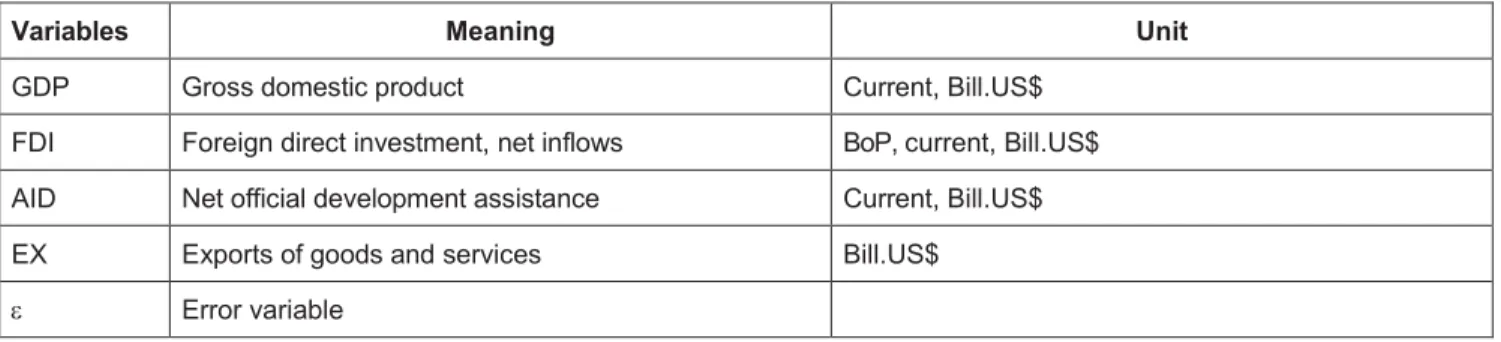
t(2) With the given data, this article perform a linear regression on the relationship between three independent variables (foreign direct investment net inflows, net official development assistance and official aid received, exports of goods and services) and economic growth (real GDP) in Vietnam to analyze the role of each force on economic growth in Vietnam during the period 1997-2018, at the same time to compare the effect degree between factors on economic growth (see Table 1).
4. Results and Discussion 4.1. Descriptive Statistics
The descriptive statistics on the relationship between FDI, aid, export and economic growth in Vietnam are shown in Table 2. Output data shows that mean of real GDP reached USD104.7804 billion; maximum and minimum real GDP was USD244.9480 billion and USD26.84400 billion, respectively. It increased 9.1 times, average annual GDP growth rate was about 6% over the period 1997-2018.
Economic reforms since 1986 have been a big motivation to promote socio-economic development, quickly bringing Vietnam from one poorest country to a low-middle-income country in the world.
Variables
Economic Growth GDP, current
(1997-2018) Foreign Direct Investment
Foreign Aid
Exports of Goods and Services
Figure 1: The relationship between five independent variables and a dependent variable
Table 1: Meaning of Variables
Variables Meaning Unit
GDP Gross domestic product Current, Bill.US$
FDI Foreign direct investment, net inflows BoP, current, Bill.US$
AID Net official development assistance Current, Bill.US$
EX Exports of goods and services Bill.US$
Error variable
Table 2: Descriptive Statistics
GDP FDI AID EX
Mean 104.7804 6.204182 2.279318 85.74495
Maximum 244.9480 15.50000 4.216000 259.5140
Minimum 26.84400 1.298000 0.852000 11.57000
Std. Deviation 73.05194 4.715962 1.065970 76.56992
Observations 22 22 22 22
Vietnam is a developing country that belongs to the group of countries with the highest growth rate in the world for many years now, owing to the contribution of foreign factors, namely, FDI, ODA and exports. Minimum of FDI (net inflows) was USD1.298 billion in 2000, due to the effect of the Asian financial crisis during the period 1997- 1999, FDI inflows to Vietnam gradually decreased from USD2.22 billion in 1997 to USD1.298 billion in 2000, but starting from 2003 gradually recovered in attracting FDI and began to increase sharply from 2007 – about USD6.7 billion to 2018 about USD15.5 billion. The reason is that Vietnam became an official member of the World Trade Organization (WTO) in 2007; also, Vietnam signed and participated in a series of free trade agreements (FTA), and became a highly open economy.
Minimum of foreign aid (net official development assistance and official aid received) was USD0.852 billion in 1997 and gradually increased over the years. The cause of these achievements is that Vietnam has been performing relatively well in receiving and using foreign aid for many years, though there have been issues primarily related to bottlenecks in the implementation of key infrastructure projects rather than restrictions of capacity. In fact, the majority of ODA was spent on infrastructure development to restructure the economy through the application of modern
production methods. However, since Vietnam became a low-middle-income country, ODA into Vietnam has been decreasing during the period 2014-2018, from USD4.216 billion in 2014 to USD1.633 billion in 2018, and is forecasted to continue to fall in the coming years. Besides, corruption in several places, even with projects implemented by reputable partners, has the consequence to reduce the effectiveness of development assistance in benefiting citizens.
Promoting exports is one of the driving forces of
economic growth; Vietnam has been continuously promoting
exploitation of traditional markets and expanding new
markets. Up to now, Vietnam’s export market for goods
and services has been present in over 200 countries and
territories. Important export markets such as the United
States, the European Union (EU), Southeast Asian countries,
Japan, South Korea, and China have experienced high export
turnover growth in the past period, where China and South
Korea are the two markets with the highest average growth
rate, 21.7% and 21.5%, respectively. As a result, annual
average during the period 1997-2018 for the exports of
goods and services reached approximately USD85.74495
billion – the lowest figure was USD11.57 billion in 1997 and
the highest was USD259.514 billion in 2018 (World Bank
Open Data).
Table 3: Correlation Matrix between GDP and Independent Variables.
FDI AID EX GDP
FDI 1
AID 0.611240 1
EX 0.948280 0.572545 1
GDP 0.960143 0.680339 0.988913 1
Table 4: Regression Analysis Results for GDP and Explanatory Variables.
Variable Coefficient Std. Error t-Statistic Prob.
C 4.458885 1.548165 2.880109 0.0100
FDI 1.779350 0.450778 3.947287 0.0009
Aid 10.83698 0.772135 14.03509 0.0000
EX 0.753177 0.026801 28.10271 0.0000
R-squared 0.998570 F-statistic 4189.362
Durbin-Watson stat 1.834989 Prob(F-statistic) 0.000000
250 250 250
200 200 200
150 150 150
100 100 100
50 50 50
0
0 2 4 6 8 10 12 14 16 0
0.8 1.2 1.6 2.0 2.4 2.8 3.2 3.6 4.0 4.4
0
0 50 100 150 200 250 300
FDI AID EX
Figure 2: Residuals of Regression Analysis Results
4.2. Correlation and Regression Analysis
Table 3 shows the correlation analysis undertaken between real GDP and explanatory variables such as FDI, aid, and exports. The impact of factors on real GDP could be positive or negative. The correlation outputs show that there is a positive and significant sign between GDP and FDI, aid, and exports. Thus, FDI, aid and exports have really become important motivations for economic growth in Vietnam for many years.
Table 4 shows the regression results, which indicate that the model is consistent and statistically significant at a 1%
significance level (Prob(F-statistic) = 0.000000). Sign of β
1, β
2, β
3shows that there is a significant positive effect of three independent variables on a dependent variable. Sign of β
0= 4.458885 shows that not only FDI, Aid, and exports affect economic growth, but also other factors that are the driving force for Vietnam’s economic growth in the period 1997- 2018. Further, R-squared = 0.998570, the explanatory level of the determinants of real GDP in terms of R
2by 99.85%.
This means that around 99.85% of variation in real GDP is explained by this model through independent variables such as FDI (net inflows), aid, and exports of goods and services.
The value d of Durbin-Watson test by d = 1.834989 while at 5% level significance (α = 5% = 0.05), sample numbers n = 22, independent variables in the model k’ = 3, inferred dL = 1.053 and dU = 1.664. Due to d
u= 1.664 < d = 1.834989 < 4 - d
u= 2.336, this concludes that the model has not an autocorrelation phenomena. To have a comparison of importance among factors, the author continues to analyze the regression results of each factor (see Figure 2).
4.2.1. Foreign Direct Investment
As analyzed above, empirical evidence previously studied in Vietnam and in other countries suggests that the relationship between FDI and economic growth is a positive sign. This means that attracting FDI inflows will add an important part of capital to total investment capital, an increase in employment and income, a motivation of exports
GDP GDP GDP