First author:Jeon, Gi-Seong, Expressway & Transportation Research Institute, Korea Expressway Corporation, 445-812,
Korea,Tel:+82-31-371-3373, E-mail:[email protected]
Corresponding author:Jeon, Gi-Seong, Expressway & Transportation Research Institute, Korea Expressway Corporation,
445-812, Korea,Tel:+82-31-371-3373, E-mail:[email protected]
Received:12 June, 2013. Revised:8 August, 2013. Accepted:12 August, 2013.
- 41 -
고속도로 비탈면의 식생천이 특성 연구
Ⅰ
전 기 성1)
1)한국도로공사 도로교통연구원
A Study on the Plant Succession Structural Analysis in Expressway Slope
Ⅰ
Jeon, Gi-Seong
1)1)Korea Expressway Corporation, Expressway & Transportation Research Institute.
ABSTRACT
This study was carried out in order to analyze the succession characteristics of the slope of expressways and the results of analysis by collecting and analyzing various literatures and data from 2011 to 2012 and surveying 75 expressway slope, as follows:
The construction methods applied to planting the slope of an expressway can be classified into 4 types including 3 Climber planting methods, 8 Vegetation thick-layer spray work methods, 4 Seed spray work methods, and 4 Stabilization work methods.
The factors which affect the cover degree of the slope of an expressway were found to be development years, gradient, length, and azimuth. Like surrounding forest areas, the expressway slope was analyzed to begin the plant succession 20, 30, and 40 years after development, and plant succession was developed in diversity in a mixed stand forest according to surrounding forest floors.
Species diversity, maximum species diversity, and the evenness of slope facing north were analyzed to be high comparing to those facing east, west, and south according to azimuth of slope.
Species diversity, maximum species diversity, evenness of slope, and the plant succession of
surroundings were analyzed to be high when the gradient of the slope was less than 40°.
The dominant species which success on the slope of an expressway and its surrounding forest area included Miscanthus sinensis var. purpurascens, Zoysia japonica, Pinus thunbergii Parl, Rubus crataegifolius, Lespedeza cyrtobotrya, Amorpha fruticosa, Artemisia princeps var. orientalis, and Oenothera biennis.
Key Words:Cutting slope, Plant succession, Forest stand, Plant coverage.
I. 서 론
도로는 자연환경을 훼손하여 건설되는 경우 가 많은데 도로는 깎기부와 쌓기부가 조성되는 것이 일반적이다.
우리나라의 경우 이러한 비탈면은 여름철 집 중호우시 토사유출, 붕괴 등의 우려가 되어 각 종 안정공법과 녹화공법을 통하여 안정화시키 고 경관을 향상시키는 경우가 많다.
기존에는 비탈면 녹화시 식생기반재취부공법 을 주로 시공할때 일부에서 외래종을 주로 파종 하여 경관을 저해하고, 주변 자연식생의 침입을 막는 경우가 많았다. 특히, 이러한 식생기반재 취부공법은 두껍게 취부되어 파종된 외래종만 의 생육이 왕성하여 생태적으로 균형이 잡히지 않은 경우가 많았다(Kim et al., 2007).
비탈면의 식생은 주변의 입지환경 즉 경사도, 너비, 높이, 방위 등의 영향을 받는데(Jeon, 2004; Kil et al., 2011; Kil et al., 2012) 입지환 경에 따라서도 주변식생의 침입정도가 달라 질 수 있을 것으로 생각한다.
주변 식생의 천이정도는 비탈면의 조성년도와 녹화공법의 시공시기에 따라서 영향을 받을 것 으로 생각되는데 고속도로의 비탈면 조성년수에 따른 주변 식생의 천이정도 규명을 위한 연구는 일부 연구(Jeon, 2004; Korea expressway corpo- ration, 1995)가 진행되었다.
기존의 연구결과 도로비탈면에서는 리기다소나 무, 잔디, 쑥, 산딸기 등이 우점하는 경우와 싸리,
산딸기, 쑥, 억새, 아까시나무 등이 우점하는 경우 가 많았다. 영동고속도로에서는 소나무, weeping lovegrass, 새, tall fescue, 억새 등이 우점하여 외 래종에 의한 녹화가 높은 것으로 분석된 사례가 있다(Jeon, 2004; Korea expressway corporation, 1995). 특히 일부 국도비탈면에서는 tall fescue, orchard grass 등 외래종에 의한 녹화로 비탈면이 외래종에 의한 경관 불량사례가 많았다.
비탈면 녹화의 근본적 취지는 단기적으로는 비탈면의 표면침식을 안정화시키고, 장기적으 로는 주변의 자연식생의 천이를 유도하여 비탈 면의 생태적, 경관적 건강성을 향상시키는 것이 목표라고 할 수 있다(Kim et al., 2006; Kim and Shim, 2009a).
따라서 이 연구에서는 고속도로 개통에 의해 조성된 비탈면 주변의 자연식생이 비탈면에 천 이되는 특성을 규명하고자 수행하였다.
II. 연구방법
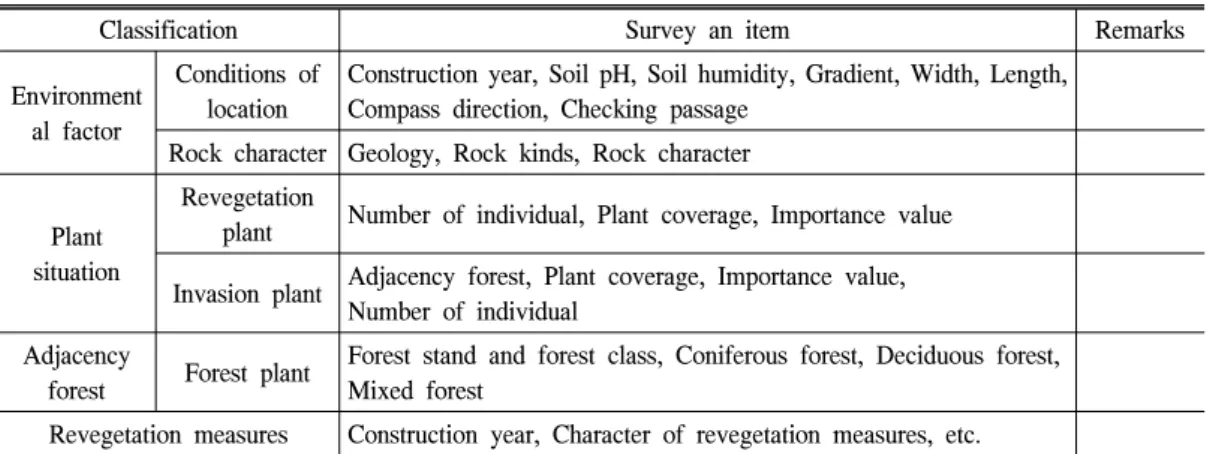
1. 조사 방법 1) 문헌조사
국내외의 연구논문, 보고서, 시방서 등의 자 료를 이용하여 현장조사를 위한 기초자료로 활 용하였다.
2) 현장조사
현장조사는 1969∼1980년대에 건설된 고속
도로 6개노선을 비롯하여 노선과 지역특성을
Table 1. Survey an item of plant by environmental factors of slope.
Classification Survey an item Remarks
Environment al factor
Conditions of location
Construction year, Soil pH, Soil humidity, Gradient, Width, Length, Compass direction, Checking passage
Rock character Geology, Rock kinds, Rock character
Plant situation
Revegetation
plant Number of individual, Plant coverage, Importance value Invasion plant Adjacency forest, Plant coverage, Importance value,
Number of individual Adjacency
forest Forest plant Forest stand and forest class, Coniferous forest, Deciduous forest, Mixed forest
Revegetation measures Construction year, Character of revegetation measures, etc.
고려하여 75개소의 깎기비탈면과 쌓기비탈면을 대상지로 하여 조사를 수행하였다.
현장조사는 밸트트랜젝트법을 이용하여 비탈 면에 9개의 조사구, 산림부와 인접부에 각 3개 소의 조사구를 설치하여 비탈면 조성년수, 방 위, 경사도, 너비 등의 입지인자 조사와 피복도, 수종 및 초종, 개체수 등을 조사하였다(Jeon, 2004; Korea expressway corporation, 1995). 주 변 산림은 침엽수림, 활엽수림, 혼효림 등의 임 상을 조사 분류하고, 세부 식물을 조사하였다.
현장조사는 2011∼2012년 동안 2년에 걸쳐 식물의 생육이 왕성한 7월∼8월에 집중적으로 비탈면의 식물현황을 조사하였다.
2. 분석 방법
1) 입지환경인자 분석
조성년수, 토양습도(%), 토양산도(pH), 경사 도(°), 방위, 배수로 등의 입지인자를 SAS통계 패키지를 이용하여 상관분석을 하였다(Korea expressway corporation, 1995; Jeon, 2004).
2) 식생현황 분석
비탈면에 생육하는 식물 및 주변 산림의 식 물상태 등의 조사자료를 이용하여 다음과 같이 분석하였다.
① 피복도 분석
대상비탈면에 임의의 조사구(4×4m)를 9개소 정하고, 주변 산림에서의 조사구(10×10m)내 식 생의 피복도를 구하여 분석하였다.
② 중요도 및 종다양성 분석
비탈면과 같은 자연식생 훼손지 등의 식생분 석은 일반적으로 Curtis & Mcintosh(1951)방법을 많이 사용하는데 식생조사의 결과로 얻은 자료를 이용하여 상대우점치(중요도․I.V.:Importance Value)를 식물종별로 산출하였다(Jeon, 2004; Korea expressway corporation, 1995)(식 1).
≃
상대밀도 상대피도 상대빈도
(식 1) 그리고 각 조사구에서 중요도가 높은 식물종 을 우점종으로 도출하였다.
종다양도는 각 조사구의 종구성 상태를 나타 내는 척도로서 Shannon(1963)의 종다양도지수 (H')를 산정하였다(식 2).
종다양도(Species Diversity:H') =
∑(ni/N)(log ni/N) (식 2) (N:한 조사구내 총개체수,
ni:한 조사구내 어떤 한 종의 개체수)
Table 2. Classification of revegetation methods by slope field survey.
노 선
공 법
Ulsan Expressway
Gyeongbu Expressway
Namhae Expressway
88Olympic Expressway
Honam Expressway
Jungbu Expressway Total 1969
Constructed 1970 Constructed
1981 Constructed
1984 Constructed
1986 Constructed
1987 Constructed
Climber planting methods
Climbing plant
measures 1 1 1 1 1 5
Wire mesh+Wisteria floribunda(Willd.) De Candolle
2 1 1 4
Net+Parthenocissus tricuspidata (Sieb.&Zucc.) Planchon
1 1 1 3
Vegetation thick-layer spray work
methods
VT-A measures 1 2 1 1 5
VT-B measures 1 1 1 1 4
VT-C measures 1 1 1 3
VT-D measures 1 1 2
VT-E measures 1 1 1 1 1 5
VT-F measures 1 1 1 1 4
VT-G measures 1 1 1 1 1 5
VT-H measures 1 1 2
Hydroseeding work methods
HS-A measures 1 1 2
Seedspray 1 3 1 3 1 1 10
Netting․Carpet
measures 1 1 2
Net + Seedspray 1 1 2 1 1 6
Stabilization work methods
Wire mesh 1 1 1 3
Shotcrete measures 1 1 1 1 4
Shotcrete+Wire mesh 1 1 1 3
Stairs revetment
measures 1 1 1 3
Total 10 14 9 16 14 12 75
각 조사구에서 종다양도의 최대가능치인 최대 종다양도(H'max)는 H'max=logs(s는 종수)식으로 구하고, 상대적 종다양도인 균재도(Evenness; J')는 J'=H'/H'max식으로 산정하였다. 또한 각 조사 구의 우점도(Dominance; D)는 D=1-J' (Whittaker, 1965)식으로 계산하였다.
III. 결과 및 고찰
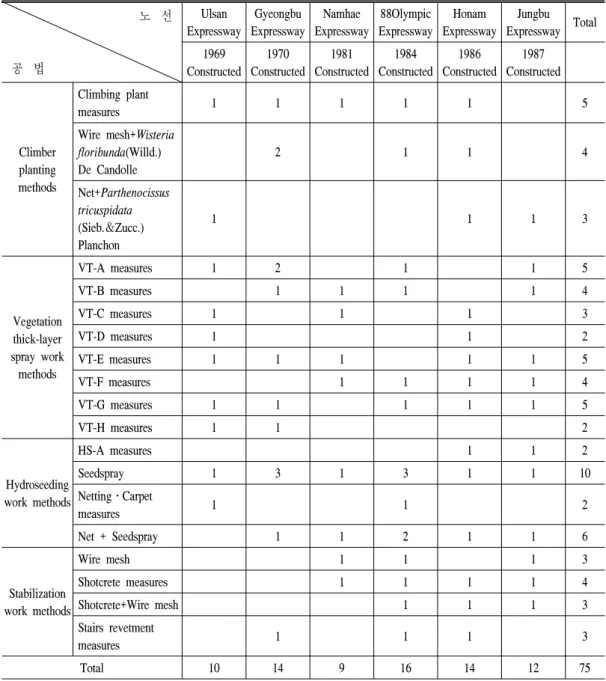
1. 비탈면 조사 녹화공법
노선별 비탈면 녹화공법을 보면 표에서와 같
이 경부선 14개 공법, 88올림픽선 16개 공법,
울산선 10개 공법, 호남선 14개 공법, 중부선
Table 3. The correlations of environmental factor in expressway slopes.
Gradient Com. d. Width Length Con. year Soil pH Soil h. Drainage Coverage Measures Gradient
Com. d.
Width Length Con. year Soil pH Soil h.
Drainage Coverage Measures
1.0000 0.0551*
0.1821*
0.1488*
0.3191**
0.0331 -0.0775 0.4206 -0.4541**
0.3289
1.0000 0.2112 0.2512 -0.1522*
0.0923 -0.3272 0.0871 -0.0945*
-0.0354
1.0000 0.3583 -0.0863*
-0.2345 0.1376 0.1432 -0.2131*
0.3568
1.0000 -0.0923*
-0.0159 -0.1343 0.1421 -0.0310*
-0.0324
1.0000 0.1887 -0.1875 0.1778 -0.1937*
0.2973
1.0000 -0.6688 -0.2345 0.0178 -0.2345
1.0000 -0.0725 0.0682 0.3352
1.0000 -0.1793 0.1982
1.0000
-0.7179 1.0000
※ Com. d.:Compass direction, Con. year:Constructed year, Soil h.:Soil humidity.
※ Significance:*(90 ≤ x < 95), **(95≤ x < 99).
12개 공법, 남해지선 9개 공법으로 조사되었다.
조사대상 고속도로 비탈면녹화에 시공된 공 법의 유형은 크게 4가지 유형으로 분류할 수 있 다(Korea expressway corporation, 1995; Woo et al., 1997; Woo and Jeon, 2005). 공법의 유형은 덩굴식물식재가 3개 공법, 식생기반재취부공법 8개 공법, 종자뿜어붙이기공법류 4개 공법, 안 정공법이 4개 공법으로 분류되었다.
가장 많이 시공한 녹화공법은 종자뿜어붙이 기공법(10개소)이며, 다음은 Net+종자뿜어붙이 기공법(6개소), 덩굴식물식재, VT-A공법, VT-E 공법이 각 5개소 등의 순이었다.
안정공법에는 철망+와이어로프, 숏크리트공 법, 숏크리트+철망+와이어로프, 계단식옹벽 등 이 있는 것으로 조사되었다.
암반으로 주로 조성된 비탈면은 전체 75개소 비탈면중 60개소였으며, 암반비탈면은 주로 안 정공법을 병행하고 있었다.
2. 환경인자별 상관분석
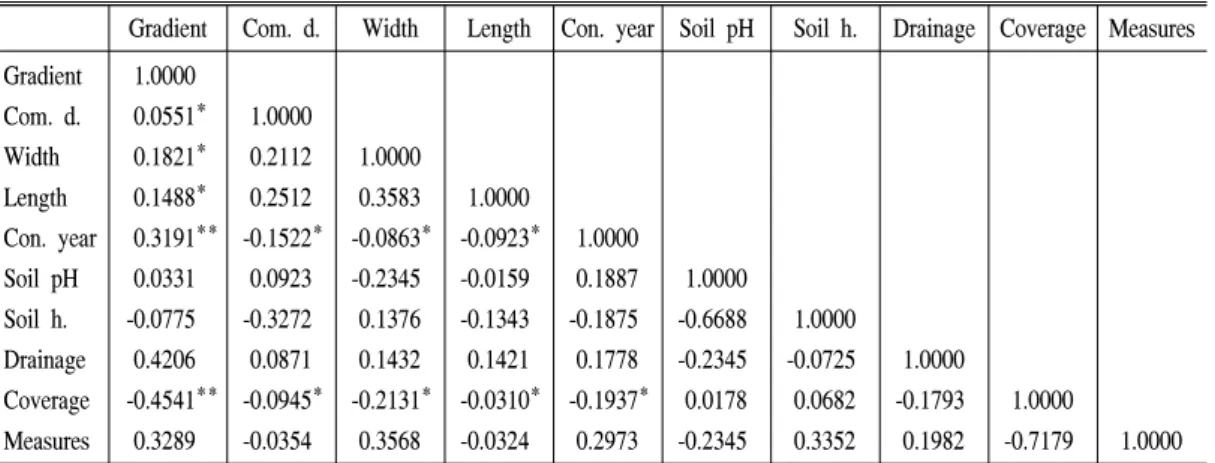
도로 비탈면의 주변 환경인자인 비탈면 조성 년수, 경사도, 방위, 비탈면 길이 등의 환경인자 를 이용하여 Table 3과 같이 상관분석을 실시하 였다.
상관분석에서 비탈면 방위는 4개방위(동, 서, 남, 북)로, 배수로는 양호, 중간, 불량 등으로 더 미변수로 처리하여 분석하였다(Jeon, 2004; Korea expressway corporation, 1995; Lee and Park, 2006).
Table 3에서와 같이 상관분석 결과, 도로 비 탈면의 식생피복도와 관계하여 배수로는 부(-) 의 상관을 나타내고 있으며, 비탈면 조성년수, 경사도, 길이, 너비 등의 인자도 부의 상관을 나 타내었다. 또한, 식생피복도와 상관이 높은 비 탈면경관에 영향을 미치는 인자는 비탈면 조성 년수, 경사도, 비탈면 길이, 방위로 나타났다.
특히, 비탈면 방위와 길이는 상관계수 값이 너 무 낮으나 선행 연구 결과(Jeon,2004; Korea expressway corporation, 1995; Kim et al., 2006) 를 검토하여 볼 때 통계적 유의성은 있어 방위 와 길이도 피복도에 영향을 주는 요인으로 분석 되었다.
3. 환경인자별 식생구조 현황
1) 비탈면 조성년수에 따른 식생구조 분석 조사대상 비탈면의 고속도로 개통년수별(1969
∼1970년 개통, 1981∼1987년 개통) 식생피복
도를 분석한 결과는 Figure 1과 같다.
Table 4. The plant structure by constructed of expressway slopes.
Situation Year of Co. Species diversity Maximum S. D. Evenness Dominance
Forest area
40year of co.
30year of co.
20year of co.
0.8856 0.8574 0.8545
0.9854 0.9772 0.9621
0.8778 0.8321 0.8462
0.1632 0.1884 0.1671
Adjacency forest area
40year of co.
30year of co.
20year of co.
0.8326 0.8244 0.7966
0.9477 0.9372 0.9121
0.8433 0.7921 0.8272
0.1772 0.2346 0.1832
Slope upper area
40year of co.
30year of co.
20year of co.
0.7512 0.7751 0.7472
0.9372 0.9761 0.9288
0.7712 0.7653 0.7747
0.2473 0.2832 0.2761
Slope middle area
40year of co.
30year of co.
20year of co.
0.7031 0.6351 0.6732
0.8472 0.8626 0.8561
0.7658 0.7562 0.7433
0.2452 0.2531 0.2783
Slope lower area
40year of co.
30year of co.
20year of co.
0.6543 0.6372 0.6833
0.8663 0.7324 0.7814
0.7712 0.7336 0.7542
0.2511 0.2732 0.2571
* Year of co.:Year of constructed, Maximum S. D.:Maximum species diversity.
* Co.:Constructed, E.:Expressway
Figure 1. The coverage situation of slopes by constructed of expressway.
Figure 1에서와 같이 개통후 40년 이상, 30년, 20년 이상의 비탈면에서는 피복도의 차이는 없 는 것으로 분석되었다. 조사된 대상지는 모두 시공후 약 20년이 경과한 것으로서 일정기간이 경과하면 녹화상태가 양호한 것으로 분석되며, 녹화상태는 특히 비탈면의 경관에 영향을 준다 (Jeon, 2004; Korea expressway corporation, 1995; Woo and Jeon, 2005).
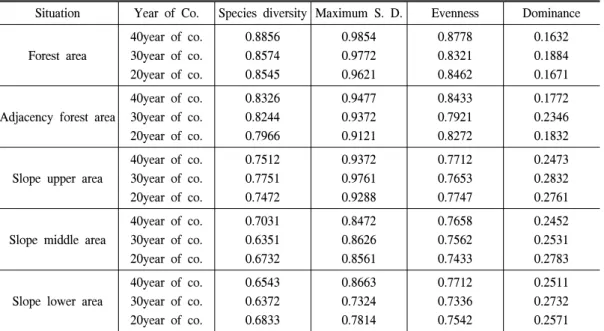
Table 4에서와 같이 경과년수 즉 40년 경과,
30년 경과, 20년 경과시의 산림부에서는 종다양 도, 최대종다양도, 균재도, 우점도에서 큰 차이 를 보이지는 않고 있으나 주변 경계부에 있어서 는 조성년수가 오래될수록 종다양도와 최대종 다양도 등이 높은 값을 보이고 있으며, 주변 산 림부의 식생구조와 유사한 식생구조를 가지는 것으로 분석되었다.
비탈면 상부, 중부, 하부로 내려올수록 균재도 는 떨어지고 우점도는 높아지는데 이것은 40년 경과, 30년 경과, 20년 경과 비탈면 모두에서 같 은 경향을 보이고 있어 비탈면 상부, 중부, 하부 에서는 특정종 즉 외래종의 우점현상이 높다는 것으로 분석되었다(Jeon, 2004; Korea expressway corporation, 1995)
2) 주변 임상에 따른 식생구조
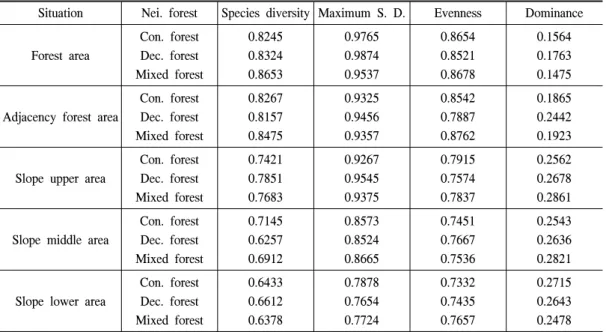
조사대상 비탈면의 주변 산림 임상에 따른 식생구조를 분석한 결과는 Table 5와 같다.
Table 5에서와 같이 주변 산림 임상에 따른
비탈면 식생구조는 침엽수림, 활엽수림에 비해
Table 5. The plant structure by forest stand of expressway slopes.
Situation Nei. forest Species diversity Maximum S. D. Evenness Dominance
Forest area
Con. forest Dec. forest Mixed forest
0.8245 0.8324 0.8653
0.9765 0.9874 0.9537
0.8654 0.8521 0.8678
0.1564 0.1763 0.1475
Adjacency forest area
Con. forest Dec. forest Mixed forest
0.8267 0.8157 0.8475
0.9325 0.9456 0.9357
0.8542 0.7887 0.8762
0.1865 0.2442 0.1923
Slope upper area
Con. forest Dec. forest Mixed forest
0.7421 0.7851 0.7683
0.9267 0.9545 0.9375
0.7915 0.7574 0.7837
0.2562 0.2678 0.2861
Slope middle area
Con. forest Dec. forest Mixed forest
0.7145 0.6257 0.6912
0.8573 0.8524 0.8665
0.7451 0.7667 0.7536
0.2543 0.2636 0.2821
Slope lower area
Con. forest Dec. forest Mixed forest
0.6433 0.6612 0.6378
0.7878 0.7654 0.7724
0.7332 0.7435 0.7657
0.2715 0.2643 0.2478
* Con. forest:Coniferous forest, Dec. forest:Deciduous forest, Maximum S. D.:Maximum species diversity.
서 혼효림일 경우 비탈면 경계부와 상부에서 종 다양도, 최대종다양도와 균재도가 우수하게 분 석되었으며, 우점도는 비교적 낮은 값을 보이고 있었다.
주변 임상에 따라서도 비탈면 중부와 하부 에서는 주로 외래종의 우점으로 인해 비탈면 의 식생천이가 다소 지연되는 것으로 분석되 었다.
3) 비탈면 방위에 따른 식생구조
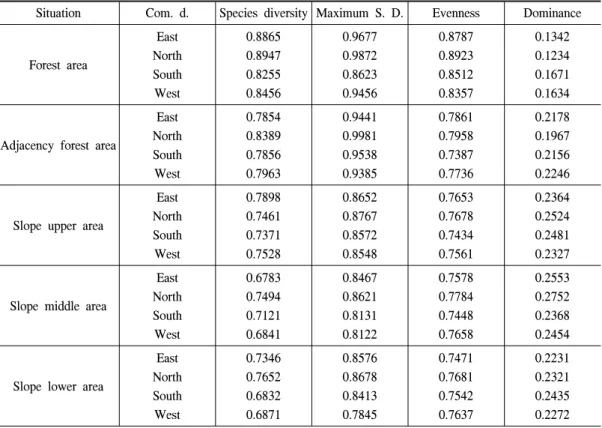
조사대상 비탈면의 방위에 따른 식생구조를 분석한 결과는 Table 6과 같다.
비탈면의 방위에 따른 식생구조를 분석해 보 면 동향, 서향, 남향에 비해서 북향의 종다양도, 최대종다양도, 균재도 등이 높은 값을 보이고 있으며, 북향에서의 식물생육이 우수한 것으로 나타났다. 이것은 북향일 수록 빛이 적게 들어 토양내의 수분유지와 관련성이 높은 것으로 생각 된다(Jeon, 2004; Korea expressway corporation, 1995; Woo and Jeon, 2005). 산림부와 주변 경
계부의 종다양도, 최대종다양도, 균재도가 높게 나타났고, 비탈 상부, 중부, 하부에서는 이들값 이 비교적 낮은 값으로 분석되었고, 우점도의 값이 높게 분석되었다.
4) 비탈면 경사도에 따른 식생구조
조사대상 비탈면의 경사도에 따른 식생구조 를 분석한 결과는 Table 7과 같다.
비탈면 경사도에 따른 식생구조를 분석해 보 면, 40° 이하일 때 종다양도, 최대종다양도, 균 재도 등이 높게 나타났고, 61° 이상의 비탈면에 서는 낮게 나타나 비탈면의 경사도는 식생구조 에 영향을 미치는 중요한 인자로 분석되었다.
비탈면 경사도에 따라서 우점도는 큰 차이를
보이지 않았고, 비탈면의 산림부, 경계부, 비탈
상부, 중부, 하부 등의 위치에 따라서 우점도의
차이가 있었다. 이상의 결과는 기존의 연구결과
(Jeon, 2004; Korea expressway corporation,
1995; Woo and Jeon, 2005)와 유사한 결과를
보였다. 경사도는 토질, 비탈면 길이 등의 영향
Table 6. The plant structure by compass direction of expressway slopes.
Situation Com. d. Species diversity Maximum S. D. Evenness Dominance
Forest area
East North South West
0.8865 0.8947 0.8255 0.8456
0.9677 0.9872 0.8623 0.9456
0.8787 0.8923 0.8512 0.8357
0.1342 0.1234 0.1671 0.1634
Adjacency forest area
East North South West
0.7854 0.8389 0.7856 0.7963
0.9441 0.9981 0.9538 0.9385
0.7861 0.7958 0.7387 0.7736
0.2178 0.1967 0.2156 0.2246
Slope upper area
East North South West
0.7898 0.7461 0.7371 0.7528
0.8652 0.8767 0.8572 0.8548
0.7653 0.7678 0.7434 0.7561
0.2364 0.2524 0.2481 0.2327
Slope middle area
East North South West
0.6783 0.7494 0.7121 0.6841
0.8467 0.8621 0.8131 0.8122
0.7578 0.7784 0.7448 0.7658
0.2553 0.2752 0.2368 0.2454
Slope lower area
East North South West
0.7346 0.7652 0.6832 0.6871
0.8576 0.8678 0.8413 0.7845
0.7471 0.7681 0.7542 0.7637
0.2231 0.2321 0.2435 0.2272
* Com. d.:Compass direction, Maximum, S. D.:Maximum species diversity.
Table 7. The plant structure by gradient of expressway slopes.
Situation Gradient Species diversity Maximum S. D. Evenness Dominance
Forest area
40° below 41∼60°
61° above
0.8963 0.8736 0.8978
0.9972 0.9884 0.9531
0.9126 0.8951 0.8863
0.1262 0.1431 0.1532
Adjacency forest area
40° below 41∼60°
61° above
0.8657 0.8156 0.7841
0.9773 0.9565 0.9355
0.8367 0.8278 0.8156
0.1663 0.1721 0.1964
Slope upper area
40° below 41∼60°
61° above
0.7368 0.7154 0.6851
0.8986 0.8325 0.8146
0.7872 0.7831 0.7892
0.2157 0.2351 0.2465
Slope middle area
40° below 41∼60°
61° above
0.6784 0.6887 0.6265
0.8715 0.8166 0.7978
0.7662 0.7834 0.7543
0.2853 0.2252 0.2467
Slope lower area
40° below 41∼60°
61° above
0.6432 0.6253 0.6176
0.8156 0.8024 0.7821
0.7682 0.7726 0.7553
0.2577 0.2331 0.2663
* Maximum S. D.:Maximum species diversity.
Table 8. The importance value and dominance of plant in survey slopes.
Forest area First Second Third Fourth Fifth
Ulsan Expressway
Miscanthus sinensis Andersson(0.4123)
Artemisia princeps Pampanini (0.1321)
Salix gracilistyla Miquel(0.1757)
Erigeron canadensis Linne(0.0525)
Alnus japonica(Thunb.) Steudel(0.0673) Gyeongbu
Expressway
Zoysia japonica Steudel (0.6171)
Arundinella hirta(Thunb.) C. Tanaka(0.1287)
Potentilla freyniana Bornmuller(0.5724)
Populus tomentiglandulosa T. Lee(0.0957)
Oenothera stricta Ledebour(0.04531) Namhae
Expressway
Pinus thunbergii Parlatore (0.5671)
Zoysia japonica Steudel (0.4232)
Amorpha fruticosa Linne(0.3162)
Arundinella hirta(Thunb.) C. Tanaka(0.0662)
Miscanthus sinensis Andersson(0.0532) 88Olympic
Expressway
Rubus crataegifolius Bunge (0.3421)
Festuca arundinacea(T.F.) (0.3236)
Miscanthus sinensis Andersson(0.2146)
Festuca ovina Linne(0.1522)
Eragrostis curvula (W.L.G.)(0.0631)
Honam Expressway
Wisteria floribunda(Willd.) De Candolle(0.5722)
Pueraria thunbergiana(Sieb.&Zucc.)
Bentham(0.4462)
Humulus japonicus Siebold et Zuccarini(0.1253)
Dystaenia takeshimana (Nak.) Kitagawa(0.0773)
Viola mandshurica W.
Becker(0.0565)
Jungbu Expressway
Amorpha fruticosa Linne(0.3461)
Parthenocissus tricuspidata(Sieb. & Zucc.)
Planchon(01361)
Kummerowia striata Schindler(0.1156)
Pueraria thunbergiana(Sieb.&Zucc.)
Bentham(0.0972)
Humulus japonicus Siebold et Zuccarini(0.0756)
Adjacency forest
area First Second Third Fourth Fifth
Ulsan Expressway
Arundinella hirta(Thunb.) C. Tanaka(0.2221)
Themeda triandra Forskal var. Japonica (Willd.)
Makino(0.2143)
Amorpha fruticosa Linne (0.1613)
Lespedeza cyrtobotrya Miquel(0.1335)
Rubus crataegifolius Bunge (0.0741)
Gyeongbu Expressway
Zoysia japonica Steudel (0.6217)
Arundinella hirta(Thunb.) C. Tanaka(0.1314)
Potentilla freyniana Bornmuller(0.5724)
Populus tomentiglandulosa T. Lee(0.0927)
Oenothera stricta Ledebour (0.0676)
Namhae Expressway
Lespedeza cyrtobotrya Miquel(0.4435)
Cymbopogon tortilis (Presl) Hitchcock var.
goeringii(Steud.) Handel-Mazzetti(0.3241)
Imperata cylindrica(L.) Beauvois var.
koenigii(Retz.) Durand et Schinz(0.1422)
Dactylis glomerafa L.
(O.R.G.)(0.0921)
Robinia pseudoacacia Linne (0.0356)
88Olympic Expressway
Rubus crataegifolius Bunge(0.3321)
Festuca arundinacea(T.F.) (0.2331)
Miscanthus sinensis Andersson(0.1325)
Festuca ovina Linne (0.1161)
Eragrostis curvula (W.L.G.) (0.0872)
Honam Expressway
Zoysia japonica Steude (0.4123)
Robinia pseudoacacia Linne (0.2112)
Cymbopogon tortilis (Presl) Hitchcock var. goeringii
(Steud.) Handel-Mazzetti(0.1332)
Persicaria hydropiper (L.) Spach(0.1257)
Kummerowia striata Schindler(0.0831)
Jungbu Expressway
Artemisia princeps Pampanini(0.5221)
Rubus crataegifolius Bunge (0.3123)
Festuca ovina Linne (0.1455)
Robinia pseudoacacia Linne (01245)
Artemisia capillaris Thunberg(0.0868)
Slope upper area First Second Third Fourth Fifth
Ulsan Expressway
Zoysia japonica Steudel (0.5143)
Artemisia princeps Pampanini(0.2411)
Salix gracilistyla Miquel (0.1467)
Erigeron canadensis Linne (0.0631)
Alnus japonica(Thunb.) Steudel(0.0672)
Gyeongbu Expressway
Oenothera erythrosepala Borbas(0.3141)
Commelina communis Linne (0.2242)
Artemisia princeps Pampanini(0.1522)
Taraxacum officinale Weber (0.0862)
Pueraria thunbergiana (Sieb.&Zucc.) Bentham(0.0724) Namhae
Expressway
Pinus thunbergii Parlatore (0.6371)
Zoysia japonica Steudel (0.4242)
Amorpha fruticosa Linne (0.2561)
Arundinella hirta(Thunb.) C. Tanaka(0.0763)
Miscanthus sinensis Andersson(0.0635)
을 받으므로 이에 대해서도 추가적인 분석이 필 요하였다(Kil et al., 2011; 2012).
4. 식생 우점도 분석
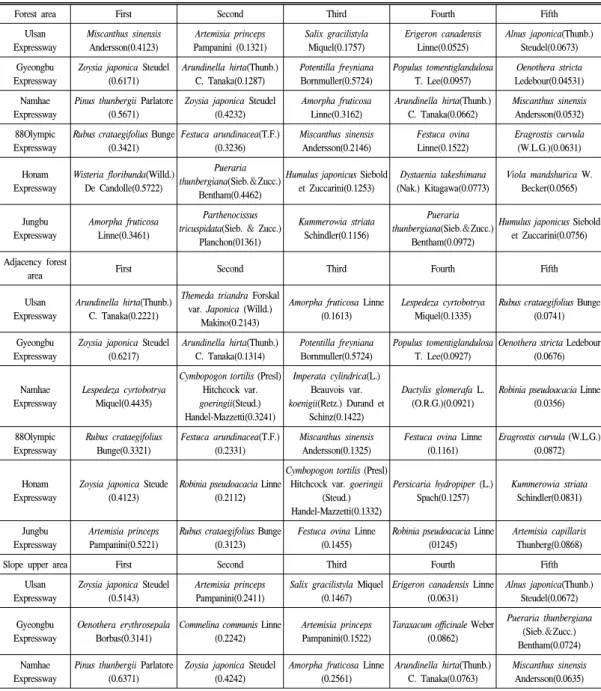
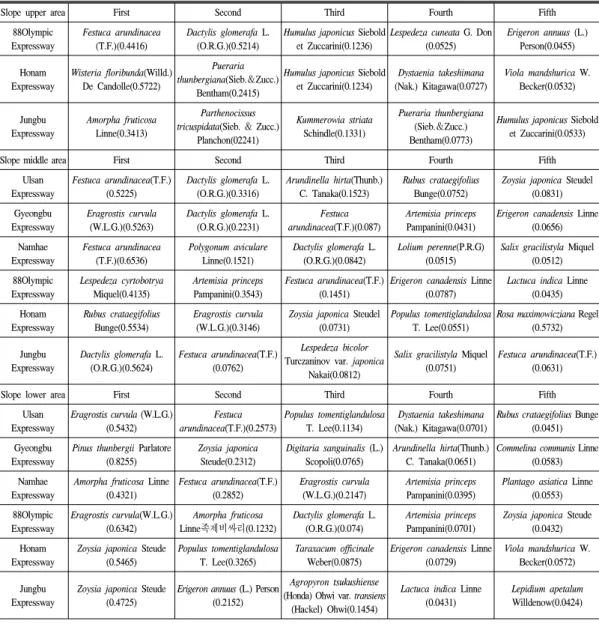
조사대상지의 우점식생현황을 노선별로 분석 해 보면 Table 8과 같다.
Table 8에서와 같이 재래종의 경우 대부분의 우
점종은 억새, 잔디, 해송, 산딸기, 참싸리, 족제비
싸리, 쑥, 달맞이꽃 등이 주로 우점하였다. 외래종
은 Tall fescue, Weeping lovegrass, Orchardgrass,
Perennial ryegrass 등이 주로 우점하여 생육하고
있었다.
Table 8. Continued.
Slope upper area First Second Third Fourth Fifth
88Olympic Expressway
Festuca arundinacea (T.F.)(0.4416)
Dactylis glomerafa L.
(O.R.G.)(0.5214)
Humulus japonicus Siebold et Zuccarini(0.1236)
Lespedeza cuneata G. Don (0.0525)
Erigeron annuus (L.) Person(0.0455)
Honam Expressway
Wisteria floribunda(Willd.) De Candolle(0.5722)
Pueraria thunbergiana(Sieb.&Zucc.)
Bentham(0.2415)
Humulus japonicus Siebold et Zuccarini(0.1234)
Dystaenia takeshimana (Nak.) Kitagawa(0.0727)
Viola mandshurica W.
Becker(0.0532)
Jungbu Expressway
Amorpha fruticosa Linne(0.3413)
Parthenocissus tricuspidata(Sieb. & Zucc.)
Planchon(02241)
Kummerowia striata Schindle(0.1331)
Pueraria thunbergiana (Sieb.&Zucc.) Bentham(0.0773)
Humulus japonicus Siebold et Zuccarini(0.0533)
Slope middle area First Second Third Fourth Fifth
Ulsan Expressway
Festuca arundinacea(T.F.) (0.5225)
Dactylis glomerafa L.
(O.R.G.)(0.3316)
Arundinella hirta(Thunb.) C. Tanaka(0.1523)
Rubus crataegifolius Bunge(0.0752)
Zoysia japonica Steudel (0.0831) Gyeongbu
Expressway
Eragrostis curvula (W.L.G.)(0.5263)
Dactylis glomerafa L.
(O.R.G.)(0.2231)
Festuca arundinacea(T.F.)(0.087)
Artemisia princeps Pampanini(0.0431)
Erigeron canadensis Linne (0.0656) Namhae
Expressway
Festuca arundinacea (T.F.)(0.6536)
Polygonum aviculare Linne(0.1521)
Dactylis glomerafa L.
(O.R.G.)(0.0842)
Lolium perenne(P.R.G) (0.0515)
Salix gracilistyla Miquel (0.0512) 88Olympic
Expressway
Lespedeza cyrtobotrya Miquel(0.4135)
Artemisia princeps Pampanini(0.3543)
Festuca arundinacea(T.F.) (0.1451)
Erigeron canadensis Linne (0.0787)
Lactuca indica Linne (0.0435) Honam
Expressway
Rubus crataegifolius Bunge(0.5534)
Eragrostis curvula (W.L.G.)(0.3146)
Zoysia japonica Steudel (0.0731)
Populus tomentiglandulosa T. Lee(0.0551)
Rosa maximowicziana Regel (0.5732)
Jungbu Expressway
Dactylis glomerafa L.
(O.R.G.)(0.5624)
Festuca arundinacea(T.F.) (0.0762)
Lespedeza bicolor Turczaninov var. japonica
Nakai(0.0812)
Salix gracilistyla Miquel (0.0751)
Festuca arundinacea(T.F.) (0.0631)
Slope lower area First Second Third Fourth Fifth
Ulsan Expressway
Eragrostis curvula (W.L.G.) (0.5432)
Festuca arundinacea(T.F.)(0.2573)
Populus tomentiglandulosa T. Lee(0.1134)
Dystaenia takeshimana (Nak.) Kitagawa(0.0701)
Rubus crataegifolius Bunge (0.0451) Gyeongbu
Expressway
Pinus thunbergii Parlatore (0.8255)
Zoysia japonica Steude(0.2312)
Digitaria sanguinalis (L.) Scopoli(0.0765)
Arundinella hirta(Thunb.) C. Tanaka(0.0651)
Commelina communis Linne (0.0583) Namhae
Expressway
Amorpha fruticosa Linne (0.4321)
Festuca arundinacea(T.F.) (0.2852)
Eragrostis curvula (W.L.G.)(0.2147)
Artemisia princeps Pampanini(0.0395)
Plantago asiatica Linne (0.0553) 88Olympic
Expressway
Eragrostis curvula(W.L.G.) (0.6342)
Amorpha fruticosa Linne족제비싸리(0.1232)
Dactylis glomerafa L.
(O.R.G.)(0.074)
Artemisia princeps Pampanini(0.0701)
Zoysia japonica Steude (0.0432) Honam
Expressway
Zoysia japonica Steude (0.5465)
Populus tomentiglandulosa T. Lee(0.3265)
Taraxacum officinale Weber(0.0875)
Erigeron canadensis Linne (0.0729)
Viola mandshurica W.
Becker(0.0572)
Jungbu Expressway
Zoysia japonica Steude (0.4725)
Erigeron annuus (L.) Person (0.2152)
Agropyron tsukushiense (Honda) Ohwi var. transiens
(Hackel) Ohwi(0.1454)
Lactuca indica Linne (0.0431)
Lepidium apetalum Willdenow(0.0424)
* W.L.G.:Weeping lovegrass, O.R.G.:Orchardgrass, P.R.G.:Perennial ryegrass, T.F.:Tall fescue.
현장조사에서 대부분 주변에서 침입이 잘되 는 선구수종은 산딸기나무, 쑥, 새, 억새, 소나 무, 해송 등이 선구수종으로 침입하여 비탈면의 녹화식물과 경쟁 생육하고 있었다(Jeon, 2004;
Korea expressway corporation, 1995; Woo and Jeon, 2005; Kim and Shim, 2009b).
중요도 측면에서도 유사하여 싸리, 새, 리기 다소나무, 해송, 산딸기나무, 잔디, 쑥류와 외래
종은 Orchardgrass, Perennial ryegrass, Weeping lovegrass 등이 중요도가 높게 나타나 이들 종이 피복효과를 높이는 것으로 분석되었다. 하지만 Weeping lovegrass는 재래초종의 침입을 억제 하므로 이에 대한 사용을 제한하는 것이 필요하 다고 생각한다(Jeon, 2004; Korea expressway corporation, 1995).
고속도로 비탈면의 경우 20년 이상 된 녹화
시공지에서는 주변 자연식생의 천이가 원활하 게 이루어지는 것으로 생각되며, 외래종과 재래 종의 적정 배합에 의해서 비탈면 녹화에 대한 자연천이의 지속적인 모니터링을 수행하여 우 리나라에 적합한 녹화수종을 개발하는데 기초 자료를 제시해야 한다고 생각한다.
IV. 결 론
이 연구는 고속도로 비탈면의 천이특성을 분 석하기 위해, 2011년부터 2012년까지 문헌과 자료를 수집․분석하고, 고속도로 비탈면 75개 소의 비탈면을 현장 조사․분석한 결과는 다음 과 같다.
1. 우리나라 고속도로 비탈면 녹화에 시공된 공법의 유형은 4가지 유형으로 분류할 수 있으 며, 덩굴식물식재공법 3개 공법, 식생기반재취 부 8개 공법, 종자뿜어붙이기공법류 4개 공법, 안정공법 4개 공법으로 분석되었다.
2. 고속도로 비탈면의 피복도에 영향을 주는 주요 인자는 비탈면 조성년수, 경사도, 길이, 방 위로 분석되었다.
3. 조성년수 40년, 30년, 20년이 지난 비탈면 의 경우 주변 산림부와 같이 식물천이가 진행되 는 것으로 분석되었으며, 주변 임상에 따라 혼 효림에서 식물천이가 다양하게 나타나는 것으 로 분석되었다.
4. 비탈면의 방위에 따라서는 동향, 서향, 남 향에 비해서 북향의 비탈면이 종다양도, 최대종 다양도, 균재도 등이 우수하게 분석되었다.
5. 비탈면의 경사도에 따른 식생구조를 보면 40° 이하일 때 종다양도, 최대종다양도, 균재도 등이 우수하게 분석되었으며, 경사도와 주변의 토질, 비탈면 길이에 대한 보완분석이 필요하 였다.
6. 고속도로 비탈면에서 주변 산림부에서 천 이되는 우점종은 억새, 잔디, 해송, 산딸기, 참싸 리, 족제비싸리, 쑥, 달맞이꽃 등이 우수하였다.
인 용 문 헌