2009년도 춘계 학술발표회 논문집 대한방사선방어학회
174 _http://www.karp.or.kr
Effects of N-acetyl-L-cysteine (NAC) on Radiation-induced Cytotoxicity in Fish Hepatoma Cells
Min Han1), Kyung Man Hyun1), Tae Ho Ryu1), Mohammad Nili2), Jin Kyu Kim1)
1Korea Atomic Energy Research Institute, Advanced Radiation Technology Institute, Jeongeup 580-185, Korea
2Dawnesh Radiation Research Institute, Barcelona 08007, Spain E-mail: [email protected]
Key words : protective effects, NAC, radiation, PLHC-1 cells
Introduction
N-acetyl-L-cysteine (NAC) is one of well-known sulfhydryl-containing antioxidants, whose role in radioprotection has been explored in several studies [1-3]. The antioxidant property of NAC can be attributed to its ability to provide cysteine and other precursors of glutathione synthesis, as well as its ability to directly scaveng free radicals [4]. With regard to the radioprotective effects of NAC, the majority of studies have been performed in vitro [5-6]. NAC were used to protect the CHO (Chinese hamster ovary) cells from radiation-induced apoptosis by controlling the enzyme that triggers programmed cell death [7].
This study was designed to evaluate the radioprotective effects of NAC in different doses on the cell viability in fish cell line induced by ionizing radiation.
Materials and Methods
Cells and culture conditions
PLHC-1 cells were derived from a hepatocellular carcinoma in an adult female (Poeciliopsis Lucida), a topminnow from the
Sonoran desert (ATCC®#CRL-2406). PLHC-1 cells were cultured in EMEM suplemented with 5%
fetal bovine serum (FBS) and incubated at 30℃ in a humidified atmosphere with 5% CO2.
Irradiation and NAC treatments of cells
PLHC-1 cells were seeded in 96-well plates at a density of 2 x 10⁵ cells/㎖ and incubated for 24 hr.
Then cells were treated γ-rays from a 60Co γ-ray source (Korea Atomic Energy Research Institute, Korea) with 50∼300 Gy in the presence or absence of 0.05∼1.25 mM of NAC which were added 1 hr before.
Cell viability assay
To assess cell viability, 10㎕ of MTT solution was added to each well after removal of 100㎕
supernatant and incubated for another 4 hr at 30°C.
The generated formazan crystal was dissolved and the absorbance was detected at 570nm using ELISA reader (MultiskanⓇEX, Forma Scientific, Inc.).
Results and Discussion
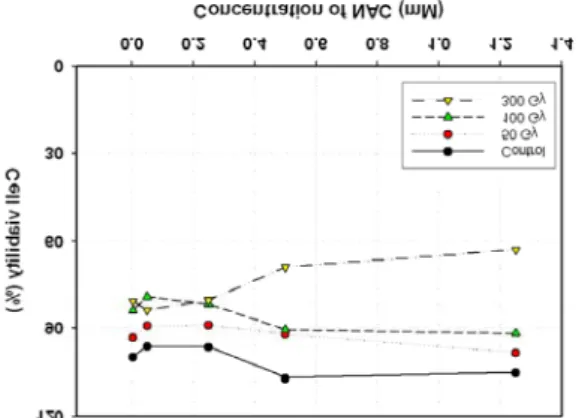
The cell viability of NAC pretreated groups was higher than that of 50 and 100 Gy radiation-
2009년도 춘계 학술발표회 논문집 대한방사선방어학회
대한방사선방어학회_175
treated groups without NAC. The results showed that NAC prevented cells from radiation-induced death, but it caused cytotoxicity in 300 Gy radiation-treated groups as its concentration increases. While NAC has been used as radioprotective agent in lower concentrations it is cytotoxic at high concentration. The radioprotective effect of NAC was assessed after exposure to HgCl2 combined with 4-nonylphenol [8]. The result showed that cell death was prevented in the group pretreated with NAC . The potential utility of NAC in lower concentrations as a protector against radiation is worth considering here.
Fig. 1. Protective effects of NAC in radiation-induced cytotoxicity.
Conclusion
Protective effects of NAC were assessed using PLHC-1 cells, irradiated with 50~300 Gy. The data showed that NAC in lower concentrations prevented cell death after irradiation. Theses results suggest that NAC may be able to attenuate radiation-induced cytotoxicity. Also, this investigation give a clue for fundamental theories associated with positive efficacy of radiation applications including radioprotection.
Reference
1. R. Neal, R. H. Matthews, P. Lutz, N. Ercal, Antioxidant role of N-acetylcysteine isomers following high dose irradiation, Free Radical Biology and Medicine, 34, 689-695(2003)
2. J. S. Murley, Y. kataoka, D. Cao, J. J. Li, L. W.
Oberley, D. J. Grdina, Delayed radioprotection by NF kappaB-mediated induction of Sod2 (MnSOD) in SA-NH tumor cells after exposure to clinically used thiol-containing drugs, Radiation Research, 62, 536-546(2004)
3. N. Morley, A. Curnow, L. Salter, s. Campbell, D.
Gould, N-acetyl-L-cysteine prevents DNA damage induced by UVA, UVB and visible radiation in human fibroblasts, J. of Photochemistry and Photobiology, 72, 55-60(2003)
4. G. S. Kelly, Clinical applications of N-acetylcysteine, Alternative Medicine Review, 3, 114-127(1998) 5. P. Sminia, A. H. Van der Kracht, W. M. Frederiks,
W. Jansen, Hyperthermia, radiation carcinogenesis and the protective potential of vitamin A and N-acetylcysteine, J. of Cancer Res. Clin. Oncol, 122, 343-350(1996)
6. G. Abt, H. Vaghef, E. Gebhart, C. V. Dahlgren, B.
Hellman, The role of N-acetylcysteine as a putative radioprotective agent on X-ray-induced DNA damage as evaluated by alkaline single-cell gel electrophoresis, Mutat. Res, 384, 55-64(1997) 7. W. Wu, L. Abraham, J. Ogony, R. Matthews, G.
Goldstein, N. Ercal, Effects of N-acetylcysteine amide (NACA), a thiol antioxidant on radiation-induced cytotoxicity in Chinese hamster ovary cells, Life Sci., 82, 1122-1130(2008)
8. S. H. Lee, M. J. Cha, C. K. Kang, E. T. Sohn, H.
K. Lee, A. Munawir, J. S. Kim, E. K. Kim, Mutual synergistic toxicity between environmental toxicants: A study of mercury chlorede and 4-nonylphenol, Environmental Toxicology and Pharmacology, 27, 90-95(2009)