Incontinentia Pigmenti with Multiple Missing Teeth : Case Reports
Shinae Choi, Youngjin Kim, Soonhyeun Nam, Hyunjung Kim
Department of Pediatric Dentistry,School of Dentistry, Kyungpook National University
Incontinentia pigmenti, also called Bloch-Sulzberger syndrome, is a rare X-linked inherited dominant disorder that affects females, but causes spontaneous abortion of prenatal males. Incontinentia pigmenti is a systemic disease with clinical features similar to ectodermal dysplasia, including congenitally missing teeth. The pathogenesis is related to gene mutations in NF-kappa-B essential modulator on chromosome Xq28.
Incontinentia pigmenti is caused by a defect in the developmental stage of organs originating from the ectoderm or mesoderm and involves the skin, eyes, hair, teeth and central nervous system. This report discusses the management of three cases of 3 to 5 years old females with incontinentia pigmenti and accompanying multiple missing teeth. The cases had sparse hair, and showed oligodontia and anomalous crowns with supplementary cusps in the posterior teeth and conical anterior teeth. Removable space maintainers were applied, achieving improved esthetics, recovery of mastication and increased self-esteem in the patients.
Key words :
Incontinentia pigmenti, Congenital missing, Ectodermal dysplasia Abstract
Ⅰ. Introduction
Several systemic diseases involve congenitally missing teeth, such as ectodermal dysplasia, cleft, Rieger syn- drome, Down’ s syndrome and incontinentia pigmenti (IP). As both ectodermal dysplasia and IP arise from mutations in the NF-kappa-B essential modulator (NEMO) gene, they share similar congenital sympto- matic clinical and dental manifestations such as missing or deformed teeth.
IP is a rare X-linked dominant disorder expressed in 1 in 40,000 females
1). This genodermatosis affects females, but causes spontaneous abortion of prenatal males
2-5). IP involves tissues and organs that originate from the ecto-
derm and mesoderm, including cutaneous tissue, hair, eyes, central nervous system and teeth
6,7).
Cutaneous manifestations of IP are common and occur in four phases. In addition to cutaneous manifestations, dental manifestation in patients with IP can be found with frequency, affecting both primary and permanent dentition
8). Hypodontia is the most frequent dental ab- normality and occurs in 43% of patients, followed by conical and pegged teeth
9-11).
This report described the dental treatment in three patients with IP based on clinical and radiological find- ings. We suggest that a valid treatment plan for patients with IP should be based on precise diagnosis by evaluat- ing clinical and radiographic symptoms.
Corresponding author : Hyunjung Kim
Department of Pediatric Dentistry, School of Dentistry, Kyungpook National University, 2177 Dalgubeol-daero, Jung-gu, 700-412, Korea Tel: +82-53-600-7211 / Fax: +82-53-426-6608 / E-mail: [email protected]
Received October 13, 2014 / Revised December 2, 2014 / Accepted December 2, 2014
※This research was supported by Kyungpook National University Research Fund, 2014.
Ⅱ. Case Reports 1. Case 1
A 3-year-old female with IP visited the pediatric den- tistry clinic due to lack of eruption. The patient’ s 5- year-old sister (Case 2) also showed multiple congenital- ly missing teeth. Both of them were diagnosed as IP at the pediatric dentistry of Kyungpook National University Hospital. The patient had sparse hair and eyebrows as extraoral manifestations (Fig. 1). However, neither spe- cific cutaneous manifestations nor systemic symptoms were apparent.
Oral examination revealed marginal alveolar resorp- tion with congenitally missing teeth in the right maxil-
lary first primary molar position and the right and left mandibular first and second primary molar positions. In addition, the patient had conically shaped primary ca- nines in all four quadrants (Fig. 2). Radiographic exami- nation showed that a total of 12 permanent teeth were missing, including the second molar and the first and second premolars in all four quadrants in the panoramic view (Fig. 3). Therefore, to resolve mastication and es- thetic problems caused by multiple congenitally missing teeth, we applied removable space maintainer containing pontics of the missing primary molars (Fig. 4). After fit- ting the removable space maintainer, the patient re- ceived regular check-ups every 6 months for fluoride ap- plication and oral hygiene instruction for prevention of caries.
Fig. 1. Extraoral view of thin and sparse hair.
Fig. 2. Intraoral view revealing the absence of multiple primary teeth.
Fig. 3. Panoramic radiograph indicating the absence of multiple primary and permanent teeth.
Fig. 4. Post-treatment photographs. A removable space maintainer was placed in the mandible.
2. Case 2
A 5-year-old female (the sister of Case 1) visited the pediatric dentistry clinic because of unerupted teeth.
Similar to Case 1, this patient was diagnosed with IP and had sparse hair and negligible eyebrows, but had no signs of systemic illness (Fig. 5).
Oral examination revealed marginal alveolar resorp- tion and congenitally missing teeth in the positions of lateral primary incisors in all four quadrants, the left maxillary first primary molar, and the right and left mandibular first primary molars. In addition, the patient had conical-shaped primary canines (Fig. 6).
A panoramic radiograph confirmed the absence of mul-
tiple congenital permanent teeth. The patient had a to- tal of 17 missing teeth: the lateral incisors and second molars in all four quadrants, the right maxillary first molar and canine, the left maxillary canine and first and second premolars, the left mandibular first molar and second premolar, and the right and left mandibular first premolars (Fig. 7).
As Case 2 had more missing primary teeth than Case 1, Case 2 had greater problems with mastication using primary molars and esthetic appearance. To restore masticatory and esthetic functions, removable space maintainers including pontics were applied on both the maxillary and mandibular primary molar areas (Fig. 8).
After treatment using removable space maintainers, the
Fig. 5. Extraoral view of thin and sparse hair.
Fig. 6. Intraoral view indicating the absence of multiple primary teeth.
Fig. 7. Panoramic radiograph revealing the absence of multiple primary and permanent teeth.
Fig. 8. Post-treatment photographs. Removable space maintainers were placed in the maxilla and mandible.
patient received regular check-ups every 6 months for fluoride application and oral hygiene management.
Prosthetic rehabilitation was planned upon completion of growth.
3. Case 3
A 4-year-old female was seen at the pediatric den- tistry clinic due to anterior cross bite and congenitally missing teeth. The patient was diagnosed with IP at the pediatric dentistry of Kyungpook National University Hospital and extraoral examination revealed features such as thin hair, scant eyebrows and mandibular prog- nathism (Fig. 9).
Oral examination revealed missing teeth in the right and left maxillary lateral incisors, left maxillary second primary molars, and left mandibular first and second primary molar positions. In addition, peg-shaped anteri- or teeth and enamel defects in the distal area of the left maxillary incisor were noted along with extrusion ten- dency of the left maxillary first primary molar due to the absence of an antagonistic mandibular primary molar
(Fig. 10). Prosthetic restoration was expected to be com- plicated by the missing succedaneous permanent teeth that caused alveolar bone resorption in the left mandibular area. In addition, the patient had an esthet- ic issue due to an anterior cross bite.
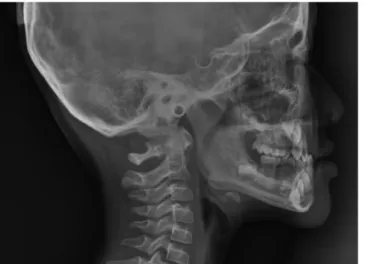
Panoramic radiograph revealed a total of 14 congeni- tally missing teeth: right and left maxillary second mo- lars, first and second premolars, lateral incisors, right and left mandibular second molars and second premo- lars, and right mandibular first molar and first premolar teeth (Fig. 11). Lateral cephalogram and cephalometric analysis indicated anterior crossbite and mandibular prognathism (Table 1, Fig. 12).
In addition to esthetic issues, the patient required treatment for unilateral occlusion caused by congenitally missing teeth. To restore masticatory function, we ap- plied a removable space maintainer with pontics. The design of the partial denture to restore occlusion was complicated by the fact that the patient suffered from an anterior crossbite and abnormal condition of the primary molars (Fig. 13). The patient received regular check-ups every 3 months.
Fig. 9. Extraoral view revealing mandibular prognathism and thin and sparse hair.
Fig. 10. Intraoral view demonstrating the absence of multiple primary teeth and a conically shaped left primary incisor.
Fig. 11. Panoramic radiograph revealing the absence of multiple primary and permanent teeth.
Ⅲ. Discussion
IP, or Bloch-Sulzberger syndrome, was first reported by Garrod
12)in 1906. IP usually affects females, but causes spontaneous abortion of prenatal males.
IP is a disorder usually caused by a single gene muta- tion in the NEMO/IKK-γgene
13,14)that results in a dele- tion of exons 4-10 in 60-88% of patients
15). NEMO en- codes a key regulator for growth factors such as cy- tokines, chemokines and adhesion molecules.
Cutaneous manifestation is a common IP symptom, which is classified into four stages: stage 1 (vesicles or inflammatory blisters), stage 2 (hyperkeratotic or verru- cous lesions), stage 3 (brown and greyish blue hyperpig- mentation) and stage 4 (cutaneous atrophy or hypopig- mentation)
15-17).
Extracutaneous manifestations are expressed in 70- 80% of patients with IP. Strabismus and cataracts are the most frequent manifestations in patients with oph- thalmologic alteration
18-20)and may be accompanied by
Fig. 13. Post-treatment photographs. A removable space maintainer was placed in the mandible.Fig. 12. Lateral cepholgram indicating anterior crossbite.
Table 1. Cephalometric analysis
Measurement Mean S.D. Patient Deviation
SNA (�) 81.4 2.6 82.2 0.3
SNB (�) 78.6 1.0 83.7 5.1
ANB 2.7 2.1 -1.5 -2.0
Pog-N perpend (mm) -8.9 3.4 -1.6 2.1
Mn. Body length (mm) 103.6 4.4 101.3 -0.5
ODI 66.7 4.2 71.0 1.0
APDI 84.8 3.6 95.6 3.0
82.8 84.2***
-1.5<<
85.3***
0.7***
75.8***
42.2
64.2*
neurologic (cerebral atrophy, leukomalacia, mental re- tardation) and musculoskeletal (hemiatrophy, supernu- merary ribs, short limbs) manifestations
21). Dental mani- festation is a typical noncutaneous manifestation of IP.
In addition, patients with IP exhibit thin hair and nail dystrophy
22). This study described three cases of IP with multiple congenitally missing or deformed teeth.
Both ectodermal dysplasia and IP arise by mutation in the NEMO gene and share similar symptomatic and dental manifestations, such as congenitally missing and deformed teeth. However, IP is caused by amorphic mu- tations in the NEMO gene that suppress protein synthe- sis, whereas ectodermal dysplasia results from hypomor- phic mutations in NEMO that do not remove its entire function. The majority of ectodermal dysplasia cases are autosomal recessive disorders that occur more frequently in males. On the other hand, IP is an X-linked dominant disease that affects females. The dental manifestations of IP and ectodermal dysplasia are similar, and a thor- ough differential diagnosis is required.
Patients with ectodermal dysplasia have fine dry skin due to sweat gland deficiency, while patients with IP have cutaneous manifestations and other systemic symptoms. Genetic analysis is considered essential for accuracy in differential diagnosis
23). When patients with multiple congenitally missing teeth visit the clinic, the possibility of various systemic diseases must be consid- ered with respect to the specific medical history.
Multiple congenitally missing teeth in IP may cause psychological problems from an esthetic viewpoint in ad- dition to causing problems in mastication and occlusion.
Teeth stimulate local bone growth by working as a functional unit. Thus, patients with congenitally missing teeth show underdevelopment in jaw growth, which is more severe in the maxilla compared to the mandible.
Moreover, when congenitally missing teeth occur in the molar area, the lower face can suffer from underdevelop- ment due to the lack of occlusal support and crossbite caused by lower jaw prognathism.
The influence on jaw growth is greater when teeth are missing from posterior vs. anterior regions. In IP pa- tients, growth may accompany mandibular prognathism and crossbite. In previous reports, oral hygiene manage- ment and space maintainers were applied to IP patients to resolve spacing problems. Whenever pediatric dentists observe facial skeletal growth and commensurate profile changes, congenitally missing teeth should be consid- ered, with space-maintaining and prosthetic treatment
applied using regular extraoral photographs and cephol- grams. Cenk et al.
24)studied an IP patient with multiple missing and malpositioned teeth. A rapid palatal expan- sion (RPE) was initially applied, with prosthetic restora- tion following the alignment of malpositioned residual teeth. Yamashiro et al.
25)reported on an IP patient suf- fering from a Class III malocclusion and malpositioned teeth; excessive preparation was avoided by applying or- thodontic treatment prior to prosthetic restoration.
Therefore, in addition to regular check-ups, mainte- nance of proper spacing and occlusion restoration are re- quired for recovery of both occlusion and esthetic func- tion. Upon completion of growth, permanent restoration should be considered by applying prosthodontic and or- thodontic treatment.
Ⅳ. Summary
IP is accompanied commonly by cutaneous and dental manifestations, such as congenitally missing teeth, tooth-shape deformities, and delayed eruption. Patients in this study showed multiple congenitally missing teeth in both primary and permanent dentition and conically shaped supernumerary cusps in the anterior and poste- rior areas. The patients in this study were treated by applying a removable space-maintaining device in the vacant areas to maintain proper spacing and restore masticatory function. The patients received regular post- operative check-ups and oral hygiene management.
Prosthodontic and orthodontic treatment should be con- sidered upon completion of permanent dentition.
References
1. Carney RG : Incontinentia pigmenti : a world statis- tical analysis. Arch Dermatol, 112:535-542, 1976.
2. Phan TA, Wargon O, Turner AM : Incontinentia pigmenti case series : clinical spectrum of inconti- nentia pigmenti in 53 female patients and their rela- tives. Clin Exp Dermatol, 30:474-480, 2005.
3. Wettke-Schafer R, Kanter G : X-linked dominant inherited diseases with lethality in hemizygous males. Hum Genet, 64:1-23, 1983.
4. Gordon H, Gordon W : Incontinentia pigmenti : clin- ical and genetical studies of two familial cases.
Dermatologica, 140:150-168, 1970.
5. Curth HO, Warburton D : The genetics of inconti-
nentia pigmenti. Arch Dermatol, 92:229-235, 1965.
6. Takashi Y, Koichi N, Kenji T : Case report : Orthodontic treatment of dental problems in inconti- nentia pigmenti. Angle Orthod, 68:281-284, 1998.
7. Wiklund DA, Weston WL : Incontinentia pigmenti : A four-generation study. Arch Dermatol, 116:701- 703, 1980.
8. Landy SJ, Donnai D : Incontinentia pigmenti. J Med Genet, 30:53-39, 1993.
9. Niccoli-Filho WD : Incontinentia pigmenti : a case report. J Clin Pediatr Dent, 17:251-253, 1993.
10. Domingues A, Aznar T, Cabrera E : General and dental characteristics of Bloch-Sulzberger syndrome : Reviews of literature and presentation of a case report. Med Oral, 7:293-297, 2002.
11. Russel DL, Fin SB : Incontinentia pigmenti : a case report with emphasis on dental mianifestations. J Dent Children, 23:206-208, 1956.
12. Garrod AE : Peculiar pigmentation of the skin of an infant. Trans Clin Soc Lond, 39:216, 1906.
13. Curth HO, Warbuton D : The genetics of inconti- nentia pigmenti. Arch Dermatol, 92:229-235, 1965.
14. Smahi A, Courtois G, Vabres P : Genomic rearrangement in NEMO impairs NF-KappaB acti- vation and is a cause of incontinentia pigmenti.
Nature, 405:446-472, 2000.
15. Berlin AL, Paller AS, Chan LS : Incontinentia pig- menti : a review and update on the molecular basis of pathophysiology. J Am Acd Dermatol, 47:169- 187, 2002.
16. Hadj-Rabia S, Froidevaux D, Bodemer C, et al. : Clinical study of 40 cases of incontinentia pigmenti.
Arch Dermatol, 139:1163-1170, 2003.
17. Lee SY, Lee KH, Kim DE : Incontinentia pigmenti with dental problems : Case report. J Korean Acad Pediatr Dent, 32:682-686, 2005.
18. Scott JG : Ocular changes in the Bloch-Sulzberger Syndrome. Br J Ophalmol, 39:276-282, 1955.
19. Rosenfeld SI, Smith ME : Ocular findings in inconti- nentia pigmenti. Ophthalmology, 92:543-246, 1985.
20. Goldenberg MF, Custis PH : Retinal and other man- ifestations of incontinentia pigmenti. Ophtalmology, 100:1645-1654, 1993.
21. Mangano S, Barbagallo A : Incontinentia pigmenti : Clinical and neuroradiological feature. Brain Dev, 15:362-366, 1993.
22. Abimelec P, Rybojad M, Morel P, et al. : Late, painful, subungual hyperkeratosis in incontinentia pigmenti. J Am Acad Dermatol, 13:913-918, 1985.
23. Shin HS, Kim SM, Choi NK, Yank KH : Incontinentia pigmenti : Case reports. J Korean Acad Pediatr Dent, 36:563-567, 2009.
24. Cenk D, Ali AB, Hasan B : Orthodontic and ortho- pedic treatment of a patient with incontinentia pig- menti. Angle Orthod, 73:763-768, 2003.
25. Yamashiro T, Nakagawa K, Takada K : Case report
: orthodontic treatment of dental problems in incon-
tinentia pigmenti. Angle Orthod, 3:281-284, 1998.
주요어: 색소실조증, 선천적 결손치, 외배엽 이형성증
다수의 치아결손을 동반한 색소실조증 환아의 치험례