비부비동염의 보완대체의학 약물치료에 대한 최신 임상 연구 동향 - RCT 연구를 중심으로 -
장은하1․민상연2․김장현1
1동국대학교 분당한방병원 한방소아과, 2동국대학교 일산한방병원 한방소아과
Received: July 25, 2018 ∙ Revised: August 12, 2018 ∙ Accepted: August 14, 2018 Corresponding Author: Kim Jang Hyun
Department of Korean Pediatrics, Dongguk University Bundang Korean Hospital, 268 Buljeong-ro, Bun-dang-gu, Seongnam-si, Gyeonggi-do 13601, Republic of Korea.
Tel: +82-31-710-3724 / Fax: +82-31-710-3780 E-mail: [email protected]
ⓒ The Association of Pediatrics of Korean Medicine. All rights reserved. This is an open-access article distributed under the tenus of the Creative Commons Attribution Non-Commercial License (http://creativecommons.org/licenses/by-nc/3.0/), which permits unrestricted non-commercial use, distribution, and reproduction in any medium, provided the original work is properly cited.
Abstract
Review of Clinical Research for Herbal Medicine Treatment on Rhinosinusitis
Jang Eun Ha1․Min Sang Yeon2․Kim Jang Hyun1
1Department of Pediatrics, Dongguk University Bundang Oriental Hospital,
2Department of Pediatrics, Dongguk University Ilsan Oriental Hospital
Objectives
The purpose of this study is to analyze clinical studies on effectiveness of herbal medicine in rhinosinusitis.
Methods
We searched the randomized controlled trials (RCTs) with herbal medicine treatment on rhinosinusitis from the Pubmed in recent 10 years (from 2008 to 2018).
Results
11 RCTs were reviewed. In 10 out of 11 studies showed that the herbal medicine may be effective in the treatment of chronic rhinosinusitis without nasal polyp and uncomplicated acute rhinosinusitis. However, inclusion and exclusion criteria, and outcome measures were varied among different studies. No serious adverse reactions were reported from the herbal medicine treatment.
Conclusions
The results of these trials showed that herbal medicine may be effective in the treatment of rhinosinusitis.
Well-designed RCTs for domestic herbal medicine treatment on rhinosinusitis are needed to prove its efficacy clearly.
Key words: Rhinosinusitis, Sinusitis, Herbal medicine, Complementary and alternative medicine, Randomized controlled trial
ISSN 1226-8038(Print), 2287-9463(Online), https://doi.org/10.7778/jpkm.2018.32.3.044
Ⅰ. Introduction
비부비동염 (Rhinosinusitis, RS)은 비강 및 부비동 점 막의 염증을 특징으로 하는 질환이다. 대부분 비염에 속발하며, 비염 없이 부비동염만 단독으로 발생하는 경우는 거의 없기 때문에 ‘비부비동염’이라 부르는 것 이 더 정확한 표현으로 증상 지속기간에 따라 급성과 만 성으로 나뉜다1). 급성 비부비동염 (Acute Rhinosinusitis, ARS)의 주요 증상은 발열, 화농성 콧물, 안면통증 등이 며, 이들 증상은 2주까지도 지속될 수 있다2). 만성 비부 비동염 (Chronic Rhinosinusitis, CRS)의 주증상은 점액 성 혹은 점액농성 비루, 비폐색, 후비루, 후각장애, 기 침, 안면통 등이며 ARS와는 달리 대개 전신 증상을 동 반하지 않는다. CRS는 병력, 내시경 검사를 포함한 비 강 검사, 방사선 검사 등을 종합하여 진단한다.
ARS 중 세균 감염으로 인한 경우는 약 2-10%, 바이 러스가 원인인 경우는 90-98%이나 소아에서 질환별 항생제 처방률에 대한 조사에서 부비동염 진단 하에 항생제를 처방 받는 경우가 88.8%로 보고되고 있다.
바이러스에 의한 proinflammatory cytokine과 호중구의 증가는 세균 감염 반응과도 유사하기에 오진하여 항생 제가 남용되는 경우가 흔하며 이는 오히려 회복을 방 해한다1,2).
CRS의 경우, 비강 내 비용종이 있거나 중비도의 심 한 병변으로 인해 자연개구부가 폐쇄되는 경우는 처음 부터 수술을 고려하기도 하나, 주된 치료법은 macrolide 계 항생제 및 비강 스테로이드제제의 투약이다. 최근 macrolide계 항생제를 상용량의 1/2~1/3 용량으로 3개 월 이상 투여하는 저용량 장기간 macrolide 치료 (Low dose-long term macrolide, LDLT)도 보고되어 사용되고 있다. 이는 범발성 세기관지염, 낭포성 섬유증 등의 호 흡기 감염에서 사용되던 항생제 요법으로 macrolide의 항균작용을 기대하기보다는 면역조절 작용과 항염작 용을 목표로 사용된다3). 그 외 점액용해제, 소염효소 제, 비강 스테로이드제를 병용투여하며 3~6개월 투여 후에도 효과가 없을 시에는 수술치료를 고려한다3,4).
항생제는 비부비동염 치료의 근간이 되지만, 항생제 투약은 부비강의 회복 능력을 저하시킬 뿐 아니라 환 자를 항생제 부작용, 약물 상호작용, 내성, 새로운 항생 제 투약 필요 등의 문제점들에 노출시킨다1,5). 따라서 비부비동염에 대한 herbal medicine 치료의 타당성 및 안정성이 확보되어 치료에 활용된다면 종래의 항생제
위주 치료에서 나타나는 단점들을 개선할 수 있을 것 으로 사료된다.
장 등6)은 비부비동염에 대한 한의학적 치료 논문에 대한 문헌고찰을 발표하였으나, 논문 범위가 국내로 제한되었다는 한계가 있었다. 국내에서는 비부비동염 의 한의학적 치료에 대한 Randomized Controlled Trial (RCT) 연구를 찾을 수 없어 객관적인 치료 효과의 평가 가 어려웠다.
따라서 국외 보완대체의학의 herbal medicine 치료가 어떻게 이뤄지고 있는지 Pubmed를 통하여 최근 RCT 연구들을 분석하여 약간의 지견을 얻었기에 이에 보고 하는 바이다.
Ⅱ. Materials and Methods
검색 엔진으로 Pubmed를 이용하였다. 최신 연구 동 향 파악을 위해 2008년 3월부터 2018년 2월까지 최근 10년간 발표된 RCT에 한하여 2018년 6월에 검색을 실 시하였다.
주요검색어로는 herbal medicine 또는 보완대체의학 연구를 의미하는 ‘herb*’, ‘complementary medicine’, ‘alternative medicine’, ‘chinese medicine’, ‘traditional medicine’과
‘sinusitis’를 순차적으로 교차하여 검색하였다. 이후 검 색된 논문 중 한의학 및 대체의학의 herbal medicine 치 료와 관련된 원문 열람이 가능한 논문을 연구 대상으 로 하였다.
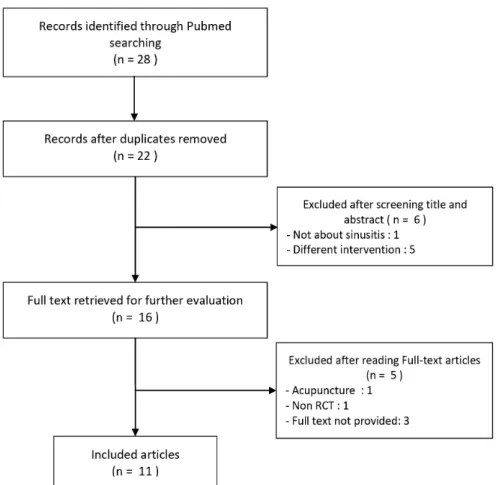
총 28개의 RCT가 검색되었으며, 그 중 6편의 중복 문헌이 제외되었다. 연구자가 제목과 초록을 검토하여 논문 주제에 부합하지 않는 문헌 1편, herbal medicine 이 아닌 다른 치료적 중재를 사용한 문헌 5편을 제외하 였다. 이후 원문을 상세히 검토하여 원문의 열람이 불 가능한 논문 3편, 침 치료를 주로 시행한 논문 1편, 실 험 디자인이 RCT가 아닌 경우 1편을 제외하여 최종적 으로 11편을 선정하였다 (Fig. 1).
최종 선정된 RCT에서 연구대상, 치료기간, 평가방 법, 치료결과, 사용된 herbal medicine의 특징을 분석하 여 정리하였다.
Ⅲ. Results
1. 연구유형
11개의 prospective RCT 중 open label trial 1편14), sin- gle blind trial 3편9,10,17), double blind trial 7편7,8,11-13,15,16)
으로 조사되었다. Placebo-controlled study 5편9,10,12,13,15)
, active treatment-controlled study 4편7,11,14,17)
, placebo-con- trolled, three-arm study는 2편8,16)이었다 (Table 1).
2. 연구대상
치료대상은 ARS가 5편11-15), CRS가 6편7-10,16,17)이었 다. post-FESS (functional endoscopic sinus surgery) care에 관한 논문 1편8)을 제외한 나머지 연구에서 최근 부비강 수술을 시행한 환자들은 연구대상에서 배제시켰다.
치료대상의 숫자는 40명 이상 100명 미만이 6편
7-10,14,17)
, 100명 이상 500명 미만이 3편11-13), 500명 이상 1000명 미만이 2편15,16)이었다 (Table 2).
3. 치료기간
치료기간은 7일이 1편11), 14-15일이 5편9,12-15), 3주가 1편10), 4주가 1편17), 6주가 1편7), 8주가 1편8), 그리고 12주가 1편16)이었다 (Table 2).
4. 유효성 평가방법
치료의 유효성을 평가하는 항목 중 주관적 증상 평가는 MSS (Major Symptom Score) 5회, SNOT-20, 22 (Sino- Nasal Outcome Test-20, 22) 3회, Severity of symptoms 2 회, TWSNOT-20 score (Taiwan version of the 20-item Sino- Nasal Outcome Test) 1회, QOL (Quality of life) 1회, pre-FESS CRSOM-31 scores (Chinese version Rhinosinusitis Outcome Measure) 1회, MCA2 (second minimal cross-sec- tional area of the nasal cavity)는 1회 사용되었다.
영상의학적 평가 항목은 PNS CT 2회, PNS X-ray 2회, Endoscopic score 2회, Ultrasonography 1회이었고, 병리 검사 로는 total white blood cell count 2회, bacterial culture rate 1회, saccharin transit time이 1회 사용되었다 (Table 1).
Fig. 1. Flow diagram of study searching and selection
1st author (country)
Study
design Intervention Evaluation method Result
Jiang7) (Taiwan)
double blind, RCT
[CHM* group]
- capsule containing 2 g of Tsang-Erh-San extract granules + 1 g of Houttuynia extract powder BID - 1 placebo capsule BID
[Erythromycin group]
- a capsule of erythromycin (250 mg) BID - 1 placebo capsule BID
1) TWSNOT-20 score+ 2) Endoscopic score 3) Bacterial culture rate 4) Saccharin transit time
- In both group, TWSNOT-20 scores and saccharin transit time significantly decreased after treatment.
- Saccharine transit times were shortened in more patients in CHM.
Liang8) (Taiwan)
double blind, placebo,
RCT
[CHM group]
- capsule containing 2 g of Tsang-Erh-San extract granules + 1 g of Houttuynia extract powder BID for 8 weeks
- 1 anti placebo capsule TID for 4 weeks [Amoxicillin group]
- 250 mg capsule of amoxicillin TID for 4 weeks - herbal placebo capsules BID for 4 weeks [Placebo group]
- herbal placebo BID - anti placebo TID
1) Pre-FESS CRSOM-31 scores†
2) Endoscopic score 3) MCA2‡ 4) CT score
- No significant benefit of CHMs or oral amoxicillin in post-FESS care of CRS patients.
Maragalawatht ha9) (Sri Lanka)
single blind, placebo,
RCT
[Treatment group]
- 120 mL of decoction of Pitawakka Navaya BID [Placebo group]
- 120 mL brown color solution BID
1) Severity of symptoms 2) X-ray paranasal
sinuses
3) Total white blood cell count
- Most of patient’s symptoms were relieved.
- Herb reduces thickening of the mucous membrane in the paranasal sinuses.
- Significant reduction in eosinophil count.
Ediriweera10) (Sri Lanka)
single blind, placebo,
RCT
[Treatment group]
- 120 mL of decoction of Katuwelbatu Deburu Katukadi BID
[Placebo group]
- 120 mL brown color solution BID
1) Severity of symptoms 2) X-ray paranasal
sinuses
3) Total white blood cell count
- Most of patient’s symptoms were relieved.
- Reduces haziness of X-ray.
- Significant reduction in eosinophil count.
Tesche11) (Germany)
double blind, RCT
[Cineole group]
- Hard gelatine capsule contains 100 mg of cineole.
2 cap TID A.C.
[Herbal preparation group]
- sugar coated tablet containing the powdered 4 herb. 1 tab TID A.C.
1) Symptoms-sum-score
- Both groups are effective.
- Cineole is clinically relevant and statistically significant.
Jund12) (Germany)
double blind, placebo,
RCT
[BNO 1016 group]
- 2 tab. 90 mg TID (total 480 mg) [Placebo group]
- placebo tab TID
1) MSS§ 2) Ultrasonography 3) QOL
- BNO 1016 relieve symptoms 2days earlier than placebo.
- No serious adverse effect.
Von13) (Germany)
double blind, placebo,
RCT
[Herbal drug- Sinupret group]
- 2 tab. 90 mg TID (total 480 mg) [Placebo group]
- placebo tab TID
1) MSS
- Sinupret relieve symptoms earlier than placebo.
- No serious adverse effect.
Passil14) (Italy)
open label, RCT
[Sinupret forte group]
- 1 tab. Sinupret Forte TID [Fluticasone furoate group]
- intranasal fluticasone furoate, 2 puffs in each nostril QD
1) MSS 2) SNOT-20II
- Both groups are effective.
- FF group caused side effect in 3 patient.
Jund15) (Belgium)
double blind, placebo, RCT
[BNO 1016 group]
- 160 mg TID (total 480 mg) [Placebo group]
- placebo tab TID
1) MSS 2) SNOT-20
- Almost 3days faster recovery with BNO 1016.
- No serious adverse events.
- Intensity of adverse events are similar for BNO1016 and placebo.
Palm16) (Germany)
double blind, placebo,
[Sinupret 240 mg group]
- 1 tab. sinupret 80 mg TID - 1 placebo tab. TID
1) MSS - Sinupret 480 mg dose was considerably effective in most outcome measures.
Table 1. Characteristics of the Included Studies
5. 치료결과
총 11편의 RCT 중 10편이 통계적으로 유의한 치료 효과를 보였다. herbal medicine군이 위약대조군에 비 해서 효과적인 경우가 6편9,10,12,13,15,16)
보고되었고, herbal medicine군이 conventional 치료군과 견줄만한 치 료성적을 낸 연구는 3편7,14,17)이 있었으며 2가지 herbal medicine군 간의 효과를 비교한 연구 1편11)과 herbal medicine군과 conventional 치료군 모두 위약대조군에 비해 통계적으로 유의한 차이를 보이지 못한 연구 1편
8)이 있었다 (Table 1).
Tsang-Erh-San (蒼耳散) & Houttuynia (魚腥草)군과 Macrolide 투여군 모두 CRS 평가지표에 효과적이었으 나, saccharin transit time의 감소 비율은 한약군이 더 높았고, 세균배양검사에서 항생제군이 gram negative 혐기성 세균의 성장이 더 높아 한약군이 치료적으로 더 우수함을 알 수 있었다7).
하지만 CRS 환자의 FESS care에서는 Tsang-Erh-San
& Houttuynia군과 oral amoxicillin군 둘 다 위약대조군 에 비해 유의한 치료성적을 나타내지 못했다8).
1st author (country)
Study
design Intervention Evaluation method Result
RCT
[Sinupret 480 mg group]
- 2 tab. sinupret 80 mb TID [Placebo group]
- 2 placebo tab. TID
Vazifehkah17) (Iran)
single blind, RCT
After NS irrigation, [Sinupium group]
- 2 drops in each nostril BID [Fluticasone group]
- 2 puffs of fluticasone nasal spray in each nostril BID
1) SNOT-22 2) PNS CT
- In Sinupium group, SNOT-20 and CT scan score was significantly greater than fluticasone.
*CHM: Chinese herbal medicine, +TWSNOT-20: Taiwan version of the 20-item sino-nasal outcome test, †CRSOM-31: Chinese version rhinosinusitis outcome measure, ‡MCA2: second minimal cross-sectional area of the nasal cavity, §MSS: major symptom score, IISNOT-20, 22: sino-nasal outcome test-20, 22
1st author (country) Population Sample
size Age (year) Period of treatment
Jiang7) (Taiwan) Chronic rhinosinusitis without nasal polyps 53 18 to 86 6 weeks
Liang8) (Taiwan) Patients with chronic rhinosinusitis who underwent FESS* 97 14 to 82 8 weeks Maragalawaththa9)
(Sri Lanka) Kaphaja shirsha shoola (chronic sinusitis) 60 Most of patients were
10 to 30 2 weeks
Ediriweera10) (Sri Lanka) Kaphaja shirsha shoola (chronic sinusitis) 80 Not reported 3 weeks
Tesche11) (Germany) Acute non-purulent rhinosinusitis 150 18 to 65 7 days
Jund12) (Germany) Acute viral rhinosinusitis 380 18 to 77 14 days
Von13) (Germany) Acute viral rhinosinusitis 386 18 to 75 15 days
Passil14) (Italy) Acute rhinosinusitis 60 18 to 75 14 days
Jund15) (Belgium)
Acute viral rhinosinusitis MSS+ of >8 and <12
facial pain/pressure >1 and <2: uncomplicated ARS
589 18 to 75 14 days
Palm16) (Germany) Bilateral chronic rhinosinusitis without nasal polyps confirmed by
endoscopy MSS of >6 and <12 929 18 to 75 12 weeks
Vazifehkah17) (Iran) Chronic rhinosinusitis (confirmed with PNS CT†) at least 3 month
without polyps 48 18 to 68 4 weeks
*FESS: functional endoscopic sinus surgery, +MSS: major symptom score, †PNS CT: para nasal sinus computer tomography Table 2. Characteristics of Patient Group
제형은 당의정 (sugar-coated tablet) 6회, capsule 3회, decoction 2회, isolated oil 1회이었다. 투여경로는 경구 투여가 10회, 비강 내 투여가 1회로 경구 투여가 가장 선호되었으며, 하루 투약 횟수는 2회가 5회, 3회가 6회 이었다.
구성하는 약재의 가지 수는 1개가 4회, 4개 2회, 5개 7회, 9개 1회였다 (Table 3).
Ⅳ. Discussion
비부비동염은 급성과 만성으로 나누어 치료하며, ARS는 발병 후 1개월 이내에 증상이 소실되는 것, CRS 는 증상이 3개월 이상 지속되는 것을 말한다. 소아의 경우 평균 1년에 6~8회 이상 감기에 걸리게 되며 이중 5~10%에서 비부비동염으로 이환된다. 최근 이른 단체 생활로 인해 감염의 기회가 늘고 있으나, 정확한 치료 지침은 확립되지 않고 있다2,18).
소아에서의 ARS는 매우 흔한 질환으로 대부분은 바 이러스에 의해 발생하나 임상적으로 세균성을 의심하 여 항생제를 불필요하게 쓰는 경우가 많다. 세균성 ARS 진단을 목적으로 방사선 촬영을 하는 것은 권장되 지 않으며, 바이러스 감염의 자연경과에 대한 이해를 바탕으로 세균감염을 감별해야 한다. 다음 중 한 가지 이상의 증상이 보일 경우 (① 발병 당시 심한 증상 또는 39 ℃ 이상의 발열과 화농성 콧물이나 안면 통증이 최 소 3-4일 지속, ② 콧물, 낮 시간의 기침이 10일 이상 호전이 없을 시, ③ 증상들이 더욱 악화되거나 호전 추 세를 보이던 중 새로 상기도감염증 발생)에만 세균성 을 염두에 두고 항생제를 고려한다19). 그 밖에 국소 혹 은 경구 충혈제거제 혹은 항히스타민제는 추천되지 않 는다고 하였다20).
CRS의 치료는 보존적 치료와 수술적 치료로 나뉘며 보존적 치료는 약물치료가 주가 된다. 비강 스테로이 드 분무제는 주된 치료 약제로 호산구의 기능을 저하 시켜 항염증 효과를 가진다. 또한 장기간-저용량 항생 제 요법은 항균보다 항염증작용을 통해 하기도의 호중
Herbal medicine Dosage form Administration
Ingredients Route Method
Tsang-Erh-San7,8) capsule containing
CHM* extract oral 1 cap (2 g) BID+, total 4 g
Angelicae Tenuissimae Radix (白芷), Magnoliae Flos (辛荑), Viticis Fructus (蒼耳子), Menthae Herba (薄荷) Houttuynia7,8) capsule containing
CHM extract oral 1 cap (1 g) BID,
total 2 g Houttuynia (魚腥草)
Pitawakka Navaya9) decoction oral 120 mL BID, total 240 mL
Bhoomyamalaka (Phyllanthus amarus), Haritaki (Terminalia chebula), Barangi (Pygmaeopremna herbacea), Chavya (Piper chavya), Pippali (Piper
longum), Salarka (Solanum trilobatum), Guduchi (Tinospora cordifolia), Shunthi (Zingiber officinale), Maricha (Piper nigrum) each 6.7 g cut into small pieces and 1,920 ml of water is added and boiled down to 240 ml
Katuwelbatu
Deburu Katukadi10) decoction oral 120 mL BID, total 240 mL
Kantakari (Solanum xanthocarpum), Jeeraka (Cuminum cyminum), Krushnajeeraka (Nigella sativa), Katurohini (Picroihiza kurrupa), Bharangi Sanskrit (Clerodendrum serratum) each 6.7 g cut into small pieces
and 1,920 ml of water is added and boiled down to 240 ml
Cineole11) gelatine capsule oral
100 mg 2 caps TID†, total 600
mg
Main ingredient of eucalyptus oil
Herbal preparation11)
sugar-coated tablet containing the powdered ingredients
oral 80 mg 2T TID, total 480 mg
Gentianae Scabrae Radix (龍膽草) 12 ml, Primulae Flos (黃花九輪草) 36 ml, Rumicis Herba (小酸模) 36 ml, Sambuci Flos 36 ml,
Verbenae herba (馬鞭草) 36 ml The herbal formula
BNO-1016 (Sinupret)12-16)
coated tablet made
by dry extract oral 80 mg 2T TID, total 480 mg
Gentianae Scabrae Radix (龍膽草), Primulae Flos (黃花九輪草), Rumicis Herba (小酸模), Sambuci Flos, Verbenae herba (馬鞭草) (1:3:3:3:3) Sinupium17) isolated oil intra-n
asal
2 drops BID, total
4 drops Pipinella anisum seed
*CHM: Chinese herbal medicine, +BID: twice a day, †TID: three times a day Table 3. Characteristics of Herbal Medicine
구성 질환 및 감염에서 큰 효과를 보였고, 이것이 상기 도질환인 CRS까지 확대되었다. 현재 호산구성 부비동 염의 경우 스테로이드 중심의 치료가, 비용종을 동반 하지 않은 비부비동염 또는 비호산구성 부비동염의 경 우 항생제 중심의 치료가 권장된다고 언급하고 있다21). 하지만 소아 CRS에 대한 내과적 치료는 아직까지 의견이 일치되지 않았다. 2012년에 발간된 ≪European position paper on rhinosinusitis and nasal polyps≫에서 는 식염수 세척과 비강 스테로이드 제제가 효과가 있 다고 보고하였으며, 단기 항생제 요법은 효과가 없는 것으로 보고하였다. 다만 LDLT에 대한 가능성은 열어 두었다1). 하지만 2세 미만의 환아, 증상이 심할 때, 보 육시설에 다니는 경우 또는 최근의 일반적 항생제 치 료에 반응이 만족스럽지 않은 경우 내성균주를 고려하 여 고용량 amoxicillin 요법의 사용을 권장하기도 한다.
최대한의 내과적 치료에도 불구하고 증상의 호전 이 없는 경우에 수술을 결정하게 되는데, 선행 내과적 치료 기간에 대한 공통된 의견은 없지만 경험적으로 3~6주를 얘기하고 있다. 소아에게는 섬모의 운동성 개선 및 균의 서식지 제거의 목적으로 아데노이드 제 거술이 1차적으로 고려된다. 아데노이드 비대가 심하 지 않거나 수술 이후 경과가 양호하지 않은 경우, 성 인처럼 FESS를 시행하나 안면성장에 영향을 미칠 수 있다. 수술 후 치료 및 예후에 있어서는 메타 분석에 서 양호함이 입증되었으나18) 부비동염과 연관된 구조 적인 비폐색과 만성 염증을 모두 제거하였음에도 불 구하고 지속적으로 증상을 호소하는 환자들도 있고, 치료 후 재발의 문제도 있기 때문에 조심스러운 접근 이 필요하다1,18,22).
이처럼 소아에게는 항생제 사용의 기준이 합의되지 않아 항생제의 오남용이 우려된다. 불필요한 항생제 사용은 설사, 발진 등 부작용의 위험에 노출시키고, 내 성균의 증가라는 문제점을 낳는다. 또한 경구 스테로 이드제보다는 덜하나 비강 스테로이드제의 경우 비출 혈, 소양감 등의 부작용이 보고되고 있다. 따라서 보다 안전하고 효과적인 대체의학 치료의 효과와 안정성을 고찰하게 되었다.
현재까지 국내에서는 加味荊芥連翹湯24,25,28), 淸金 降火湯25), 加味二陳湯26), 陽毒白虎湯27), 補兒湯加減28), 仙方敗毒湯加味28), 補中益氣湯加味29) 등의 한약으로 비부비동염을 치료한 임상례가 보고되었으나, 연구의 형태가 제한적이며 관련 RCT 연구는 보고되지 않았기 에 치료효과를 객관적으로 분석하기에 한계가 있었다.
이에 Pubmed를 이용하여 보완대체의학에서 사용되는 herbal medicine에 대한 RCT를 분석하여 그 효과를 살 펴보았다.
총 11개의 RCT 중 윤리성 문제로 open label로 시행 된 trial 1편14)을 제외하고, single blind trial이 3편9,10,17), double blind trial이 7편7,8,11-13,15,16)이었다. 위약대조군 이 있는 연구는 5편9,10,12,13,15)
, 다른 치료와 비교한 연구
가 4편7,11,14,17), 위약대조군과 치료군이 2개 이상 설정
된 연구는 2편8,16)이었다. 이중맹검 실험의 경우 대조군 은 치료군과 제형, 투약방법을 동일하게 하여 시행하 였고 이는 herbal medicine이 캡슐제제7,8,11), 당의정
11-13,15,16) 이었기에 연구 설계에 용이했다.
치료대상은 ARS 5편11-15), CRS 6편7-10,16,17)으로, 급성 과 만성에 따라 치료기간이 나뉘는 경향성을 보였다.
ARS의 경우 7일이 1편11), 14-15일이 4편12-15)으로 모두 2주 이내의 치료기간을 설정하였고 CRS의 경우 2-3주
가 2편9,10), 4주가 1편17), 6주가 1편7), 8주가 1편8), 그리
고 12주가 1편16)이었다. ARS의 경우 급성 상기도감염 의 평균적 이환기간을 고려했을 때 각 연구에서 시행 된 투약 기간은 적절하다고 사료된다. 소아 CRS의 경 우 수술을 결정하기 이전 충분한 내과적 치료기간에 대해 국내 의학계에서는 경험적으로 3~6주를 언급함 을 고려할 때6), herbal medicine도 해당기간 이상의 치 료가 필요할 것으로 고려되며 Maragalawaththa 등9)과 Ediriweera 등10)의 연구에서 설정된 투약 기간은 다소 부족한 것으로 여겨진다.
치료의 유효성을 평가하는 항목 중 주관적 증상 평 가가 14회, 영상의학적 평가가 7회, 병리 검사가 4회로 주관적 증상평가가 가장 빈용되었다. 가장 많이 사용 되었던 MSS의 경우 전문의가 연관성이 가장 높다고 선 정한 5가지 증상 (콧물, 전비루, 후비루, 비폐색, 두부와 안면의 통증 및 압박감)의 중증도를 항목별 0~3점으로 평가한 후 합산한다. 환자가 일정한 시간에 점수를 매 겨서 기록한 것을 바탕으로 측정할 수 있어 그 사용성 이 간편하다. 그 외 증상 평가도구 모두 하위 증상을 4점 평가척도를 사용하여 평가하는 방법으로 환자의 상태를 객관적으로 파악할 수 있다. SNOT-20, 22는 비 부비동염에 이환된 환자의 건강과 관련된 삶의 질 척 도를 20개의 문항을 통해 측정하는 평가도구이다.
SNOT-22는 SNOT-20보다 질문을 좀 더 확장한 것으 로 코, 귀, 안면부, 수면, 심리적인 요소 등을 포괄하며, 두 설문지 모두 鼻증상의 하위 항목인 콧물, 재채기, 비색, 후비루, 부종 등을 포함한다22). CRS의 확진은
PNS-CT를 통해 이뤄지나 그 평가척도에 대해서는 이 견이 있다. CRS의 CT영상을 분류하기 위해 널리 쓰이 는 점수체계인 Lund-Mackay score는 부비강 음영의 혼 탁률을 근거로 평가되나, 호소하는 증상과 비례하지
않아6,17) 방사선 촬영으로만 치료효과를 전적으로 판단
하기는 어렵다. 주요 증상 점수, 삶의 질 척도, 영상 검 사, 병리적 검사 등 유효성 평가방법이 표준화 되어 있 어 환자 특성에 맞추어 상호 보완적으로 선택한다면 객관적인 치료 효과 평가가 가능할 것으로 생각된다.
Herbal medicine이 위약에 비해서 효과적인 경우 6
편9,10,12,13,15,16)이 보고되었고, herbal medicine이 conven-
tional 치료와 대등하거나 더 좋은 치료성적을 낸 연구
는 3편7,14,17)이 있었다. 2가지의 herbal medicine의 치료
효과를 비교한 연구 1편11)과 herbal medcine군과 항생 제군 모두 위약대조군에 비해 통계적으로 유의한 차이 를 보이지 못한 연구 1편8)이 있었다. 총 11개의 RCT 중 10개가 통계적으로 유의성을 보였으며, 전형적인 급성 비부비동염 및 비용종을 동반하지 않는 만성 비 부비동염에 있어서 herbal medicine은 기존의 서양의학 적 치료와 비슷하거나 뛰어난 치료 효과를 보였다.
Jiang 등7)의 연구는 한약 치료가 종래의 치료보다 통계적으로 유의한 차이가 없더라도, 부작용 및 일부 평가지표에서 우위를 점하고 있음을 시사한다. Tsang- Erh-San & Houttuyni군과 Macrolide 투여군 모두 TWSNOT -20 scores와 saccharin transit time을 유의하게 감소시켰 으나, saccharin transit time의 감소 비율은 Chinese herb- al medicine군이 더 높았고, 세균배양검사에서는 항생 제군이 gram negative 혐기성 세균의 성장이 더 높았다.
Tsang-Erh-San & Houttuynia는 白芷, 辛夷, 蒼耳子, 薄 荷 및 魚腥草에서 추출된 과립을 담은 캡슐제제로, 부 비강 점막의 면역기능 회복 효과가 있다고 하였다7). 비강 스테로이드제와의 효과를 비교한 논문들을 살 펴보면, Sinupret과 Fluticasone furoate (FF) 두 치료 모두 치료에 효과적이었으며 FF는 콧물, 전비루, 비폐색에 효과적이고 Sinupret은 두통 및 안면통에 유의한 개선 을 보였다14). Sinupium은 Pipinella anisum seed를 추출 한 오일로 2 drop씩 아침, 저녁으로 비강 내 투여하는 외용제이다. Sinupium군과 FF군 둘다 CRS 치료에 효과 적이었으며, SNOT-22 항목에서 Sinupium군이 FF군보 다 더 유의한 효과를 보였으며, 후비루와 비폐색 세부 항목에서 더 뛰어난 치료 효과를 보였다17).
Sinupret (BNO-1016)의 경우 ARS에 효과가 입증된 Gentianae Scabrae Radix (龍膽草), Primulae Flos (黃花九輪
草), Rumicis Herba (小酸模), Sambuci Flos, Verbenae herba (馬 鞭草)의 dry extract로 독일에서 부비동염에 널리 쓰이
고 있다11-16). ARS의 경우 투약 3일째까지는 위약대조
군과 큰 차이가 없으나, 이후 증상 소실 속도가 빨라지 며 투약 14일째에서는 2~3.6일 가량 회복속도가 빠르
다12,13,15). 이는 ARS 환자들의 총 증상 이환 기간을 단
축시켜 사회 경제적 손실을 절감할 수 있다. CRS도 저 용량의 경우 투약 12주부터, 적정 용량 투약 시에는 투 약 8주부터 위약대조군에 비해 MSS가 유의하게 감소 하여 치료효과를 보였다. 투약 종료 8주 후에도 MSS의 차이는 유지되며16), 이는 Sinupret의 CRS로의 적용 범 위 확장 및 투약 종료 이후의 장기적 효과를 시사한다.
Herbal medicine의 안정성 측면을 살펴보면, 비강 스 테로이드 투여군에서는 경구 투여형인 Sinupret forte14) 및 점비형인 Sinupium17)에서 발생하지 않았던 비출혈, 소양감 등의 중대한 이상반응 (Serious adverse events, SAEs)이 보고되었다. 따라서 비강 스테로이드의 치료 효과는 herbal medicine과 동일하거나 더 뛰어나지만, 안정성 측면에서는 herbal medicine이 장점을 지닌다고 언급했다. Sinupret와 위약대조군 투약 후 발생하는 약 인성 이상반응 (Adverse events, AEs)은 상복부통, 설사, 두통, 오심, 발적, 비인두염, 소양감 순으로 강도는 위 약대조군과 통계적으로 유의한 차이가 없으며15,16), 이 는 herbal medicine의 안정성을 뒷받침한다.
항생제 투여가 불필요한 바이러스성 비부비동염 이 환 초기에는, 부비강 점막섬모 운동성을 개선시키고 감염을 예방하는 것이 주된 치료 목표이다. Sinuret, Cineole의 투여가 모두 7일 이내에 비부비동염 증상을 효과적으로 소실시킨다. 따라서 항생제는 합병증 위험 이 높은 환자군 또는 5일 이상 개선되지 않는 급성 비 부비동염 환자에게만 신중히 투여해야 하며, 그 외 환 자에게는 안정성을 고려했을 때 herbal medicine 투약 이 추천된다고 하였다11).
치료 대상 모집에 있어서 post-FESS care8)를 제외하 고 나머지 연구에서는 최근 부비강 수술을 시행한 환 자들 및 비용종이 있는 환자들은 연구대상에서 배제시 켰다. 연구들에서 ARS 환자군 모집 시 MSS 점수가 8점 이상 12점 이하이면서, 비폐색을 반드시 포함하고, 안 면통증 및 압박감은 1점 이상 2점 이하인 경우만 연구 를 진행했는데, 이는 전형적인 ARS 환자만을 설정하고 자 함이다11-15). 즉, 합병증이 없는 ARS 및 비용종을 동 반하지 않는 CRS의 경우 한약 단독 투여로도 기존의 서양의학적 치료와 대등한 효과를 낼 수 있는 가능성
을 보여준다.
정상군에서 알레르기 비염의 유병률은 15~20% 정 도인데 반해 비부비동염 환아의 80% 정도에서 알레르 기 비염에 대한 가족력이 보고되고 있으나, 항히스타 민제에는 반응하지 않는 점을 고려할 때 알레르기 질 환과의 연관성은 모호하다5). 하지만 호산구성 CRS의 경우 LDLT에 반응하지 않고, 알레르기 비염은 부비동 염의 선행질환 중 높은 비율을 차지하므로, herbal med- icine의 비부비동 점막의 운동성 개선 효과를 고려할 때 알레르기의 과거력이 있는 부비동염 환아들에게 herbal medicine이 효율적으로 사용될 것이라 여겨진다.
본 연구는 비부비동염 치료에 사용되는 세계 각국 의 보완대체의학 herbal medicine 치료에 관해 분석한 것이다. Herb complex를 투여하는 것은 한의학에서의 한약의 개념과 유사하나, 실제 우리나라에서 자주 사 용되지 않는 herb들이 있어 치료에 곧바로 적용하기 힘 든 한계가 있다. 하지만 투약 제형, 투약 방법, 종래의 치료와 비교한 이점 등을 임상에 활용할 수 있을 것으 로 사료된다. 본 연구에서는 herbal medicine과 서양의 학의 약물치료의 병용 투여는 시행되지 않았기에, 단 독 투여군과 병용 투여군에 관한 추가 연구가 이뤄지 면 안정성 확보에 더욱 도움이 될 것이다.
본 논문은 비부비동염의 국외 보완대체의학에서 사 용되는 herbal medicine에 대한 RCT를 고찰함으로써 한약 치료의 효과와 안정성을 객관적으로 파악할 수 있는 데 큰 의의가 있다. 향후 한의학 연구에서도 이를 기반으로 비부비동염의 한약치료에 관한 RCT 연구가 진행되어 한의학 치료가 비부비동염 치료에 효과적이 라는 객관적 근거가 마련되길 바란다.
Ⅴ. Conclusion
본 연구는 2008년부터 2018년까지 Pubmed를 통해 해외에서 보고된 비부비동염의 보완대체의학의 herbal medicine 치료에 관한 11편의 RCT 논문을 정리, 분석 하였다. 결과는 다음과 같다.
1. 총 11개의 RCT 중 open label trial 1편, single blind trial 3편, double blind trial 7편이 있었으며, 위약대조군이 있는 연구는 5편, 다른 치료와 비 교한 연구가 4편, 위약대조군 및 치료군이 2개
이상 설정된 연구는 2편이었다.
2. 연구대상은 ARS가 5편, CRS가 6편이었으며, 인 원은 40명 이상 100명 미만이 6편, 100명 이상 500명 미만이 3편, 500명 이상 1000명 미만이 2 편이었다.
3. 각 연구의 유효성 평가 항목은 주관적 증상 평가 척도 14회, 영상의학적 평가 7회, 병리 검사 4회 순으로 사용되었다.
4. 총 11개의 RCT 중 10개가 통계적으로 유의성을 보였다. 급성 바이러스성 비부비동염 및 비용종 을 동반하지 않는 만성 비부비동염에 있어서 기 존의 서양의학적 치료와 비슷하거나 뛰어난 치료 효과를 보였다.
5. 안정성 측면에서 herbal medicine은 항생제 및 비 강 스테로이드제제에서 발생하는 SAEs가 발견되 지 않았으며, 위약대조군과 AEs 출현 횟수의 유 의한 차이가 없었다.
6. 항생제 치료의 한계를 고려했을 때, 비부비동염 의 herbal medicine 치료는 임상적 활용가치가 높 을 것으로 사료되며, 국내에서도 한약의 RCT 연 구가 진행되길 기대한다.
References
1. Fokkens WJ, Lund VJ, Mullol J, Bachert C, Alobid I, Baroody F, Cohen N, Cervin A, Douglas R, Gevaert P, Georgalas C, Goossens H, Harvey R, Hellings P, Hopkins C, Jones N, Joos G, Kalogjera L, Kern B, Kowalski M, Price D, Riechelmann H, Schlosser R, Senior B, Thomas M, Toskala E, Voegels R, Wang DW, Wormald PJ. EPOS 2012: European position paper on rhinosinusitis and nasal polyps 2012. A summary for otorhinolaryngologists. Rhinology. 2012;50(1):1-12.
2. Lee HJ. Diagnosis and treatment of acute rhinosinusitis in children. J Korean Med Assoc. 2018;61(2):125-9.
3. Schultz MJ. Macrolide activities beyond their antimicrobial effects: macrolides in diffuse panbronchiolitis and cystic fibrosis. J Antimicrob Chemother. 2004;54(1):21-8.
4. Wallwork B, Coman W, Mackay-Sim A, Greiff L, Cervin A. A double-blind, randomized, placebo-controlled trial of macrolide in the treatment of chronic rhinosinusitis.
Laryngoscope. 2006;116(2):189-93.
5. Pearlman AN, Conley DB. Review of current guidelines related to the diagnosis and treatment of rhinosinusitis.
Curr Opin Otolaryngol Head Neck Surg. 2008;16(3):226-30.
6. Jang YW, Kim JY, Lee SH, Lim SH. A literature study of Korean medicine for sinusitis. J Korean Med Ophthalmol Otolaryngol Dermatol. 2017;30(3):134-54.
7. Jiang RS, Wu SH, Tsai CC, Li YH, Liang KL. Efficacy of Chinese herbal medicine compared with a macrolide in the treatment of chronic rhinosinusitis without nasal polyps. Am J Rhinol Allergy. 2012;26(4):293-7.
8. Liang KL, Su YC, Tsai CC, Lin JS, Jiang RS, Su MS.
Postoperative care with Chinese herbal medicine or amox- icillin after functional endoscopic sinus surgery: a randomized, double-blind, placebo-controlled study. Am J Rhinol Allergy. 2011;25(3):170-5.
9. Maragalawaththa MG, Ediriweera ER, Chandimarathne PB. A clinical trial of Sri Lankan traditional decoction of Pitawakka Navaya in treatment of Kaphaja Shirsha Shoola (chronic sinusitis). Ayu. 2010;31(2):193-6.
10. Ediriweera ER, Rathnayaka RL, Premakeerthi WM, Weerasinghe KD. Efficacy of Sri Lankan traditional de- coction of Katuwelbatu Deduru Katukadi in treatment of Kaphaja Shira Shula (chronic sinusitis). Ayu. 2010;
31(1):58-61.
11. Tesche S, Metternich F, Sonnemann U, Engelke JC, Dethlefsen U. The value of herbal medicines in the treatment of acute non-purulent rhinosinusitis. Results of a double-blind, randomised, controlled trial. Eur Arch Otorhinolaryngol. 2008;265(11):1355-9.
12. Jund R, Mondigler M, Steindl H, Stammer H, Stierna P, Bachert C. Clinical efficacy of a dry extract of five herbal drugs in acute viral rhinosinusitis. Rhinology.
2012;50(4):417-26.
13. Jund R, Mondigler M, Steindl H, Stammer H, Stierna P, Bachert C. Clinical efficacy of a herbal drug combina- tion in acute viral rhinosinusitis. MMW Fortschr Med.
2015;157(157Suppl4):6-11.
14. Passali D, Loglisci M, Passali GC, Cassano P, Rodriguez HA, Bellussi LM. A prospective open-label study to assess the efficacy and safety of a herbal medicinal product (Sinupret) in patients with acute rhinosinusitis. ORL J Otorhinolaryngol Relat Spec. 2015;77(1):27-32.
15. Jund R, Mondigler M, Stammer H, Stierna P, Bachert C. Herbal drug BNO 1016 is safe and effective in the treatment of acute viral rhinosinusitis. Acta Otolaryngol.
2015;135(1):42-50.
16. Palm J, Steiner I, Abramov-Sommariva D, Ammendola A, Mitzenheim S, Steindl H, Wonnemann M, Bachert C. Assessment of efficacy and safety of the herbal medici- nal product BNO 1016 in chronic rhinosinusitis.
Rhinology. 2017;55(2):142-51.
17. Vazifehkah S, Shams-Ardekani MR, Kamalinejad M, Saderhossein SM, Hosseini H, Shams SM, Abbassi S, Eghtesad S, Saedi B. Evaluation of a novel natural drop for treatment of chronic rhinosinusitis without nasal polyps: a single blind randomized trial. Int Forum Allergy Rhinol. 2016;6(9):943-9.
18. Cho HJ, Kim HY. Pediatric chronic rhinosinusitis.
Korean J Otorhinolaryngol Head Neck Surg. 2015;58 (10):667-75.
19. Korea Centers for Disease Control and Prevention.
Guidelines for the antibiotic use in children with acute upper respiratory tract infections. Cheongju: Korea Centers for Disease Control and Prevention. 2016.
20. Chow AW, Benninger MS, Brook I, Brozek JL, Goldstein EJ, Hicks LA, Pankey GA, Seleznick M, Volturo G, Wald ER, File TM. IDSA clinical practice guideline for acute bacterial rhinosinusitis in children and adults.
Clin Infect Dis. 2012;54(8):e72-112.
21. Hong SN, Kim DW. Medical treatment according to phenotypes of chronic rhinosinusitis. Allergy Asthma Respir Dis. 2015;3(3):167-72.
22. Pynnonen MA, Mukerji SS, Kim HM, Adams ME, Terrell JE. Nasal saline for chronic sinonasal symptoms: a randomized controlled trial. Arch Otolaryngol Head Neck Surg. 2007;133(11):1115-20.
23. Browne JP, Hopkins C, Slack R, Cano SJ. The Sino-Nasal Outcome Test (SNOT): can we make it more clinically meaningful?. Otolaryngol Head Neck Surg. 2007;136(5):
736-41.
24. Hong JH, Kim KH, An JH, Jung HA. A case of sinusitis patient improved by Kami-Hyunggyeyungyotang. J Korean Med Ophthalmol Otolaryngol Dermatol. 2015;
28(2):66-74.
25. Jang JH, Park JH. Two cases report of oriental medical therapy for sinusitis in the overweight children. J Korean Med Ophthalmol Otolaryngol Dermatol. 2016;29(2):
149-60.
26. Nam HJ, Kim YB. A case of headache induced by paranasal sinusitis in child. J Korean Med Ophthalmol Otolaryngol Dermatol. 2003;16(1):159-67.
27. Lee HM, Park SH. A case of chronic sinusitis patient
improved by Yangdokbackho-tang. J Sasang Constitut Med. 2007;19(3):283-92.
28. Lee KJ, Yoon YH, Choi IH, Ko SG. 5 cases of rhinosinusi- tis diagnosed and evaluated by OMU CT. J Korean Med Ophthalmol Otolaryngol Dermatol. 2014;27(3):133-44.
29. Kim SB, Kim JS, Kim GJ. The clinical observation on cases of chronic paranasal sinus. J Korean Med Ophthalmol Otolaryngol Dermatol. 2001;14(2):1-8.