일개 보건소에서 시행한 불면증에 대한 한약치료의 효과분석
정인호 # , 권찬영* ,†,# , 김종우 ‡,§ , 정선용 ‡,§
고흥보건소, 양구보건소*, 경희대학교 일반대학원 임상한의학과
†, 경희대학교 한의과대학 한방신경정신과
‡,
강동경희대학교병원 한방신경정신과
§Clinical Effect of Herbal Medicine Treatment on Insomnia in a Public Health Center
In-Ho Jung # , Chan-Young Kwon* ,†,# , Jong-Woo Kim ‡,§ , Sun Yong Chung ‡,§
Goheung Public Health Center, *Yanggu Public Health Center,
†Department of Clinical Korean Medicine,
Graduate School of KyungHee University,
‡Department of Neuropsychiatry, College of Korean Medicine, KyungHee University,
§
Department of Korean Neuropsychiatry, KyungHee University Hospital at Gangdong
Received: October 31, 2017 Revised: December 19, 2017 Accepted: December 21, 2017
Objectives: We conducted a public health promotion program in Korean medicine for participants suf- fering from chronic insomnia in 2016∼2017. A significant improvement effect was obtained through the 8-week herbal medicine treatment program. The object of this study is to report the results of this public health promotion program.
Methods: Seventy patients diagnosed with chronic insomnia participated in the program, 49 of whom completed the program. Participants were treated with the herbal medicine for insomnia treatment for 8 weeks. A sleep diary was used to assess the total sleep time, sleep latency, and number of times the participants woke. The treatment satisfaction was then evaluated.
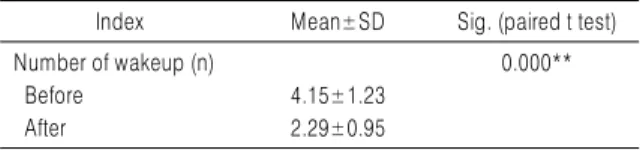
Results: Through the 8-week herbal medicine treatment program, the total sleep time was sig- nificantly increased by 109.59±70.77 minutes, the sleep latency was significantly decreased by 63.53±47.79 minutes, and the number of times the participants woke was significantly decreased by 1.54±1.19 times compared to the baseline (all, p=0.000). Among the 24 patients who were examined for the treatment satisfaction, the average score was 4.33 points of a total of 5 points. Six patients had adverse events. Except for one patient, the symptoms of other patients were mitigated by changing or discontinuing the herbal medicine.
Conclusions: For patients with chronic insomnia, the 8-week herbal medicine treatment program was effective, with few side effects and high treatment satisfaction. This study has significance as this is the first report in Korea on the effect of a herbal medicine treatment program for chronic insomnia through Korean medicine public health promotion.
Key Words: Korean medicine, Insomnia, Herbal medicine.
Correspondence to Sun Yong Chung
Department of Neuropsychiatry, College of Korean Medicine, KyungHee University, Department of Korean Neuropsychiatry, KyungHee University Hospital at Gangdong, 149, Sangil-dong, Gangdong-gu, Seoul, Korea.
Tel: +82-2-440-7133 Fax: +82-2-440-7143 E-mail: [email protected]
#
The first two authors contributed equally to this study.
Copyright © 2017 by The Korean Society of Oriental Neuropsychiatry. All rights reserved.
CC