국내 소아성장 한약치료에 대한 고찰
권지현1⋅조성우2⋅유선애1
1동의대학교 한의과대학 소아과, 2동의대학교 한의과대학 재활의학과
Received: October 26, 2018 ∙ Revised: November 13, 2018 ∙ Accepted: November 15, 2018 Corresponding Author: Yu Sun Ae
Department of Pediatrics, Dongeui University Oriental Medicine Hospital, 62 Yangjeong-ro, Busanjin-gu, Busan, 614-851, Republic of Korea Tel: +82-51-850-8680, Fax: +82-51-850-8744
E-mail: [email protected]
ⓒ The Association of Pediatrics of Korean Medicine. All rights reserved. This is an open-access article distributed under the tenus of the Creative Commons Attribution Non-Commercial License (http://creativecommons.org/licenses/by-nc/3.0/), which permits unrestricted non-commercial use, distribution, and reproduction in any medium, provided the original work is properly cited.
Abstract
Review of Clinical Researches for Herbal Medicine Treatment in Pediatric Growth - Focusing on recent national studies -
Kweon Ji Hyeon1⋅Cho Sung Woo2⋅Yu Sun Ae1
1Department of Pediatrics, College of Oriental Medicine, Dongeui University,
2Department of Rehabiliation Medicine, College of Oriental Medicine, Dongeui University
Objectives
The purpose of this study is to provide clinical evidences on effectiveness of herbal medicine treatment regarding pediatric growth based on recent clinical studies.
Methods
Selected 17 clinical studies since January 1998 to June 2018 from the Journal of Pediatrics of Korean Medicine and OASIS Traditional Medicine Knowledge Portal were reviewed.
Results
Medications that strengthening spleen and stomach (健脾胃藥), digestant (消導藥), supplementing kidneys (補 腎藥), and lungs (補肺藥) were frequently used.
Frequently used herbs were Hoelen (茯苓), Citri Pericarpium (陳皮), Glycyrrhizae Radix (甘草), Atractylodis Rhizoma Alba (白朮), Dioscoreae Rhizoma (山藥), Angelicae Gigantis Radix (當歸), Amomi Fructus (砂仁), Rehmanniae Radix Preparata (熟地黃).
Conclusions
This study showed that Korean herb medicine treatment can be effective for pediatric growth.
Key words: Growth, Korean medicine, Review
대한한방소아과학회지 제32권 제4호(2018년 11월) J Pediatr Korean Med. November, 2018;32(4):103-112 ISSN 1226-8038(Print), 2287-9463(Online), https://doi.org/10.7778/jpkm.2018.32.4.103
Ⅰ. Introduction
성장이란 키, 체중 등이 양적으로 증가해 나가는 과 정을 말하며, 이에 영향을 주는 요인은 인종, 가계, 연 령, 성별 등의 유전적 요인과 영양, 운동, 질병, 사회 경제적 요인 등과 같은 환경적 요인이 있다1).
성장의 유형은 영아기와 사춘기에 급성장하는 일반 형, 출생 초기부터 급성장하여 4세경에 성인 수준의 80%에 달하는 신경형, 10~12세경에 성인의 2배에 달 했다가 퇴축하여 18세경에 성인 수준이 되는 림프형, 사춘기부터 급속히 성장하여 16~18세에 성인 수준에 도달하는 생식형의 4가지로 구분된다. 키, 체중, 호흡 기, 소화기, 신장, 심장, 비장, 근육 및 골, 혈액량 등은 일반형의 성장을 보이며, 뇌, 척수, 시각기, 두위 등은 신경형, 림프조직은 림프형, 생식기, 유방, 음모, 자궁, 전립샘 등은 생식형의 성장이 이루어진다1).
성장의 단계는 출생 전 성장과 출생 후 성장으로 구 분되며, 출생 후 성장은 미숙아나 부당경량아들이 따 라잡기 성장이 가능한 영유아기 성장, 성장호르몬이 가장 중요 결정인자가 되는 유년기 성장, 성호르몬이 관여하기 시작하며 급성장이 이루어지는 사춘기 성장 의 3단계로 분류된다1,2).
의학적 저신장이란 키가 동일 연령, 동일 성별의 평 균 신장보다 2표준편차 미만인 경우나 3백분위 미만인 경우를 말하며, 이는 다시 골격계의 내인적인 결함으 로 발생하는 1차 성장장애와 외부의 환경적 인자에 의 해 발생하는 2차 성장장애, 성장호르몬 분비가 정상이 며 특별한 원인 없이 발생하는 특발성 저신장으로 나 눌 수 있다1,2). 1차 성장장애는 역연령에 비하여 골연령 의 지연이 없으며, 2차 성장장애는 역연령에 비해 골연 령이 의미 있게 감소되어 있다1).
최근 외모가 사회생활에 미치는 영향이 커지고 서 구인이 미의 기준이 되면서, 저신장이 아닌 정상 아이 들도 작은 키로 인한 차별을 걱정하며 키를 더 키울 수 있는 치료를 받기 위해 병원에 내원하는 경우가 많 다3-5).
저신장의 서양의학적 치료로 성장호르몬제 주입이 주를 이루고 있지만, 투여 초기에는 성장속도가 증가 하나 해를 거듭할수록 감소하고, 치료 중단 시 일시적 으로 성장속도가 오히려 감소하며, 다양한 부작용의 가능성, 경제적 부담 등을 이유로 최근 상대적으로 비
용이 적게 들고, 치료를 잠시 중단하더라도 성장효과 가 급속히 저하되지 않는 한의학적 성장치료에 대한 관심과 수요가 늘어나고 있는 추세다6,7).
성장에 관한 한의학적 연구 또한 이 등8), 김 등9)의 성장척도 간의 관계 분석, 이10), 홍 등11)의 성장요인 분 석, 유 등12), 윤 등13)의 보호자 인식 조사, 민14), 이 등15) 의 문헌고찰, 이 등16), 김 등17)의 성장치료 임상연구 등 이 활발히 이루어지고 있다.
이에 성장치료에 가장 일반적이고 빈번하게 이루어 지는 한약치료에 있어서, 우리나라 아동들의 특성에 맞게 구체적으로 어떤 한약을 어떤 기준으로 사용하는 지 알아보기 위해 국내 한의학적 성장치료에 관한 임 상논문들을 분석해보고자 한다.
Ⅱ. Materials and Methods
1. 문헌 검색
논문 검색은 대한한방소아과학회지, OASIS 전통의 학정보포털을 이용하였다. 검색어로는 ‘성장’ or ‘허약’
or ‘저체중’ or ‘저신장’을 사용하였고, 검색일은 2018년 6월 28일이었으며, 1998년 1월 이후 발표된 연구로 한 정하였다.
2. 문헌 선택
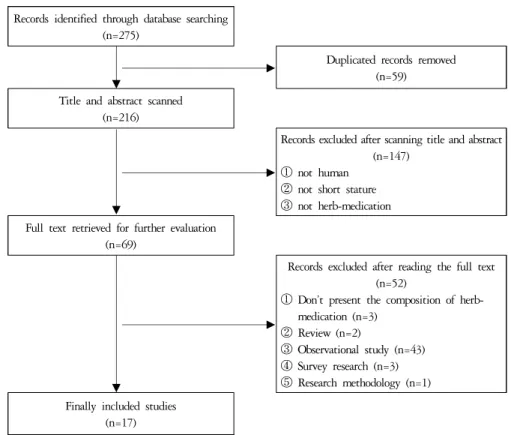
검색된 문헌 총 275편 중 중복되는 문헌 59편을 제 외하였다. 제목과 초록을 검토하여 사람을 대상으로 하지 않았거나, 저신장에 관한 내용이 아니거나, 한약 치료를 시행하지 않은 147개의 문헌을 배제하였다. 전 문 검토 후 문헌고찰연구, 관찰연구, 설문조사연구, 치 료에 사용한 한약에 대한 정보가 없는 연구, 연구방법 론에 관한 논문 52편을 제외하여 최종적으로 17편의 문헌을 대상으로 하였다 (Fig. 1).
3. 자료 추출
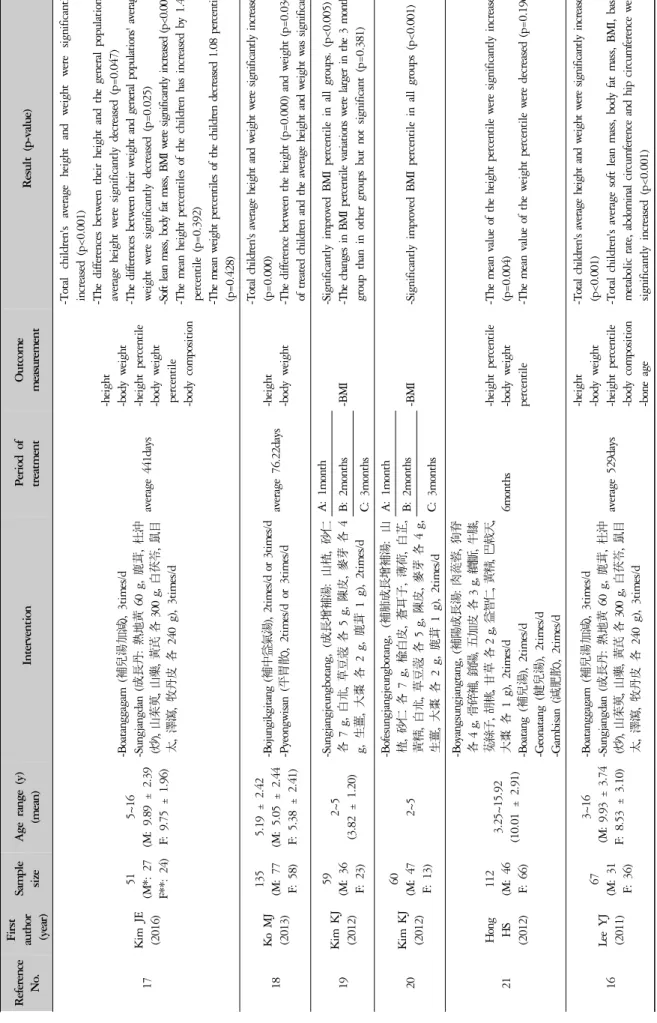
선정된 문헌에서 연구대상, 치료방법, 치료기간, 평 가지표 및 치료결과에 관한 정보를 추출하였다 (Table 1). 사용된 한약처방의 구성을 기재하였으며 (Table 1), 약재별 빈도를 조사하였다 (Table 2).
105
Table 1. Key Data of Studies about Treatment for Growth of Children Reference No.
First author (year)
Sample sizeAge range (y) (mean) InterventionPeriod of treatmentOutcome measurementResult (p-value) 17Kim JE (2016)
51 (M*: 27 F**: 24)
5~16 (M: 9.89 ± 2.39 F: 9.75 ± 1.96) -Boatanggagam (補兒湯加減), 3times/d -Sungjangdan (成長丹: 熟地黃 60 g, 鹿茸, 杜沖 (炒), 山茱萸, 山藥, 黃芪 各 300 g, 白茯苓, 鼠目 太, 澤瀉, 牧丹皮 各 240 g), 3times/d
average 441days
-height -body weight -height percentile -body weight percentile -body composition
-Total children's average height and weight were significantly increased (p<0.001) -The differences between their height and the general populations' average height were significantly decreased (p=0.047) -The differences between their weight and general populations' average weight were significantly decreased (p=0.025) -Soft lean mass, body fat mass, BMI were significantly increased (p<0.001) -The mean height percentiles of the children has increased by 1.47 percentile (p=0.392) -The mean weight percentiles of the children decreased 1.08 percentile (p=0.428) 18Ko MJ (2013)
135 (M: 77 F: 58)
5.19 ± 2.42 (M: 5.05 ± 2.44 F: 5.38 ± 2.41) -Bojungikgitang (補中益氣湯), 2times/d or 3times/d -Pyeongwisan (平胃散), 2times/d or 3times/daverage 76.22days-height -body weight
-Total children's average height and weight were significantly increased (p=0.000) -The difference between the height (p=0.000) and weight (p=0.036) of treated children and the average height and weight was significant 19Kim KJ (2012)
59 (M: 36 F: 23)
2~5 (3.82 ± 1.20) -Sungjangjeungbotang, (成長增補湯: 山楂, 砂仁 各 7 g, 白朮, 草豆蔲 各 5 g, 陳皮, 麥芽 各 4 g, 生薑, 大棗 各 2 g, 鹿茸 1 g), 2times/d
A: 1month -BMI-Significantly improved BMI percentile in all groups. (p<0.005) -The changes in BMI percentile variations were larger in the 3 months group than in other groups but not significant (p=0.381)B: 2months C: 3months 20Kim KJ (2012)
60 (M: 47 F: 13)2~5
-Bofesungjangjeungbotang, (補肺成長增補湯: 山 楂, 砂仁 各 7 g, 楡白皮, 蒼耳子, 薄荷, 白芷, 黃精, 白朮, 草豆蔲 各 5 g, 陳皮, 麥芽 各 4 g, 生薑, 大棗 各 2 g, 鹿茸 1 g), 2times/d
A: 1month -BMI-Significantly improved BMI percentile in all groups (p<0.001)B: 2months C: 3months 21Hong HS (2012)
112 (M: 46 F: 66)
3.25~15.92 (10.01 ± 2.91) -Boyangsungjangtang, (補陽成長湯: 肉蓯蓉, 狗脊 各 4 g, 骨碎補, 鎖陽, 五加皮 各 3 g, 續斷, 牛膝, 菟絲子, 胡桃, 甘草 各 2 g, 益智仁, 黃精, 巴戟天, 大棗 各 1 g), 2times/d -Boatang (補兒湯), 2times/d -Geonatang (健兒湯), 2times/d -Gambisan (減肥散), 2times/d
6months-height percentile -body weight percentile
-The mean value of the height percentile were significantly increased (p=0.004) -The mean value of the weight percentile were decreased (p=0.196) 16Lee YJ (2011)
67 (M: 31 F: 36)
3~16 (M: 9.93 ± 3.74 F: 8.53 ± 3.10) -Boatanggagam (補兒湯加減), 3times/d -Sungjangdan (成長丹: 熟地黃 60 g, 鹿茸, 杜沖 (炒), 山茱萸, 山藥, 黃芪 各 300 g, 白茯苓, 鼠目 太, 澤瀉, 牧丹皮 各 240 g), 3times/d
average 529days
-height -body weight -height percentile -body composition -bone age -Total children's average height and weight were significantly increased (p<0.001) -Total children's average soft lean mass, body fat mass, BMI, basal metabolic rate, abdominal circumference and hip circumference were significantly increased (p<0.001)
Reference No.
First author (year)
Sample sizeAge range (y) (mean) InterventionPeriod of treatmentOutcome measurementResult (p-value) -The mean height percentile (p=0.543) and the mean weight percentile (p=0.413) were increased 22Yu HY (2009)1216~14 -Seongjangbojunggeonatang (成長補中健兒湯: 白 朮, 黃芪 各 6 g, 甘草, 枸杞子, 白芍藥, 山楂, 山茱萸, 龍眼肉, 人蔘, 枳實 各 4 g, 桂枝, 當歸, 木瓜, 砂仁, 生薑, 升麻, 陳皮 各 3 g, 鹿茸, 大棗 各 2 g, 紅花子 1 g), 2times/d
12months-height-The mean height of total children were significantly higher compared to normal average height (p<0.005) 5Kong JC (2008)
42 (M: 21 F: 21)
M: 11.7 ± 2.9 F: 10.8 ± 2.4 -Gamiikgitang (加味益氣湯: 黑太, 黃芪, 龍眼肉, 枸杞子, 當歸, 白朮, 山藥, 葛根, 鹿茸 等), 3times/d -Gamiyukmitang (加味六味湯: 黑太, 豆豉, 熟地 黃, 山茱萸, 山藥, 當歸, 杜沖, 鹿茸 等), 3times/d
6~8months-growth percentile -predictive height-The mean growth percentile of total children was increased (p<0.001) -The mean predictive height of total children was increased (p<0.001) 23Jeong MJ (2008)
18 (M: 12 F: 6)
M: 4~12 F: 4~10 -Seongjangtanggami (成長湯加味: 香附子, 蒼朮 各 6 g, 當歸, 川芎, 熟地黃, 芍藥, 山茱萸, 茯苓, 半夏, 陳皮, 免絲子 各 4 g, 杜沖, 牛膝, 狗脊 各 3 g, 蒲黃, 紅花, 藿香, 五加皮, 甘草 各 2 g), 3times/d -Palmijihwanghwan (八味地黃丸), 3times/d -Jeonssiigongsan (錢氏異功散), 3times/d -Jeonssibaekchulsan (錢氏白朮散), 3times/d
6months or more-height percentile -GV -BMI
-Total children's average height percentile was increased -Total children's average GV was increased -Total children's average BMI was increased 24Cha KB (2007)
10 (M: 5 F: 5)6~13-Yukmijihwangtang plus Bojungikgitang (六味地黃 湯合補中益氣湯), 3times/d1~32months-height-The mean height of total children were significantly higher compared to normal average height (p<0.005) 25Kim HJ (2006) 32 (M: 15 F: 17)7~15-Jwagwieumgagam (左歸飮加減) -Jeonssibaekchulsangagam (錢氏白朮散加減)12months or more (average 12.87months) -height -body weight -BMI -bone age
-The mean growth percentile of children was increased (p=.046) -Difference between bone and choronological age was reduced (p=.040) 26Park SM (2001)
165 (M: 101 F: 64)2~16 -Hwalhyeolseongjangsan (活血成長散: 五加皮 12 g, 香附子, 大棗 各 6 g, 熟地黃, 當歸, 川芎, 白芍 藥, 山藥, 山茱萸, 茯苓, 半夏, 陳皮 各 4 g, 厚朴, 白朮, 山査, 紅花, 五味子, 黄芪, 杜沖, 枳實, 牛 膝, 桂枝 各 3 g, 藿香 知母 各 2 g, 鹿茸 1 g) -Seongjantang (成長湯) -Yukmijihwangtang (六味地黃湯) -Samultang (四物湯) -Bojungikgitang (補中益氣湯)
12months-height -growth hormone -Growth variations of total children were higher compared to normal average growth variations -The growth hormone figure of children was increased
107
M: male, F: female, BMI: body mass index, GV: growth velocity
Reference No.
First author (year)
Sample sizeAge range (y) (mean) InterventionPeriod of treatmentOutcome measurementResult (p-value) -Hyangsapyeongwisan (香砂平胃散) -Gwibitang (歸脾湯) 27Lee SY (2001)1435~17 -Soeumin Hyangbujapalmultanggagam (少陰人 香 附子八物湯加減), 2times/d -Soyangin Yukmijihwangtanggagam (少陽人 六味 地黃湯加減), 2times/d -Taeeumin Cheongsimyeonjatanggagam (太陰人 淸 心蓮子湯加減), 2times/d -Boatang (補兒湯), 2times/d -Boikyangwitang (補益養胃湯), 2times/d
6months
-height -body weight -BMI -growth percentile grade
-The mean value of height (p=0.000), weight (p=0.000), BMI (p=0.011), growth percentile grade (p=0.000) were increased 3Jeong HS (2001)
51 (M: 19 F: 32)6~11-Boyangsungjangtang (補陽成長湯: 肉蓯蓉, 金毛 狗脊, 骨碎補, 鎖陽, 五加皮, 續斷, 牛膝, 菟絲子, 胡桃, 甘草, 益智仁, 黃精, 大棗, 巴戟)6weeks or more-height-growth rate-The mean value of height-growth rate was grater than that of prepuberty children who are in 50 percentile (p<0.001) 28Lee SY (2000)2 (F: 2)10y 9mo, 5y 3mo-Boikyangwitanggami (補益養胃湯加味)6months-height-growth percentile-Each height-growth percentile was increased 29Na DG (1999)
200 (M: 116 F: 84)~14
-SungjangtangA (成長湯A: 四六湯 加 五加皮 10 g, 牛膝, 杜沖, 續斷, 破故紙, 狗脊, 骨碎補 各 4 g, 紅花 2 g) -SungjangtangB (成長湯B: 補中益氣湯 加 五加皮 10 g, 牛膝, 杜沖, 續斷, 破故紙, 狗脊, 骨碎補 各 4 g, 紅花 2 g)
12months-height-Average of height-growth was increased 30Kim JH (1998)
20 (M: 11 F: 9)
8.37 (M: 8.48 F: 8.15)
-Bojunggeonatanggagam (補中健兒湯加減) -Samchulgeonbitanggagam (蔘朮健脾湯加減) -Danggwieumjagagam (當歸飮子加減) -Bopyejeongcheontanggagam (補肺定喘湯加減) -Bangpungtongseongsangagam (防風通聖散加減) -Jeonssibaekchulsangagam (錢氏白朮散加減) -Gamiboatang (加味補兒湯) -Gamisihogayonggolmoryeotang (加味柴胡加龍骨 牡蠣湯) -Boeumjeonggitanggagam (補陰正氣湯加減) -Geonpyetanggagam (健肺湯加減) -Gamiijintang (加味二陳湯) -Gamihyeonggaeyeongyotang (加味荊芥蓮翹湯)
average 29.46weeks-height percentile-Total children's average height percentile was increased (p=0.027)
Records identified through database searching (n=275)
Duplicated records removed (n=59) Title and abstract scanned
(n=216)
Records excluded after scanning title and abstract (n=147)
① not human
② not short stature
③ not herb-medication Full text retrieved for further evaluation
(n=69)
Records excluded after reading the full text (n=52)
① Don’t present the composition of herb- medication (n=3)
② Review (n=2)
③ Observational study (n=43)
④ Survey research (n=3)
⑤ Research methodology (n=1) Finally included studies
(n=17)
Fig. 1. Flow chart of study selection process
Table 2. Frequency of Herbs in Prescription
Frequency Herbal name
17 Hoelen (茯苓)
14 Citri Pericarpium (陳皮)
13 Glycyrrhizae Radix (甘草), Atractylodis Rhizoma Alba (白朮) 12 Dioscoreae Rhizoma (山藥)
11 Angelicae Gigantis Radix (當歸), Amomi Fructus (砂仁), Rehmanniae Radix Preparata (熟地黃) 10 Corni Fructus (山茱萸), Astragali Radix (黃芪)
9 Aucklandiae Radix (木香)
8 Cervi Parvum Cornu (鹿茸), Jujubae Fructus (大棗), Paeoniae Radix Alba (白芍藥) 7 Eucommiae Cortex (杜沖), Cnidii Rhizoma (川芎), Crataegi Fructus (山楂)
6 Drynariae Rhizoma (骨碎補), Lycii Fructus (枸杞子), Cibotii Rhizoma (狗脊), Pinelliae Rhizoma (半夏), Achyranthis Radix (牛膝), Alpiniae Oxyphyllae Fructus (益智仁), Cyperi Rhizoma (香附子), Carthami Flos (紅花)
5 Hordei Fructus Germinatus (麥芽), Zingiberis Rhizoma Crudus (生薑), Acanthopanacis Cortex (五加皮), Ginseng Radix (人蔘), Aurantii Immaturus Fructus (枳實), Psoraleae Semen (破故紙)
4 Cinnamomi Ramulus (桂枝), Agastachis Herba (藿香), Moutan Cortex Radicis (牧丹皮), Amomi Rotundus Fructus (白豆蔲), Dipsaci Radix (續斷), Longanae Arillus (龍眼肉), Cistanches Herba (肉蓯蓉), Alismatis Rhizoma (澤瀉), Magnoliae Cortex (厚朴) 3 Puerariae Radix (葛根), Cynomorii Herba (鎖陽), Cuscutae Semen (菟絲子), Massa Medicata Fermentata (神麯), Zizyphi Spinosae
Semen (酸棗仁) 2
Chaenomelis Fructus (木瓜), Dolichoris Semen (白扁豆), Cimicifugae Rhizoma (升麻), Schisandrae Fructus (五味子), Atractylodis Rhizoma (蒼朮), Amomi Tsaoko Fructus (草果), Alpiniae Katsumadai Semen (草豆蔲), Typhae Pollen (蒲黃), Polygonati Rhizoma (黃精)
1
Platycodi Radix (桔梗), Raphani Semen (蘿蔔子), Glycine Semen Preparatum (豆豉), Angelicae Dahuricae Radix (白芷), Acori Graminei Rhizoma (石菖蒲), Bupleuri Radix (柴胡), Nelumbinis Semen (蓮子肉), Polygalae Radix (遠志), Ulmi Macrocarpae Cortex (楡白皮), Myristicae Semen (肉豆簆), Anemarrhenae Rhizoma (知母), Xanthii Fructus (蒼耳子), Morindae Radix (巴戟天), Scrophulariae Radix (玄蔘), Juglandis Semen (胡桃), Carthami Fructus (紅花子), Scutellariae Radix (黃芩), Coptidis Rhizoma (黃連), Aconiti Lateralis Preparata Radix (附子)