Received : December 5, 2012; Revised : December 15, 2012; Accepted : December 17, 2012
Correspondence : Seung-Hun Cho, Department of Neuropsychiatry, College of Korean medicine, Kyung-Hee University, Hoegi-dong Dongdaemun-gu, Seoul, Korea.
Tel : +82-2-958-9188, Fax : +82-2-958-9186, Email : [email protected]
혈관성 치매 치료 한약물 임상연구 고찰
김가나, 조성훈
경희대학교 한의과대학 신경정신과
Review of Clinical Trials about Herbal Medicine for Vascular Dementia
Ka-Na Kim, Seung-Hun Cho
Department of Neuropsychiatry, College of Korean Medicine, Kyung-Hee University, Korea
Abstract Objectives :
The purpose of this study is to investigate the frequently used herbal materials among herbal prescription for vascular dementia.
Methods :
Every article relevant to vascular dementia was initially obtained from a Korean database and PubMed. Keywords searched were 'vascular dementia', 'herbal medicine' and 'human'.
Results :
Clinical study, which vascular dementia were treated with herbal medicine, were 12. Among these 12 articles, 6 were case study, 1 was Controlled Clinical Trial and 5 were Ramdomized Controlled Trial (RCT). High frequently used herbal materials were Ginseng Radix (9 times) , Cnidii Rhizoma (8 times) , Glycyrrhizae Radix, Citri Pericarpium, Astragali Radix and Angelicae Gigantis Radix (6 times).
Conclusions :
We could know frequent-used herbal medicine for vascular dementia. To be aware of the frequently used herbal medicine for vascular dementia can be helpful in adding herbal materials to prescription in a clinical treatment and development of new drugs.
Key Words:
Vascular dementia, Herbal medicine, Ginseng Radix , Cnidii Rhizoma .
Ⅰ. 서론
치매는 뇌의 만성적 진행성 변성질환에 의해 흔히 기억장애 및 기타 지적기능의 상실이 일어나는 임상 증후군을 말한다. 좀 더 넓은 의미로는 지적 황폐화 뿐만 아니라 행동 이상 및 인격 변화를 초래하며, 정 서적 기능상실과 진행성인 지적 황폐화가 사회적 혹 은 직업적 기능의 장애를 추래하게 되는 상태이다
1)
. 우리나라 65세 이상 노인의 치매 유병율은 약 9.08%로 대략 52만명에 이르며 2030년에는 9.61%(대략 110만명), 2050년에는 13.17%(대략 212만명) 으로 증가할 것으로 보인다. 이 중에서도 알쯔하이 머형 치매의 유병률은 4.2%에서 9.0%, 혈관성 치매 의 유병률은 1.0%에서 4.8%로 보고되었다
2)
.치매는 원인질환에 따라 분류를 하는데 대표적으 로 알쯔하이어형 치매(AD, Dementia of Alzheimer type), 혈관성 치매(VD, Vascular dementia), 전측두 엽성 치매(FTD, Frontotemporal dementia) 등이 있 다
3)
.혈관성 치매는 뇌의 혈관성 병변 때문에 일어나는 치매를 주증상으로 한 질환군을 총칭한 것으로 동맥 경화나 혈관 뇌출혈 등에 기인한 것이다
4)
.혈관성 치매는 서서히 진행되는 알쯔하이머병 치 매와는 달리 갑자기 치매현상을 보이거나 상당 기 간에 걸쳐 호전과 악화의 경과를 보이거나 과거에 뇌졸중의 경력이 있거나 국소적인 신경학적 이상 소 견을 가지는 것이 보통이다. 혈관성 치매는 두통, 현 기증, 상하지의 무력감, 몸이 저리고 피로하기 쉬우 며 집중곤란 등의 신경쇠약 증상으로 시작되는 경우 가 많다. 인격변화는 비교적 초기에서부터 볼 수 있 으며 원래의 성격이 첨예화되는 경우가 많다
5)
.치매을 일으키는 원인질환 중에서 혈관성 치매는 치매의 약 20%를 차지하며 알쯔하이머병 다음으로 유병률이 높은 치매를 일으키는 원인 질환이다. 특 히 우리나라와 일본에서는 서구보다 혈관성 치매가 더 흔하다고 알려져 있으며 알쯔하이머병 만큼이나
중요하게 인식되고 있다
6)
.혈관성 치매는 대부분 뇌졸중의 후속질환으로 나 타나므로 한의학적 범주에서는 中風에 해당한다
7)
. 한의학적 병인은 風, 火, 痰, 瘀 등으로 요약할 수 있고, 治法으로는 化痰祛瘀, 益氣活血, 開竅通絡 등 이 있다. 한의학에서는 <景岳全書>에서 ‘癡呆
’라 하 여 최초로 치매의 증상에 관하여 언급하였으며, 그 이후 <石室秘錄>, <辨症奇聞> 등에서 이를 ‘呆
病’이 라 칭하고 그 증상 및 치료법을 비교적 자세하게 기 록하였는데 그 이전에는 ‘癲狂症’, ‘健忘症’, ‘鬱症’, ‘痰 濕’, ‘虛勞’ 등 치매와 유사한 서로 다른 병증에 포함 하여 치매를 파악한 것으로 생각된다8)
.본 연구에서는 pubmed와 국내 오아시스 검색에 서 한약을 이용한 혈관성 치매 치료 임상 연구를 리 뷰하여 약물을 조사한 후 향후 한방 처방과 약물 개 발에 도움이 되도록 혈관성 치매에 쓰인 빈용 약재 를 알아보려 한다.
Ⅱ. 연구 대상 및 방법
1. 연구 선택
연구 대상의 선정 기준은 사람을 대상으로 한약물 투여를 한 연구이며, 혈관성 치매로 진단받은 환자 를 대상으로 한 논문을 고찰하였다. 리뷰 논문, 동물 을 대상으로 한 연구, 한약을 사용하지 않은 연구는 제외하였다.
2. 데이터베이스 및 검색방법
영어 논문 데이터 베이스를 검색하기 위해 Pubmed 를 이용하였고, Pubmed 검색에서 혈관성 치매 환자를 대상으로 한 한약물 연구를 검색하였고, 영어로 작성 된 논문만을 검색하였다. 검색 방법은 다음과 같다.
("Dementia, Vascular"[Mesh] OR "vascular dementia"
[Tiab]) AND ("Herbal Medicine"[Mesh] OR "Drugs, Chinese Herbal"[Mesh] OR "Medicine, Chinese
Studes screened(n=32) - pubmed(n=21) - oasis(n=11)
Studies excluded after screening the form of the article - review : 10
Excluded after screening form of article(n=22)
The subject of study - animal : 1 - normal person : 1
Article about subtype of vascular dementia : 1 Article about stroke patients mild cognitive impairments : 1
Excluded after screening the subject of study(n=18)
Herb materials that constitute prescription are not ex- pressed : 1
Intervention is not herbal medicine : 4
Prescribed medication does not contain only herbal medi- cine: 1
Studies included in this review(n=12)
Fig. 1. Flow Diagram Prefered Reporting Items for Review
Traditional"[Mesh:NoExp] OR "Medicine, East AsianTraditional"[Mesh] OR "herb"[Tiab] OR "herbal"
[Tiab]) AND "humans"[MeSH Terms] AND "English"
[lang]로 검색하였다.
국내 논문 데이터베이스 검색에서는 전통의학 전 문포털인 오아시스에서 ‘혈관성 치매’로 검색하였다.
Ⅲ. 결과
1. 대상 연구의 선정
Pubmed 검색에서 21개의 논문이 검색되고, 국내 논문 데이터베이스 검색에서는 11개의 논문이 검색
되어 총 32개의 논문을 대상으로 하였다.
선정된 논문들 중 리뷰 논문 10편을 제외하였다.
연구의 대상이 동물인 논문(1편), 연구의 대상이 혈 관성 치매 환자가 아닌 정상인인 논문(1편)을 제외 하였다. 혈관성 치매 자체가 아닌 혈관성 치매의 아 형인 피질하 혈관성 치매를 다룬 논문(1편)과 혈관 성 질환으로 경도 인지장애는 생겼지만 치매까지 진 단되지는 않는 환자를 대상으로 한 논문(1편)을 제 외하였다.
마지막으로 한약이 중재 방법으로 사용되었어도 처방구성이 기재되어 있지 않은 논문(1편) 중재 방 법이 한약이 아닌 일반 식물 추출물로만 이루어져 있는 논문(4편)이나 한약재와 일반식물이 함께 쓰인 논문(1편)은 제외하였다.
Subject Author Article
type Number Intervention Control
Name of prescripati
on
Main herbal material
Assesmen
t scale Conclusion
Cases Report about Vascular Dementia Treated with Bojungikki-tang-ga mibang
9)Kim DJ,
Park MY case 9
herbal medicine+acupu ncture
-
Bojungikki -tang-gami bang(補中 益氣湯)
Astragali Radix(黃芪),
Ginseng Radix(人蔘)
MMSE-K, Hachinski Ischemia coefficient
s, K-DRS
the K-DRS score significantly increased after Bojungikki-tang-gamibang treatment
Case of Vascular Dementia Treated with
Bojungikki-tang-ga mibang
10)Park K, Kim HJ et al
case 1
herbal medicine+acupu ncture+physical therapy
-
Bojungkki- tang-gamib ang(補中益 氣湯)
Astragali Radix(黃芪),
Ginseng Radix(人蔘)
MMSE-K, Motor grade
After
Bojungikki-tang-gamibang treatment, dementia, Rt.
side hemiparesis, insomnia, anorexia got improved and MMSE-K score increased as well
Clinical Report of One Patient with the Vascular de- mentia by Sesimtang mixed Gujuntag
11)Jung MS, Kang HC et al
case 1
herbal medicine+acupu ncture+
moxibustion -
Sesimtang mixed Gujuntang (洗心湯 合
祛癲湯)
Atractylodis Rhizoma White(白朮),
Poria(茯神), Zizyphi spinosae
semen (酸棗仁)
MMSE-K, K-DRS,
Motor grade
As a result of herb medication, patient's memory and disorientation were improved and the score of K-DRS and MMSE-K was ascended.
Two Case Reports on Soeumin Woolgwang-in- curable Disease with Vascular Dementia
12)Hong SY, Kim TH et al
case 2
herbal medicine+acupu ncture+
moxibustion + Western medicine
-
Doksampal mul- tang(獨蔘
八物湯)
Ginseng Radix(人蔘)
degree of sleep, firing and
fever
Doksampalmultang were given, ther symptoms(sleep, firing and fever) were improved over all Table 1. Analysis of articles
2. 논문의 경향성
최종 분석 대상으로 선정된 논문은 총 12개의 논 문으로 이 중 국내 논문이 4개, 영어 논문이 8개였다.
국내 논문은 모두 증례 논문이었고, 영어 논문 9개 중 2개는 증례 논문이었고, 1개는 대조군 연구였으며 5개가 무작위 대조군 연구(Randomized Controlled Trial, RCT))였다. 따라서 최종 분석 대상이 된 논문 중 7개가 증례 논문이었고, 1개가 대조군 연구였으며 5개가 무작위 대조군 연구(Randomized Controlled Trial, RCT)였다.
이 중 한약 처방을 탕약의 방식으로 사용한 논문 은 6개였고, 추출약이나 제제약의 방식으로 만들어 진 한약 처방을 사용한 논문은 6개였다.
증례 논문에서는 중재 방법으로 한약 처방만을 사
용한 논문이 2개, 한약과 침을 병행한 논문이 1개, 한약, 침, 물리치료를 병행한 논문이 1개, 한약, 침, 뜸을 병행한 논문이 1개, 한약, 침, 뜸, 양약을 병행한 논문이 1개가 있다.
대조군 연구 논문 1편에서는 중재 방법으로 한약 처방만을 사용하였다.
무작위 대조군 연구에서는 실험군에 한약을 투여 하고, 대조군은 양약 투여를 하여 효과를 비교한 논 문이 2개였다. 실험군에 한약과 양약을 병행 투여하 고, 대조군은 양약 투여를 하여 효과를 비교한 논문 이 1개였다. 실험군에 한약을 투여하고 대조군은 위 약 투여를 하여 효과를 비교한 논문이 1개였다. 대상 자를 네 군으로 나누어 각각 한약과 재활, 한약과 침, 한약과 침과 재활 치료를 하고 대조군에는 양약을 투여하여 효과를 비교한 논문이 1개였다(Table 1).
Effects of yokukansan on behavioral and psychological symptoms of vascular dementia
13)Nagata, K., E.
Yokoya ma, et al
case 13 herbal medicine - yokukansan
(抑肝散)
Poria(茯神), Atractylodis Rhizoma
(蒼朮)
NPI, MMSE,
BI, DAD, UPDRS
In the NPI-subcategories, there was a significant im- provement in agitation and disinhibition after the treat- ment
A clinical investigation on zhi ling tang for treatment of senile dementia
14)Yan, L., B. Liu, et
al
case 32 herbal medicine -
zhi ling tang (智靈湯)
Ginseng Radix(人蔘),
Polygoni multiflori Radix (何首烏)
LAB, HDS
Revised Hasegawa de- mentia scales(HDS) scores and clinical symptoms were improved. The total effec- tive rate was 81.3%.
Tongqiao huoxue tang and buyang huanwu tang for treatment of vascular dementia--a report of 36 cases
15)Liu, C., L. Zhou,
et al Compar
ative study
ex- perimental
group:36, control group:28
herbal medicine western medicine (Duxil)
Tongqiao huoxue tang and
buyang huanwu tang(通窺 活血湯 合 補中益氣湯)
Carthami Flos(紅花),
Allii Radix(蔥白)
MMSE, HDS
Tongqiao Huoxue Tang and Buyang Huanwu Tang has a good effect on indexes of blood rheology, expecially on VaD.
Clinical research on comprehensive treatment of senile vascular dementia
16)Chen, L.
P., F. W.
Wang, et al
RCT
1. 32(herbal medicine +rehabilitati on ) 2. 33(herbal
medi- cine+acu- puncture) 3. 37(herbal
medi- cine+acu-
punc- ture+re- habilitation)
4.
32(western medicine)
32(herbal medicine+rehabi litation ) 33(herbal medicine+acupu ncture) 37(herbal medicine+acupu ncture+rehabilita tion) 32(western medicine)
western medicine
Shenlong Jiannao Tang(參龍
健腦湯)
Acori Graminei Rhizoma (石菖蒲), Epimedii Herba (淫羊藿)
MMSE, BBS
Chinese medicine and acu- puncture plus rehabilitation treatment can improve in- telligence and living ability of senile VD patients.
Efficacy of Choto-san on vascular dementia and the protective effect of the hooks and stems of Uncaria sinensis on
glutamate-induced neuronal death
17)Itoh, T., Y.
Shimada, et al
RCT
1. well-con- trolled(ex- perimental group: 31, control group:26) 2. double
blind(ex- perimental group: 69, control group:70)
herbal medicine placebo Choto-san (釣藤散)
Citri Pericarpium
(陳皮), Pinelliae Rhizoma
(半夏)
global improvem ent rating
Choto-san showed statisti- cally significant superi- ority(PB 0.001) to the place- bo in the utility rating.
Choto-san was superior to placebo with statistical sig- nificance in the global improvement rating of dis- turbance in daily living ac- tivities
Jian Nao Ning for treatment of memory impairment in patients with mild or moderate multi-infarct dementia
18)Tian, J., J. Yin, et
a RCT
ex- perimental
group:25, control group:15
herbal medicine western medicine
Jian Nao Ning (健腦寧)
Polygoni multiflori Radix (何首烏), Ginseng Radix(人蔘)
MMSE, HVLT(Ho
pkins Verbal Learning
Test)
After treatment, the mean
scores fo verbal memory in
the Hopkins Verbal
Learning Test and total
memory scores of memory
items in JNN group in-
creased significantly; and
improvement in episodic
memory function including
story recall, delayed word
recall, verbal learning and
verbal recognition and visu- al recognition are improved.
Clinical systematic observation of Kangxin capsule curing vascular dementia of senile kidney deficiency and blood stagnation type
19)Liu, X., J. Du, et
al RCT
ex- perimental
group:29, control group:27
herbal medicine western medicine (Piraceta m 등)
Kangxin capsule
Lycii Fructus (枸杞子), Pinelliae Rhizoma
(半夏)
HIS, HDS, Endotheli n(ET), sex hormone, immunity and routine examinati ons
For the male VaD patients of the Kangxin group, T lev- el increases and estro- dial(E2)·testerone(T)−.1 value decreases after the treatment Kangxin capsule is a valid and safe prepara- tion of Chinese traditional medicine for curing VaD of senile kidney deficiency and blood stagnation type.
A clinical study of yi zhi capsules in prevention of vascular dementia
20)Xu, H., N. Shao,
et al RCT
ex- perimental
group:40, control group:40
herbal medicine+weste rn medicine
western medicine (Piraceta m 등)
yi zhi capsules
Ginseng Radix(人蔘),
Polygoni multiflori Radix (何首烏)
HDS, blood lipid level
The morbidity of vascular dementia was much lower and the blood lipid level and some indexes in rheo- logical esaminations were also improves significantly.
The data indicate that YZC is a relatively good prepara- tion for prevention of vas- cular dementia
치료 효과의 평가 척도 중 인지기능과 관련하여 사용된 scale 및 검사는 MMSE(Mini-Mental State Examination), MMSE-K(MMSE의 한글판), 하세가와 치매척도(HDS, Hasegawa dementia scales), K-DRS, HVLT(Hopkins Verbal Learning Test)가 있 었다. MMSE는 4개의 논문에서 사용되었으며 MMSE-K 또한 4개의 논문에서 사용되었다. HDS 는 4개의 논문에서 사용되었고 K-DRS는 2개의 논 문에서 사용되었다. HVLT는 1개의 논문에서 사용 되었다.
그 외 인지기능과 직접적인 관련성은 없지만 증상 의 호전 정도를 측정하기 위해서 Hachinski 허혈계 수, Motor grade, NPI(Neuropsychiatric Inventory), BI(Barthel index), DAD(Disability Assessment for Dementia), UPDRS(United Parkinson’s Disease Rating Scale), BBS(Bless Behavior Scale), 혈중지질 농도(blood lipid level) 등이 있었다.
3. 사용된 한약물에 대한 분석
중재로 한약 처방을 사용했다고 하더라도 처방 구 성이 나와 있지 않은 논문은 처방에 어떤 한약재가 쓰였는지 알 수 없었기 때문에 제외하였다.
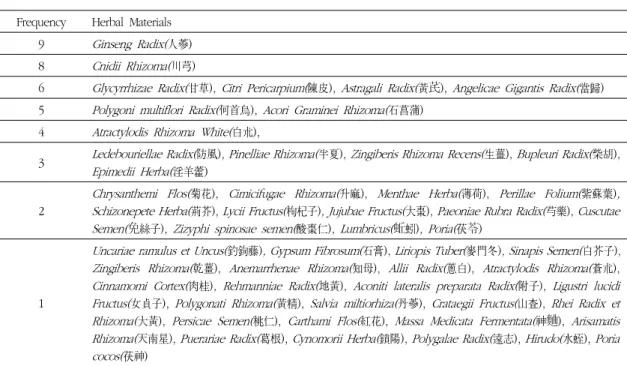
혈관성 치매의 치료에 중재로 한약 처방이 쓰인 논문들에서 약재의 빈도수를 살펴보면 人蔘과 川芎 이 각각 9번과 8번으로 가장 많이 쓰인 쪽에 속했으 며, 그 다음으로 많이 쓰인 약재는 甘草, 陳皮, 黃芪, 當歸가 각 6회, 何首烏, 石菖蒲가 각 5회, 白朮이 4회, 防風, 半夏, 生薑, 柴胡, 淫羊藿이 각 3회씩 사용되었 다. 2번 쓰인 약재로는 菊花, 茯苓, 升麻, 薄荷, 紫蘇 葉, 荊芥, 枸杞子, 大棗, 芍藥, 免絲子, 酸棗仁, 蚯蚓 이 있었다. 1번씩만 쓰인 약재는 釣鉤藤, 石膏, 麥門 冬, 白芥子, 乾薑, 知母, 蔥白, 蒼朮, 肉桂, 地黃, 附子, 女貞子, 黃精, 丹蔘, 山査, 大黃, 桃仁, 紅花, 神麯, 天南星, 葛根, 鎖陽, 遠志, 水蛭, 茯神이 있었다 (Table 2).
Frequency Herbal Materials 9 Ginseng Radix( 人蔘) 8 Cnidii Rhizoma( 川芎)
6 Glycyrrhizae Radix( 甘草), Citri Pericarpium( 陳皮), Astragali Radix( 黃芪), Angelicae Gigantis Radix( 當歸) 5 Polygoni multiflori Radix( 何首烏), Acori Graminei Rhizoma( 石菖蒲)
4 Atractylodis Rhizoma White( 白朮),
3 Ledebouriellae Radix( 防風), Pinelliae Rhizoma( 半夏), Zingiberis Rhizoma Recens( 生薑), Bupleuri Radix( 柴胡), Epimedii Herba( 淫羊藿)
2
Chrysanthemi Flos( 菊花), Cimicifugae Rhizoma( 升麻), Menthae Herba( 薄荷), Perillae Folium( 紫蘇葉) , Schizonepete Herba( 荊芥), Lycii Fructus( 枸杞子) , Jujubae Fructus( 大棗), Paeoniae Rubra Radix( 芍藥), Cuscutae Semen( 免絲子), Zizyphi spinosae semen( 酸棗仁), Lumbricus( 蚯蚓), Poria( 茯苓)
1
Uncariae ramulus et Uncus( 釣鉤藤) , Gypsum Fibrosum( 石膏), Liriopis Tuber( 麥門冬) , Sinapis Semen( 白芥子), Zingiberis Rhizoma( 乾薑), Anemarrhenae Rhizoma( 知母), Allii Radix( 蔥白), Atractylodis Rhizoma( 蒼朮), Cinnamomi Cortex( 肉桂), Rehmanniae Radix( 地黃), Aconiti lateralis preparata Radix( 附子), Ligustri lucidi Fructus( 女貞子), Polygonati Rhizoma( 黃精), Salvia miltiorhiza( 丹蔘), Crataegii Fructus( 山査), Rhei Radix et Rhizoma( 大黃), Persicae Semen( 桃仁), Carthami Flos( 紅花), Massa Medicata Fermentata( 神麯), Arisamatis Rhizoma( 天南星), Puerariae Radix( 葛根), Cynomorii Herba( 鎖陽), Polygalae Radix( 遠志), Hirudo( 水蛭), Poria cocos( 茯神)
Table 2. Frequency of Herbal Materials that Constitute the Intervention Prescriptions
Ⅳ. 고찰
혈관성 치매는 뇌의 혈관성 병변 때문에 일어나는 치매를 주증상으로 한 질환군을 총칭한 것으로 동맥 경화나 혈관 뇌출혈 등에 기인한 것이다
4)
. 혈관성 치매는 치매의 약 20%를 차지하며 알쯔하이머병 다 음으로 유병률이 높은 치매를 일으키는 원인질환이 다. 특히 우리나라와 일본에서는 서구보다 혈관성치 매가 더 흔하다고 알려져 있으며 알쯔하이머병 만큼 이나 중요하게 인식되고 있다. 또한 혈관성치매는 치매를 예방할 수 있고, 진행을 막을 수 있는 측면이 있기 때문에 관심도가 높아지고 있다6)
.본 연구는 혈관성 치매 환자를 대상으로 한약물 치료를 한 임상 연구들을 선별하여, 많이 사용한 약 재를 분석하였다. 국내데이터베이스와 Pubmed에서 본 연구의 목표에 합당한 연구를 찾아 12편을 선정 하였다. 이 중 증례 논문은 6편이었고, 대조군 연구 는 1편이었으며 무작위 대조 연구는 5편이었다. 증 례 논문에서 한약만을 처방한 논문은 2편이었고, 그 외 양약, 침 등과 함께 병행치료를 한 논문은 4편이
었다. 대조군 연구 1편은 한약만을 처방하였다. 무 작위 대조 연구에서는 한약 대 위약의 효과를 살펴 본 논문이 1편, 한약 대 양약의 효과를 살펴본 논문 이 2편, 한약과 양약 병행치료 대 양약의 효과를 살 펴본 논문이 1편, 한약과 침, 재활 등의 병행치료 대 양약의 효과를 살펴본 논문이 1편이었다.
국내데이터베이스에서 검색된 논문의 경우 모두 증례논문이었고, 국내에서 혈관성 치매 환자를 대상 으로 한 무작위 대조 연구는 한 편도 없었다. 본 연구 에서 최종 선정된 무작위 대조 연구 논문들은 모두 Pubmed에서 검색된 논문들이었다. 전체적으로 논 문의 개수가 미흡한 상황이기 때문에 앞으로 혈관성 치매에 대한 연구가 더 필요할 것이다. 또한 그 중에 서도 무작위 대조 연구가 부족한 상황으로 특히 무 작위 대조 연구가 활발히 이루어져야 혈관성 치매에 대한 한약물의 효능을 좀 더 객관적으로 증명할 수 있을 것이다.
치료 효과의 평가 척도 중 인지기능과 관련하여 사용된 scale 및 검사는 MMSE(Mini-Mental State Examination), MMSE-K(한국판 MMSE), 하세가와
치매척도(HDS, Hasegawa dementia scales), K-DRS, HVLT(Hopkins Verbal Learning Test)가 있 었다.
MMSE-K는 현재 가장 많이 사용되는 검사이며 다 른 검사들과 상관계수가 높고, 뇌 전산화 단층 촬영 영상의 병변정도와 상관관계가 높으며 검사자간의 신뢰도도 높다고 알려져 있다. Folstein과 McHugh(1975)가 개발한 MMSE를 한국설정에 맞게 번안하여 수정한 도구이다
21)
.일본에서 개발되어 동양권에서 주로 사용되는 HDS는 MMSE에 비해 교육수준과 연령의 영향을 적 게 받고, 언어 유창성 검사와 숫자 거꾸로 대답하기 같은 전두엽 기능검사가 포함되어 있으며, 동작성 과제가 없어 시각기능이나 운동기능 장애가 있는 노 인에게도 사용 가능하고, 글자 읽기, 쓰기 항목이 없 어 문맹에도 적용할 수 있는 장점이 있다
22)
.HVLT는 검사가 용이하고 간편할 뿐 아니라 치매 의 선별검사(screening test)로 가장 흔하게 사용되 는 Mini-Mental State Examination(MMSE)에 비하여 학력에 영향을 받지 않고 경도의 치매 환자에서는 MMSE보다 더 예민한 검사로 알려져 있다
23)
.한약 처방을 고찰해 본 결과 전체적으로 人蔘이 9회, 川芎이 8회, 甘草, 陳皮, 黃芪, 當歸가 각 6회 사용되어 가장 많이 사용된 약재들이었다. 한약 처 방을 탕제 형태로 쓴 경우도 있었지만 추출하여 캡 슐제제로 사용하거나 가루약 형태의 제제약으로 만 들어 쓴 경우도 있었다.
人蔘은 氣가 溫하여 通經絡, 理氣益氣, 行血 작용 을 한다
24)
.또 人蔘은 혈관을 확장하며 혈액 순환을 개선함으로서 항고혈압 및 항 혈전작용을 나타낸다.홍삼의 총 사포닌은 혈관내피세포-유래 nitric oxide(NO)를 혈관 내피세포로부터 유리하여 혈액의 흐름을 원활하게하고 혈관을 확장하기 때문이다
25)
.川芎은 活血行氣, 祛風止痛하는 효능이 뛰어나 血 中의 氣藥으로 불리며 中風 및 각종 疼痛疾患, 부인 과 질환에 다용되고 있다. 川芎의 주요성분 중 tetramethylpyrazine과 cnidiumlactone이 주로 뇌로
공급되는 미세혈관의 혈류를 개선함으로써 뇌허혈 로 인한 뇌손상에 대해 치료효과를 가지는 것으로 알려져있다
26)
.임상 연구들에서 혈관성 치매에 처방한 한약물의 처방명과 그 효능을 살펴보면 다음과 같다. 補中益 氣湯은 中氣不足및 제반 氣虛證에 사용되는 대표적 인 처방이고,
9)
洗心湯은 肝鬱을 풀고 痰을 없애며 胃氣를 健全하게 하기 위해 사용하며 祛癲湯은 脾胃 虛寒을 치료하면서 痰을 치료하는 효능이 있는 처방 이다10)
. 獨蔘八物湯은 강력한 生陽을 통해 胃와 大 腸의 津液을 도와 潤燥와 함께 逐冷하는 처방이고,12)
抑肝散은 肝氣亢旺에 의한 興奮을 抑制 鎭靜시키는 처방이다27)
.釣藤散은 抑肝散등과 함께 潛陽熄風劑 로 분류되는데, 특히 조등산은 平肝潛陽하는 효능이 있으며 補氣健脾 , 理氣하는 약물이 배합되어 있어 기허를 바탕으로 한 肝風內動에 효과가 있는 처방이 다28)
. 따라서 補氣, 祛痰, 生陽, 平肝潛陽의 효능을 가지고 있는 처방들이 혈관성 치매에 효과가 있었다.Pubmed에서 검색된 논문들은 대부분이 중국과 일본에서 연구된 논문들이었다. 또한 혈관성 치매 환자에게 한약물을 투여한 논문을 Pubmed에서 찾 아보면 중국어로 된 논문들이 꽤 검색되어 한약물에 대한 연구가 중국에서 활발히 시행되고 있음을 알 수 있었다. 그렇지만 본 연구에서는 중국어로 쓰여 진 논문을 배제했다는 점이 논문의 한계점으로 지적 될 수 있다.
또한 처방 구성이 나오지 않은 논문이 있어 어떤 한약재가 쓰였는지 알 수 없는 논문이 있었다. 그리 고 처방 구성이 기재되어 있는 논문이라고 하더라도 그 용량에 대해서는 기재가 안 되어 있는 논문들이 있었다. 어떤 약재를 어느 정도 썼는지 용량에 대한 기재가 없다면 임상에서 처방하거나 약을 개발할 때 불편함이 많기 때문에 추후 이뤄지는 연구들에서는 약재 구성과 더불어 용량을 기재함이 필요할 것이다.
한약물을 투여하여 혈관성 치매에 효과가 있는지 를 살펴본 논문들에는 사람을 대상으로 한 연구뿐만
아니라 동물을 대상으로 한 연구도 있었다. 동물을 대상으로 한 연구에는 Danggui-Shaoyao-San을 혈 관성 치매 쥐 모델에게 투여하여 효과를 연구한 논 문
29)
, 지황음자가 허혈성 뇌 손상을 입힌 쥐에게서 항치매 효과가 있음을 연구한 논문30)
, Kangxin Capsule이 혈관성 치매 쥐 모델에서 신경성장인자 (nerve growth factor) 발현에 효과가 있음을 연구한 논문31)
등이 있다.혈관성 치매에 치료 효과가 있는 한약재에 대한 특허가 어느 정도 등록되어 있는지 알기 위해 본 연 구에서 3회 이상의 빈도수를 보인 人蔘, 川芎, 甘草, 陳皮, 黃芪, 當歸, 何首烏, 石菖蒲, 白朮, 防風, 半夏, 生薑, 柴胡, 淫羊藿과 혈관성 치매, 혈관성 뇌질환, 치매 등의 키워드로 검색을 하였다. 검색 결과 위에 나열된 약재들은 모두 혈관성 치매와 관련된 특허가 있었다. 본 연구에서 혈관성 치매에 빈용된 한약재 들이 모두 특허가 있는 것을 볼 때 임상적 효과가 있는 약재들을 대상으로 실제 연구도 많이 진행되고 있음을 알 수 있었다.
Ⅴ. 결론
본 연구는 혈관성 치매 증상이 있는 환자를 대상 으로 한약물 치료를 한 임상 연구를 선정하여 다빈 도 약재를 선정하고 유효성 있는 한약물을 선정하기 위해 시행되었다.
1. 혈관성 치매 증상이 있는 환자를 대상으로 한 약물을 처방하여 효과를 본 임상 논문은 총 12 개였으며 이 중 6개가 증례 논문이었고, 1개는 대조군 연구였으며 5개가 무작위 대조군 연구 (Randomized Controlled Trial, RCT)였다.
2. 인지기능과 관련하여 치료효과를 평가하기 위 해 사용된 척도로 MMSE, MMSE-K, HDS가 각 각 4개의 논문에서 사용되었고 K-DRS는 2개의 논문에서 사용되었으며 HVLT는 1개의 논문에
서 사용되었다.
3. 처방에 빈용된 약재를 정리해본 결과 人蔘, 川 芎 순으로 높았고, 그 다음으로는 甘草, 陳皮, 黃芪, 當歸 순으로 많이 쓰임을 알 수 있었다.
본 연구를 통해 임상에서 환자들에게 많이 쓰인 약재를 정리할 수 있었고, 이를 통해 임상에서 한약 물을 처방하거나, 신약 개발, 단미제 개발에도 도움 이 될 것이다.
References
1. The Korean society of oriental neuropsychiatry.
Oriental neuropsychiatry. 1st ed. Seoul:
Jipmundang;2007:324
2. Cho MJ. The Prevalence and Risk Factors of Dementia in the Korean Elderly. Health-wel- fare policy forum, 2009;156:43-8.
3. Park SA, Yun YH, Park JY, Kim HY, Oh MJ, Park JH, et al. The distribution of dementia subtypes and their neuropsychological characteristics. Journal of Soonchunhyang Medical Science. 2009;14(3):541-6.
4. Bae OS. Consideration of constitutional medi- cal classification of senile dementia. J Korean Oriental Med. 1992;13(2):101-6.
5. Han YS. A study on the welfare service improv- ment of the old with dementia, Major course of Graduate School of Industrial Engineering.
Management & Design hanyang university.
2011
6. Choi SH, Ku SK, Cheon WH, Baek KM, Han CH, Jeon WK, Lee YJ. Diagnosis, Treatment and Prevention of Subcortical Vascular Dementia with a Case Report. Kor. J oriental preventive medical society. 2010;14(3):63-75.
7. Lee BH, Jeon WK, Han CH. A Study on Interpretation of Alzheimer Disease through Three Yin and Three Yang and the Direction of Acupuncture Treatment. Korean journal of acupuncture. 2011;28(4):159-67
8. Lee DW, Shin GJ, Lee WC. a comparative con- sideration of treatment on dementia in oriental and occidental medicine. the journal of dong guk oriental medicine. 1995;3:67-80.
9. Kim DJ, Park MY. Cases Report about Vascular Dementia Treated with Bojungikki-tang-gamibang.
Korean J. Oriental Physiology & Pathology.
2011;25(1):144∼8.
10. Park K, Kim HJ, Son JY, Kwak MA, Kim SM, Kim DJ, et al. Case of Vascular Dementia Treated with Bojungikki-tang-gamibang. Korean J. Oriental Physiology & Pathology. 2008;22(4):
943-7.
11. Jung MS, Kang HC, Lee SG. Clinical Report of One Patient with the Vascular dementia by Sesimtang mixed Gujuntag. Journal of Oriental Neuropsychiatry. 2007;18(2):163-71.
12. Hong SY, Kim TH, Han DN, Lim EC. Two Case Reports on Soeumin Woolgwang-incurable Disease with Vascular Dementia. Journal of Sasang Constitutional Medicine. 2007:19(2) :213-22.
13. Ken N, Eriko Y, Takashi Y, Daiki T, Tetsuya M, Satoshi T, et al. Effects of yokukansan on behavioral and psychological symptoms of vascular dementia. Phytomedicine. 2012;19:
524-8.
14. Yan L, Liu B, Guo W, Li G, Li Y, Gao H, Cui H, Sun L, Wang M. A clinical investigation on zhi ling tang for treatment of senile dementia. Journal of Traditional Chinese Medicine. 2000;20(2):83-6.
15. Liu C, Zhou L, Shui Z. Tongqiao huoxue tang and buyang huanwu tang for treatment of vas- cular dementia--a report of 36 cases. Journal of Traditional Chinese Medicine. 2003;23(4):
243-5.
16. Chen L, Wang F, Zuo F, Jia J, Jiao W. Clinical research on comprehensive treatment of senile vascular dementia. Journal of Traditional Chinese Medicine. 2011;31(3):178-81.
17. Takashi I, Yutaka S, Katsutoshi T. Efficacy of Choto-san on vascular dementia and the pro- tective effect of the hooks and stems of Uncaria sinensis on glutamate-induced neuro-
nal death. Mechanisms of Ageing and Development. 1999;111(2-3):155-73.
18. Tian J, Yin J, Liu H, Yang C, Wang Y. Jian Nao Ning for treatment of memory impairment in patients with mild or moderate multi-infarct dementia. Journal of Traditional Chinese Medicine. 2012;22(4):247-51.
19. Liu X, Du J, Cai J, Liu X, Xu G, Lin A, et al.
Clinical systematic observation of Kangxin cap- sule curing vascular dementia of senile kidney deficiency and blood stagnation type. Journal of Ethnopharmacology. 2007;112:350-5.
20. Xu H, Shao N, Cui D, Hu Z, Bi J, Jiang Q, et al. A clinical study of yi zhi capsules in prevention of vascular dementia. Journal of Traditional Chinese Medicine. 2000;20(1):10-3.
21, Kwon YC, Park JH. Korean Version of Mini-Mental State Examination(MMSE-K).
Neuropsychiatry. 1989;28(1):125-35
22. Shin JH. Diagnosis of Dementia: Neuropsy- chological Test. Korea J Fam Med. 2010;
31:253-66.
23. Kwak YT, Cho DS. Usefulness of Seoul Verbal Learning Test in Differential Diagnosis of Alzheimer's Disease and Subcortical Vascular Dementia. Journal Korean neurol assoc.
2004;22:22-8)
24. No SH. The effects of ginseng. Herbology.
1992;7(1):53-60.
25. Kim ND. Ginsenosides-mediated Vascular Relaxation and Its Molecular Mechanisms.
Journal of ginseng research. 2008;32(2):89-98.
26. Baek IS, Park CS, Park CG. The Effects of Cnidium Officinale extract on the Ischemic Stroke and Oxidative Neural Damage in Rats`
Brain. Kor. J. Herbology. 2003;18(4):37-46.
27. Hyun WC, Lee SL. Studies on the Effect of AntiConvulsion and Analgesic by Ukgansan and Ukgansangami. Journal of Oriental Neuropsychiatry. 1994;5(1):69-79
28. Jin JS, Kwon DY. A review on pharmacological properties of Jodeungsan. the korean journal of oriental medical prescription. 2008;16(1):
55-64
29. Liu J, Wang JS, Kong LY. Comparative pharma-
cokinetics of paeoniflorin in plasma of vascular dementia and normal rats orally administrated with Danggui-Shaoyao-San or pure paeoniflorin.
Fitoterapia. 2011;82(3):466-73.
30. Hu R, Yin CL, Wu N, Cui GY, Meng H, Wu XG, Luo HS, Gang T, Hu S, Shi J, Lin JK, Feng H. Traditional Chinese herb Dihuang Yinzi(DY) plays neuroprotective and anti-dementia role
in rats of ischemic brain injury. J Ethnophar- macol. 2009;121(3):444-50.
31. Cai J, Du J, Ge ZH, Zhou F, Zhou LY, Chen LY. Effect of Kangxin Capsule on the ex- pression of nerve growth factors in parietal lobe of cortex and hippocampus CA1 area of vascular dementia model rats. Chin J Integr Med. 2006;12(4):292-6.
![Fig. 1. Flow Diagram Prefered Reporting Items for ReviewTraditional"[Mesh:NoExp] OR "Medicine, East Asian](https://thumb-ap.123doks.com/thumbv2/123dokinfo/4678106.501596/3.825.91.727.511.1017/diagram-prefered-reporting-items-reviewtraditional-noexp-medicine-asian.webp)