| Abstract |
Purpose: The purpose of this study was to conduct balance training through vision control to improve the balance, postural control, and balance confidence and to decrease the visual and sensory dependence of stroke patients.
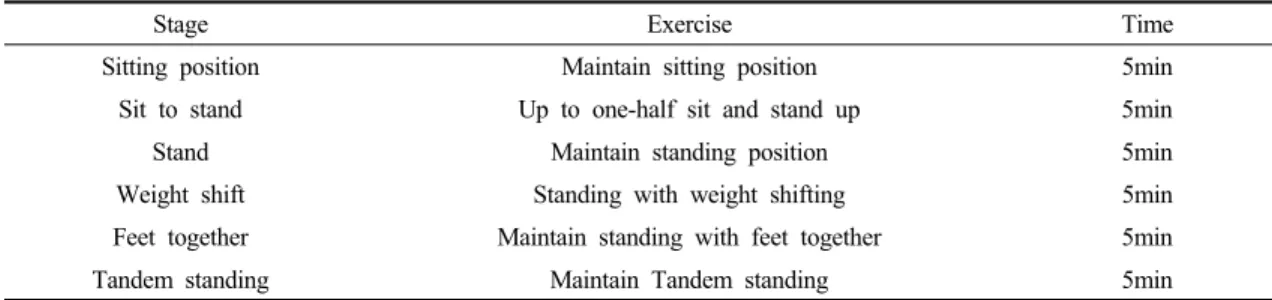
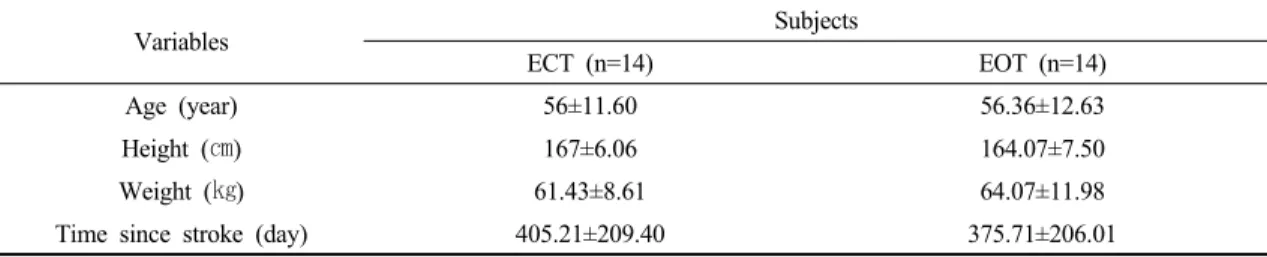
Methods: Twenty-eight chronic stroke patients volunteered to participate in the study. They were randomly assigned to the eyes-closed and the eyes-open training groups. Three times a week for four weeks each group performed an unstable-support session and a balance training session for thirty minutes per set. Their balance, postural control, and balance confidence were assessed using BIO Rescue (BR), the postural assessment scale for stroke (PASS), and the Korean activity-specific balance confidence scale (K-ABC), respectively. All data were analyzed using SPSS version 22.0. Statistical methods before and after working around the average value of each dataset were independent T-test. The significance level for statistical analyses was set at 0.05.
Results: Comparison between the groups showed statistically significant effects on all variables before and after the intervention (p < 0.05).
Conclusion: This study reflected that balance-training programs involving vision control improve the balance, postural control, and balance confidence of chronic stroke patients. Thus, stroke patients should undergo training programs that increase the use of their other senses with vision control in clinical practice.
Key Words: Chronic stroke, Visual control, Balance confidence
†Corresponding Author : Hyun-Mo Koo ([email protected])
Original Article Open Access
시각 통제를 이용한 균형훈련이 만성 뇌졸중 환자의 균형능력과 자세조절, 균형자신감에 미치는 영향
정성화⋅구현모
1†1)큰솔2병원 물리치료실,
1경성대학교 이과대학 물리치료학과
Effects of Balance Training through Visual Control on Balance Ability, Postural Control, and Balance Confidence in Chronic Stroke Patients
Seong-Hwa Jeong, P.T., M.S⋅Hyun-Mo Koo, P.T., Ph.D
1†Department of Physical Therapy, Keunsol2 Hospital
1