| Abstract |
Purpose: The current study seeks to examine the effects of stabilizing reversal(SR) and rhythmic stabilization(RS) in proprioceptive neuromuscular facilitation (PNF) techniques on static balance in normal female adults.
Methods: Subjects included 20 healthy women in their 20s. They were randomly divided into SR and RS groups. To assess static balance before and after PNF intervention, the good balance system was used to measure the interior and exterior center of pressure (COP) movement distance, front and rear COP movement distance before and after the intervention, and velocity moment.
Results: Interior and exterior COP movement distance, front and rear COP movement distance, and velocity moment decreased in the SR group, but no statistically significant differences were observed. In the RS group, the interior and exterior COP movement distance declined without any significant difference, while the front and rear COP movement distance and velocity moment significantly decreased. The interior and exterior COP movement distance, front and rear COP movement distance, and velocity moment declined more in the RS group than in the SR group.
Conclusion: The findings of the current study indicate that the RS technique is more effective than the SR technique for improving the balance ability of healthy female adults. The results of this study can thus be utilized in the selection of effective interventions for improving the balance ability of healthy female adults.
Key Words: Proprioceptive neuromuscular facilitation, Stabilizing reversal, Rhythmic stabilization, Balance
* 본 연구는 대한고유수용성신경근촉진법학회 부산시회 학술연구비 지원에 의해 수행되었음
†Coressponding Author : Seung-Min Lee ([email protected])
Journal of Korea Proprioceptive Neuromuscular Facilitation Association, 2015; 13(3): 119-125 Print ISSN: 1598-933X
Original Article Open Access
고유수용성신경근촉진법의 안정적 반전과 율동적 안정화 기법이 정상 성인 여성의 정적 균형에 미치는 영향
신재욱⋅이승민†⋅김좌준11)
부산의료원 재활센터, 1춘해보건대학교 물리치료과
The Effects of Stabilizing Reversal and Rhythmic Stabilization in Proprioceptive NeuromuscularFacilitation Techniques on the Static Balance in Normal Female Adult
Jae-Wook Shin⋅Seung-Min Lee†⋅Jwa-Jun Kim1 Rehabilitation Center, Busan Medical Center
1Department of Physical Therapy, Choonhae College of Health Sciences
Received: July 20, 2015 / Revised: August 10, 2015 / Accepted: August 12, 2015
ⓒ 2015 Journal of Korea Proprioceptive Neuromuscular Facilitation Association
This is an Open Access article distributed under the terms of the Creative Commons Attribution Non-Commercial License (http://creativecommons.org/licenses/by-nc/3.0) which permits unrestricted non-commercial use, distribution, and reproduction in any medium, provided the original work is properly cited.
Ⅰ. 서 론
균형은 기저면 내에 신체 무게 중심을 유지할 수 있는 능력으로, 신체가 이동할 때 주변 환경과 상호작 용을 통해 지속적으로 자세를 유지하는 능력을 말한 다(Shumway-Cook & Woollacott, 2000). 균형에는 움직 이지 않는 기저면 내에서 흔들림 없이 서 있을 수 있는 정적균형과 기저면이 변하거나 외부에서의 자극으로 부터 스스로 균형을 유지할 수 있는 동적균형으로 나 눌 수 있다(Ragnarsdottir, 1996). 균형 유지를 위해 필요 한 감각계에는 시각, 전정, 고유수용성감각 등이 있으 며, 이런 감각기관들과 운동계, 인지 능력간의 상호작 용을 통해 균형유지를 효과적으로 할 수 있다(Cheng, 2001; Wernick et al, 1997).
균형능력을 평가하기 위한 방법으로는 버거 균형 척도(berg balance scale), 일어나 걸어가기 검사(timed up and go test), 압력의 중심부(center of pressure, COP) 이동거리 등이 주로 사용되고 있다. 특히 COP는 균형 장애에 대한 진단과 치료에 대한 평가도구와 신체 중 심의 이동경로를 반영하는 척도로 적용되고 있다 (Michaelson et al, 2003).
균형능력을 증진시키기 위한 방법으로는 체간 안 정화 운동(Kim, 2010), 발목 주변 근육 강화 및 관절가 동범위 운동(Lee, 2005; Lee, 2007), 다리 근력강화운동 (Choi, 2010) 등이 있다. 특히 다리 근육의 약화는 낙상 의 주요 위험 인자로서 균형유지의 큰 부분을 담당한 다(Amiridis et al, 2005; Shigematsu et al, 2002). 이러한 다관절 근력강화운동에 효과적인 치료로 고유수용성 신경근촉진법(proprioceptive neuromuscular facilitation, PNF)이 있으며, PNF의 대각선 운동패턴은 근육의 수 축방향과 일치하기 때문에 단일 방향과 단일 면으로 운동을 하는 것 보다 효과적인 근력강화 운동을 할 수 있다(Kofotolis et al, 2002). 또한 다양한 치료 기술로 고유수용기를 자극하는 PNF 치료 방법은 근력, 유연 성 및 균형유지 능력과 협응력을 증가시켜 운동단위 가 최대로 활성화되도록 하는 효과적인 운동치료방법 이다(O’Sullivan & Schmize, 2001).
PNF의 기법 중 안정적 반전(stabilizing reversal, SR) 기법은 정적인 상태에서 주동근과 길항근 시너지가 교대로 발생되는 기법으로 주동근과 길항근의 협응력 증진을 목적으로 하고(Koo et al, 2009), 율동적 안정화 (rhythmic stabilization, RS) 기법은 길항근의 공동수축 이 일어나게 하는 기법으로서 움직임이 발생되지 않 도록 저항에 대응하여 실시하는 교대적 등척성 수축 을 이용하는 방법이다(Adler et al, 2008). 이러한 PNF 기법이 다리 근력을 강화시키고 균형을 개선시킨다는 선행 연구들이 많이 보고되고 있다(Ryu et al, 2015;
Seo et al, 2015). PNF의 SR과 RS가 뇌졸중 등의 환자에 게 효과적이지만 정상 성인의 정적, 동적 균형에 미치 는 영향에 대한 연구는 부족하다. 따라서 본 연구는 PNF의 SR과 RS 기법이 정상 성인의 정적 균형에 미치 는 영향에 대해 알아보고자 한다.
Ⅱ. 연구 방법
1. 연구 대상자
본 연구는 여자 대학생 20명을 대상으로 실험을 실 시하였다. 선정된 대상자들은 연구 결과에 영향을 미칠 수 있는 신경계 및 근골격계 질환이 없는 자, 안뜰계 손상이나 시력 장애로 인한 균형에 문제가 없는 자로 선정하였다. 대상자들에게 실험 전에 실험에 대한 충분 한 설명을 하였고, 실험 참여에 자발적으로 동의한 사 람들을 대상으로 하였다. 본 연구에 참여한 대상자는 SR과 RS군에 각각 10명씩 무작위로 배정되었다.
2. 연구도구 및 측정방법
본 연구에서는 선 자세에서의 정적 균형을 평가하 기 위해 Good balance system (Metitur Ltd, Finland)을 사용하여 실험 전⋅후에 측정을 하였다. 이 장비는 측정 대상자의 질량 중심부에서 중력의 방향으로 힘 판에 형성되는 압력의 중심부가 그려지는 동선으로 안쪽가쪽의 이동거리와 전후 이동거리를 X, Y축으로 하여 각 축 값에 평균 속도를 측정하여 내외측 속도(㎜
␞⎧ḯ῞ૺ⨇⛂ᦓԨ≆┓⓿Ԩᤖ│৺Ԩ␦თ⓿Ԩ≆┓㍒Ԩମᦓ⑲Ԩ┓ᶿԨḯ⑶Ԩ⋪ḯԨ┓⓿Ԩ㌓⋎Ԩ⭖ྒԨ⋿㊣ | 121
/s), 전후 속도(㎜/s)의 수치를 계산할 수 있고, X축과 Y축으로 움직인 동선 거리(㎜)의 총면적에 평균속도 를 측정하여 ㎟/s단위로 환산한 결과값인 속도 모멘트 (velocity moment)를 구할 수 있다. 본 실험에서는 선 자세에서의 정적 균형 평가를 위해 발을 힘판의 발 위치에 놓고 30초 동안 눈을 뜨고 측정하는 방법을 이용하여 안쪽가쪽에서의 COP 이동거리, 전후 COP 이동거리 그리고 속도 모멘트를 측정하였다.
3. 실험방법
SR군은 대상자가 선 자세에서 어깨 위쪽 부분에 나선, 대각선 방향에서 SR 기법을 적용하였다. “나의 저항에 대항하여 미세요”라는 구두명령과 함께 교대 적인 등장성 수축(Alternating isotonic contractions)을 적용하였다. 한 방향에서 등장성 수축을 적용한 후 휴식 시간을 주였고 다른 방향으로 적용하는 방법을 반복하였다.
RS군은 대상자가 선 자세에서 어깨 위쪽 부분에 나선, 대각선 방향에서 RS 기법을 적용하였다. “움직 이지 말고 유지하세요”라는 구두명령과 함께 교대적 인 등척성 수축(Alternating isometric contractions)을 적 용하였다. 나선, 대각선 방향 중 무작위 방향에서 등척 성 수축을 적용한 후 휴식 시간을 주었고 다른 방향으 로 적용하는 방법을 반복하였다.
두 기법을 적용할 때 안정성을 증가시키기 위해 압 축을 동시에 적용하였고 각 군별 10분씩 적용하였다.
4. 통계처리
본 연구는 Window SPSS version 18.0 통계 프로그램 을 이용하여 수집된 자료를 분석하였다. 연구대상자 의 일반적 특성은 기술통계를 이용하여 평균과 표준 편차를 산출하였다. 실험 전⋅후 SR군과 RS군의 안쪽 가쪽에서의 COP 이동거리, 전후 COP 이동거리 그리 고 속도 모멘트를 분석하기 위해 대응표본 t-검정을 실시하였으며, 두 군 간의 평균차이 값을 알아보기 위해 독립표본 t-검정을 실시하였다. 통계학적 유의수 준은 α는 0.05로 하였다.
Ⅲ. 연구 결과
1. 연구 대상자의 일반적인 특성
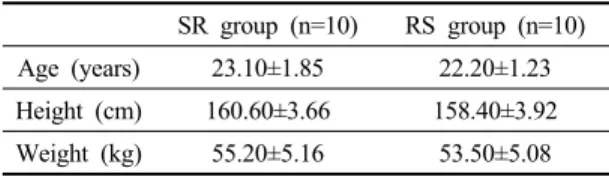
본 연구에 참여한 전체 대상자는 여자 20명으로, 평균 연령은 22.65±1.60세, 신장은 159.50±3.86cm, 체 중은 54.35±5.06kg이었다. 본 연구 대상자들의 일반적 특성은 다음과 같다(Table 1).
SR group (n=10) RS group (n=10) Age (years) 23.10±1.85 22.20±1.23 Height (cm) 160.60±3.66 158.40±3.92 Weight (kg) 55.20±5.16 53.50±5.08 Mean±SD
SR : Stabilizing Reversals RS : Rhythmic Stabilization
Table 1. General characteristics of subjects (N=20)
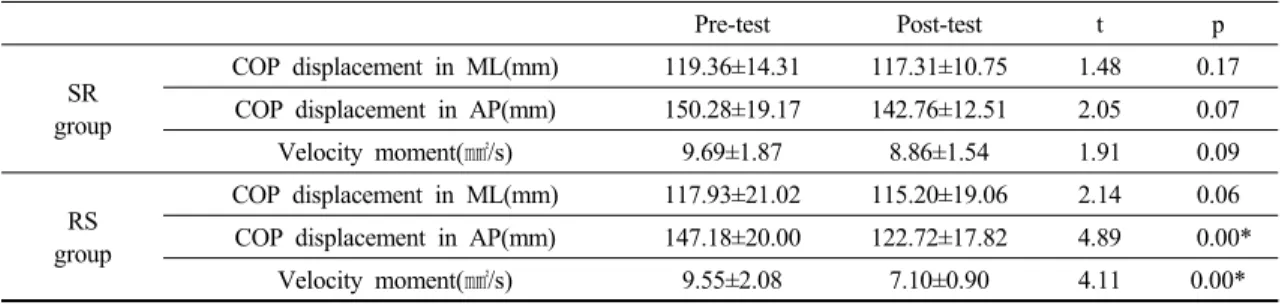
2. 실험 전⋅후 SR군과 RS군의 정적 균형 비교 실험 전⋅후 각 군의 정적 균형에 대한 측정 결과는 Table 2와 같다.
SR군에서는 안쪽가쪽에서의 COP 이동거리, 전후 COP 이동거리 그리고 속도 모멘트가 감소되었으나 통계적으로 유의한 차이를 보이지 않았고, RS군에서 는 안쪽가쪽에서의 COP 이동거리는 감소되었으나 유 의한 차이를 보이지 않았고, 전후 COP 이동거리가 실험 전 147.18±20.00mm에서 실험 후 122.72±17.82mm 로 감소하였고, 속도 모멘트가 실험 전 9.55±2.08㎟/s에 서 실험 후 7.10±0.90㎟/s로 감소되어 통계적으로 유의 한 차이를 보였다(p<0.05).
3. 실험 후 SR군과 RS군의 정적 균형 변화 비교 실험 후 각 군 사이의 정적 균형에 대한 변화 비교 결과는 Table 3과 같다.
안쪽가쪽에서의 COP 이동거리, 전후 COP 이동거 리 그리고 속도 모멘트의 변화 비교 모두 RS군이 SR군 에 비해 감소를 나타냈다. 안쪽가쪽에서의 COP 이동 거리에 대한 평균 변화량 비교에서는 SR군과 RS군 사이에 유의한 차이가 없었다(p>0.05). 전후 COP 이동
거리에 대한 평균 변화량 비교에서는 SR군이 7.52±11.62mm, RS군이 24.46±15.83mm로 SR군과 RS 군 사이에 유의한 차이가 있었다(p<0.05). 속도 모멘트 에 대한 평균 변화량 비교에서는 SR군이 0.83±1.38㎟
/s, RS군이 2.45±1.89㎟/s로 SR군과 RS군 사이에 유의 한 차이가 있었다(p<0.05).
Ⅳ. 고 찰
본 연구는 PNF의 SR, RS 기법을 통해 정상인의 균형에 미치는 영향에 대해 알아보고자 실시하였고, RS군이 SR군에 비해 안쪽가쪽 COP 이동거리, 전후 COP 이동거리와 속도 모멘트가 감소되었다.
실험 전후 COP 이동거리와 속도 모멘트에 대한 평 균 변화량 비교에서는 SR군과 RS군 사이에 유이한
차이를 보였지만, 내외측에서의 COP 이동거리에 대 한 평균 변화량 비교에서는 유의한 차이를 보이지 않 았다. 이러한 결과는 두 기법을 적용할 때나선, 대각선 방향에서 각각의 기법을 적용하였으며, 좌우방향에 대한 저항보다는 전후 방향의 저항이 많이 적용되었 기 때문일 것이다. PNF의 RS 기법, 등장성 혼합 기법을 노인들을 대상으로 적용한 연구에서, 전후 균형이 안 쪽가쪽보다 더욱 개선되었다(Kang et al, 2011). PNF의 RS 기법을 적용할 때 전후 방향으로 10회씩 적용하였 으며 이러한 기법 적용 방법이 전후 균형 개선에 더욱 크게 영향을 미쳤을 것으로 생각되며 본 연구의 결과 와도 일치한다.
SR 기법은 움직임의 의도가 있는 등장성 근육 작용 이며 외력에 대항하여 미는 것이고, RS 기법은 움직임 의 의도가 없는 등척성 동시수축 근육 작용이며 외력 에 대항하여 가만히 유지하는 것이다(Adler et al,
SR group RS group t p
Pre-Post
COP displacement in ML(mm) 2.05±4.39 2.73±4.04 -0.36 0.72 COP displacement in AP(mm) 7.52±11.62 24.46±15.83 -2.73 0.01*
Velocity moment(㎟/s) 0.83±1.38 2.45±1.89 -2.19 0.04*
*p<0.05
SR : Stabilizing Reversals RS : Rhythmic Stabilization
Pre-Post : the value of difference between pre-test and post-test COP : Center of pressure, ML : Mediolateral, AP : Anterioposterior
Table 3. A comparison of the value of difference of static balance between the groups
Pre-test Post-test t p
SR group
COP displacement in ML(mm) 119.36±14.31 117.31±10.75 1.48 0.17 COP displacement in AP(mm) 150.28±19.17 142.76±12.51 2.05 0.07 Velocity moment(㎟/s) 9.69±1.87 8.86±1.54 1.91 0.09
RS group
COP displacement in ML(mm) 117.93±21.02 115.20±19.06 2.14 0.06 COP displacement in AP(mm) 147.18±20.00 122.72±17.82 4.89 0.00*
Velocity moment(㎟/s) 9.55±2.08 7.10±0.90 4.11 0.00*
*p<0.05
SR : Stabilizing Reversals RS : Rhythmic Stabilization
COP : Center of pressure, ML : Mediolateral, AP : Anterioposterior
Table 2. A comparison of static balance between pre-test and post-test in the group
␞⎧ḯ῞ૺ⨇⛂ᦓԨ≆┓⓿Ԩᤖ│৺Ԩ␦თ⓿Ԩ≆┓㍒Ԩମᦓ⑲Ԩ┓ᶿԨḯ⑶Ԩ⋪ḯԨ┓⓿Ԩ㌓⋎Ԩ⭖ྒԨ⋿㊣ | 123
2014). 본 연구에서 안쪽가쪽COP 이동거리, 전후 COP 이동거리와 속도 모멘트가 RS군이 SR군에 비해 감소 되었으며, RS 기법은 모든 방향의 외력에 대해 신체를 움직이지 않고 유지하는 기법이기 때문에 이동거리와 속도 모멘트를 감소시켰을 것으로 생각된다.
편마비 환자 10명을 대상으로 앉은 자세와 선 자세 에서 PNF의 RS 기법과 등장성 혼합 기법을 적용한 연구에서 정적, 동적 균형능력의 개선을 보고하였다 (Lee et al, 2007). PNF의 다리패턴 운동, 불안정판 위에 서 다리패턴과 SR 기법 적용을 통해 편마비 환자의 정적 및 동적 균형 개선을 보고하였고(Kim, 2013), 만 성요통을 가진 노인환자들을 대상으로 PNF 적용을 통해 체간안정성과 균형에서의 개선을 보고하였다 (Koo et at, 2007).
인체의 균형을 유지하기 위한 전략으로는 족관절 전략, 고관절 전략, 걸음전략으로 구성되어 있는데, 특히 전후 안정성에 관해서는 족관절 전략이 가장 먼 저 발생된다(Shumway-Cook & Woollacott, 2000). 발목 관절 전략은 신체 중심을 이동하기 위해 이용되는 힘 이 발목에서 나타나며 작고 느린 수평이동에 반응하 여 이용된다(Horak & Nashner, 1986). 본 연구에서 이용 된 SR과 RS 기법은 움직임이 없거나 작은 움직임만 허용하는 기법으로 발목관절 전략을 이용하게 하여 균형을 개선시킨다.
RS 기법의 적용을 통하여 요통환자에게서 통증 경 감과 몸통 움직임의 개선 효과와, 만성요통환자에게 몸통 근육의 지구력 증진에 RS 기법이 효과가 있다는 것이 보고되었다(Nicolaos et al, 2008; Kofotolis et al, 2006). 또한 뇌졸중 환자에게 PNF의 SR, RS 기법을 적용한 연구에서 몸통 안정화, 균형, 보행 능력이 개선 되었음을 보고하였다(Kim, 2010; Min, 2012). 여러 연 구들에서 RS 기법을 통해 몸통 안정성을 강화할 수 있으며 정적 균형유지에 효과적이라는 본 연구의 결 과와 그 의미가 연결된다고 생각된다.
본 연구는 대상자의 수가 적어 모든 정상인에게 일반화하기 어려움이 있으며 중재 시간이 짧아 전체 효과를 판단할 수 없다는 것이 제한점으로 생각된다.
앞으로 정상인뿐만 아니라 낙상 위험이 있는 노인, 여러 환자군 등에게 다양한 형태의 실험을 통해 균형 에 어떠한 영향을 미치는지 추가적인 연구가 필요할 것으로 사료된다.
Ⅴ. 결 론
본 연구는 PNF의 SR 기법과 RS 기법이 정상 성인 여성의 정적 균형에 어떠한 영향을 미치는지 알아보 고자 연구를 실시하였다. RS군이 전후 COP 이동거리 와 속도 모멘트에 효과적이었다. 본 연구결과를 바탕 으로 정상 성인 여성의 선 자세에서 정적 균형 개선을 위해 RS 기법을 활용할 수 있으며 임상적 활용을 위해 다양한 대상으로 연구가 진행되어야 할 것으로 사료 된다.
References
Adler S, Becker D, Buck M. PNF in Practice. An IIIustrated Guide. 3nd ed. Springer. 2008.
Amiridis I, Arabatzi F, Violaris P, et al. Static balance improvement in elderly after dorsiflexors electrostimulation training. European Journal of Applied Physiology. 2005;94(4):424-433.
Cheng PT, Wu SH, Liaw MY, et al. Symmetrical body-weight distribution training in stroke patients and its effect on fall prevention. Archives of Physical Medicine and Rehabilitation. 2001;82(12):1650-1654.
Choi YI. Effects of task-oriented approach and lower extremity strengthening exercise on walking in stroke patients.
Yongin University. Dissertation of Master’s Degree 2010.
Horak FB, Nashner LM. Central programming of postural movement: adaptation to altered support surface configurations. Journal of Neurophysiology. 1986;
55(6):1369-1381.
Kang DW, Kang MK, Kang ES, et al. The effect of PNF technique application using thera-band on the balance and gait of females over 65 years old. The journal of Korean academy of physical therapy science.
2011;18(1):1-10.
Kim HK. The effect of proprioceptive exercise program on balance performance in hemiplegic patients. Journal of Korea Proprioceptive Neuromuscular Facilitatiom Association. 2013;11(1):7-16.
Kim YH. The effects of trunk stability exercise on the balance and gait in the patients with stroke. Daegu University.
Dissertation of Master’s Degree. 2010.
Klein DA, William JS, Wayne TP. PNF training and physical function in assisted-living older adults. Journal of Aging and Physical Activity. 2002;10(4):476-488.
Kofotolis N, Kellis E. Effects of two 4-week proprioceptive neuromuscular facilitation programs on muscle endurance, flexibility, and functional performance in women with chronic low back pain. Physical Therapy.
2006;86(7):1001-1012.
Kofotolis N, Vrabas I, Kalogeropoulou E, et al. Proprioceptive neuromuscular facilitation versus isokinetic training for strength, endurance and jumping performance.
Journal of Human Movement Studies. 2002;42(2) :155-165.
Koo HO, Park SM, Kim AJ, et al. Effects of proprioceptive neuromuscular facilitation on trunk stability and balance in elderly people with chronic low back pain : The application of rhythmci stabilization and combination of isotonic. Journal of Korea Proprioceptive Neuromuscular Facilitatiom Association. 2007;5(2):
37-46.
Lee HO, Kim DK, Ryu SG, et al. The effects of proprioceptive neuromuscular facilitation on balance in patients with hemiplegia : Application of rhythmic stabilization and combination of isotonic technique. Journal of
Korea Proprioceptive Neuromuscular Facilitatiom Association. 2007;5(2):55-62.
Lee JW. Effect of ankle strategy exercise on improvement of balance in elderly with impaired balance. Yonsei University Dissertation of Doctorate Degree 2007.
Lee SE. Effects of increasing ankle range of motion program on ambulation and balance for the elderly with balance disorder. Physical Therapy Korea. 2005;12(2):28-36.
Michaelson P, Michaelson M, Jaric S, et al. Vertical posture and head stability in patient with chronic neck pain.
Journal of Rehabilitation Medicine. 2003;35(5):
229-235.
Min YK. The effects of stabilizing reversal and rhythmic stabilization in PNF techniques on the trunk stability and gait in the patients with stroke. Daegu University.
Dissertation of Master’s Degree 2012.
Nikolaos DK, Symeon PV, Eleftherios K. Sequentially allocated clinical trial of rhythmic stabilization exercises and TENS in women with chronic low back pain. Clinical Rehabilitation. 2008;22(9):99-111.
O’Sullivan SB, Schmize TJ. Physical rehabilitation: Assessment and treatment. 4th ed. Philadelphia. FA Davis. 2001.
Ragnarsdottir M. The concept of balance. Physiotherapy.
1996;82(6):368-375.
Ryu HS, Kim SH, Park HS. The effects of band exercise using proprioceptive neuromuscular facilitation on muscular strength in lower extremity. Journal of Exercise Rehabilitation. 2015;11(1):36-40.
Seo KC, Park SH, Park KY. The effects of stair gait training using proprioceptive neuromuscular facilitation on stroke patients’ dynamic balance ability. Journal of Physical Therapy Science. 2015;27(5):1459-1462.
Shigematsu R, Chang M, Yabushita N, et al. Dance-based aerobic exercise may improve indices of falling risk in older women. Age and Aging. 2002;31(4):261-266.
Shumway-Cook A, Woollacott, MH. Motor control: Theory and practical applications, 2nd ed. Baltimore.
␞⎧ḯ῞ૺ⨇⛂ᦓԨ≆┓⓿Ԩᤖ│৺Ԩ␦თ⓿Ԩ≆┓㍒Ԩମᦓ⑲Ԩ┓ᶿԨḯ⑶Ԩ⋪ḯԨ┓⓿Ԩ㌓⋎Ԩ⭖ྒԨ⋿㊣ | 125
Lippincott, Williams& Wilkins. 2000.
Wernick-Robinson M, David E, Krebs, et al. Functional reach:
Does it really measure dynamic balance? Archives
of Physical Medicine and Rehabilitation. 1999;
80(3):262-269.