• 검색 결과가 없습니다.

The Effect of Stabilizing Reversal and Rhythmic Stabilization in PNF on Walking and Balance in Patients with Stroke

N/A
N/A
Protected

Academic year: 2021

Share "The Effect of Stabilizing Reversal and Rhythmic Stabilization in PNF on Walking and Balance in Patients with Stroke"

Copied!
11
0
0

로드 중.... (전체 텍스트 보기)

전체 글

(1)

| Abstract |

Purpose: The purpose of this study was to demonstrate the effects of proprioceptive neuromuscular facilitation (PNF) stability techniques on walking speed, trunk stability, and balance in stroke patients.

Methods: Ten stroke patients volunteered to participate in the study, and each of subjects was randomly assigned to either the stability technique (ST) group (n=5) or to the treadmill (TM) group (n=5). Each therapeutic exercise program was provided for 30 minutes a day, 5 days per week for 4 weeks. The ST group performed a PNF pattern combined with stabilizing reversal and rhythmic stabilization of the PNF stability technique. Walking speed (measured using a 10-meter walking test), trunk stability (TIS), and balance (BBS, FRT) were evaluated before and after training. All data were analyzed using SPSS version 18.0. The significance level for statistical inspection was set at 0.05.

Results: Both groups showed improvements on the 10-meter walking test, the trunk impairment scale, the Berg balance scale, and the functional reaching test.

Conclusion: PNF stability techniques are effective for improving trunk stability, balance, and walking speed in stroke patients.

For stroke patients, PNF stability techniques are very useful and effective, including in clinical practice.

Key Words: Stabilizing reversal, Rhythmic stabilization, Splinter skate pattern, Stroke, Treadmill, Walking speed, Balance

†Corresponding Author : Gwan-Cheol Maeng ([email protected])

Original Article Open Access

PNF의 안정적 반전과 율동적 안정화 기법이 뇌졸중 환자의 보행 및 균형에 미치는 영향

김진인⋅강혜원

1

⋅지민

2

⋅황상수

3

⋅맹관철

4†1)

안산조은재활요양병원,

1

순천향대학교부천병원,

2

인천백병원,

3

예은병원,

4

미추홀재활전문병원

The Effect of Stabilizing Reversal and Rhythmic Stabilization in PNF on Walking and Balance in Patients with Stroke

Jin-In Kim⋅Hye-Won Kang

1

⋅Min Ji

2

⋅Sang-Su Hwang

3

⋅Gwan-Cheol Maeng

4†

Dept. of Physical Therapy, Ansan joun Hospital

1

Dept. of Physical Therapy, Soonchunhyang University Bucheon Hospiatal

2

Dept. of Physical Therapy, Incheon Baek Hospital

3

Dept. of Physical Therapy, Yeeun Hospital

4

Dept. of Physical Therapy, Michuhall Hospital

Received: March 21, 2018 / Revised: August 9, 2018 / Accepted: August 9, 2018

ⓒ 2018 Journal of Korea Proprioceptive Neuromuscular Facilitation Association

This is an Open Access article distributed under the terms of the Creative Commons Attribution Non-Commercial License

(http://creativecommons.org/licenses/by-nc/3.0) which permits unrestricted non-commercial use, distribution, and reproduction

in any medium, provided the original work is properly cited.

(2)

Ⅰ. 서 론

인간 수명의 증가와 뇌졸중 발생율의 증가로 재활 서비스에 대한 수요가 증가되고 뇌졸중 관련 장애의 치료와 관련된 의료 자원 효율성의 최적화는 점점 더 우선순위로 간주된다(Balaban et al., 2011). 뇌졸중은 뇌에 혈액공급 방해를 받아 뇌 기능을 빠르게 잃어버 리는 것으로 막힘 (혈전 또는 동맥 색전)으로 인한 허혈 (뇌혈류 부족) 또는 출혈 때문이다(Chung & Lee, 2013).

뇌졸중은 여러 나라에서 성인장애를 일으키는 첫 번 째이며 사망의 원인도 암과 심장질환 다음 순서이다 (Sims et al., 2010). 뇌졸중 환자는 운동장애, 인지 및 지각장애, 언어장애 등으로 인해 일상생활동작에서 많은 장애를 동반할 수 있다 (Gowland et al., 1992). 편마 비로 인한 운동장애는 균형반응 장애, 비대칭적 자세, 보행능력의 저하, 섬세한 기능을 수행하는 운동능력 상실 등과 같은 문제점을 보이게 된다 (Carr et al., 1985).

이러한 문제점은 환자의 독립적인 일상생활에 제한을 가져오게 되고 낙상과 같은 이차적인 손상을 초래하 기도 한다(Perry & Jon, 1992).

뇌졸중 환자의 약 30%는 영구적인 장애를 갖게 되 며 약 75%는 보행 능력이 저하 된다(Jorgensen et al., 1995). 이에 뇌졸중 환자의 재활 과정에서 보행 능력의 향상은 환자의 독립성과 직결되는 중요한 요소이며 (Taylor et al., 2012), 기능적 독립성을 이루는데 가장 중요한 항목으로 치료의 중요한 목표가 된다(Turnbull et al., 1995). 보행 속도는 건강한 성인과 뇌졸중 환자의 기능장애를 분별하는 지표로써(Taylor et al., 2012), 뇌 졸중 환자들은 느린 보행속도와 낮은 지구력으로 인해 독립적 이동이 어렵게 되며(Hill et al., 1997) 느린 보행속도는 기능적 독립수준과 삶의 질에 부정 적인 역할을 주게 되어 보행속도의 개선은 안전하게 집과 지역사회에서 활동하기 위한 필수 요소이다 (Dickstein, 2008).

보행은 일반적으로 균형능력 협응능력 운동감각 고유수용감각 관절 및 근육의 통합적 작용으로 나타 나며 보행의 안정성을 확보하기 위하여 시각, 운동감

각 , 촉각, 전정감각은 서로 자동적인 보행 패턴 전략을 가지고 조절 된다. 균형 조절 기능은 신체 이동 시 중력에 대항하여 무게 중심을 조절하고 보행 시 보폭 이나 보행을 안정적으로 유지함으로써 다양한 자세를 취하게 하는 자동운동 조절 능력이라 할 수 있다 (Berg et al., 1992). 뇌졸중 환자는 몸통의 근력과 고유수용성 감각 등의 결손으로 인하여 몸통을 조절하는 능력이 감소하게 되어 보행과 균형능력에 영향을 미치게 된 다(Ryerson et al., 2008). 뇌졸중 환자에서 보행능력과 동적 균형 능력은 일상생활동작과 상관관계가 상당히 높으며(Langhammer et al., 2006), 뇌졸중 환자에게서 균형조절은 일상생활에서 가장 필요하며 보행에 있어 기본적인 기술이다.

체간은 자세 반응과 조절에서 신체의 중심 역활을 하며 다양한 일상생활 활동을 위해서는 균형을 유지 하기 위한 체간 조절 능력이 필요하다(Dean &

Shepherd, 1997). 체간의 적절한 안정화 없이는 상, 하 지 근육의 수축이 체간에 영향을 미쳐 척추구조와 연 부조직에 과도한 부하가 발생되는 움직임을 야기하며 이로 인해 자세조절, 균형 및 보행에 장애가 유발될 수 있다 (Song & Kim, 2010). 체간조절 능력을 기르는 것이 보행을 개선시키기 위한 중요한 인자가 될 수 있을 것이다(Chung et al., 2012).

이러한 보고들을 바탕으로 고전적 물리치료 방법 뿐만 아니라 트레드밀 훈련(Polese et al., 2013), 측방보 행훈련(Kim et al., 2013), 보행적응 훈련(Timmermans et al., 2016) 등의 다양한 치료가 행해지고 있다. 이러한 다양한 치료 중 기능적 활동 능력을 향상시키기 위해 적절한 치료법이 필요하며 이를 위해서는 운동성 및 근력 지구력을 높이는 치료 프로그램이 강조되고 있 다(Lord et al., 2004).

PNF는 1940년 이후로 물리치료 분야에서 많이 알

려진 치료법 중 하나이다. Kabat 박사와 Margaret

(Maggi) Knott는 치료적 기법과 절차를 지속적으로 개

발하고 확장하기 시작하였다 . 오늘날 신경학적 환자,

외상환자 뿐만 아니라, 근골격계 증상을 가진 환자들

도 이 치료 개념으로 치료를 받고 있다(Adler et al.,

(3)

2013). PNF에는 기능적 활동 능력을 향상시키기 위해 여러 가지 기법들이 있으며 안정성과 균형 향상을 위 하여 안정적 반전과 율동적 안정화 기법을 많이 사용 하고 있다. Dietz (2009)는 보행주기 중 일어나는 운동 패턴과 동작을 PNF 개별 패턴과 통합하여 보행을 분 석하고 치료하는 것을 소개하였는데 이것을 달리는 사람(sprinter)과 스케이트 타는 사람(skater)의 동작으 로 분석하고 치료하였다 . 이는 몸통의 안정성을 전제 로 하고, 직립 보행을 묘사한다.

이러한 이유로 본 연구에서는 뇌졸중 환자들의 보 행과 균형 능력 향상을 위해 임상에서 흔히 사용되고 있는 treadmill을 이용한 트레드밀 훈련과(Oujamaa et al., 2009) 균형능력을 증진시키기 위한 PNF의 안정적 반전과 율동적 안정화 기법을 직립 보행을 묘사한 스 프린터, 스케이터 패턴에 적용하여 뇌졸중 환자를 치 료하였을 때를 비교하여 어느 치료 방법이 뇌졸중 환 자의 보행과 균형 능력을 향상시키는데 보다 더 효과 적인 방법인지를 확인하고자 한다.

Ⅱ. 연구 방법

1. 연구 대상

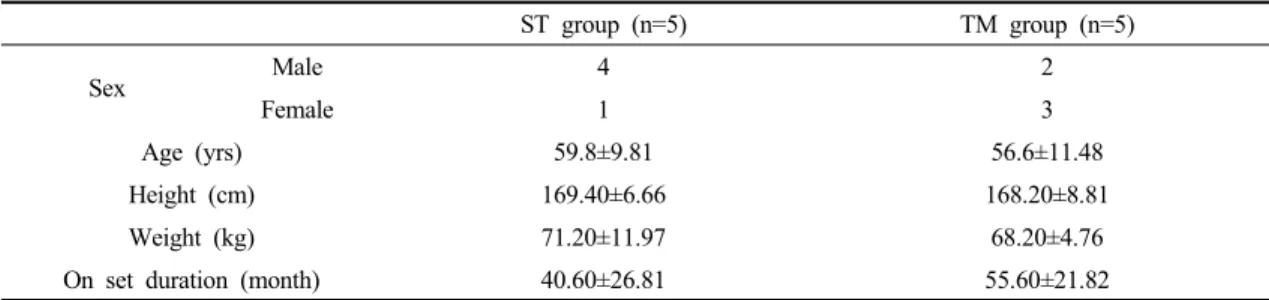
본 연구의 대상자는 인천광역시 B구 소재의 G 병원 에 입원하고 있는 환자를 대상으로 실시하였다 . 대상 자는 뇌졸중으로 인한 편마비를 진단받고 독립적으로

10m 보행이 가능하며, 연구자가 지시하는 내용을 이 해하고 따를 수 있도록 한국판 간이 정신상태 검사 (mini mental state examination-Korea, MMSE-K) 점수가 24점 이상인 자로 본 연구에 대한 목적과 절차의 설명 을 충분히 숙지하고 동의서를 받은 10명을 대상으로 하였다. 이들은 각각 PNF 안정성 기법을 적용한 실험 군(n=5)과 트레드밀 훈련을 실시한 대조군(n=5)으로 배정하였다. 연구대상자의 신체적 특징을 Table 1과 같다.

2. 측정 방법 및 도구

1) 10미터 걷기 검사(10 meter walking test, 10MWT)

본 연구에서는 보행 능력을 측정하기 위해 10m 걷 기 검사를 실시하였다. 10MWT는 보행 능력를 알아보 기 위한 측정도구로서 10M를 걷게 한 후 소요된 시간 을 측정하는 것이다. 바닥에 줄자를 이용하여 총 14M 거리를 설정하여 시작 지점과 끝 지점에 테이프를 이 용하여 표식을 하고 시작 지점과 끝 지점으로부터 각 각 2M 지점에 표식을 하여 그 구간을 걷게 한 후 중간 의 10M 지점을 경과한 시간을 초시계를 이용하여 측 정하였다 . 이 측정의 측정자 내 신뢰도는 r=0.95, 측정 자 간 신뢰도는 r=0.90으로 나타났다(Mehrholz et al., 2007).

ST group (n=5) TM group (n=5)

Sex Male 4 2

Female 1 3

Age (yrs) 59.8±9.81 56.6±11.48

Height (cm) 169.40±6.66 168.20±8.81

Weight (kg) 71.20±11.97 68.20±4.76

On set duration (month) 40.60±26.81 55.60±21.82

Values=means±SD

ST: stability technique, TM: treadmill

Table 1. General characteristics of study subjects (n=10)

(4)

2) 버그균형척도 검사(Berg balance scale, BBS)

BBS 검사는 뇌졸중환자의 낙상 위험도 및 동적 균 형을 측정하기 위하여 사용되는 임상측정 방법이다.

본 측정은 총 14개의 항목으로 구성되어 있으며 자세 변화, 서기, 앉기의 3개의 하위영역으로 구분되어 0점 에서 4점까지 총 14개 항목에 대한 56점 만점으로 구성 된다. BBS 검사는 뇌졸중 환자에서 측정자 내 신뢰도 가 r=0.97이고 검사-재검사 신뢰도가 r=0.98에 해당하 는 매우 높은 신뢰도가 보고된 측정방법이다(Blum et al., 2008).

3) 기능적 팔뻗기 검사(functional reach test, FRT)

길이가 표시된 쇠자를 어깨 높이로 벽에 고정한 후 대상자가 측면으로 어깨관절의 어깨뼈 봉우리가 벽에 거의 닿도록 하였다. 어깨 관절은 90로 굴곡하고, 팔굽 관절은 완전히 신전한 후 손은 편 상태로 벽에 닿지 않도록 하였다. 대상자는 손을 평행하게 앞으로 뻗었을 때 세 번째 손 허리뼈의 끝을 측정하여 시작점 을 표시하였다. 대상자가 측정도구와 수평으로 가능 한 한 전방으로 뻗치도록 지시한 후 10초간 유지할 수 있는 지점에 표시하였다 . 대상자들이 발을 움직이 면 측정을 다시 하였다 총 대상자들에게 한 번의 연습 시도가 주어졌고 본 측정을 시행하였다 . 각 측정 사이 는 근육의 피로 유발을 방지하기 위하여 1분 동안 휴식 을 취하게 하였다(Duncan et al., 1990).

4) 체간 장애 척도(trunk impairment scale, TIS)

TIS는 뇌졸중 환자의 체간 움직임의 질을 관찰할 수 있다. 안정적인 앉은 자세 균형, 동적인 앉은 자세 균형, 체간조화로 측정을 하게 된다. 최대 점수는 안정 적 & 동적인 앉은 자세 균형과 체간조화의 각 점수는 7, 10, 6점이다. TIS는 최소 0점에서 최대 23점이며 점수가 높을 수록 체간 수행력이 좋은 것을 의미한다.

TIS는 측정자 간 신뢰도는 r=0.99 검사-재검사 신뢰도

가 r=0.96로 나타났다(Verheyden et al., 2010).

3. 실험 방법

1) 트레드밀 훈련 운동군

임상에서는 뇌졸중 환자들의 보행과 균형 능력 향 상을 위해 일반적인 트레드밀 훈련 방법이 주로 사용 되고 있다 (Oujamaa et al., 2009). 본 연구에서는 트레드 밀 보행훈련을 위하여 경사 트레드밀(Treksta, Jaeilfitness, Korea)을 사용하였다. 이 트레드밀은 0.1km/hour의 최저속도로부터 시작할 수 있게 되어 있다. 트레드밀은 환자가 편안하게 할 수 있는 속도로 보행운동을 하루 30분 주 5회, 4주간 실시하였다. 이때 보조하는 물리치료사 1명을 위치하여 안정감 있고 편 안한 상태에서 트레드밀을 탈 수 있도록 유도하였다 . 2) 고유수용성신경근촉진법 안정성 기법 운동군

중재기간 동안 실험군에게 준비운동으로 splinter

pattern을 10분간 실시하고 운동 프로그램은 sitting,

half standing에서 상하지 협응적 패턴자세를 취한 후

안정적 반전과 율동적 안정화 치료기법을 적용하였으

며 마무리 운동으로 splinter pattern을 10분간 실시하여

하루 30분 주 5회, 4주간 실시하였다. 협응적 패턴 자세

는 Dietz (2009)에 의해 소개되었던 스프린터(sprinter)

패턴으로 한쪽편 상지는 scapular anterior elevation,

shoulder flexion adduction external rotation, elbow flexion

supination를 하지는 pelvic posterior depression, knee

extension 자세를 취하고 반대측 상지는 scapular

posterior depression, shoulder extension abduction

internal rotation, elbow extension pronation를 하지는

pelvic anterior elevation, knee flexion 자세를 취하여

양쪽 교대적으로 수행하였다. 안정적 반전은 치료사

가 자신의 한손을 주동근과 반대손을 길항근에 교대

로 접촉하여 지속적으로 근육이 활성화 되도록 실시

하고 율동적 안정화는 양손을 주동근과 길항근이 동

(5)

시에 활성화 되도록 실시하였다. 자세한 운동방법은 Table 2에 제시 하였다.

4. 자료 처리

측정된 데이터는 SPSS 18.0 version (SPSS, Chicago, IL, USA) 프로그램을 사용하여 평균(M)과 표준편차 (SD)로 나타내었다. Shapiro-wilk로 정규성 검정을 하 였고 트레드밀 운동군과 PNF 안정성 기법 운동군의 중재 전 후의 집단 내 변화를 비교하기 위하여 Paired t-test, 집단 간 변화를 비교하기 위하여 independent t-test를 실시하였으며 모든 통계학적 유의수준은 α

=0.05로 설정하였다.

Ⅲ. 연구 결과

1. Change of 10meter walking test between ST group and TM group

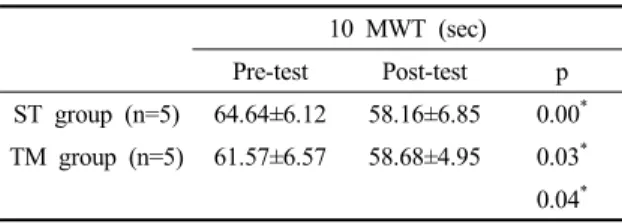
10m 걷기 검사에서 ST 그룹은 중재 전 64.64±

6.12(sec)에서 중재 후 58.16±6.85(sec)로 유의한 감소 를 보였으며, TM 그룹에서도 중재 전 61.57±6.57(sec) 에서 중재 후 58.68±4.95(sec)로 유의한 감소를 보였다.

Program Repeated / set Time

Warm up Sprinter pattern 10min

Eexercise program

Position Pattern Technique

Sitting Sprinter SR, RS 10 repeated (2set) 5min

Half standing Sprinter SR, RS 10 repeated (2set) 5min

Cool down Sprinter pattern 10min

SR: stabilizing reversal, RS : rhythmic stabilization Table 2. Exercise program

Fig. 1. Splinter pattern in sitting position. Fig. 2. Splinter pattern combine with stability techniques.

(6)

그리고 훈련방법에 따른 그룹 간 차이 비교에서 ST 그룹은 TM 그룹과 유의한 차이가 있었다(Table 3).

2. Change of Berg balance scale between ST group and TM group

BBS 검사에서 ST 그룹은 중재 전 31.80±4.32(score) 에서 중재 후 33.80±3.96(score)로 유의한 차이를 보이 지 않았으며, TM 그룹에서도 중재 전 35.40±

4.45(score)에서 중재 후 35.20±3.63(score)으로 유의한 차이를 보이지 않았다. 그리고 훈련방법에 따른 그룹 간 차이 비교에서 ST 그룹은 TM 그룹과 유의한 차이 가 없었다(Table 4).

3. Change of functional reach test between ST group and TM group

FRT 검사에서 ST 그룹은 중재 전 17.82±2.41(cm)에 서 중재 후 19.88±2.21(cm)으로 유의한 증가를 보였으 며, TM 그룹에서는 중재 전 17.46±2.58(cm)에서 중재 후 17.62±1.85(cm)로 유의한 차이를 보이지 않았다.

그리고 훈련방법에 따른 그룹 간 차이 비교에서 ST 그룹은 TM 그룹과 유의한 차이가 있었다(Table 5).

4. Change of trunk impairment scale between ST group and TM group

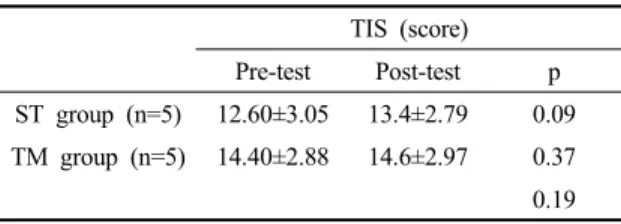
TIS 검사에서 ST 그룹은 중재 전 12.60±3.05(score) 에서 중재 후 13.4±2.79(score)로 유의한 차이를 보이지

10 MWT (sec)

Pre-test Post-test p ST group (n=5) 64.64±6.12 58.16±6.85 0.00* TM group (n=5) 61.57±6.57 58.68±4.95 0.03* 0.04* Values=mean±SD

*p<0.05

10MWT: 10 meters walking test

Table 3. Change of 10MWT between ST group and TM group

BBS (score) Pre-test Post-test p ST group (n=5) 31.80±4.32 33.80±3.96 0.08 TM group (n=5) 35.40±4.45 35.20±3.63 0.74 0.25 Values=mean±SD

*p<0.05

BBS: Berg balance scale

Table 4. Change of BBS between ST group and TM group

Fig. 3. Result of 10meter walking test between ST group and TM group.

Fig. 4. Result of Berg balance scale between ST group and TM group.

(7)

않았으며, TM 그룹에서도 중재 전 14.40±2.88(score)에 서 중재 후 14.6±2.97(score)로 유의한 차이를 보이지 않았다 . 그리고 훈련방법에 따른 그룹 간 차이 비교에 서 ST 그룹은 TM 그룹과 유의한 차이가 없었다(Table 6).

Ⅳ. 고 찰

뇌졸중으로 인한 편마비 환자는 비정상적인 근긴 장도, 불안정한 균형, 근력 약화 등으로 인해 비대칭적 자세 보행능력 저하와 같은 운동능력의 상실을 가져 온다(Sharp et al., 1997). 이 중 근력약화는 편마비 환자 의 기능적 재활을 어렵게 하며(Bohannon & Richard, 1995) 특히 약화되는 근육 중 신체의 중심인 체간에 위치한 체간 근육은 일상생활 중 다양한 자세유지에

필수적으로 이 근육들의 적절한 근력과 지구력은 매 우 중요하다 (Handa et al., 2000). 체간 근육에 의해 결정 되는 체간 안정성은 팔, 다리의 움직임 동안 발생된 불안정에 대해 체간을 준비시켜 특정한 목적에 맞는 운동을 할 수 있도록 체간을 적응시키는 것이다 (Dickstein et al., 2004). 하지만 뇌졸중 환자들은 정상인 에 비해 체간의 안정성이 감소되어 있으며 이러한 체 간 안정성의 감소는 뇌졸중 환자의 균형과 전반적인 보행양상의 변화를 가져오게 된다(Tsuji et al., 2003).

PNF에서 제시한 각 분절 패턴을 통합하여 사지 간 협응 체계로 정형화 한 것이 스프린터 , 스케이터인데 이 동작은 몸통패턴 , 상지패턴, 하지 패턴, 머리와 목 패턴을 포함하고 있는 다면적 복합운동 프로그램이다 (Kim & Kim, 2013). 이러한 스프린터, 스케이터는 가장 효율적이고 기능적인 동작을 가장 잘 표현한 것이며 ,

FRT (cm)

Pre-test Post-test p ST group (n=5) 17.82±2.41 19.88±2.21 0.00* TM group (n=5) 17.46±2.58 17.62±1.85 0.69 0.00* Values=mMean±SD

*p<0.05

FRT: functional reaching test

Table 5. Change of FRT between ST group and TM group

TIS (score) Pre-test Post-test p ST group (n=5) 12.60±3.05 13.4±2.79 0.09 TM group (n=5) 14.40±2.88 14.6±2.97 0.37 0.19 Values=mean±SD

*p<0.05

TIS: trunk impairment scale

Table 6. Change of TIS between ST group and TM group

Fig. 5. Result of functional reach test between ST group and TM group.

Fig. 6. Result of trunk impairment scale between ST group and TM group.
(8)

패턴의 결합을 이용하는 것은 체간의 안정성을 향상 시키고 사지의 고유수용성감각을 증진시킨다 하였다 (Dietz, 2009).

최근 뇌졸중 환자의 보행능력 증진을 위하여 보행 속도의 차이, 이중과제, 트레드밀을 이용한 보행훈련 등을 통한 다양한 방법으로 접근을 하고 있다. 이에 본 연구에서는 뇌졸중 환자의 보행 문제점 개선을 위 하여 뇌졸중으로 인한 편마비 환자 10명을 대상으로 트레드밀 훈련을 실시한 대조군 5명과 체간에 PNF 안정화기법인 RS, SR과 스프린터, 스케이터 패턴을 실시한 실험군 5명으로 구분하여 4주간 중재 후 체간 능력(TIS), 균형능력(FRT, BBS), 보행속도(10M 걷기 검사 )에 어떠한 영향을 미치는지 논의하고자 하였다.

이에 대한 선행 연구들을 살펴보면 Lim (2014)은 22명의 뇌졸중 환자를 대상으로 4주간 상하지 결합패 턴 훈련을 적용한 실험군이 대조군에 비해 정적, 동적 균형 및 보행능력이 중재 전후와 집단 간 비교에서 모두 유의한 향상을 보였고 Kim (2011)은 PNF의 결합 패턴인 스프린터 , 스케이터 훈련이 보행 과정 중 연속 적인 상호교대적 상하지 협응 패턴이 보행의 질을 향 상 시킨다고 하였다. Hwang 등(2016)은 불완전 척수 손상 환자를 대상으로 PNF 패턴을 결합한 협응적 이 동훈련을 적용하여 균형과 보행능력에 유의한 향상을 보였다 . PNF 패턴을 이용한 협응적 움직임은 각각의 신체 분절의 움직임과 관계된 패턴을 분석함으로써 디자인 되어있으며(Adler et al., 2013) 이는 몸통을 중 심으로 다리에서 팔까지 힘이 전달되어 몸통의 근력 이 증가되는 것이 자세 조절과 균형능력 향상에 효과 적이라고 사료된다.

Lee 등(2007)은 체간부에 적용한 RS와 CI 기법이 뇌졸중 환자의 균형회복에 효과적이라고 하였다. 본 연구 결과에서도 TIS 결과 중재 전 12.6점에서 중재 후 13.4점으로 향상이 있었다. 스프린터, 스케이터 패 턴에서 안정적 반전과 율동적 안정화 기법을 적용함 에 따라 체간과 어깨 및 골반의 대칭적인 움직임을 유도하고 마비된 측 사지의 활성을 유발하여 건측에 편중된 중력 중심점의 이동을 더욱 체간의 중심부로

이동하였기 때문일 것으로 생각된다 (Jung et al., 2014).

Karthikbabu 등(2011)은 30명의 급성기 뇌졸중 환자 를 대상으로 체간 운동을 실시하였을 때 dynamic sitting balance와 coordination이 좋아졌다고 보고하였 으며 Kim (2008)은 체간 안정화 운동군과 일반적 균형 운동군으로 분류하여 7주간 중재하였을 때 체간 안정 화 운동군이 일반 균형 운동군보다 체간 근력 , BBS, TUG가 더 향상되었다고 보고하였다. 본 연구 결과에 서도 FRT 결과 중재 전 17.82cm에서 중재 후 19.88cm 으로 향상되었으며 BBS 결과 중재 전 31.8점에서 중재 후 33.8점으로 향상이 있었다. 이는 체간에 PNF 안정 성 기법을 적용하였을 때 단일근육에 대한 적용이 아 니라 체간 전체에 대한 적용으로 주동근과 길항근의 적절한 사용으로 인해 체간근의 협응력을 증진시킴으 로써 균형능력에 긍정적인 효과를 가져 온 것으로 생 각된다.

Lee 등(2010)은 편마비환자 20명을 대상으로 체간 의 굴근과 신근의 강화를 위하여 등속성 체간 훈련을 실시하여 체간 근력, 10m 보행검사, TUG검사 결과 유의한 향상을 볼 수 있었고 Park 등(2016)은 편마비환 자 11명을 대상으로 의자의 높이를 달리하며 PNF 안 정화 기법을 적용하였을 때 보행속도 , 분속수, 보장과 같은 보행기능의 향상이 있었다고 보고 하였다. 본 연구 결과에서도 실험군의 10M 보행검사 결과 중재 전 64.64초에서 중재 후 58.16초로 보행속도 향상이 있었다 . 정상적인 보행은 하지의 여러 관절이 잘 조화 된 역학 운동이 동시에 일어나 체중심을 이동시키는 복잡한 과정으로 상지와 체간의 움직임이 상호교대 적으로 부드럽게 함께 일어나 그 효율성을 증대시킨 다 . 그러나 편마비 환자의 경우 체간의 안정성 저하로 인해 균형능력의 저하로 마비측과 비마비측의 자세 조절이 잘 되지 않게 된다 . 하지만 체간에 PNF 안정화 기법을 적용하여 체간의 안정성 강화를 통한 자세와 균형을 개선시키게 됨으로써 보행속도가 향상되었다 고 생각된다.

본 연구의 PNF 안정성 기법은 체간의 안정화 및

균형능력의 향상을 가져오는데 효과적이었고 그로인

(9)

해 보행능력의 향상도 볼 수가 있었다 . 그러나 본 연구 는 대상자 수가 적으며 연구 기간이 4주인 관계로 이 결과를 일반화하기 어려운 면이 있다 . 그러므로 향후 의 연구에서는 더 많은 대상자 수로 연구 기간을 늘려 운동효과를 일반화 할 수 있는 연구가 필요하다고 생 각된다.

Ⅴ. 결 론

본 연구는 뇌졸중 환자를 대상으로 PNF의 안정성 기법을 사용한 운동그룹과 트레드밀 운동그룹으로 나 누어 4주 후 대상자의 보행 속도와 균형, 체간 안정성 의 차이를 비교하여 PNF 안정성 기법을 사용한 운동 방법이 뇌졸중 환자의 보행 및 균형, 체간 안정성에 어떠한 영향을 미치는지를 알아보고자 하였다.

PNF 안정성 기법 운동그룹은 뇌졸중 환자의 보행 및 균형, 체간 안정성이 유의한 증가를 나타내었으며 트레드밀 운동그룹보다 더 큰 향상을 보였다. 이를 통해 PNF 안정성 기법 운동은 뇌졸중 환자에게 효과 적인 치료적 방법으로 사료되며 뇌졸중 환자의 보행 및 균형, 체간 안정성을 향상시키는 프로그램의 하나 로 유용하게 적용할 수 있을 것으로 여겨진다.

References

Adler SS, Becker D, Buck M. PNF in practice: an illustrated guide, 4th ed. Berlin. Springer, 2013.

Anderson TP, Bourestom N, Greenberg FR, et al. Predictive factors in stroke rehabilitation. Archives of physical medicine and rehabilitation. 1974;55(12):545-553.

Balaban B, Tok F, Yavuz F, et al. Early rehabilitation outcome in patients with middle cerebral artery stroke.

Neuroscience letters. 2011;498(3):204-207.

Berg KO, Wood—Dauphinee SL. Williams JI, et al. Measuring balance in the elderly: validation of an instrument.

Public Health. 1992;83(suppl 2):S7-S11 Blum L, Korner-Bitensky N. Usefulness of the Berg balance

scale in stroke rehabilitation: a systematic review.

Physical therapy. 2008;88(5):559-566.

Bohannon RW. Recovery and correlates of trunk muscle strength after stroke. International Journal of Rehabilitation Research. 1995;18(2):162-167.

Carr JH, Shepherd RB, Nordholm L, et al. Investigation of a new motor assessment scale for stroke patients.

Physical Therapy. 1985;65(2):175-180.

Chung EJ, Lee B. The effects of treadmill training on dynamic balance and gait function in stroke patients: a pilot randomized controlled trial. Physical Therapy Rehabilitation Science. 2013;2(1):39-43.

Chung EJ, Lee JS, Kim SS, et al. The relationships among trunk control ability, dynamic balance and gait in stroke patients. The Journal of Korean Medicine.

2012;33(1):148-159.

Dean CM, Shepherd RB. Task-related training improves performance of seated reaching tasks after stroke.

Stroke. 1997;28(4):722-728.

Dickstein R, Shefi S, Marcovitz E, et al. Anticipatory postural adjustment in selected trunk muscles in poststroke hemiparetic patients. Archives of physical medicine and rehabilitation. 2004;85(2):261-267.

Dickstein R. Rehabilitation of gait speed after stroke: a critical review of intervention approaches. Neurorehabilitation and neural repair. 2008;22(6):649-660.

Dietz B. Let’s sprint, let’s skate: innovation Tm PNF-konzept.

Berlin. Springer. 2009.

Duncan PW, Weiner DK, Chandler J, et al. Functional reach:

a new clinical measure of balance. Journal of gerontology. 1990;45(6):M192-M197.

Gowland C, deBruin H, Basmajian JV, et al. Agonist and antagonist activity during voluntary upper-limb movement in patients with stroke. Physical therapy.

1992;72(9):624-624.

(10)

Handa N, Yamamoto H, Tani T, et al. The effect of trunk muscle exercises in patients over 40 years of age with chronic low back pain. Journal of orthopaedic science. 2000;5(3):210-216.

Hill K, Ellis P, Bernhardt J, et al. Balance and mobility outcomes for stroke patients: a comprehensive audit. Australian Journal of Physiotherapy. 1997;43(3):173-180.

Hwang SS, Maeng GC, Kim JI, et al. the effects of coordinative locomotion training using the pnf pattern on walking in patients with spinal cord injury. journal of the Korean Proprioceptive Neuromuscular Facilitation Association. 2016;14(2);67-74.

Jang SH, Kwon YH, Motor recovery in stroke patients.

Yeungnam University Journal of Medicine. 2005;

22(2):119-130.

Jørgensen HS, Nakayama H, Raaschou HO, et al. Recovery of walking function in stroke patients: the Copenhagen stroke study. Archives of physical medicine and rehabilitation. 1995;76(1):27-32.

Jung K, Kim Y, Chung Y, et al. Weight-shift training improves trunk control, proprioception, and balance in patients with chronic hemiparetic stroke. The Tohoku journal of experimental medicine. 2014;232(3):195-199.

Karatas M, Bayramoglu M, Dilek A, et al. Trunk muscle strength in relation to balance and functional disability in unihemispheric stroke patients. American journal of physical medicine & rehabilitation. 2004;83(2):

81-87.

Kim CY. The effects of a trunk stability exercise on trunk strengthening, dynamic balance and walking in the persons with chronic stroke. SahmYook University.

Dissertation of Master’s Degree. 2008.

Kim IS, Jeon SJ, Lee GC, et al. Effects on balance and gait for chronic stroke patients with side walking training.

Journal of The Korean Society of Integrative Medicine.

2013;1(1): 1-9.

Kim SH, Kim DH. The effects of PNF exercise on body functions

and fall efficacy of elderly women. The Korean Journal of Physical Education. 2013;52(52):495-512.

Kim SJ. The effect of sprinter and skater pattern training of PNF on balance and gait ability in patients with stroke.

Daegu University. Dissertation of Master’s Degree.

2011.

Langhammer B, Stanghelle JK. Co‐variation of tests commonly used in stroke rehabilitation. Physiotherapy Research International. 2006;11(4):228-234.

Lee HO, Kim DK, Ryu SG. The effects of proprioceptive neuromuscular facilitation on balance in patients with hemiplegia: application of rhythmic stabilization and combination of isotonic technique. Journal of the korean proprioceptive neuromuscular facilitation association. 2007;5(2):55-62.

Lee GC, Kang HG, Lee SM, The effect of isokinetic trunk exercise for strength, gait and balance in the patients with chronic stroke. Journal of Special Education

& Rehabilitation Science. 2010;49(3):199-218.

Lim CG. The effects of proprioceptive neuromuscular facilitation (PNF) pattern exercise using the sprinter and the skater on balance and gait function in the stroke patients. Journal of Korean Physical Therapy.

2014;26(4);249-256.

Lord SE, McPherson K, McNaughton HK, et al. Community ambulation after stroke: how important and obtainable is it and what measures appear predictive? Archives of physical medicine and rehabilitation. 2004;

85(2):234-239.

Mehrholz J, Wagner K, Rutte K, et al. Predictive validity and responsiveness of the functional ambulation category in hemiparetic patients after stroke. Archives of physical medicine and rehabilitation. 2007;

88(10):1314-1319.

Oujamaa L, Relave I, Froger J, et al. Rehabilitation of arm

function after stroke. Literature review. Annals of

physical and rehabilitation medicine. 2009;52(3):

(11)

269-293.

Park SE, Moons SH. Effects of trunk stability exercise using proprioceptive neuromuscular facilitation with changes in chair height on the gait of patients who had a stroke. Journal of Physical Therapy Science.

2016;28(7):2014-2018.

Perry J, Davids JR. Gait analysis: normal and pathological function. Journal of Pediatric Orthopaedics. 1992;

12(6):815.

Polese JC, Ada L, Dean CM, et al. Treadmill training is effective for ambulatory adults with stroke: a systematic review.

Journal of physiotherapy. 2013;59(2);73-80.

Ryan EE, Rossi MR, Lopez R. The effects of the contract-relax-antagonist-contract form of proprioceptive neuromuscular facilitation stretching on postural stability. The Journal of Strength &

Conditioning Research. 2010;24(7):1888-1894.

Ryerson S, Byl NN, Brown DA, et al. Altered trunk position sense and its relation to balance functions in people post-stroke. Journal of Neurologic Physical Therapy.

2008;32(1):14-20.

Sharp SA, Brouwer BJ. Isokinetic strength training of the hemiparetic knee: effects on function and spasticity.

Archives of physical medicine and rehabilitation.

1997;78(11):1231-1236.

Sims NR, Muyderman H. Mitochondria, oxidative metabolism

and cell death in stroke. Biochimica et Biophysica Acta (BBA)-Molecular Basis of Disease. 2010;

1802(1):80-91.

Song JM, Kim SM. The effect of trunk stability exercise on balance and gait in stroke patients. Journal of the Korean Society of Physical Medicine. 2010;5(3):

413-420.

Taylor-Piliae RE, Latt LD, Hepworth JT, et al. Predictors of gait velocity among community-dwelling stroke survivors. Gait & posture. 2012;35(3):395-399.

Timmermans C, Roerdink M, van Ooijen MW, et al. Walking adaptability therapy after stroke: study protocol for a randomized controlled trial. Trials. 2016;17(1):425.

Tsuji T, Liu M, Hase K, et al. Trunk muscles in persons with hemiparetic stroke evaluated with computed tomography. Journal of rehabilitation medicine.

2003;35(4):184-188.

Turnbull GI, Charteris J, Wall JC. A comparison of the range of walking speeds between normal and hemiplegic subjects. Scandinavian journal of rehabilitation medicine. 1995;27(3):175-182.

Verheyden G, Kersten P. Investigating the internal validity of the trunk impairment scale (TIS) using rasch analysis: the TIS 2.0. Disability and rehabilitation.

2010;32(25):2127-2137.

수치

Table 1. General characteristics of study subjects  (n=10)
Fig. 1. Splinter pattern in sitting position. Fig. 2. Splinter pattern combine with stability techniques.
Table 3. Change of 10MWT between ST group and TM group
Table 5. Change of FRT between ST group and TM group

참조

관련 문서

The objective of this study is to understand the effects of walking activity using fairy tales on the peer competence and emotional intelligence of

The purpose of this study is to analyze the effects of sports marketing strategy fit on organizational attitude and organizational citizenship behavior

The purpose of this study was to investigate how the Da Vinci body board exercise program affects the body balance and physical stress of women with body imbalance.. For

The purpose and necessity of this study was to investigate the effect of the 8-week GX complex exercise program on the stress index, blood lipid and APG

The purpose of this study was to examine the parents' perceptions on the current status, effects and satisfaction of personal assistant service for students

The purpose of this study was to examine the effects of football on PAPS in sports club activity for 12 weeks in middle school boys.. The following

Objective: The purpose of this study was to analyze recent trend in incidence of basal cell carcinoma and squamous cell carcinoma in patients from the Gwangju City

The purpose of study are analyzing the effects of dance majors' self-management on dance performance ability, self-efficacy and concentration, In the future,