국 문 요 약
2000년대 초반의 동아시아 수산활동을 기후변화와 사회경제적 개발과 연관하여 연구하였다. 세계 인구의 약 1/3 이 동아시아 지역에 살고 있는데, 이들은 많은 수산물을 생산하고, 소비하며, 국제무역에 기여하고 있다. 지역적으로, 전지구적으로 진행되고 있는 기후변화와 더불어 해수의 온난화 및 산성화는 수산생물과 수산업에 심대한 영향을 미 칠 것이다. 동아시아 지역의 잦은 태풍은 연안의 사회집단에 막대한 손실과 희생을 유발할 것이며, 이러한 환경의 변화속도는 우리가 효과적으로 대응하기에 벅찰 정도로 빠르게 진행 중이다. 과학적 활동은 기후변화의 상황에서 발 생하는 문제점들을 찾아내고, 더 나아가 효과적인 해결책을 만들기 위한 기본 지침을 제공하여야 한다. 또한 수산관리 계획은 기후변화와 더불어 사회체제의 변화를 고려하여 수립되어야 한다. 그러므로 이 해역에서 공동과학연구를 추진 하고, 수산자원을 보존하고 관리하는 국제적 공조체제를 구축하여야 한다는 제안은 매우 논리적이다.
❙주제어❙ 기후변화, 수산, 사회경제-생태학적 체제, 동아시아
Abstract
The fisheries in East Asia are reviewed in conjunction with climate change and social-economic developments in the 20th century. About one third of the human population resides in this region, producing a large share of the world’s fisheries products, consuming them, and contributing significantly to the international trade of the products. Ongoing local and global climate changes, as well as ocean warming and acidification, are anticipated to have significant impacts on fisheries. Frequent typhoons have brought untold calamities and miseries to coastal communities. The rate of environmental change
Emerging Issues of East Asian Fisheries in Conjunction with Changes in Climate and
Social Systems in the 21st Century
Suam Kim
1)*and Loh‐Lee Low
2)21세기 기후 및 사회체제 변화와 관련하여 동아시아 수산활동에서 떠오르는 사안들
김수암 ‧ Loh‐Lee Low
1) 부경대학교 자원생물학과(Dept. of Marine Biology, Pukyong National University) 2) Alaska Fisheries Science Center, National Marine Fisheries Service, USA
제출: 2011년 6월 13일 수정: 2011년 8월 11일 승인: 2011년 8월 31일
is outpacing our ability to respond effectively. The science must now move beyond identifying issues and toward providing sound bases for the development of innovative solutions, including effective adaptation and mitigation strategies. Fisheries management plans must be made to consider both changes in climate and social systems. It seems logical that an international forum should be made available to coordinate scientific research, management, and conservation of the region’s fishery resources.
❙Keywords❙ Climate Change, Fisheries, Socioeconomic-ecological Systems, East Asia, Running title: Fisheries with changes in climate and social systems in East Asia
Ⅰ. Introduction
The East Asian Seas (EAS) region is one of the most densely populated regions on the globe, as approximately 31% of the world’s population call it home (Cruz et al., 2007). The region covers a diverse geographical range with climatic features from tropical to subarctic.
China, with its large population and territory, has historically had great political, social, and cultural influences over the region. However, from the early 20th century, other nations have been catching up and achieving great societal growth and industrialization. In southeast Asia, ASEAN was formed in 1967 to create an Association of Southeast Asian Nations which would promote economic growth, social progress, and cultural development. In northeast Asia, China, Japan, and the Republic of Korea developed independently without an equivalent ASEAN organization, but they achieved even greater growths both in economic capacity and yields in fishery products.
The nations of East Asia have enjoyed long periods of peace and cooperation where economics and social order have flourished. Such a densely populated area needs stable supply of water and energy, as well as food security, to sustain and support improved livelihoods and economic growth. The Food and Agriculture Organization (FAO) of the United Nations (UN) is concerned about these issues and recommended that international treaties and national policies should seek to enhance global efforts to mitigate and adapt to climate change.1) Fishery productions, from marine to fresh water, figure into this food
1) See ftp://ftp.fao.org/docrep/fao/010/i0142e/i0142e.pdf
security mandate. The fishery yield of the northwestern Pacific Ocean (FAO statistical area 61) has maintained the highest production among FAO statistical areas since 1970s (Kim, 2010). For example, the capture fisheries production was 23.5% (21.6 million metric tons (MT)) of the world’s total (92 million MT) in 2006, indicating the highest capture fisheries production per unit area (1,054 kg/km2). Climate change, gradual and catastrophic, is an obvious ongoing threats to fisheries production security at sea and in mega-deltas in Asia, such as the lower Mekong Delta (IPCC, 2007a).
We live in a period of accelerated global climate change that affects the Seas of East Asia. It is generally recognized that impacts of environmental changes to fishery sectors in developing countries may be 2~3 times higher than in developed countries, requiring a higher adaptation costs than in developed countries. Because marine social-ecological systems are complex, inter-connected, and highly dynamic, it seems unlikely that a single framework and policy response to global changes could apply to all situations (Perry and Ommer, 2010). Therefore, we need to explore conceptual, comparative, and governance issues to adapt to marine social-ecological systems and global changes. This paper aims to review the current status of fisheries in East Asia to identify the emerging issues in fisheries under changing climate and suggest some considerations for an efficient management of marine resources.
II. Methods and Data
In this study, fishery information from East Asia was compared and analyzed in relation to some climatic characteristics and socio-economic status. National statistics and information on climate environments of East Asian countries were collected from the Fourth Assessment Report (AR4) of the Intergovernmental Panel on Climate Change (IPCC) and some websites.
Fisheries statistics and additional data on socio-economic conditions, such as gross domestic product (GDP), international trade, fisheries employment, and animal consumption of fishery products, were available through FAO2) and the World Research Institute.3)
2) See FAOSTAT, http://www.fao.org/fi/statist/fisoft/
3) See http://earthtrends.wri.org/
III. Results
1. Population and Fisheries Production
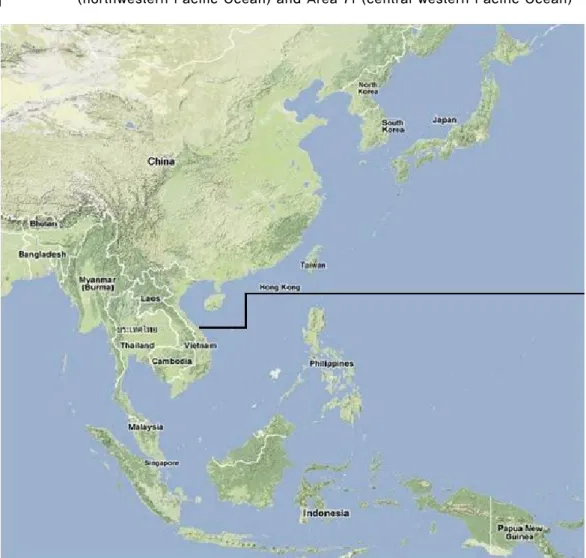
The Seas of East Asia comprise the FAO Statistical Area 61 (northwestern Pacific Ocean) and Area 71 (central western Pacific) (Figure 1). The area includes the western Bering Sea, Sea of Okhotsk, East Sea/Sea of Japan, Yellow Sea, Bohai Sea, East and South China Seas, and open western Pacific Ocean waters that encompass the Philippines. The major population centers of China, Japan, Korea, Taiwan, Vietnam, Cambodia, and the Philippines are located at or near the coasts. Therefore, a great proportion of the people (31% of the world population) depends on the seas for their food and living (Table 1). In 2006, the world’s total fishery production was 92 million MT from capture fishery and 52 million MT from aquaculture, respectively. Overall, more than 40% of the world’s capture fisheries and 80% of the aquaculture production were produced in East Asia in 2006. China is the biggest fishing nation, but ASEAN nations also produced about 20 million MT from capture fisheries and aquaculture.
The country contributions of the 2006 capture and aquaculture productions are shown in Table 1. The production of China was dominant in capture fisheries and aquaculture, occupying 45% (17 million MT) and 83% (34 million MT) of the total EAS countries, respectively. Besides China, Indonesia (4.8 million MT) and Japan (4.2 million MT) were the largest capture fisheries producers and were clear leaders over Thailand (2.8 million MT) and Philippines (2.3 million MT). For aquaculture production outside of China, Vietnam (1.7 million MT) was the largest producer, followed closely by Thailand (1.4 million MT) and Indonesia (1.3 million MT). The breakdown of all fisheries production, total capture, and aquaculture productions during the 2002 through 2006 periods by the EAS countries, is shown in Figure 2. China was clearly the dominant producer (17 million MT). The producers with the closest second amounts were Indonesia and Japan, roughly producing about 5 million MT each.
The EAS region has indeed been a significant fish producer of the world. Figure 3 shows the importance of capture and aquaculture fisheries production for 2006 (FAO, 2008a) as
compared to the production for the rest of the world. Among the 92 million MT of 2006 world capture fisheries, China accounted for 19%, while the rest of the EAS countries accounted for 23% of the world's catch. Therefore, the EAS region accounted for about 42%
of the world’s production of capture fisheries. For aquaculture production, the global total was 51.7 million MT in 2006. China alone contributed 67% of the world's aquaculture production, and the rest of East Asia accounted for 13% of the world's aquaculture production. The total aquaculture production for the countries of EAS is an astonishing 80%
of the world’s aquaculture production in 2006.
While there is the perception that we live in an era of prosperity when the people in urban areas demand more in quality than quantity of fisheries products for their nutrition.
The reality, however, is that a significant proportion of the Asian population, particularly in rural areas, is living below social and economic poverty thresholds. Asia accounts for over 60% of all malnourished people (UN-ESCAP, 2006), many in urban areas as well. Fish accounts for about 20% of animal protein in the diets of over 2.8 billion people.4) Statistics on fish protein as a percentage of animal protein supply indicated that a high proportion of animal protein was provided from fishes in the East Asian region. In 2002, the regional mean of fish protein as a percentage of animal protein supply was 28%, while that of world's total was 15%.
Table 1 shows the human population size of East Asia in 2002, which totaled almost 2 billion people, or 31% of the world’s population. This table shows that all the countries associated with the Seas of East Asia rely heavily on the sea for food fish and food security.
There is a difference in fish consumption among East Asian countries. The average fish consumption per capita in the EAS area was almost double (28.9 kg/person) the world's average of 16.3 kg/person in 2002. Especially high consumptions of fishery products were shown in Japan, the Republic of Korea, and Malaysia. The total consumption from the EAS area was estimated to be 56.2 million MT in 2002, which was about 42% of the sum from the world's capture fisheries (93.2 million MT) and aquaculture production (40.4 million MT).
4) See ftp://ftp.fao.org/docrep/fao/010/i0142e/i0142e.pdf
The total number of fishers in this region was 20.3 million in 2000, accounting for 58.8%
of the world's total (34.5 million). Large numbers were from China, but the fishers in other East Asian countries were still over 8 million (Table 1). In comparing the fisher population with the total population of each country, we realized that approximately 1% of the total population are involved in fisheries in East Asia. Economic status of each country is highly variable. The GDP per capita of Japan was over 38,000 US dollars in 2004, while that of Cambodia was less than 400 US dollars. China shows only 1,323 US dollars in GDP per capita, but the sum for the whole country is extremely large due to its population size.
The fisheries products naturally have to be transported and sold to consumers. Thus fishing also stimulates trade and related economic activities. Figure 4 shows the country trade breakdown of the 2006 fishery catches (FAO, 2008a). China again stands out as the number one in trading of these products. China and Japan are the biggest exporting and importing nations of fishery products, respectively. China exported about 9 billion US dollars worth, and Japan imported about 14 billion US dollars worth in 2006, respectively.
The Chinese exports saw a 100% increase from 4.5 to 9 billion dollars, while the Japanese imports remained similar to the 2002 level. Monetary values of exports and imports in 2002 in the northeastern countries (i.e., China, Japan, Republic of Korea) were 6.3 and 17.7 billion US dollars, respectively (Kim, 2010).
2. Climate Changes and Extreme Weather Events
Since the mid 19th century, humans have systematically measured air temperatures over the earth’s surface, and it was found that air temperature has risen by 1°C over the past 142 years in the northern hemisphere. Temperatures stabilized or slightly declined from 1940 through the late 1970s, but they continued to accelerate up from the late 1970s. The AR4 of the IPCC anticipated that the warming would rise 1.8~4.0°C by the end of this century, depending on various climate scenarios and models (IPCC, 2007b). Both air and ocean temperatures are warming, and these temperature rises have precipitated other associated climatic changes. Although there are not enough quantitative predictions of impacts on marine resources, it is now widely acknowledged that climate change has lasting
impacts on the properties of marine ecosystems. In East Asia, 0.1 to 0.3°C increase per decade was reported in the second half of the 20th century. In the northeastern Asian region, the rate of warming was particularly pronounced. In Japan, the rise was about 1.0°C in 20th century with 2~3°C increase in large cities (Cruz et al., 2007). Korea also experienced 0.23°C rise in annual mean temperature per decade since the 1960s (Kim et al., 2007), and the sea surface temperatures increased by 0.93°C and 0.79°C in the East China Sea and East/Japan Sea during the 35 years in late 20th century, respectively (Hahn, 1994).
On the other hand, the Philippines area experienced dramatic and catastrophic weather events that brought great threats to the well-being of the people and their dependence on reliable food fish production. The extreme weather events, such as super-typhoons, are tragic disasters to human communities in and near coastal areas. Honorable Jose L. Atienza, Jr., Director of the Department of Natural Resources for the Philippines, said in his opening address at the East Asian Seas Congress 2009 in Manila, Philippines that “typhoons like the Philippines so much that they come to visit and re-visit again and again; and continue on to visit other Asian countries…. We have many good examples that showcase initiatives and achievements in coastal and ocean management, our national policy on sustainable development of the country's coastal and marine environment and resources.”5) These typhoons are more frequent and of greater force than of the past; and their occurances seem to have accelerated due to global warming and global climate change. Disasters caused by typhoons are among the most severe natural calamities occurring in the EAS region.
Typhoons bring wind, flood, storm surge, and wave disasters due to strong winds and heavy rainfall. Winds cause damages to properties, and floodings are destructive to fisheries and the communities that depend on the sea for their living.
Such rapid climate change and their deleterious impacts on the earth’s ecosystems are a global concern which will impact more than just the East Asian people. The UN Secretary-general, Mr. Ban Ki-Moon, stated in November 2007 that climate change is a serious threat to development everywhere.6) He said that the time for doubt has passed. The IPCC has unequivocally affirmed the warming of our climate system, and the IPCC has
5) See http://pemsea.org/about-pemsea/pemsea-news/the-philippines-gears-up-for-the-eascongress/view 6) See http://www.un.org/apps/news/story.asp?NewsID=24704&Cr=Climate&Cr1
linked it directly to human activity. Slowing or even reversing the existing trends of global warming is the defining challenge of our age. Thus, Mr. Ban said that galvanising international action on global warming should be one of the main priorities of the UN Secretary-general.
3. Emerging Issues of Climate Change
The changes in sea surface temperature (SST) profiles of the world show that warming of the oceans appears on the high side for the Seas of East Asia (Figure 5) and other northern hemisphere areas like the NE Atlantic. The amount of warming is lower in the southern hemisphere. As SSTs rise, sea water expands, and polar ice caps melt. The IPCC reported that the sea level rise would be from 0.18 to 0.59 m by the end of this century, depending on various model results (IPCC, 2007b). Due to more rapid ice melting in the polar region, however, recent analysis was corrected from their earlier conclusion: the expected sea-level rise until the end of this century would be 0.5~1.8m (Castro and Huber, 2010). Sea level rises regularly flood coastal areas, and seawater intrusions due to sea-level rises are likely to increase coastal inundations, which cause serious affects in aquaculture industries (Cruz et al., 2007).
Precipitation levels in the region may also change the pattern of livelihoods, as well as ecosystems. Occurrences of tropical storms, typhoons, and super-typhoons with heavy rains are prominent in the Philippines area. More than 20~30 tropical storms per year start in the Philippine Area of Responsibility for the monitoring of typhoons. As many as six of them, would become super typhoons that pack gale forces of 170 km/hr, which in 2009 resulted in the total fatality of over 1,500 and monetary damage of 5.6 billion US dollars. Figure 6 shows the tracks of 2009 typhoons in the region extracted from internet sites.7) The frequency and intensity of these typhoons seem to be related to the recent global climate change, as the number of natural disasters reported globally has increased from about 100 in 1970s to 400 in 2000s.8)
7) See http://en.wikipedia.org/wiki/2009_Pacific_typhoon_season 8) See ftp://ftp.fao.org/docrep/fao/010/i0142e/i0142e.pdf
Climate change brings both rapid and long term changes to the region. Catastrophic events like super-typhoons cause floods, and the damages inflicted by typhoons demand immediate mitigation, which attracts the attention of the people and press. Less obvious are the longer term impacts to fisheries and other natural resources that affect the social-economic systems of each coastal community. The sciences of dramatic changes in weather events to the marine ecosystems and their aftermath to the human communities are quite complex. Social mitigation is even more problematic to resolve. The misery and long term restoration of the impacts from Hurricane Katrina to New Orleans in 2006 are well known to Americans, but the countries of East Asia are inflicted by several equivalent super typhoons every year. Typhoons bring great destruction to coastal areas. They disrupt fishing patterns and seasons. They inflict physical damages to fishing vessels and aquaculture facilities. The storm events disrupt formation of fish schools and primary and secondary marine productions. Therefore, they bring about unknown effects on fish productivity as the ocean ecosystem and environment changes. Typhoons and storms also flood aquaculture facilities and disrupt aquaculture productions which are important to the region; in total, about 80% of the world’s aquaculture production comes from Asia.
On a broader basis, climate change has long term effects on the ecosystem and all the creatures that live in them. A rise in ocean temperature causes a host of physical oceanographic features to change. In response to changes in ocean's physical environment, the living marine resources (LMRs) are also expected to adapt to changes in their physical environment. The climatic changes, their effects on LMRs, and the ability for adaptation are quite complex to determine. Higher sea temperatures gradually lower ocean environment's oxygen contents that LMRs depend on for their biological functions. Increased carbon dioxide contents in sea water will cause ocean acidification, which will affect the ability of crustaceans to form protective calcium shells. IPCC (2007b) projected reductions in the average global surface ocean pH of between 0.14 and 0.35 units over the 21st century.
Zooplankton and other marine fauna may be particularly sensitive to acidification, as indicated by Fabrey et al. (2006), thus affecting the basic nature of food-web of plankton to fish. Carpenter et al. (2008) also indicated that ocean acidification accelerated the extinction of coral reefs that many of the LMRs of the East Asian Seas depended on for
refuge and feeding. Cruz et al. (2007) stated that between 24% and 30% of the reef in Asia would likely be lost during the next 10 years and 30 years, respectively.
IV. Discussions
What will the fisheries of the East Asian Seas look like in the years, decades, and centuries to come? How far and in what ways can the fisheries be stressed before they reach tipping points, undergoing rapid transitions into significantly different states with unforeseen consequences? These are questions, which scientists must address. The ocean and atmosphere interact together in complex ways. Due to its large water mass, oceans act as the “memory” of Earth’s climate system and can store heat for long periods of time — for decades or even longer. As oceans' water temperatures rise and atmospheric forces change, the ocean environment and its ecological processes are expected to change. While some of the features of these changes can be determined for the most part, Beamish (2008) reviewed situations in the North Pacific Ocean and noted that they were still unpredictable. This is particularly true when relating climate to ecosystem structures since physical-biological coupling is non-linear, and the biological responses are an integrated process of many physical signals from a number of time and space scales and sources. In addition, the impacts of higher temperatures on LMRs would get “integrated” into the impacts of other environmental changes and events that simultaneously take place in the oceans.
The world’s population is projected to increase to 9.0 billion by 2050, and the production of fish has to increase by approximately 50% from current levels in order to meet projected food requirement (Rice and Garcia, 2011). To achieve this goal, we need a better strategy in fishery management, and managers should understand the complex ecological and socio-economic environments in which fish and fisheries exist (Zhang et al., 2009 and 2011). In this regard, we need to investigate the climatic change phenomena and their impacts on the fishery resources and ecosystems. Because ecosystem components from micro-organisms to apex species in ocean are vulnerable to rapid warming and acidification, the scientific efforts must be coordinated, and the research must be shared. We note, however, that the rate of environmental change is outpacing our ability to respond
effectively. To respond appropriately, science must now pass beyond identifying issues and move towards providing sound bases for the development of innovative solutions, which would require effective adaptation and mitigation strategies. FAO (2008b) described key climate change adaptation measures in communities, as well as national and regional levels, emphasizing the benefits of strong capacity-building. Each country has either developed or is developing their national policy and strategies for climate change adaptation. For example, the Republic of Korea has established the Korea Adaptation Center for Climate Change (KACCC) in 2009 to develop the adaptation policy and tool; facilitate multi-disciplinary research between research organizations; and provide information to the government and general public.9)
The Seas of East Asia is clearly a region of high fisheries production, consumption, and trade of fishery products, and the sustainability of high fishery production and conservation of their ecosystems in this region are important to the market, employment, and economy of the world. The impacts of climate change on fisheries could be seriously detrimental as discussed by Cruz et al. (2007) and Kim (2010). McFarlane et al. (2009) insisted that it is necessary to develop adaptive fisheries management plans in situation of rapid global warming and its subsequent impacts on marine ecosystems. Furthermore, due to the differences in social, economical, and political systems in East Asian countries, timely international co-management actions might not be easy in the current political situation of each nation. Therefore, the foundation of a new international organization is essential in the EAS region for the efficient management of migratory fishes. As one of the new organization’s activities, we propose that an internationally coordinated project on “Climate Impact Studies on Seas of East Asia (CISSEA)” be initiated. The main objective of the study would be to determine offsetting effects of climate changes on LMRS in the Seas of East Asian and advise how to derive benefits for the fishermen. Studies on the negative effects of climate change are a common research theme research for oceans, but positive effects of climate change on the LMRs and the users of these resources must also exist, at least in spatial and time concepts. Such internationally coordinated study is feasible if
9) See http://www.kei.re.kr
funding can be obtained from donor countries, whose leadership could lead to an objective limited research project.
It is anticipated that capture fisheries production would decrease, as natural productions have reached their limits; thus the need for aquaculture production would inevitable to compensate for the shortages of wild production. Climate change on aquaculture must also be scientifically studied, and the fishery industry needs to adapt its techniques to maintain long-term sustainable production. The newly establishing socio-economic-ecological interaction and relationship caused by climate change and its effects on human society have not been well studied and understood. The use of social sciences are also suggested to analyze the region's socio-economics of fisheries and aquaculture industries.
Acknowledgements
This work is a product of cooperation between ecologists and fishery managers. Special thanks are given to friends who encouraged such collaboration and anonymous reviewers for their valuable comments on earlier manuscripts. This work was supported by the Pukyong National University Research Abroad Fund in 2009 (PS-2009-029).
References
Beamish, R. J. ed. 2008. Impacts of Climate and Climate Change on the Key Species in the Fisheries in the North Pacific. PICES Scientific Report No.35. p.217.
Belkin, I. M. 2009. “Rapid warming of large marine ecosystems”. Progress in Oceanography, 81: 207-213.
Carpenter, K. E. et al. 2008. “One-Third of Reef-Building Corals Face Elevated Extinction Risk from Climate Change and Local Impacts”. Science, 321: 560-563.
Castro, P. and M. E. Huber. 2010. Marine biology. McGraw Hill International Edition (8th Edition).
McGraw Hill Company, Inc., p.461.
Cruz, R. V. et al. 2007. “Asia, Climate Change 2007: Impacts, adaptation, and vulnerability. Contribution of working group II to the Fourth Assessment Report of the Intergovernmental Panel on Climate Change”.
Parry, M. L. et al. eds. Cambridge, UK: Cambridge University Press, pp.469-506.
Fabrey, V. J. et al. 2006. “Impacts of ocean acidification on marine fauna and ecosystem processes”.
ICES Journal of Marine Science: Journal du Counseil, 65: 414-432.
FAO. 2008a. FAO Yearbook, Fishery and Aquaculture Statistics 2006. Rome, Italy: Food and Agriculture Organization of the United Nations, p.81.
____. 2008b. Report of the FAO Expert Workshop on Climate Change Implications for Fisheries and Aquaculture. Rome, Italy, 7-9 April 2008. FAO Fisheries Report No.870, p.32.
Hahn, S. D. 1994. “SST warming of Korean coastal waters during 1881-1990”. KODC Newsletter, 24:
29-37.
IPCC. 2007a. Climate change 2007: Impacts, adaptation and vulnerability. Contribution of working group II to the Fourth Assessment Report of the Intergovernmental Panel on Climate Change. Parry, M.
L. et al. eds. Cambridge, UK: Cambridge University Press, p.976.
_____. 2007b. Climate change 2007: The Physical Science Basis. Contribution of working group I to the Fourth Assessment Report of the Intergovernmental Panel on Climate Change. Solomon, S. et al.
eds. Cambridge, UK and New York, USA: Cambridge University Press, p.996.
Kim, S. 2010. “Fisheries development in northeastern Asia in conjunction with changes in climate and social systems”. Marine Policy, 34: 803-809.
Kim, S. et al. 2007. “Climate Variability and Its Effects on Major Fisheries in Korea”. Ocean Science
Journal, 42: 179-192.
McFarlane, G. A. et al. 2009. “Contrast in life Histories of exploited fishes and ecosystem structures in coastal waters off west Canada and east Korea”. Ocean Science Journal, 44: 43-60.
Perry, R. I. and R. E. Ommer. 2010. “Introduction: Coping with global change in marine social-ecological systems”. Marine Policy, 34: 739-741.
Rice, J. C. and S. M. Garcia. 2011. “Fisheries, food security, climate change, and biodiversity: characteristics of the sector and perspectives on emerging issues”. ICES Journal of Marine Science, 68: 1343-1353.
UN-ESCAP. 2006. Achieving MDGs in Asia: a case for more aid? New York, USA: United Nations Economic and Social Commission for Asia and the Pacific, p.37.
Zhang, C. I. et al. 2009. “An ecosystem-based fisheries assessment approach for Koean fisheries”. Fisheries Research, 100: 26-41.
Zhang, C. I. et al. 2011. “An IFRAME approach for assessing impacts of climate 1 change on fisheries”.
ICES Journal of Marine Science, 68: 1318-1328.
Figure 1 The Seas of East Asia, generally encompassing FAO Statistical Area 61 (northwestern Pacific Ocean) and Area 71 (central western Pacific Ocean)
Figure 2 Mean annual tonnage production by East Asian Sea countries of capture and aquaculture production combined and averaged from 2002-2006
0 5 10 15 20
Million MT
Cambodia Taiwan Malaysia Korea,RO
Vietnam Philippines
Thailand Japan Indonesia
China
Figure 3 Percentage production of capture fisheries and aquaculture of the world’s total for 2006
Figure 4 The trade of fisheries products from 2006 for the East Asian Seas countries
Taiwan Thailand Korea, RO Hong Kong China Japen
Korea, RO Taiwan Indonesia
Vietam Thailand
China
Scale = Billions of USD
(Compiled form FAO Statistical Yearbook 2006)
0 5 10
0 5 10
Figure 5 Warming of the oceans around the world (from Belkin, 2009)
Figure 6 Summary of storm tracks for 2009 in the East Asian Seas region