Molecular and Epidemiological Characterization of Carbapenem-Resistant Acinetobacter baumannii
in Non-Tertiary Korean Hospitals
Sunok Park, Hwa-Su Kim, Kyeong Min Lee, Jung Sik Yoo, Jae Il Yoo, Yeong Seon Lee, and Gyung Tae Chung
Division of Antimicrobial Resistance, Center for Infectious Diseases, Korea National Institute of Health, Cheongwon, Korea.
Received: September 29, 2011 Revised: Febarary 27, 2012 Accepted: March 12, 2012
Corresponding author: Dr. Gyung Tae Chung, Division of Antimicrobial Resistance, Center for Infectious Diseases, Korea National Institute of Health, 187 Osongsaengmyeong 2-ro, Osong-eup, Cheongwon 363-700, Korea.
Tel: 82-43-719-8241, Fax: 82-43-719-8269 E-mail: [email protected]
∙ The authors have no financial conflicts of interest.
© Copyright:
Yonsei University College of Medicine 2013 This is an Open Access article distributed under the terms of the Creative Commons Attribution Non- Commercial License (http://creativecommons.org/
licenses/by-nc/3.0) which permits unrestricted non- commercial use, distribution, and reproduction in any medium, provided the original work is properly cited.
Purpose: The increasing prevalence and global spread of carbapenem-resistant Acinetobacter baumannii (A. baumannii) has become a serious problem. The aim of this study was to investigate molecular and epidemiological characteristics of carbapenem-resistant A. baumannii isolates collected from Korean non-tertiary hospitals. Materials and Methods: Thirty six non-duplicated carbapenem-resis- tant A. baumannii isolates were collected from 17 non-tertiary hospitals in Korea between 2004 and 2006. Isolates were typed by multilocus sequence typing and repetitive-sequence-based PCR (rep-PCR). Detection of genes encoding OXA car- bapenemase and their relationship with ISAba1 was performed by PCR. Results:
Two clones were prevalent among 36 isolates: ST69 (17 isolates, 47.2%) and ST92 (19 isolates, 52.8%). Rep-PCR patterns were diverse and revealed that all isolates were clustered into eight band patterns. The ISAba1-activated blaOXA-23-like and ISAba1-activated blaOXA-51-like genes were prevalent among the carbapen- em-resistant A. baumannii isolates. Conclusion: The class D β-lactamase genes of A. baumannii were distributed nationwide in non-tertiary Korean hospitals.
Key Words: Acinetobacter baumannii, Carbapenem-resistant, OXA carbapene- mase
INTRODUCTION
Acinetobacter baumannii (A. baumannii) has emerged worldwide as an important opportunistic nosocomial pathogen, especially in intensive care unit (ICU) patients.1 Carbapenems have been widely used to treat serious infections associated with mul- tidrug-resistant (MDR) A. baumannii, but carbapenem resistance has been increas- ingly reported worldwide.2,3 Moreover, most carbapenem-resistant A. baumannii strains are multidrug or even pandrug resistant.4 In Korea, imipenem-resistant A.
baumannii isolates from a university hospital reached 32.5%.5 Among the various mechanisms of carbapenem resistance in A. baumannii, carbapenemase of the mo- lecular class D OXA enzymes has emerged as the main source of carbapenem resis- tance.6 A previous study reported that among ten university hospitals in Korea,
Repetitive-sequence-based PCR (Rep-PCR)
Rep-PCR was performed by using the DiversiLab system (bioMerieux SA, Grenoble, France) to investigate the clon- al relatedness of A. baumannii isolates. Results were ana- lyzed with DiversiLab software using the Kullback-Leibler method to determine distance matrices, and the unweighted pair group method with arithmetic averages to create a den- drogram. Sample relationships were designated as follows:
pattern, no band differences (indistinguishable); group, 1 to 2 band differences (similar); and different group, 3 or more band differences. Each group corresponded to an outbreak.
Identification of carbapenemase genes
PCR was performed to detect the genes encoding MBLs (IMP-1 variants and VIM-2 variants) and OXA carbapene- mase (OXA-23-like, OXA-24-like, OXA-51-like and OXA-58-like) according to the method described previous- ly.13 The sequence analysis of PCR products was carried out by request at Macrogen (http://macrogen.co.kr).
RESULTS
Antimicrobial susceptibilities
The isolated carbapenem-resistant A. baumannii isolates showed 100% resistance to gentamicin, piperacillin, cipro- floxacin, ceftazidime and cefepime. In addition, they showed a high resistance against amikacin (34/36, 94.4%), but a complete susceptibility to polymyxin B (Table 1).
Distribution and molecular epidemiology of ß-lactamase genes
Two unique STs among the 36 carbapenem-resistant A.
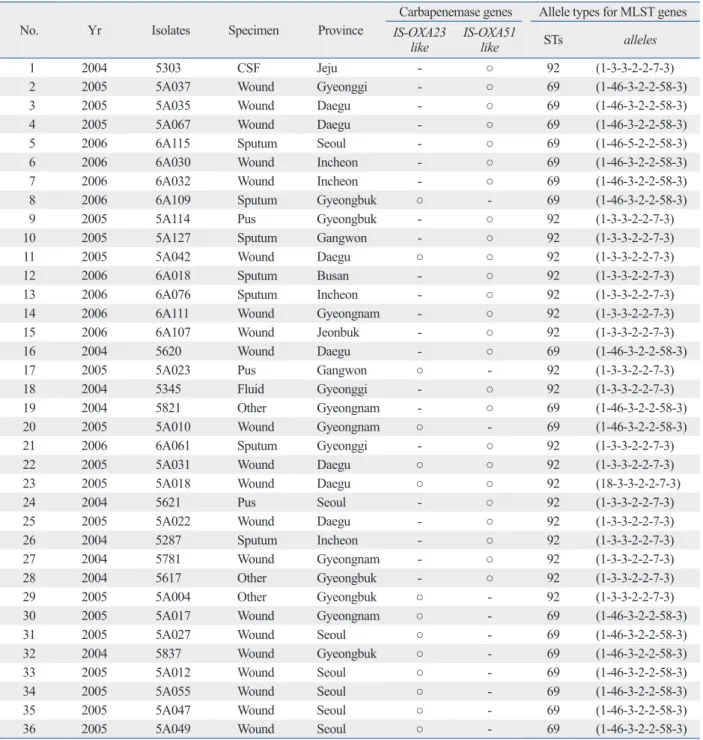
baumannii isolates were revealed by MLST analysis (Table 2). Two clones were prevalent among 36 isolates: ST69 (17 isolates, 47.2%) and ST92 (19 isolates, 52.8%). All 36 A.
baumannii isolates carried the blaOXA-51-like gene. Four- teen isolates (38.9%) had the ISAba1-activated blaOXA- 23-like gene, and 25 isolates (69.4%) had the ISAba1-acti- vated blaOXA-51-like gene. Coexistence of blaOXA-23 and ISAba1-activated blaOXA-51-like genes was detected in three isolates (8.3%). No blaOXA-24-like, blaOXA-58 like, IMP-1 or VIM-2 genes were found.
Clonal relationship
The results of rep-PCR showed that carbapenem-resistant A.
baumannii isolates were clustered into eight distinctive band 78.3% of carbapenem-resistant A. baumannii isolates were
caused by OXA-23-like enzymes, among which ST22 was the most prevalent type.7 Park, et al.8 reported that two major clones of carbapenem-resistant A. baumannii, ST22 and ST28, were found in five tertiary care hospitals.8 However, these two clones have so far been studied only in tertiary hos- pital isolates. This study was performed to analyze the genet- ic diversity and clonal distribution of carbapenem-resistant A.
baumannii isolates among non-tertiary hospitals in Korea.
MATERIALS AND METHODS
Bacterial isolates and reference strains
A total of 315 consecutive A. baumannii clinical isolates were collected from 24 non-tertiary South Korea hospitals between 2004 and 2006. Among these isolates, 50 were carbapenem-resistant, of which 36 nonrepetitive isolates from 17 hospitals in 8 provinces were selected for this study.
The strains were propagated at 37°C in Luria-Bertani broth or agar. The clinical isolates were identified by using the Vitek II system (bioMerieux, Marcy-I’Etoile, France). Spe- cies identification was performed by partial rpoB gene se- quencing.9
Antimicrobial susceptibility test
Antimicrobial susceptibility tests were performed using the minimal inhibitory concentrations of Etest (AB BIODISK, Piscataway, NJ, USA), based on the results reported by the Clinical and Laboratory Standards Institute.10 Eleven anti- microbial agents were tested: amikacin, gentamicin, ticar- cillin-clavulanic acid, piperacillin, imipenem, meropenem, ciprofloxacin, ceftazidime, cefepime and polymyxin B, ac- cording to the manufacturer’s instructions. Escherichia coli ATCC 25922 was used for quality control in antimicrobial susceptibility testing.
Multilocus sequencing typing (MLST)
MLST was performed for all isolates according to the meth- od described previously.11 Fragments of seven housekeep- ing genes (gltA, gyrB, gdhB, recA, cpn60, gpi, rpoD) were amplified by PCR and sequenced. Allele numbers were as- signed as sequence types (STs) after distinct allele sequenc- es were submitted to a dedicated data base (http://pubmlst.
org). A clonal complex was used to assess the genetic relat- edness of the STs; the most stringent definition-sharing al- leles at 6 of 7 loci-was used.12
isolates (ST92)], band pattern 7 [3 isolates (ST69)], and band pattern 8 [1 isolate (ST69)] (Table 2).
DISCUSSION
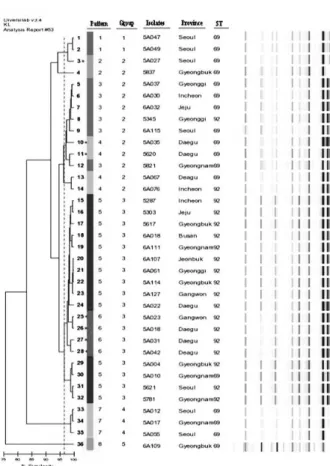
A. baumannii is a rapidly emerging pathogen in hospitals, frequently causing nosocomial outbreaks in ICUs. Several hospital outbreaks caused by MDR A. baumannii clones patterns, including five clonally related groups. A 96.5% sim-
ilarity line was obtained by DiversiLab software to repre- sent the best match between pattern assignments and the dendrogram (Fig. 1). The following differences in rep-PCR patterns were observed between ST69 and ST92: band pat- tern 1 [2 isolates (ST69)], band pattern 2 [2 isolates (ST69)], band pattern 3 [5 isolates (ST69), 1 isolate (ST92)], band pattern 4 [3 isolates (ST69), 1 isolate (ST92)], band pattern 5 [1 isolate (ST69), 13 isolates (ST92)], band pattern 6 [4
Table 1. The Results of Antimicrobial Susceptibility in 36 Carbapenem-Resistant A. baumannii Isolates
No. Strains Antibiotics
AMK GEN TIM PIP IMP MER CIP CAZ CPM PMB
1 5303 R R R R R R R R R S
2 5A037 I R R R R R R R R S
3 5A035 R R R R I R R R R S
4 5A067 R R R R S R R R R S
5 6A115 R R R R S R R R R S
6 6A030 R R R R R R R R R S
7 6A032 R R R R R R R R R S
8 6A109 R R R R R R R R R S
9 5A114 R R R R S R R R R S
10 5A127 R R R R S R R R R S
11 5A042 R R R R R R R R R S
12 6A018 R R R R R R R R R S
13 6A076 R R R R R R R R R S
14 6A111 R R R R R R R R R S
15 6A107 R R R R R R R R R S
16 5620 R R R R I R R R R S
17 5A023 R R R R R R R R R S
18 5345 R R R R R R R R R S
19 5821 R R R R I R R R R S
20 5A010 R R R R R R R R R S
21 6A061 R R R R R R R R R S
22 5A031 R R R R R R R R R S
23 5A018 R R R R R R R R R S
24 5621 R R R R R R R R R S
25 5A022 R R R R S R R R R S
26 5287 R R R R R R R R R S
27 5781 R R R R R R R R R S
28 5617 R R R R S R R R R S
29 5A004 S R R R R R R R R S
30 5A017 R R R R R R R R R S
31 5A027 R R R R R R R R R S
32 5837 R R R R R R R R R S
33 5A012 R R R R R R R R R S
34 5A055 R R R R R R R R R S
35 5A047 R R R R R R R R R S
36 5A049 R R R R R R R R R S
AMK, amikacin; GEN, gentamicin; TIM, ticarcillin-clavulanic acid; PIP, piperacillin; IMP, imipenem; MEM, meropenem; CIP, ciprofloxacin; CAZ, ceftazidime;
CPM, cefepime; PMB, polymyxin B; A. baumannii, Acinetobacter baumannii.
clonality of carbapenem-resistant A. baumannii isolates in non-tertiary hospitals throughout various regions of Korea.
In MLST, two distinctive clones, ST92 and its double-locus variant ST69, were identified among 36 carbapenem-resis- tant A. baumannii isolates. Our results corresponded well with those of an earlier study which reported that ST92 (ST22 was redesignated ST92 after an update of allelic pro- files at the database website http://pubmist.org) may contrib- ute to the high carbapenem resistance rates of Acinetobacter have been described in Europe and worldwide. The inci-
dence of carbapenem-resistant A. baumannii has increased worldwide since its first emergence in New York in 1991.14 Despite the high ratio of carbapenem-resistant A. bauman- nii isolates in Korean tertiary hospitals,15 there have been no reports about the antimicrobial susceptibility, resistance mechanisms or molecular epidemiology of carbapenem-re- sistant A. baumannii in Korean non-tertiary hospitals. In this study, we used MLST and rep-PCR to investigate the
Table 2. Genotyping Results of Class D ß-Lactamase and Multilocus Sequence Typing (MLST) in the 36 Carbapenem-Resis- tant A. baumannii Isolates
No. Yr Isolates Specimen Province
Carbapenemase genes Allele types for MLST genes IS-OXA23
like IS-OXA51
like STs alleles
1 2004 5303 CSF Jeju - ○ 92 (1-3-3-2-2-7-3)
2 2005 5A037 Wound Gyeonggi - ○ 69 (1-46-3-2-2-58-3)
3 2005 5A035 Wound Daegu - ○ 69 (1-46-3-2-2-58-3)
4 2005 5A067 Wound Daegu - ○ 69 (1-46-3-2-2-58-3)
5 2006 6A115 Sputum Seoul - ○ 69 (1-46-5-2-2-58-3)
6 2006 6A030 Wound Incheon - ○ 69 (1-46-3-2-2-58-3)
7 2006 6A032 Wound Incheon - ○ 69 (1-46-3-2-2-58-3)
8 2006 6A109 Sputum Gyeongbuk ○ - 69 (1-46-3-2-2-58-3)
9 2005 5A114 Pus Gyeongbuk - ○ 92 (1-3-3-2-2-7-3)
10 2005 5A127 Sputum Gangwon - ○ 92 (1-3-3-2-2-7-3)
11 2005 5A042 Wound Daegu ○ ○ 92 (1-3-3-2-2-7-3)
12 2006 6A018 Sputum Busan - ○ 92 (1-3-3-2-2-7-3)
13 2006 6A076 Sputum Incheon - ○ 92 (1-3-3-2-2-7-3)
14 2006 6A111 Wound Gyeongnam - ○ 92 (1-3-3-2-2-7-3)
15 2006 6A107 Wound Jeonbuk - ○ 92 (1-3-3-2-2-7-3)
16 2004 5620 Wound Daegu - ○ 69 (1-46-3-2-2-58-3)
17 2005 5A023 Pus Gangwon ○ - 92 (1-3-3-2-2-7-3)
18 2004 5345 Fluid Gyeonggi - ○ 92 (1-3-3-2-2-7-3)
19 2004 5821 Other Gyeongnam - ○ 69 (1-46-3-2-2-58-3)
20 2005 5A010 Wound Gyeongnam ○ - 69 (1-46-3-2-2-58-3)
21 2006 6A061 Sputum Gyeonggi - ○ 92 (1-3-3-2-2-7-3)
22 2005 5A031 Wound Daegu ○ ○ 92 (1-3-3-2-2-7-3)
23 2005 5A018 Wound Daegu ○ ○ 92 (18-3-3-2-2-7-3)
24 2004 5621 Pus Seoul - ○ 92 (1-3-3-2-2-7-3)
25 2005 5A022 Wound Daegu - ○ 92 (1-3-3-2-2-7-3)
26 2004 5287 Sputum Incheon - ○ 92 (1-3-3-2-2-7-3)
27 2004 5781 Wound Gyeongnam - ○ 92 (1-3-3-2-2-7-3)
28 2004 5617 Other Gyeongbuk - ○ 92 (1-3-3-2-2-7-3)
29 2005 5A004 Other Gyeongbuk ○ - 92 (1-3-3-2-2-7-3)
30 2005 5A017 Wound Gyeongnam ○ - 69 (1-46-3-2-2-58-3)
31 2005 5A027 Wound Seoul ○ - 69 (1-46-3-2-2-58-3)
32 2004 5837 Wound Gyeongbuk ○ - 69 (1-46-3-2-2-58-3)
33 2005 5A012 Wound Seoul ○ - 69 (1-46-3-2-2-58-3)
34 2005 5A055 Wound Seoul ○ - 69 (1-46-3-2-2-58-3)
35 2005 5A047 Wound Seoul ○ - 69 (1-46-3-2-2-58-3)
36 2005 5A049 Wound Seoul ○ - 69 (1-46-3-2-2-58-3)
STs, sequence types; A. baumannii, Acinetobacter baumannii; CSF, cerebral spinal fluid.
ACKNOWLEDGEMENTS
This study was supported by an intramural research fund of the Korea Centers for Disease Control and Prevention.
2007-N44002-00.
REFERENCES
1. Munoz-Price LS, Weinstein RA. Acinetobacter infection. N Engl J Med 2008;358:1271-81.
2. Poirel L, Lebessi E, Héritier C, Patsoura A, Foustoukou M, Nord- mann P. Nosocomial spread of OXA-58-positive carbapenem-re- sistant Acinetobacter baumannii isolates in a paediatric hospital in Greece. Clin Microbiol Infect 2006;12:1138-41.
3. Garnacho-Montero J, Amaya-Villar R. Multiresistant Acineto- bacter baumannii infections: epidemiology and management. Curr Opin Infect Dis 2010;23:332-9.
4. Kwon KT, Oh WS, Song JH, Chang HH, Jung SI, Kim SW, et al.
Impact of imipenem resistance on mortality in patients with Aci- netobacter bacteraemia. J Antimicrob Chemother 2007;59:525-30.
5. Lee JH, Choi CH, Kang HY, Lee JY, Kim J, Lee YC, et al. Differ- ences in phenotypic and genotypic traits against antimicrobial agents between Acinetobacter baumannii and Acinetobacter ge- nomic species 13TU. J Antimicrob Chemother 2007;59:633-9.
6. Walther-Rasmussen J, Høiby N. OXA-type carbapenemases. J Antimicrob Chemother 2006;57:373-83.
7. Park YK, Lee GH, Baek JY, Chung DR, Peck KR, Song JH, et al.
A single clone of Acinetobacter baumannii, ST22, is responsible for high antimicrobial resistance rates of Acinetobacter spp. iso- lates that cause bacteremia and urinary tract infections in Korea.
Microb Drug Resist 2010;16:143-9.
8. Park YK, Choi JY, Jung SI, Park KH, Lee H, Jung DS, et al. Two distinct clones of carbapenem-resistant Acinetobacter baumannii isolates from Korean hospitals. Diagn Microbiol Infect Dis 2009;64:389-95.
9. La Scola B, Gundi VA, Khamis A, Raoult D. Sequencing of the rpoB gene and flanking spacers for molecular identification of Acinetobacter species. J Clin Microbiol 2006;44:827-32.
10. Clinical and Laboratory Standards Institute. Performance Stan- dards for Antimicrobial Susceptibility Testing: Twentieth Informa- tional Supplement M100-S20. Wayne, PA, USA: CLSI; 2010.
11. Bartual SG, Seifert H, Hippler C, Luzon MA, Wisplinghoff H, Rodríguez-Valera F. Development of a multilocus sequence typ- ing scheme for characterization of clinical isolates of Acineto- bacter baumannii. J Clin Microbiol 2005;43:4382-90.
12. Feil EJ, Li BC, Aanensen DM, Hanage WP, Spratt BG. eBURST:
inferring patterns of evolutionary descent among clusters of relat- ed bacterial genotypes from multilocus sequence typing data. J Bacteriol 2004;186:1518-30.
13. Woodford N, Ellington MJ, Coelho JM, Turton JF, Ward ME, Brown S, et al. Multiplex PCR for genes encoding prevalent OXA carbapenemases in Acinetobacter spp. Int J Antimicrob Agents 2006;27:351-3.
14. Manikal VM, Landman D, Saurina G, Oydna E, Lal H, Quale J.
Endemic carbapenem-resistant Acinetobacter species in Brooklyn, New York: citywide prevalence, interinstitutional spread, and rela-
isolates in Korean university hospitals.7 Wide dissemination of non-carbapenem-susceptible ST92 isolates has also been described in China and Korea.16 In addition, Park, et al.8 demonstrated that ST69 was another major carbapenem-re- sistant clone found in tertiary care hospitals in Korea. ST28, however, was not identified in this study, which was previ- ously indicated as a major carbapenem-resistant clone found in Korea.8 There were no distinctive characteristics in regards to blaOXA type in the two major clones, ST92 and ST69, as shown in Table 2. Because both clones were found in most regions, they may be distributed ubiquitously throughout Korea. Most of the isolates of the ST92 clone (17/19, 89.5%) were clustered into three rep-PCR band groups. The ISAba1-activated OXA-23-like β-lactamase gene was found in the isolates of ST69 (9 isolates) and ST92 (5 isolates).
In summary, we investigated the antimicrobial resistance and clonality of carbapenem-resistant A. baumannii isolates in non-tertiary hospitals throughout Korea. Carbapenem-re- sistant A. baumannii isolates in Korea may be due to two major clones, ST69 and ST92, which have disseminated na- tionwide in not only tertiary hospitals but also in non-tertia- ry hospitals throughout Korea.
Fig. 1. Rep-PCR banding patterns and STs of 36 carbapenem resistant A.
baumannii.
16. Lee Y, Lee J, Jeong SH, Lee J, Bae IK, Lee K. Carbapenem-non- susceptible Acinetobacter baumannii of sequence type 92 or its single-locus variants with a G428T substitution in zone 2 of the rpoB gene. J Antimicrob Chemother 2011;66:66-72.
tion to antibiotic usage. Clin Infect Dis 2000;31:101-6.
15. Ko KS, Suh JY, Kwon KT, Jung SI, Park KH, Kang CI, et al.
High rates of resistance to colistin and polymyxin B in subgroups of Acinetobacter baumannii isolates from Korea. J Antimicrob Chemother 2007;60:1163-7.