• 검색 결과가 없습니다.

Syndrome of Inappropriate Antidiuretic Hormone Secretion in a Patient with Large Cell Neuroendocrine Carcinoma

N/A
N/A
Protected

Academic year: 2022

Share "Syndrome of Inappropriate Antidiuretic Hormone Secretion in a Patient with Large Cell Neuroendocrine Carcinoma"

Copied!
3
0
0

로드 중.... (전체 텍스트 보기)

전체 글

(1)

Yonsei Med J http://www.eymj.org Volume 53 Number 3 May 2012 667

Case Report http://dx.doi.org/10.3349/ymj.2012.53.3.667

pISSN: 0513-5796, eISSN: 1976-2437 Yonsei Med J 53(3):667-669, 2012

Syndrome of Inappropriate Antidiuretic Hormone Secretion in a Patient with Large Cell Neuroendocrine Carcinoma

Hyung Jung Oh, 1 Mi Jung Lee, 1 Seon Jung Jang, 2 Dong Ho Shin, 1 and Shin-Wook Kang 1

1

Department of Internal Medicine, Division of Nephrology and

2

Department of Pathology, Yonsei University College of Medicine, Seoul, Korea.

Received: June 9, 2011 Revised: July 4, 2011 Accepted: August 2, 2011

Corresponding author: Dr. Shin-Wook Kang, Department of Internal Medicine, Yonsei University College of Medicine, 50 Yonsei-ro, Seodaemun-gu, Seoul 120-752, Korea.

Tel: 82-2-2228-1959, Fax: 82-2-393-6884 E-mail: [email protected]

∙ The authors have no financial conflicts of interest.

© Copyright:

Yonsei University College of Medicine 2012 This is an Open Access article distributed under the terms of the Creative Commons Attribution Non- Commercial License (http://creativecommons.org/

licenses/by-nc/3.0) which permits unrestricted non- commercial use, distribution, and reproduction in any medium, provided the original work is properly cited.

The syndrome of inappropriate antidiuretic hormone secretion has only been report- ed in a few patients with large cell neuroendocrine carcinoma (LCNEC); however, it has never been reported in a patient with LCNEC of the lung, whose serum sodi- um levels were normalized after surgical resection of the mass. A 63-year-old male presented with a two-day history of dizziness and recent memory loss. On admis- sion, his serum sodium level was 113 mEq/L with a serum osmolality of 236 mosm/kg, a urine osmolality of 441 mosm/kg, and a urine sodium level of 65 mEq/L. His chest computed tomography revealed a 2.7×2.3 cm-sized mass in the left lower lobe. After surgical removal of the mass, his serum sodium concentra- tions were normalized, and histopathology of the mass revealed LCNEC.

Key Words: Hyponatremia, syndrome of inappropriate antidiuresis, large cell neuroendocrine carcinoma

INTRODUCTION

Since Schwartz, et al.

1

first described the syndrome of inappropriate antidiuretic hormone secretion (SIADH) in two patients with lung cancer in 1957, there have been a number of reports of SIADH in patients with malignancies.

2

To date, how- ever, there were only a few reports of cases of SIADH in a patient with large cell neuroendocrine carcinoma (LCNEC). Furthermore there were no reports of a case of SIADH in a patient with LCNEC of the lung, whose serum sodium levels were normalized after surgical resection of the mass.

CASE REPORT

A 63-year-old male was admitted to our hospital because of a two-day history of dizziness, general weakness, and recent memory loss. The patient had a ten-year history of diabetes mellitus and an eight-year history of hypertension. He also had a 60 pack-year history of smoking.

Upon admission, physical examinations revealed no evidence of volume deple-

tion, and neurologic examinations revealed no abnormalities except for slightly

slurred speech. Laboratory studies showed microcytic hypochromic anemia, a blood

(2)

Hyung Jung Oh, et al.

Yonsei Med J http://www.eymj.org Volume 53 Number 3 May 2012 668

(3% NaCl: 20 gtt/min for 12 hours) with frequent monitor- ing of serum sodium levels because of suspected hypona- tremic symptoms at the emergency room. Subsequent se- rum sodium concentrations thereafter were 113, 117, 119, and 121 mEq/L. After improvement in hyponatremic symp- toms, his treatment was switched to isotonic saline infusion and furosemide (20 mg bid per os). The follow-up serum sodium level was 122 mEq/L and increased to 127 mEq/L at the time of a lung biopsy, which was performed through mediastinoscopy and revealed a neuroendocrine carcinoma.

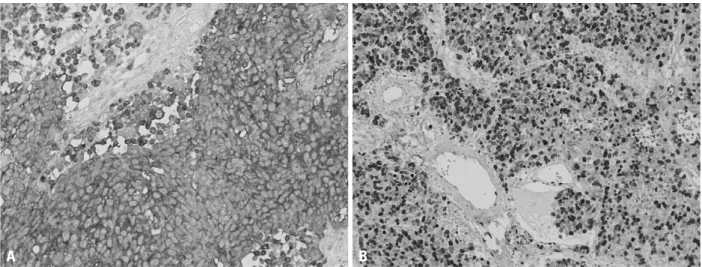
The patient underwent video-assisted thoracoscopic lobec- tomy of the left lower lobe with mediastinal lymph node dissection. The mass was revealed to be a 3×2.2 cm-sized LCNEC with visceral pleural invasion (Fig. 2). In addition, an enlarged interlobar lymph node was observed and re- moved. The final stage of LCNEC was T

2

N

0

M

0

(I

B

). After surgical removal of the lung mass, his serum sodium con- centrations were normalized (135 and 137 mEq/L) without any additional specific management. During the follow-up at an outpatient clinic, the patient received adjuvant chemo- therapy with MAGE-A3 antigen-specific cancer immuno- therapeutic, and hyponatremia did not recur.

DISCUSSION

SIADH is a common cause of hyponatremia in patients with malignancies.

2

Even though small cell lung cancer (SCLC) is responsible for more than 60% of tumor-associ- ated SIADHs,

3

SIADH may also occur in patients with non- SCLC as well as in patients with a variety of tumors.

3

We herein report for the first time a case of SIADH in a patient with LCNEC of the lung, whose serum sodium levels were urea nitrogen of 9.3 mg/dL, and a serum creatinine of 0.88

mg/dL. Urinalysis revealed trace proteinuria with no signifi- cant casts. Serum sodium concentration was 113 mEq/L with a serum osmolality of 236 mosm/kg, a urine osmolality of 441 mosm/kg, and a urine sodium concentration of 65 mEq/

L. His thyroid and adrenal functions were normal. The pa- tient denied excessive water ingestion and the usage of di- uretics or any other medications affecting serum sodium lev- els. Based on the above information, he was diagnosed with SIADH.

No newly developed lesions in the central nervous sys- tem were found on a brain magnetic resonance imaging with angiography. An approximately 2.5 cm-sized round mass lesion on the left perihilar area was noticed on a chest X-ray, and chest computed tomography revealed a 2.7×2.3 cm-sized well-defined lobulated mass in the superior seg- ment of the left lower lobe (Fig. 1).

The patient was initially treated with hypertonic saline

Fig. 1. Chest computed tomography revealed a 2.7×2.3 cm-sized well-de- fined lobulated mass in the superior segment of the left lower lobe, abut- ting on the parietal pleura.

Fig. 2. Immunohistochemical staining showed diffusely strong staining for synaptophysin (A) and Ki-67 (B).

A B

(3)

SIADH in a Patient with LCNEC

Yonsei Med J http://www.eymj.org Volume 53 Number 3 May 2012 669

ACKNOWLEDGEMENTS

We would like to thank the patient who kindly supplied us with the vital information described herein.

REFERENCES

1. Schwartz WB, Bennett W, Curelop S, Bartter FC. A syndrome of renal sodium loss and hyponatremia probably resulting from inap- propriate secretion of antidiuretic hormone. 1957. J Am Soc Nephrol 2001;12:2860-70.

2. List AF, Hainsworth JD, Davis BW, Hande KR, Greco FA, John- son DH. The syndrome of inappropriate secretion of antidiuretic hormone (SIADH) in small-cell lung cancer. J Clin Oncol 1986;4:1191-8.

3. Bartter FC, Schwartz WB. The syndrome of inappropriate secre- tion of antidiuretic hormone. Am J Med 1967;42:790-806.

4. Brambilla E, Travis WD, Colby TV, Corrin B, Shimosato Y. The new World Health Organization classification of lung tumours.

Eur Respir J 2001;18:1059-68.

5. Asamura H, Kameya T, Matsuno Y, Noguchi M, Tada H, Ishikawa Y, et al. Neuroendocrine neoplasms of the lung: a prognostic spec- trum. J Clin Oncol 2006;24:70-6.

6. Takei H, Asamura H, Maeshima A, Suzuki K, Kondo H, Niki T, et al. Large cell neuroendocrine carcinoma of the lung: a clinico- pathologic study of eighty-seven cases. J Thorac Cardiovasc Surg 2002;124:285-92.

7. Johnson BE, Chute JP, Rushin J, Williams J, Le PT, Venzon D, et al. A prospective study of patients with lung cancer and hyponatre- mia of malignancy. Am J Respir Crit Care Med 1997;156:1669-78.

8. Agarwala SS. Paraneoplastic syndromes. Med Clin North Am 1996;80:173-84.

completely normalized after surgical resection of the mass.

LCNEC is an uncommon tumor of the lung and belongs to the category of neuroendocrine tumors of the lung, along with typical carcinoid tumor, atypical carcinoid tumor, and SCLC.

4

Since LCNEC has been regarded as a new type of lung cancer distinct from SCLC for only 20 years, the clini- cal features and prognosis thereof have not been extensively explored.

5

Previous studies have demonstrated that most pa- tients with LCNEC are male and have a heavy smoking his- tory.

5

In addition, no significant differences in the clinical symptoms and signs between patients with LCNEC and those with other lung cancers have been reported.

5

In con- trast to SCLC, no paraneoplastic phenomenon was observed at the time of diagnosis in 87 patients with LCNEC.

6

On the other hand, Johnson, et al.

7

reported a patient with LCNEC that developed hyponatremia and described a response of serum sodium levels during chest radiotherapy and chemo- therapy. However, there has been no report of a case of SI- ADH in a patient with LCNEC of the lung, whose serum sodium levels were normalized after surgical resection of the mass. We surmise that this case may be the first report of SIADH in a patient with LCNEC, whose serum sodium lev- els were resolved after surgical resection of the mass.

Previous studies also demonstrated that SIADH may antici-

pate the diagnosis of malignancy several months in advance.

8

In addition, SIADH is known to have a similar course to the

underlying tumor.

2

Therefore, serial measurements of serum

sodium levels in these patients during follow-up may be use-

ful for monitoring the status of LCNEC.

수치

Fig. 2. Immunohistochemical staining showed diffusely strong staining for synaptophysin (A) and Ki-67 (B).

참조

관련 문서

Cerebral salt wasting syndrome distinct from the syndrome of inappropriate secretion of antidiuretic hormone (SIADH).. A case of cerebral salt wasting syndrome

저등도 신경내분비 종양은 전형적 유암종(typical carcinoid tumor)과 비전형적 유암종(atypical carcinoid tumor)으로, 고 등도 신경내분비 암종은 소세포 신경내분비

Schwartz WB, Bennett W, Curelop S, Bartter FC: A syndrome of renal sodium loss and hyponatremia probably resulting from inappropriate secretion of antidiuretic

Syndrome of inappropriate secretion of antidiuretic hormone (SIADH) associated with Ramsay Hunt syndrome: report of a case and review of the literature.. Kucukardali Y,

On a barium study and CT imaging, a gastric large cell neuroendocrine carcinoma is depicted as an ulcerofun- gating tumor with minimal peritumoral infiltration and

Neuroendocrine differentiation may be expressed in a variety of ovarian tumors including surface epithelial tumor, Sertoli-Leydig cell tumors, teratomas, carcinoid tumor, small

We report a case of bronchogenic squamous cell carcinoma associated with Swyer-James syndrome that performed right upper lobectomy and lymph node dissection with a relevant

We report the imaging findings in a case of primary neuroendocrine tumor (large cell neuroendocrine carcinoma with atypical carcinoid features).. Primary Neuroendocrine Tumor of