Case Report
Obstet Gynecol Sci 2017;60(1):115-117 https://doi.org/10.5468/ogs.2017.60.1.115 pISSN 2287-8572 · eISSN 2287-8580
www.ogscience.org 115
Introduction
The syndrome of inappropriate antidiuretic hormone secre- tion (SIADH) is defined as impaired water excretion resulting in dilutional hyponatremia, leading to central nervous system symptoms [1,2]. SIADH results from a variety of medical con- ditions including central nervous system disorders, pulmonary diseases, paraneoplastic syndromes, and the administration of certain drugs [1-3].
Here, we report the case of a patient who presented with ovarian clear cell carcinoma (Ia3) and suffered from SIADH following combination chemotherapy with cisplatin and iri- notecan. Cisplatin is known for its association with toxicities, primarily neuropathy and nephropathy. Although it is well known that chemotherapy drugs such as vincristine and cyclo- phosphamide can induce SIADH [4-9], severe hyponatremia secondary to irinotecan-cisplatin is uncommon. Hence, we briefly discuss this relatively rare case of SIADH, induced after irinotecan-cisplatin infusion.
Case report
A 45-year-old woman underwent debulking surgery includ- ing total abdominal hysterectomy with bilateral salpingo- oophorectomy, omentectomy, pelvic node dissection, and appendectomy for a massive right ovarian mass (pathological staging Ia G3 clear cell type). Nine months later, computed
Syndrome of inappropriate antidiuretic hormone
secretion following irinotecan-cisplatin administration as a treatment for recurrent ovarian clear cell carcinoma
Do Youn Kwon
1, Gwan Hee Han
1, Roshani Ulak
2, Kyung Do Ki
1, Jong Min Lee
1, Seon Kyung Lee
11Department of Obstetrics and Gynecology, Kyung Hee University Hospital at Gangdong, Seoul; 2Department of Medicine, Graduate School, Kyung Hee University Seoul, Korea
Syndrome of inappropriate antidiuretic hormone secretion (SIADH) has various causes including central nervous system disorders, pulmonary and endocrine diseases, paraneoplastic syndromes, and use of certain drugs. SIADH induced by chemotherapy with irinotecan-cisplatin is not a common complication. Here, we review a case of SIADH after treatment with irinotecan-cisplatin. A 45-year-old woman received adjuvant chemotherapy (paclitaxel-carboplatin) for ovarian clear cell carcinoma, but the cancer recurred within 9 months of chemotherapy. Subsequently, a second line of combination chemotherapy containing irinotecan-cisplatin was initiated. However, 5 days after chemotherapy administration, her general condition began to deteriorate; her hematological tests revealed hyponatremia.
Therefore, it is imperative to consider the possibility of SIADH in patients being treated with irinotecan-cisplatin–
based chemotherapy. Proper monitoring of serum sodium levels and assessment of clinical symptoms should be performed in such patients for early diagnosis and prompt management.
Keywords: Cisplatin; Inappropriate ADH syndrome; Irinotecan; Ovarian cancer, clear cell
Articles published in Obstet Gynecol Sci are open-access, distributed under the terms of the Creative Commons Attribution Non-Commercial License (http://creativecommons.
org/licenses/by-nc/3.0/) which permits unrestricted non-commercial use, distribution, and reproduction in any medium, provided the original work is properly cited.
Copyright © 2017 Korean Society of Obstetrics and Gynecology Received: 2016.5.26. Revised: 2016.7.15. Accepted: 2016.7.15.
Corresponding author: Kyung Do Ki
Department of Obstetrics and Gynecology, Kyung Hee University Hospital at Gangdong, 892 Dongnam-ro, Gangdong-gu, Seoul 05278, Korea
Tel: +82-2-440-7880 Fax: +82-2-440-7894 E-mail: [email protected]
http://orcid.org/0000-0002-1060-2297
www.ogscience.org 116
Vol. 60, No. 1, 2017
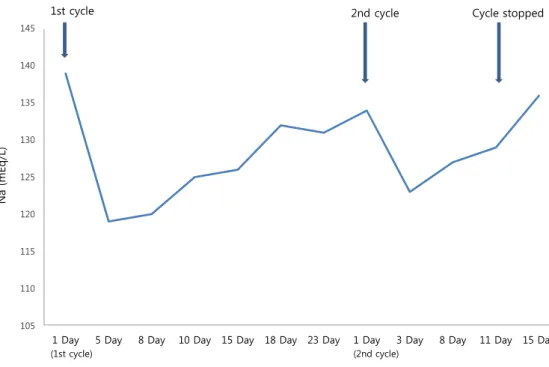
tomography (CT) of the abdomen and pelvis revealed a slight increase in the size of the left para-aortic lymph node and newly developed peritoneal carcinomatosis. She had previous- ly undergone 6 cycles of chemotherapy with paclitaxel and carboplatin after the index surgery on 2007. Hence, she was treated with modified chemotherapy with irinotecan on days 1, 8, and 15 along with cisplatin on day 1 for the recurrence of the disease. After 7 days of irinotecan and cisplatin admin- istration, she was admitted to the hospital with complaints of general weakness; nausea; darkened face, palm, and nail;
epigastric pain; chills; and dyspepsia. Hematological investiga- tions revealed hyponatremia (119 mEq/L). She was treated with water restriction and drip infusion protocols until the electrolyte imbalance no longer persisted. The remaining two cycles of irinotecan were continued without cisplatin. A sec- ond cycle of irinotecan and cisplatin (day 1) was initiated after 4 weeks. A few days later, she was admitted to the hospital with signs of nausea, general weakness, and poor oral intake.
Her plasma sodium concentration was 123 mEq/L, plasma os- molarity 267 mOsm/kg/H2O, and urine osmolarity 473 mOsm/
kg/H2O, which were higher than the normal limit, thus con- firming the diagnosis of SIADH induced by chemotherapy (Fig.
1); however, the patient remained alert. After intravenous drip infusion, her electrolyte balance was maintained. Magnetic resonance imaging of the head did not demonstrate any sec- ondary metastases, edema, or cerebrovascular insults. Find- ings from the brain and chest CT performed after completion
of the second cycle of chemotherapy were non-significant, but the recurrence of the cancer was evident around the ab- dominal area, as depicted on CT.
A new regimen of the chemotherapy including three cycles of docetaxel was started because of the elevation of tumor markers and metastases, and was continued subsequently. Iri- notecan and cisplatin treatment was discontinued as the elec- trolyte disturbance that occurred during the chemotherapy sessions strongly suggested that they induced the SIADH.
Discussion
SIADH was first described by Bartter and Schwartz in 1967 [10]. SIADH results in hyponatremia owing to water retention caused by persistent elevated levels of arginine vasopressin or a similar peptide, despite hypotonicity of the body fluid and increased effective circulating volume [11].
Here, the patient suffered from mild symptoms such as gen- eral weakness and nausea. However, severe hyponatremia can lead to central nervous system symptoms, including confusion fatigue, seizures, coma, and even death. Thus, effort should be made to diagnose and treat SIADH, as early as possible [3].
The laboratory findings of our patient showed normal renal, adrenal, and thyroid functions. The possibility of brain metas- tases, cerebral edema, or cerebrovascular complications was excluded by magnetic resonance imaging, ruling out other
Fig. 1. Changes in serum sodium level after irinotecan- cisplatin administration.
Figure legend
Figure 1. Changes in serum sodium level after irinotecan-cisplatin administration
105 110 115 120 125 130 135 140 145
1 Day 5 Day 8 Day 10 Day 15 Day 18 Day 23 Day 1 Day 3 Day 8 Day 11 Day 15 Day
1st cycle 2nd cycle Cycle stopped
Na (mEq/L)
(1st cycle) (2nd cycle)
145
140
135
130
125
120
115
110
105
www.ogscience.org 117 Do Youn Kwon, et al. SIADH caused by Irinotecan-cisplatin
causes of hypotonic hyponatremia [12].
There have been a few reports suggesting that SIADH is caused by cisplatin infusion. Levin et al. [13] suggested that administration of cisplatin caused SIADH; the mechanism of action may involve the alteration of central antidiuretic hor- mone secretion by cisplatin and also the direct effect on renal function. However, the precise basis for cisplatin-induced SIADH remains unknown. Cisplatin-related renal tubule dam- age is the most likely cause.
In conclusion, although SIADH following irinotecan-cisplatin infusion is an uncommon event, clinicians should be well aware of the possibility that chemotherapy administration including irinotecan-cisplatin may cause SIADH, and monitor electrolyte balance carefully.
Conflict of interest
No potential conflict of interest relevant to this article was reported.
References
1. Kagawa K, Fujitaka K, Isobe T, Yamasaki M, Miyazaki M, Oguri T, et al. Syndrome of inappropriate secretion of ADH (SIADH) following cisplatin administration in a pulmonary adenocarcinoma patient with a malignant pleural effusion. Intern Med 2001;40:1020-3.
2. Yokoyama Y, Shigeto T, Futagami M, Mizunuma H. Syn- drome of inappropriate secretion of anti-diuretic hor- mone following carboplatin-paclitaxel administration in a patient with recurrent ovarian cancer. Eur J Gynaecol Oncol 2005;26:531-2.
3. Vanhees SL, Paridaens R, Vansteenkiste JF. Syndrome of inappropriate antidiuretic hormone associated with chemotherapy-induced tumour lysis in small-cell lung cancer: case report and literature review. Ann Oncol 2000;11:1061-5.
4. Frahm H, von Hulst M. Increased secretion of vasopres- sin and edema formation in high dosage methotrexate therapy. Z Gesamte Inn Med 1988;43:411-4.
5. Tsujita Y, Iwao N, Makino S, Ohsawa N. Syndrome of in- appropriate secretion of antidiuretic hormone and neu- rotoxicity induced by vincristine and alkylating agents during chemotherapy for malignant lymphoma of thy- roid gland. Gan To Kagaku Ryoho 1998;25:757-60.
6. Antony A, Robinson WA, Roy C, Pelander W, Donohue R.
Inappropriate antidiuretic hormone secretion after high dose vinblastine. J Urol 1980;123:783-4.
7. Kuroda H, Kawamura M, Hato T, Kamiya K, Kawakubo M, Izumi Y, et al. Syndrome of inappropriate secretion of antidiuretic hormone after chemotherapy with vinorel- bine. Cancer Chemother Pharmacol 2008;62:331-3.
8. Greenbaum-Lefkoe B, Rosenstock JG, Belasco JB, Rohrbaugh TM, Meadows AT. Syndrome of inappropriate antidiuretic hormone secretion: a complication of high- dose intravenous melphalan. Cancer 1985;55:44-6.
9. Gilbar PJ, Richmond J, Wood J, Sullivan A. Syndrome of inappropriate antidiuretic hormone secretion induced by a single dose of oral cyclophosphamide. Ann Pharmaco- ther 2012;46:e23.
10. Bartter FC, Schwartz WB. The syndrome of inappro- priate secretion of antidiuretic hormone. Am J Med 1967;42:790-806.
11. Otsuka F, Hayashi Y, Ogura T, Hayakawa N, Ikeda S, Makino H, et al. Syndrome of inappropriate secretion of antidiuretic hormone following intra-thoracic cisplatin.
Intern Med 1996;35:290-4.
12. Canzler U, Schmidt-Gohrich UK, Bergmann S, Hanseroth K, Gatzweiler A, Distler W. Syndrome of inappropri- ate antidiuretic hormone secretion (SIADH) induced by vinorelbine treatment of metastatic breast cancer.
Onkologie 2007;30:455-6.
13. Levin L, Sealy R, Barron J. Syndrome of inappropriate an- tidiuretic hormone secretion following dis-dichlorodiam- mineplatinum II in a patient with malignant thymoma.
Cancer 1982;50:2279-82.