• 검색 결과가 없습니다.

Expression of Endothelin-1 and Its Receptors in Cisplatin-Induced Acute Renal Failure in Mice

N/A
N/A
Protected

Academic year: 2022

Share "Expression of Endothelin-1 and Its Receptors in Cisplatin-Induced Acute Renal Failure in Mice"

Copied!
5
0
0

로드 중.... (전체 텍스트 보기)

전체 글

(1)

149 Corresponding to: Dowhan Ahn, Department of Physiology, Kosin University College of Medicine, 35, Amnam-dong, Seo-gu, Busan 602-703, Korea. (Tel) 82-51-990-6415, (Fax) 82-51-990-3081, (E-mail)

[email protected] ABBREVIATIONS: ET

A

R, endothelin A receptor; ET

B

R, endothelin B receptor; ECE, endothelin-converting enzyme; ARF, acute renal failure.

Expression of Endothelin-1 and Its Receptors in Cisplatin-Induced Acute Renal Failure in Mice

Seokwoo Lee and Dowhan Ahn

Department of Physiology, Kosin University College of Medicine, Busan 602-703, Korea

Endothelin-1 (ET-1) is unequivocally elevated in the kidney with ischemic acute renal failure (ARF), whereas ET receptors (ET

A

R and ET

B

R) are variably expressed. Although renal functional and structural changes are similar between ischemic and nephrotoxic ARF, there are few reports on the alteration in the ET system in nephrotoxic ARF. This study was, therefore, undertaken to investigate changes in renal expression of ET-1 and its receptors in nephrotoxic ARF induced by cisplatin. Mice were intraperitoneally injected with 16 mg of cisplatin/kg at a single dose, and the expression of mRNA and protein was then quantified by real-time RT-PCR and W estern blot, respectively. Immuno- histochemistry was conducted for localization. Three days after treatment, ET-1 transcript in cisplatin- treated mice was thirteen times higher than that in controls, whereas ET-1 peptide was increased by 1.5-fold. Cisplatin caused a 2-fold increase in the levels of ET

A

R mRNA and protein. Most of the increased immunoreactive ET-1 and ET

A

R were localized in damaged tubules. Neither the expression of ET

B

R mRNA nor the abundance and immunoreactive level of ET

B

R protein were changed. The findings suggest that the individual components of the renal ET system are differentially regulated in cisplatin-induced nephrotoxic ARF.

Key Words: Cisplatin, Acute renal failure, Endothelin, Endothelin receptor

INTRODUCTION

The endothelin (ET) system includes ET isotypes (ET-1, ET-2, ET-3), ET converting enzyme (ECE), and its receptors (ET

A

R, ET

B

R). ET exerts its effects by binding to the cell-surface ET receptors, which belong to G protein-coupled receptor. Vasoconstriction, mitogenesis, and anti-apoptosis are mediated through ET

A

R, whereas vasodilation, Na and water balance, ET clearance, and inflammatory pain through ET

B

R (Nelson et al, 2003). Evidence indicates that ET plays a role in the pathophysiology of various forms of renal disease, including renal hypertension (Hoffman et al, 1994; Ahn et al, 2004), renal fibrosis (Chatziantoniou &

Dussaule, 2005), transplant rejection (Braun et al, 1999) and renal failure (Takaoka et al, 2000).

Acute renal failure (ARF) is characterized by an abrupt and reversible kidney dysfunction. Two spectra of ARF from intrarenal origin are ischemic and nephrotoxic. Ischemic ARF primarily affects renal hemodynamics with afferent arteriolar vasoconstriction. Reduced renal blood flow in- creases vasoconstrictors such as ET and angiotensin II, and decreases vasodilators such as nitric oxide and prosta- glandin I-2 (Sheridan & Bonventre, 2001). The imbalance in intrarenal vasoactive hormones causes persistent intra- renal hypoxia, thereby exacerbating tubular injury (Sheri- dan & Bonventre, 2001). Nephrotoxic ARF usually causes

primary tubular injuries, and an initial decrease in RBF is not necessary for the development of renal functional im- pairment as in ischemic ARF. Rather, a specific cellular in- sult may precede in this type of ARF. Depending on neph- rotoxicants, injury sites may be glomeruli, proximal tu- bules, medulla, renal vessels, and interstitium. Tubular dysfunction by nephrotoxicants leads to reduced Na re- absorption, backleak of glomerular filtrate, and tubular obstruction. Both types of ARF result in reduced glomerular filtration, tubular cell necrosis and apoptosis (Stein et al, 1978; Schellmann & Kelly, 1999). Therefore, ischemic and nephrotoxic ARF are likely to show similar functional and histological changes.

Although renal expression of ET-1 in ischemic ARF is ele- vated in most cases, that of ET

A

R and ET

B

R varies depend- ing on ischemic models and investigators (Roubert et al, 1994; Shimizu et al, 1998; Forbes et al, 2001). Prior to eval- uating the usefulness of ET receptor antagonists, we exam- ined the expressions of renal ET-1, ET

A

R and ET

B

R in nephrotoxic ARF. For that purpose we used cisplatin, which is well-known to cause nephrotoxic ARF (Stein et al, 1978;

Ramesh & Reeves, 2002).

METHODS

Cisplatin administration and kidney preparation

C57BL/6 male mice of 10 to 11 week ages (20∼25 g) were

(2)

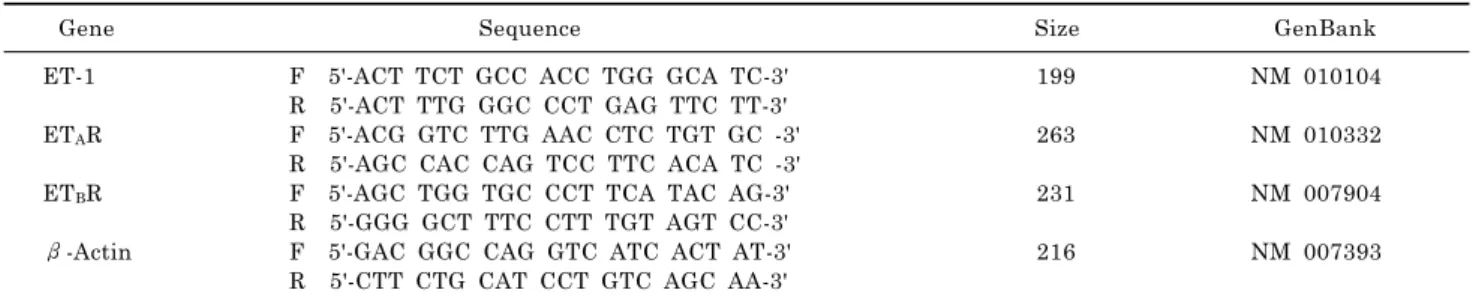
Table 1. Primer sequences for real time RT-PCR

Gene Sequence Size GenBank

ET-1 F 5'-ACT TCT GCC ACC TGG GCA TC-3' 199 NM 010104

R 5'-ACT TTG GGC CCT GAG TTC TT-3'

ET

A

R F 5'-ACG GTC TTG AAC CTC TGT GC -3' 263 NM 010332

R 5'-AGC CAC CAG TCC TTC ACA TC -3'

ET

B

R F 5'-AGC TGG TGC CCT TCA TAC AG-3' 231 NM 007904

R 5'-GGG GCT TTC CTT TGT AGT CC-3'

β -Actin F 5'-GAC GGC CAG GTC ATC ACT AT-3' 216 NM 007393

R 5'-CTT CTG CAT CCT GTC AGC AA-3'

ET-1, endothelin-1; ET

A

R, endothelin A receptor; ET

B

R, endothelin B receptor.

used and had free access to food and water. The animals received a single intraperitoneal injection of cisplatin (16 mg/kg, body weight) or saline. Seventy-two hrs after the treatment, mice were anesthetized with ketamine (50 mg/kg) and zylazine (16 mg/kg). Blood was drawn from car- diac puncture and then mice were sacrificed with cervical dislocation. Right kidneys and half of the left kidneys were frozen in liquid nitrogen and stored at 80°C for RNA or protein isolation. The rest of left kidneys were fixed in 10%

buffered saline, embedded in paraffin, sectioned at 4 um, and stained with Periodic acid-Shiff (PAS). Plasma crea- tinine concentration and blood urea nitrogen (BUN) were measured by an enzymatic method using commercially available kits (Asanpharm Co., Seoul, Korea).

Tissue ET-1 level

One preweighed kidney was immersed in a 2 ml solution containing 0.2 M acetic acid and 0.5 M NaCl and then ho- mogenized for 2×10 sec on ice. The homogenate was centri- fuged at 30,000 rpm for 30 min., and the supernatant was saved. A BondElut C18 column (Varian, Harbor City, CA, USA) was pre-equilibrated with 3 ml of 60% acetonitrile in 0.1% trifluoroacetic acid (TFA) and washed four times with 0.1% TFA. After applying the supernatant to the col- umn, the column was eluted with 3×3 ml of pre-equilibra- tion solution. The eluant was kept at 70

o

C and then freeze-dried overnight. ET-1 was measured using EIA kit (IBL, Gunma, Japan) according to the supplier's instruc- tion.

Real-time RT-PCR

Total RNA was extracted using RNAqueous-4PCR kit (Ambion, Austin, TX, USA) according to manufacturer's di- rections and treated with DNAse I included in the kit. After spectrophotometric determination of total RNA concen- trations, reverse transcription was performed in a total vol- ume of 40 ul containing 0.5 to 1 ug each of RNA and oligo (dT) using SuperScript II first-strand synthesis system (Invitrogen, Carlsbad, CA, USA). PCR was run in a ABI Prism 7000 system with a 25 ul reaction which contained 5 ul of 5-fold diluted cDNA, 1 nM primer, and 2× SYBR II master buffer (Applied Biosystems, Foster City, CA, USA). Reaction conditions are: 95

o

C for 10 min followed by 45 cycles at 95

o

C for 15 sec and 60

o

C for 1 min. The relative mRNA expression was calculated using a comparative del- ta-delta method as described in ABI user bulletin #2.

Relative PCR efficiencies of targets (ET-1, ET

A

R, and ET

B

R)

and reference (β-actin) were approximately equal. Primers were generated using Primer 3 software (Rosen S and Skaletsky HJ, Whitehead Institute, MIT). All of them were designed to include one or two introns and their sequences are presented in Table 1.

Western blot

The frozen kidney was thawed, and the entire kidney ex- cept the papillary region was homogenized in mannitol buf- fer (300 mM mannitol, 10 mM HEPES/Tris, 1 mM EDTA, pH 7.4) with 1× protease inhibitor cocktail (Sigma, St Louis, MO, USA). Protein concentration was determined using Bio-Rad assay kit (Hercules, CA, USA). For Western blot, an aliquot of homogenates was electrophoresed and then transferred to PVDF membranes (Amersham Pharma- cia, Alington Height, IL, USA). The blot membranes were incubated overnight at 4

o

C with either 1:200 dilution of rabbit anti-ET

A

R antibody (Alomone labs, Jerusalem, Israel) and mouse monoclonal anti-ET-1 antibody (Sigma, St Louis, MO, USA) or 1:500 dilution of rabbit anti-ET

B

R antibody (Alomone labs, Jerusalem, Israel). After washing the membranes, HRP-conjugated secondary antibody was added and signals were detected using ECL kit (Amersham Pharmacia, Alington Height, IL, USA). To confirm equal loading of sample proteins, blots were stripped for 30 min at 50

o

C in stripping buffer (100 mM 2-mercaptoethanol, 2%

SDS, 62.5 mM Tris-HCl, pH 6.7) and then reprobed with primary antibody to β-actin. The intensity of bands was quantified and normalized to β-actin.

Immunohistochemistry

The kidneys were perfusion-fixed with 4% paraformalde-

hyde and postfixed overnight in the same solution. Paraffin

sections were mounted on probe-on slides (Fisher Scientific

Korea, Seoul, Korea), deparaffinized, hydrated, and treated

with 3% H

2

O

2

for 6 min to inhibit intrinsic H

2

O

2

of the

tissue. H

2

O

2

was removed by extensive washing in immuno-

assay buffer (Biomeda, Fostar City, CA, USA). The tissue

sections were then treated with blocking buffer (Zymed,

South San Francisco, CA, USA) for 15 min and incubated

with the primary antiserum of ET-1 (1:40), ET

A

R (1:20),

or ET

B

R (1:40) as instructed by the manufacturer

(HistoMouse-Max kit, Zymed, South San Francisco, CA,

USA). The immunoreactive signals were observed through

3-amino-9-ethylcarbazole staining.

(3)

Table 2. Changes in BUN and plasma creatinine concentration

Control Cisplatin

BUN (mg/dl) 18.3±4.0 107±31.6*

P

creatinine

(mg/dl) 0.72±0.07 1.11±0.16*

Blood was obtained 72-hr after saline or cisplatin (16 mg/kg) injection. Values are mean±SD of 6 animals. *p<0.05 vs.

control

Fig. 1. Relative expression of ET-1, ET

A

R, and ET

B

R genes in the kidney of the control and cisplatin-treated mice. Real-time RT-PCR was performed as described in Materials and Methods. Relative expression was calculated by a comparative C

T

method. Values are mean±SD of 3 separate experiments. *p<0.05 vs. matched control.

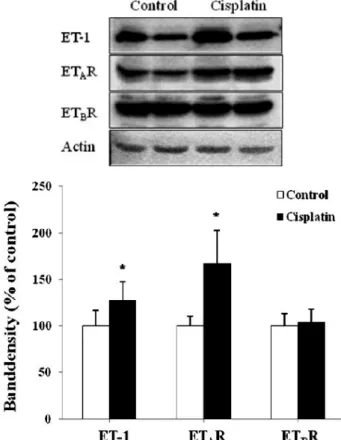
Fig. 3. Representative immunoblots (upper panel) and densito- metric analysis (lower panel) of ET-1, ET

A

R, and ET

B

R proteins.

Each blot was loaded with 50 ug of protein. Band density was normalized to β-actin. Values are mean±SD of 3 separate experiments. *p<0.05 vs. respective control.

Fig. 2. ET-1 contents in kidney homogenates of the control and cisplatin-treated mice. Values are mean±SD of 6 animals. *p<0.05 vs. control.

Statistical analysis

Data are expressed as mean±SD. Unpaired Student's t-test was performed and a p value less than 0.05 was con- sidered statistically significant.

RESULTS Induction of ARF

As shown in Table 2, plasma creatinine and BUN were significantly increased at 72 hr after cisplatin treatment, indicating deterioration of renal function. PAS staining showed that cisplatin administration caused necrosis of proximal tubules and produced tubular luminal casts, how- ever, no effects on glomeruli, distal tubules, and medullary regions (data not shown).

Changes in transcript and protein levels

Quantitative real-time PCR was performed to follow changes in mRNA expression of the ET system. Fig. 1 de- picts a relative renal expression of ET-1, ET

A

R, and ET

B

R mRNAs. Cisplatin administration upregulated ET-1 mRNA by 13-fold and ET

A

R mRNA by 2-fold compared with controls. However, the expression of ET

B

R mRNA was not

different between cisplatin-treated mice and controls. To

examine whether the changes in mRNA level are correlated

with protein expression, ELISA and Western blot were

conducted. Fig. 2 shows that the content of ET-1 peptide

in kidney homogenates was increased by 1.5-fold after cis-

(4)

Control Cisplatin

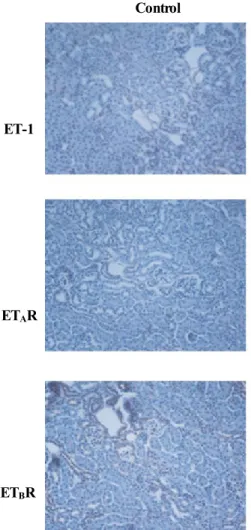
Fig. 4. Immunostaining for ET-1, ET

A

R, and ET

B

R in the renal cortex of control and cisplatin-treated mice. ET-1, ET

A

R, and ET

B

R are diffusely expressed in tubular segments. Note that intense immuno- staining for ET-1 and ET

A

R is found in the cisplatin- treated group. Magnification:

×100.

platin treatment (p<0.05). Similar increase was also ob- served in Western blot (Fig. 3). The primary antibody to ET-1 recognized the band at about 21 kDa, which is the expected size of unprocessed preproET-1 (Gumz et al, 2003). ET

A

R expression was increased by 1.7-fold, but ET

B

R expression was not different between cisplatin- treated mice and controls.

Localization of immunoreactivity

To examine the localization of protein expression of the ET system, immunohistochemistry was applied (Fig. 4).

Immunoreactive ET-1 was strongly detected in some of proximal tubules and vessels, but not in glomeruli. Al- though it was not as intense as in controls, ET-1 expression was more diffuse in cisplatin-treated mice than in controls.

The ET

A

R immunoreactivity showed a distribution similar to ET-1 and tended to increase in cisplatin-treated mice.

It was predominantly localized in damaged proximal tu- bules, but was sparsely detected in peritubular capillaries and arteries. In spite of its relatively high background, ET

B

R immunoreactivity was not changed by cisplatin treatment.

DISCUSSION

Nephrotoxic ARF is usually caused by heavy metals, anti- cancer agents, and aminoglycoside antibiotics. There are few reports on the expression of the ET system in neph- rotoxic ARF. In cisplatin-induced nephrotoxic ARF, we found that renal damages were confined to the cortex, and ET-1 and ET

A

R were up-regulated without change of ET

B

R.

Yanagisawa et al (1993) showed that HgCl

2

treatment in- creased ET-1 mRNA in the kidney. Elevated ET-1 ex- pression has been also found in other renal diseases such as ischemic ARF (Roubert et al, 1994; Shimizu et al, 1998;

Forbes et al, 2001), chronic transplant rejection (Deng et al, 2000), polycystic kidney disease (Ong et al, 2003), me- sangial proliferative nephritis (Yoshimura et al, 1995), and aminonucleoside-induced nephrosis (Nakamura et al, 1995). ET-1 directly inhibits Na-K-ATPase of renal tubular cells (Garvin & Sander, 1991) and modulates a variety of signal transduction pathways through its receptors as well.

Therefore, while there is little doubt that ET-1 plays a cer- tain role in the pathogenesis of renal diseases, it is not yet clear whether ET-1 acts as a causative factor in various renal diseases including ARF. An unusual finding in the present study was that ET-1 mRNA was increased in cis-

ET-1

ET

A

R

ET

B

R

(5)

platin-treated mice by 13-fold compared with controls, whereas ET-1 peptide was increased by less than 2-fold (Figs. 1 and 2). Since ET-1 gene is known to be transcrip- tionally regulated, such a discrepancy remains to be clarified.

Although ET-1 exerts its action through ET

A

R and/or ET

B

R, expression of ET receptors varies depending on is- chemic ARF models used. In ischemic ARF induced by renal artery occlusion, Nambi et al (1993) showed that the affin- ity of ET receptor to ET-1 increased, accompanied with no change in the number of ET

A

R, whereas Forbes et al (2001) demonstrated that the level of ET

A

R decreased in the cortex. In glycerol-induced ischemic ARF, in which the pro- nounced fall of renal blood flow has been considered to be an important pathogenic event, ET

A

R mRNA in the cortex was up-regulated in one study but not in the other study (Roubert et al, 1994; Shimizu et al, 1998). In our model of nephrotoxic ARF, ET

A

R mRNA and protein was up-regu- lated by 1.5 to 2.0-fold compared with controls. Considering that ET

A

R mediates vasoconstrictive action of ET-1, an in- crease in ET

A

R expression could have reduced blood supply to the cortex, thus leading to aggravate the renal injury.

It is, however, interesting to note that administration of selective ET

A

R antagonists has partly ameliorated renal tubular injuries and functions, in spite of decreased ex- pression of ET

A

R in ischemic ARF (Gellai et al, 1994; Birck et al, 1998; Kuro et al, 2000).

ET

B

R level has been shown to be reduced or increased in ischemic ARF (Roubert et al, 1994; Shimizu et al, 1998;

Forbes et al, 2001). The present study showed that both ET

B

R mRNA and protein expression levels were not differ- ent between controls and cisplatin-treated mice. Using a similar ET

B

R antibody that we have used, Francis et al (2004) reported that ET

B

R was detected mainly in tubular structures and was preferably expressed in the inner medulla. We found that the immunoreactivity of ET

B

R was much greater in the inner medulla than in the cortex and its immunoreactivity in the medulla seemed to be not differ- ent between the two groups (data not shown). Because re- nal damages by cisplatin administration was mainly con- fined to proximal tubules of the cortex, we speculate that ET

B

R expression would be least affected, if any.

In conclusion, this study demonstrated that the ex- pressions of ET-1 and ET

A

R, but not ET

B

R, were increased, suggesting that the individual components of the renal ET system are differentially regulated in cisplatin-induced nephrotoxic ARF. Therefore, drug targeting to ET

A

R could help lessen nephrotoxic ARF induced by cisplatin.

REFERENCES

Ahn D, Ge Y, Stricklett PK, Gill P, Taylor D, Hughes AK, Yanagisawa M, Miller L, Nelson RD, Kohan DE. Collecting duct-specific knockout of endothelin-1 causes hypertension and sodium retention. J Clin Invest 114: 504 511, 2004

Birck R, Knoll T, Braun C, Kirchengast M, Munter K, van der Woude FJ, Rohmeiss P. Improvement of postischemic acute renal failure with the novel orally active endothelin-A receptor antagonist LU 135252 in the rat. J Cardiovasc Pharmacol 32:

80 86, 1998

Braun C, Conzelmann T, Vetter S, Schaub M, Back WE, Yard B,

Kirchengast M, Tullius SG, Schnulle P, van der Woude FJ, Rohmeiss P. Prevention of chronic renal allograft rejection in rats with an oral endothelin A receptor antagonist. Transplan- tation 68: 739 746, 1999

Chatziantoniou C, Dussaule JC. Insights into the mechanisms of renal fibrosis: is it possible to achieve regression? Am J Physiol Renal Physiol 289: F227 234, 2005

Deng DX, Jiang J, Garcia B, Zhong R, Chakrabarti S. Endothelin-1, endothelin-3 and their receptors (endothelin (A) and endothelin (B)) in chronic renal transplant rejection in rats. Transpl Int 13:

175 182, 2000

Forbes JM, Jandeleit-Dahm K, Allen TJ, Hewitson TD, Becker GJ, Jones CL. Endothelin and endothelin A/B receptors are in- creased after ischaemic acute renal failure. Exp Nephrol 9: 309 316, 2001

Francis BN, Abassi Z, Heyman S, Winaver J, Hoffman A.

Differential regulation of ETA and ETB in the renal tissue of rats with compensated and decompensated heart failure. J Car- diovasc Pharmacol 44: S362 S365, 2004

Gellai M, Jugus M, Fletcher T, DeWolf R, Nambi P. Reversal of postischemic acute renal failure with a selective endothelinA receptor antagonist in the rat. J Clin Invest 93: 900 906, 1994 Hoffman A, Grossman E, Goldstein DS, Gill JR, Jr., Keiser HR.

Urinary excretion rate of endothelin-1 in patients with essential hypertension and salt sensitivity. Kidney Int 45: 556 560, 1994 Kuro T, Kohnou K, Kobayashi Y, Takaoka M, Opgenorth TJ,

Wessale JL, Matsumura Y. Selective antagonism of the ETA receptor, but not the ETB receptor, is protective against ischemic acute renal failure in rats. Jpn J Pharmacol 82: 307 316, 2000 Nakamura T, Ebihara I, Fukui M, Osada S, Tomino Y, Masaki T,

Goto K, Furuichi Y, Koide H. Modulation of glomerular endothelin and endothelin receptor gene expression in ami- nonucleoside- induced nephrosis. J Am Soc Nephrol 5: 1585 1590, 1995

Nelson J, Bagnato A, Battistini B, Nisen P. The endothelin axis:

emerging role in cancer. Nat Rev Cancer 3: 110 116, 2003 Ong AC, Newby LJ, Dashwood MR. Expression and cellular

localisation of renal endothelin-1 and endothelin receptor sub- types in autosomal-dominant polycystic kidney disease. Nephron Exp Nephrol 93: e80, 2003

Ramesh G, Reeves WB. TNF-alpha mediates chemokine and cytokine expression and renal injury in cisplatin nephrotoxicity.

J Clin Invest 110: 835 842, 2002

Roubert P, Gillard-Roubert V, Pourmarin L, Cornet S, Guilmard C, Plas P, Pirotzky E, Chabrier PE, Braquet P. Endothelin receptor subtypes A and B are up-regulated in an experimental model of acute renal failure. Mol Pharmacol 45: 182 188, 1994 Schellmann RG, Kelly KJ. Pathophysiology of nephrotoxic acute

renal failure. In: Schrier RW ed, Atlas of Diseases of the Kidney.

1st ed. Current medicine Inc., Philadelphia, p 15.1-15.14, 1999 Sheridan AM, Bonventre JV. Pathophysiology of ischemic acute

renal failure. Contrib Nephrol 7 21, 2001

Shimizu T, Kuroda T, Ikeda M, Hata S, Fujimoto M. Potential contribution of endothelin to renal abnormalities in glycerol- induced acute renal failure in rats. J Pharmacol Exp Ther 286:

977 983, 1998

Stein JH, Lifschitz MD, Barnes LD. Current concepts on the pathophysiology of acute renal failure. Am J Physiol 234: F171 181, 1978

Takaoka M, Kuro T, Matsumura Y. Role of endothelin in the pathogenesis of acute renal failure. Drug News Perspect 13: 141

146, 2000

Yoshimura A, Iwasaki S, Inui K, Ideura T, Koshikawa S, Yana-

gisawa M, Masaki T. Endothelin-1 and endothelin B type

receptor are induced in mesangial proliferative nephritis in the

rat. Kidney Int 48: 1290 1297, 1995

수치

Table 1. Primer sequences for real time RT-PCR
Fig. 1. Relative expression of ET-1, ET A R, and ET B R genes in the kidney of the control and cisplatin-treated mice
Fig. 4. Immunostaining for ET-1, ET A R,  and ET B R in the renal cortex of control and cisplatin-treated mice

참조

관련 문서

Results : The expression of p21 was increased in boderline serous tumor and serous cystadenocarcinoma in contrast to benign serous tumors. The expression of

In this study, we found that Pin1 plays a pivotal role in insulin- induced AP-1 activation through its interaction with p70S6K and prolongs activity of

Therefore, in this study, genetic tests were performed to investigate and identify the infections of Orientia tsutsugamushi, Ricekttsia genus, Anaplasma phagocytophilum ,

mandibular P-18 inncisor from Nfic-deficient mice (×3,000)... In this study, histological and immunohistochemical studies were carried out to investigate

Glucose level before use of mannitol and peak osmolarity during mannitol treatment were associated with renal failure in univariate analysis.. In logistic regression

Therefore, in this study, based on the media facade expression characteristics and expression techniques, evaluation factors through satisfaction analysis on

Objective: The purpose of this study was to investigate the expression of syndecan-1, E-cadherin, and beta-catenin in tissue sections of normal sun-damaged skin,

포에서 We s t e r nbl ot 을 통해 HJ ME가 i NOS의 단백질 발현을 농도의존적으로 저해 하는 것을 확인하였다( Fi g.6) .그러므로 환삼덩굴은 i NOS의 발현을