pISSN 1598-642X eISSN 2234-7305
간장 유래 혈전분해 효소 생산 균주의 분리 및 배양학적 특성
백성열1·윤혜주1,2·박희동2·여수환1*
1농촌진흥청 국립농업과학원 농식품자원부 발효이용과, 2경북대학교 농업생명과학대학 식품공학과 Received : October 13, 2011 / Revised : November 28, 2011 / Accepted : November 29, 2011
Isolation and Optimized Culture Conditions of Fibrinolytic Enzyme Producing Strain Isolated from Korean Traditional Soybean Sauce. Baek, Seong Yeol1, Hye Ju Yun1,2, Heui-Dong Park2, and Soo-Hwan Yeo1*. 1Fermentation & Food Processing Division, Department of Agro-food Resource, NAAS, RDA, Suwon 441- 853, Korea, 2Department of Food Science & Technology, Agro Biotechnology Education Center, Kyungpook National University, Daegu 702-701, Korea − Bacterial strains exhibiting fibrinolytic activity were screened from traditional Korean soybean sauce. The Fibrinolytic activities of the various isolated microorganism were further examined and the superior strain YJ11-21 was selected for further analyses. Gene sequence analysis of 16S rDNA of the YJ11-21 strain revealed Bacillus licheniformis. Optimal culture conditions were investigated in order to maximize the production of the fibrinolytic enzyme by YJ11-21. Amongst the carbon sources tested, glucose was the most effective for enzyme production and amongst the nitrogen sources tested, yeast extract was seen to be the most effective. A one percent addition of NaCl to the medium resulted in the highest fibrinolytic activity. Interestingly, a 10% addition of NaCl resulted in a high activity together with a high cell growth rate. Therefore, YJ11-21 is speculated of being a halotolerant. The optimum pH and temperature for enzyme production were a pH of 9.0 and 30oC, respectively.
Keywords: Bacillus sp., 16S rDNA, soybean sauce, fibrinolytic enzyme
서 론
현대사회에서 식생활의 서구화와 스트레스로 인해 동맥경 화증, 심근경색, 뇌졸증, 혈전증과 같은 성인병이 해마다 증 가되고 있다. 그 중 뇌혈관 질환은 상처 발생시 생긴 fibrin 이 뇌혈관 등에 분해되지 않고 축적되어 혈액순환을 방해하 면서 발생된다. 우리 신체는 혈관을 통해 각 조직에 영양물 질과 산소를 공급하여 신진대사를 유지하므로 원활한 순환 계에서 혈류를 방해하는 요인 중 하나가 혈액에서 생성되는 혈전이다[3]. 혈관 내에서 생기는 혈전으로 인하여 유발되는 질병을 혈전증(thrombosis)이라고 한다. 혈전은 혈관벽이 손 상을 입었을 때 혈전 유출방지를 위한 정상적인 기능을 하 고 있지만, 평소에 생성된 혈전은 혈관을 좁게 만들어 혈압 을 상승시키기도 하고, 또 뇌혈관에 생성되었을 경우, 뇌 혈 전증을 일으켜 뇌출혈을 유발하여 생명에 지장을 준다[20].
혈전은 thrombin에 의해서 fibrinogen이 fibrin으로 전환되어 불용성의 중합체를 형성함으로써 생성되며 plasminogen이 활성화되어 생성되는 plasmin에 의해 분해된다[10, 12]. 따 라서 이들 질환의 예방 및 치료에 대한 연구가 활발하게 진
행되고 있으며 그 일환으로 혈전생성을 억제시키는 항혈전 제의 개발과 생성된 혈전을 용해시키는 혈전용해제 개발에 초점을 두고 있다[23]. 현재, 혈전증(thrombosis) 치료에 널 리 사용되는 용해제로는 plasmin을 절단하는 효소인 urokinase, tPA(tissue type plasminogen activator)가 알려져 있고, 심장과 발작증 치료에 이용되는 미생물 유래의 streptokinase가 있다. Urokinase는 사람이나 동물의 소변(뇨) 에서 정제된 것을 사용하고 있으며 현재까지 정맥 주사용으 로 사용되고 있으나 가격이 비싸고 급성 혈전증 환자에게만 사용이 한정되고[26, 28, 29, 30], Urokinase를 제외한 용해 제는 경구투여가 불가능하다. 이 문제를 해결하고자 식품 섭 취를 통해 심근경색, 혈전증 등을 미연에 방지하고 개선할 수 있는 신물질 탐색 연구와 발효미생물에 의해 생성되는 혈 전용해제에 관심이 집중되고 있다[12, 32].
혈전분해효소를 뱀독[4]과 지렁이[18, 22]로부터 분리, 정 제하였다는 보고가 있었으며, 일본에서는 natto[5, 6, 19]를 발효하여 그 식품 중에 혈전용해효소가 존재하는 것을 발견 하고 기능성 식품으로서의 개발을 시도한 바 있다. 그리고 국내에서도 전통발효식품인 청국장[14, 27], 된장[15, 21, 23], 젓갈[7, 16], 김치[18] 등에서 혈전용해작용에 대한 연 구가 활발히 진행되고 있다.
현대인들의 식습관이 서구화 되어가면서 발생하는 각종
*Corresponding author
Tel: +82-31-299-0580, Fax: +82-31-299-0554 E-mail: [email protected]
성인병 중 특히 심혈관계 질환이나 혈전증 등과 같은 질병 에 대한 치료 및 예방을 위해, 본 연구에서는 우리나라 전통 발효식품인 간장에서 혈전용해 효소를 생산하는 균주를 분 리동정하였다. 그리고 선발된 균주의 혈전용해 효소 생산의 최적조건 확립과 혈전용해 효소의 특성을 규명 하였다.
재료 및 방법 시료
본 실험에 사용한 균원시료는 경기도 양주시 일대에서 시 판 중인 재래식 간장을 수집하여 사용하였다. 분석에 사용 한 시약은 Sigma aldrich(Sigma, ST. Louis, USA)에서 구 입하여 사용하였다.
균주 배양 및 선발
수집한 간장 시료(10 g)을 0.85% NaCl용액으로 현탁하여 R2A agar 배지(yeast extract 0.05%, proteose peptone no.
3 0.05%, casamino acids 0.05%, dextrose 0.05%, soluble starch 0.05%, sodium pyruvate 0.03%, dipotassium phos- phate 0.03%, magnesium sulfate 0.005%, agar 1.5%)에 100 µL 도말하여 30oC에서 24시간 배양하였다. 배양된 미 생물의 형태적 차이를 이용하여 1차 선별한 다음, 단백질 분 해능과 혈전분해능을 갖는 균주를 분리하기 위해 2차 선별 을 수행하였다. R2A broth에 1% skim milk와 1.2% plant agar 첨가하여 만든 skim milk plate와 fibrin plate에 분리균 을 접종한 후, clear zone을 생성하는 균주를 선발하였으며 대조구로는 Bacillus subtilis KACC 10114(농촌진흥청 한국 농업미생물보존센터)를 사용하였다. 선발된 균주를 LB배지 (bacto tryptone 1%, yeast extract 0.5%, sodium chloride 1%, pH 6.8)에 30oC에서 24시간 배양한 후, 10,000 rpm, 4oC에서10분간 원심분리하여 균체를 제거하고 그 상징액을 조효소액으로 하여 혈전용해 효소활성을 측정하였다. 각 실 험의 효소활성은 3회 측정하여 평균값으로 표기하였다.
분리균주의 16S rDNA 유전자 염기서열 분석
16S rDNA 유전자 염기서열 분석은 Universal PCR primer 27F(5'-AGAGTTTGATCCTGGCTCAG-3')와 1492R (5'-GGTTACCTTGTTACGACTT-3')로 합성하여 분리균의 16S rDNA 유전자 단편을 PCR로 증폭시켰다. PCR산물의 염기서열은 Solutions for Generic Technologies(Solgent) 사 에 의뢰하여 염기서열을 분석하였다. Phylogenetic tree 작성 은 Lasergene사의 DNASTAR pro software(SeqMan Pro) 와 The National Center for Biotechnology Information (NCBI, http://www.ncbi.nlm.nih.gov/)에서 제공하는 Advanc- ed blast search 프로그램을 통하여 GenBank에 보고된 유사 균주와의 염기서열을 비교하여 계통분류학적 유연관계를 분 석한 후, MEGA v4.0을 이용하여 Tamura-Nei distance
model과 neighbor-joining method[25]에 의해 계통도를 작성 하였다.
혈전용해 활성 측정
Astrup과 Mullertz 방법[1]을 변형하여 5 mL 인산완충용 액(10 mM, pH 7.8, 0.15 M NaCl)에 fibrinogen을 0.3%가 되도록 용해시키고 1% agarose 용액을 동량 첨가하여 혼합 하였다. 여기에 thrombin(100 NHI/mL)을 100 µL 첨가하여 실온에서 고화시키고 지름 5 mm 정도의 구멍을 뚫은 후, 배 양액 30 µL를 분주하여 37oC에서 18시간 반응시켜 fibrin plate 용해 면적을 측정하였으며 대조구는 정제된 혈전용해 효소인 plasmin(1.0 units/mL)을 사용하여 다음의 식으로 혈 전 용해능을 계산하였다.
Fibrinolytic activity (%)
균체 생육과 효소활성에 미치는 배양시간의 영향
분리 선발한 혈전용해 효소활성을 가지는 균주 YJ11-21 를 LB배지에 5% 농도로 접종하여 30oC에서 72시간 동안 진탕 배양하면서 경시적으로(4, 8, 12, 24, 36, 48, 60, 72시 간) 배양액을 취하여 spectrophotometer로 탁도(OD660)를 측 정하여 균체의 성장을 측정하고 fibrin plate assay로 혈전용 해 효소활성을 측정하여 배양시간의 영향을 조사하였다.
효소생성에 미치는 탄소원의 영향
탄소원의 종류에 따른 효소활성을 측정하기 위해, LB배 지에 각 탄소원(glucose, maltose, lactose, galactose, su- crose)을 2% 농도로 첨가하고 배양액의 초기 pH를 6.8로 조 정하였다. 그리고 전배양된 YJ11-21 배양액을 각각 5% 접 종하여 30oC에서 24시간 진탕 배양한 후, 혈전용해 효소활 성을 측정하였다.
효소생성에 미치는 질소원의 영향
질소원의 종류에 따른 효소활성을 측정하기 위해, LB배 지에 질소원으로 첨가된 1%의 tryptone과 동일농도의 peptone, yeast extract, malt extract, NaNO3, (NH4)2SO4, NH4Cl, casein으로 대체하고 배양액의 pH를 6.8로 조정하였 다. 그리고 전배양된 YJ11-21 배양액을 각각 5% 접종하여 30oC에서 24시간 진탕 배양한 후, 혈전용해 효소활성을 측 정하였다.
효소생성에 미치는 NaCl 농도의 영향
NaCl 농도에 따른 균체의 생육 및 효소활성을 측정하기 위해, LB배지의 NaCl 농도를 각각 1%, 3%, 5%, 7% 및 10%로 조정하였다. 그리고 전배양된 YJ11-21 배양액을 각 각 5% 접종하여 30oC에서 24시간 진탕 배양하여 spectro- photometer로 탁도(OD660)를 측정하여 NaCl 농도에 따른 균
Area of sample Area of plasmin ---×100
=
체의 성장과 혈전용해 효소활성을 측정하였다.
균체 생육과 효소생성에 미치는 배양액 초기 pH의 영향 배양액 초기 pH 변화에 따른 균체의 생육 및 효소활성을 측정하기 위하여 LB배지의 pH를 1 N HCl 또는 1 N NaOH 를 사용하여 각각 4, 5, 6, 7, 8, 9, 10으로 조정하였다. 제조 된 배지에 전배양된 YJ11-21 배양액을 각각 5% 접종하여 30oC에서 24시간 진탕 배양한 후, spectrophotometer로 탁도 (OD660)를 측정하여 균체의 생육정도와 fibrin plate assay로 혈전용해 효소활성을 측정하였다.
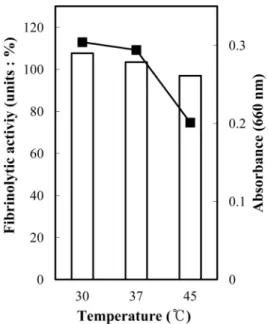
균체 생육과 효소생성에 미치는 배양 온도의 영향 온도 변화가 혈전용해 활성에 미치는 영향을 조사하기 위 하여, LB배지에 전배양된 YJ11-21 배양액을 각각 5% 접종 하여 각각 30oC, 37oC 및 45oC에서 24시간 진탕 배양하여 spectrophotometer로 탁도(OD660)를 측정하여 균체의 성장과 혈전용해 효소활성을 측정하였다.
결과 및 고찰 혈전용해 활성이 우수한 균주 분리 및 선발
전통 장류인 된장이나 간장은 발효과정에서 미생물이 생 산하는 다양한 효소에 의해 콩에 함유된 단백질, 다당류, 이 소플라본, 지질 등이 소화되기 쉬운 형태의 아미노산, 유리 당, 이소플라본 아글리콘, 지방산 등으로 분해되며, 이 과정 중에 항산화 및 혈전용해 기능을 갖는 2차 대사산물이 생성 된다[23, 24, 31]. 경기도 양주시에서 수집한 간장 시료에서 분리한 균을 skim milk plate와 fibrin plate에 접종하여clear zone을 형성하는 균주를 1차 분리하였다. 1차 분리된 균주 중에서 혈전용해 효소활성이 우수한 YJ11-21균주를 선발하 였으며, 표준균주(B. subtilis KACC 10114)와 비교한 결과 단백질 분해능은 표준균주와 유사하였으나(Fig. 1) 표준균주 는 혈전용해 활성을 나타나지 않은 반면에 분리균 YJ11-21
은 높은 혈전용해활성을 나타냈다.
분리 균주의 동정
간장 시료에서 혈전용해 효소를 생산능이 우수한 균주 YJ11-21을 선발하여 16S rDNA 유전자 염기서열을 분석한 결과, Bacillus sp.로 나타났다. YJ11-21 균주의 계통학적 유 연관계는 16S rDNA 유전자의 염기서열을 기초로 Bacillus 속(genus)의 표준 종들과의 similarity를 조사한 결과, Fig. 2 와 같이 B. licheniformis와 높은 유사성(98%)를 나타냈다.
그리고 이 균주를 B. licheniformis YJ11-21로 명명하고 농 촌진흥청 농업유전자원정보센터에 등록 및 기탁하였다 (KACC91684P). Bacillus sp.에 속한 미생물들은 혈전용해 효소를 생산하는 것으로 알려져 있으며, Yun[33] 등이 한국 재래식 간장에서 분리한 B. amyloliquefaciens K42와 Lee[14] 등이 청국장에서 분리한 B. subtilis KCK-7이 혈전 용해 효소를 생산하는 균주로 보고되었다.
균체 생육과 효소활성에 미치는 배양시간의 영향
배양시간에 따른 YJ11-21균의 생육과 효소활성을 조사한 결과를 Fig. 3에 나타내었다. 균주의 생육은 배양 초기부터 Fig. 1. Proteolytic and fibrinolytic activities of the strain YJ11- 21 producing fibrinolytic enzymes isolated from Korean tradi- tional soybean sauce. Symbols: A; Skim milk plate, B; fibrin plate, 1; Type strain KACC10114, 2; isolated strain YJ11-21.
Fig. 2. Phylogenetic tree based on 16S rDNA sequences showing the positions of the strain YJ11-21 producing fibrinolytic enzymes isolated from Korean traditional soybean sauce.
서서히 증가하기 시작하여 배양 60시간에 최대성장을 나타 내었다. 배양초기에 높은 혈전용해 효소활성이 나타났고 배 양 8시간에 최대활성이 나타났으며 균주의 성장과 관계없이 유도기부터 정지기까지 배양기간 동안 일정한 효소활성이 유지되었다. 이는 혈전용해 효소가 세포 밖으로 분비되는 효 소이기 때문에 균주의 성장이 끝나고 정지기에 들어서도 일 정한 농도로 유지가 되는 것으로 추정된다. Ok[21] 등이 보 고한 된장에서 분리한 혈전용해 효소를 분비하는 Bacillus sp.의 경우, 배양 초기(배양 12시간)에 최대 혈전용해 효소활 성을 나타내었고 그 이후, 감소한다는 보고하여 본 실험에서 배양 8시간에 최대활성을 보인 결과와 유사하였다. 또한, Kim[11]이 청국장에서 혈전용해 효소 생성균으로 분리한 Bacillus sp.의 경우, 배양 8시간에 최대 효소활성을 나타낸 결과와도 유사하였다.
효소생성에 미치는 탄소원의 영향
탄소원의 종류에 따른 선발균의 혈전용해 효소활성을 측 정하였다(Fig. 4). 사용한 탄소원에 대한 혈전용해 활성을 조 사한 결과, glucose를 사용하였을 때 가장 높았다. Ok[21]
등이 된장에서 분리한 Bacillus sp.은 galactose를 사용하였 을 때, Choi[2] 등 및 Lee[13] 등이 재래식 간장에서 분리한 B. subtilis globigii는 soluble starch 2% 첨가시, 혈전용해 효소활성이 높아진다는 보고와는 차이가 있었다.
효소생성에 미치는 질소원의 영향
질소원의 종류에 따른 선발균의 혈전용해 효소활성을 측 정하였다(Fig. 5). 혈전용해 활성은 yeast extract를 사용하였 을 때 가장 높게 나타났다. 이는 Kalebina[9] 등이 보고한 B.
brevis가 yeast extract를 이용하였을 때 가장 높은 혈전용해 활성이 나타난 결과와 유사하였으며, Ok[21] 등이 된장에서 분리한 Bacillus sp.은 malt extract를 사용하였을 때 가장 높 은 효소활성을 나타내었다는 보고와 상이한 결과를 보였다.
효소생성에 미치는 NaCl 농도의 영향
선발된 균주 B. licheniformis YJ11-21은 대두발효 식품인 재래간장에서 분리하였고, 효소생산이 염의 농도에 영향을 받을 것으로 예상되어 NaCl 농도에 따른 혈전용해 효소활 Fig. 3. The effect of fibrinolytic enzyme activities on time of the
strain YJ11-21. Symbols: ■; Cell growth, □; Fibrinolytic activ- ity.
Fig. 4. The effect of fibrinolytic enzyme activities on carbon source. Symbols: GL; Glucose, MA; Maltose, LA; Lactose, GA;
Galactose, SC; Sucrose.
Fig. 5. The effect of fibrinolytic enzyme activities on nitrogen source. Symbols: PE; Peptone, YE; Yeast extract, ME; Malt extract, NN; NaNo3, NS; (NH4)2SO4, NC; NH4Cl, CA; Casein.
성과 균주의 생육도를 측정하였다(Fig. 6). 그 결과, 1%
NaCl을 첨가한 배지에서 가장 높은 혈전용해 효소활성이 나 타났으며 3% NaCl 첨가 배지에서 분리 균주의 생장률이 가 장 높았다. 그리고 10% NaCl 농도에서도 높은 혈전용해 효 소활성이 나타내고 있어 본 균주는 내염성균으로 추정된다.
균체 생육과 효소생성에 미치는 배양액 초기 pH의 영향 배지의 초발 pH 변화가 혈전용해 효소 생산에 미치는 영 향을 조사하기 위하여 1 N HCl 또는 1 N NaOH를 사용하
여 pH를 4~10으로 조정하여 선발균의 생육도와 혈전용해 효소활성을 측정하였다(Fig. 7). 그 결과, 배양배지의 pH 5~10까지 안정한 효소활성을 보였다. 그리고 pH 9에서 가 장 높은 혈전용해 효소활성과 균주의 생장률이 나타났다. 이 상의 결과에서 보는 바와 같이 YJ11-21균주는 알칼리성 조 건에서 최고의 생장률과 높은 효소활성을 나타내지만 분비 하는 효소가 알칼리성인지 알기 위해서는 효소의 pH 안정 성 실험이 추가로 필요할 것으로 생각된다.
균체 생육과 효소생성에 미치는 배양 온도의 영향 배양시 온도 변화에 따른 혈전용해 효소활성에 미치는 영 향을 조사하기 위하여, 선발균 YJ11-21을 5% 접종하여 각 각 30oC, 37oC 및 45oC에서 24시간 진탕 배양한 후, 생육 도와 효소활성을 측정하였다(Fig. 8). Fig. 8에서와 같이 30oC에서 가장 높은 혈전용해 효소활성이 나타났고 배양온 도가 높아 질수록 낮은 효소활성이 나타났다. 이상의 결과 는 대부분의 Bacillus sp. 세균들이 30~37oC에서 생육 최적 온도를 갖는 것과 일치하였다.
요 약
전통발효식품인 재래간장에서 fibrinolytic enzyme를 생산 하는 미생물을 분리하였고 산업적으로 활용하기 위해 분리 된 미생물 중 fibrinolytic enzyme 활성이 우수한 YJ11-21 균주를 선발하였다. YJ11-21을 분자수준에서 16S rDNA 유 전자 염기서열을 분석한 결과, Bacillus licheniformis로 동정 되었다.
Fibrinolytic enzyme 생산을 위한 최적 배양조건으로서 탄 Fig. 6. The effect of fibrinolytic enzyme activities and cell
growth on NaCl concentration. Symbols: ■; Cell growth, □; Fibrinolytic activity.
Fig. 7. The effect of fibrinolytic enzyme activities and cell growth on initial pH. Symbols: ■; Cell growth, □; Fibrinolytic activity.
Fig. 8. The effect of fibrinolytic enzyme activities and cell growth due to temperature. Symbols: ■; Cell growth, □; Fibrin- olytic activity.
소원은 glucose, 질소원은 yeast extract를 첨가하였을 때 가 장 높게 나타났다. 그리고 1% NaCl를 첨가한 배지에서 혈 전용해 효소활성이 가장 높게 나타났고, 10% NaCl에서도 높은 효소활성과 생장률 또한 양호하여 YJ11-21는 내염성균 으로 추정된다. YJ11-21를 30oC에서 배양시 가장 높은 효소 활성과, 초발 pH 5-10까지 안정한 효소활성을 보였다. 그리 고 pH 9에서 가장 높은 혈전용해 효소활성과 균주의 생장 률이 나타났다.
Acknowledgement
This study was carried out with the support of “Research Program for Agricultural Science & Technology Develop- ment (Project No. PJ006763)”, National Academy of Agricul- tural Science, Rural Development Administration, Republic of Korea.
REFERENCES
1. Astrup, T. and Mullertz. 1952. The fibrin plate method for estimating fibrinolytic activity. Archives Biochem. Biophy- sics. 40: 346-351.
2. Choi, K. J. 1995. Separation of Bacillus sp. and changes of NH2-N, NH3-N and protease activity in Chonggukchang meju adding with mugwort extract. Kon-Kuk Univ. Master’s Degree Thesis.
3. Choi, W. A., J. W. Lee, K. H. Lee, and S. Park. 1998. Effects of environmental and nutritional conditions on fibrinolytic enzyme production from Bacillus subtilis BK-17 in flask culture. Kor. J. Biotechnol. Bioeng. 13: 491-495.
4. Chung, K. H. and D. S. Kim. 1992. Fibrinolytic and co- gulation activies of Korean snake venoms. Kor. Biochem. J.
25: 696-701.
5. Fujita, M., K. Hong, Y. Ito, S. Misama, N. Takeuchi, K.
Kariya, and S. Nishimuro. 1995. Transport of nattokinase across the rat intestinal tract. Biol. Pharm. Bulletin., 18:
1194-1196.
6. Fujita, M., K. Nomura, K. Hong, Y. Ito, A. Asada, and S.
Nishimuro. 1993. purification and characterization of a strong fibrinolytic enzyme(nattokinase) in the vegetable cheese natto, a popular soybean fermented food in Japan.
Biochem. Biophys. Res. Comm. 197: 1340-1347.
7. Jang, S. A., M. H. Kim, M. S. Lee, and M. J. Lee. 1999.
Isolation and Identification of fibrinolytic enzyme producing strain from shrimp Jeot-Gal, a tiny salted shrimps, and optimum conditions of enzyme production. Korean J. Food Sci. Technol. 31: 1648-1653.
8. Jeong, Y. K., W. S. Yang, J. O. Kang, I. S. Kong, and J. O.
Kim. 1995. Fibrinolysis of fermented kimchi. Korean. J. Life Science. 5: 203-210.
9. Kalebina, T. S., N. R. Galina, I. O. Selyakh, O. M. Khodova,
AND I. S. Kulaev. 1988. Serine proteinase from Bacillus brevis. Apple. Microbiol. Biotech. 28: 531-537.
10. Kil, J. O., G. N. Kim, and I. Park. 1998. Production and characterization of fibrinolytic enzyme: optimal condition for production of the enzyme from Bacillus sp. KP-6408 isolated from Chungkook-jang. J. Korean Soc. Food. Nutr.
27: 51-56.
11. Kim, Y. T. 1995. Characteristics of fibrinolytic enzyme produced by Bacillus sp. Isolated from Chungkookjang.
Sejong Univ. Doctoral Degree Thesis.
12. Kim, Y. T., W. K. Kim, and H. I. Oh. 1995. Screening and identification of the fibrinolytic bacterial strain from Chung- kook-jang. Kor. J. Appl. Microbial. Biotechnol. 23: 1-5.
13. Lee, E. G., E. H. Park, H. H. Lee, H. H. Hyun. 1996. Isola- tion and characterization of pseudomonas sp. producing alkaline protease. Kor. J. Microbiol. 22: 289-297.
14. Lee, S. K., S. Heo, D. H. Bae, and K. H. Choi. 1998.
Medium optimization for fibrinolytic enzyme production by Bacillus subtilis KCK-7 isolated from Korean traditional Chungkookjang. Kor. J. Appl. Microbiol. Biotechnol. 26:
226-231.
15. Lee, S. K., S. Seok, H. K. Joo, and K. B. Song. 1999. The study on isolation of fibrinolytic bacteria from soybean paste. J. Korean Soc. Agric. Chem. Biotechnol. 42: 6-11.
16. Lee, S. S., S. M. Kim, U. Y. Park, H. Y. Kim, and I. S. Shin.
(2002) Studies on proteolytic and fibrinolytic activity of Bacillus subtilis JM-3 isolated from Anchovy sauce. Korean J. Food Sci. Technol. 34: 283-289.
17. Mah, J.H., K. S. Kim, J. H. Park, M. W. Byun, Y. B. Kim, and H. J. Hwang. 2001. Bacteriocin with a broad antimicro- bial spectirum, produced by Bacillus sp. isolated from Kimchi. Kor. J. Microbiol. Biotechnol. 11: 577-584.
18. Mihara, H., N. Nakajima, and H. Sumi. 1993. Characteri- zation of potent fibrinolytic enzyme in earthworn, Lumbri- cus rubellus. Biosci. Biotech. Biochem. 57: 1730.
19. Nakamura, T., Y. Yamagota, and E. Ichishima. 1992. Nucleo- tide sequence of the subtilisin NTA gene, aprN, of Bacillus subtilis(natto). Biasci. Biotech. Biochem. 56: 1869-1871.
20. Noh, K. A., D. H. Kim, N. S. Choi, and S. H. Kim. 1999.
Isolation of fibrinolytic enzyme producing strain from kimchi. Kor. J. Food Sci. Technol. 31: 219-223.
21. Ok, M. and Y. S. Cho. 2005. Screening of fibrinolytic enzyme producing from microprganisms in korea fermented soybean and optimum conditions of enzyme production.
Korean J. Food Preserv. 12: 643-649.
22. Park, Y. D., J. W. kim, B. G. Min, J. W. Seo, and J. M. Jeong.
1998. Rapid purification and biochemical characteristics of Lumbrokinase from earthworm for use as a fibrinolytic agent. Biotechnol Lett. 20: 169-172.
23. Ra, K.S., S. H. Oh, J. M. Kim, and H. J. Suh. 2004. Isolation of fibrinolytic enzyme and β-glucosidase producing strains from Doenjang and optimum conditions of enzyme pro- duction. J. Kor. Soc. Food Sci. Nutr. 33: 439-442.
24. Ryu, B. H. 2003. Development of functional Doenjang for antioxidative and fibrinolytic activity. Kor. J. Life Sci. 13:
559-568.
25. Saitou, N. and M. Nei. 1987. The neighbor joining-methods:
a new method for reconstructig phylogenetic trees. Mol.
Biol. Evol 4: 406-425
26. Sasaki, K., S. Moriyama, Y. Tanaka, H. Sumi, N. Toki, and K. C. Robbins. 1985. The transport of 125I-labeled human high molecular weight urokinase across the intestinal tract in a dog model with stimulation of synthesis and/or release of plasminogen activators. Blood 66: 69-75.
27. Shon, B. H., S. C. Kwon, and K. H. Oh. 2008. Fibrinolytic activity and proteomic analysis of Bacillus licheniformis HK-12 isolated from Chungkook-jang. Korean J. Biotechnol.
Bioeng. 23: 251-256.
28. Sumi, H., M. Maruyama, T. Yoneta, and H. Mihara. 1983.
Activation of plasma fibrinolysis after intrarectal adminis- tration of high molecular weight urokinase and its derivative.
Acta Haematol. 70: 289-295.
29. Toki, N., H. Sumi, K. Sasaki, I. Boreisha, and K. C. Robbins.
1985. Transport of urokinase across the intestinal tract of normal human subjects with stimulation of synthsis and/or release of urokinase-type protein. J. Clin. Invest. 75: 1212- 1222.
30. Wun, T. C., W. D. Schleuning, and E. Reich. 1982. Isolation and characterization of urokinase from human plasma. J.
Biol. Chem. 257: 3276-3283.
31. Yoo, S. K., W. H. Cho, S. M. Kang, and S. H. Lee. 1999.
Isolation and identification of microorganisms in Korean traditional soybean paste and soybean sauce. Kor. J. Appl.
Microbiol. Biotechnol. 27: 113-117.
32. Yoshinori, M., H. K. W. Ada, and J. Bo. .2005. Fibrinolytic enzymes in asian traditional fermented foods. Food Re- search International. 38: 243-250.
33. Yun, G. H., E. T. Lee, and S. D. Kim. 2003. Purification and characterization of a fibrinolytic enzyme produced from Bacillus amyloliquefaciens K42 isolated from Korean soy sauce. 31: 284-291