• 검색 결과가 없습니다.

Comparison of the miR-23b and miR-203 Expressions in Endometrial Cancer

N/A
N/A
Protected

Academic year: 2021

Share "Comparison of the miR-23b and miR-203 Expressions in Endometrial Cancer"

Copied!
5
0
0

로드 중.... (전체 텍스트 보기)

전체 글

(1)

pISSN 1738-3544 eISSN 2288-1662

Comparison of the miR-23b and miR-203 Expressions in Endometrial Cancer

Kyung Eun Lee 1,2

1

Department of Clinical Laboratory Science, College of Health Sciences, Catholic University of Pusan, Busan, Korea

2

Brain Busan 21 Project for Catholic University of Pusan, Busan, Korea

자궁내막암종에서 miR-23b와 miR-203 발현 비교

이경은 1,2

1
부산가톨릭대학교 보건과학대학 임상병리학과,

2

Brain Busan 21 사업단

MicroRNAs (miRNAs/miRs) are a group of small noncoding RNAs that modulate gene expression.

Many studies, demonstrating altered expressions of specific miRNAs in diverse types of human neoplasia, suggested that they may play a key role in tumorigenesis. Recently, miRNA genes were found to be abnormally expressed in several types of cancer, including endometrial cancer.

However, miR-23b and miR-203 expression in endometrial cancer has yet to be studied in Korea.

As such, the purpose of this study was to analyze miR-23b and miR-203 expressions in endometrial cancer and to evaluate the relationship between miR-23b and miR-203 expressions.

A retrospective study was carried out on the formalin-fixed, paraffin-embedded tissues of 42 endometrial cancer tissues using quantitative real-time PCR. In endometrial cancer tissues, miR-23b expression levels (2.70±4.45) were higher than miR-203 expression levels (−2.34±4.08).

Endometrial cancer tissues showed an overexpression of miR-23b in 30 (71.4%) of the 42 endometrial cancer cases, whereas miR-203 was underexpressed in 29 (69.0%) of the 42 cases.

There was a significant association between miR-23b and miR-203 expressions in endometrial cancer tissues ( p =0.0005). These findings suggest that miR-23b and miR-203 expressions may be involved in endometrial carcinogenesis. More studies are needed to further define the relationship between miR-23b and miR-203 expressions and tissue-specific protein expression.

Key words: miR-23b, miR-203, Endometrial cancer

Corresponding author: Kyung Eun Lee Department of Clinical Laboratory Science, College of Health Sciences, Catholic University of Pusan, 57 Oryundae-ro, Geumjeong-gu, Busan 46252, Korea

Tel: 82-51-510-0562 Fax: 82-51-510-0568 E-mail: [email protected]

This is an Open Access article distributed under the terms of the Creative Commons Attribution Non-Commercial License (http://creativecommons.org/licenses/by-nc/4.0) which permits unrestricted non-commercial use, distribution, and reproduction in any medium, provided the original work is properly cited.

Copyright © 2017 The Korean Society for Clinical Laboratory Science. All rights reserved.

Received: October 19, 2017 Revised: October 25, 2017 Accepted: October 30, 2017

INTRODUCTION

Endometrial cancer incidence has shown a marked increase in Korea recently. Determining the causes of endometrial cancer has already yielded much research attention. However, the molecular events that lead from estrogen stimulation to tumor development remain unclear. Epigenetic changes in gene expression caused by

chromatin without DNA mutation, such as microRNA

(miRNA/miR) regulation, are now receiving attention as

possible causes of cancer [1]. miRNAs are a class of small

noncoding RNAs that regulate gene expression at the

post-transcriptional level [1]. They bind to 3’-untrans-

lated (3’-UTR) regions of target messenger RNAs (mRNAs),

blocking translation and mRNA degradation [2]. They play

an important role in essential cellular processes, including

(2)

cell differentiation, growth, and death [2,3]. Several studies have demonstrated the altered expression of specific miRNAs in different types of human neoplasia, suggesting that they play a key role in tumorigenesis [4,5].

However, the biological mechanisms of miRNAs are not fully understood, and studies on the role of miRNAs in the development of endometrial cancer are scarce in Korea.

The expression of miRNAs can serve as a biomarker for cancer diagnosis, as changes in miRNA expression are involved in the initiation, progression, and metastasis of human cancer [2,3]. Several miRNAs have been shown to be dysregulated in endometrial cancer, including miR-205, miR-429, miR-210, miR-204, miR-23b and miR-203 [6-8]. However, the possible involvement of miRNA ex- pression in endometrial cancer remains to be established.

Many studies have identified either upregulated or down- regulated miRNAs in cancer tissues [9]. Among these, findings on miR-23b and miR-203 expression in cancer tissues have been inconsistent; miR-23b has been reported to be upregulated in gastric cancer and to act as an oncogene [10]. However, other studies have reported that miR-23b is significantly downregulated in bladder cancer tissues and acts as a tumor suppressor gene [11].

miR-203 expression has been found to be upregulated in psoriasis, breast cancer, and ovarian cancer, whereas its downregulation has been reported in brain tumors, esophageal cancer, lymphomas, and leukemia [12]. Thus, the etiology of miR-23b and miR-203 expression in endometrial cancer has not yet been elucidated in Korea.

Thus, the present study was conducted to analyze miR-23b and miR-203 expression in endometrial cancer and to evaluate the relationship between miR-23b and miR-203 expression.

MATERIALS AND METHODS

1. Tissue samples

A retrospective study was carried out on 42 for- malin-fixed, paraffin-embedded (FFPE) tissues from endometrial cancer patients admitted to a local hospital in Busan from 2010 to 2013. The ages of the 42 patients

ranged from 32 to 69 years (median age: 49 years). All cancer samples were obtained by endometrial curettage, and histopathologically confirmed; no patients had un- dergone any preoperative chemotherapy or radiotherapy.

The HE stained tissues were reviewed in each case to confirm the original diagnosis, which was based on the International Federation of Gynecology and Obstetrics (FIGO) classification. Histologic diagnoses were reviewed by independent pathologists.

2. Total RNA extraction

Four 10 m thick sections of FFPE endometrial cancer tissues from each paraffin block were used for total RNA extraction. The paraffin was removed from the samples by placing them in 1 mL of 100% xylene, heating for 3 min at 56°C to melt the paraffin, and then centrifuging for 2 min at room temperature at 20,000 ×g to pellet the tissue.

After centrifugation, the xylene was removed and 1 mL of absolute ethanol (EtOH) was added. After mixing, the sample was centrifuged again at 20,000 ×g for 2 min at room temperature and the EtOH was discarded without disturbing the pellet. The ethanol washing process was repeated twice, removing as much residual EtOH as possible without disturbing the pellet. Finally, the pellet was air dried for approximately 30 min.

The RecoverAll Total Nucleic Acid Isolation Optimized

for FFPE Samples kit (Ambion Inc., Austin, Texas, USA) was

used according to the manufacturer's protocol. The

proteins were degraded with 100∼200 L digestion buffer

and 4 L protease, followed by incubation for 15 min at

50°C, and for 15 min at 80°C. The RNA was then isolated

by adding 790 L of buffer including absolute ethanol,

followed by passage through a purification column. The

column was then washed twice with a buffer from the kit,

and DNase treatment was performed, followed by two

additional washings. Finally, RNA was eluted into 60 L of

elution buffer from the kit at room temperature according

to the manufacturer’s instructions. All steps in the pre-

paration and handling of total RNA were conducted in a

laminar flow hood under RNase-free conditions. The

isolated total RNA was stored at −70°C until use.

(3)

Table 1. Relationship between miR-23b and miR-203 in endometrial cancer tissues

Expression miR-23b level miR-203 level

p -value

N(%) N (%)

Over 30 (71.4) 13 (31.0)

Under 12 (28.6) 29 (69.0) 0.0005

Total 42 (100) 42 (100)

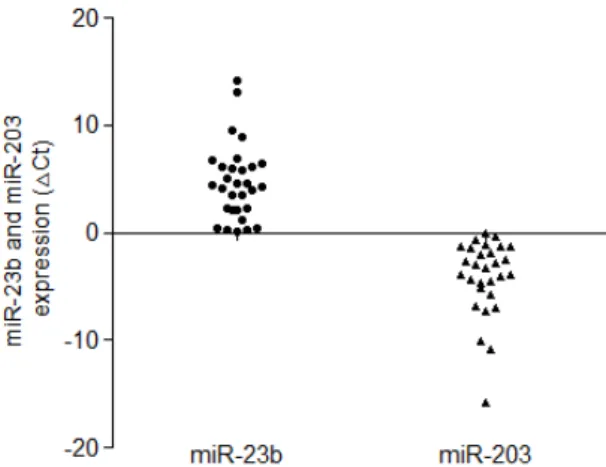
Figure 1. Comparison of miR-23b and miR-203 expression in endometrial cancer tissues. The average standard deviation of each cycle threshold value between the duplicate data for miR-23b and miR-203 indicated that the miR-23b expression level was higher in endometrial cancer tissues (2.70±4.45) than the miR-203 expression level (−2.34±4.08).

3. MicroRNA TaqMan reverse transcriptase reaction Complementary DNA (cDNA) was synthesized using microRNA TaqMan Reverse Transcription Kit and triplicate TaqMan MicroRNA Assays (Applied Biosystems, Foster City, CA, USA) according to the manufacturer's recommendations. A 5 L sample of total RNA was used for RT, using stem-loop RT primers for each miR. For each reaction, 1.5 L of RT buffer, 0.15 L of 100 mM dNTP, 1

L of Reverse-Transcriptase, 0.186 L of RNase inhibitor and 3 L of RT primer were mixed. Purified water was added to reach a final volume of 15 L. The cDNA synthesis reaction by RT-PCR was performed at 16°C for 30 min, 42°C for 30 min, and 85°C for 5 min.

4. Quantitative real-time PCR (qRT-PCR) assay

The qRT-PCR of cDNA obtained from miR was performed with TaqMan Universal PCR Master Mix and TaqMan Human MicroRNA Assays (Applied Biosystems, Foster City, CA, USA) using a real-time PCR for thermal cycling and fluorescence detection. Real-time PCR amplification of miRNA was performed in a reaction mix containing 10 L of master mix, 1.33 L of template cDNA, 1 L of 20× primers, and 7.67 L of distilled water (DW) to give a final volume of 20 L for each sample. The reaction mixture was incubated in a strip at 95 for 10 min, and 40

cycles of 95°C for 15 sec and 60°C for 1 min for Real-Time PCR. The U6 small nuclear 2 (RNU6b) was used to normalize the input of total small RNA. Absolute quan- tification for each miR as well as RNU6b was performed using a generated standard curve and expression of each miR was presented as the ratio between miR and RNU6b expression. The relative expression level of each miR-23b and miR-203 were measured using the ΔCt method and the following formula: ΔCt=Ct (miR-23b or miR-203)−Ct (RNU6b), where Ct represents the threshold cycle number.

5. Statistical analysis

Statistical analysis was performed using SPSS for Windows Standard version 18.0 (SPSS Inc., Chicago, IL, USA). The Fisher exact test was performed to assess the relationship between the expression patterns of miR-23b and miR-203. A p-value less than 0.05 was considered statistically significant.

RESULTS

We determined the levels of miR-23b and miR-203 expression in endometrial cancer tissues (N=42) using quantitative real-time polymerase chain reaction (qRT-PCR).

The average standard deviation of each cycle threshold

value between the duplicate data for miR-23b and

miR-203 indicated that the miR-23b expression level was

higher in endometrial cancer tissues (2.70±4.45) than the

miR-203 expression level (−2.34±4.08) (Figure 1). The

endometrial cancer tissues showed the overexpression of

miR-23b in 30 (71.4%) of the 42 endometrial cancer cases,

whereas miR-203 was underexpressed in 29 (69.0%) of the

42 cases. There was a significant association between

miR-23b and miR-203 expression in endometrial cancer

(4)

tissues (p=0.0005) (Table 1).

DISCUSSION

miRNAs, which are 21∼25 nucleotide functional RNA molecules, represent a class of short noncoding RNAs [3].

They play an important regulatory role in sequence-specific base pairing on the 3’UTRs of mRNAs, thereby inhibiting translation and promoting mRNA degradation [3]. miRNA dysregulation has been reported in many human diseases, including cancer [5,13]. Among studies that have reported miRNA dysregulation, several studies have shown the upregulation or downregulation of miRNAs in endometrial tissue samples [9]. However, the underlying mechanisms leading to endometrial cancer development are not yet fully understood.

Specific overexpression or underexpression has been correlated with particular tumor types. For example, miRNA overexpression can result in the downregulation of tumor suppressor genes, whereas miRNA under- expression can lead to oncogene upregulation. The expression of miR-23b in cancer is controversial because it has been found to be upregulated and oncogenic in kidney and gastric cancer, where it causes the trans- lational repression of tumor suppressor PTEN genes [14];

however, it has also been found to be downregulated and act as a tumor suppressor gene in prostate and bladder cancer, where it directly targets Src kinase and Akt oncogenes [15]. In the present study, the overexpression of miR-23b was detected in 30 (71.4%) of the 42 endo- metrial cancer tissues studied. miR-203 is a skin-specific miRNA that is specifically expressed in keratinocytes and promotes epidermal differentiation [12]. The etiology of miR-203 expression in cancer has not been elucidated;

some studies have shown an increase in colorectal and breast cancer [12,16], while other studies have shown a decrease or no change in colorectal and esophageal cancer [12,17]. In the present study, the underexpression of miR-203 was detected in 29 (69.0%) of the 42 endo- metrial cancer tissues studied. Many studies have been conducted on miRNA expression in cancer, but miR-23b

and miR-203 expression in normal endometria and in endometrial hyperplasia has yet to be reported; thus, further studies on this topic are needed.

The expression of miRNA can be regulated by several mechanisms, including genomic loss, epigenetic modi- fication, and transcriptional regulation [18]. miR-23b and miR-203 have been reported to suppress cancer cell proliferation, invasion, and metastasis [18]. The modu- lation of miR-23b and miR-203 expression by genetic and epigenetic silencing has been conducted in various tumors [19]. Majid et al. [15] reported that miR-23b is methy- lation-silenced tumor suppressor in prostate cancer, and its high expression level was found to be associated with higher survival rates in prostate cancer patients [14].

Further, Huang et al. [7] reported that the hypermethylation of miR-203 was found in endometrial cancer cell lines.

When these cancer cells were treated with inhibitors of DNA methyltransferases and histone deacetylases, the expression of miR-203 was reactivated [7]. The findings of these studies suggest that miR-203 expression might be subject to epigenetic regulation.

Further studies are needed to define the role of miRNAs

and methylation in endometrial tumorigenesis. The

importance of studying the role of miRNAs in endometrial

tumorigenesis is further highlighted by the many factors

known to be involved in its regulation. A complex network

of regulatory mechanisms results in the tissue-specific

expression of miRNAs in various types of cancer; as such,

further studies are needed on this topic. In summary, this

study was conducted to analyze miR-23b and miR-203

expression in endometrial cancer tissue samples using

qRT-PCR. This study indicated that miR-23b and miR-203

are involved in post-transcriptional regulation and that

miR-23b overexpression and miR-203 underexpression

may play roles in endometrial carcinogenesis. Further

studies are required to define the relationship between the

expression of specific miRNAs (e.g., miR-23b and miR-203)

and that of tissue-specific proteins.

(5)

요 약

MicroRNA는 작은 비암호화 RNA로서 유전자 발현을 조절 한다. 다양한 인체 종양에서 특이 miRNA 발현의 변화가 보고되 면서 종양 발생에 중요한 역할을 수행하는 것으로 알려졌다. 최 근에는 자궁내막암종을 포함한 다양한 암종에서 여러 miRNA 의 비정상적인 발현이 보고되었으나, miR-23b와 miR-203 발 현에 대한 연구 결과는 아직 국내에 보고되지 않았다. 따라서 본 연구에서는 자궁내막암종에서 miR-23b와 miR-203의 발현을 비교하고 상호 연관성을 분석하고자 하였다. 인체 자궁내막암 종으로 진단된 파라핀 블록 42건을 대상으로 quantitative real-time PCR을 이용하여 miRNA 발현 수치를 분석하였다.

miR-23b 발현 수치는 2.70±4.45로 miR-203의 발현 수치

−2.34±4.08 보다 높게 나타났다. 또한 miR-23b는 총 42건 중 30건(71.4%)에서 양의 발현이 나타났고, miR-203은 총 42 건 중 29건(69.0%)에서 음의 발현이 나타났으며, 이는 통계학 적으로 유의한 차이를 나타냈다(p=0.0005). 따라서 본 연구에 서는 miR-23b와 miR-203 발현은 자궁내막암종 발생에 연관 이 있을 것으로 추정되며, 향후 miR-23b 와 miR-203 발현과 조직특이 단백 발현과의 상호 연관성에 대한 연구가 더 필요할 것으로 사료된다.

Acknowledgements: None

Funding: This work was supported by RESEARCH FUND offered from Catholic University of Pusan.

Conflict of interest: None

REFERENCES

1. Banno K, Kisu I, Yanokura M, Masuda K, Kobayashi Y, Ueki A, et al. Endometrial cancer and hypermethylation: regulation of DNA and microRNA by epigenetics. Biochem Res Int. 2012;

738274. doi: 10.1155/2012/738274.

2. Poy MN, Eliasson L, Krutzfeldt J, Kuwajima S, Ma X, Macdonald PE, et al. A pancreatic islet-specific microRNA regulates insulin secretion. Nature. 2004;432:226-230.

3. Qin X, Yan L, Zhao X, Li C, Fu Y. MicroRNA-21 overexpression contributes to cell proliferation by targeting PTEN in endome- trioid endometrial cancer. Oncol Lett. 2012;4(6):1290-1296.

4. Gilabert-Estelles J, Braza-Boils A, Ramon LA, Zorio E, Medina P, Espana F, et al. Role of microRNAs in gynecological pathology.

Curr Med Chem. 2012;19(15):2406-2413.

5. Choi WS, Kwon KC. Expression of micro RNA in paraffin em- bedded tissue of multiple myeloma. Korean J Clin Lab Sci.

2015;47(4):292-297 .

6. Yanokura M, Banno K, Kobayashi Y, Kisu I, Ueki A, Ono A, et al.

MicroRNA and endometrial cancer: roles of small RNAs in hu- man tumors and clinical applications (Review). Oncol Lett.

2010;1(6):935-940.

7. Huang YW, Kuo CT, Chen JH, Goodfellow PJ, Huang TH, Rader JS, et al. Hypermethylation of miR-203 in endometrial car- cinomas. Gynecol Oncol. 2014;133(2):340-345.

8. Castilla MÁ, Moreno-Bueno G, Romero-Pérez L, Van De Vijver K, Biscuola M, López-García MÁ, et al. Micro-RNA signature of the epithelial-mesenchymal transition in endometrial carcino- sarcoma. J Pathol. 2011;223(1):72-80.

9. Lee H, Choi HJ, Kang CS, Lee HJ, Lee WS, Park CS. Expression of miRNAs and PTEN in endometrial specimens ranging from his- tologically normal to hyperplasia and endometrial adeno- carcinoma. Mod Pathol. 2012;25(11):1508-1515.

10. Ma G, Dai W, Sang A, Yang X, Gao C. Upregulation of microRNA-23a/b promotes tumor progression and confers poor prognosis in patients with gastric cancer. Int J Clin Exp Pathol. 2014;7(12):8833-8840.

11. Majid S, Dar AA, Saini S, Deng G, Chang I, Greene K, et al.

MicroRNA-23b functions as a tumor suppressor by regulating Zeb1 in bladder cancer. PLoS One. 2013;8:e67686. doi:

10.1371/journal.pone.0067686.

12. Li J, Chen Y, Zhao J, Kong F, Zhang Y. miR-203 reverses che- moresistance in p53-mutated colon cancer cells through downregulation of Akt2 expression. Cancer Lett. 2011;304(1):

52-59.

13. Han C, Yu Z, Duan Z, Kan Q. Role of microRNA-1 in human cancer and its therapeutic potentials. Biomed Res Int. 2014;

428371. doi: 10.1155/2014/428371.

14. Zaman MS, Thamminana S, Shahryari V, Chiyomaru T, Deng G, Saini S, et al. Inhibition of PTEN gene expression by oncogenic miR-23b-3p in renal cancer. PLoS One. 2012;7(11):e50203.

doi: 10.1371/journal.pone.0050203

15. Majid S, Dar AA, Saini S, Arora S, Shahryari V, Zaman MS, et al.

miR-23b represses proto-oncogene Src kinase and functions as methylation-silenced tumor suppressor with diagnostic and prognostic significance in prostate cancer. Cancer Res. 2012;

72(24):6435-6446.

16. Furuta M, Kozaki KI, Tanaka S, Arii S, Imoto I, Inazawa J.

MiR-124 and miR-203 are epigenetically silenced tumor-sup- pressive microRNAs in hepatocellular carcinoma. Carcino- genesis. 2010;31(5):766-776.

17. Chiang Y, Song Y, Wang Z, Chen Y, Yue Z, Xu H, et al. Aberrant expression of miR-203 and its clinical significance in gastric and colorectal cancers. J Gastrointest Surg. 2011;15(1):63-70.

18. Li XJ, Ren ZJ, Tang JH. MicroRNA-34a: a potential therapeutic target in human cancer. Cell Death Dis. 2014;5:e1327. doi:

10.1038/cddis.2014.270.

19. Bueno MJ, Perez de Castro I, Gomez de Cedron M, Santos J,

Calin GA, Cigudosa JC, et al. Genetic and epigenetic silencing of

microRNA-203 enhances ABL1 and BCR-ABL1 oncogene

expression. Cancer Cell. 2008;13(6):496-506.

수치

Table  1.  Relationship  between  miR-23b  and  miR-203  in  endometrial  cancer  tissues

참조

관련 문서

In our analysis, combining the expression levels of EC Notch1 and miR-34a in surgical tissue revealed their potential for predicting survival outcomes in patients with

Furthermore, the qRT-PCR analysis revealed increased expression of LINC00703 and KLF6, and decreased level of miR-181a in LINC00703 expressing tumor tissues (Fig. 4E).. Correlation

Purpose: The aims of this study were to evaluate the expression of the large tumor suppressor (LATS) genes LATS1 and LATS2 by immunohistochemical staining of gastric cancer, and to

Recurrence and survival after random- ization to laparoscopy versus laparotomy for comprehensive surgical staging of uterine cancer: Gynecologic Oncology Group Study LAP2..

Expression of p53 and vascular endothelial growth factor associated with tumor angiogenesis and prognosis in gastric cancer. Xiangming C, Hokita S, Natsugoe S,

Together with several causes of colorectal neoplasia, aberrant expression of oncomiRs (oncogenic and tumor suppressor miRNAs) in cancer cells was found to be indirectly result

We show that miR-326, which forms a negative feedback regulatory loop with HDAC3, regulates the invasion and the metastatic potential of cancer cells and tumor- induced angiogenesis

Comparative analysis of prostate-specific antigen free survival outcomes for patients with low, intermediate and high risk prostate cancer treatment by radical therapy. Results from